
November 24, 2023
Season 2 Episode 127 | 27m 31sVideo has Closed Captions
A special edition featuring stories that focus on literacy.
A special edition featuring stories that focus on literacy. The 2023 Kentucky School Report Card and a recent report by the National Assessment of Educational Progress both showed more than half of Kentucky students are not proficient readers.
Problems playing video? | Closed Captioning Feedback
Problems playing video? | Closed Captioning Feedback
Kentucky Edition is a local public television program presented by KET
November 24, 2023
Season 2 Episode 127 | 27m 31sVideo has Closed Captions
A special edition featuring stories that focus on literacy. The 2023 Kentucky School Report Card and a recent report by the National Assessment of Educational Progress both showed more than half of Kentucky students are not proficient readers.
Problems playing video? | Closed Captioning Feedback
How to Watch Kentucky Edition
Kentucky Edition is available to stream on pbs.org and the free PBS App, available on iPhone, Apple TV, Android TV, Android smartphones, Amazon Fire TV, Amazon Fire Tablet, Roku, Samsung Smart TV, and Vizio.
Providing Support for PBS.org
Learn Moreabout PBS online sponsorship>> She may have dyslexia, but that doesn't define her.
The science of literacy, how it's helping kids learn how to read.
>> We're looking at taking the curriculum for being liked a mile wide looking at picking the curriculum and making them all the.
>> Out with the old and with the news as Jefferson County Teachers learn a new way to teach reading.
We are setting the foundation for them to be able to read for the rest of their lives.
A school district is going into year 3 with an evidence-based approach to teaching the ABC's.
>> Matter what, no matter how old you are.
You know, it is cool to read.
>> Students get a message from men from all walks of life on the importance of reading.
>> Production of Kentucky Edition is made possible in part by the KET Endowment for Kentucky Productions.
Leonard Press Endowment for Public Affairs and the KET Millennium Fund.
♪ ♪ >> Good evening and welcome to Kentucky EDITION with this special focus on the foundations of learning early literacy.
I'm Renee Shaw.
Thank you for spending some time with us and Kentucky.
There's already been a steady decline in reading levels over the last decade.
The 2023 Kentucky School report Card and a recent report by the National Assessment of Educational Progress.
Both showed more than half of Kentucky students are not proficient readers and studies show students who have difficulty reading all more likely to struggle academically.
Our Christy Dot and introduces us to one Jefferson County student who went through that struggle and shows us what put her on the path to being a better reader.
>> Myla is in 3rd grade.
She's 8 years old and she's making great strides academically, learning to read and thriving in school.
But that wasn't always the case.
There was a time when things were a lot harder.
Describe some of the clues that you got.
Those first clue that she might have some learning differences.
So, you know.
>> I think we.
>> I wondered about it early and then.
>> She's left handed whether that really means and they're not we don't really know.
some of the teachers thought that maybe she was marrying.
So she would write things backwards because she was wearing what they were doing.
So we kind of we're watching that.
We weren't a kind of being all that aware to whether was decide tonight until.
Really until she went in first grade and there, yes, he came home and just her attitude started changing.
She was not thrilled to go to school anymore.
She KET that she wasn't pick it up on everything as quickly as some of the other students.
>> And so when she was in the first grade, she brought home this, but that she made and that was a bit of an aha moment.
Tell us that story.
>> So she had come home from school and they make a book where you right.
You know, a script at the bottom.
And there's a picture and she was very proud that she had done that.
And so she came home from school and said, Mommy, I want to show you this book that I'd made.
So she got it out and then she wasn't able to read it and she was extremely frustrated because she had written it and then couldn't read the book at all.
So we reached out for that diagnosis.
Tell us how that came about and how that felt.
I honestly wasn't expecting a dyslexia diagnosis.
When we got our tested, they said that she was seeing that, you know, reading it was not at all.
There is no fanatic awareness in terms of seeing a letter and knowing.
>> What sound that and to know that your has been sitting in a classroom and seeing hieroglyphs in understanding that her peers are able to 2 things in understand things that she wasn't able to do was extremely overwhelming and sad.
So in the first grade she moved from public elementary school to the depasquale which that specialize in and children, students that learn differently.
What kind of differences that made for her the same night.
I mean, within a week for being here, she was back to being happy.
you weren't wanted to go to sign in to go to Confidence.
>> So And she's always had a lot of and then understood that she may have dyslexia, but that doesn't define And if anything, it's a superpower.
She's been given this wonderful things.
Read of Lee, creative.
And yours, no matter how quickly how fast you can read, does not at >> Have any correlation with your intelligence.
>> So, you know, we're very thankful for for the school here that the pond and the differences and that they.
The way that they're able to teach differently here to meet, to meet the children where they are.
>> It's just it's been it's like having our kids and Hearne she can read.
I mean, which is amazing.
>> Legislation passed last year requires all Kentucky school districts to adopt literacy curriculum that aligns with what's called the science of reading.
It's a phonics based approach to reading an August KET hosted a forum on early literacy featuring a panel of experts who discussed the science of reading the impact.
It's having and why it's important for children to receive targeted interventions as early as possible.
>> That phrase the science of refers to a robust body of data that we have now from decades of really good research from multiple fields of science.
So it's not just research of classroom practices, but brain scans and Rolla G and and other aspects of study to see what is happening when a brain learns to read and why does it seem to happen?
More effortlessly for some?
And then with great struggle for others.
And he's really clarified for us.
What reading really is in the brain and it's clarified for us what practices are better and work better and which practice is really don't help someone learn to read.
So it's clarified for us for the general public.
What are best practices and that has really helped us in the area of reading disabilities to determine what really is the breakdown.
What is the roadblock and how do we get past that?
>> So it's really about making those brain connections.
And now we know the science behind it.
Yes.
>> We've learned so much more than we once did, of course.
And a lot of what we thought we KET turned out to be meth.
And so now we know and teachers are familiar now with terms like funny.
Michael Ware, nurse, that wasn't in our vocabulary a few decades ago.
And now we realize that really in order to teach phonics or the coating, there's got to be component of education company.
Michael Ware in a switch literally builds neurology and the temporal lobe to dissect or words.
And the sounds.
>> So let's talk about exactly what that means when it comes to teaching.
So I go to you, Lindsay, you've been teaching this skills-based literacy and your first grade classes for about 3 years now and your school chance.
He was a pilot program for this.
A shift in Jefferson County.
So before you were teaching what was called a balanced literacy approach, explain how you teach reading in these 2 different ways.
Okay.
So before.
>> We would have our reading block and we would read a fiction story and we would focus on it maybe a week and it would be a graphic organizer with the story and maybe even do a craft with it.
But it is very surface level.
We never die D now we use the Kerr County out curricula until a certain section and we go very deep into the attacks.
We study a topic.
We study attacks.
We go into the vocabulary of it.
Like our small group reading areas in the past, we would have guided meeting card that would give us comprehension questions in a text to go with that and maybe a one-minute thing on work work.
And by next and you would have a level 2 reader to go with it.
And so the kids would not have time or would not have.
Access to practice.
That's go in Sioux.
Now when we're doing our reading, we do a skill.
So we'll learn a skill and we will be able to assess kids on that scale and our groups.
They're no longer level of that proving that those have not been.
Effective.
In fact, they widen the gap for children.
And so now I can pull kids on a specific skill that they're lacking.
So maybe they're struggling with a certain vow team.
I put the kids that are shared with that bout team and we hit it hard and then they continue on.
And in the next week, it might be a different view that has a different.
Struggle.
And you can just see so much Mark rescues.
The kids are getting such intentional instruction.
They are able to decode the words they have strategy now, instead of just look at the picture in what you think might happen.
What would that would be if you look at that picture and now we're not doing that with their learning the skills Qd code, a word.
>> So the problem is, though, that some brains are going to make those connections no matter what.
And then we saw like with milas instance and some need that more explicit instructions.
So if he'll explain what that means for children and parents, how it can easily lead to struggles in other areas.
Beyond this.
>> Right.
One thing I want to point out that when we're talking about students who need explicit instruction in the code of language, we're not talking just about students with dyslexia.
We're actually talking about the majority of children, about 60% of children need some explicit instruction because as you said, it's not a natural thing for the brain to be doing.
For those 40% who learn to read with very little effort.
They still benefit from that code based instruction.
They're they're reading and spelling skills to improve with that so I want to kind of clarify that for everyone.
But what it means for someone who needs an explicit instruction in decoding if they don't get that reading is a mystery to them.
They think it's a sort of magic that other kids can do and they can't.
And their experience leads to their connection with reading their emotional connection.
It's difficult and they're they're not successful.
They don't enjoy it.
And so they avoid it.
And that avoidance, of course, means they're not practicing to get better while their peers who are good readers love it and read as much as they can.
So they're setting their being set up by the system to avoid something that they desperately need and to not get the type of instruction they need.
Parents, meanwhile, are being told as some of the miss that we've learned from from the research things like, well, your child will catch on just a little bit later in.
The research is very clear that that significant deficit to the beginning of the of the curve.
They don't improve on their own.
They need an intervention.
So there it turns into a waiting game.
And what point is my child far enough behind that they're finally will get the instruction they need.
And sometimes that comes at too late, an edge to really take advantage of how your plastic the brain is at that young age.
It's easier to do intervention early.
>> While this is a new concept for some schools, other schools have been teaching this model of literacy for some time allowing us to see it in action at measure that progress.
One of those districts is in Hancock County.
Our Laura Rogers takes us there.
>> This is letter young boys and girls in its 4th day of the new school year at North Hancock Elementary School.
It has just made such a difference with kids and how quickly they learn.
And these kindergarten students are learning their first letters of the alphabet.
See, it gets kids excited because it involves so many different modalities.
>> To see their malformation in the Mir has made such a huge difference, especially for your speech.
Kids.
>> Hancock County schools begin implementing the science of reading 2 years ago with the arrival of the new superintendent to her son, Ali, seen its success.
>> My son was diagnosed with dyslexia whenever he was in elementary school and once he started receiving or gillingham approach to reading, then he just flourished.
>> trains, teachers in reading approach based on scientific research into how the brain processes written language kindergarten for many, many, many years.
I would work with kids and they would be struggling.
And I KET that that was the missing piece that have been looking for for many, many years, say I actually cried during my training.
Rana Pulliam as an I M S E Institute for Multi sensory education, certified educator.
We have seen tremendous growth out of our students.
They catch on very easily cause its hands on its multi-sensory instruction.
She believes much of the success of the science of reading approach is the methodology.
We can't underestimate the sequential part of it and going in an order that make sense to You can't have hazard like a trading.
It's a sequence and you have to follow that.
>> A matching E she now provide support to other teachers in the district who have each undergone 90 hours of both online and in-person training.
>> themselves have said this is some of the most impactful work that they have done their entire careers because they see the difference that it makes with students.
And you're seeing me feeling they're hearing.
And I think when you combine all of that together, it just makes it so much easier than me just standing in front of them saying this is many it's is a new day.
>> We read it comes as schools are working to close the gap after a decade of dismal reading scores across the state and learning loss during the pandemic.
School districts like Hancock County are actively laying a foundation for students to build on year after year.
>> And with all the teachers getting this training, all the teachers are speaking, common language just melt.
So when students move from grade to grade, they're hearing similar information.
There.
You are hearing the same verbiage they're hearing saying terminology, which I think you're seeing kind of that light bulb or the harm shot go off and kids are able to make connections that maybe we didn't see in the past why students are leading most discussions.
>> In leading these approaches to later say I love seeing the engagement in the classrooms and saying the students like really pick up on all the skills more than I ever have.
>> You do it to stay here.
The science of reading includes phone, a logical awareness which teacher say parents can begin at home before kindergarten teaching children rhyme and alliteration.
This is their chance to really understand those letters and no sales because from layer, we take in start to simple, confident about consonant words, you know, be ready to move in December will work to make the writing was so much easier.
And then as they mean that the great levels, things just come so much more naturally.
If they've got that foundation of letters she fails to disclose your lives are together doing in the school district is also focused on early intervention and small groups for students who may be struggling.
>> Giving interventions at the 30% down below.
And I think a lot of districts are only doing the 10% down below, but we're trying to give those other 20%.
>> Even more help rain.
Absolutely to educators say the science of reading with its hands on multi sensory instruction as an effective way to teach children to read.
I think it's the best reprogramming out there for all students.
This type of sages.
What and I think that we're going to see the benefits on down the road for many, many years.
>> Sales for Kentucky edition.
I'm Laura thank you, Laura.
When the Kentucky General Assembly passed the read to Succeed Act last year, this phonics based approach to teaching became a requirement for all school districts.
2 of the sponsors of what was called Senate Bill.
9 states.
Senator Stephen West of Paris and state Representative James Tipton of Taylorsville.
We're on the panel of experts on our early learners.
A forum that was held earlier this fall along with Christie, bigger staff director of early literacy with the Kentucky Department of Education's Office of Teaching and Learning they talked about what's included in the legislation and why teachers say they are excited about the change.
>> We have an oversight responsibility legislature, 60% of our state budget goes to education and we had looked at our Nate scores when when care first came out in 93, we we had seeing a pretty significant increase, but that of plateaued.
And our scores were on the decline.
And we KET something had to change something was not working in Kentucky.
And something was not working in are economically depressed areas West and the Louisville, other places.
So we we realize that something had to change quickly in.
We worked for several years to Senate Bill 9 across the finish line.
There are different parts of this legislation.
When a the first part is what I refer to as the universal screener.
>> We have to know where the children are.
So we require that a these and we use the term evidence based.
We think that's key.
It has to be evidence based universal screeners were sent to be selected to be to identify the students.
Students that were identified.
It's potentially having problem.
The next phase is a diagnostic assessment and not all that we have had to correct tool.
The teachers have to be trained.
How to use that to us part the legislation.
I another key component of this legislation as we recognize most of her teachers have not been trained in the size of green.
So it's essential that we have professional development and that's where the letters program came.
Ian.
>> It's the foundational learning it's the brain learns to read.
It's information that our teachers have been asking for and have been desperately seeking for a long time.
And I hear that from a lot of the participants in the letters cohort saying, you know, this is the professional development that I never KET I needed.
And now that I have it, I'm so excited, too, at putting into place.
But the letters instruction goes through that the components of literacy that Michael Ware net Spawn IX and vocabulary comprehension and fluency and really teaches our teachers how to teach reading how the brain works.
You know, as he was talking about the science behind all of that information because once you know the how you understand the why and the what really becomes apparent.
So that's really essentially what the letters program is doing for our teachers.
It's teaching them how to teach reading.
>> Before the start of the school year, almost 3,000 Jefferson County teachers were trained on a new K through 8 language arts curriculum.
We spoke to some Jefferson County teachers who are going through the training.
>> JCPS teachers are taking part in a K through 8 la training district-wide to ensure that we are ready for literacy going into next year and we have a tier one are common curriculum as we approach.
23.
24 LA is English language arts.
>> And that is most commonly people refer to that as your phonics penny.
Michael Ware, nurse, your comprehension, you're reading vocabulary and fluency.
>> We're looking at taking the curriculum for being liked a mile wide looking at taking curriculum and making them all the so that all students have access to them to correct one that students struggle with it, which is what we want them to do, that calling grappling We've always called it the productive struggle.
But I think if they do that, it's really going to help students to deepen their understanding of things where they're not just at the surface level, but now they're evaluating things before we had over 150 different curricula are different programs that were being used.
>> We never had a common language or consistent expectations across all grade levels.
So for the first time we're able to speak a common language, have a common focus on literacy, address some of those foundational skill gaps that we've seen for so many years, but never had the chance to build momentum to address and you'll find teachers here for the first time.
Get to collaborate across schools, not just in their school teams, which is really exciting.
When we look at the Council of Great City tore we also noticed that most of them are using a tier one, our core curriculum.
So we are now much more on pace with other district our size to address those tier one supports, which means all students are getting a common core curriculum at the LA.
We're such a huge district and we're very transient to us as students go from one school to another.
So the child might go for my school.
>> To Josh, a school and as you might get lost.
But now with this new curriculum, if a student goes from my school that Josh a school or any school in the district, students are going to have that common language and they're going to be able to understand what they're doing.
And that is just monumental for our district that we've also encouraged subs to get trained.
We're going have another sad day for them to ensure that they're able to meet.
The needs of our kids are also going to have additional virtual training for any new teachers that are hired.
So the goal is everyone will have.
>> Access to high quality instructional resources to support literacy that the like I was tiptoeing when I came in.
But today, I kind of feel like up with the hope, the water and we're ready to go for day one.
>> It's not just teachers who are focused on helping children become better readers.
>> It's also the goal of real men read by United Way, Literacy Initiative in Somerset.
>> The program and less role models who share stories and their love of books with young students.
>> This one is a big ad in a surprise to me.
>> Real men rate is something we started this year.
Thanks to a grant from the Dollar General Literacy Foundation this is a program that other United ways across the country and done.
But it's unique and every community.
So in our community, what we've done is purchased books for each school and our local community in Pulaski County that will be donated to their library.
And then at Hopkins Elementary School and a science Hill independent School, we have male volunteers in our community, her positive.
Well, male role models going into the classrooms one time per month and reading those books to students.
We know that early education is a model for future success.
And literacy is such an important part of that.
So we put a lot of thought into the books that we chose.
We worked with the librarian is called are what we want to make sure that they were going to be engaging hooks for the students because learning to read is hard.
But the more fun that you can make that and the more exciting the literacy can be the better.
It sets them up for success.
>> Prague because Brown, his case marginal trees and ice cream.
Sundays.
>> A lot of our students in and well in any in general, in any elementary school don't have a lot of mail mentors are our especially supporting the early literacy United Way's brought this program to us and the excitement and anticipation and our children as proof it's very much needed.
And then the males that come are very important to.
And Rita classes are very important to supporting this early childhood literacy.
I think it's really important for students to see.
>> A man in different careers pass and that reading is important for all of those careers past.
So we've had volunteers who are in the insurance industry who are in health care, who are in finance, who are excavating.
I'm just a real variety and reading is essential to all of those.
So it lets them see a different side of education.
How education is applicable to real life and not just education in the classroom.
>> I think reading is such a fundamental part of every child's education.
And if we can play a small part in that process to improve their reading skills of our children in our community and it's all worth it.
And it opens up so many windows for their future academic growth.
>> I hope that they take away from the fact there are adults out there that care for them.
But outside lure their and the principles.
>> And that no matter what, no matter how old you are, you know, it is cool to read >> no matter if it's an elementary style or or if it's a notebook or whatever.
You know that the literacy of something that you need to have.
>> Yeah, the class was are here.
>> We know that getting students interested in reading sets them up for success in all areas of law.
You can't fill out a job application.
If you can't read the applications.
So even something that simple is a barrier, if people can't read.
>> It is the heart's desire and my deep hope that every student in our building.
>> Sees the need.
>> And the love and how much growth they can have.
All the people around him them who actually read and that they would fall in love with reading so that they can fall in love with the book they can disappear and whatever they're doing in that day or whatever is going around on around them, they can disappear in that book.
And whatever's happening and that that is the highlight of my monthly calendar.
>> And I wouldn't miss it for the world.
>> Sometimes different day.
>> Good stuff.
United Way's goal is to expand this program to every school in Pulaski County.
Well, we thank you for joining us on this special program focused on early literacy.
We thank you so very much for watching Kentucky EDITION today.
We hope to see you right back here again tomorrow at 6.30, Eastern 5.30, central where we inform connect and inspire.
Check us out all the ways you see on your screen there as well to stay in the loop.
>> I'm Renee Shaw, thanks again for watching.
Take really good care.
And also you said.
♪ ♪ ♪

Kentucky’s Literacy Curriculum Requirements
Video has Closed Captions
Clip: S2 Ep127 | 6m 43s | Legislation passed last year requires all Kentucky school districts to adopt literacy ... (6m 43s)
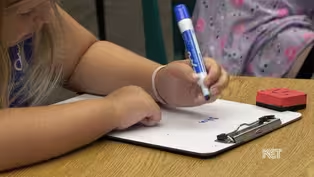
One Student’s Path to Better Reading
Video has Closed Captions
Clip: S2 Ep127 | 4m 1s | The 2023 Kentucky School Report Card and a recent report by the National Assessment of ... (4m 1s)
Video has Closed Captions
Clip: S2 Ep127 | 3m 11s | When the General Assembly passed the Read to Succeed Act last year, this phonics-based ... (3m 11s)
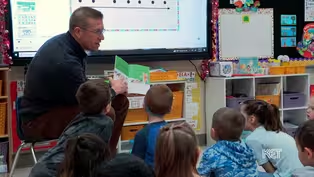
Video has Closed Captions
Clip: S2 Ep127 | 4m 9s | "Real Men Read,” a United Way literacy initiative in Somerset, enlists role models who ... (4m 9s)
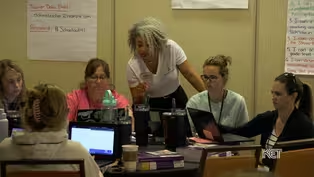
Teachers Learning to Teach Reading
Video has Closed Captions
Clip: S2 Ep127 | 2m 36s | Before the start of the school year, almost 3,000 Jefferson County teachers were ... (2m 36s)
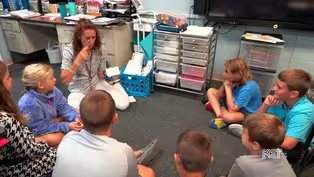
“The Science of Reading” in Action
Video has Closed Captions
Clip: S2 Ep127 | 4m 44s | Hancock County has been teaching “the science of reading” for some time, allowing us to... (4m 44s)
Providing Support for PBS.org
Learn Moreabout PBS online sponsorship
- News and Public Affairs

Top journalists deliver compelling original analysis of the hour's headlines.

- News and Public Affairs

FRONTLINE is investigative journalism that questions, explains and changes our world.












Support for PBS provided by:
Kentucky Edition is a local public television program presented by KET