
November 25, 2023 - PBS News Weekend full episode
11/25/2023 | 24m 9sVideo has Closed Captions
November 25, 2023 - PBS News Weekend full episode
Saturday on PBS News Weekend, a last-minute snag delays the release of hostages held by Hamas in exchange for Palestinians in Israeli prisons. A look at how what we eat could be affecting our mental health. The complicated history of America’s first and only Native American vice president. Plus, why doing good makes us feel good.
Problems playing video? | Closed Captioning Feedback
Problems playing video? | Closed Captioning Feedback
Major corporate funding for the PBS News Hour is provided by BDO, BNSF, Consumer Cellular, American Cruise Lines, and Raymond James. Funding for the PBS NewsHour Weekend is provided by...
November 25, 2023 - PBS News Weekend full episode
11/25/2023 | 24m 9sVideo has Closed Captions
Saturday on PBS News Weekend, a last-minute snag delays the release of hostages held by Hamas in exchange for Palestinians in Israeli prisons. A look at how what we eat could be affecting our mental health. The complicated history of America’s first and only Native American vice president. Plus, why doing good makes us feel good.
Problems playing video? | Closed Captioning Feedback
How to Watch PBS News Hour
PBS News Hour is available to stream on pbs.org and the free PBS App, available on iPhone, Apple TV, Android TV, Android smartphones, Amazon Fire TV, Amazon Fire Tablet, Roku, Samsung Smart TV, and Vizio.
Providing Support for PBS.org
Learn Moreabout PBS online sponsorshipJOHN YANG: Tonight on PBS News Weekend, a last minute snag delays the release of hostages held by Hamas and exchanged for Palestinians and Israeli prisons, then how what we eat could be affecting our mental health and a complicated history, the story of America's first and only Native American Vice President.
WOMAN: It's very sad because I think society at that time forced him to choose.
And he said it was at that moment I chose the white man's world, but he would be forever known as the Indian.
(BREAK) JOHN YANG: Good evening, I'm John Yang.
Tonight 13 more Israeli hostages held by Hamas and four foreign nationals have been freed after frantic negotiations resolved a last minute snag.
Hamas complaints that Israel wasn't delivering all the aid to Gaza that it had promised threatened not just this second round of hostage release, but the pause and fighting as well.
Egyptian and Qatari officials were involved in resolving the problem, and that now clears the way for more happy reunions like yesterday's.
JOHN YANG (voice-over): When Ohan Munder saw his father, no words were needed.
They had been apart on Ohan's ninth birthday when he was being held by Hamas and Gaza.
The family was reunited in Schneider Children's Medical Center in Petah Tikva.
Ohan's mother and grandmother were also released.
Missing from this scene, his grandfather who's still being held captive.
In another part of the hospital four-year-old Raz Katz Asher in the arms of her father telling him that over the last 50 days, she dreamt of going home.
That dream has come true for her, her mother and her younger sister.
In Bethlehem on the West Bank, Hernan Takatkah (ph) prepared a special breakfast where his son Qusay, home after spending more than a year in Israeli prison.
He was among the Palestinian prisoners exchanged for Israeli hostages.
QUSAY TAKATKAH, Released Palestinian Prisoner (through translator): It's an indescribable feeling.
Thank God I am with my family and with my mother and father.
This means the world to me.
JOHN YANG (voice-over): In Rafah in southern Gaza, residents use the pause and fighting to line up for gas.
In the Jabalya refugee camp in northern Gaza, residents survey the damage from weeks of fighting.
WOMAN (through translator): What can I say?
What do I tell you their homes are destroyed.
Those who didn't have their homes destroyed lost their children.
JOHN YANG (voice-over): But the peace is only temporary.
Israeli Chief of Staff Herzi Halevi told his troops today to be ready to resume the fight.
And in Tel Aviv, Israeli said that while they were happy some hostages had been released the job won't be done until they're all home.
Shahar Mor is related to them under family.
SHAHAR MOR, Relative of Munder Family: Each and every one here is a complete world and in itself, you know, that the so many people, there's so many life stories involved here.
JOHN YANG (voice-over): Lives like Ohan Munder's now able to reunite with both friends and family.
JOHN YANG: In Ukraine overnight, the most intense Russian drone attack of the war so far.
Across Kyiv sirens blared in the sky lit up with a five hour assault.
Ukrainian official said air defenses knocked out 74 of the 75 or Iranian made drones that Russia deployed.
At least five civilians were wounded and buildings across the city were damaged by debris falling from the intercepted drones.
And the Minnesota Attorney General said Derek Chauvin, the former Minneapolis Police Officer convicted of murdering George Floyd is expected to survive being stabbed by a fellow inmate at a federal prison in Arizona.
Chauvin pressed a knee on Floyd's neck for more than nine minutes, the deaths spurred worldwide protest over police brutality and racism.
Still to come on PBS News Weekend, the legacy of America's first Native American vice president and a look at why doing good makes us feel good.
(BREAK) JOHN YANG: The food we eat affects us in many ways, eating a lot of highly processed foods has been shown to increase the risk of cancer, stroke and heart disease.
But what about mental health?
Ali Rogin takes a deeper look at new research into that question.
ALI ROGIN: A recent study from Massachusetts General Hospital and Harvard Medical School finds a link between ultra-processed foods and depression, it found a nearly 50 percent increase in the risk of depression for those who consumed nine portions or more of ultra-processed foods a day.
Researchers also observed that foods and drinks containing artificial sweeteners could increase the incidence of depression.
The study observe the eating habits and mental health status of more than 31,000 middle aged mostly white women for nearly 15 years.
Olivia Okereke worked on the study and is an associate professor of Psychiatry at Harvard Medical School.
Olivia, thank you so much for joining us.
Where did the idea to study this connection come from?
OLIVIA OKEREKE, Harvard Medical School: Well, depression we know is one of the leading causes of disability worldwide.
There are hundreds of millions of people affected by depression.
And so we need to identify ways to prevent it to modify the risk.
And diet is one of those things that people can readily modify.
So, we wanted to look at an important dietary factor in this case, the frequency of consumption of processed foods.
If we looked at all of these ultra-processed foods combined, that a higher number of servings of these nine or more compared to four or fewer per day, were related to this increased risk of depression if there were certain types of processed foods that had a particularly high risk.
So the artificially sweetened beverages in particular, we saw had an increased risk of depression.
ALI ROGIN: Let's just break down really quick, what are the reasons why processed food is so bad for us?
OLIVIA OKEREKE: So we know that processed foods involve adding artificial flavorings, preservatives, whitening, they sometimes involve modification to the food itself, stripping it of some of its nutrient components.
The other thing is that the chemicals involved in ultra-processing of foods also may be unhelpful.
So we think that they may be triggering some unhealthy biological processes that are the same things that could be predisposing to depression.
ALI ROGIN: And of course, there are a number of different risks when it comes to depression.
There's family history, how are you able to rule out that participants in this study, we're not experiencing one of those other risk factors?
OLIVIA OKEREKE: Well, there's a couple of things that we do.
So the first is that we make sure that at the start of following up the participants, that they're not affected by depression already.
So we're really looking into what we call incident depression, that means the person is developing depression during the follow up.
And then the second thing that we do is we look at a whole range of other factors that may correlate with diet.
So things like smoking, physical activity, there's a whole range of these factors.
And they're all very carefully measured in the same women.
ALI ROGIN: Now, the cohort we're talking about, it's an existing observational study.
It's called the Nurses Health Study.
And you made clear in the study the limitations of this cohort, because it's primarily, as we said, middle aged white women, what are the drawbacks of such a limited cohort?
OLIVIA OKEREKE: Well, one of the strengths is that it's very large, these women have been followed for nearly 50 years.
And so we know a lot about a whole range of factors.
And that's critical for doing careful analyses.
Of course, there aren't any men, and it may not be as diverse as we see in other cohorts.
And so that is a limitation.
And that means if there's a stronger association, for example, of these ultra-processed foods and depression risk among young people, or among other groups in the population, we won't really be able to see anything about that.
ALI ROGIN: And that really leads to my next question, which is how clear is the link between ultra-processed foods and mental health right now and what sort of additional study needs to be conducted?
OLIVIA OKEREKE: So, one of the strengths of this particular study is that there really weren't prior studies of this type.
So we've alerted people to this potential issue.
And so some of the next steps are the following.
The first is to look at a broader sample of people.
So for example, other studies that have data on diet and on depression, but maybe more diverse in terms of age ranges, gender, racial or ethnic backgrounds.
Another type of follow up that can be done is to try to understand the mechanisms.
For example, ultra-processed foods may increase inflammation in the body, they may cause metabolic changes in the body that are the same things that we suspect are related to risk of depression.
But additional studies to probe those mechanisms can also be done.
ALI ROGIN: Olivia Okereke with Harvard Medical School, thank you so much for your time.
OLIVIA OKEREKE: thank you.
JOHN YANG: When Kamala Harris became vice president, many said she was the first person of color in that position, but many Native Americans are quick to say she's actually the second.
In 1929 Charles Curtis and a roll member of the Kaw Nation became Herbert Hoover's vice president.
Deb Goodrich is writing a biography of Curtis called "From The Reservation to Washington: The Rise of Charles Curtis," and Ken Bellmard is a tribal attorney, a member of the Kaw Nation, and a distant cousin of Charles Curtis, thank you both for joining us.
Deb, I'd like to start with you.
I know you're writing a book about Charles Curtis.
But can you give us sort of the thumbnail biography about how he was raised where he grew up.
DEB GOODRICH, Biographer: Charlie Curtis, and he did encourage Charlie the familiar was born on the north bank of the Kaw River named for the Kaw Nation just north of Topeka, in 1860.
Kansas will become a state a year later, there is no more divided, no more contentious place on earth at that moment than the Kansas-Missouri border in the midst of Bleeding Kansas and the Civil War.
And then later the Plains Indian Wars.
And he comes of age and all of these times of turmoil.
His father is a pioneer.
His mother is French Kaw and he loses his mother so is effectively an orphan at the age of three.
She dies and his dad goes off to join the Union army.
And he pretty much is raised by his grandmother's his white grandmother in Topeka.
And then his French Kaw grandmother on the reservation at Council Grove, Kansas.
His French and Kaw grandmother is the one that tells Charlie to go back to Topeka to stay with his white family and get an education.
So he will amount to something.
And he said later everything he became he owed to her.
And it's very sad because I think society at that time forced him to choose.
And he said it was at that moment I chose the white man's world.
But he would be forever known as the Indian.
JOHN YANG: Ken, given that fact, given that he grew up really came of age and white culture, how was he viewed by members of the Kaw Nation?
KEN BELLMARD, Kaw Nation Member: Declination takes a mixed view of Charles Curtis.
I think those of us that are related to him, we appreciate the fact that he was a man of accomplishment.
However, others in the tribe, because of the fact that the Curtis Act, which was very detrimental to tribal governments bears his name.
I think that causes a lot of people to have some mixed emotions about him and maybe not think of him in an overly positive way.
JOHN YANG: You mentioned the Curtis Act that abolished tribal courts and put the residents of tribal lands under federal law.
That was a big blow to tribal sovereignty.
KEN BELLMARD: Yeah, well, that's correct.
I believe that Charles Curtis probably made a conscious thought that because of the pressures that were happening, that the only way for tribes and tribal people to succeed in any way was to assimilate.
JOHN YANG: Deb given that he was a great advocate of assimilation, when he went into politics.
And by the way, he wasn't just vice president.
He was Senate Majority Leader at one point, he came close to winning the Republican presidential nomination at another point.
Did he use his identity as a Native American in politics when he ran?
DEB GOODRICH: Other people used his identity.
I think he was somebody who was very practical and I think even with the Curtis Act, he truly saw this and I believe he was sincere that he was protecting those nations and his kinsmen.
You know, John, Indians couldn't vote.
They weren't citizens, for, you know, most of Charlie's life.
And for him, I think that was the most important thing.
They had to be citizens.
They had to be part of the government and making the government work.
And that was their only way to survive.
So I don't think he used it.
JOHN YANG: What do you think is his political legacy is?
DEB GOODRICH: He was certainly a man of compromise.
He built relationships with people on both sides of the aisle.
He knew what every man wanted.
He knew their wives, their kids their dog's names, and he truly went across the aisle to get things done.
He was a champion of women's rights.
He introduces the Equal Rights Amendment.
And he didn't just Mao that.
He practiced it.
His half-sister is the second female secretary for a congressman to go to Washington.
And he trusted her to speak for him on stage.
And I do think that part of that understanding of women's rights and appreciation from it does come from that call ancestry, where the women are so revered, and I definitely think that is one area where his car heritage plays a part.
JOHN YANG: Ken as we said you are related to Charles Curtis, what did you hear growing up any stories from older relatives about Curtis?
KEN BELLMARD: One of my uncle's Mose Bellmard who was a World War I veteran, was a very good friend of Charles Curtis.
And they actually campaigned together with Mose being an advanced man for him.
So, he was seen and, and at least in our family, as someone that was to be looked up to and revered, but at the same time, you know, there was the understanding, he was a man of his times, and he did what he believed was best for, for himself and for his family and, and for his political party.
JOHN YANG: Ken Bellmard and Deb Goodrich, thank you very much.
Thank you.
DEB GOODRICH: Thank you.
KEN BELLMARD: Thank you.
JOHN YANG: Giving someone a hand with their car, a simple thank you to a cashier.
These acts of kindness, whether big or small, can have a huge effect on others.
Ali Rogin is back with a look at insights into the power of these acts of kindness.
LORELEI COLBERT, Diagnosed With Breast Cancer: If we've learned anything through this journey, it's coming together and taking on those little moments, appreciating the little things.
ALI ROGIN (voice-over): Three years ago, Lorelei Colbert was diagnosed with an aggressive form of breast cancer.
LORELEI COLBERT: I was facing a very scary diagnosis at the age of 28.
And it came out of nowhere.
When you get a diagnosis like that.
It shifts your perspective on a lot of things.
And for me, it was just tapping into how do I want to live.
ALI ROGIN (voice-over): On her first day of chemo, she set a goal to channel her pain into purpose and inspire the community around her to do the same.
So she turned to social media and encouraged her friends, family and anyone else who wanted to join in to simply be kind to one another.
LORELEI COLBERT: What I'm challenging everyone to do is please uplift me with acts of good.
ALI ROGIN (voice-over): She called it the Chemo to Kindness Challenge.
Over 16 weeks of treatment, these individual acts became a movement.
LORELEI COLBERT: We are at 1,127 acts of kindness around the world.
It could be anything from opening the door for a stranger.
It could be calling your mom, calling your grandmother making a donation to a nonprofit.
We had some teachers do lessons on kindness in elementary schools, and I had students helping their mothers, their brothers, they were dropping off cookies to neighbors.
ALI ROGIN (voice-over): Along the way, Colbert became more and more interested in the science behind these acts of kindness.
LORELEI COLBERT: I learned that acts of kindness, raise the oxytocin levels in you.
So if you're performing an act of kindness, or you're paying it forward to someone else, it's science that your body is getting that wave of love that wave of happiness.
ALI ROGIN (voice-over): UCLA scientist Naomi Eisenberger studies brain activity during an act of kindness.
NAOMI EISENBERGER, Professor, UCLA: What we found is that even in the height of COVID two or three acts of kindness a week seem to significantly reduce levels of depression and anxiety.
ALI ROGIN (voice-over): One study Eisenberger worked on looked at acts of kindness between romantic partners.
NAOMI EISENBERGER: When we look at what's going on neurally for the person who's providing this kind act who's helping their partner, we see increased activation in certain reward related regions.
These are regions like the ventral striatum and the central area.
And so the idea here is that maybe there's something rewarding about actually being able to help a loved one.
AMIT KUMAR, University of Texas: That turns out that interacting with other people can often be a powerful source of happiness.
So being kind to other people can improve our well-being.
ALI ROGIN (voice-over): Amit Kumar studies kindness and its impacts as part of his research at the University of Texas.
AMIT KUMAR: The main question that we were testing is whether these acts of kindness actually go even further than people anticipate.
What was interesting to me as a happiness researcher is that that people have lots and lots of opportunities for being kind to other people doing things that are going to make them happy, or that are likely to make them happy, that they don't always take advantage of.
ALI ROGIN (voice-over): Kumar study found that receivers of acts of kindness felt better than expected, and the givers of kindness were happier than before the act.
AMIT KUMAR: What we find is that performers have an act of kindness, or thinking about whatever it is they're giving, how much would someone like a cupcake?
Or how much would someone like a hot chocolate or an item like that from someone else, as a random act of kindness tends to give the recipient something beyond the cupcake or the hot chocolate itself, it suggests that someone cares about them that someone wanted them to feel good that someone wanted them to feel happy.
ALI ROGIN (voice-over): The study also found that people consistently undervalued the impact of their kindness on others.
AMIT KUMAR: What people told us is that they wanted to perform more random acts of kindness in their lives.
So if this is something that we want to be doing more often, if it's something that makes us feel better, why aren't we doing it?
Well, one of the reasons is because we think it might not matter as much as it actually does.
ALI ROGIN (voice-over): Lorelei Colbert has been cancer free for nearly two years.
But the impact of her kindness challenge remains.
LORELEI COLBERT: People feel better.
You can make a big difference by doing one act of good.
I think it has the power to save a life.
And I think when we all take a little bit of accountability, to say if I do this one act of good, I can really impact others.
It will make our world a much better place to be.
ALI ROGIN (voice-over): The phrase kindness is contagious, might be a cliche, but it turns out, it's also backed by science.
For PBS News Weekend, I'm Ali Rogin.
JOHN YANG: And that is PBS News Weekend for this Saturday.
For all of my colleagues, thanks for joining us.
See you tomorrow.
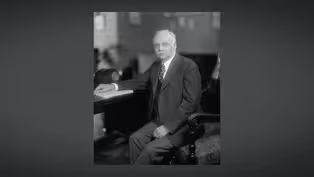
The complicated legacy of Native American VP Charles Curtis
Video has Closed Captions
The complicated legacy of Native American vice president Charles Curtis (6m 25s)
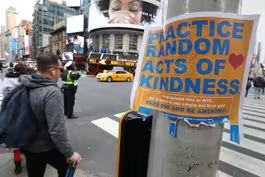
The science behind why doing good makes us feel good
Video has Closed Captions
The science behind why doing good makes us feel good (5m 26s)
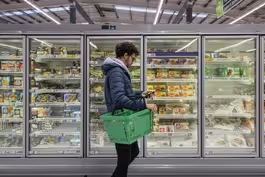
Study links ultra-processed foods to higher depression risk
Video has Closed Captions
Researcher explains connection between ultra-processed foods and depression (5m 22s)
Providing Support for PBS.org
Learn Moreabout PBS online sponsorship
- News and Public Affairs

FRONTLINE is investigative journalism that questions, explains and changes our world.

- News and Public Affairs

Today's top journalists discuss Washington's current political events and public affairs.












Support for PBS provided by:
Major corporate funding for the PBS News Hour is provided by BDO, BNSF, Consumer Cellular, American Cruise Lines, and Raymond James. Funding for the PBS NewsHour Weekend is provided by...