
November 27, 2023 - PBS NewsHour full episode
11/27/2023 | 57m 46sVideo has Closed Captions
November 27, 2023 - PBS NewsHour full episode
November 27, 2023 - PBS NewsHour full episode
Problems playing video? | Closed Captioning Feedback
Problems playing video? | Closed Captioning Feedback
Major corporate funding for the PBS News Hour is provided by BDO, BNSF, Consumer Cellular, American Cruise Lines, and Raymond James. Funding for the PBS NewsHour Weekend is provided by...
Support provided by:

November 27, 2023 - PBS NewsHour full episode
11/27/2023 | 57m 46sVideo has Closed Captions
November 27, 2023 - PBS NewsHour full episode
Problems playing video? | Closed Captioning Feedback
How to Watch PBS News Hour
PBS News Hour is available to stream on pbs.org and the free PBS App, available on iPhone, Apple TV, Android TV, Android smartphones, Amazon Fire TV, Amazon Fire Tablet, Roku, Samsung Smart TV, and Vizio.
Providing Support for PBS.org
Learn Moreabout PBS online sponsorshipGEOFF BENNETT: Good evening.
I'm Geoff Bennett.
AMNA NAWAZ: And I'm Amna Nawaz.
On the "NewsHour" tonight: Israel and Hamas extend the temporary cease-fire, and expand the prisoner exchange.
We speak to a Palestinian woman released by Israel and an Israeli man whose family was freed by Hamas.
DORI ROBERTS, Family Member of Hamas Hostages: We do value life, and we do appreciate, like, the return of our loved ones.
And I think there is no too big price to pay.
We have to bring them back.
GEOFF BENNETT: Vermont police arrest a suspect in a shooting of three college students of Palestinian descent being investigated as a hate crime.
AMNA NAWAZ: And Tamara Keith and Amy Walter break down the latest political headlines as Congress returns with a full agenda.
(BREAK) AMNA NAWAZ: Welcome to the "NewsHour."
It appears tonight that the lull in the Israel-Hamas war will last a little longer.
The two sides agreed today to extend their cease-fire for two more days.
GEOFF BENNETT: The announcement came as the initial four-day pause was in its final hours.
But Israeli Prime Minister Benjamin Netanyahu said his policy has not changed.
BENJAMIN NETANYAHU, Israeli Prime Minister (through translator): With regard to the hostages, we are continuing with the outline as agreed and we are also continuing with the main goal we said, to bring about the release of our hostages, to complete the elimination of Hamas and, of course, also to ensure that this threat will not repeat itself in Gaza.
AMNA NAWAZ: In the meantime, Hamas released 11 more hostages, who are almost all children, for 33 Palestinians held by Israel.
It was the fourth exchange under the cease-fire.
The pause has also created a window for hundreds of trucks loaded with fuel and humanitarian aid to flow into Gaza.
Today, the White House welcomed the prospect of additional days of calm.
JOHN KIRBY, NSC Coordinator For Strategic Communications: The approach that were taking with Israel and, quite frankly, with our partners in the region is working.
It's getting aid into people that need it.
It's getting a pause in the fighting.
It's getting hostages out.
It's getting Americans out.
And, quite frankly, we continue to urge and will continue to urge the Israelis as they conduct military operations to do so with the utmost care for innocent civilian life.
GEOFF BENNETT: Foreign affairs and defense correspondent Nick Schifrin joins us now.
Nick, it's good to see you.
So, what are the terms of this two-day extension, and what were the sticking points in getting to this deal?
NICK SCHIFRIN: The core of the agreement is an extension of what we have already seen, and that is that 10 or so Israeli hostages are released today for 30 Palestinian detainees released every day, as Israel holds fire, and, as we just saw, Israel allows a significant more amount of humanitarian aid to reach Gaza, including fuel.
So, that seems straightforward, just to add two days.
But it's been very difficult to get there.
The United States originally wanted this first part of the deal, the four-day pause, to have all 90 women and children released all at the same time.
But what Hamas told mediators in Qatar and Egypt is that it only had 50.
It could only actually find 50 of those 90 women and children.
And so it's not clear if the cease-fire has allowed Hamas to find about 20 or so more women and children.
That would be the next two days.
Or if Hamas has collected those women and children from other terrorist groups that we know have taken some of these people from Israel on October the 7th.
But the bottom line is that, for Israel, Hamas has been able to pledge that it can find these 20 extra hostages.
And, today, the White House welcomed this deal and said that it wanted the truce to extend until all 90 women and children could be released, in fact, possibly all the hostages, up to 240, could be released.
And those include two American women, 7-year-old Judith Higai (ph) and 49-year-old Liat Azili (ph), currently at this point still hostages.
GEOFF BENNETT: And we know 11 more hostages were released today.
What more can you tell us about them, based on your reporting?
NICK SCHIFRIN: Yes.
As we have been saying, this is all focused on women and children, perhaps none more so obviously than today.
Of the 11, nine were children.
Nine were children, all of them kidnapped from the kibbutz Nir Oz, where one out of four residents on October the 7th were either killed or captured.
Among those released today, the Calderon family, you see them there, Sahar, 16, Erez, 12-year-old.
There's video of Erez being taken.
You see that there on the morning of October 7.
One thing you might notice also there is that the people taking Erez were not wearing the traditional Hamas flag.
That day, their father, Ofer Calderon, was also taken.
You see him there.
He is still a hostage.
Also released today, the Cunio family, 33-year-old Sharon and her 3-year-old twins, Emma and Yuli.
Their father also remain.
remains a hostage.
The others released today include the Engel family, again, a mother and two children.
The father remains a hostage.
And 12-year-old Eitan Yahalomi was released by himself.
His father also remains a hostage.
And for all of those children and women, they're all going to go into Israeli hospitals, where they will receive the mental and physical care they need.
And part of this, Geoff, as we have been talking about, is this ratio.
For every Israeli hostage release, you get 10 Palestinians released.
And that has meant that we have been seeing every day Palestinian prisoners released from Israeli detention.
That was one, of course, Hamas' stated aims of the October 7 terrorist attack, to force Israel to release Palestinian prisoners, a step that has been part of the Palestinian national movement for decades.
They arrived to an adoring crowd, International Committee of the Red Cross buses full of freed Palestinians.
And as soon as they set foot in Ramallah, the West Bank's largest city, they received a hero's welcome surrounded by the flags of Hamas, tearful family reunifications between a mother and a teenage son she hasn't seen in four months and the family of 27-year-old Walaa Tanjii in the Tulkarm refugee camp outside Nablus.
Inside, her extended family welcomed her back.
She told us today her homecoming felt bittersweet.
WALAA KHALED TANJII, Released Palestinian Prisoner (through translator): It's a mixed feeling between happiness and sadness because of all of the people who have been killed in Gaza.
We lost a lot of women, children and innocent people in Gaza.
NICK SCHIFRIN: Years ago, the documentary "What Walaa Wants" chronicled her dreams to join the Palestinian Authority's police force.
These days, her dream is instilled by her mother: Finish her education.
WALAA KHALED TANJII (through translator): I have a lot of things I want to do.
I have a lot of dreams, ambitions.
And I want to achieve my mom's dream.
My mom's dream was to go to college and study political science.
NICK SCHIFRIN: But, right now, those are dreams deferred.
In August 2022, she was arrested outside an Israeli checkpoint in the West Bank.
Israel accuses you of trying to shoot Israeli soldiers at a checkpoint.
Did you?
WALAA KHALED TANJII (through translator): I deny this.
They stopped me while I was with my friends trying to visit one of our friends to congratulate her on her wedding.
They brought us to the jail and accused us of trying to kill some Israeli soldiers.
NICK SCHIFRIN: She ended up here, Ofer Prison.
And she says after the October 7 terrorist attacks, conditions inside got much worse.
WALAA KHALED TANJII (through translator): They treat us in a very bad way.
They threaten us that they would rape us.
They prevent us from having food and water.
After the 7th of October, we lost everything.
We lost our rights.
We lost our privacy.
They hit us, kicked us every day for 49 days.
NICK SCHIFRIN: Israel denies mistreating prisoners.
It wasn't the first time Tanjii or her family members were arrested.
She was detained in September 2017 for scuffling with prison guards to protect her brother, who himself has been arrested.
Her mother served eight years in Israeli prison for helping a failed suicide bomber.
Tanjii does not deny or denounce her mother's actions.
Was she guilty of that crime?
WALAA KHALED TANJII (through translator): I do not find my mom guilty because she resists any occupier who stole our lands.
And we have the right to defend ourselves and to resist the occupier and get our lands back.
And we deserve to be free.
NICK SCHIFRIN: She even praises the Hamas October 7 terrorist attack that killed 1,200 people in Israel.
WALAA KHALED TANJII (through translator): At that moment, I expected our lands will be reclaimed back.
And, God willing, it will return, because it's our land, our right.
NOUR ODEH, Political Analyst: For Palestinians, prisoners is an issue that affects almost every family.
NICK SCHIFRIN: Nour Odeh is a political analyst in Ramallah.
NOUR ODEH: They're seen as heroes because they have been able to withstand the process and the experience of being in prison, in Israeli prison.
These experiences are very harsh.
They're very lonely.
There are no rights.
There is no contact with the families most of the time.
NICK SCHIFRIN: Israel currently holds more than 7,000 Palestinian prisoners; 2,000 of them are held in administrative detention without charges.
And of the 300 Palestinians whom Israel identifies as possible releases, one-third are under 18.
NOUR ODEH: Most of the kids and the women who would have been released or will be released have not been charged and have not been tried.
All of them would have gone through the Israeli military court system.
NICK SCHIFRIN: Since October the 7th, Israeli-Palestinian clashes in the West Bank have increased.
And Palestinian human rights groups say Israel has arrested some 3,000 additional Palestinians.
NOUR ODEH: Amassing more Palestinian prisoners is also viewed as Israel's way of having more bargaining chips in these negotiations.
NICK SCHIFRIN: And now that the truce has been extended, those negotiations can continue.
Each day, Hamas is committed to release 10 more hostages, and Israel to release 30 more Palestinian prisoners.
For the "PBS NewsHour," I'm Nick Schifrin.
AMNA NAWAZ: So far, about 70 hostages have been released by Hamas over four days of a cease-fire, and as many as 175 people remain held in Gaza.
We turn to someone with family members in both situations.
Dori Roberts is the cousin of Doron Katz-Asher, who was just freed by Hamas, along with her two daughters, Raz, who is 4, and Aviv, who is 2.
But Dori's aunt, Doron's mother, Efrat Katz, was killed by Hamas en route to Gaza.
And Efrat's partner, Gadi Moses, and another of Dori's cousins, Ravid Katz, remained held hostage.
Dori Roberts joins us now.
Dori, let's just begin with what a bittersweet moment this must be for you and your family.
But let's start with Doron and Raz and Aviv, who were released.
How are they doing?
What can you tell us?
DORI ROBERTS, Family Member of Hamas Hostages: Well, I think you can see on my smile.
That is, they're doing much better.
They're surrounded by family and by loved ones.
They're back in home.
They're back in their home now after medical examinations and after surrounding themselves with the medical teams, mental health workers, social workers, and, of course, family.
They're very delighted to be home.
They're doing well.
They're undergoing, after 50 days at the hostages, all of them have been held by the Hamas as hostages.
And they're finally home and they're safe.
And this is why we're trying to provide them that safety and that hugging, loving family care that they will need from now until -- for quite a while, until they're fully recovered.
AMNA NAWAZ: Could they share anything with you about their time in captivity?
Were they hurt?
Were they fed?
How they were treated?
DORI ROBERTS: We're learning more they will tell about their time in -- helping captive, where food was very, very minimal to pretty much tin cans and canned food, wherever they could, some beans and chickpeas, dried pitas, and water.
Maybe spent an hour max at daylight.
And they had some medication provided to them, but not something you can really exist and have nutrition is, of course, based on that.
So we're trying to provide them all that back now, especially for the kids who suffered from a lot of those crucial nutrients and food that they need to just to grow and to be healthy, normal kids.
They're receiving all that right now back in Israel and we're so happy that they're finally home.
We have to make sure that all that time that they're staying down there under the tunnels, it's been really dark, and they're kept in groups.
I don't know how much.
There are some rumors about five or six groups in one cell with heavy guards.
So that is pretty intimidating for 2 years old, a 5 years old.
And their mother took upon herself to keep them safe and keep them protected as much as she could.
AMNA NAWAZ: We are so sorry for your loss, Dori.
I can't imagine what these children in particular have seen.
At the same time, I have to ask.
One of the stated goals of Hamas on the day they attacked, on October 7, was to release Palestinians who were held by Israel, which is now happening as part of the hostage release deal.
Do you support that, especially if it means more of your loved ones could come home?
DORI ROBERTS: I think, overall, after so many days of ongoing war, I think that it was time to take a break and return those hostages back from the Hamas.
I think the deal, to my view, is fair.
All those Palestinian people were evacuated from their homes and fled to Southern Gaza got a relief of food and clothes, fuel, electricity, and the prisoners who were held by Israel were released back to the Palestinian authorities.
And we saw some unpleasant images from there of their going straight back to the hands of the Hamas, and some of them are even paying for their own lives, being accused as spies and whatnot.
So it's sad to see it, but we do value life, and we do appreciate, like, the return of our loved ones.
And I think there is no big price to pay.
We have to bring them back.
AMNA NAWAZ: Dori Roberts, we thank you so much for joining us tonight.
We're glad your family is somewhat reunited.
We hope everyone else is home with you soon.
Thank you again.
DORI ROBERTS: Thank you so much.
AMNA NAWAZ: In the day's other headlines: The Pentagon said militants who seized an Israeli-owned tanker over the weekend were likely Somali pirates, not rebels from Yemen.
The rebels, backed by Iran, have staged other attacks since the Israel-Hamas war erupted.
In Sunday's incident, a U.S. Navy destroyer rescued the tanker in the Gulf of Aden.
Later, two ballistic missiles were fired into the area from rubble-held areas in Yemen.
The ship was not hit, and the pirates were put under arrest.
Elon Musk visited Israel today and said he supports neutralizing Hamas and condemns hate speech.
The billionaire has been accused of both endorsing antisemitism and letting it go unchecked on his social media platform X, formerly known as Twitter.
Today, he toured a kibbutz attacked by Hamas on October 7.
He also met with hostage families and Israeli President Isaac Herzog.
ISAAC HERZOG, Israeli President: You have a huge role to play, and I think we need to fight it together, because, under the platforms which you lead, unfortunately, there's a harboring of a lot of old hate, which is Jew hate, which is antisemitism.
AMNA NAWAZ: Officials said Musk also agreed that his Starlink satellite network will be accessible in Gaza only with Israeli oversight.
War-torn swathes of Southern and Central Ukraine are struggling to deal with the fallout from a powerful Black Sea storm.
On Sunday, snow drifts up to six feet knocked out power to some 2,000 towns and shut down more than a dozen highways.
Today, rescuers were out moving thousands of stranded vehicles.
Others cleaned up trees blown down by strong winds.
The storm also battered Southern Russia.
Forecasters said it was one of the most powerful ever recorded in the region.
In Sierra Leone, a curfew has eased a bid after authorities said they arrested leaders of an attack that killed 20 people on Sunday.
Gunmen in the West African nation stormed the main military barracks and prison.
But hours later, the country's president said calm had returned.
JULIUS MAADA BIO, President of Sierra Leone: In times like this, we are reminded of the importance of national unity.
Let us not succumb to fear or division.
Let us come together as one people, one nation.
AMNA NAWAZ: Nearly 2,000 prisoners escaped during the chaos.
It followed the president's disputed reelection victory this past summer.
Back in this country, three days of memorial tributes began for the late first lady Rosalynn Carter.
This afternoon, a hearse carrying the casket arrived at the Jimmy Carter Presidential Library and Museum in Atlanta.
Mrs. Carter is lying in repose there this evening.
Funerals are planned in Atlanta on Tuesday and in the Carters' hometown of Plains on Wednesday.
Rosalynn died last week at the age of 96.
Class was back in session at public schools in Portland, Oregon, today, as a teachers strike ended.
School officials announced a tentative deal with the union late Sunday.
Teachers had been on the picket line since November 1 over pay, class sizes and planning time.
And on Wall Street, stocks edged slightly lower to start the week.
The Dow Jones industrial average lost 56 points to close at 35333.
The Nasdaq fell nearly 10 points.
The S&P 500 was down nine.
And Merriam-Webster is keeping it real this year.
The dictionary company says authentic is the word of the year.
It's based on large numbers of searches for the term and its meaning.
Runners-up, influenced greatly by news events, included deepfake, coronation, and indict.
Still to come on the "NewsHour": Tamara Keith and Amy Walter break down the latest political headlines; a new book details the U.S. government's search for alien life; the shortest member of the Marine Corps reflects on the challenges and triumphs of his service; plus much more.
GEOFF BENNETT: The shooting of three college students this holiday weekend has added more fear and concern about a rise in bias, discrimination, and violent attacks against Arab Americans and Muslims in the U.S. William Brangham has the story.
WILLIAM BRANGHAM: Forty-eight-year-old Jason Eaton was arraigned today in connection with the shooting of three college students of Palestinian descent in Burlington, Vermont over the weekend.
He's charged with three counts of attempted murder in the second degree.
Authorities say he shot the man without saying a word, and while no motive has been determined, the shooting is being investigated as a possible hate crime.
The uncle of Kinnan Abdalhamid, one of the victims, spoke today at a news conference.
RADI TAMIMI, Uncle of Shooting Victim: Kinnan grew up in the West Bank, and we always thought that that could be more of a risk in terms of his safety, and sending him here would be the right decision.
We feel somehow betrayed in that decision here.
WILLIAM BRANGHAM: In addition to Abdalhamid, families identified the other victims as Hisham Awartani and Tahseen Aliahmad.
Relatives said the three were walking to dinner on a residential street when they were suddenly attacked.
Two of them were wearing keffiyehs, a traditional Palestinian headdress, and they were reportedly speaking a mixture of English and Arabic.
Awartani is a junior at Brown University, Abdalhamid a student at Haverford College, and Aliahmad attends Connecticut's Trinity College.
They were in Vermont for Thanksgiving, visiting one of their families.
Today, Attorney General Merrick Garland said that because of the Israeli-Hamas conflict, tensions here are high.
MERRICK GARLAND, U.S. Attorney General: All of us have also seen a sharp increase in the volume and frequency of threats against Jewish, Muslim and Arab communities across our country since October 7.
There is understandable fear in communities across the country.
WILLIAM BRANGHAM: This shooting comes amid a documented rise in Islamophobia and anti-Arab incidents.
Since the Israel-Hamas conflict began, the Council on American-Islamic Relations has received over 1,200 requests for help or reports of bias, a 216 percent surge from the same time last year.
Those incidents include at least one murder, two other attempted murders and numerous violent threats involving guns being discharged or brandished.
On October 15, 6-year-old Chicago resident Wadea Al-Fayoume killed, stabbed 26 times by his landlord.
Officials say he targeted the family because they were Muslim.
The alleged shooter in Burlington pleaded not guilty today, and the three young men are being treated at a local hospital.
While the motive for this attack is still unclear, some groups argue officials should clearly consider this a hate crime.
Abed Ayoub is the national executive director of the Arab American Anti-Discrimination Committee.
He's been in regular touch with the families of the three students.
Could you first tell us how these three young men are doing?
ABED AYOUB, National Executive Director, Arab American Anti-Discrimination Committee: The young men right now are, first of all, relieved that the person responsible for their shooting has been apprehended and is in custody.
And Burlington is safer with him off of the streets.
One of them is recovered fully.
He should be released from the hospital soon.
If not, he was released already.
And two of them are -- have some injuries that they are overcoming, one of them some very serious injuries, but they are -- they have a long road of recovery ahead of them physically and emotionally as well.
WILLIAM BRANGHAM: And how are the families doing?
We heard one of the uncles describing how his nephew moving to the U.S. from the West Bank was considered by the families to be the safe choice.
How are they all processing this?
ABED AYOUB: This has come as a shock to the family members and to the community.
They're having a difficult time.
They had a difficult time initially being overseas, comprehending everything, putting everything together and flying over here.
The students were at the grandmother's house of one of the victims.
So it's good that there were some relatives there, some familiar faces there, but it's difficult when you're thousands of miles away and your son gets shot.
It's a whirlwind of emotions and trying to gather yourself.
But a lot of folks in the community have stepped up.
And they are on their way here.
And, hopefully, they will be with their children soon.
WILLIAM BRANGHAM: As we reported, we still don't know what the motive is here, whether this was a random attack or whether these young men were specifically targeted because they're Palestinian.
The families, as you know, put out a statement today saying they clearly believe that this is a hate crime.
And I want to read an excerpt of this.
They place the blame on: "U.S. media and even elected officials from the highest levels of the government have repeated racist and dehumanizing language in recent weeks.
This hateful rhetoric emboldens people to act with violence."
I'm curious, do you share that same belief?
ABED AYOUB: Absolutely.
Our belief has been that the rhetoric against Arabs, against Palestinians in this country, the dehumanization of Palestinians would eventually lead to these violent hate crimes we're seeing.
That's exactly what's happening.
That's what happened in Chicago to Wadea, the 6-year-old was stabbed.
That's what happened in this situation and other examples that our office has been fielding across the country since early October.
So the rhetoric, the way we're being dehumanized and the way Arabs and Palestinians are being portrayed leads to these violent hate crimes.
And, unfortunately, this may not be the last incident we hear of, unless there's an effort to change the rhetoric and to change the way we are being portrayed.
WILLIAM BRANGHAM: What would you like to see local and national leaders do in this moment?
I mean, I know on social media you wrote that you wanted college campuses and college leaders to make sure that Arab and Muslim students are safe on campuses.
What would you like our leaders to do?
ABED AYOUB: The first thing they can do is recognize that the Arab and Palestinian community here is under attack and hate incidents are on the rise and work with the community to push some of that hate and some of that incidents away from us, right?
They can do that by changing the rhetoric and stop the attacks, the baseless attacks on the community, going after Palestinian student groups, going after Palestinian students, allowing for the doxxing of Arab and Palestinian students on your college campuses.
All of that eventually is going to lead down one road, and that's going to be violent hate crimes.
So we have to stop a lot of these things that are happening on college campuses and in the general public.
And our elected officials, our leaders need to stand up to those, say, enough is enough.
We don't need to see any more of the doxxing.
We don't need to see any more of the targeting.
We don't need to shut down Arab and Palestinian student groups.
We can engage in civil discourse and in debate, but we don't need to go as far as to start vilifying individuals just to shut them down and keep them quiet.
WILLIAM BRANGHAM: I mean, at the same time, obviously, what is happening with -- between Israel and Hamas is horrifying to watch.
And there are groups on both sides supporting the Israelis and groups supporting the Palestinians here in the U.S., and they have a legal right to be protesting.
How do you counsel people how to express their First Amendment rights while also staying safe in the United States?
ABED AYOUB: Both sides do have a First Amendment right to protest, but only one side is consistently under attack and having that right taken away.
So the basic fundamental right of protest and assembly for Arabs and Palestinians in this country, that within itself is under attack, and that should worry all Americans, where, if you can start taking away the right of protest and assembly of individuals you disagree with, then we have nothing left when it comes to the First Amendment on our campuses and elsewhere.
So this is a critical moment in our country's history.
This is bigger than a Palestine protest or a pro-Israel protest.
This is an attack on our fundamental freedoms in this country, and people need to start paying attention.
WILLIAM BRANGHAM: All right.
Abed Ayoub of the Arab American Anti-Discrimination Committee, thank you so much for being here.
ABED AYOUB: Thank you.
I appreciate it.
GEOFF BENNETT: We are less than 50 days out from the Republican Iowa caucuses, and a couple of key endorsements are aimed at shifting the momentum in the GOP primary race, if that's even possible.
To help us make sense of it all, we're joined by our Politics Monday duo of Amy Walter of The Cook Political Report With Amy Walter and Tamara Keith of NPR.
It's good to see you both.
Thanksgiving is behind us.
We are back to work, and so too are the 2024 presidential candidates.
Tam, we have talked before about the ways in which Ron DeSantis has -- he's basically sinking a ton of time and resources into Iowa.
He picked up that key endorsement from Iowa's popular governor, Kim Reynolds.
He also, over the weekend got the backing of Bob Vander Plaats, who is an influential evangelical leader.
What difference do these endorsements make?
TAMARA KEITH, National Public Radio: It's not clear that they will make a difference.
And one big question I have with the Vander Plaats endorsement is, how significant are evangelical voters as a bloc?
Are they voting as a bloc in -- or caucusing as a bloc in Iowa anymore?
Is an influential figure like Vander Plaats still as influential as he used to be if he is telling people not to vote for Donald Trump, who has significant support among evangelicals in Iowa?
There seems to be a real disconnect there.
And the reality is that while Vander Plaats has had a decent record of picking Iowa caucus winners, he hasn't had a great record of picking nominees or presidents.
So, how far this takes DeSantis, it's just not clear.
At this point, it's really DeSantis and Nikki Haley battling it out for second place, and battling it out pretty viciously, while former President Trump is seemingly above the fray and doing quite well in basically every Iowa poll we see and the average of all of them.
AMY WALTER, The Cook Political Report: Yes.
I mean, the viciously attacking is an important point, because it feels like we have just gone back in the time machine to 2016, when all the other candidates who weren't named Donald Trump were fighting amongst themselves to get to be that one candidate to take on Donald Trump.
And the theory was, once it was one-on-one race, they could beat him, which, of course, did not end up occurring.
In this case, the most recent ads, if you're sitting in Iowa right now watching television, the ads for the DeSantis super PAC are attacking Nikki Haley, the Nikki Haley super PAC is attacking DeSantis, and Donald Trump's super PAC is talking about Joe Biden.
And so not that -- and I also think it's important to note that Donald Trump isn't not taking Iowa seriously.
He's taking Iowa seriously.
He's been doing rallies there.
But it is -- it's this fascinating piece here where Donald Trump is the anti-establishment establishment candidate and that he is basically the front-runner because he's almost like the sitting incumbent and has the benefit of that, while at the same time the regular establishment, people like evangelical leaders and the governor, line up against him.
GEOFF BENNETT: But, Tam, looking beyond Iowa, Nikki Haley, in many ways has pushed past Ron DeSantis as the top Trump alternative, New Hampshire, for instance.
TAMARA KEITH: Well, and she has pushed back - - pushed past him with the establishment Republicans who are looking for a place to go that isn't Donald Trump.
Ron DeSantis came in to the race with all of this promise, and everybody thought he would be great.
And he has spent, and his super PAC especially, has just spent a ton of money, and it hasn't gotten him anywhere.
And Haley is sort of riding off of her strong debate performances and also harnessing momentum as you head into actual voting occurring.
The theory of the case from Haley's people and Haley's team is that she -- probably not going to win Iowa, but come in second in Iowa, strong showing in New Hampshire, and then make it to her home state of South Carolina, and somehow -- somehow, they all have this idea that you can pierce the inevitability of Trump, and once you do, then the air will be out, and then they can really take him on.
That is a great theory.
But until it happens, it hasn't happened.
GEOFF BENNETT: Well, let's talk about President Biden, specifically his handling of the Israel-Hamas war, because he's had to navigate these complex political realities.
He's facing pressure from all sides.
And it has resulted at times in headlines like this one from The Washington Post: "Biden's resistance to cease-fire could alienate youth voters in 2024."
Come to find out that President Biden behind the scenes was helping to craft a temporary cease-fire.
AMY WALTER: Right.
So I think the challenge in talking about how young voters see what's happening in Israel and Gaza and how older voters see it is that I think, for many older voters, this is a geopolitical issue, and for younger voters, this is a human rights issue, and it long has been a human rights issue, and that what separates -- and, in fact, in polling, we're hearing from pollsters who say, we have never seen such a generational gap on an issue that technically is foreign policy as this issue.
Support for sending more military aid to Israel among voters 65 and older is 40 points more than those in the 18 to 34 category.
But if you are a younger voter who sees this, the issue of Palestine and Israel through a lens that looks very different than their parents and grandparents, namely, one in which race and privilege and access is the main focus, versus one that is really looking at this as what's the stability in the region, who's at fault, what does it mean for the rest of the world.
And that's where I think, even if he is able to have a cease-fire work for a certain amount of time, releasing some of these hostages, those are all things that he can get credit for.
But it's still the -- it's not changing the nature of the conversation about what it means to be Palestinian.
GEOFF BENNETT: Tam, how does the White House see it?
Because separate from Amy's salient point is this notion that President Biden, the White House, I'm told, feels that he doesn't always get the credit for doing the work, because he doesn't do the work in a way that's properly politically theatrical.
TAMARA KEITH: This is the story of Joe Biden as seen by the White House.
And he very much does not make a public show of things until after it's done.
And then he tries to claim credit, like with all of his economic accomplishments.
And then he can't get the credit.
And it's already baked in.
And that's just the story of Joe Biden.
I think that, with this case, that people in the Biden inner circle think it's a year out.
These numbers are not good, but it's a year out.
And a lot can change in a year.
This is unlikely to be the top headline and the top driving issue for voters a year from now.
And the reality is that most voters don't make decisions based on foreign policy.
They pick the candidate they like, and political science has shown that then they sort of meld their foreign policy views to those of the candidate that they have sort of hooked to themselves onto.
So the White House, though, does realize that they have a problem with young voters.
It ties into what's happening with Israel and Gaza, but it goes well beyond that.
They're working on it.
But -- and they know, they readily acknowledge that this is not going to be easy.
Like, running for reelection is hard.
Just ask anyone else who's around for reelection.
The sheer act of being president means that you have now committed policy that has turned off people who voted for you the first time around.
AMY WALTER: Yes.
And it goes back to the generational issue, because if you see what young voters' biggest concern about Biden has long been is his age.
And this is just a representation of that.
And he's in the 65-plus category, not in the younger category.
And so his world view as well as his ability to connect with these voters is -- that's a big challenge because of that generation.
GEOFF BENNETT: Amy Walter and Tamara Keith, last word.
TAMARA KEITH: That's the one thing they can't change, is the president's age.
GEOFF BENNETT: Absolutely.
Thank you both.
AMY WALTER: Thank you.
TAMARA KEITH: You're welcome.
AMNA NAWAZ: Since the 1940s, unidentified flying objects, or UFOs, have been a part of our nation's cultural phenomena.
But for the U.S. government, they have been a mystery and something the military has been investigating for decades.
I recently sat down with author Garrett Graff to discuss his new book called "UFO: The Inside Story of the U.S. Government's Search for Alien Life Here and Out There."
Garrett Graff, welcome back to the "NewsHour."
GARRETT GRAFF, Author, "UFO: The Inside Story of the U.S. Government's Search for Alien Life Here and Out There": Thanks so much for having me.
AMNA NAWAZ: So you have written incredible, deeply researched and reported books on Watergate, an oral history of 9/11.
Why UFOs?
Why did you turn your attention to this?
GARRETT GRAFF: So I came at this as a national security writer, as you know.
And what changed for me, what got me interested in the subject was there was this sea change in recent years in Washington around this topic, that you started to hear serious people talking seriously about this subject.
And, for me, there was this one very specific moment in December 2020 where John Brennan, who was just wrapping up the better part of a decade as the former CIA director, White House homeland security adviser in the Obama years, said, basically, like, there's stuff out there.
We don't know what it is.
It puzzles me.
And the phenomenon may end up constituting some new form of life.
And it was a really startling comment to me.
And so for him to be leaving office saying, I still don't know what this thing is, felt to me like a topic that would be fun to dig into.
AMNA NAWAZ: Tell me more about that sea change, though, because you do trace in the book the 75-year history of related military programs.
And there was, for years, a real lack of transparency, I think it's fair to say.
You cite specifically, of course, the 1947 crash outside of Roswell, New Mexico.
But what has happened over the years that's moved this conversation from the fringe to the mainstream?
GARRETT GRAFF: Yes.
So, in the book, I try to trace two threads that historians and journalists normally treat differently.
There's the 75-year, 80-year history of the military's attempt to solve the mystery of UFOs here.
And then there's the evolving science and astronomy of what's known as the search for extraterrestrial intelligence, SETI, out there in the rest of the universe.
And both sides of these conversations have really seen revolutions in the last decade, where there was some blockbuster reporting here by The New York Times and Politico in 2017 that outlined the Pentagon's study of what the government now calls UAPs, unidentified anomalous phenomenon.
The other thing that's really changed in all of the science is our understanding of how big the universe actually is.
And we now understand sort of just how many stars around the universe have planets and how many of those planets would be habitable by things that we recognize as life.
And sort of as part of that, we have seen the science really shift from the possibility that life exists to the probability that there's actually likely a lot of life and probably a lot of intelligent life out there across the universe.
AMNA NAWAZ: You talked about this specifically.
You said that the math is on the side of the aliens.
What does that mean?
GARRETT GRAFF: So we now understand -- and this is a huge sea change -- that as late as the 1990s we didn't know that there was a single planet outside of our own solar system.
We now believe that, almost every star, effectively every star has planets, and that as we understand the scale and the scope and the breadth of the universe, once you adjust for what they call the Goldilocks zone, sort of planets that would be at the temperature and ability to hold water and atmospheres of oxygen that we would recognize, there are potentially a sextillion habitable planets across the universe.
So that's a billion trillion habitable planets across the universe.
AMNA NAWAZ: All this made me think about -- you probably know this very well -- the Pale Blue Dot photo.
GARRETT GRAFF: Yes.
AMNA NAWAZ: Right?
It's taken by NASA, the Voyager 1 back in 1990, that small dot from a distance of some four billion miles from the sun.
That dot is Earth.
It makes you remember that we are just so very small.
But you are a journalist.
You deal with facts and you deal with evidence.
So, are you convinced we're not alone?
GARRETT GRAFF: So, I think that the math really strongly suggests we are not alone.
The flip side of that is the math also says that the life and intelligent life out there is probably too far away for us to ever know, and that part of what's fun about diving into the UFO history of this, the pop culture, the science of these sightings is, there's this wonderfully human-centric vision that aliens would care about us, that Sort of aliens would travel, master interstellar, intergalactic travel, come all the way here to make friends or invade us or conquer us, whereas, statistically, what's probably most likely is that there's intelligent life out there.
And it doesn't know about us.
And even if it did, it wouldn't necessarily care at all.
AMNA NAWAZ: I want to be as specific as we can about this, because you have studied this so in depth.
When you say intelligent life out there, what does that mean to you?
What does that even look like?
GARRETT GRAFF: I think we don't really know.
And I think part of this journey and sort of coming to try to understand and write about this subject is, you have to be really humble about what we know and what we don't know about just how weird the universe actually could be and just how new our knowledge and understanding of the universe probably actually is.
AMNA NAWAZ: The book is "UFO: The Inside Story of the U.S. Government's Search for Alien Life Here and Out There."
The author is Garrett Graff.
Garrett, thanks for being here.
GARRETT GRAFF: My pleasure.
Thank you.
GEOFF BENNETT: And we will be back shortly to hear from the man who is believed to be the shortest U.S. Marine ever.
AMNA NAWAZ: But, first, take a moment to hear from your local PBS station.
It's a chance to offer your support, which helps to keep programs like ours on the air.
GEOFF BENNETT: For those of you staying with us, a look at the intersection of arts and health.
A music school known for training some of the world's most talented artists is bringing music into the lives with people who have disabilities.
Earlier this year, Jeffrey Brown traveled to the Berklee Institute for Accessible Arts Education.
It's for our arts and culture series, Canvas.
JEFFREY BROWN: Eleven-year-old Ashton Kiprotich on the cello and the ukulele.
Ashton, I saw you play the ukulele and I saw you play the cello.
Which is your favorite?
ASHTON KIPROTICH, Student: Both of them.
JEFFREY BROWN: Both of them?
ASHTON KIPROTICH: I would never say that I dislike them.
JEFFREY BROWN: Twenty-four-year-old Shania Ward on the keytar, her mother, Donna Gibbons-Ward, watching.
Every time I see you performing, you're smiling.
SHANIA WARD, Student: Yes.
JEFFREY BROWN: You have a beautiful smile.
SHANIA WARD: Thank you.
JEFFREY BROWN: Why are you smiling so much?
Are you happy with the music?
SHANIA WARD: Yes, I'm happy with the music.
DONNA GIBBONS-WARD, Mother of Shania Ward: Yes, music is her thing.
JEFFREY BROWN: Yes?
DONNA GIBBONS-WARD: She listens to it all the time, yes?
JEFFREY BROWN: Why do you think music became her thing?
DONNA GIBBONS-WARD: I think it helped her to... SHANIA WARD: Helped me to learn.
JEFFREY BROWN: Music for learning, for connecting, for sheer joy.
Shania and Ashton are students at the Berklee Institute for Accessible Arts Education, part of the Berklee College of Music in Boston.
Founded in 2007, it started small with a focus on autism, but has expanded to serve more than 300 people of all ages with disabilities of all kinds.
DR. RHODA BERNARD, Founding Manager Director, Berklee Institute for Accessible Arts Education: Every person can learn in the arts, can grow in the arts, can create, can, in this case, make music.
So I think you have to start with that belief.
JEFFREY BROWN: Rhoda Bernard heads the institute, which she says is the only such program offered at a college or university.
The goal, to develop and share new ways to reach and teach this community, while expanding the field of arts education.
DR. RHODA BERNARD: Arts educators are generally trained to teach the way they were taught.
There are longstanding traditions in how the arts have been taught, and those... JEFFREY BROWN: Meaning what?
I mean... DR. RHODA BERNARD: Like the conservatory tradition of what a private lesson looks like.
Often, the arts can be more of a teacher-centered kind of approach, where the teacher is showing what they want, and the students are responding.
And to make it more accessible means providing more entry points, providing students with more ways to engage with material and more ways to show what they know and are able to do than just the conventional.
JEFFREY BROWN: That means meeting the individuals where they are, incorporating aspects of special education into teaching music and the arts, in private lessons and also in group settings.
The institute holds a wide variety of classes every Saturday, including many ways to play together, rock band, chorus, an iPad ensemble, and more.
There's also a two-week summer camp.
DR. RHODA BERNARD: We're creating a place where they're accepted for who they are, where they belong, a place of yes.
These are folks who hear a lot of no.
This is a place where it's, yes, you can.
So there's a constant asset-based belief in all of the students, who hear so much deficit language.
So, that's the first, but then... JEFFREY BROWN: That goes to who they are and how they're accepted in the world.
DR. RHODA BERNARD: Absolutely, and creating that environment and then providing them with what they need and watching them flourish.
JEFFREY BROWN: Ashton Kiprotich, diagnosed with autism when he was nearly 2 years old, didn't speak until he was 7.
He still has difficulty processing thoughts into speech.
But, here, his mother, Kelly Phillips says, teachers like Miles Wilcox really get it, offering love and patience, as well as training in how to hold a bow.
And music somehow brings out something different in her son.
KELLY PHILLIPS, Mother of Ashton Kiprotich: Still, he struggles with processing, auditory processing disorder.
And so it's really -- there's a lot of delay in getting answers from him.
So we still see that.
With music, I don't see that happen at all.
It's just there.
He is very spontaneous.
He plays in different keys.
He will sit down and play something he's heard that he's never seen the music for.
JEFFREY BROWN: Did that surprise you?
KELLY PHILLIPS: Very much.
JEFFREY BROWN: Yes.
KELLY PHILLIPS: I have to say school has not really been easy.
Language acquisition has been exceptionally difficult.
But then you see, in music, he will sit down and be part of an ensemble, knows where to come in, knows -- timing-wise, knows it all.
And it's a little baffling to me when you compare those two things.
JEFFREY BROWN: Ashton, does music -- is music easy for you, easier than other things?
ASHTON KIPROTICH: Yes.
JEFFREY BROWN: Why do you think?
Why can you play music so well?
ASHTON KIPROTICH: Because I can.
JEFFREY BROWN: Shania Ward, diagnosed with mild intellectual delay, also takes full advantage here, singing in the rock band, taking lessons with her teacher, Nadia Castagna Morin.
Shania's mother, Donna Gibbons-Ward, says the institute has given her daughter greater confidence and autonomy.
DONNA GIBBONS-WARD: I wanted her to be among her peers and for her to be free, and for her to also gain -- she loves music.
So, being here, you're free.
JEFFREY BROWN: You mean free in a way that she's not as free in the rest of the world?
DONNA GIBBONS-WARD: So, you know how society always judges us and looks down on people, and other kids point fingers and laugh at you when you're different.
Here, you can be free.
That's what I mean by free.
You can be yourself and just express yourself however you want.
And that makes her happy with the music, so she's happy.
SHANIA WARD: Music always makes me feel happy.
Sometimes, like, when I feel like I'm upset or, like, getting mad or frustrated, I usually listen to music.
I always, like, take a break and listen to music and calm myself down, put my headphones on.
And then I listen to it.
And then, in here, I definitely like to learn music.
I definitely -- I listen to my music teachers.
JEFFREY BROWN: In fact, Shania, who's about to enter a specialized college program, wants to be a music teacher herself.
Why is that important for you?
SHANIA WARD: Because I want to be a teacher to help younger kids and older kids learn how to be smart and be like me.
JEFFREY BROWN: A big part of the mission here, says Rhoda Bernard, is training a new generation of arts educators in accessibility practices.
In addition to offering a master's program, she and her team run professional development training programs around the world.
But it remains a work in progress.
If this is so obvious, as it is to you, why isn't it everywhere?
DR. RHODA BERNARD: I think it's taken the education profession, and particularly the arts education field, a long time to understand the wide range of difference in how people learn, in what people bring into the classroom.
And then, because there are established frameworks that don't allow for that, there's a struggle.
And we're in that struggle now.
And it's moving.
Even in the 20 years or so that I have been doing this work, I have seen a lot of movement.
And I'm really excited for what the next generation is going to bring.
JEFFREY BROWN: For the "PBS NewsHour," I'm Jeffrey Brown at the Berklee Institute for Accessible Arts Education in Boston.
AMNA NAWAZ: And now a profile of someone who didn't let height define him.
At just over 4.5-feet tall, Nathaniel Laprade is thought to be the shortest U.S. Marine on record.
And as "PBS NewsHour" digital producer Casey Kuhn reports, he entered boot camp with something to prove.
PFC.
NATHANIEL LAPRADE, U.S. Marine Corps: If you have a weakness, and you know it's your weakness, I can pretty much promise you that by the end of the time in the military, it will become one of your greatest strengths.
CASEY KUHN: Nineteen-year-old Private 1st Class Nathaniel Laprade just became a Marine.
And at 4'7'', he's believed to be the shortest person ever to serve in the U.S. armed forces.
PFC.
NATHANIEL LAPRADE: It kind of has affected me my whole life.
I was always the shortest guy, whether that be on the soccer team or the wrestling team.
Back when I was in high school, there wasn't really eyes on me.
It was just, oh, he's the short kid.
And when I joined the Marine Corps, it was, oh, he has something to prove.
CASEY KUHN: To become a Marine, Laprade endured the grueling Marine boot camp training regimen at Parris Island.
MAN: And you are taking the first step to become a member of the world's finest fighting force, the United States Marine Corps!
CASEY KUHN: He hiked for miles carrying a 40-pound rucksack and overcame huge obstacles.
PFC.
NATHANIEL LAPRADE: There's a lot of weight in our hikes.
And, sometimes, they're moving at a faster pace.
I don't want to go back and say, oh, it's because I have little legs, but it is a tad harder to keep up.
But you just keep your head up, keep your legs moving one foot in front of the other.
And, honestly, I always felt that I had to do better than everyone else.
Everywhere I went, it was, where's the short one?
We'd be running obstacle courses or on the range.
It would be, look at what the little one's doing.
Usually, it was a good thing, because I was really efficient with the obstacle course.
CASEY KUHN: Laprade credits his success at boot camp to guidance from his instructors.
PFC.
NATHANIEL LAPRADE: The instructors would tell me either it's all in my head or just push a little harder or dig a little deeper.
And, sure enough, I would just do what the instructors tell me to do.
And I got through it.
What I will do is, I will pick a role model from them and I will say, I want to be like that guy.
And so when he tells me to do something, it's straight on the spot.
CASEY KUHN: His goal is to become a logistics specialist, which means he'd be part of the teams who manage and prepare equipment for deployment.
But Laprade has a longer-term plan.
He wants to come back to Parris Island as a drill instructor to motivate other Marines, following in the footsteps of the instructors who motivated him.
PFC.
NATHANIEL LAPRADE: So I have always liked teaching.
I have always thought of myself good at teaching, because, if I use what they have been using on us, I will be able to become an even better teacher.
CASEY KUHN: A teacher to inspire and command respect, just like the instructors he had.
For the "PBS NewsHour," I'm Casey Kuhn.
GEOFF BENNETT: And that is the "NewsHour" for tonight.
I'm Geoff Bennett.
AMNA NAWAZ: And I'm Amna Nawaz.
On behalf of the entire "NewsHour" team, thank you for joining us.
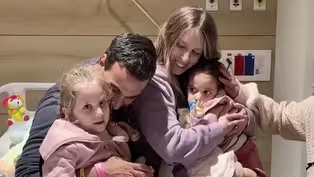
Family of freed Israeli hostages on loved ones still held
Video has Closed Captions
Clip: 11/27/2023 | 4m 48s | Family of freed Israeli hostages discusses release and loved ones still held in Gaza (4m 48s)
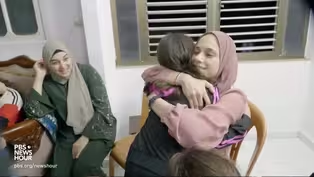
Freed Palestinian: 'We have the right to defend ourselves'
Video has Closed Captions
Clip: 11/27/2023 | 4m 32s | Freed Palestinian prisoner: 'We have the right to defend ourselves' (4m 32s)
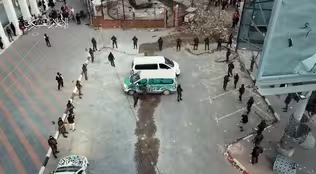
More Gaza hostages to be released as cease-fire extended
Video has Closed Captions
Clip: 11/27/2023 | 4m 54s | More hostages and prisoners to be released as Israel and Hamas extend temporary cease-fire (4m 54s)

New book details U.S. government's search for alien life
Video has Closed Captions
Clip: 11/27/2023 | 6m 22s | New book details U.S. government's UFO investigations and search for alien life (6m 22s)
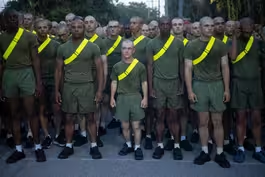
Shortest Marine on challenges and triumphs of his service
Video has Closed Captions
Clip: 11/27/2023 | 2m 44s | Shortest member of Marine Corps on the challenges and triumphs of his service (2m 44s)
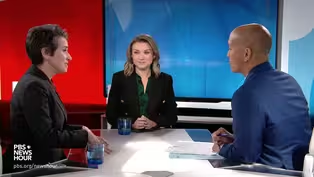
Tamara Keith and Amy Walter on GOP hopefuls building support
Video has Closed Captions
Clip: 11/27/2023 | 8m 47s | Tamara Keith and Amy Walter on the Republicans building support ahead of the Iowa caucuses (8m 47s)

Vt. shooting raises concerns about attacks on Arab Americans
Video has Closed Captions
Clip: 11/27/2023 | 8m 29s | Vermont shooting raises more concerns about attacks against Arab Americans (8m 29s)
Providing Support for PBS.org
Learn Moreabout PBS online sponsorship
- News and Public Affairs

FRONTLINE is investigative journalism that questions, explains and changes our world.

- News and Public Affairs

Amanpour and Company features conversations with leaders and decision makers.











Support for PBS provided by:
Major corporate funding for the PBS News Hour is provided by BDO, BNSF, Consumer Cellular, American Cruise Lines, and Raymond James. Funding for the PBS NewsHour Weekend is provided by...