
November 28, 2023 - PBS NewsHour full episode
11/28/2023 | 56m 39sVideo has Closed Captions
November 28, 2023 - PBS NewsHour full episode
November 28, 2023 - PBS NewsHour full episode
Problems playing video? | Closed Captioning Feedback
Problems playing video? | Closed Captioning Feedback
Major corporate funding for the PBS News Hour is provided by BDO, BNSF, Consumer Cellular, American Cruise Lines, and Raymond James. Funding for the PBS NewsHour Weekend is provided by...
Support provided by:

November 28, 2023 - PBS NewsHour full episode
11/28/2023 | 56m 39sVideo has Closed Captions
November 28, 2023 - PBS NewsHour full episode
Problems playing video? | Closed Captioning Feedback
How to Watch PBS News Hour
PBS News Hour is available to stream on pbs.org and the free PBS App, available on iPhone, Apple TV, Android TV, Android smartphones, Amazon Fire TV, Amazon Fire Tablet, Roku, Samsung Smart TV, and Vizio.
Providing Support for PBS.org
Learn Moreabout PBS online sponsorshipAMNA NAWAZ: Good evening.
I'm Amna Nawaz.
GEOFF BENNETT: And I'm Geoff Bennett.
On the "NewsHour" tonight: The extended cease-fire in the Middle East allows more hostages to be released while the U.S. pushes Israel to avoid displacing more civilians in Gaza.
AMNA NAWAZ: Abortion before the Texas Supreme Court.
A group of women make the case that the state's lack of exceptions for pregnancy complications puts their lives in danger.
GEOFF BENNETT: And a look at what's causing nurses to burn out and the risks that poses to patients' health.
SARAH KINCAID, Family Nurse Practitioner: You have this moral obligation to assist patients in achieving their health and wellness.
When you can't do that because of systems that are in place, that's where that distress comes from.
(BREAK) GEOFF BENNETT: Welcome to the "NewsHour."
Today was the day the war could have resumed in Gaza, with an initial truce set to expire.
AMNA NAWAZ: Instead, it is the fifth day of a pause in fighting, the fifth day of Hamas releasing mostly Israeli hostages, Israel releasing 30 detained Palestinians, half of them women, and more aid arriving into Gaza.
Nick Schifrin begins our coverage.
NICK SCHIFRIN: As a fifth day of armistice allowed the fifth release of mostly Israeli hostages from Gaza, and 30 Palestinians from military detention in the West Bank, there is a diplomatic push tonight to extend the pause.
In Doha, CIA Director Bill Burns met with his Israeli counterpart David Barnea.
One of their goals, expand the hostage release agreement beyond foreign workers and Israeli women and children that have so far been released to the more than 100 Israeli male hostages being held in Gaza.
Hamas has indicated it is interested.
The negotiations are mediated by Qatar.
MAJED BIN MOHAMMED AL ANSARI, Qatari Foreign Ministry Spokesman: We are hopeful that, in the next 48 hours, we will be getting more information from Hamas regarding the rest of the hostages.
NICK SCHIFRIN: In Israel, public sentiment is mixed.
MEIRAV RAMOT, Israeli Resident: We need all of them back home.
If a truce is what will get them home, yes.
MICHAEL REICHAL, Israeli Resident: In two days, we should stop the cease-fire and go back to war and for -- get rid of Hamas.
NICK SCHIFRIN: Prime Minister Benjamin Netanyahu is holding on to both goals, even if most analysts believe they're contradictory.
BENJAMIN NETANYAHU, Israeli Prime Minister (through translator): We are committed to completing our tasks, the release of all the abductees, the elimination of this terrorist organization above and below the ground.
And, of course, Gaza will not return to what it was and will not pose a threat to the state of Israel.
NICK SCHIFRIN: Today, humanitarian groups warned that the 49 days of war that preceded the pause had pushed Gaza to -- quote -- "absolute chaos."
During the pause, we filmed Gazans who'd stayed in the north and finally decided to evacuate south.
They walk for miles, the injured, the vulnerable, the grieving.
This is Fatima.
FATIMA, Displaced Gazan (through translator): Nineteen members from my household, hundreds under the rubble.
We are from Sabra, three families I swear, killed.
NICK SCHIFRIN: This is Amal.
She says her son died in an Israeli airstrike.
AMAL, Displaced Gazan (through translator): They are treating us like animals.
They tell us to raise our hands in the sky while walking, take our belongings from us.
We are suffering a lot.
I can't take my breath because I keep walking.
NICK SCHIFRIN: A U.N.-led consortium today estimated Israeli airstrikes had damaged or destroyed 60 percent of all of Gaza's housing.
A senior administration official today warned that any Israeli operation in Southern Gaza would have to be a -- quote -- "different type of campaign" and avoid significant further displacement.
More than three-quarters of all of Gaza is displaced, helping spread disease, the WHO warned today.
DR. MARGARET HARRIS, World Health Organization: So, eventually, we will see more people dying from disease than we are even seeing from the bombardment, if we are not able to put back this health system and provide the basics of life, food, water, medicines, and, of course, fuel to operate the hospitals.
NICK SCHIFRIN: Meanwhile, in Southern Gaza, today's hostage release included for the first time those held by Palestinian Islamic Jihad, a group labeled by the United States a terrorist organization.
We also learned more today about how the hostages have been held.
Israel's Channel 13 aired an interview with Ruthi, or Ruth, Munder, who was held overground in Gaza and released with her daughter Keren and grandson Ohad, who reunited with family on Saturday.
RUTH MUNDER, Released Hostage (through translator): We were held in a suffocating room.
You were not allowed to open the curtains.
We were not allowed.
I just opened the window for some air.
NICK SCHIFRIN: At one point, Hamas commander Yahya Sinwar visited to promise the hostages would survive.
RUTH MUNDER (through translator): We slept on chairs without a mattress.
We covered ourselves with a sheet.
That's all we had, and not everyone had a sheet.
The boys slept on the ground, because we wanted them next to us, so they wouldn't be alone.
NICK SCHIFRIN: Ruthi Munder's husband, Abraham, who, like her, is 78, was taken hostage too.
He remains in Gaza.
Their son, Amna, was killed in the October 7 attack.
AMNA NAWAZ: Nick, you have been reporting too on this truce extension, right?
Tell us about the negotiations behind the scenes, what goes into that.
Could it be extended further?
NICK SCHIFRIN: That's certainly what the U.S. is hoping for.
So, as you saw in our story, U.S. officials say the goal is to expand the category of hostage that Hamas would release.
So far, it's been women and children.
We think, after tomorrow, there will be about 20 or so women and children left to be released, including two Americans.
After that, the U.S. says the goal would be to get elderly men released, and then civilian men out, all civilian men.
And then the last category, the most difficult by far, would be female Israeli Defense Forces soldiers who are also hostage, as well as male Israeli defense soldiers.
At each step, Israel would have to expand the category, again, of Palestinian it is willing to release from its detention, from its prisons.
And that is the core of what the U.S. officials, intelligence officials are in Doha right now to try and negotiate with Hamas, mediated by Qatar, try and figure out how Hamas can expand the categories and how Israel can expand the categories of detainees and prisoners it would release.
The U.S. says that it wants that no matter how long it takes.
But it does say that its goal is mirroring the Israeli goal, to get Hamas out of Gaza entirely again, even though those two goals aren't necessarily compatible, get all the hostages out, while at the same time allow Israel to complete its military mission, as Israel defines that military mission.
And on that front, as we said, the U.S. officials went much further than they have so far, warning Israel about the military operation, saying that the military operation in the south cannot displace as many Gazans as it did in the north, cannot damage or destroy as many buildings as they did in the north.
And this senior administration official put it this way, that if Israel doesn't change its tactics, it will be beyond the capacity of any humanitarian support network to cope.
But, again, strategically, the U.S. supports what Israel is trying to do, try and get Hamas entirely out of Gaza.
AMNA NAWAZ: We will see how those words meet actions on the ground day by day.
Nick Schifrin, thank you so much for your reporting.
NICK SCHIFRIN: Thank you.
GEOFF BENNETT: In the day's other headlines: Hunter Biden countered a subpoena from House Republicans with an offer to testify publicly before Congress.
The House Oversight Committee wants a closed-door deposition for its impeachment inquiry into President Biden.
But in a letter to committee Chair James Comer, Hunter Biden's lawyer said -- quote -- "We have seen you use closed-door sessions to manipulate, even distort the facts and misinform the public."
Comer then accused Biden of wanting to play by his own rules, adding, that won't stand with House Republicans.
In the Republican presidential race, the powerful Koch network formally endorsed former U.N.
Ambassador Nikki Haley today, lending her an army of activists and a huge fund-raising boost.
The conservative group led by billionaire Charles Koch argues that former President Trump cannot beat President Biden.
Haley has been rising in the polls, but remains far behind Mr. Trump.
A rescue drama that gripped Northern India for 17 days is now finally over; 41 trapped construction workers emerged from a collapsed mountain tunnel today.
They were greeted with jubilation after being pulled out one by one, then were taken for medical exams.
Officials say no one was seriously injured.
PUSHKAR SINGH DHAMI, Chief Minister of Uttarakhand, India (through translator): They all have come out from a different environment and conditions, so we will work as per the advice of the doctors.
We will send them home, but first they will be kept under medical supervision.
No one is in critical condition.
GEOFF BENNETT: Rescuers had to bore and drill through nearly 200 feet of rock before they were finally able to get them out through a series of welded pipes.
The workers had survived on food and oxygen supplied through narrow steel tubes.
American journalist Evan Gershkovich will stay in Russian pretrial detention until at least January 30.
A Moscow court issued that order today.
The Wall Street Journal correspondent appeared briefly at the proceeding, but did not speak.
He was arrested in March on espionage charges, but the U.S. says he is wrongfully detained.
And here at home, the holiday shopping season is off to a strong start.
The National Retail Federation reports more than 200 million shoppers took advantage of Thanksgiving weekend deals.
And the data tracking firm Adobe Analytics says spending jumped nearly 8 percent from a year ago.
The numbers were well above expectations.
And on Wall Street, stocks nudged a little higher after a strong report on consumer confidence.
The Dow Jones industrial average gained 83 points to close at 35417.
The Nasdaq rose 40 points.
The S&P 500 added four.
Still to come on the "NewsHour": the late former first lady Rosalynn Carter is honored at a service in Georgia; and a program in Louisville, Kentucky, amplifies unheard voices through the power of publishing.
The Texas Supreme Court today heard arguments in a case brought by a group of 20 women who say they have been denied emergency care because of the state's abortion laws, some of the nation's most restrictive.
They argue that the medical exceptions in the state's abortion bans are too narrow to protect patients who face pregnancy complications.
The case marks the first time patients denied abortions have sued a state since Roe was overturned.
Taylor Edwards, who is one of the plaintiffs, and Molly Duane, their lead attorney, join us now.
Thank you both for being with us.
And, Taylor, we will start with you.
Tell us your story about why you had to leave Texas and go to Colorado to receive care.
TAYLOR EDWARDS, Plaintiff: Hi.
Thanks so much for having me.
I guess I can start my story back through - - I went through a long IVF journey to get pregnant in the first place.
It was actually our third embryo transfer that worked.
And so we were highly monitored throughout the pregnancy and everything was going really smoothly, until we got to our anatomy scan.
And we -- at our anatomy scan, we were given a fatal diagnosis of an encephalocele.
And so she was essentially never going to live if she made it to birth.
And having to kind of sit there with your doctor and them tell you, we can't help you, here's a number to call, that's kind of what we were left with after that appointment.
And so we had to call out of state.
We had to go to New Mexico first.
We tried to get a clinic.
We had an appointment with a clinic there.
And three hours before we were supposed to board a plane to New Mexico, they canceled the appointment due to a shortage of medication.
So we were left to kind of scramble.
I was 18 weeks pregnant at that point and trying to -- like, I was worried I was going to be too far along.
It was a whole thing.
And so I tried to find another clinic in New Mexico that was available, and there was none.
And so we had to rebook everything to go to Colorado just to receive medical care.
I mean, it took a feat to get through all of that logistics.
And traveling is stressful enough already when you're even just like going on vacation.
So going through the most traumatic experience of your life while traveling is just an extra layer.
GEOFF BENNETT: Did the doctor in Texas explicitly say that they could not provide care because of the state's abortion laws?
TAYLOR EDWARDS: Yes, he said: "My hands are tied.
If this would have happened a year-and-a-half ago, I would have been able to provide you an abortion in the hospital here with your doctor."
GEOFF BENNETT: Molly, how common are stories like Taylor's?
MOLLY DUANE, Senior Staff Attorney, Center for Reproductive Rights: Well, Taylor's story is horrible, but it is not unique, unfortunately.
This is something that is happening daily in places like Texas, along with all the other states, 13, 14 states in the United States, where abortion is now banned.
And while there are technically medical exceptions on the books, as Taylor's experience shows, they simply do not function in practice.
GEOFF BENNETT: So what then is the ultimate goal with this lawsuit, Molly?
MOLLY DUANE: Well, the goal with this lawsuit is so that people like Taylor will not have to go through the extreme trauma that she went through.
We have, in this case, it began with five women.
It is now up to 20 women, which just shows how widespread the problem is in Texas, as well as other states around the country.
And the goal is to help women, right, and to make sure that doctors can actually provide medical care, which is what an abortion is.
It is standard reproductive medical care that women and pregnant people routinely need for any number of reasons.
And, in some ways, this lawsuit is very small.
It is just about being able to make sure that the medical exception that exists under Texas' law actually functions in practice.
But, in other ways, it is quite large, because Taylor and her co-plaintiffs are showing an unbelievable amount of bravery and self-sacrifice to tell their stories publicly, so that the public can understand abortion is health care.
And what is happening in states across the country is unconscionable and should not continue anymore.
GEOFF BENNETT: What are the penalties for physicians who violate Texas' abortion laws?
MOLLY DUANE: They could not be more extreme.
We are talking about life in prison, loss of medical license, and hundreds of thousands of dollars in civil fines.
So, quite understandably, physicians are terrified.
They don't know when or how close to death a patient needs to be before they can provide abortion care.
And they have been begging the Texas Medical Board and the rest of the state for guidance for years.
And it has fallen on deaf ears.
So here we are.
We came to court.
Courts are places that can vindicate constitutional rights, and Taylor has constitutional rights, just like everyone else in Texas.
GEOFF BENNETT: The assistant attorney general in Texas makes the point that the law is clear enough, in that the problem, if there is one, lies with the doctors.
Here's what she had to say earlier.
BETH KLUSMANN, Texas Assistant Attorney General: If, as she said, a woman is bleeding or has amniotic fluid running down her legs, then the problem is not with the law.
That is with the doctors.
I mean, that woman clearly would qualify for medical emergency exception.
And so if she has to come to court to make that happen, that is not the state's fault.
GEOFF BENNETT: So, Molly, what's your response to that argument?
MOLLY DUANE: Well, my response is that the state has been saying over and over again the exception is clear, yet they have never once told us what they think the exception means.
In fact, contrary to what they said today, they have made every attempt to show that amniotic fluid does in fact need to be running down a patient's leg before they can come to court.
What Taylor said that her doctor said to her is verbatim what I have heard from every single one of my clients, which is, my doctor said that her hands were tied.
And who tied them?
It was the state of Texas.
GEOFF BENNETT: Taylor, how did you hear about this lawsuit and why did you feel compelled to join it?
TAYLOR EDWARDS: Yes, so as soon as we got home from Colorado, I contacted multiple news outlets, because I felt like people needed to know.
I felt like there's surely no way that people under -- and that this is happening and people just don't know about it, because it's so horrible.
So I contacted local station FOX 7 here in Austin.
My husband and I gave an interview, I think, weeks after we got back from Colorado.
And Molly saw that interview and reached out to me.
And I knew immediately I wanted to join the suit.
I mean, it wasn't even a question, because I went public with my story to make change and to bring awareness.
And that's what this lawsuit is doing.
I think it's really important.
All of our stories are different and horrifying, but very, very important.
GEOFF BENNETT: How are you and your husband doing now?
TAYLOR EDWARDS: We're hanging in there.
I'm actually currently pregnant.
My last IVF transfer worked, after we -- four months after we lost our daughter.
So that's been a new experience.
Yes, it's been tough.
Being pregnant in Texas again is really scary, and I don't have any living children, or I wouldn't have gone through this again, because it's just a really scary time to be a pregnant person in Texas.
GEOFF BENNETT: Taylor Edwards, thank you for sharing your story with us.
And, Molly Duane, thank you for your time.
We appreciate it.
MOLLY DUANE: Thank you.
TAYLOR EDWARDS: Thanks.
AMNA NAWAZ: A series of private and public memorials are being held for former first lady Rosalynn Carter this week.
Today, she was honored in Atlanta, Georgia.
As in her life, faith, service and duty were at the center of Rosalynn Carter's memorial, as family, friends and dignitaries filled Glenn Memorial United Methodist Church to pay their respects to Mrs. Carter, who died in her Plains, Georgia, home on November 19 at the age of 96.
REV.
MARK WESTMORELAND, Pastor, Glenn Memorial United Methodist Church: Today, let us affirm together the faith Rosalynn lived so beautifully.
Death, though real, does not have the last word.
AMNA NAWAZ: Her husband, Jimmy Carter, now 99, made his first public appearance since September, joined by fellow former President Clinton and President Biden, and a rare convening, as every living first lady gathered in Atlanta to remember one of their own.
Some of Mrs. Carter's favorite hymns peppered the service.
And Bible verses wove her beliefs throughout.
LUELLA BIRD REYNOLDS, Great-Granddaughter of Rosalynn Carter: Serve one another humbly in love, for the entire law is fulfilled in keeping this one command, love your neighbor as yourself.
REV.
TONY LOWDEN, Pastor, Maranatha Baptist Church: When great souls die, the air... AMNA NAWAZ: Tony Lowden has been the Carters' personal pastor.
REV.
TONY LOWDEN: We breathe briefly.
Our eyes are filled with hurtful clarity.
And our memories suddenly sharpens, examines the words unsaid and promises of walks never taken.
AMNA NAWAZ: Speakers recalled a dedicated servant, first lady, global humanitarian, and fierce advocate for mental health and social justice.
Kathryn Cade was a longtime aide and friend of Mrs. Carter's.
She serves as vice chair of the Carter Center's board of trustees.
KATHRYN CADE, Vice Chair, The Carter Center: What a remarkable woman she was, wife, mother, business manager, political strategist, diplomat, advocate, author.
Yet what I remember most about her was her tireless dedication to taking care of others.
AMNA NAWAZ: The "NewsHour"'s Judy Woodruff covered the Carters and reflected on their decades-long friendship.
JUDY WOODRUFF: What we witnessed was a first lady who saw her role as going well beyond the essential warm and welcoming host to being a close and trusted, yes, adviser,in essence, an extension of the president himself, a first lady who understood the weight of her words and especially her actions.
Without Rosalynn Carter, I don't believe there would have been a President Carter.
AMNA NAWAZ: And daughter Amy shared a letter her father wrote to Rosalynn 75 years ago while serving in the Navy.
AMY LYNN CARTER, Daughter of Rosalynn Carter: "While I'm away, I try to convince myself that you really are not, you could not be as sweet and beautiful as I remember.
But when I see you, I fall in love with you all over again.
Does that seem strange to you?
It doesn't to me.
Goodbye, darling.
Until tomorrow, Jimmy."
AMNA NAWAZ: The Carters 'grandson and Georgia politician Jason Carter remembered his late grandmother.
JASON CARTER, Grandson of Rosalynn Carter: My grandmother doesn't need a eulogy.
Her life was a sermon.
And it was a mighty testament to the power of faith and to the power of a deep and determined love.
AMNA NAWAZ: Tomorrow, the Carter family will hold a private funeral at their home church in Plains.
Rosalynn Carter's final resting place will be a plot within sight of the Carters' home porch.
And you can watch the former first lady's full memorial service on our Web site.
That's PBS.org/NewsHour.
GEOFF BENNETT: Last year, nearly half of all U.S. health workers reported they often feel burned out.
That's according to a new federal study.
Research suggests that nurses are especially vulnerable and that can affect the care they provide.
In collaboration with the Global Health Reporting Center, with support from the Pulitzer Center, Stephanie Sy reports from Columbus, Ohio, for our series Critical Care: The Future of Nursing.
STEPHANIE SY: It is a typical weeknight in Sarah Kincaid's home, rushing to find her daughter's soccer cleats, keeping her 4-year-old busy, policing the family's herd of ducks.
Kincaid is also a full-time nurse in Columbus, Ohio, a 40-minute drive away.
SARAH KINCAID, Family Nurse Practitioner: My patients know I celebrate with them.
When we hit milestones, they have made a change with their diet, they quit have smoking, we hoot and holler and we dance around.
STEPHANIE SY: But all that passion, along with obligations back at home and a lack of administrative support, can take a heavy emotional toll.
SARAH KINCAID: Nurses are especially vulnerable because of the caring role we play.
I was experiencing extreme levels of stress and anxiety, went on maternity leave.
And, during that time, I was like, I don't know I want to go back.
STEPHANIE SY: Research shows that nurses suffer disproportionately from mental health conditions.
Even before the pandemic, the risk of suicide among female nurses was nearly twice the risk in the general population and 70 percent higher than among female physicians.
Today, hospital nurses are much more likely to report burnout than their physician counterparts.
At Ohio State University, Bern Melnyk is sounding the alarm.
She's a nurse herself and the first chief wellness officer of any U.S. university system.
BERNADETTE MELNYK, Chief Wellness Officer, Ohio State University: It is absolutely urgent.
My studies have shown, the more depressed and burnt out you are, the more preventable medical heirs that are made.
So not only is it unhealthy for our population, but it adversely impacts health care quality and patient safety.
STEPHANIE SY: Melnyk says she's taking an evidence-based approach to creating a culture of wellness across Ohio State's hospitals and academic colleges.
BERNADETTE MELNYK: I have the philosophy, in God we trust, but everybody else better bring data to the table.
STEPHANIE SY: You're a data person.
OK. BERNADETTE MELNYK: Absolutely.
STEPHANIE SY: I like that.
BERNADETTE MELNYK: So nurses, for example, who believe their organization has a culture that invests in their well-being, there's much less burnout, much less depression and stress.
STEPHANIE SY: A culture of wellness may sound intangible, but Melnyk says it leads to real measurable benefits, over three times the return on investment at OSU.
When is the best time to present that content and material?
BERNADETTE MELNYK: It must begin with our students.
Self-care is a necessity, not a nicety.
STEPHANIE SY: An urgent necessity.
Nearly 18 percent of newly licensed registered nurses quit the profession within the first year.
TAYLOR SCHWEIN, Student Instructor, Mindstrong: Another thing we talk a lot about is gratitude.
STEPHANIE SY: Taylor Schwein is a psychiatric nurse practitioner in training.
She teaches a cognitive skills building program for fellow OSU students called Mindstrong.
Its benefit's are backed up by 20 studies.
TAYLOR SCHWEIN: We also measure levels of stress, anxiety and depression with validated survey tools.
And we consistently see that those three levels decrease after taking Mindstrong.
STEPHANIE SY: Mindstrong found Schwein's peer, Yang Du, at a critical juncture, questioning her success as a student nurse and struggling with what she calls passive suicidal thoughts.
YANG DU, College Student: Just doing self-statement really boosts your self-esteem, right?
You keep giving yourself the positive influence.
Yes, I'm good.
I'm a good nurse.
I'm caring.
I'm making a difference.
And that brings you -- that reminds you of how great you are.
STEPHANIE SY: There is an outsized need for support programs like this one.
A national survey of 7,000 nurses earlier this year found two-thirds were not receiving any kind of mental health support.
Nurses' 24/7 schedules can be part of the problem.
SARAH KINCAID: I remember working night shift, and there were a lot of things that day shift would have access to, but, night shift, we didn't have those things.
It has to be available for -- to meet nurses where they are.
STEPHANIE SY: Along with Mindstrong, Ohio State offers a peer-to-peer wellness counseling program.
WOMAN: I talk about wellness.
I talk to students about wellness.
BERNADETTE MELNYK: These things work.
Mindfulness is evidence-based, really decreases stress and anxiety, cognitive behavior skills building, and that is all about teaching people to catch, check, and change automatic, unhelpful thoughts.
STEPHANIE SY: Ohio State is also making some innovative new investments, including golden retriever Shiloh, one of 37 therapy dogs who visit Wexner Medical Center, not for patients, but clinicians.
WOMAN: Yes.
STEPHANIE SY: One factor pushing nurses to the brink, the pressures of a profit-driven health care system.
SARAH KINCAID: That amount of time we're spending to get to know the patient, developing a plan of care that is patient-centered, that should be valued financially more than the number of people who are coming through that office.
STEPHANIE SY: Kincaid says less time to see more patients and high drug costs, among other industry profit incentives, can run counter to a nurse's most sacred duty.
SARAH KINCAID: You have this moral obligation to assist patients in achieving their health and wellness.
When you can't do that because of systems that are in place, that's where that distress comes from.
That's where that frustration, that burnout - - there's only so many times it can hit your head against a wall.
STEPHANIE SY: Researchers call this feeling moral injury and find it can lead clinicians to depression and even post-traumatic stress disorder.
Some stressors are hard to see, except for the people who deal with them every day.
Ease-of-use issues with the Electronic Health Record, or EHR, systems have also been linked to higher rates of burnout.
Nationally, more than a third of nurses surveyed say they spend excessive time working on inputting stats in a computer on breaks or after shifts.
BERNADETTE MELNYK: When you think about why people went into nursing, it's because they love people.
But a lot of the joy in taking care of people has been taken away, in large part because of many tasks that need to be done.
SARAH KINCAID: If you find it's going to be longer, let me know.
Give me a call.
It should be in my chart.
While I think the conversation regarding wellness needs to continue, I think we need to go beyond just a conversation.
We need to take care of our nurses.
We need to take care of our health care providers.
STEPHANIE SY: Taking care of nurses so they can take care of us.
For the "PBS NewsHour," I'm Stephanie Sy in Ohio.
AMNA NAWAZ: Ordinary people with extraordinary stories.
That is the ethos behind the Louisville Story Program, which is celebrating 10 years of amplifying unheard voices and untold stories.
Jeffrey Brown went to Kentucky to see the power of writing one's own story.
It's part of our arts and culture series, Canvas.
JEFFREY BROWN: The beauty, the power, the precision of thoroughbreds on the racetrack, familiar images of Churchill Downs.
But there's another side to life at the home of the Kentucky Derby, the so-called backside.
That's the term for where 22-year-old Merlin Cano Hernandez has been working since she was 11, alongside family members who've come over the years from Guatemala.
MERLIN CANO HERNANDEZ, Contributor, "Better Lucky Than Good": A lot of people don't know about what goes on here, all of the different roles everyone plays back here and how that it's, like, the most important one for what happens at the front.
JEFFREY BROWN: For many workers on the backside, work can start as early as 4:00 a.m., sometimes seven days a week, grooming, training, walking the horses.
MERLIN CANO HERNANDEZ: There's like so many people that I think like I can't count them with my hands right now.
JEFFREY BROWN: Yes.
MERLIN CANO HERNANDEZ: For me, it was really important and really amazing to be able to tell, like, the readers a little bit of how it is to work back here.
JEFFREY BROWN: Cano Hernandez is one of 31 contributors to the book "Better Lucky Than Good: Tall Tales and Straight Talk from the Backside of the Track."
It was published in 2019 by the nonprofit Louisville Story Program and distributed to readers here and around the country.
The program was created to tell stories by and about its community, among them, "In Heaven Everyone Will Shake Your Hand," which features the work of self-taught artist Julie Baldyga, "The Fights We Fought Have Brought Us Here" from 10 young writers from the high school Muhammad Ali attended, and "No Single Sparrow Makes a Summer," the stories of young Louisville women who collectively speak nine languages and have lived in seven countries.
Ravon Churchill helped write "I Said Bang!
A History of the Dirt Bowl," the crown jewel of what locals call the most basketball-obsessed city in America.
It details the annual summer basketball tournament held in West Louisville since 1969.
There was much lore from the early days, including one tournament in particular that attracted thousands, but Churchill says: RAVON CHURCHILL, Contributor, "I Said Bang!
": There's no pictures.
I mean, there's no video.
There's no way to document it.
So we wanted to be able to for the next generation of Dirt Bowlers and people who enjoy Louisville basketball in the summer to able to go back and look and be like, hey, this is where I started and so, because there's not a lot of people I know sit down and read books these days.
So I didn't really know what to expect.
But the response that we got was overwhelming.
DARCY THOMPSON, Executive Director, Louisville Story Program: This is a shot from the 1950s from The Louisville Defender.
JEFFREY BROWN: Behind these efforts is a small team led by Darcy Thompson, executive director of the Louisville Story Program, who on this day was literally sifting through history to tell the story of Louisville's 20th century Black photographers whose work has been hidden unprotected in basements and garages, inaccessible to the public.
DARCY THOMPSON: We link arms with folks like that who want to tell the stories of their communities.
We want to offer those stories, and we accompany them in the process of developing nonfiction, like documentary, books, radio stories, exhibits, in which they document the richness and vividness of their communities from the inside.
JEFFREY BROWN: And it really becomes about voice, right, individual voice... DARCY THOMPSON: Yes.
JEFFREY BROWN: ... which somehow you have to help bring out.
What's the key to that?
DARCY THOMPSON: That's a great question, because we -- someone who is a little newer to this kind of process, they develop writing in school and often have been sort of told to write in ways, certain ways, that may not be their voice.
And we will basically encourage them, you don't have to worry about the sort of formal things.
Just kind of let it out.
We try to be sensitive and not push them away from their voice, you know?
JEFFREY BROWN: Operating in this small basement office of Spalding University, the team works to curate the past.
Deputy Director Joe Manning was taking old recordings of gospel music gone missing, hidden in closets and attics, and digitizing them as part of I'm Glad About It: Louisville Gospel Restoration Project.
In the mid-20th century, the city was a hotbed of gospel producing and recording.
Manning took us to see fifth-generation gospel singer Wilma Clayborn, who ran a record label called Grace Gospel and a record store by the same name in the 1970s and 1980s.
She was rehearsing with her grandson, recording and performing artist Jason Clayborn, and spoke of the history she wants to put into the book.
WILMA CLAYBORN, Contributor, "I'm Glad About It": The talent in Louisville was so powerful.
We moved to a store.
It was owned by a church.
And we rented the -- it was two or three rooms, and we set up the records.
And I said, well, we got -- this is records.
We've got to have gospel music in here.
So that's what started the gospel music industry in Louisville for me.
There were no other stores that were selling gospel music.
That was taken here in Louisville after a program.
If you don't write the history or tell somebody the history, the history is lost.
And I found that the history of gospel music has been lost, pretty much.
JEFFREY BROWN: Another story being worked on, the incarceration of Cheketa Tinsley and others for a book in process titled "Tracing Grout Lines in Cinder Blocks."
CHEKETA TINSLEY, Contributor, "Tracing Grout Lines in Cinder Blocks": Louisville Story Program allowed me to kick the door off the hinges.
JEFFREY BROWN: Tinsley grew emotional at the realization she would be recognized as a published author.
CHEKETA TINSLEY: It makes me say that I am one, because I have so many journals that I have written in private, and because I was afraid to share my writings with people.
DARCY THOMPSON: It helps our city know itself.
JEFFREY BROWN: Know itself?
DARCY THOMPSON: Yes, really know.
And then our role is also to shout from the rooftops, you need to listen to this.
You need to read this -- what this person wrote.
You need to understand all this.
JEFFREY BROWN: Darcy Thompson ended this day gathering material from another generations-strong gospel family, the Pimpleton Singers, known for carrying on the gospel quartet tradition, one more part of this city's history now being preserved.
For the "PBS NewsHour," I'm Jeffrey Brown in Louisville, Kentucky.
GEOFF BENNETT: Over the last five years, more than 170 churches have joined the Reverend Dr. Heber Brown III's mission to address disenfranchisement and food insecurity.
Tonight, Reverend Brown shares his Brief But Spectacular take on nourishing the mind, body, and soul.
REV.
DR. HEBER BROWN III, Executive Director, Black Church Food Security Network: One of the things that I learned about being a pastor was that so much of my work went far beyond Sunday morning.
I really was sharing life with people.
And as I shared life with members of our church, I learned so much about the pressing matters of their lives, like their health, like their finances, like their food needs in their households, and that pulled my heart to do something more and do something different with respect to how I showed up as a pastor.
I was a pastor for 14 years.
And, after 14 years, I left the pulpit, went to the farm, so my ministry continues, but now I'm kind of a preacher and a farmer altogether.
But while I was pastoring Pleasant Hope Baptist Church, I noticed that many of the members of our congregation were being hospitalized repeatedly for diet-related issues.
When I noticed that pattern and I recognized that the nutrient-rich food that we needed was too expensive for me and our members, we started growing our own food.
I watched that garden transform the lives of the people of that church.
The magic was in the garden and in the food.
I was led to establish a national organization called the Black Church Food Security Network.
The church has served as a hub for the African American community.
And so it only makes sense to utilize the existing assets of the church in order to address our food and health concerns.
Now we're upwards of 250-member congregations and more than 100 Black farmers in our directory as well.
The misconception that the Black community is wholly deficient when it comes to addressing health challenges and food insecurity is a dangerous one, because what I have seen is that, in these same communities where there is high prevalence of diabetes and kidney challenges and heart disease, there are also the ingredients to help address and overcome those very challenges.
What we do have in Black communities is relationships, heritage, history, and, yes, faith institutions, many of which have been around for 100-plus years, that can serve as a stable bedrock and foundation for the co-creation of a more just, ethical food system that's better for people and the planet.
I'm Reverend Dr. Heber Brown III, and this is my Brief But Spectacular take on nourishing mind, body and soul through African American church communities.
GEOFF BENNETT: And you can watch more Brief But Spectacular videos online at PBS.org/NewsHour/Brief.
AMNA NAWAZ: And we will be back shortly with a story about a Native tribe in Minnesota that welcomed home their ancestors' remains more than a century after they were removed.
GEOFF BENNETT: But, first, take a moment to hear from your local PBS station.
It's a chance to offer your support, which helps to keep programs like this one on the air.
AMNA NAWAZ: For those of you staying with us, we have an encore report on what was once the most popular sport in the U.S., cricket.
It was overtaken by baseball in the years after the Civil War, but it's now seeing a resurgence, thanks in part to thriving South Asian American communities, who revere the game.
This story originally aired on "PBS News Weekend."
It's game day in Germantown, Maryland.
Players warming up, parents settling in on the sidelines and the unmistakable sound of summer in America the crack of bet against ball.
But it's not baseball that brought these crowds out today.
It's cricket.
On this Sunday, two local youth cricket academies are squaring off.
Those are the Mavericks in red and the Jaguars and blue.
One of the first batters up for the Jaguars is 12 year old Aakash Venkatesh, whose journey to Cricket was a long one.
What was your first sport?
AAKASH VENKATESH, Local Youth Cricket Player: Soccer.
AMNA NAWAZ: And then after that?
AAKASH VENKATESH: Tennis.
AMNA NAWAZ: Then after that?
AAKASH VENKATESH: (Inaudible) AMNA NAWAZ: Was there any sport you didn't try ?
AAKASH VENKATESH: Football because too much contact.
AMNA NAWAZ: I hear that with other sports.
I'd like played it.
I had fun but then it got boring after a couple of weeks.
With cricket I just like felt that spark.
AMNA NAWAZ: A spark fanned into an all-consuming main passion by his parents including mom's Sunita who dutifully drives Aakash and big brother Adithya to dozens of matches every year across Maryland and Virginia.
SUNITHA VENKATESH, Mother of Aakash Venkatesh: We just love it.
I see the games going on.
I see parents cheering supporting the kids.
The loud keeps going on.
AMNA NAWAZ: Cricket keeps this family close.
It also filled every corner of their home from trophies lining the shelves.
ADITHYA VENKATESH: One of these ones I had 100 and this one here.
Not this one.
This one.
This one here was -- AMNA NAWAZ: So many you get them confused.
To a makeshift practice pitch in the basement.
Much of that enthusiasm comes from dad, Venky, who grew up loving the game in India.
VENKATESH KUMAR, Father of Adithya Venkatesh: I started playing cricket right when I was probably eight or nine years old, and had a dream built around cricket.
One day one wanted to be a cricket player.
AMNA NAWAZ: When the couple moved to America, more American sports took center stage.
VENKATESH KUMAR: We introduced them to all American sports initially.
They try tennis, soccer, basketball, swimming, but after a couple of weeks, the energy died down, and cricket was the last sport that was introduced to them.
AMNA NAWAZ: And this time it stuck.
AAKASH VENKATESH: We all played at some point or watched it sometimes we'd like put it on the TV, and then watch it all together.
It's just a fun thing to do together.
AMNA NAWAZ: The family trains together honing the boy skills in a game that's now catching on across the country.
And it's not as easy as it looks.
Cricket was invented in 17th century England and spread across the globe with the British Empire arriving in Australia, the West Indies and India by the 18th century.
The game is played on a 360 degree field with batters on one team trying to score runs by hitting the ball past fielders and a pitcher known as a bowler on the opposing team, all while protecting their wickets from the ball.
It remains most popular in former British colonies like India, Pakistan, South Africa and Australia.
So why is this old British game taking off in the United States?
AISHWARYA KUMAR, ESPN: A confluence of things is happening.
AMNA NAWAZ: Aishwarya Kuma of ESPN says immigration to the U.S. from Cricket obsessed nations is one reason.
AISHWARYA KUMAR: The South Asian American population is exponentially increasing.
It was 3.4 million back in 2010.
And it's 5.4 million now.
AMNA NAWAZ: Another is live streaming cricket, keeping fans connected to the highest level of play like the Indian Premier League, no matter where they live.
AISHWARYA KUMAR: There is a global movement around okay, we can stay in India and Australia and still watch cricket that's happening in the U.S. AMNA NAWAZ: Another reason money, as the audience has grown here so has the financial investment.
AISHWARYA KUMAR: A lot of resources being poured into building stadiums and actually like making sure that there is infrastructure in place and resources in place to develop something from scratch and get people excited here.
AMNA NAWAZ: That something Major League Cricket or MLC launched this summer and American competition hoping to win viewers around the world.
VIJAY SRINIVASAN, Founder, Major League Cricket: We think for the casual American sports fan who's never seen a game should come and take a look at one and I think there'll be AMNA NAWAZ: Vijay Srinivasan is co-founder of the league.
VIJAY SRINIVASAN: It's not the traditional image of cricket had many people in America, which lasts several days.
And you know, there's people dressed in white clothes and sit down for a cup of tea and wait for lunch and so on.
AMNA NAWAZ: The league featuring six teams from across the country was a passion project for Srinivasan.
e founded a live streaming cricket channel in the early 2000s, which showed him there was a viewer base in the U.S. hungry for elite competition.
This season sold out most games and Srinivasan says there are plans to build more stadiums and infrastructure.
VIJAY SRINIVASAN: That's going to change the landscape for cricket, usually in this country.
And also me with the Cricket World Cup coming to the U.S. next year.
It's going to be a very different picture a few years from now.
AMNA NAWAZ: A picture that may feed your future pros like Aakash and Adithya who is now trying out for the under 19 Team USA.
So I'm going to ask you both a question and I want you to both answer at the same time on the count of three ready?
Who's the better player?
One, two, three go.
ADITHYA VENKATESH: At the moment.
I'm excited you know because I mean now like the cricket here is getting a lot better.
So at the end of the day if we become like a like a great nation and cricket, we might be rivaling up against India, Pakistan, those kinds of teams that it's going to be fun.
AMNA NAWAZ: What's it like for you as a parents to watch your children succeed in this sport that clearly means so much to you?
VENKATESH KUMAR: It's kind of a dream come true.
Nothing else apart from that, and I can say I'm living my dream through them.
AMNA NAWAZ: A dream carried across an ocean and a generation that found new life here in the U.S. GEOFF BENNETT: A Native American tribe in Minnesota recently welcomed home five of its ancestors more than a century after their remains left the state.
Their burial sites had been looted by a white landowner who took them to Connecticut.
The remains sat in a basement until state officials stepped in, hoping to right a wrong.
As Native American Heritage Month comes to a close, reporter Kaomi Lee of Twin Cities PBS has the story.
KAOMI LEE: On this October day, despite the bitter wind and cold, a homecoming occurred.
Some 120 years after being removed from their graves in Minnesota, five Dakota ancestors finally came home.
Dozens of members of the Prairie Island Indian Community gathered at a burial site an hour south of Minneapolis.
It was a sacred ceremony, one we were not allowed to film.
The ancestors were carried down the hill as drums rang out.
A ceremonial fire was lit and their remains were placed on scaffolding in the open air.
This lasted four days, as is custom, until their final burial.
FRANKY JACKSON/OYATE DUTA OBMANI, Prairie Island Indian Community It's a feeling of excitement for many.
KAOMI LEE: Franky Jackson is with the tribe's historic preservation office and was one of the organizers.
FRANKY JACKSON/OYATE DUTA OBMANI: What it allows them to come together as a community and put together this burial practice to welcome relatives back.
PAUL MARAVELAS, Lake Minnetonka Historian: It's an unusual story.
There aren't many instances where human remains that were excavated in the 19th century have survived this long.
KAOMI LEE: Historian Paul Maravelas researches the area where the ancestors originally were buried, Lake Minnetonka on the western outskirts of Minneapolis.
PAUL MARAVELAS: Lake Minnetonka has a heavy concentration of mounds.
Some archaeologists claim that it's one of the most dense areas of mound-building in Southern Minnesota.
KAOMI LEE: In 1875, an attorney from Connecticut named Carrington Phelps acquired an entire island on Lake Minnetonka.
He renamed it Phelps Island and built a lodge.
It was also home to two Native American burial mound groups.
The lake was considered sacred to the Dakota and other tribes, who used it as their final resting place.
PAUL MARAVELAS: Almost 500 mounds at Lake Minnetonka that were counted and mapped in the late 1880s, most of these were excavated at Lake Minnetonka by 1890.
There wasn't a sense that they should have been preserved, as we think we today.
KAOMI LEE: And, also, were they novelties, souvenirs, people grave-digging?
PAUL MARAVELAS: Absolutely.
KAOMI LEE: In 1902, Phelps lost ownership of the island.
He had already moved back to Colebrook, Connecticut, a few years earlier.
It's believed he took with him Native ancestors who were buried on the island.
Their remains were given to the Colebrook Historical Society a decade ago when his descendants sold the house.
According to the Colebrook Historical Society, the family made no effort to hide the fact that he brought the bones back after he destroyed the mound.
Over the years, they showed them to people as if they were souvenirs.
They eventually made their way to the Connecticut State Archaeology Office.
That agency complied with a federal law called the Native American Graves Protection and Repatriation Act.
It requires institutions that are federally funded or located on federal land to identify and return indigenous ancestral remains and objects to the Native nations to which they belong.
But 33 years after it became law, anthropologists like Carlton Shield Chief Gover says compliance is falling short.
CARLTON SHIELD CHIEF GOVER, Indiana University: Museums have too much stuff that has remained unanalyzed and unstudied since it was recovered in the 1930s and 1940s, and no one's touched it since.
We still have so much that's remained unanalyzed.
KAOMI LEE: A ProPublica investigation this year found that a handful of American institutions, including prestigious museums and government entities, still had not repatriated large numbers of Native American ancestors.
The law doesn't address Native remains in private collections, as was the case with these ancestors.
That helps explain why it took so long to return them to Minnesota.
FRANKY JACKSON/OYATE DUTA OBMANI: The relatives that are coming back now is just one example of the tribes working collectively to reconcile relatives outside of Minnesota.
KAOMI LEE: Franky Jackson says bringing home their ancestors has been rewarding and worth the effort.
FRANKY JACKSON/OYATE DUTA OBMANI: To play just a small role in that is incredibly rewarding and satisfying, but more importantly for the Dakota Oyate that reside here in Minnesota.
It is one of those ultimate acts of sovereignty, to be able to reclaim our relatives in this way.
KAOMI LEE: For the "PBS NewsHour," I'm Kaomi Lee in Welch, Minnesota.
AMNA NAWAZ: And that is the "NewsHour" for tonight.
I'm Amna Nawaz.
GEOFF BENNETT: And I'm Geoff Bennett.
Thanks for spending part of your evening with us.
A Brief But Spectacular take on nourishing the body and soul
Video has Closed Captions
A Brief But Spectacular take on nourishing the mind, body and soul (3m 11s)

Indigenous remains returned 120 years after graves looted
Video has Closed Captions
Remains of 5 Native Americans returned home 120 years after graves were looted (4m 57s)
Kentucky program amplifies unheard voices through publishing
Video has Closed Captions
Kentucky writing program amplifies unheard voices through the power of publishing (7m 39s)
Negotiations continue to extend cease-fire, hostage release
Video has Closed Captions
Negotiations continue to extend cease-fire and expand hostage release (6m 30s)
Rosalynn Carter remembered for faith, service and duty
Video has Closed Captions
Faith, service and duty at center of memorial for Rosalynn Carter (4m 25s)
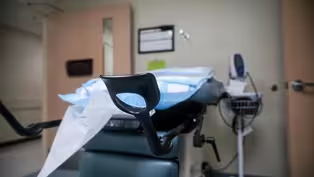
Texas Supreme Court hears arguments clarifying abortion ban
Video has Closed Captions
Group of women sue Texas over abortion law's narrow medical exemptions (7m)
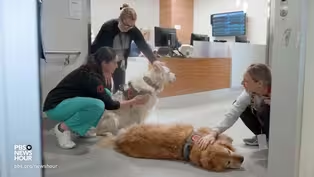
What makes nurses vulnerable to burnout
Video has Closed Captions
What makes nurses vulnerable to burnout and how it impacts the care they provide (8m 22s)
Providing Support for PBS.org
Learn Moreabout PBS online sponsorship
- News and Public Affairs

FRONTLINE is investigative journalism that questions, explains and changes our world.

- News and Public Affairs

Amanpour and Company features conversations with leaders and decision makers.












Support for PBS provided by:
Major corporate funding for the PBS News Hour is provided by BDO, BNSF, Consumer Cellular, American Cruise Lines, and Raymond James. Funding for the PBS NewsHour Weekend is provided by...