
November 29, 2024
11/29/2024 | 55m 47sVideo has Closed Captions
Kholood Khair; Cindy McCain; Saad Mohseni; Jerusalem Demsas
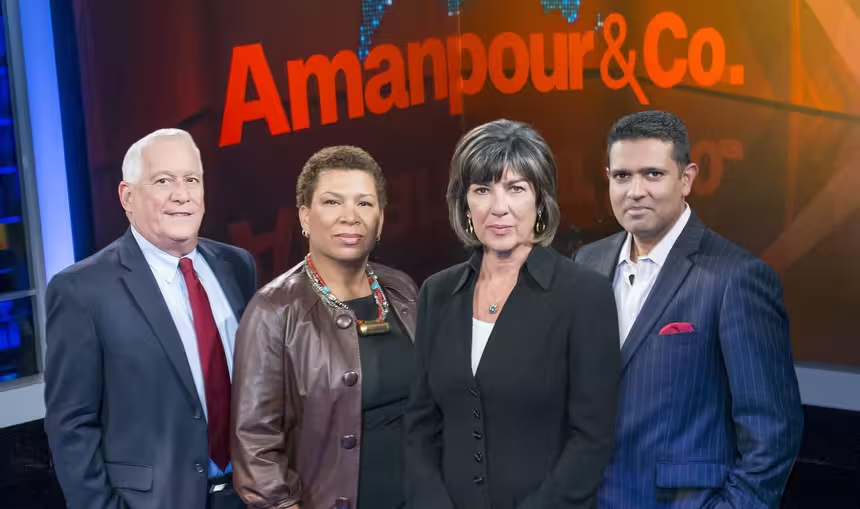
Kholood Khair, a Sudanese journalist, joins the show to shed light on what some call a forgotten crisis in Sudan. Cindy McCain, Director of the World Food Programme, describes the hardship that has spread across Sudan since the outbreak of war. Saad Mohseni on his memoir and the struggle for a free and independent press in Afghanistan. Jerusalem Demsas on the housing crisis in America.
Problems playing video? | Closed Captioning Feedback
Problems playing video? | Closed Captioning Feedback
November 29, 2024
11/29/2024 | 55m 47sVideo has Closed Captions
Kholood Khair, a Sudanese journalist, joins the show to shed light on what some call a forgotten crisis in Sudan. Cindy McCain, Director of the World Food Programme, describes the hardship that has spread across Sudan since the outbreak of war. Saad Mohseni on his memoir and the struggle for a free and independent press in Afghanistan. Jerusalem Demsas on the housing crisis in America.
Problems playing video? | Closed Captioning Feedback
How to Watch Amanpour and Company
Amanpour and Company is available to stream on pbs.org and the free PBS App, available on iPhone, Apple TV, Android TV, Android smartphones, Amazon Fire TV, Amazon Fire Tablet, Roku, Samsung Smart TV, and Vizio.
Watch Amanpour and Company on PBS
PBS and WNET, in collaboration with CNN, launched Amanpour and Company in September 2018. The series features wide-ranging, in-depth conversations with global thought leaders and cultural influencers on issues impacting the world each day, from politics, business, technology and arts, to science and sports.Providing Support for PBS.org
Learn Moreabout PBS online sponsorship(upbeat music) - Hello everyone and welcome to Amanpour & Company.
Here's what's coming up.
- [Reporter] One of the world's worst humanitarian catastrophes.
25 million people in Sudan require urgent aid after more than a year of conflict.
Sudanese analyst Kholood Khair joins me.
And with famine like conditions in the country, leaving millions hungry and desperate, I'll speak to the head of the World Food program, Cindy McCain.
Then... - We are in a way, the canary in the coal mine because as long as we continue, it means that women can say things, they can appear in front of the camera.
- [Reporter] Pushing the boundaries of media in Afghanistan.
Christiane's conversation with the author of, "Radio Free Afghanistan," Saad Mohseni.
Also ahead.
- I think about housing as the fundamental building block of the economy and of people's lives.
- [Reporter] Atlantic staff writer Jerusalem Demsas speaks to Hari Sreenivasan about America's housing shortage.
(upbeat music) - [Narrator] Amanpour & Company is made possible by, the Anderson Family Endowment, Jim Attwood and Leslie Williams, Candace King Weir, the Sylvia and Simon B. Poyta Programming Endowment to Fight Anti-Semitism, the Family Foundation of Layla & Mickey Straus, Mark J. Blechner, the Filomen M. D'Agostino Foundation, Seton J. Melvin, the Peter G. Peterson and Joan Ganz Cooney Fund, Charles Rosenblum, Koo and Patricia Yuen, committed to bridging cultural differences in our communities.
Barbara Hope Zuckerberg, Jeffrey Katz and Beth Rogers, and by contributions to your PBS station from viewers like you.
Thank you.
- Welcome to the program, everyone.
I'm Bianna Golodryga in New York, sitting in for Christiane Amanpour.
Sudan is living through a nightmare and the world needs to wake up and help.
Those words from the head of the World Health Organization who visited the country in the grips of a raging humanitarian crisis, one of the world's worst.
Around 25 million people are in dire need of aid but the WHO says it has less than a quarter of the funding they need to provide it.
The true number is hard to pin down, but anywhere between 15,000 to 150,000 people have been killed since the war broke out between rival generals in early 2023.
Now over 10 million people are displaced, famine is stalking parts of North Darfur, millions are without safe drinking water, and 19 million children are out of school.
Kholood Khair is a Sudanese researcher and political analyst and joins the program live for us.
Kholood, thank you so much for taking the time.
As we note, this is one of the world's worst humanitarian crises.
25 million people, as we note, are in dire need of aid.
10 million people have been displaced a wide range in numbers and figures as to what the actual death toll is.
You describe it as a crisis with no off switch.
Give us a sense of what you are hearing from people on the ground, what they are telling you now over a year into this horrific war.
- I think people recognize that this war has gotten very bad very quickly.
There was no sort of gradual descent.
This war started off in Khartoum and it was the capital that was hit first and hit hardest in a very centralized state.
That means very immediately we started to see the education sector, the health sector, the food supply sector, all of them break down and state collapses happening really right in front of our eyes.
People all recognize that regardless of the politics of this, of what happens between the different armed groups, particularly the Sudanese Armed Forces and the RSF, it is they who are feeling the brunt of this.
They've lost their homes, they've lost their possessions, they've lost their livelihoods, they've lost their dignity.
And there's a very real sense that things will get infinitely worse as starvation sets in in very many areas across the country.
- And what I hear in terms of what can bring this fighting to an end is that neither side feels that they are vulnerable enough in a position to surrender, to end the fighting.
Both sides think they're still in a position to continue to fight and win the battle.
What is the best way, in your view, that this war can come to an end?
What needs to happen?
- Well, Sudan has had many wars of various descriptions and various scales and all of those wars, without exception, have ended in a political settlement.
None have been settled militarily.
And this war is unlikely to be an exception because even though right now the Rapid Support Forces seem stronger, they have much better sophisticated weaponry, they are able to recruit very many people from both within Sudan and across the Sahel and they're able to position themselves very strongly militarily.
But there's no military win here for them.
They don't have a governance plan, they don't have an ability to win hearts and minds.
The Sudan Armed Forces, on the other hand, is also unable to win back as much territory as it's losing.
And so very clearly both of these sides need to then come to some kind of political arrangement.
The fear here is that both of these sides will come up with the similar kind of political and peace agreements that we've seen before.
Basically power sharing, wealth sharing, and will not really address any of the real existing issues in the country or indeed address what people want to see, which is a civilian democratic Sudan.
As this is very much a counter-revolutionary war, the generals are fighting themselves, but they're also fighting the proponents of the revolution.
We can tell that at some point, even if they tire, even if they get into what is called a hurting stalemate, they would much rather make a deal between themselves to maintain some kind of control over the economy and over resources rather than hand over power to a civilian democratic government, which is exactly what the people of Sudan have been calling for since at least 2018.
- And it's been described as we've covered here on this show as a forgotten war.
So much of the world's attention has been focused on the war in Ukraine, on the war in Gaza, and yet we know here the death toll, we don't even have an estimate for the death toll in this crisis.
It's being described as one of the worst in history, though the U.S. has appointed an envoy to the region, and even analysts would argue that the U.S. has done more than other countries at this point.
What more, in your view, can the U.S. alone do right now?
Because we've seen over the last year really an alliance of strange bedfellows supporting both sides.
- Well, Sudan has become something of a carcass where all of these different international actors are picking at it, and most of these international actors are U.S. allies.
So the question here isn't what can the U.S. do alone?
In fact, the very kernel of that question is wrong.
The U.S. cannot do this alone.
It has to work with its allies to mitigate the impact of their allies on this region.
You have Egypt, a very key strategic ally for the U.S. supporting the Sudanese Armed Forces and another key strategic ally, the United Arab Emirates supporting the RSF.
Neither of these have significantly committed to any kind of peace process because they're too busy, effectively looting in the case of the UAE and in the case of Egypt, trying to control and manage the conflict rather than resolve it.
We're seeing this also with the Saudi Arabia and Israel, though it is otherwise engaged, is also implicated in this as are non-US allies like Iran and Russia.
The fear here is that as this war moves increasingly into the proxy like characteristics, it'll be very difficult to move towards a peaceful resolution anytime soon and we could see like Sudan's other wars decades long conflict.
- The UAE has denied its support for the RSF and as you note, the RSF has gained control of the Darfur area and much of Khartoum the capital as well.
And what seems to be a bit puzzling is that among the two, both warring factions have committed numerous war crimes that have been documented.
But specifically the RSF is not popular at all among the Sudanese.
So in terms of envisioning what a day after could look like it appears that there's no likelihood that the Sudanese people would accept an RSF leadership.
- And I think this is very true and I think the RSF is recognizing that without a governance plan, without a campaign to win hearts and minds with the looting that we've seen, with the sexual abuse, that we have rampant sexual abuse, we have seen with the genocidal attacks that we have seen in Darfur and other areas, there's very little chance of them winning.
And this actually makes them winning hearts and minds and this actually makes them very, very dangerous.
It means that they will pursue a sort of position within a ruling system at any cost, mostly to avoid any kind of accountability and transitional justice measures.
So what we have to do here really is instead of seeking a ceasefire, which is where all of the international communities energies have gone, we need to figure out how to make the revolution's call come into, you know, manifest.
Which is that the Sudanese Armed Forces should be reformed and the RSF should be disbanded.
Now, how we do that becomes the question.
I think trying to find peace between them is not going to happen, the conditions for it are not right, that both sides are signaling very strongly that they have no interest in a cease fight that they both see as a military solution.
And so we should be investing in protection of civilians, we should be investing in humanitarian aid to make sure people are alive long enough to see the Sudan that we want to see, and at the same time make sure that we invest in figuring out how to reform the Sudanese Armed Forces and make sure that we get to a stage where we can disband the RSF so they don't continue to wreak havoc in the country.
- We'll talk more with Cindy McCain from the World Food Program about getting that humanitarian assistance where it's needed most, but specifically as it comes to the RSF, we know that they are not following or engaging in any rules of war.
In fact, they're violating them, they're looting hospitals.
It is very difficult to get aid to the people there in the territory that they now hold.
They've also been accused of sexual violence and rape, gender-based violence.
These are weapons of war that they are accused of using in Darfur for some 20 plus years ago.
What more can the African Union do specifically because the African Union at this point has expelled Sudan, but the SAF still holds a seat in representing the country at the UN.
So what can the African Union, if anything, do in terms of doing more?
- Well, the African Union suspended Sudan's membership after the coup in 2021 not since this war began.
I think the African Union has done very, very little in trying to mitigate any of the sort of the fallouts of the war, but also in trying to find a resolution.
Initially it was caught up in this tug of war, if you will, between... With the IGAD Regional group.
And so now it needs to really very quickly that now after it has appointed a panel move very quickly on the protection agenda.
I think that is where the African Union can provide the most value right now.
If they're able to push forward a protection agenda and look at options of deploying protection of civilians, troops, that would actually allow it to play a much more impactful role than trying to figure out some kind of ceasefire between the generals.
So far, many African countries are also implicated in supporting either one side or the other most of them favoring the Rapid Support Forces.
Not out of any love for the RSF necessarily, but because they have a very long history with the Sudanese Armed Forces and they have a lot of baggage there that has gone unresolved.
So the African Union has to move beyond these regional issues and it has to be able to move towards a strategy that actually puts the people of Sudan first and not the generals.
So far we haven't seen any institution, regional or international that has done that.
- What role have we seen specifically Iran play more in this war?
Who are they helping at this point?
- They're very numerous incredible reports that the Iranians are supporting the Sudanese Armed Forces.
The Iran wants a position on the Red Sea, it wants some kind of presence on the Red Sea.
Right now it has some presence with the Houthis in the southern eastern part of the Red Sea, and it would like very much place more northwards on the Western Bank of the Red Sea.
And because of that, they very much want to engage with the Sudanese Armed Forces, a group that they have had a long history with since at least the Iranian Revolution in 1979.
And so they're very much backing the Sudanese Armed Forces.
Now, they, the Sudanese Armed Forces say that they're not engaging with Iran.
They know that this puts off the Americans, they know that this puts off the Israelis, but they are in a position with so few friends in the region.
So few friends they can rely on to really engage with whomever they can, Iran, Russia, et cetera.
And the Iranians recently have been found by reports from Human Rights Watch to be supplying the Muhajir 6 drones, quite sophisticated drones to the Sudan Armed Forces as earlier as sort of earlier this year.
This support looks likely to continue even if the Sudanese Armed Forces aren't able to grant Iran a port or some kind of military base on the Red Sea.
And we're also starting to see the proxy elements of this sort of Iran supporting SAF versus the UAE supporting the RSF really take primacy in this war.
- Yeah, as you note, Sudan has a 500 mile border on the Red Sea, making it strategically vital in that region.
Kholood, in terms of what the future may look like, can you paint any picture of somewhat optimism that you foresee in the months and years to come?
- I think those of us who watch Sudan pretty closely, who have family there, who have friends there, they know there's a lot of developments on a daily basis that are actually quite depressing and it can be quite a difficult sort of set of developments to contend with.
The one bright spot has been the way that communities have grouped together to provide support for each other, to provide sort of humanitarian corridors for each other, to provide food.
Food kitchens have been set up all across the country, particularly in urban areas, and they have been a lifeline for people.
And Sudanese people have basically because as you say, this war has been forgotten by many people around the world have relied on themselves.
Now, I don't think that should continue as much as possible the world needs to know that it is concerned with the future of Sudanese people, but in many ways it is the Sudanese people that are doing this themselves.
And by providing for each other in the vacuum of humanitarian support, they are weaving together the social fabric that is being ripped apart by this war, especially along ethnic lines, especially along regional lines, and really recreating those human... Those community ties that would've otherwise really made this a much more difficult war to go through for those on the ground.
- All right.
KhoLood Khair, thank you so much for your time, for your expertise.
We will continue to cover this war and make sure it is not forgotten.
- Thank you.
- We appreciate the time.
Well, the UN says that Sudan is the world's largest hunger crisis and the head of the World Food Program, Cindy McCain, says that they urgently need better access to those at risk of starvation and more money calling it nearly a forgotten crisis.
Cindy McCain joins us now from Rome and welcome to the program, Cindy.
It is... - Thank you.
- It is disheartening to continue to refer to this as a forgotten war, a forgotten crisis.
But just judging by these figures, 25 million people now facing acute hunger, it's very difficult to get aid where it needs to be.
That is really a bleak but honest assessment of where things stand now a year over, a year into this war, the worst situation is in the Zamzam camp home to some 400,000 displaced people.
Would you agree with the assessment right now and what more can the world, the WFP do to address this as soon as possible?
- Well, I certainly agree with the assessment and I think it's even worse than that.
We have not had unfettered and clean and secure access into Sudan.
As you know, Audrey Gate is open and so is Tenae but it's inconsistent and we also are facing a climate change issue with regards to rains and flooding.
So it's been very difficult for any of our trucks to get all the way through, especially to Zamzam and other places because the roads are washed out, the bridges are down and so we're left with doing the very best that we can but under incredible circumstances, we have not had access until just recently.
Let's be very clear about that.
And that's something that the United Nations and all of the agencies that are working and trying to get into Sudan need to have.
And it also needs to be safe and unfettered and with respect to humanitarian law.
- [Bianna] And we know that that isn't the current situation.
It is not safe and it's not unfettered and it's not in... Aligns with humanitarian law at this point.
Does the World Food Program have an estimate as to how many people have died thus far from famine alone?
Because some of these estimates are quite shocking, two and a half million people even.
- I think right now it would be...
It wouldn't be the right thing to give an estimate it's a lot because we can't have access.
We haven't been able to get in there to actually do the tallies and find out what exactly the numbers could represent.
We do know 25 million people are at risk here, as you know, across the borders in Chad, South Sudan and other countries in the region they've absorbed almost 2 million people now and they're doing their very best to make sure that those people are fed but those countries are stressed also.
So the bottom line is here we need the access, we need to get in now and we need just like what your previous guest said, we need political help to make sure we can help this crisis end so that we can get in and feed and save a generation of children who are starving to death.
- What are some of the biggest challenges in parts of the country that are most difficult to get aid into right now?
- Well, again, climate change with the flooding and the weather, of course, we've had the various factions on the roads.
They'll take and hold our trucks up for weeks at a time.
If we can get through, we can't make it all the way to the end.
We have near...
Right now we have nearly 40 trucks on the road and only two have made it to where they need to be going.
So I mean, this is what we're up against.
So we should have been able to have gotten in earlier, prior to the rains that way we wouldn't be in this situation like this.
But nevertheless, here we are and we need the world to pay attention to this, not only with their finances but also with political solutions so that this war ends and we can feed people.
- Throughout the course of this war, every expert that we've spoken with that is familiar with the region has come back with just haunting stories, personal stories about the impact this has had on the Sudanese people.
I'm wondering if there's anything in particular that has stood out to you about those innocent people that have been caught up in this horrific war?
- Well, they're not there because they wanna be and because this is such a drastic situation, many of them are gonna be faced with migration.
Is the days that I think I wake up and I think, "How am I gonna feed these people today?"
I will have to make the choice to take food from the hungry to give to the starving.
That's the kind of situation we're in right now as a humanitarian agency and as UN agencies on a whole too.
So though it breaks my heart just to not be able to make the decisions and be able to feed the way I should feed.
- We mentioned that both warring factions and sides have been accused of committing war crimes.
The RSF in particular though, has been reported to make things very difficult, very dangerous for aid workers to get in.
They have been...
There have been reports of storming and looting of hospitals, for example.
How concerned are you about your workers, the people there that are trying their best to provide aid to people who need it most?
- Well, I'm very worried as you know there are close to 20 maybe more, I've actually lost track of the number of UN aid workers that are being held hostage.
One of them is a WFP worker.
Things are very dangerous there.
And so that's why we do need these political solutions and we need our various countries to come in the countries that Sudan will listen to and be able to negotiate with if this is a catastrophe and it's not just for the country of Sudan, it's a regional catastrophe that could have great implications with Europe and other parts of the world because of the migration aspect to it.
So this is not all about food, it's also about the stability of the region.
- Yeah, and there's also concern about disease as well.
You mentioned the floodings there, outbreak of disease, especially cholera is a big concern.
We recently saw what has been deemed a successful campaign in Gaza for a pause in the fighting to vaccinate children in that enclave.
And the WHO says that they believe that 90% of the estimated children there, they'd hope to immunize, have in fact been immunized at least in the first stage.
I'm wondering if there's anything you're optimistic about or think you can learn from that campaign and use in Sudan as well?
- Well, again, safe access.
In the case of Gaza we have been able to get some of our trucks in as you know, to carry the polio vaccines.
But let me say, as you know, WFP workers were attacked not only in a car.
They were shot bullets, hit 10 times into the car, didn't kill anybody, thank God.
And also an airstrike took out the top floor of our guest house.
Humanitarian aid workers are being targeted, targeted, respect for humanitarian law no longer exists.
We have to change that.
Otherwise, I can't in good conscience leave my people in a country where it is totally unsafe and not be able to at least guarantee their safety and give them the option to get out.
And I don't wanna have to do that, but I may have to.
- Are you saying, I mean, I wanna...
If we can just spend more time on that does that give you pause or are you concerned now about the responsibility you bear in sending people into these war zones to provide this aid given what we've seen transpire?
- Well, this is our job.
This is who we are, we're humanitarians and we work in the toughest spots.
But of course it is, ultimately I am responsible and so I have to make the tough decisions.
And if it looks like we can't handle our mandate and can't do the job that we're sending there to do at scale we may have to consider pulling out, but I don't wanna do that.
And I'm not suggesting I'm going to do it right away.
But I just want you to know that's how dangerous this is.
- No doubt.
Are you in contact with either officials from either warring factions, the SAF or RSF when it comes to finding an opportunity to make the delivery of aid as safe as possible in Sudan?
- Our people are, yes, on the ground.
We have some people that work on the ground, but it's been very difficult because we've been restricted as to where we could go.
So we have had our folks in Port Sudan dealing with the various faction and of course with the various politicos that are in there.
And I have great hope.
I mean, there I do have a little bit of hope that people are reasonable and will eventually be able to figure out what they need to be doing for their own country and for their people before they starve to death.
- Cindy, you've talked about this before, this notion of donor fatigue.
We have multiple hot wars going on around the world, sadly.
The U.S. has appointed an envoy to Sudan, obviously much more can be done and is needed to be done to address this war and the humanitarian aid that's needed in the country.
But what is your message to those that are watching right now that may feel terrible about what's happening, but may also question about where their money may go and maybe even experiencing some of that donor fatigue?
- Well, there has been donor fatigue, not just with WFP, but all across the board.
If we don't pay attention to this crisis that's going on and if we let it go or leave it to others who are not engaged, this will be a full-blown catastrophe that can affect the world.
This is the largest hunger crisis on the planet and could be the largest one ever in history.
So we have to pay attention and we as humanitarians pay very close attention to the fact that we not only how we can get in, when we can get in, but most importantly that we can get in.
And that's what I'm asking the international community to please do for us, please work politically, work behind the scenes, however it works, but help get us in at scale, please.
- Yeah, the last thing we wanna do is repeat history as the economist notes, it's almost certain to be as bad or at worse even than the crisis that afflicted Ethiopia in the 1980s.
Cindy McCain, thank you so much for joining us.
Thank you for the work that you're doing, and thank you for your time.
- Thank you.
- Well, this week mark's 23 years since the 9/11 attacks and America's subsequent invasion of Afghanistan.
Following the overthrow of the Taliban, Afghanistan opened up, many Afghans returned and helped rebuild their country.
Among them was Saad Mohseni, who created a media company that pushed the boundaries of what people in Afghanistan saw and heard on both television and radio.
Even now, after the Taliban's return, his company continues to bravely report from inside the country.
Christiane spoke with Mohseni about his memoir and the struggle for a free and independent press in Afghanistan.
- Saad Mohseni, welcome back to the program.
So you have just written this wonderful book, 'Radio Free Afghanistan.'
Is Afghanistan free, is the radio free?
- Relatively speaking, yes.
Not as free as it was, but you know, we still have an important role to play in the country.
As a matter of fact, I started writing this book assuming we will not be in Afghanistan.
And it was a sort of a cathartic experience for me.
- We being your media company?
- Well, I mean, we sat together and we said we may not have a TV station, we may not have a radio station.
So let's tell the story of what we did in 2002, expecting not to have anything in 2024.
We still do.
You've been there, you've seen it.
We're still plugging away, but surprisingly it's not as good as it used to be.
Let's put it this way.
- It's not surprising, right?
Because it's now fully obvious that this is Taliban 101 when it comes to freedom of expression, when it comes to any kind of women and girls rights.
This is Taliban 101.
- Well, yes and no.
I think it's a little bit more nuanced than that in terms of decrees and directives, yes, it's the same Taliban.
In terms of implementation and execution, it's a little different.
But there has to be a convergence at some stage.
One has to catch up with the other.
Either they have to loosen the decrees and directives or in terms of implementation, they go full on.
- So let's just dive into this in a slight order.
So basically 2001 9/11 happened.
This has been commemorated 23 years later as we speak this week.
The U.S. and its allies come and they get rid of, in very short order, Al-Qaeda and their Taliban backers in Afghanistan.
And to people like yourself who see this amazing opportunity, you come and create this incredible media company and bring product to Afghanistan that they've never seen, at least not in decades.
What did you think would happen?
What did you think would be the future of your operation television, you know, all the stuff that you brought to Afghanistan back, what did you think would be the long lasting effect of it?
- I mean, it was sort of an accidental business.
We set up this radio station, not really expecting it to succeed.
It succeeded, - What was it called?
- It was called Arman.
- And that means - Arman means hope.
So we set up Arman and then a TV station followed, the second TV station followed.
And lo and behold, we had a dozen media platforms in the country.
So it was very organic in the way that the business grew.
But I think what was extraordinary was how the people also changed.
The population has doubled in 20 odd years and the median age is still like 18.
It's the youngest country outside of Sub-Saharan Africa.
So my hope is, you know, we talk about the Taliban, but the country is a changed country since the mid 1990s.
And my mom was just in Kabul and she pointed out that, for example, when you arrive, the government officials, you stamp your passports are all ladies, for example.
So the conduct of the Taliban today in 2024 is quite different to 2021 that they're more accepting of this changed Afghanistan.
But I mean, I'm not saying that it's gonna last, but nonetheless I think the Taliban are dealing with a very changed country.
- Okay, so let's just try to pick through that, because on the one hand there was this edict as soon as they came in... Well, first everybody thought it was gonna be new touchy feely Taliban for the 2020s.
Clearly it wasn't.
But as you say, the place has changed, history has moved on.
They did bring down edicts that women should not be in the public space, should not be working.
And yet, as you say, the immigration stampers are women.
They did say when I was there in your news organization, in your actual newsroom, that women, that very day the edict came down, that women had to now start to mask themselves after 20 years of freedom on the air.
They then allowed women to speak publicly.
And now the latest edict is even a woman's voice cannot be heard publicly.
So I don't know how that affects your anchors and reporters, but is there a contradiction?
- Well, the anchors continue.
They're reporting on issues, they're presenting programs.
They're producing, they're in front of the camera.
They're behind the camera.
So that continues for now.
So I think that the challenge is, you've met some of the "pragmatists" I wouldn't call 'em all.
- You mean the leaders?
- The leaders like Amani.
- And others, their views differ from the leadership, but- - You mean the religious leadership- - Well, the leadership in Kandahar who imposing these very draconian decrees, but at some stage they need to step up because they keep on telling people behind the scenes where different, this is a change in Afghanistan, the Taliban government it's gonna reflect the new Afghanistan.
But in reality, all these decrees, which are being introduced on a weekly basis, contradict that.
But something has to give.
- I wanna play a little soundbite because it's kind of heartbreaking.
I did this amazing report from the newsroom on that day.
And the girls, the women were so determined.
They were sad, they were scared, but determined.
Your male, their male colleagues went in solidarity with them on the air, put a mask over their face.
The male, you know, the news director was incredible and a huge amount of support.
But there was fear.
This is Khatera one of the anchors.
This is what she told me.
- It's not clear even if we appear with the burqa maybe they will say that women's voices are forbidden.
They want women to be removed from the screen.
They are afraid of an educated woman.
- That was about two years ago.
And she was right.
She was right.
They're afraid or they hate women or whatever it is, but they have constantly encroached on that space.
- Absolutely.
Well, we are in a way the canary in the coal mine because as long as we continue, it means that women can say things, they can appear in front of the camera.
For how long, I'm not too sure, but I know that this particular, this last degrees has been quite controversial even amongst the Taliban and discussions I've had with them is that please continue.
It's gotta be business as usual.
- They say that to you.
- They've said that to me and my colleagues in Kabul, I mean senior people, so we'll see.
- So, they're kind of defying the molars of Kandahar.
- For now.
It's not a monolithic movement and yet they abide by the leadership.
But as I said, something has to give.
- And what will it be?
- I'm not sure.
- Let's go back a little bit to your story.
Your family left when the Soviets invaded in- - Before that.
- Okay.
- We left in '78.
My father was posted to Tokyo.
He was a diplomat.
So we moved in '78 and then the Russians invaded and we stayed in Japan for two years and then we immigrated to Australia.
- Did you ever think you'd go back to Afghanistan?
- I think we always did, yes.
- So when you came back after 9/11, what were your feelings?
What were your thoughts about what was possible?
Firstly, why did you choose media?
And secondly, tell our audience, remind us, you know, you did Afghan star, you had reality shows with Mollahs, with the religious and stuff like that.
You did try to bring them together.
- Yeah, I mean we... Well, we were very enthusiastic, obviously we wanted to do all of the above.
So we did sports and reality shows, music shows, soap operas, all of those things.
And the important thing for us was to build capacity to let Afghans produce these programs, which I think we were quite good at.
And media has been one of Afghanistan's great success stories.
- I think the international community is completely at a loss as to how to deal with the Taliban, you know, correct statements about the unacceptability of a gender apartheid, as many activists are calling it of a misogynistic.
It's the worst place in the world for women right now.
It's the only place where actual high school girls cannot go to school.
It's the only place in the world, certainly the only place in the Islamic world.
And so what is your view of how the world should try to influence, because nothing has worked yet.
You yourself don't go back, right?
Because you don't wanna legitimize them.
- Well to, yeah, partially, yes.
- But you think governments should what?
- I think they should engage for a number of reasons.
Firstly, because I think that there different personalities on the ground who are willing to engage and men in their thirties and forties who can actually bring about this change we're talking about.
And I think we have to see the Taliban change from within.
That's the best hope for Afghanistan.
- You think it's possible?
- Well, I think two things have become clear.
The sanctions and the current approach to Afghanistan has not worked.
And for now at least it seems that Taliban are here to stay.
So a slightly different approach may be needed.
But the other important thing is Afghanistan is on the verge of collapse basically.
This humanitarian crisis is a serious one.
Something like 20 odd million people basically don't have enough food.
A third of the country, they don't have proper housing.
And we've got this winter around the corner.
And because of El Nina, it's meant to be a very cold winter.
So malnourishment, I mean, if you look at every single, the UN list of everything that could possibly go wrong in the country it's going wrong.
So the world needs to engage first and foremost for the sake of the Afghan population in terms of basic needs, helping with food security, with livelihoods, making the economy more resilient.
But I think it's not a bad idea also to engage with the Taliban to make them understand in terms of what they need to do.
Because I think for them legitimacy is also important.
- Can I ask you just to sum up, you've written this book, what is it 'cause we can't get to every chapter and every line in this interview.
What is it that you want to tell readers, viewers, the world about your country?
- Well, it's a wonderful country.
Warm people.
It's an exciting place.
And I tell the story of all the different characters that made the media business possible for us in Afghanistan.
It's as much as their story as it is my story.
- And that is very vibrant.
I mean, I was amazed to see how a generation of journalists took to this free media opportunity in a very rigorous way.
- And they're still doing it.
- That's good, that's a good note to end on.
Saad Mohseni, thank you so much.
- Thank you.
- We turn now to an issue that took center stage at this week's presidential debate, and which our next guest describes as a national tragedy.
That is the housing market in America.
Atlantic staff writer Jerusalem Demsas has covered this at length, including in her new book 'On the Housing Crisis: Land Development Democracy.'
She sit down with Hari Sreenivasan to discuss why it's so difficult to find an affordable home.
- Bianna, thanks.
Jerusalem Demsas, thanks so much for joining us.
You watched the presidential debate, I'm sure recently the first question up out of the bat, out of the box was about the housing crisis.
You write about the housing crisis and have been for quite some time for the Atlantic.
What went through your mind?
- It's just remarkable to see this take such center stage at the debate.
I mean, the first question wasn't even about the housing crisis and yet vice presidential... Vice President Kamala Harris and Democratic nominee for president, I mean, her right out the gate, her answer is about housing.
And I think that that's something that many people who have followed this space would not have expected.
- You call the housing crisis in America a national tragedy.
Why?
- I think about housing as the fundamental building block of the economy and of people's lives.
When someone thinks about how they wanna make their life work, when they think about the kids they wanna have, they wanna think about if they wanna be close to their friends or family.
When they think about the types of jobs that give them dignity, meaning that pay them well, all of those things are predicated on the idea that there will be a home available waiting for them if they to move.
Americans move a lot.
I mean, one study showed that Americans move on average 12 times over 12 times over the course of their life.
We move when we're kids to different school districts to get a better education.
We move to go to college.
Some of us, we move for different jobs.
We move when we get married, we move in with different partners.
There's lots of times where we have expectations that in order to make our lives work, there will be housing that we can afford and fits with what we need.
And when that's taken away, when that's not available, it really undermines the quality of life that people are looking to create.
- Give us some scale or some perspective on how bad the crisis is.
What kind of statistics leap out at you that you think people might not be as aware of?
- The core statistic I look at is this idea around a housing shortage, right?
Right now we have multiple estimates that put that number at around 4 million homes.
To put that into context, the last time we saw a number like that was after World War II, when the vets were returning home.
And we hadn't built since before the Great Depression at any scale at all.
That's the kind of crisis we're confronting right now.
But at the very human level, most people watching this have themselves probably seen the housing crisis in their own lives.
They've seen it in family members who have been unable to live near their parents when they have kids.
They have seen it in their own lives as young people trying to move out of the parent's house and start their own life fresh.
They've seen it with seniors who have been trying to downsize, but remain in their communities.
And all of these ways you see the housing crisis is really impacting people on a very human level.
- Let's kind of take a step back.
How did we get to the situation where there is such a lopsided gap in the amount of housing available versus what's necessary?
- You know, the housing shortage in the post World War II era in the immediate aftermath, the answer is pretty simple.
We don't have enough housing, we need to build more housing.
- Sure.
- We built out the suburbs, this is what baby boomers refer to as kind of the big wealth creation of their lives is the creation of all of these homes that they're able to buy into and get access to and begin jumping on that equity and home ownership ladder.
But at a some point, you kind of build out the suburbs that are available and what people want is they want more housing closer to the urban core because they wanna be able to commute to work.
And so what we see happening is instead of accommodating that new growth, instead of building more densely, instead of building these smaller starter homes and single family homes, smaller starter homes and multifamily homes that can accommodate lower income and middle income Americans, we've stopped allowing that sort of building to happen.
And so it's really a very simple economics 101 problem where we need more housing, we're creating a lot of good jobs in America.
We have them in a bunch of our urban centers.
Places like San Francisco, Seattle, Washington D.C., Boston, Nashville, Austin, Miami.
These cities are producing jobs at really, really high rates.
But when people show up, there's not building at the rates necessary to accommodate them.
And that opposition has largely come from local governments that have been loathed to allow the kind of change necessary in order to accommodate that change in growth.
- So let's talk a little bit about, look, if it's economics 101 supply and demand, theoretically even out because the market solves for it.
If there are not enough houses, one would think that builders would rush to build more houses so they can sell it to consumers who want them, right?
What are the stumbling blocks?
- Developers are chomping at the bit to build, whether it's private market developers, but also I talk to affordable housing developers who are really, really wanting to build, they see this demand, they want to be able to do this, and often they have the money to be able to do this, but the laws make it very difficult to do so.
And to give you an example, starter homes are often thought to be around 1500 square feet.
That's the size of starter home that baby boomers were used to buying into for their first house.
Now that kind of house is illegal to build in the vast majority of residential land in this country.
You cannot just go as a builder, buy some property, some land, and decide you're going to build a bunch of small starter homes.
It's illegal.
Many places you'll have to build something that's at least 5,000 square feet, maybe even 10,000 square feet in some parts of this country.
How is their knowledge be built on smaller than one acre of land?
When you create those kinds of regulations at the local level that make it impossible to build smaller houses, you're basically outlawing affordable housing that can be bought by people who are making a middle income salary, even if they're working two jobs.
And that's why we see home prices going from an average of $300,000 across the country to 700,000 in some places and even a million in other places.
That's not natural.
Developers are motivated by a private market instinct to make a lot of money, and they're being constrained from being able to chop up this land into smaller pieces by local governments that are often hostile to that kind of building.
- You mentioned the average size of a starter home, and it also makes me wonder, I mean, sometimes starter homes are just the right fit for kind of not just your first house, but also your last house.
But what about sort of seniors in communities that are kind of locked into where they're living now, but they can't really downsize because that kind of house isn't around for them?
- Yeah, this is some of the sad stories I've heard about the housing crisis have come from seniors who have been locked in place.
So there are a lot of seniors, I mean, as they get older, a lot of people are unable to use the stairs the way they would or it becomes much more difficult for them to do so.
It literally becomes unusable for them to be in their own home.
But then they have to make the very difficult choice of saying, do I stay in this house where it's literally inaccessible for me to use the facilities I need or do I have to leave my community?
Because when they look around their neighborhoods, there aren't the homes available to them that would actually meet their needs.
It's really, really devastating for someone kind of nearing the end of their life to have to move out of their community that they're familiar with, that they're comfortable in, and maybe have to even early on in their life, much earlier than they expected, move into a residential facility.
And that can actually end up shortening your life or really impeding how you wanted it to go.
And so it's really interesting to see AARP get involved in pro housing legislation as a result of this.
- How much, when you mention the phrase affordable housing in conversations about real estate and about communities, that seems to sort of trigger other kinds of impressions right away for people.
And how much I wonder, are these policies from these local communities really a version of class segregation?
- Yes, that's a really good question.
So zoning regulations, and that's kind of the class of regulations I've been talking about.
So these are regulations that determine what sorts of things you're allowed to do with land, how big you can build a house, how much you can cut it down, whether you can have a two story house.
All of these things are under the banner of zoning regulations.
So these regulations are created in the 1910s after the Supreme Court rules that it is illegal to explicitly zone areas based on race.
So you can no longer just say, here's the area for the Black people, here's the area for Chinese people, here's the area for white people.
You're not allowed to do that.
And so cities are very innovative, racists are very innovative.
And so what they do is they decide they're just going to create a facially, racially neutral policy, which is to say, well, we're not gonna say no Black people can live here.
We're just gonna say the only types of houses that can exist here are ones that are affordable to millionaires.
And what that does in a country that has created a bunch of set class segregation is of course defacto means that it becomes racially segregated.
Over the course of the 20th century, we see a bunch of different developments that make it possible for people of color to also achieve wealth.
So you do see, of course, Black, Asian-American, Latino-American people able to buy into these neighborhoods, but they don't actually break down the class barriers.
So right now, middle income people, people who are just starting out in life, people who were used to being serviced by the private market and not needing government assistance in order to afford housing no longer can do so in our most productive cities and suburbs in America.
- So there's supposed to be a feedback loop from local communities where if we don't like the laws, we can change them, right?
Why is that not working?
If there is such a pressing need in different communities, why aren't people able to go to the polls, so to speak, put up ballot initiatives or measures, go to city hall and change things?
- Yeah, I mean, I think there are a few different reasons for this.
I think the first reason is that there's often a disconnect to people between new buildings that are being constructed and the impact that they have on the broader housing market.
So it can be hard to tell from your own personal perspective, why is it that if a developer can't build a few more houses on smaller lots of land, how does that affect my life?
But what we know from economic research is that it's really clear that when new homes are constrained, then rich people begin to occupy cheaper homes.
I think the clearest place where this is most evident to people is places like New York City where you see people who are making well into the six figures living in houses that are tiny, dilapidated.
Often they're living in places that are fire unsafe.
They don't actually, they don't up to code.
And a lot of places in the country would expect to have up to code.
And the reason for that is because when you stop building enough, rich people still get the housing that they want.
They just... Or rich people still get housing, but everyone else is then pushed into worse and worse units.
But the other reason I think is the democratic problem.
So what we have in this country is the fact that most of the power around housing, around land is at the local level, but Americans as democratic, and by that I mean small be democratic animals are not local political thinkers anymore.
We don't engage in local politics, we don't vote there.
But even if we did, it's a real problem because how would you even as an expert in this field really know who to blame?
Do you blame your local city council member?
Do you blame your mayor, your zoning commissioner, your historic preservation board?
Do you blame the county?
It's actually becomes a situation where there's so many different layers of government all responsible for different overlapping issues that it becomes difficult to have any kind of democratic accountability.
And I think that's really ties into why you see so much energy at the national level finally on trying to solve this issue because this is a place where Americans pay attention.
- How much of it comes down to our sort of personal preferences when push comes to shove?
Look, I wanna have a good hospital nearby, but maybe I don't want the sound of the ambulances, right?
I'm for drug rehab centers, I just don't necessarily need it down the block from me where people could be walking back and forth with drug paraphernalia.
I mean, the sort of not in my backyard portion of this.
How big is that in the hurdles to getting better housing policy?
- Yeah, so not in my backyard or NIMBY as you brought up is a real problem because it is very, very difficult for people when they're to ask, "Hey, do you want there to be homeless shelters?"
They're like, yes, there should be a homeless shelter.
And then you ask them, well, should it be sited a couple blocks from your home?
And they're like, "No, I prefer it's not gonna be there."
And if every single community behaves that exact same way then that means no homeless shelters ever get built.
And you see problems like in Los Angeles where they approve over a billion dollars for affordable housing construction in order to get homelessness off the streets, but they can't cite that affordable housing at all because no one will accept that.
And you have mass homelessness on the streets creating huge problems both for the people who are experiencing homelessness, but for the city at large as well.
And so it's a really big problem, but I think often we can focus too much on individual people's viewpoints about where they want stuff to be cited and not enough on the institutional factors that are creating the problem.
All around the world you have people who would prefer not to have homeless shelters or drug rehabilitation centers or apartment buildings built near them.
But in America we've created different system of localism and decentralization that makes it really, really hard for governments to balance a bunch of interests.
When you devolve authority to tens of thousands of local governments, no one can do that balancing.
No one can say, here's where development should occur, here's where we should constrain development.
It's just a bunch of different entities saying no.
- There was a recent Pew Charitable Trust poll that said almost 9 in 10 Americans would like to figure out ways to expedite the permitting process, right?
So why are we not seeing kind of more movement on the legislative front at the state level or in the federal level?
- I think it can be very, very difficult to, because it's not a partisan issue, right?
At the state and local level, usually partisan issues are actually the easiest things to get done because you often see partisan control of these state houses and of these governor mansions.
But because this issue really breaks up the coalition, there are Republicans in favor and opposed, there are Democrats in favor and opposed, essentially no major bill on pro housing issues has been passed without bipartisan support because you simply need to get all the support you can muster.
The difficult politics of this are often because we've only just now recently begun addressing the role of these regulations to these elected officials, but we are seeing increased attention.
States like Montana, like Oregon, like Washington, California, Arizona, Texas, Florida, this is a very wide range of political ideologies.
All of these states have begun passing pro housing legislation.
Colorado, where Jared Polis is the governor has been a leader on this.
It's a purple state there too.
So seeing that kind of coalition building in a bunch of different state houses, a bunch of different ideologies shows the promise of this sort of approach.
But it's a big hurdle when you're 4 million homes behind, you can make a lot of progress without actually getting all the benefits you need to really reduce the pain.
- During the DNC, President Barack Obama during a speech says, "If we wanna make it easier for more young people to buy a home, we need to build more units in clear ways.
Some of the outdated laws and regulations that made it harder to build homes for working people in this country."
You tweeted how surprised you were by that.
- Yeah, so former President Barack Obama, when he was in office in his second term, he's a very wonky guy, a very technocratic guy as we all remember.
And so this has been a conversation, this conversation about these regulations about local governments and their responsibility for the housing crisis has been something that academics and experts have known for a long time.
And so I'm not surprised personally that Barack Obama knows this, but what I am surprised about and was excited and invigorated about is that now finally people at the national level are willing to take on the difficult politics of this issue in order to try and help solve this crisis.
If you talk to political scientists or law professors from a decade ago, they would just tell you that this is an intractable problem.
That Americans are just going to continue to have higher and higher home prices, higher and higher rents, and all the problems that come downstream of that, because it's too difficult to handle the political breakdown at the local level.
I mean, this is like one of the third rails of state and local politics alongside things like property tax reform.
And so because of that, seeing Barack Obama and also Democratic nominee for president, Kamala Harris, both in her own speech at the DNC and then in ensuing ads and in the debate that we just watched with former President Donald Trump, seeing that before grounded and the willingness to take on this thorny issue really showcases how far we've come and showcases how acute the pain has gotten for the American people that there's no choice but to take on the difficult politics here.
- Her new book is called 'On the Housing Crisis, Land Development and Democracy.'
You can see Jerusalem's essays there.
Thanks so much for joining us.
- Thank you.
- And finally, for us, if the housing crisis is demoralizing, here's a story that could make your commute more fun, at least.
Formula one star Orlando Norris took a life-sized Lego car for a spin around the Silverstone Circuit, one of the world's premier Grand Prix racing tracks.
He was driving a replica of his usual ride, a McLaren P1 Supercar.
The Lego racer featured more than 300,000 Lego technic elements, and it took a team of experts over 8,000 hours to build.
Thank you for watching Amanpour & Company on PBS.
Join us again next week.

- News and Public Affairs

Top journalists deliver compelling original analysis of the hour's headlines.

- News and Public Affairs

FRONTLINE is investigative journalism that questions, explains and changes our world.












Support for PBS provided by: