Vermont This Week
November 29, 2024
11/26/2024 | 26m 46sVideo has Closed Captions
Animal Shelter Special
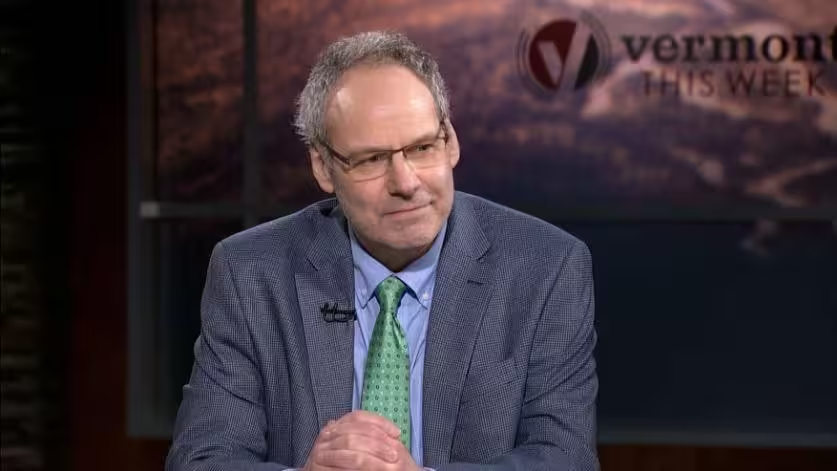
Animal Shelter Special | Panel: Mitch Wertlieb - Moderator, Vermont Public; Erika Holm - Co-Executive Director, Central Vermont Humane Society & Chair, VT Animal Cruelty Board; Krista Malaney - Executive Director, Homeward Bound; Emily Hecker - Director of Development, Humane Society of Chittenden County.
Problems playing video? | Closed Captioning Feedback
Problems playing video? | Closed Captioning Feedback
Vermont This Week is a local public television program presented by Vermont Public
Sponsored in part by Lintilhac Foundation and Milne Travel.
Support provided by:


Vermont This Week
November 29, 2024
11/26/2024 | 26m 46sVideo has Closed Captions
Animal Shelter Special | Panel: Mitch Wertlieb - Moderator, Vermont Public; Erika Holm - Co-Executive Director, Central Vermont Humane Society & Chair, VT Animal Cruelty Board; Krista Malaney - Executive Director, Homeward Bound; Emily Hecker - Director of Development, Humane Society of Chittenden County.
Problems playing video? | Closed Captioning Feedback
How to Watch Vermont This Week
Vermont This Week is available to stream on pbs.org and the free PBS App, available on iPhone, Apple TV, Android TV, Android smartphones, Amazon Fire TV, Amazon Fire Tablet, Roku, Samsung Smart TV, and Vizio.
Support the crew
Help Mitch keep the conversations going as a member of Vermont Public. Join us today and support independent journalism.Providing Support for PBS.org
Learn Moreabout PBS online sponsorshipAnimal shelters throughout the state are fundamental to the communities they serve.
Providing care to animals in need and supporting the human animal bond through advocacy, education, and adoption.
On a special edition of Vermont this week, we sit down with representatives from three Vermont shelters to hear about the challenges they're facing and how you can help.
That's ahead on Vermont this week.
From the Vermont public Studio in Winooski.
This is Vermont this week, made possible in part by the Lintilhac Foundation and Milne Travel.
Here's moderator Mitch Wertlieb.
Thanks so much for being with us.
I'm Mitch Wertlieb.
It's Friday, November 29th and joining us for our special panel today.
We have Erika Holm, co Executive director of the Central Vermont Humane Society and chair of the Vermont Animal Cruelty Board.
Also, Krista Malaney, executive director at Homeward Bound, Addison County's Humane Society and Emily Hecker, director of development at the Humane Society of Chittenden County.
Thank you all so much for being here.
I am really excited about the show and yes, off the top I have to show off.
I have been waiting forever to have an excuse to wear this particular tie.
This is a special tie I hope you can all see this year with its dogs on the front.
So thank you all for giving me this perfect excuse to wear this tie for today's show, because we're going to be talking about not just dogs, but animals, pets, things that people love.
And they're just so important.
As I said at the top to that human animal bond that we have, you know, we have seen reports in Vermont really around the whole country, about increases in animals being relinquished to shelters.
A number of shelters are struggling to meet the demand here.
And I wonder if I'm going to open this up to all of you.
But we'll start with you.
Emily has your shelter in Chittenden County seen an increase in the number of animals that you're caring for.
And tell me a little bit about the factors that are contributing to that increase.
If there is one.
Yeah.
So in 2024, we have seen an increase in, requests to surrender animals to our shelter.
There are often many factors that go into making a decision, like giving up your pet to a shelter.
So it's hard to pinpoint exactly one reason.
I think it's multiple reasons.
You know, anecdotally, people have mentioned housing and financial issues.
One thing is certain, though, the animals coming into our shelter have more behavioral and medical needs than we've ever seen before.
And so I think it's a pretty safe assumption to, to say that animals that come into our care, are coming in because their owners might not be able to afford their medical care.
That's pretty tough.
I mean, tell us a little bit more about that.
Krista.
Have you seen an increase in this as well?
And how do you deal with some of those challenges?
Emily was just talking about?
Yeah, we absolutely have down in Middlebury seen very similar things.
I think it's a statewide sort of epidemic, if you will, that people, because of the economic climate, because of the housing shortage and everything that's going on with housing in Vermont, it's been very difficult for people to take care of their animals responsibly.
And we know these people love their pets, right?
So, they want to do what's right.
And so when they relinquish, it's a hard it's a very difficult thing for them to do.
But they it's the responsible thing to do is to bring it to an area shelter where they know the animal will be cared for, vetted.
You touched upon vetting.
That's a huge issue that we've seen.
People cannot afford to bring their animal, to veterinary clinics and hospitals.
And that's one of the reasons that we started a onsite clinic about 4 or 5 years ago, so that we could offer affordable spay and neuter to local animals.
Erica, I remember that the narrative around the time the pandemic was starting was, you know, so many people wanted to adopt pets and, you know, getting through the worst of Covid.
The idea was, okay, you know, now we're seeing these pets given back.
How much of that is contributing to an increase in the shelter capacity?
Well, I think that the reasons for giving back since the pandemic isn't just because, oh, I didn't really think this through.
It's more along the lines of, again, housing, and expenses.
But housing has impacted folks in so many different ways, not only just losing their housing, but a lot of our housing has changed in the type of housing it is, and rental housing is not as open to animals.
You know, we've lost some of our long term rentals to, Airbnb type of housing and they're not allowing animals.
So we've seen some animals coming in that, you know, have been in their homes for a very, very long time their entire life.
And now their folks are in a position where they can't keep them.
How do you deal with these behavioral problems that you were mentioning, Emily?
Because, you know, you get these folks who work so hard at these shelters and they want to do the right thing, but they're not necessarily trained in all the different things that can, you know, be happening to an animal.
Yeah.
We're very fortunate to have, a robust, canine behavioral program.
We work with a consultants.
And so she comes in and helps advise and work really closely with our staff to help develop behavior plans for all the canines that need it.
Sometimes that does, lead to a really long length of stay.
I think all of us here have probably experienced, animals in our care for six, seven, eight months as we work through the behavioral, program that our behaviorists have put in place.
One of the things we're really proud of this year, as we've been able to, offer a post adoption consultation, with our behavior expert to help really, like, kind of troubleshoot and say, okay, what kind of behavior are you seeing at home?
How can we help?
Here's what we've tried here at the shelter.
That worked well.
And this year we also have a staff, an animal care staff person who, really took a shine to behavior training and is offering an in person behavior consult post adoption.
So we're really proud of that service and being able to offer that and know that it's really, critical and people feeling supported and being successful and bringing a dog that might have some challenges home and really helping that animal adapt to life must be incredibly popular because I can imagine folks who are saying, you know, I want so badly for this to work out and have this animal stay a part of our family, be in the home.
But but to have that console that, that's something that sounds pretty new and exciting and people can can rely on that.
That's right.
And then that's another part of animal ownership that we don't necessarily always think about.
And specifically the canines that behavior, piece there's lots of really skilled, behaviorist in Vermont, that can help guide, but it costs it comes at a cost.
And so that's something that's always at the heart of our mission, which is, surrender prevention.
How do we help keep people with the pets that they love?
And so that looks like providing a whole spectrum of services.
And that's one of them is, you know, really, we've had our consultant at Central Vermont Humane Society.
We've offered, ongoing as part of our adoption contract.
And she was dog training classes after the adoption.
And we've done that for many, many years with, a number of the same certified dog trainers.
It's all fear free, force free, positive reinforcement training.
And, that's what the dogs are experiencing with us while they're with us.
And then we provide that to the adopters ongoing.
We also have a behaviorist that, we work very closely with because some of our dogs may not do well in a group class.
But it's great to get the information to the owners on how they can work with the dog and and be successful in that way.
We're going to talk about other pets, too.
It's not just dogs, obviously.
There's cats, there's rabbits, there's guinea pigs, all sorts of things.
We have chillers.
Okay, I have ferrets.
I've heard mentioned at times, but I think a lot of people do think about dogs.
And of course the behavior part and the training part is so important with that.
I want to back up a little bit and let's talk about the start of the process.
A lot of people, when they're looking for a pet to bring into a home, they'll start because it's the age we live in with the internet and there are pet adoption websites, a lot of them out there.
What should people know about sites like Petfinder or different sites?
Both the good and the bad?
Crystal, let's start with you.
Sure.
Well, I think it's important for people to do their research and know what sites are reputable and trusted.
Petfinder is a great example of a trusted, It's been around for a long time, and it really is how we found our dog.
Sorry to interrupt, but that's great.
We found it.
Yeah, it's easy to access, and it gives the animals and our shelter a wider audience of potential adopters.
Of course, we put, the animals on our own website, but Petfinder is the one that we really focus on to update and keep the animals current so that people who are really hot to try.
As far as adopting an animal there, she or he is.
And then they make the phone call and and connection.
But again, people should be really, really diligent about doing their research and picking the websites or the social media platform that is reputable.
Erica, what can you tell us about the not so positive aspect of these sites?
Well, Petfinder itself is reputable, but keep in mind, there are many organizations that can post on Petfinder, and so you need to, understand where that animal is that you're looking at.
So there's also, many cases where it might say, like you do a search within 50 miles of your home.
And it turns out that animal is sitting in Alabama.
And they just post them as being local to Burlington or Montpelier.
And so then somebody falls in love with the photo and the description, and then they find out their animal needs to be transported up here, and then there's no support because where they're coming from is not going to follow through with you.
And if there is a problem with the match, if it's not a good fit for your family, you don't have the local support that you're going to get from a local shelter or rescue in the state.
So that's another aspect of it that you do have to be very diligent about.
And finding out if there's some way you can be sure the information you're given medically and behaviorally, that really is true.
It's amazing.
You say that you mentioned Alabama, and I have to say that is where my dog came from.
We went through this exact process.
And you're absolutely right.
We didn't realize, we found them through Petfinder but did not realize at the time that he was going to have to come from Alabama all the way to Vermont.
We got lucky.
There were people that were happened to be going to a wedding, and they said, do you know a place called Colchester?
And we said, yes, we do.
Well, we're going to go there.
And that's where they ended up dropping him off.
But we got lucky with that.
So you do have to, to realize that not all these places are within that 50 mile radius.
So that's something to look for, right?
If I might add something.
It's really important to also factor in that we as brick and mortar nonprofit shelters, we end up with a lot of these dogs that don't work out for people for whatever reason.
As Erica was saying, you don't necessarily have the support from that rescue.
And so if it doesn't work out, it's organizations like us who have to intake those dogs, and those aren't the easy dogs to rehome.
We talked about behavioral, the length of stay is extended.
So there's a lot of different factors that impact us.
I want to talk about sort of the funding that you folks rely on so much.
Because all of this is expensive.
It can be expensive to have a pet that the food costs that are involved, things like litter, you know, veterinarian costs, etc., but that's costs that are incurred by the shelters as well, right?
Yeah.
That's right.
So, surrender prevention is the heart of our mission, keeping pets with the people that love them.
And to that effect, we have, opened a community pet clinic in 2021.
It's becoming more and more of a popular model for shelters, who probably already have a veterinarian on staff and vet tech.
So we were able to start to expand those services.
So we do serve, low income community members with wellness visits for their pets, sick, visits for their pets and then spay neuter, all at a reduced price and occasionally free through a couple of very generous, funders to be able to make, spay and neuter as accessible as possible.
The, the food costs.
That is something that, you know, a lot of people have to budget for and sometimes at the end of the month can't manage to fit into their food budget, their grocery budget.
So we have a pet food shelf and we work with several partners, around, Chittenden County to help distribute that food and make it as accessible as possible.
And that's all dependent on community donations.
So people bring in, you know, we get calls several times a day of folks saying, I bought this bag of dog food, or my dog hates it.
Like it's actually more like cats.
The cats are too, of course.
Would do it, but the cats are like, I'm not touching that.
So, they bring in a lot of donated food that we're, you know, either used for animal shelter or for animals in our shelter.
Are we putting our pet food shelf?
And it's popular.
When we open our doors, we usually have a line at the door of people waiting to access the products on our pet food shelf.
Krista in the Middlebury area is can Vermonters sort of pet themselves on the back just a little bit here?
Because I am thinking that what Emily was just referring to, those donations from the community have got to be critical, because this really adds up.
Absolutely.
Another thing that people don't always take into consideration is staffing.
We have to hire people to take care of these animals.
We're open 365 days a year.
We have living, breathing creatures that depend on us to feed them, to, socialize them, to let them out, take them and keep them clean, all of those things.
And so that is a huge expense, at least for our shelter is, staff.
And, Erica, why are so many of these animals that we see coming from?
And again, this is anecdotal.
Every time I'm walking, my dog and I meet somebody and we start talking about our dogs, invariably, where's your dog from?
Or from Tennessee or from Alabama?
South Carolina.
So many of these dogs and I don't know, maybe cats too, seem to come up from the south to places like Vermont.
What's behind that?
Well, there's a couple of things.
One is that the South, has not been as diligent in spay neuter, as the northeast has been.
So, there are some national programs that try to aid in that and increase spay neuter.
Some of it is cultural, the reluctance to do so and then some of it's financial.
But a lot of the southern, shelters are looking to transport their way out of the problem, and that is sending animals north northeast, where, you know, folks do spay neuter and certainly almost, well, all the shelters do before we adopt out and most of the rescues do.
But also there's just been an explosion of rescues, in the state.
Currently it's unregulated.
We're trying to work on that.
But, you know, anybody that feels badly for a dog or cat, in another area of the country that that doesn't, have the options that the animals here seem to have, you know, starts up a rescue and just starts moving, animals north.
So there has been a really huge increase in that in the last five, 5 to 10 years.
How important are people who foster animals?
We, talked about that.
Yet that seems to me to be a wonderful thing to do and kind of hard to.
Right?
I mean, yeah, you have to say you can fall in love with this pet.
Give them away.
Yeah.
Our foster program is very robust.
We have a full time foster care coordinator who works really hard to develop relationships and to kind of train up those families.
So, you know, we work really hard on making sure that the most vulnerable pets in our shelter at any given point are in foster care.
And usually that looks like about 50% of the animals in our care.
So yeah.
So any every month we take in approximately 100 or so sometimes more animals and about half of them are in foster care.
Generally it's the most vulnerable animals.
So it's pregnant or nursing.
Moms.
You know, hospice animals, animals with a lot of complex health needs or just animals who experience a lot of stress being in the shelter.
Our staff are incredible with the pets.
They I mean, I, you know, I would be a pet for it to any of them.
They're just so wonderful, such animal centric people.
But it's really tough to, to be in the shelter environment.
And so we know that the home environment's better, gives our animals time to relax and rest and, you know, recover from a procedure, for example, and then find the right home.
So, we are always looking for, skilled and loving foster families, but you do get attached.
That's the risk we love.
Foster fails to foster.
So that's common.
Then what is it?
What do you mean by foster fails when you see foster, fail is someone who fosters the animal to help out the shelter, but then falls in love with the animal so much that they end up attempting.
Oh, okay.
That's.
Yeah.
That's when a failure is not really.
We welcome those.
Yeah.
We love this failure.
Great name for it.
Protecting animals is so important.
Erica home.
I know that, as chair of the Vermont Animal Cruelty board, there's a new bill that's been put out H 6 to 6.
I believe it was passed this last legislative session.
This creates the position of the director of animal welfare.
What does that position do?
So.
Or what will it do it H 6 to 6 as it was introduced, was a very large bill.
It's like 70 pages.
What was passed, was eight pages.
And so it did create that position.
And that's just the first step of what we're looking for.
H 6 to 6 was the culmination of a lot of work from a lot of people over probably the past two decades.
A number of boards, including the animal cruelty investigation Advisory Board, the Vermont Humane Federation, and some individual, animal welfare people worked really hard on, the aspects that are important right now for changing the way that we're investigating cruelty in Vermont.
So, it's really a broken system at this time.
You know, we have the 251 club, right?
For 251 towns.
That's kind of how it's handled.
Is every town has its own way of doing it, whether it's, in the past, through, you know, animal control officers, sheriff, a constable, the state police.
So it's it's very fragmented.
And it's not being handled the same throughout the state.
So that concern has brought forward these various boards to study it.
The legislature is great at, creating boards, to look at topics.
And, the last board, that I am currently chairing, the cruelty board, we worked with the VA and essentially wrote each 6 to 6 with a lot of input from some very concerned legislators, who really stepped forward to help with this process.
And we took on the big major issues that need to be solved, one of which is transportation of animals into the state.
Whether it's, organizations within the state bringing them in or whether it's like, what, you found an individual rescue or shelter in the South sending them and creating some regulations to protect the animals and the people of our state from, like, disease, and behavioral problems, also regulating the shelters that are here and, bringing back regulations to, the shelters that were under, the department of Tag, but also rescues that have never had any oversight.
And then creating a uniform way of when there are animal cruelty reports and cases that those get investigated.
So it sounds like they're getting serious about this now.
And the state is currently accepting applications for that position.
Correct.
Right.
So, yes, that position, that has closed the applications, the interviews will start next week.
And then that director will have like eight months to sort of, put together a report for the legislature and hopefully figure out how we can staff that division and get it up and running.
Okay.
In the time that we have left here, I want to talk about some animals that are up for adoption.
And we've got some, some photos.
I do want to, present this caveat.
We are taping this show a few days before the Thanksgiving holiday.
So, by the time you're seeing this Friday, we want you to check your, animal adoption websites to see if any of these are still available or if they've been adopted out.
What are some of the wonderful pets that are up for adoption right now?
I've got a couple of those.
Please go right ahead.
Different, very different animals.
One of which is midnight and midnight just came to us last week.
He is an older gentleman, a dog.
There's a picture of him.
They're very dignified.
He's very dignified.
He is a quiet guy.
He's 12 years old, so he's got that nice quietness about him.
And at the same time he can be playful, very smart, loving guy.
He was sort of a victim, if you will, of the housing crisis.
His, his people, have had him since he was a baby, and they lost their housing.
So he's with us.
And he's fantastic.
The other animal is a rabbit.
For some reason, this year was the year of the rabbits at Homeward Bound.
And we have a lovely female rabbit by the name of Arbor.
The staff call her the dancing Queen, so there's no connection, but she's very sweet.
So I encourage people to think about adopting a rabbit to.
We would also accept.
Fernando, I suppose, for that rabbit.
Right.
Okay.
Look, I'm an avid fan.
What can I tell you?
Who else do we have?
Any other animals?
We can talk about it for a dog, I think.
The cat.
Yeah.
He's doing a lovely senior ginger cat.
She's almost, eight years old.
Her name is Gigi.
She is very sweet.
She has overcome many health issues.
As many senior cats have.
She has got a skin allergy and, hypothyroidism.
But she manages with a special diet.
She's currently pretty happy in her foster home.
But would love to meet a family where she can be the only star that shines in your home.
So she just would prefer no dogs and no cats.
Please.
Respectful children.
She'll consider.
But she would make a really wonderful companion.
You say she's a senior cat.
Did you mention the age?
I'm sorry.
She's eight.
She's eight years old.
Yeah.
I want to put in a little plug here for, you know, adopting older animals.
Everybody wants a puppy.
Everybody wants a kitten.
But when you can bring in an animal who's older, they need the love, too, right?
Absolutely.
Yeah.
And typically they're trained.
Good point, which is nice.
That's not always, but.
Yeah.
Yeah.
You know what you're going to get with them.
They've gone through those stages of life where they change and now you have them at the best point basically.
But what are some of the questions people should ask when they're thinking, okay, I really want to adopt a pet.
Now, what are some very basic questions right out of the gate that people should ask themselves?
Well, we always really place a big emphasis on lifestyle.
So what are you looking for in a pet?
Are you very active?
Do you want to hike on the weekend?
Then probably a senior dog with arthritis probably won't be a good fit for you.
Or if you work, you know, in an office all day and leave the dog at home.
If they've got a ton of energy, they might not be really happy there.
So I think really we try to fit in all of our adoption counseling.
Really lifestyle preference.
Right.
Like what's going to be a really good fit for you and your family?
And you know, of course, like, do you have kids in the home?
Do you like to get out, you know, do you like to travel a lot?
Those kinds of questions.
Our first and then after, you know, I think you also want to look at the health of the animal.
What kind of needs are required to keep that animal healthy and happy?
So, you know, there's always a cost associated with certain medical needs.
So making sure that that's something that you're comfortable with and your family's budget.
There are so many animals available, I'm sure, but I don't want to I didn't want to cut the conversation short on any others.
You wanted to mention any other specific animals up for adoption anybody would like to highlight?
Well, I'd like to highlight knife Navy.
He's a dog that's been with us a little while.
Family changes and he and his, other, dog sibling, had come in to us, and the smaller one has already been adopted.
A navy is a very, fun, energetic dog, and I have brought him home, a few different times with me to work with me when I was working at home, or spend the night and see how he did, and, he's just.
What kind of dog is Navy?
Really lovely.
Well, I think that the owner said he was a boxer mix, but, you know, we hear that, quite commonly, he's brindle and, he's on our website.
He's just adorable.
And, even though he is, I think he's like 6 or 4.
I forget now, but he's full of energy, so he is a great dog for somebody that, you know, wants to do things, with their dog.
But he's already reached that age where you you know who he is, you know who his personality is.
And very briefly, Emily, I'm going to let you have the last word here.
What should people do to help?
They want to help shelters.
They want to do things.
What can they do?
That's a great question.
So first of all, adopt a dog.
If you're looking for a pet, adopt an animal.
Come visit us and look at our website.
Foster become the foster family.
If that feels like something that you are, you know, interested in and able to do, volunteer.
If you know, you don't mind rolling up your sleeves and getting your hands dirty, literally getting your hands dirty because it's messy.
Work in the shelter.
And then, of course, donate.
75% of our revenue comes from local philanthropy, so donations are critical.
Great to know.
Thank you all so much for being here today.
Erika Holm and Krista Malaney and Emily Hecker all working to bring pets into homes to love.
Thanks for watching Vermont this week.
We'll be back next week.

- News and Public Affairs

Top journalists deliver compelling original analysis of the hour's headlines.

- News and Public Affairs

FRONTLINE is investigative journalism that questions, explains and changes our world.












Support for PBS provided by:
Vermont This Week is a local public television program presented by Vermont Public
Sponsored in part by Lintilhac Foundation and Milne Travel.