
November 29, 2024 - PBS News Hour full episode
11/29/2024 | 57m 46sVideo has Closed Captions
November 29, 2024 - PBS News Hour full episode
Friday on the News Hour, the country of Georgia is rocked by protests over its decision to suspend a bid to join the European Union. And a look back on the outstanding career of Rafael Nadal, whose retirement signals the end of an era in professional tennis.
Problems playing video? | Closed Captioning Feedback
Problems playing video? | Closed Captioning Feedback
Major corporate funding for the PBS News Hour is provided by BDO, BNSF, Consumer Cellular, American Cruise Lines, and Raymond James. Funding for the PBS NewsHour Weekend is provided by...
November 29, 2024 - PBS News Hour full episode
11/29/2024 | 57m 46sVideo has Closed Captions
Friday on the News Hour, the country of Georgia is rocked by protests over its decision to suspend a bid to join the European Union. And a look back on the outstanding career of Rafael Nadal, whose retirement signals the end of an era in professional tennis.
Problems playing video? | Closed Captioning Feedback
Where to Watch PBS News Hour
PBS News Hour is available to stream on pbs.org and the PBS app.
Providing Support for PBS.org
Learn Moreabout PBS online sponsorshipWILLIAM BRANGHAM: Good evening.
I'm William Brangham.
Geoff Bennett and Amna Nawaz are away.
On the "News Hour" tonight: The country of Georgia is rocked by protests over its decision to suspend a bid to join the E.U.
David Brooks and Jonathan Capehart on the ending of the federal cases against Donald Trump and his transition back to the White House.
And a look back at the outstanding career of Rafael Nadal, whose retirement signals the end of an era in professional tennis.
PATRICK MCENROE, Former Professional Tennis Player: He suffered physically over the years, but, of course, he made a lot of his opponents suffer in another way, particularly on that red clay, where he was just basically unbeatable for years and years.
(BREAK) WILLIAM BRANGHAM: Welcome to the "News Hour."
The more than decade-old civil war in Syria appears to be reigniting, as rebel fighters breached Aleppo, Syria's second largest city, following a surprise large-scale offensive this week.
It's the first time they have set foot there since they were ousted by a brutal military campaign eight years ago, and it marks the most significant challenge to President Bashar al-Assad's government in years.
Videos released by the Syrian Civil Defense, or White Helmets, showed the city and its surrounding villages in ruins.
Syrian government forces and their Russian allies have countered the insurgent in tax in recent days with airstrikes.
The U.N. says at least 27 civilians, including eight children, have been killed in the fighting.
There are also simmering tensions elsewhere in the Middle East.
The fragile cease-fire between Israel and Lebanese Hezbollah militants appears to be holding, but the Israeli military conducted another airstrike today after it says it identified -- quote -- "terrorist activity."
This video claims to show the destruction of a Hezbollah rocket launcher, and more footage shows Israeli troops operating in Southern Lebanon, where they can remain for up to 60 days.
A senior Israeli commander said their focus for now is enforcement and that they are watching Hezbollah closely.
MAJ. GEN. ORI GORDIN, Israeli Defense Forces (through translator): If Hezbollah make a mistake, it will be a big one.
we are prepared to return to offense and return to combat.
Yes, we are now in enforcement mode, but we can very clearly, in a very short time, give the opposite order and move forward again.
WILLIAM BRANGHAM: The Lebanese army has accused Israel of breaking the cease-fire several times since it went into effect.
There have been no reported casualties in these Israeli strikes.
Iran plans to expand Iranian enrichment at its two top nuclear sites, sparking concern in the West that added enrichment capacity could bring more uranium up to weapons grade levels.
The United Nations nuclear watchdog, the IAEA, says Tehran has acquired thousands of advanced centrifuges to purify uranium faster.
But it says Iran only plans to purify to 5 percent levels.
Uranium must be enriched to 90 percent for a bomb.
Recently, the IAEA reprimanded Iran for not fully cooperating with it.
Tehran insists its nuclear program is peaceful.
Ukraine's military said it struck an oil depot in Russia's Rostov region overnight.
Cell phone video posted this morning claimed to show the Atlas oil facility ablaze.
It comes amid repeated Russian strikes targeting Ukraine's power grid as freezing temperatures start to set in.
Meantime, Russia's new defense minister met with his counterparts in North Korea today.
He noted that military cooperation between the two countries is expanding.
Regarding U.S. assistance to Ukraine, Russia's military claims to have shot down at least 10 U.S.-made ATACMS missiles fired by Ukraine over the past week.
Heavy monsoon rains have Malaysia gearing up for what's expected to be the worst floods in a decade.
More than 90,000 people have already been displaced and three have died.
In many parts of the country, roads and villages are underwater.
And officials fear the flooding could be more severe than in 2014, when 21 people died and 250,000 were displaced.
Malaysia's monsoon season starts in November, and it could last until March.
Back here at home, Thanksgiving has left a chill across the eastern half of the country.
Temperatures in the Midwest and especially in the South are well below normal.
It'll plunge to near or below freezing tonight for more than 13 million people in places like Louisiana, Mississippi and Northern Florida.
Meanwhile, up north, the cold is more visible.
Snow has fallen in places like New York and Ohio.
In greater Buffalo, New York, where over a foot of snow is expected to blow in from Lake Erie through the weekend, officials say they're prepared, but ask people not to take unnecessary risks.
MARK POLONCARZ, Erie County, New York, Executive: The snow totals through Monday are significant, but these are not amounts we cannot handle.
Because it's falling over basically a two-day period, we should be able to handle these as long as vehicles are not on the road that don't need to be on the road and getting stuck.
WILLIAM BRANGHAM: For those returning home from Thanksgiving in these areas impacted by lake-effect snow, the National Weather Service cautions, travel could be very difficult to impossible.
Stocks finished in the Black with across-the-board gains on this Black Friday.
It was a shorter trading day today, but the Dow Jones industrial average still managed to reach a new record high.
Tech stocks drove much of the momentum today, sending the Nasdaq up over 150 points, and the S&P 500 also climbed into new record territory.
And a passing of note.
Robert Dixon, the last known remaining soldier from the U.S. Army's all-Black unit, better known as the Buffalo Soldiers, has died, according to The New York Times.
The Buffalo soldiers were formed after the civil war and continued until 1948, when the U.S. Army was desegregated.
During World War II, Corporal Dixon was stationed at West Point, where he trained cadets to be skilled horsemen.
After retiring from the military, he went into ministry.
Robert Dixon died in Albany, New York, in mid-November, according to his wife.
He was 103 years old.
Still to come on the "News Hour": New York City removes the outdoor dining spaces that became a hallmark of the pandemic; Notre Dame Cathedral is rebuilt five years after a devastating fire; and influential music producer Joe Boyd pens a book on how pop has been shaped by global sounds.
The ruling party of the country of Georgia has suspended talks to join the European Union, causing an uproar.
The opposition says this is because of a pro-Russian effort to rig recent parliamentary elections and turn the former Soviet republic back towards Moscow.
Georgia is a nation of 3.6 million people between Russia and turkey on the Black Sea.
As protesters continue to fill the streets, Nick Schifrin reports on the future of a country that plays a pivotal role in us influence across the region.
NICK SCHIFRIN: On the streets of the capital, Tbilisi, a fight for the country's future.
Last night, Georgian police charged, arrested by the dozen, pepper-sprayed, and even assaulted protesters and journalists.
Thousands of Georgians demonstrated the government's decision to end talks with the European Union, armed only with flags, multigenerational indignity, and aspirations for a European future.
ANNA DOLIDZE, Chair, For the People Party: The government has been using excessive and disproportionate violence against peaceful protesters.
Standing right now in front of a huge demonstration in Tbilisi.
NICK SCHIFRIN: Anna Dolidze is a former deputy defense minister and chair of the opposition For the People Party.
She and other opposition groups are boycotting Parliament led by the Georgian Dream Party, denouncing the institution meant to represent Georgians as instead denying the desires of 80 percent of Georgians to join the E.U.
ANNA DOLIDZE: This has been the cornerstone, Georgia's pro-European orientation, membership in NATO, and that there is an inscription in the Constitution that all government officials should aspire to implement Georgia's pro-Western course.
Now we are standing in front of a clearly pro-Russian power and a pro-Russian representative or a bastion in the South Caucasus.
NICK SCHIFRIN: More than 20 years ago, Georgia was the first ex-Soviet republic to launch a pro-democracy revolution.
In 2008, Russian troops invaded Northern Georgia and have occupied 20 percent of the nation ever since.
The ruling Georgian Dream first won elections in 2012, financed by the billions of former Prime Minister Bidzina Ivanishvili, who made his fortune in various enterprises in post-Soviet Russia.
In last month's election, Georgian Dream argued that aligning with the E.U.
would lead to Ukraine-level destruction and yesterday called E.U.
demands that Georgia make reforms to its laws and institutions insulting.
IRAKLI KOBAKHIDZE, Georgian Prime Minister (through translator): They are asking from Georgia not reforms, but steps that would mean a rejection of our dignity.
NICK SCHIFRIN: That idea echoed today by the head of the Russian Parliament's International Affairs Committee, who wrote -- quote -- "The Georgians did not allow their country to be made a puppet of the West."
ANNA DOLIDZE: In no sense this should be minimized to a local democracy or authoritarianism issue.
It's a geopolitical issue.
Either we will be locked down in this camp, which is pro-Russian, we will be using Georgian territory for Russian projects, or we will remain a Western ally.
NICK SCHIFRIN: Local and international election observers argue the Georgian Dream government is illegitimate because last month's parliamentary election was marked by widespread fraud.
SANDRO BARAMIDZE, Transparency International Georgia: Elections have been always ripped under the Georgian Dream, but this time this was rigged in a way, in a much larger scale.
NICK SCHIFRIN: Sandro Baramidze is the executive director of Transparency International Georgia, an anti-corruption NGO that helped oversee more than 1,300 election observers.
SANDRO BARAMIDZE: Most of them have reported the endemic violation, paving way for the Georgian Dream.
NICK SCHIFRIN: His organization found instances of bribery, intimidation and physical violence inside polling stations, and repeat voting, even ballot stuffing.
When the Central Election Commission, considered controlled by the Georgian Dream, validated the results, an enraged opposition party member threw ink at the election chief.
Both the E.U.
and U.S. have called for investigations.
The protests have continued, will continue.
You will continue to work internationally and domestically, but, with all due respect, what power do you have?
ANNA DOLIDZE: Yes, the only power we have is high moral ground, which we really have.
So, that is people's choice, people's voice and the peaceful nature of resistance.
So we will continue channeling the voice and the choice of the Georgian people, but we definitely need international attention and assistance.
NICK SCHIFRIN: And so protesters will keep fighting Georgian Dream to achieve their own European Dreams.
But, so far, nothing is stopping the authorities from forcing the country's fate.
For the "PBS News Hour," I'm Nick Schifrin.
WILLIAM BRANGHAM: With the dismissal of the two federal cases against him, president-elect Donald Trump has bypassed some of the most serious legal jeopardy he has faced.
He's now assembling a Cabinet to carry out his agenda.
On that and other matters shaping the transition, we turn to the analysis of Brooks and Capehart.
That's New York Times columnist David Brooks, and Jonathan Capehart, associate editor for The Washington Post.
Gentlemen, so nice to see you.
DAVID BROOKS: Good to be with you.
WILLIAM BRANGHAM: Happy Thanksgiving, day after.
David, on the dismissal of these federal cases, on the one hand, the election cast that die.
If he's the sitting president, the DOJ says, we don't prosecute a sitting president.
Ergo, they go away.
On the other hand, all of this evidence as to what went down leading up to January 6 and the attempt to overthrow that election, all of that evidence of Mar-a-Lago and the classified documents in the bathrooms and ballrooms, all of that goes away.
And I just wonder how that sits with you.
DAVID BROOKS: Yes, I have thought a lot about that this week.
I think, in general, obviously, no person is above the law.
And in my view, if a sitting president has committed a murder, extortion, some horrible crime like that, then the precedent that we don't prosecute sitting presidents, that should be overridden.
In this particular case, some of the trials, especially in New York and Georgia, looked a little political.
Donald Trump ran saying they're attacking me with lawfare.
Kamala Harris talked a lot about the trial, so it was right there in the center of the election.
And 75 million Americans decided it wasn't disqualifying.
And, to my view -- and I understand there's a danger in putting him sort of above the law, but to me the greater danger is that we use trials as political weapons in the years ahead.
So I think, on balance, Jack Smith did the right thing.
WILLIAM BRANGHAM: He was sort of forced in that sense.
He had no choice.
But you would have said that January 6 should not have been pressed even if you're a president?
This is the DOJ policy, but you wouldn't want to see that pushed past... DAVID BROOKS: I just think that was, like, a political event.
And at this point, when the American voters have spoken, I think respect for democracy and for the precedent that we don't use trials as political footballs - - and once we started voting that precedent, I think we're very close to the point where we started using trials as political footballs.
And that would be terrible for politics and for our judicial system.
WILLIAM BRANGHAM: How do you see that?
JONATHAN CAPEHART: Not the way David does.
I mean, I don't see the January 6 trial or the classified documents cases, trials as political weapons.
They were not political weapons.
Our system was attacked, literally attacked, and there needed to be accountability when it comes to January 6.
There needed to be accountability for a former president who took national security secrets, in contravention of the law, and stored them in various places, as you noted in the opening of the question.
So I don't begrudge Jack Smith or Attorney General Merrick Garland for proceeding with the cases.
We can argue, as they are arguing on the Democratic side and on the left, about the speed with which the attorney general moved.
He should have moved faster, some people say.
Other people are saying that he did the right thing in being very judicious, very cautious in proceeding with these cases.
But to say -- to put them in the category of political weapons, I don't think is right, because once you allow something like that to happen without going through the process of trying to get some sort of accountability, then it just gives a green light to the next person to just go ahead.
And, in essence, that's what's happened now.
WILLIAM BRANGHAM: I mean, David's point is that the voters looked at all of that, again, as much as you could, the charges, they don't see all of the evidence, but they looked at it and they sized up Donald Trump and said, we pick him.
JONATHAN CAPEHART: Right.
And that's what's among many things that I found troubling about the 2024 election.
It was all out there.
And he talked about it.
Everyone talked about it.
And yet the American people looked and decided, you know what?
Gas is high, grocery store prices are too high.
And so, yes, we're just going to go with this guy.
Leave aside all sorts of other things he said, such as mass deportations.
Folks just seemed to put that to the wayside.
WILLIAM BRANGHAM: David, there has been talk from Trump and many of his allies that they ought to go after Jack Smith and his entire team to get retribution for this lawfare, as you described it.
What do you think about that?
DAVID BROOKS: Yes, that's a terrible idea.
Jack Smith is being criticized for being too cautious, for taking too much time, for following the rules too much.
There's no way Jack Smith did anything to subvert the rule of law in this country.
It was not -- what he did was not recriminations.
It was not vengeful.
It was just trying to uphold the law.
And he moved slowly.
He moved judiciously.
And if Trump does that, which I expect him to do, it would further undermine the legitimacy of so many of our institutions, especially the rule of law.
WILLIAM BRANGHAM: Let's talk a little bit about this transition.
We are seeing Trump's Cabinet start to take shape.
He certainly seems to be in an emboldened mood, Jonathan.
WILLIAM BRANGHAM: When you look at the Cabinet and his Cabinet-to-be, does it give you a better sense of what Trump 2.0 is going to look like compared to the prior?
JONATHAN CAPEHART: Oh, yes.
Trump 2.0, as we can see right now, at this point in 2016, he didn't have his entire Cabinet or 90 percent of it chosen.
He was still -- he was shocked himself that he won back in 2016.
Now, much more organized.
Everything he said on the campaign trail, he's doing it.
We should not be surprised that RFK Jr. is his choice for HHS.
The one surprise to me is Senator Marco Rubio as secretary of state.
That's, like, one of a few people who you look and go, actually, that's plausible.
Don't agree with him politically, but... WILLIAM BRANGHAM: You could have seen that in a Romney presidency or a George W. Bush.
JONATHAN CAPEHART: Exactly, a Romney or a McCain presidency.
But, look, Donald Trump said, reelect me, I'm going to be disruptive, I'm going to go after the -- quote, unquote -- "deep state."
And that is what he's doing.
He's putting people in agencies who have no qualifications, most of them, have no standing in these agencies, and he's putting them there for the very purpose of metaphorically blowing them up, and, in essence, showing -- saying to the American, that the government's broken.
And by putting in people who don't know how to run the agencies, he's just going to prove, yes, the government's broken.
WILLIAM BRANGHAM: How do you see -- I mean, what do you think the Democrats ought to be doing vis-a-vis this, if they do resist?
DAVID BROOKS: Yes, well, first, they have to stand for institutions.
I'm an institutionalist.
I believe we're born into a world of institutions, the Constitution, the Treasury Department, the U.S. military, the "News Hour."
We enter these institutions, we achieve our moral progress, such as we have it, by adhering to the standards of these institutions.
We become stewards of institutions and try to pass them along better.
It's a whole moral ethos of being an institutionalist.
Trump reverses that.
He thinks all institutions are illegitimate and therefore the people who will be most destructive to institutions, basically the manly men who take what they want and break the rules, those are his paragons of virtue.
They're my paragons of vice.
Restraint, which I regard as a virtue, he regards as a vice.
So it's a complete transvaluation of values, what he's doing, and the Democrats need to stand up for the institutions.
But what they do not need to do is be defenders of the status quo.
And I'm a little afraid they're going to do that.
They're going to see this assault on institutions and say, no, we defend it.
They have to be like a lot of institutionalists - - one of my heroes, George C. Marshall, was chief of staff of the Army in World War II.
He was a firm institutionalist, but he was also a reformer.
He knows that to love an institution, you have to change it.
And in my mind, Democrats cannot be the stand-patters.
We're defending the institutions.
They have to be reformers, not revolutionaries.
WILLIAM BRANGHAM: Do you think that they will do that?
They will make that distinction about saying, maybe there are things that the DOD we ought to look at, or maybe things we ought to look at about COVID policy, or do you think they will just try to put this -- a much stricter wall?
JONATHAN CAPEHART: It depends.
Well, and I agree to a certain extent what David is saying, but it all depends on what, say, a Secretary Hegseth does.
Right.
If he's doing things that are ruinous to the department, and to challenge him means to defend the status quo, well, then I guarantee you Democrats will try their best to defend the status quo.
But we're talking about a Washington where, when you are the party out of power, there's nothing you can do except scream from the sidelines.
Things that will happen at DOD and in these other agencies, they're going to happen.
And Democrats, all they can do is -- at this point is just stand back and scream.
WILLIAM BRANGHAM: Lastly, we are here today after Thanksgiving.
Tell me what you guys said around the Thanksgiving table.
What were you grateful for?
JONATHAN CAPEHART: Oh, well, we were having martinis and a great conversation about politics, but I'm not going to talk about that.
JONATHAN CAPEHART: What I'm thankful for in general are Black women.
They have stood for this democracy.
They stood fast for this democracy in this last election.
And so I am thankful for them.
But, in particular, I'm thankful for two specific Black women.
One is my mom, who turned 83 a couple weeks ago.
WILLIAM BRANGHAM: Happy birthday.
JONATHAN CAPEHART: And so the longer I get to spend time with her, the more grateful I am for her.
And then the other person I'm grateful for is Vice President Harris, who, in the vice presidency and in her 107-day presidential campaign, exemplified Black excellence.
And for those of us in the Black community and those around the country who love us, seeing her on the campaign trail was something to truly be thankful for.
WILLIAM BRANGHAM: Lovely.
David?
DAVID BROOKS: Yes, we talk politics here, but 95 percent of life is not politics.
And it's the most important 95 percent, and it's family, it's relationships, it's faith, whatever.
I have found it so important to be in touch with the arts, with music.
I got to see a da Vinci etching in the last couple of weeks.
That was just such a thrill for me.
And I really needed it.
WILLIAM BRANGHAM: David Brooks, Jonathan Capehart, so great to see you both.
Thank you.
JONATHAN CAPEHART: You too, William.
DAVID BROOKS: Thank you.
WILLIAM BRANGHAM: The holiday season is a time of reflection, so we're going to spend a few minutes talking about a memorable era in men's tennis.
When Rafael Nadal retired from the game last week, he left a remarkable two-decade legacy in his wake.
As Stephanie Sy details, Rafael was beloved on the court and off by players and fans alike.
STEPHANIE SY: Throughout his career, Rafael Nadal, known by fans as simply Rafa, claimed 92 single career titles, including 22 Grand Slams and a record 14 French Open titles.
The two-time Olympic gold medalist played his last career match in the Davis Cup last week, which was held in his home country.
Tributes for the Spaniard have poured in ever since, including from Patrick McEnroe, whom you might recognize from his time as a tennis champ.
He's an ESPN commentator and president of the International Tennis Hall of Fame.
Patrick McEnroe, it's a pleasure to have you on the "News Hour."
I first saw Rafa play in 2010 at the U.S. Open, and I just remember this guy with a modest demeanor that really belied the fire and intensity of his tennis.
Over the years, you have seen it all.
How would you describe his game?
And was there a specific moment when you realized he was going to be one of the greatest?
PATRICK MCENROE, Former Professional Tennis Player: We were all lucky enough to be blessed to watch him.
And I think, to me, Stephanie, it was the fact that Rafael Nadal, as you said, was one of the most intense competitors, maybe the most intense competitor, that the sport of tennis has ever seen, arguably one of the greatest athletes that we have ever seen.
But I think it was his demeanor off the court and the fact that he was so humble.
When he talked about his game and he talked about the moment, you really felt that what he said was so true, when he talked about he wanted to be in the fight.
He wanted to work hard.
It wasn't just about the wins and losses.
And a lot of athletes say that, but you don't really believe it.
But with Nadal, I really believe it, that he just loved the fight.
He loved the competition.
Of course, he loved to win.
But he always had a saying, Stephanie.
He used to say: "I have to be willing to suffer when I go out on the court.'
Now, he suffered physically over the years.
But, of course, he made a lot of his opponents suffer in another way, particularly on that red clay where he was just basically unbeatable for years and years.
And I saw him for the first time in a competitive match in the Davis Cup final when I was the captain for the U.S. We were playing in Seville in a soccer stadium in the final.
And they put in this young teenager.
And we thought to ourselves, oh, maybe we have got a shot.
This is before he'd won the French.
Maybe we could beat this guy.
And when I saw him beat Andy Roddick in that Davis Cup match in front of the home crowd of 35,000 people, I thought, wow, this guy is different.
And he sure turned out to be very different.
STEPHANIE SY: He was barely driving age at that time, Patrick.
We were all, of course, bracing for the last few years for his retirement.
I don't think anyone wanted his run to end.
I want to play a little bit of what Nadal said recently about his decision.
RAFAEL NADAL, Former Professional Tennis Player: At the end of the day, I will relate to the question of myself.
It's about, OK, I can hold for one more year, but why?
I mean, to say goodbye in every single tournament?
I mean, I don't have that ego to need that.
STEPHANIE SY: Ego is something one seldom associated with Nadal.
In fact, Roger Federer said the one word he would use to describe his former rival is kind.
Patrick, what kept him so grounded and what impact has that had on the game?
PATRICK MCENROE: He's a real family person.
His uncle was a legendary football player, soccer player for Spain.
His uncle, of course, uncle Toni, became his coach at a young age.
And he really guided him.
And he made it more about being a sportsman and being disciplined as a player, but also as a person.
And that's what made him so popular, not just for what he did on the court, but who he was as a person on and off the court.
STEPHANIE SY: Well, he was known as the king of clay, a surface which you also know very well, Patrick, dominant on that surface at the French Open.
He's also, though, a lefty.
Is his style of tennis, his grip on the racket, his approach something we're seeing influence younger generations?
Is it impossible to imitate?
PATRICK MCENROE: I have never, to this day, Stephanie, seen another player being able to do what Rafa did on that slingshot forehand, which created all that topspin, which is what made him so incredibly successful, especially on clay.
Now, he had all the other attributes.
He had a great two-handed backhand.
He became an excellent volleyer.
He also became a great all-court player.
Remember, he won two Wimbledon titles, including that epic final when he won his first Wimbledon, beating Federer in what many think is the greatest match ever played.
But what also sticks in my mind is the last Major he won outside of Paris in Australia.
I was in the studio in Bristol, Connecticut, for ESPN because it was just after COVID.
And he was two-sets-to-love down and a break down.
And I remember saying to myself, this is over.
Daniil Medvedev is going to win this match.
He was totally outplaying Rafa.
And Nadal came back and won that in five epic sets.
He had other five epic setters against Djokovic, especially in Australia.
But that one late in his career really kind of epitomized the desire, the tenacity, the ferocity that Nadal brought to the court every single time he stepped out there, win or lose.
STEPHANIE SY: You talk about Roger Federer.
Nadal, Federer, Djokovic, these were known as the big three.
And, of course, Djokovic is the only one that has not retired at this point.
Had men's tennis ever seen an era like this, Patrick?
PATRICK MCENROE: Absolutely not.
Federer set the bar.
Then Nadal was right there with him.
And then Djokovic, who for a long time was number three behind those big two, just kept creeping up, creeping up and eventually has surpassed all of them now with 24 Majors.
Now, the one regret that I think Nadal probably has, Stephanie, that he will never admit to, but that he missed a lot of Majors because of injury.
And he played with so much intensity, so much physicality that, when we first saw him, we thought, this guy's not going to play until maybe his late 20s.
Of course, he ended up playing into his mid, late 30s.
But I think his dynamic style of play and that ferociousness that he played with eventually caught up to him, but it was still remarkable to see that both Federer and he and now Djokovic have been able to play at a high level into their mid to late 30s.
And I always knew, Stephanie, that, when Rafa knew that he couldn't compete -- a little bit goes back to that sound bite you played from him - - that he wouldn't be able to be competitive in the big tournaments, that he would walk away.
He probably could have won a few matches in a lot of tournaments, but he didn't think that he could actually win it.
And that's why he finally said, no mas.
STEPHANIE SY: Patrick McEnroe, thank you so much for truly the insider's view on this.
PATRICK MCENROE: Thank you for having me.
WILLIAM BRANGHAM: There are many ways that we define American culture, the music, art, and literature we produce, how our politics plays out, but also the food we eat and where we choose to eat it.
And my next guest has been chronicling that slice of America in New York City in particular for over a decade.
But now, after countless restaurants and hundreds of reviews, Pete Wells is moving on from his job as The New York Times restaurant critic.
In a parting column, he wrote -- quote -- "A funny thing happened when I got to the end of all that eating.
I realized I wasn't hungry, and I'm still not, at least not the way I used to be."
And Pete Wells joins us now.
Pete Wells, such an honor to have you on the program.
Your reviews and guides to eating have been critical, obviously, for New Yorkers, but for people who come to the city and want to experience its bounty.
How has it felt for you since you sort of hung up your pen and pad in the last few months?
PETE WELLS, The New York Times: Well, it's -- I have real mixed emotions.
I mean, I'm really glad to be staying home at night, almost every night, and eating maybe a vegetable or something, you know?
PETE WELLS: And when I hear when you say people are looking for guidance when they come to the city, I think, oh, oh, I have got something to say about that.
So, it's a little bit hard to.
But I don't miss the routine, but I do kind of miss having the megaphone.
I'd like to be broadcasting my thoughts once in a while, maybe not every week.
WILLIAM BRANGHAM: I get that.
For those who didn't read your last column, could you explain why you left?
Because, again, to people on the outside, you had what is arguably one of the great all-time jobs, to search out the new and the best restaurants in New York City and write about them and bring them to the masses.
So why'd you step aside?
PETE WELLS: It is a great job.
I really, really loved it.
I had a conversation with my doctor that was very serious and unwelcome at first.
And then I just realized that I needed to become a healthier person.
And if I stayed on the restaurant beat, maybe I could do it through enormous discipline.
But I don't even have a little discipline.
I have zero discipline.
So I just -- I needed to eat a little more sanely.
And that's one thing a restaurant critic can't do.
WILLIAM BRANGHAM: One of the pieces that you wrote looked at how New York City is going through this process for code reasons, basically taking down those sheds that became ubiquitous, outdoor dining sheds across New York City.
And I understand the code violations that the city is arguing as to why they need to take them down.
But it also seems like something precious is being lost.
New Yorkers got a chance to eat outside in a way that they never had before.
And I wonder what you think about that.
PETE WELLS: I agree that something's being lost.
Sitting out on the pavement in what had been parking spaces, that was totally new.
And that was amazing, I think.
I loved a lot of the structures.
Some of them were a complete mess, but a lot of the restauranteurs really put love and care into them to make them into something that was contributing to the street life, contributing to the neighborhood.
And then they -- I came to love the experience of eating out in the cold weather, which, at first, I thought like, oh, who wants to sit in a parka and eat a salad?
But as time went on, I really fell in love with that whole experience, just being in a little house on the street with a space heater and a speaker playing the restaurant's playlist.
I thought that was a wonderful experience.
WILLIAM BRANGHAM: What do you hope that people take away from restaurant criticism?
How have you seen this -- your job over the last 12 years?
PETE WELLS: I came to see it more and more as sort of an ongoing sketch of the city and what New York City had to offer, who New York City fed and who came to New York City, and the different reasons people come to New York City, from the chefs who want to become world-famous, and then the chefs who had no ideas of fame and just wanted to feed a community.
Maybe it was the Thai community in Woodside, or maybe it was just people who lived five or six or seven blocks away, but they would still pour their hearts into it, and everything in between that.
And I just came to find that so interesting, because it encapsulates something about New York, that it's a magnet for all kinds of reasons.
People may come here for a better job, for a better life.
And some people come here to write their name on the big wall for everybody to see.
And that, to me, somewhere in the mix of that is what makes the city great.
WILLIAM BRANGHAM: Pete Wells, we are all going to miss reading your reviews in The New York Times, but look forward to whatever you do next at the paper.
So great to have you on the program.
Thank you.
PETE WELLS: Thank you.
WILLIAM BRANGHAM: Five years after a devastating fire gutted a world icon, Paris' Notre Dame Cathedral is just days away from reopening.
France's President Emmanuel Macron toured the monument today, and his visit provided some first glimpses of this extraordinary restoration.
Special correspondent Malcolm Brabant went to Paris to meet some of the expert artists and artisans whose skills have preserved our lady for centuries to come.
MALCOLM BRABANT: With every passing day, as scaffolding is removed, the scar on the Parisian skyline heals a little more.
After 2,063 days of being outside the construction site perimeter, Parisians will finally reclaim their cathedral.
It's taken 5.5 years and three-quarters-of-a-billion donated dollars for this World Heritage phoenix to rise from the ashes.
After the fire, President Macron set a five-year deadline for the restoration of Notre Dame, which some people thought was insufficient time.
But a dedicated and skillful army of artists, artisans and craftsmen has succeeded.
And, today, a week before a service of rededication, the French president came for a final incident of inspection.
DR. DOROTHEE CHAOUI-DERIEUX, Chief Heritage Curator, Ministry of Culture (through translator): The cathedral, as you will rediscover, is very different from the one everyone remembered.
MALCOLM BRABANT: Archaeologist Dorothee Chaoui-Derieux led teams identifying and cataloging collapsed remains, so they could be correctly used in the reconstruction.
She's also a founder of the Artisans Choir.
This is one of their last rehearsals before Notre Dame reopens for worship.
DR. DOROTHEE CHAOUI-DERIEUX (through translator): The masonry in particular was very dark.
It was the dust of centuries that had finally accumulated.
Me, in my memory, I really had the image of a very, very dark, very dark cathedral.
The stained-glass windows had not been cleaned for a very long time as well.
There, we will find a stone that is very, very blond.
It's true that it's a cathedral of light today that we're going to rediscover, which doesn't correspond at all to the image we had of it, but I'm sure it will really please all those who will have the chance to rediscover it.
MALCOLM BRABANT: One imperative was to reconstruct the distinctive ornamental spire fashioned from 500 tons of timber and coated with 250 tons of lead.
Patrick Jouenne was the lead carpenter.
PATRICK JOUENNE, Lead Carpenter (through translator): It's going to come back to the Parisian landscape for many years to come.
It's truly a source of pride personally and for the group of carpenters who worked with me.
It's really an honor.
MALCOLM BRABANT: As Jouenne watched flames consume the spire, a sixth sense drove him to give up his job southwest of Paris.
PATRICK JOUENNE (through translator): I'm a believer but not very religious.
I always thought that I would be the one to rebuild the spire.
Was it a gift or at least a sign?
I never doubted it.
When I left my job, I didn't have confirmation that I'd be working on the rebuild, but I always felt like something was guiding me.
MALCOLM BRABANT: He set about recreating the 19th century vision of architect Eugene Viollet-Le-Duc.
PATRICK JOUENNE (through translator): We had to use exactly the same techniques as before or at least assemble things as closely as possible to make it look 100 percent like what was there before.
So I looked back at the documents from 1858 by the carpenter at the time.
And, wow, what an honor to touch the papers drawn by the former workers involved in the project.
It was really moving.
MALCOLM BRABANT: Mission accomplished.
The workers gathered in the nave to listen to the president singing their praises.
EMMANUEL MACRON, French President (through translator): We owe this metamorphosis to you.
You were the magicians of this construction site and you changed charcoal into art.
DOMINIQUE PERRAULT, Architect (through translator): In France, there's a very, very important historical heritage.
There are schools dedicated to preserving this know-how.
MALCOLM BRABANT: Dominique Perrault is one of France's most distinguished architects and town planners, renowned for modern designs and repurposing historic buildings.
DOMINIQUE PERRAULT (through translator): And the know-how of all these craftspeople is a marvel, a treasure, and Notre Dame is an absolute perfect demonstration of this.
It's wonderful what has happened to Notre Dame, this new life and a country, truly a country behind this restoration, behind this ambition of restitution.
At last, France has risen up as one to say, let's rebuild.
Let's rebuild.
Let's rebuild right away.
MALCOLM BRABANT: Thanks in no small part to the leadership of this man, whose royal sense of humor disguises a passion for his vocation.
This humble cubicle is the domain of Philippe Villeneuve, the chief architect of France's national monuments.
PHILIPPE VILLENEUVE, Chief Architect (through translator): When I was young, I used to build my model of Notre Dame out of wood, cardboard, whatever you like.
And when I closed the vault of the north transept, which was the first vault we closed, well, I felt like I was still 16.
But then I was working on the real thing, and that's where I still can't quite get over the fact that I'm the one in charge.
MALCOLM BRABANT: Villeneuve insists that no corners have been cut in the drive to meet President Macron's deadline.
PHILIPPE VILLENEUVE (through translator): When you look at the photos just after the fire, when you look at the way it looks now, you say to yourself, there's no way we could have done this in five years or so.
In fact, we were able to do it because we had the means, thanks to the donors, both large and small.
And we really have to thank them, because this is the first time we have been able to say that we built a cathedral almost entirely from the inside out.
MALCOLM BRABANT: So what's the judgment of Villeneuve's peers?
DOMINIQUE PERRAULT (through translator): Perhaps, if we'd been under Napoleon, we might have imagined something different.
And maybe, in 50 years, 200 years, when Notre Dame catches fire once again, maybe there will be other ideas.
But, today, as we have seen with the Olympic Games, Paris is a city that puts great importance on its heritage.
Restoring Notre Dame to its original form was certainly the right choice.
MALCOLM BRABANT: But is there anything you would have done differently?
DOMINIQUE PERRAULT: No.
ANNA RUSSAKOFF, American University of Paris: Notre Dame lives up to the old medieval motto of Paris, that she floats with the waves, but never sinks.
MALCOLM BRABANT: Anna Russakoff is professor of art history at the American University of Paris.
How do you think history would judge the reconstruction of Notre Dame?
ANNA RUSSAKOFF: I think they did a very solid job.
They have really preserved a lot of the monument and kept it in a way that's quite recognizable to people and also preserving a lot of the earlier medieval building techniques and materials.
And this is something that hopefully will last for hundreds of years to come.
MALCOLM BRABANT: Even in driving snow, people come to feast their eyes.
Among them, Dr. Paul Rock, who, as a history major, first visited Notre Dame 35 years ago.
Rock is now senior pastor at the American Church in Paris.
DR. PAUL ROCK, Senior Pastor, American Church in Paris: I believe that we're all inherently spiritual, and there's something about this space, even in a secular state like France, that brings people together and calls together both the historical and also the revolutionary past that brings us to higher ideals of equality and unity and love.
MALCOLM BRABANT: The bells, the bells of the sound of worship are making their presence felt after a long absence.
This was the return of a medieval statue known as the Virgin of Paris.
DR. PAUL ROCK: Thousands of Parisians in this secular country sang songs and held candles and processed back with her to Notre Dame.
To me, it was just the epitome of, yes, things burn down and the world can feel very divided, and we fall down, but, with perseverance, we stand back up again.
And so Notre Dame, to me, is a symbol of the perseverance of hope.
MALCOLM BRABANT: These past five years may have seemed like an eternity, but, viewed through the prism of Notre Dame's 860-year-long history, the fire and her renaissance are just a moment in time.
For the "PBS News Hour," I'm Malcolm Brabant in Paris.
WILLIAM BRANGHAM: Western pop music has always been influenced by artists and styles from around the world.
A new book aims to give those varied influences, all of them, their due.
Special correspondent Tom Casciato has our story.
It's part of our arts and culture series, Canvas.
TOM CASCIATO: A literary event in New York City at the French Consulate's Villa Albertine, where the topic is musical influences.
DAVID BYRNE, Musician: I'd grown up listening to the Beatles singing "Twist and Shout," things like that.
And then I realized much later, I realized, oh, that's a Cuban rhythm.
TOM CASCIATO: That's David Byrne of Talking Heads fame, and the gentleman to his right?
JOE BOYD, Author, "And the Roots of Rhythm Remain": One way of looking at the history of American music is of a series of shocks.
TOM CASCIATO: His name is Joe Boyd, and he has a way of showing up where history is made.
He was in Paris when a 1964 film captured a tour introducing American blues artists to Europe.
MAN: Brownie McGhee and Brownie McGhee TOM CASCIATO: That's him in the hat and sunglasses in 1965, while Bob Dylan is rehearsing "Like a Rolling Stone" at his most famous concert ever, the Newport Folk Festival.
Boyd would become a producer with extraordinary sonic range, from the psychedelia of Pink Floyd, to the pensive folk of Nick Drake, to the jazzy pop of Maria Muldaur.
Nowadays, he's a writer.
His new book, "And the Roots of Rhythm Remain," is a sweeping look at how sounds the world over have influenced the pop music of the West.
JOE BOYD: Samba, salsa, reggae, Bulgarian women's choirs, who are the people that create this music?
The Western tempered scale was not absolute.
TOM CASCIATO: From Brazil to Pakistan, Jamaica to South Africa and more, Boyd probes the foundations of the familiar.
For example, you might know Ravi Shankar, whose drones and improvisations were a highlight of the film documenting the famed Monterey Pop Festival.
You might know he taught the sitar to Beatle George Harrison.
But Boyd brings us the person who gave Ravi his start, his older brother, Uday Shankar.
JOE BOYD: And Uday was this incredible-looking guy.
And he formed a dance company.
And little Ravi, 11, 12 years old, became a star dancer.
He occasionally would pick up the company's sitar and start playing it.
TOM CASCIATO: But it was famed musician and teacher Allaudin Khan who got Ravi to be serious.
JOE BOYD: When Khan said, you're really talented, and you're throwing it away, if you just practice every once in a while.
You want to really be good, come and live with me.
Ravi turned out to be the ideal ambassador for Indian music.
TOM CASCIATO: Shankar would go on to influence fellow giants, from violinist Yehudi Menuhin to saxophonist John Coltrane.
JOE BOYD: Coltrane felt liberated by the discovery of Indian music and the modal approach where you have a drone.
He's sort of exploring this new world that's open to him with the corniest, most Western song you can possibly imagine.
TOM CASCIATO: Corny to some, beloved by legions.
"My Favorite Things" went from popular smash to hypnotic jazz classic, as Coltrane applied what he'd learned from India.
JOE BOYD: All through what he did in the '60s was very influential on other musicians.
And if you listen to that crazy guitar solo on "Eight Miles High," it's Ravi Shankar meets John Coltrane.
TOM CASCIATO: Boyd's book also shows how music often takes a circuitous path.
In 1899, Hawaiian Joseph Kekuku pretty much invented the style in which the guitar is played on your lap as you slide a metal bar across the neck.
Its variations, including pedal steel guitar, would become staples in both country and blues music.
But the slide style also made its way to India by way of multi-instrumentalist V.M.
Bhatt.
JOE BOYD: V.M.
Bhatt was a student of Ravi's, and he discovered Hawaiian guitar and thought, hmm.
TOM CASCIATO: In Bhatt's work, you can hear strains of what came before, but the sound is still unmistakably his own.
To create it, he would develop an instrument, the Mohan veena, played on his lap with a slide bar, but having additional strings like a sitar tuned along the guitar's neck.
JOE BOYD: And the Indian classical music establishment didn't like it at all, but he became very popular and they had to accept it.
And now he's a big star in India.
The mainstream culture of the West... TOM CASCIATO: In the give-and-take of cultural transmission, some of Boyd's stories, of course, a lot more take than give.
JOE BOYD: ... treated the musicians incredibly badly.
TOM CASCIATO: Take the case of South African Solomon Linda, who would come from the countryside to Johannesburg, where he would write and record the 1939 hit "Mbube" with his group, the Evening Birds.
JOE BOYD: And there's a moment where he starts improvising with it.
TOM CASCIATO: And with that improvisation, a famous melody was born.
And the record became huge in South Africa.
The folk group The Weavers misheard the term uyimbube, which means "You are a lion" in Zulu, as wimoweh when they recorded it in 1951.
Ten years later, a version by The Tokens, with lyrics now, went all the way to number one.
There was another hit version in the '70s, another in the '80s.
And in the '90s, the song provided a comic scene in "The Lion King."
ACTOR: The lion sleeps to -- I can't hear you, buddy.
Back me up!
JOE BOYD: The amount of money that it generated is astronomical.
And Solomon Linda was dead.
TOM CASCIATO: A 2006 settlement would pay some royalties to Solomon Linda's but more dispute would follow.
I JOE BOYD: think that is one of the worst examples of influences across cultures that doesn't get paid for it correctly.
And that happened a lot.
But there are lots of different ways to look cross-cultural connection.
TOM CASCIATO: The Guardian called Boyd's book epic and inspiring.
JOE BOYD: The bottom-line message in a way is, we're all connected.
And the great thing is that, when anyone tries to replicate the music of another, they always fail.
But they very often fail in a wonderful way.
Something wonderful comes out of the act of emulation.
TOM CASCIATO: For the "PBS News Hour," I'm Tom Casciato in New York City.
WILLIAM BRANGHAM: Remember, there is a lot more online, including our digital weekly show that takes a look at finding joy, purpose and connection as we get older.
That's at PBS.org/NewsHour.
And be sure to watch "Washington Week With The Atlantic" tonight on PBS.
Jeffrey Goldberg and his panel discuss why Donald Trump is among the most powerful and emboldened U.S. presidents ever to take office.
On "PBS News Weekend," the story of one woman's fight to end hunger for millions of malnourished children around the world.
And that is the "News Hour" for tonight.
I'm William Brangham.
On behalf of the entire "News Hour" team, thank you for joining us.
We hope you have a wonderful weekend.
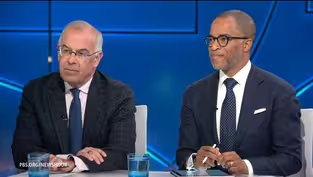
Brooks and Capehart on Trump's federal case dismissals
Video has Closed Captions
Brooks and Capehart on the dismissal of Trump's federal cases (10m 50s)
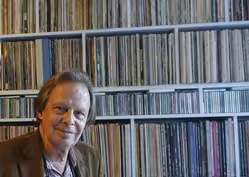
New book explores global influences on Western pop music
Video has Closed Captions
New book explores roots of Western pop music and global influences that shaped it (6m 53s)
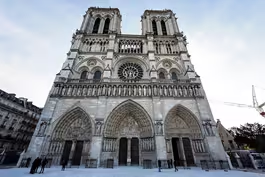
Paris's Notre Dame Cathedral set to make a comeback
Video has Closed Captions
Notre Dame Cathedral to reopen 5 years after devastating fire (9m 4s)
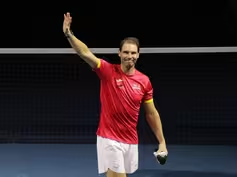
Reflecting on Rafael Nadal's storied career in tennis
Video has Closed Captions
End of an era: Reflecting on Rafael Nadal's storied career in tennis (7m 37s)
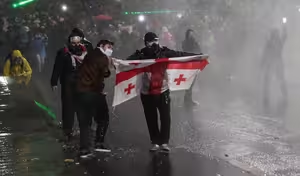
Thousands protest in Georgia after government kills EU bid
Video has Closed Captions
Thousands protest in Georgia after government suspends EU bid (5m 39s)
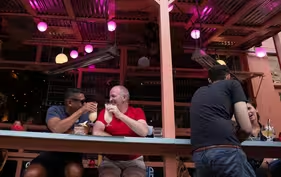
Why this famous New York food critic is moving on
Video has Closed Captions
'I needed to eat a little more sanely' : Why this famous New York food critic is moving on (5m 35s)
Providing Support for PBS.org
Learn Moreabout PBS online sponsorship New Episode
- News and Public Affairs

Today's top journalists discuss Washington's current political events and public affairs.

- News and Public Affairs

FRONTLINE is investigative journalism that questions, explains and changes our world.

 New Episode
 New Episode
 New Episode
 New Episode
 New Episode
 New Episode
 New Episode
 New Episode
Support for PBS provided by:
Major corporate funding for the PBS News Hour is provided by BDO, BNSF, Consumer Cellular, American Cruise Lines, and Raymond James. Funding for the PBS NewsHour Weekend is provided by...