
November 3, 2025
Season 4 Episode 91 | 26m 30sVideo has Closed Captions
Flags are lowered to half-staff in honor of former Governor Martha Layne Collins.
A look back at the legacy of Kentucky's only female governor, the Trump administration says it will partially fund SNAP, how communities are stepping up to help feed Kentuckians, and Congressman Massie remarries.
Problems playing video? | Closed Captioning Feedback
Problems playing video? | Closed Captioning Feedback
Kentucky Edition is a local public television program presented by KET
November 3, 2025
Season 4 Episode 91 | 26m 30sVideo has Closed Captions
A look back at the legacy of Kentucky's only female governor, the Trump administration says it will partially fund SNAP, how communities are stepping up to help feed Kentuckians, and Congressman Massie remarries.
Problems playing video? | Closed Captioning Feedback
How to Watch Kentucky Edition
Kentucky Edition is available to stream on pbs.org and the free PBS App, available on iPhone, Apple TV, Android TV, Android smartphones, Amazon Fire TV, Amazon Fire Tablet, Roku, Samsung Smart TV, and Vizio.
Providing Support for PBS.org
Learn Moreabout PBS online sponsorship>> Education and economic development because I think they're the key to everything.
>> A look back at the legacy of Kentucky's 56th governor.
>> The uncertainty is real and the fear is growing.
>> How one of the state's largest cities is responding to concerns about Snap benefits and food insecurity.
>> They usually don't mix like this, so it's a great opportunity for them to learn from each other and hear each other's goals.
>> How young men are learning to navigate life as a student athlete.
>> I am able to use my voice to share my story, but many people don't have that privilege.
>> And this year's Miss Kentucky is making history.
Hear how she's using her own story to change the lives of children in foster care.
>> Production of Kentucky Edition is made possible in part by the KET Millennium Fund.
>> Good evening and welcome to Kentucky Edition for this Monday, November the 3rd.
The start of a brand new week.
I'm Renee Shaw, and we thank you for joining us this evening.
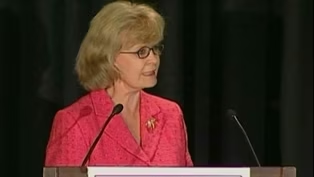
Flags were at half staff today in honor of former Kentucky Governor Martha Layne Collins, the state's first and only female governor.
Collins died on Saturday.
She was 88 years old.
Tonight, our Toby Gibbs looks back at her legacy to the Commonwealth.
>> She came from a little town?
No stoplight.
>> Martha Layne Collins was born Martha Hall on December 7th, 1936, in the town of Bagdad in Shelby County.
Her family moved to Shelbyville when she was in the sixth grade.
Her father became a funeral director.
She believed that background shaped her.
>> I'm proud I keep referring to my roots in Bagdad, in Shelbyville in Kentucky.
It's where you develop your values and your sense of yourself.
>> The future governor graduated from Shelbyville High School and went to Lindenwood College in Missouri before transferring to the University of Kentucky.
She graduated in 1959 with a Bachelor of Science degree in home economics.
She married Bill Collins, a future dentist, shortly after graduation.
They would have two children, Steve and Marla.
The Collinses moved to Versailles in 1966.
She became a teacher at Woodford County Junior High School and soon became involved in Democratic politics.
She was named secretary of the state Democratic Party in 1975, and was elected clerk of the Kentucky Court of Appeals.
In 1979, she was elected lieutenant governor under Governor John Y. Brown in 1983.
Collins was elected as Kentucky's 56th governor, its first and only woman governor, defeating state Senator and future U.S.
Senator Jim Bunning 54 to 44%.
She took office with two main priorities.
>> Well, I'd stick with the priorities I had when I was there 20 years ago, education and economic development, because I think they're the key to everything.
>> She pushed for more money for public schools.
>> Being a schoolteacher, I felt like education was very important.
And I did try to start an educational reform.
>> She backed mandatory kindergarten teacher testing, teacher races and smaller class sizes.
She helped persuade Toyota to locate an $800 million manufacturing plant in Georgetown.
It's probably her best known achievement.
Today, the plant turns out more than a half million vehicles a year, and it's produced 14 million vehicles since 1988.
Governors at the time were not allowed to succeed themselves.
She left office in 1987 and never ran for public office again.
She became president of Saint Catharine College near Springfield in 1990.
In 1993, her husband, doctor Bill Collins, was accused and convicted of influence peddling during Governor Collins term in office.
He served time in prison and was released in 1997.
Governor Collins was not charged with any crime.
In her later years, Martha Layne Collins stayed busy.
She became director of the International Business and Management Center at the University of Kentucky.
She stayed active in Democratic politics, and in 1998 took a part time position at Georgetown College as Executive Scholar in Residence, and served on the boards of directors of several corporations.
For Kentucky edition, I'm Toby Gibbs.
>> Thank you.
Toby.
Funeral arrangements for former Governor Martha Layne Collins have not yet officially been announced.
We will update you as we learn more.
Reacting to the news, U.S.
Senator Mitch McConnell of Kentucky said Collins was known for breaking barriers.
In a statement, he said she was, quote, a tireless advocate for all levels of education in Kentucky.
Kentucky Attorney General Russell Coleman said, quote, as a dad of two daughters, I applaud Governor Collins's service to Kentucky and busting through the glass ceiling to show that there are no limitations in our Commonwealth.
End quote.
Governor Andy Beshear called Collins a friend, adding, quote, she created a foundation for us to build a strong future upon, and her legacy will continue to benefit Kentucky families for generations.
End quote.
In other news today, President Donald Trump says his administration will partially fund the SNAP food aid program.
The decision comes after two federal judges ruled payments needed to continue.
It remains unclear how long it will take for Snap recipients to receive their benefits.
Funding for the program dried up on Saturday due to the government shutdown, leaving more than 40 million Americans without money for groceries on Friday.
Kentucky Governor Andy Beshear signed an executive order declaring a state of emergency, saying a loss of SNAP is a threat to public health and safety.
The order directs $5 million from the state's Budget Reserve Trust Fund to help support Kentucky food banks.
Nearly 600,000 Kentuckians rely on Snap, with almost 40% of them being children.
Uncertainty surrounding Snap benefits has led the state's second largest city to launch a community wide food drive.
Mayor Linda Gordon says the idea for Lexington's Big Give Food drive came after a meeting last week with city leaders, where someone shared concerns raised by families at one center about continued food assistance.
>> As mayor, I naturally want to ensure the programs and facilities our city runs are supported that those who rely on them receive the services they need.
That's why our initial focus was getting nutritious food to the families served by the family care center.
However, I recognize that many other families all across our community need our help.
There are many families who need food assistance and we need to pitch in.
>> We are hearing from families who have never needed help before.
Parents who are skipping meals so their children can eat.
Seniors who are stretching every dollar, and workers who are suddenly without a paycheck due to the government shutdown.
The uncertainty is real and the fear is growing for many.
The question isn't what's for dinner?
It's will there be dinner at all?
But in the face of these challenges, we see something powerful.
Community volunteers, donors and partners are coming together to make sure no one goes hungry.
>> The city has set up blue barrels throughout Lexington to collect nonperishable food items.
The food drive will continue through November.
Food pantries are working to meet the need as more families reach out for help.
Many of them are seeing an increase in requests as Snap benefits remain in limbo.
Our Laura Rogers has more from Bowling Green.
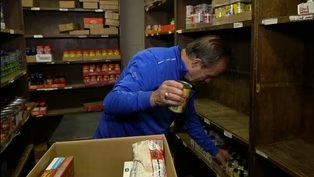
>> We give a box of crackers.
We give a box of instant oatmeal.
Different packets.
>> Doug Watson volunteers three days a week at the Hillview Heights Church Food Pantry.
>> The risk of running out is if we underestimate how much to order week to week, which we did this week.
>> They had to make an emergency run to restock.
As the church gave out well over 100 food boxes the last week of October, close to double an ordinary week.
>> It's just like a mad rush to get here and get some food.
>> A lot of people calling in with concerns about losing their Snap benefits.
>> United Way of Southern Kentucky's 211 connects callers to agencies and resources to help with food, housing, rent and utility bills, and numerous other needs and concerns.
>> Since the first full week of October, we noticed an uptick in our calls.
>> Predominantly about food insecurity.
>> One thing with 211 is that we're not even just sharing where to go, but we're already screening them and giving them the list of the ones that specifically can help them.
>> For many of those callers, that's House on the Hill.
>> We have basically doubled in the last month.
>> Executive Director Joel Hawkins says they prepare 350 food boxes a month, helping more than 600 families through their food programs, free grocery pickup and delivery.
>> We've had a lot of people coming who are out of their food stamps.
They know they're not going to be getting, or they believe they're not going to be getting, as we all believe, they're not going to be getting food stamps in the next month.
>> Friday morning, there was a virtual meeting among area food pantries and nonprofits, along with family resource and youth services centers in the school systems to discuss challenges and solutions.
>> Some of the smaller pantries, feeling like they're not going to be able to sustain the need of the community, you know, they're smaller, they don't have a lot of food anyway.
>> We're all working together to try to figure out how do we all maintain one, the clients that were already serving and then the influx that we might see.
>> Hawkins says.
House on the Hill is preparing for that influx by purchasing more food.
>> We plan ahead.
We always have extra food on hand.
It's just part of our model.
>> Especially as they plan to make 1000 Thanksgiving boxes for area families in need.
>> We have ordered stocked a little bit of extra food knowing what was going to happen.
>> He says there are misconceptions about many people who rely on government assistance.
>> People that are on Snap benefits are not people who are not working.
They're not people who are just sitting around their house waiting for somebody to give them food and do everything for them.
>> Hawkins says.
Many of those they help are employed, but their wages are low and Snap benefits make up a fifth to a quarter of their household expenses.
>> Without those Snap benefits, they're going to have to make up for, you know, between 5 and $600 in their in their monthly budget.
>> And that's difficult for those who may live paycheck to paycheck.
>> We need the government to open back up.
People need their Snap benefits.
>> And then a can of soup.
>> But there are people stepping up and helping out.
Until that happens.
>> Our community is really coming together so that people don't go hungry.
>> For Kentucky edition chicken.
I'm Laura Rogers.
>> And thank you so much, Laura from Bowling Green.
Now groups in Northern Kentucky are also ramping up food drives.
Our Emily Sisk was in Maysville, where a church is working to make sure no one in the community will go hungry.
>> There is no shame in wanting to eat.
>> Leaders at Crosspoint Church in Maysville are doing their part to make sure there's no shame in getting food.
The church is partnering with the local Save-A-Lot grocery store to provide $5 bags of nonperishable food items.
>> We're getting in some monetary donations, and then also people can go to Save-A-Lot themselves, purchase a $5 bag of food, and then our team of volunteers will be out once a week to distribute that food to families in the area that are in need.
>> This isn't the first year for Crosspoint Church to partner with Save-A-Lot, but due to the loss of SNAP benefits, they want to increase their impact.
>> So we're really ramping up this year because of circumstances years past.
Chad, our pastor has just kind of done this himself.
But this year we are anticipating the need being much larger.
>> In Mason County.
Nearly 20% or 1 in 5 households typically receive Snap benefits.
The percentage is even higher in bordering Robertson and Lewis counties.
State Representative William Lawrence, who serves the northeast Kentucky region, said he believes snap recipients in his district are hard working people.
>> The things that I'm hearing about, people aren't working or they're not trying.
I don't find that necessarily true.
And you were just talking about the numbers of the participants on that program that are in my district.
A lot of the jobs in our district are just low income jobs.
If you look at the price of groceries, especially in the last couple of years, I honestly don't know how anyone can make it on minimum wage.
>> Gary Zornes said the church wants to put politics aside and help anyone who is in need.
>> The majority of people who receive Snap benefits are children, are the elderly and are people with disabilities.
Feeding people health care.
These things aren't political.
We've made them that way.
>> And there are other local businesses pitching in to provide meals like Kims Southern Table in Germantown.
>> If you come in and say Southern Special, they're going to feed you with no questions asked and it's free of charge.
And of course, they're asking people that need it to come in there and just say it.
Don't feel don't be embarrassed about it.
Just tell them.
>> Representative Lawrence said he's not surprised by how many people have stepped up to help.
>> I know the people in my community and when push comes to shove, we are there for one another and you better believe that we will show up.
>> Crosspoint church leaders said regardless of the outcome with Snap benefits and if they are reinstated, they will continue their donation drive through the month of November for Kentucky edition.
I'm Emily Sisk.
>> We thank you, Emily.
Now we'll talk more about how Kentuckians are dealing with the uncertainty around Snap and other government food assistance programs.
That's on Kentucky tonight, this evening at eight eastern, seven central.
And we invite your questions and comments right here on KET.
U.S.
Representative Thomas Massie of Kentucky says he's remarried in a post on social media, the Republican from Kentucky's fourth congressional district introduced his followers to Carolyn Moffa.
Massie says they were married in Kentucky on October the 19th and had a wedding ceremony over the weekend in Pennsylvania, where Moffa is from.
He says he first met Moffa in 2016, when she was working for U.S.
Senator Rand Paul of Kentucky.
Massie's, wife of 35 years, Rhonda massie, died unexpectedly in June of last year.
They have four children.
And another note we are remembering journalist Barry Peele, who many of you saw right here on KET.
He covered Kentucky politics for decades during his time at KET and Wtvc in Lexington.
He was also a frequent guest on WKYT's Comment on Kentucky.
And you saw him often.
Peele was from Garrard County.
His obituary says he died Friday at a nursing home in Lincoln County.
Funeral arrangements are pending.
Barry Peele was 80 years old.
There are currently more than 8600 children in foster care in Kentucky.
This year's Miss Kentucky was one of them.
On the latest episode of Inside Louisville, our Kelsie Starks sits down with Arianna Rodriguez, who made history as this year's Miss America pageant by becoming the first former foster youth to earn a spot in the top 11 of the national competition at just 20 years old.
Her platform is making life better for other foster kids in her situation.
>> You are well known around the state for traveling and to talk to kids, particularly kids who are in the same situation that you found yourself in.
What are some of the things that you tell them, and what do you hope they can learn from your story?
>> Just telling them, you know, we're all people and I might wear a crown and sash, but I used to be a kid just like you.
So before I even tell my story, I like to set the tone by just, you know, getting on their level, getting down to their level, you know, squatting down so that they can see me and they see I'm just a normal person.
I wear a crown and sash, but at the end of the day, I take it off and I'm Arianna, and I want them to know that this personal connection isn't just because I'm Miss Kentucky and I have to go into schools, but because I really want to learn from them in the same way that they're able to learn from me.
So I go into schools and I tell my story of being in foster care, and even those who haven't grown up in the system, I feel, are able to relate to that.
I always say in my speeches how many people have went through something difficult, and even the kindergartners raised their hand.
They're like, oh, my brother broke my crayon.
But some of them really do have stories like mine where they might be in kindergarten, but they have experienced those really difficult things in their life already.
And so I'm able to talk to them and tell them, you know, your past doesn't define your future.
You're the one who gets to control that.
And you can turn your pain into purpose.
If you truly believe in yourself and continue doing work that uplifts others and that makes yourself a better person.
So I go in and I try to share that story of inspiration and even people who don't have experience within the foster care system will come up to me and say, you know, that really inspired me.
I just visited a an elementary school where a little boy.
He's a military kid.
And he came up to me and we were talking about how difficult it was for me to move from school to school all the time, because you have to in foster care.
In the ten years that I was in kinship and foster care, I was in 20 different placements.
That's once or twice a year that you're moving.
And he really related to that as a military kid.
And he came up to me and he said, I have to move at the end of this month.
And so all of the kids in his class, we all got together and we wrote notes to him, to his new address, and we're sending them to him so he can have those friends and those connections from his old school and take them to his new school, because that's one thing that I really felt was one of the most difficult parts of being in foster care was not only are you transitioning from home to home, from family to family constantly having to adjust to that, but you're also a kid.
You're losing the friends that you have at school.
You're losing those personal connections that you have with your teachers.
And so I was really thankful to be able to be a small part of his journey and to let him know that although he might be in a different state, he still has the community here in Kentucky.
>> Yeah, it's that is hard for a kid.
That's hard for anyone, much less a kid.
I want to talk about the Lucky Ones Foundation, which is the foundation that you created to help children who were in that same situation.
Tell me about how you came up with the idea and and what it is you all do.
Yeah.
>> When I was in foster care, when I was placed at the doorsteps of my first home, given a trash bag, and you're placed at the doorstep of a stranger, and I had just been separated from my sister.
It was a very difficult and traumatic time in my life, and I remember just getting in the car of the CPS worker and just crying.
I mean, I was very upset.
I was very young and having to deal with all of these things that were changing in my life.
And I remember the CPS worker looked at me and she said, you should be grateful.
You're one of the lucky ones.
And she told me about stories of children just like me, who were raped, who were trafficked, and who were abused far worse than I am or far worse than I was.
And I just remember sitting there and thinking, how am I one of the lucky ones, you know, feeling guilty, I guess that I had it easier than other kids, but also just feeling this pain of everything that I had experienced.
And so I knew that something had to change.
And that's when I started the Lucky Ones Foundation.
The nonprofit is designed to amplify the voices of youth in foster care and educate the public about the issues that they face.
>> Well, what an inspirational and impressive young woman.
You can learn more about the Lucky Ones Foundation and some of the policies this young woman is working to change in the current system.
That's on inside Louisville, which you can stream online and on demand at ket.org.
Some student athletes from every Jefferson County public, middle and high school recently spent a day learning how to be more successful at sports and life.
They took part in the first ever Boys Brotherhood Conference hosted by JC Athletics.
The goal to provide them the resources and information they need to navigate life as a student athlete in today's world.
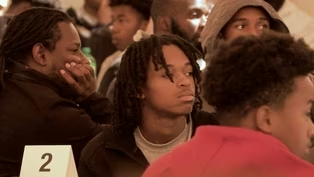
>> Today is our first ever Boys Brotherhood Conference.
This is an opportunity for students to visit workshops, hear from a keynote, have the opportunity to see vendors from around the community so that we can pour into them about leadership and grooming and just how to be a good athlete inside and outside the classroom.
>> I'm just looking for advice, honestly, advice to go to the next level.
Advice that I can take back to my peers to go to the next level.
Advice that I can take back to the younger ones.
To go to the next level and meeting new people.
You know what I mean?
Exploring new connections.
>> We've got middle school and high school students, so they're grouped together by their grade level, and some of them are doing interview skills, they're doing grooming, they're doing building relationships.
How to build your brand.
Now that Nil is very important to students.
And so they're getting a little bit of everything.
I hope that they're learning some leadership from other males.
I think it's important for them to have role models.
So it's a great opportunity for them to learn from fraternities, from other male athletes that have already walked the journey and path that they're going to go.
>> I want to I want to make sure the middle schools I know there's a lot of middle schools here.
I want to make sure they're not nervous or scared or anything like that coming into high school, because, yeah, going into high school, it can be very scary and everything.
But just like the Lil Wayne song, let it all work out to see that JC and Doctor Brooks is doing so much to help the middle schoolers transition to high school and high school.
Transitioning to colleges.
It's honestly just amazing.
>> As an athlete, it's all about teamwork, so you learn from each other.
So this is a great opportunity for schools to come together and have an opportunity to hear from golfers and track stars and basketball players and football players.
They usually don't mix like this, so it's a great opportunity for them to learn from each other and hear each other's goals.
>> What it means to me is a it helps me understand a bigger picture.
Like now, oh, you going through this?
Or I'm going through this and we put that together.
Oh, now we got a better solution and a bigger solution for that problem.
I just want to say that I honestly am grateful for this experience.
I'm grateful for this opportunity, this thing that Doctor Yearwood is doing with all the JC Athletics.
And I'm so grateful to be a part of the junior program being the first of many, and I just can't wait to see how far we can go with Jason.
>> PS first.
>> And finally tonight we have everything from the giant of Letcher County to a New York Giant with Kentucky ties is our Toby Gibbs looks back at This Week in Kentucky history.
>> Kentucky lawmakers met for the first time in a permanent Capitol building when the General Assembly convened in Frankfort on November 3rd, 1794.
The first floor housed the state treasurer, auditor, registrar and public printer.
The House of Representatives met on the second floor.
The Senate and the Secretary of State were on the third floor.
The building burned down in November of 1813.
Kentucky's second permanent capitol building also burned down on November 4th, 1824.
Hodgenville, Kentucky native Abraham Lincoln married Lexington native Mary Todd in Springfield, Illinois on November 4th, 1842.
Lincoln was elected president on November 6th, 1860.
And President William Howard Taft visited LaRue County on November 9th, 1911, for the dedication of a Lincoln Memorial.
James Gresham, a native of McLean County, was one of the first Americans killed in World War One.
On November 3rd, 1917, a German raid killed Gresham and two other Americans while wounding three more.
Happy birthday to Phil Simms, born November 3rd, 1955, in Washington County.
The former Morehead State University quarterback led the New York Giants to a Super Bowl win in 1987.
And happy birthday to Martin Van Buren Bates, the giant of Letcher County, born November 9th, 1845, Bates grew to seven foot 11 and 525 pounds.
He served in the Confederate Army during the Civil War, met presidents, and was received by Queen Victoria while touring Europe.
And that's a look back at This Week in Kentucky history.
I'm Toby Gibbs.
>> Thank you, Toby Gibbs.
That will do it for us tonight, but be sure.
Thank you for being with us tonight.
And you can watch full episodes and clips online on demand at ket.org.
You can also look for us on the social media channels Facebook, Instagram and to see all what's happening here at KET and send us a story idea by email to Public Affairs at ket.org.
I'll be back at 8:00 on Kentucky tonight to talk about SNAP and other food assistance programs.
Sure hope you'll join us.
Until then, take really good care.
So long.
Food Pantries Seeing Increase in Food Requests
Video has Closed Captions
Clip: S4 Ep91 | 3m 25s | Wit SNAP benefits in limbo, food pantries see more families reach out for help. (3m 25s)
Learning to Navigate Life as a Student-Athlete
Video has Closed Captions
Clip: S4 Ep91 | 2m 40s | Conference gives young male athletes resources to be successful in sports and life. (2m 40s)
Maysville Groups Ramp Up Food Drives
Video has Closed Captions
Clip: S4 Ep91 | 2m 53s | One Northern Kentucky church holding food drive to fend off hunger in community. (2m 53s)
Remembering Martha Layne Collins
Video has Closed Captions
Clip: S4 Ep91 | 4m 7s | A look back at the legacy of Kentucky's 56th governor. (4m 7s)
Providing Support for PBS.org
Learn Moreabout PBS online sponsorship
- News and Public Affairs

Top journalists deliver compelling original analysis of the hour's headlines.

- News and Public Affairs

FRONTLINE is investigative journalism that questions, explains and changes our world.












Support for PBS provided by:
Kentucky Edition is a local public television program presented by KET