
November 8, 2023 - PBS NewsHour full episode
11/8/2023 | 57m 46sVideo has Closed Captions
November 8, 2023 - PBS NewsHour full episode
November 8, 2023 - PBS NewsHour full episode
Problems playing video? | Closed Captioning Feedback
Problems playing video? | Closed Captioning Feedback
Major corporate funding for the PBS News Hour is provided by BDO, BNSF, Consumer Cellular, American Cruise Lines, and Raymond James. Funding for the PBS NewsHour Weekend is provided by...
Support provided by:

November 8, 2023 - PBS NewsHour full episode
11/8/2023 | 57m 46sVideo has Closed Captions
November 8, 2023 - PBS NewsHour full episode
Problems playing video? | Closed Captioning Feedback
How to Watch PBS News Hour
PBS News Hour is available to stream on pbs.org and the free PBS App, available on iPhone, Apple TV, Android TV, Android smartphones, Amazon Fire TV, Amazon Fire Tablet, Roku, Samsung Smart TV, and Vizio.
Providing Support for PBS.org
Learn Moreabout PBS online sponsorshipGEOFF BENNETT: Good evening.
I'm Geoff Bennett.
AMNA NAWAZ: And I'm Amna Nawaz.
On the "NewsHour" tonight: Reproductive rights advocates score big wins in state contests that could signal how Americans are likely to vote in next year's national elections.
GEOFF BENNETT: Israeli troops and Hamas battle inside Gaza City, as the death toll rises and desperation grows worse for the civilians displaced by war.
AMNA NAWAZ: And a spike in the number of babies born with syphilis raises concerns about health care and equality in the United States.
DR. JOHN VANCHIERE, LSU Health Shreveport: Our system of health in the United States is failing to do its job to curb STIs, sexual transmitted infection, broadly, including syphilis.
(BREAK) AMNA NAWAZ: Welcome to the "NewsHour."
We're following two main stories tonight, the ongoing war between Israel and Hamas and the results of last night's state elections, which will have far reaching implications and could shed light on voters' priorities going into next year's elections.
GEOFF BENNETT: Let's start with politics here in the U.S. Democrats have much to celebrate after securing key victories on election night.
Abortion access was a driving issue for the party and helped turn out voters for the Democratic ticket.
And it sets the party up with a plan of action heading into next year's election.
Lisa Desjardins has more.
LAUREN BLAUVELT, Planned Parenthood Advocates of Ohio: Abortion access is the law of the land in Ohio.
(CHEERING AND APPLAUSE) LISA DESJARDINS: A win for reproductive rights supporters in the Buckeye State, where lawmakers have passed six-week abortion bans.
Yesterday, a majority of Ohio voters passed a constitutional amendment to enshrine access to abortion, contraception, and miscarriage care.
MARCELA AZEVEDO, Ohio Physicians For Reproductive Rights: Across the states, we're going to bed knowing that we own our own bodies.
LISA DESJARDINS: The vote makes Ohio the seventh state where voters have directly supported abortion access since the Supreme Court overturned Roe v. Wade last year.
Abortion will likely remain a driving force heading into the 2024 election, when 11 more states could vote on abortion-related ballot measures.
GOV.
GLENN YOUNGKIN (R-VA): I will back a bill to protect life at 15 weeks.
LISA DESJARDINS: In Virginia, Republican Governor Glenn Youngkin had promised to restrict abortion after 15 weeks of pregnancy, with some exceptions, if his party regained complete control of the state legislature.
CHRISTINA HARRELL, Virginia Voter: Even though I am pregnant, I still believe in the choice of a woman to be able to decide in these matters, not the government at all whatsoever.
LISA DESJARDINS: Instead, Democrats held on to the Senate and flipped the House.
They will have the majority in both chambers and be a potential check on the final two years of Youngkin's term.
GOV.
GLENN YOUNGKIN: Virginia is clearly a state that has historically moved back and forth from control of one party in the legislature to control the others.
LISA DESJARDINS: For other incumbent governors... GOV.
TATE REEVES (R-MS): Thank you, Mississippi.
LISA DESJARDINS: ... victory.
In deep red Mississippi, Republican Tate Reeves beat back a challenge from Democrat Brandon Presley, a second cousin of the king of rock 'n' roll, who drew national attention and dollars.
GOV.
TATE REEVES: We all now know what it means in a state like Mississippi when you stand up to the national liberals and when you stand up to Joe Biden.
WOMAN: Your governor for four more years, Andy Beshear!
(CHEERING AND APPLAUSE) LISA DESJARDINS: And, in Kentucky, Democrat Andy Beshear won a second term with 52 percent of the vote in a state that former President Donald Trump carried by 26 points in 2020.
Beshear offering Democrats a potential message for red and purple states next year.
GOV.
ANDY BESHEAR (D-KY): It was a victory that sends a loud, clear message, a message that candidates should run for something and not against someone.
(CHEERING AND APPLAUSE) LISA DESJARDINS: At the U.S. Capitol, overall, Republican Senator Thom Tillis of North Carolina was frustrated and blunt.
SEN. THOM TILLIS (R-NC): We have got to do a better job.
Yesterday, to me, was a complete failure.
LISA DESJARDINS: Elsewhere, in Uvalde, Texas, a past mayor returns to the job.
CODY SMITH, Mayor-Elect of Uvalde, Texas: Everybody's going to need to take a long look at themselves and see what they can do to help this community.
LISA DESJARDINS: The small town is still reeling after the gun massacre at Robb Elementary School last year left two adults and 19 students killed, including 10-year-old Lexi Rubio.
Her mother, Kimberly, a gun control advocate, conceded the mayoral race last night.
KIMBERLY MATA-RUBIO, Uvalde, Texas, Mayoral Candidate: I see so much hurt, and I wanted to be a part of helping that.
I can still do that.
And as far as why, I do everything for Lexi.
Lexi is always with me.
I take her no matter where I go.
LISA DESJARDINS: In some other races, historic firsts.
Philadelphia elected its 100th mayor and first woman to serve.
CHERELLE PARKER, Philadelphia, Pennsylvania, Mayor-Elect: We will not let divide and conquer be the tool that people use to stop us from working together.
LISA DESJARDINS: And with the results of a special election, Rhode Island will send its first Black member of Congress to Washington.
GABE AMO (D), Rhode Island Congressman-Elect: Thank you to Rhode Island for putting your trust in me.
I won't let you down.
LISA DESJARDINS: With that seat filled, the math gets harder for Republicans, one vote harder in the House.
For the "PBS NewsHour," I'm Lisa Desjardins.
GEOFF BENNETT: For analysis of yesterday's election and what we learned about the voters, we're joined by Amy Walter of The Cook Political Report With Amy Walter.
It's good to see you, Amy Walter.
AMY WALTER, The Cook Political Report: Great to be here.
GEOFF BENNETT: So, look, abortion rights have won every time they have been on the ballot since the Supreme Court overturned Roe last year.
What's your read on Ohio becoming the latest red-leaning state to vote in support of abortion access and by a pretty large margin?
AMY WALTER: By a very big margin.
It's similar to the margin that we saw in another deep red state, Kansas, in the last year.
I think what is pretty clear, when you put the question of abortion access on the ballot in its own separate space, it is not competing with candidates or the position of candidates, it is a popular position, having either abortion rights enshrined or, in the case of Kansas, making sure that abortion rights are not restricted.
If you look, you can see the number of counties, I think it's about 18, that voted in 2020 for Donald Trump and also voted for the -- to support this abortion rights initiative.
GEOFF BENNETT: Yes.
AMY WALTER: The big question becomes, and we will be talking about this, I'm sure, in a minute, is once you take it from an initiative and put it into a candidate, in other words, what position do you hold on abortion, what position does another candidate hold, it becomes a little more complicated.
GEOFF BENNETT: Well, let's look at what happened in Virginia, because abortion wasn't explicitly on the ballot, but as we saw in Lisa's reporting, Glenn Youngkin and Virginia Republicans campaigned on what they said was a more reasonable approach, a 15-week ban, as opposed to a six-week ban or a total ban on abortion.
But it didn't work because Virginia voters denied the governor and his party the legislative majorities they were looking for.
AMY WALTER: Yes, this was a big gamble by Governor Youngkin.
He -- what he looked at after 2022 is he looked at the fallout from the 2022 midterms and said, Republicans have to have an answer, have to have a better message on abortion.
We can't continue to let Democrats define it for us, so we're going to come out with what he called a reasonable restriction on it.
However, what seems to be clear from Virginia and from Ohio is that voters do not see that as a reasonable restriction.
And when I talked to one Democrat who was doing a lot of work in Virginia this morning, this person told me that Republicans don't have a communications or a messaging problem.
They have a problem problem.
And the problem is that voters don't trust them on the issue of abortion.
And I think that is what is really difficult for so many Republicans who do say, we need to get beyond being defined by this issue by the Democrats, but when they try to find a way to do that, what Democrats have been effectively able to do is to say, yes, but do you really trust that Republicans will stop at 15 weeks?
GEOFF BENNETT: That's interesting.
I was texting with two Democratic officials today who said that Democrats would be wise to put as many abortion rights amendments on as many ballots as humanly possible in the next election.
AMY WALTER: Right.
GEOFF BENNETT: Do you think that would help Democrats deal with their enthusiasm challenge that they so often face with younger voters, in particular?
AMY WALTER: It may.
But, as we saw in Ohio, you could also see people coming and turning out and supporting Donald Trump in one part of the ballot and also supporting abortion rights in the other part of the ballot.
There's no doubt, though, that this is a much more motivating issue for Democrats than it is for Republicans.
Even when the issue is about restricting abortion, Republicans aren't as enthusiastic about this as Democrats are to enshrine it.
And it's an issue, however, that seems to do best in some of the areas where Democrats have been doing really well since the era of Trump, especially in suburban swing areas, in and around those areas.
So what we saw in this last election in Virginia, Democrats did do very well in suburban areas, didn't do quite as well in other parts of the state that don't look like that.
GEOFF BENNETT: Well, it's difficult to predict what all of this means for 2024, but what we know from 2022 and 2023 is that there is this disconnect between President Biden's polling and Democrats' polling across the board versus Democrats' performance in actual elections.
AMY WALTER: Right.
(CROSSTALK) GEOFF BENNETT: What's up with that?
AMY WALTER: What is up with that, Geoff?
It's that voters can hold two thoughts simultaneously.
They can say, I don't think Joe Biden's doing a particularly good job, or I think maybe he's too old for this, or I don't think the economy is going particularly well, but the issue of abortion or the issue of democracy or the issue of voter intimidation, those things are much more important to me than what I think about Joe Biden.
And so they pick that issue, whether it's abortion or democracy issues, over how they feel about Joe Biden.
GEOFF BENNETT: Amy Walter, I always enjoy speaking with you.
Thanks for coming in.
AMY WALTER: Great to see you.
AMNA NAWAZ: Turning to our other top story, the war in Gaza between Israel and Hamas, the Israel Defense Forces' ground operation is engaged in heavy fighting focused on the north, and Israel's punishing bombardment of Gaza continues.
America's top diplomat laid out the most specific plan to date that the U.S. wants for postwar Gaza.
Leila Molana-Allen is in Tel Aviv again tonight.
LEILA MOLANA-ALLEN: In the Northern Gaza Strip, Israel's ground invasion grinds on.
IDF spokesman Daniel Hagari said today troops have gained ground.
REAR ADM. DANIEL HAGARI, Spokesperson, Israeli Defense Forces (through translator): Hamas has lost control and is continuing to lose control in the north.
LEILA MOLANA-ALLEN: The IDF also claims they have made progress demolishing Hamas' network of underground tunnels and have killed hundreds of Hamas militants, including a leading weapons-maker today.
In Tokyo, group of seven diplomats weighed in on the war, including Secretary of State Antony Blinken.
ANTONY BLINKEN, U.S. Secretary of State: The G7 ministers reaffirmed our staunch support for Israel's right and obligation to defend itself.
LEILA MOLANA-ALLEN: They issued a unified statement after two days of intense talks.
It backs Israel's retaliation against Hamas while calling for urgent action to help civilians in Gaza.
ANTONY BLINKEN: We all agreed that humanitarian pauses would advance key objectives, to protect Palestinian civilians, to increase the sustained flow of humanitarian assistance, to allow our citizens and foreign nationals to exit, and to facilitate the release of hostages.
LEILA MOLANA-ALLEN: And on Gaza after the war, Secretary Blinken made clear there's no room for Hamas.
ANTONY BLINKEN: Gaza cannot be -- continued to be run by Hamas.
It's also clear that Israel cannot occupy Gaza.
LEILA MOLANA-ALLEN: He did warn of a -- quote - - "transition period" afterward, but reaffirmed that Palestinians ultimately need to govern the enclave.
Prime Minister Benjamin Netanyahu said he foresees Israel maintaining security control over Gaza indefinitely, although other Israeli officials later clarified that they don't intend to occupy Gaza after the war.
And, as the IDF gains ground inside Gaza City, it reports that 32 of its soldiers have now been killed since the ground invasion began.
Across the border, IDF soldiers rotating out of the battle zone wait at rest stops like these across Southwestern Israel, which has become a staging ground for the war.
Many of them are run by volunteers.
Kobi and his family started this donations tent on their own dime.
Within days, the entire community was pitching in.
Now they're feeding 1,000 soldiers a day.
KOBI GANON, Israeli Volunteer: They seem the zombies, like they came back from hell.
Sometimes, they come from the area and they say, do you have soap?
I cannot smell myself, because it was all - - from all the bodies.
LEILA MOLANA-ALLEN: Kobi says Israelis living here are of one mind about the goals of this war.
KOBI GANON: Everyone coming here, they have a mission to save their own kids, to save their own family, whether they were in the killing area, or even if they're not, because they know they're coming next.
I'm here because I know, if I'm not here supporting our soldiers, my kids will be next.
LEILA MOLANA-ALLEN: Back in Gaza, Palestinians packed the roads by foot, car and horse car, fleeing the fighting in the north for yet another long day.
"NewsHour" producer Shams Odeh was there.
SHAMS ODEH: We are now in the main street of Gaza City, Salah al-Din street.
It's the main street from Gaza, north of Gaza to the south of Gaza.
People are crossing since the morning.
Thousands of them left Gaza, crossing the streets to the south, looking for the safety.
LEILA MOLANA-ALLEN: More than 70 percent of Gaza's 2.3 million residents have left their homes, including Zayed.
ZAYED KHADER, Gaza Strip Resident (through translator): We saw everyone evacuating, so we evacuated.
They said go to the Nuseirat refugee camp.
And here we are, walking, no food, no water, no money.
LEILA MOLANA-ALLEN: Waiting for them in the south, more devastation.
Nuseirat refugee camp in the area Zayed and so many others were told to flee to was hit by an Israeli airstrike today.
At least 18 people were killed, but others believe the death toll is higher.
Gasping for air between the sobs, Anas says dozens were killed in his uncle's house.
ANAS SHEHADA, Gaza Strip Resident (through translator): They bombed our house and my uncle's house.
There's maybe 30 people in there now.
Under the rubble could be about 30 to 40 people.
Accept them as martyrs, please, lord.
LEILA MOLANA-ALLEN: Others in Southern Gaza are living packed into tent cities.
Many of their homes have been destroyed.
They have no idea where they will go next.
For the "PBS NewsHour," I'm Leila Molana-Allen in Tel Aviv.
AMNA NAWAZ: Tonight, two American F-15s conducted an airstrike in Eastern Syria against what the U.S. identified as a weapons storage facility used by Iran's Revolutionary Guard Corps and its affiliates.
It's the second U.S. airstrike on Iranian-backed groups since the October 7 Hamas terrorist attack on Israel, and it follows nearly 40 attacks by those groups on U.S. troops in Iraq and Syria.
Before the strike, I spoke with John Kirby, spokesperson for the National Security Council at the White House, about the diplomacy around the Israel-Hamas war and Israel's military campaign.
Admiral Kirby, welcome back to the "NewsHour."
Thanks for joining us.
JOHN KIRBY, NSC Coordinator For Strategic Communications: Thanks for having me.
AMNA NAWAZ: So there are reports of talks under way for a potential three-day pause in fighting.
First, can you confirm those talks?
And then how do you ensure that any pause doesn't allow Hamas to just rearm, regroup and fight even longer?
JOHN KIRBY: I can't confirm those specific reports, but I absolutely can confirm that we are in constant touch with our Israeli counterparts and our partners in the region about the necessity, the need, the importance, the criticality -- criticality of humanitarian pauses, temporary, short-term, localized pauses in the fighting that will allow us to get aid and assistance in and to get people out, particularly our hostages.
So there are active discussions going on right now about the probability of doing that.
AMNA NAWAZ: And how do you make sure in any pause that Hamas doesn't just use the time to regroup?
JOHN KIRBY: Of course.
I mean, that's why we don't favor a cease-fire right now, a cessation of hostilities across Gaza, because that would really benefit Hamas.
They would be able to arm, plan, execute additional attacks.
Plus, it kind of validates what they did on October 7.
But these pauses would be in place.
Again, we're not taking anything that Hamas says at face value, but it would be done with the understanding that they would meet their obligations under this localized, temporary pause in the fighting to allow for the movement of people or humanitarian goods.
And obviously, we would, with our Israeli counterparts, monitor it as best we could.
AMNA NAWAZ: So, we know Israel has so far rejected any calls for a pause.
Are they receptive now?
JOHN KIRBY: There have been ongoing conversations with the Israelis.
I don't want to speak for them, but you heard Prime Minister Netanyahu just over the last 24 hours or so acknowledge that short-term pauses were something he'd be willing to consider, and he has done it already.
I mean, it's not like no pauses have occurred.
There have been a couple of short-term pauses while we worked on getting hostages out.
AMNA NAWAZ: Well, the pauses were just to get hostages out previously.
I mean, they didn't last more than a few hours at a time.
Is that what you're looking for here?
JOHN KIRBY: It could be.
It could be a few hours.
It could be longer than that.
It could be a few days in extent.
I mean, it really kind of depends on the specific purpose for the pause.
Each pause would be developed, again, with a list of criteria, why you're doing it, and for how long you're going to do it, and over the map, like, what -- the geographic area that the pause is going to apply, because it wouldn't apply for all of Gaza.
So each one's going to be taken a little bit in its own turn.
AMNA NAWAZ: But we had an assessment from the United Nations secretary-general today about the way the war has unfolded so far.
He cited the number of thousands of Gaza children killed so far, and he said that means that there's something -- quote -- "clearly wrong" in the way that the Israeli military operations have unfolded.
Is he wrong?
JOHN KIRBY: Well, we certainly share the concern about the civilian casualties.
Many, many thousands of innocent Palestinians have been killed, and each death is a tragedy.
Each one should be grieved and mourned, and, obviously, each one should be prevented.
And we have been stressing and urging our Israeli counterparts to be as discriminant and cautious, as careful as possible as they prosecute these operations, so as not to take more innocent Palestinian life.
Now, the Hamas terrorist group is literally putting these civilians in harm's way by sheltering underneath their homes and having command-and-control centers in their hospitals.
But, again, that doesn't mean that Israel is absolved of the added burden of doing everything that they can to avoid civilian casualties.
And, again, we're going to keep talking to them about that.
AMNA NAWAZ: Well, you said you have been encouraging them to be as discriminant and careful as possible.
We're now a month into the war.
Have they been as discriminant and careful as possible so far?
JOHN KIRBY: I think we would all agree that there have been too many civilians killed through the conduct of these operations.
I think we agree that the death toll is high, and we don't want to see any civilians killed.
That's why we're going to continue to urge our Israeli counterparts to abide by the law of armed conflict and to respect innocent civilian life to the maximum extent possible.
AMNA NAWAZ: Is that to say you don't believe that they have been as discriminant and careful as possible so far?
JOHN KIRBY: We're not going to armchair quarterback every single strike or event or operation that they're conducting.
We want to make sure they have got the tools and capabilities to do their military operations effectively.
And that includes the perspective of the United States and our own experience in urban warfare and in trying to limit civilian casualties.
AMNA NAWAZ: So, Secretary Blinken said today there should be no reoccupation of Gaza after the conflict ends.
Does Israel's plan to have what they call overall security responsibility indefinitely over Gaza go against that?
JOHN KIRBY: Well, again, I'd let Prime Minister Netanyahu speak for himself and his views on what post-conflict Gaza is going to look like from their perspective.
AMNA NAWAZ: What is your and the U.S.' understanding of that, though?
JOHN KIRBY: We don't believe that it should be reoccupied.
And, obviously, as Secretary Blinken also said, it's possible that there could be some sort of a transitional period where you're going to have Israeli security forces on the ground in the immediate aftermath of the conflict providing some measure of security.
But we don't believe that's a long-term solution that's viable, and it's not going to be in keeping with the aspirations of the Palestinian people.
AMNA NAWAZ: And just looking for some semantic clarity here, when they say overall security responsibility indefinitely, and you say no reoccupation, are those two things in conflict?
JOHN KIRBY: I can't speak for the Israelis.
I can only speak for the administration.
We don't believe that there should be a reoccupation of Gaza, that the future of Gaza, the governance of Gaza in the long term, number one, can't be by Hamas.
We can't go back to October 6.
And, two, it should be in keeping with the aspirations of the Palestinian people.
They have a voice.
They have a vote.
They should get to determine what their future looks like.
AMNA NAWAZ: Admiral, before I let you go, I have to ask about any update you can offer on the Americans you still believe to be held hostage by Hamas.
Have you had any confirmation at this point, one month into the war, they're all still alive?
JOHN KIRBY: We haven't heard any confirmation to the contrary.
So we're still trying to get more information about where they are and how they're being kept, the conditions they're in.
We still believe it's less than 10 Americans that are being held hostage, along with more than 240 other people who Hamas continues to hold hostage.
All of them should be returned to their families immediately.
Hamas should release them all.
Short of that instantaneous release, we're going to keep working with our partners to do everything we can to get more information about where they are, how they are, and get them released.
AMNA NAWAZ: Admiral John Kirby, spokesperson for the National Security Council, thank you again for your time.
JOHN KIRBY: My pleasure.
AMNA NAWAZ: In the day's other headlines: Minnesota's Supreme Court refused to toss former President Trump off the state's primary ballot next year.
A lawsuit had argued he violated the 14th Amendment to the U.S. Constitution by inciting the January 6 assault on the U.S. Capitol.
The amendment bars anyone involved in insurrection from federal office.
Similar lawsuits are pending around the country.
Republicans are holding their third presidential debate tonight, this time in Miami.
Five candidates are taking part, Ron DeSantis, Tim Scott, Nikki Haley, Vivek Ramaswamy, and Chris Christie.
Notably absent again is former President Trump.
He is holding his own campaign event just blocks from the debate venue.
Ivanka Trump testified in New York today that she played no role in her father's financial statements.
She arrived at a courthouse this morning to appear in the civil fraud trial against the family's real estate business.
She is not a defendant in the lawsuit.
Republicans on the House Oversight Committee issued subpoenas today to President Biden's son Hunter and his brother James.
It's part of an impeachment inquiry involving family business dealings.
The committee posted video showing Chair James Comer signing the subpoenas for the Bidens.
So far, there's no evidence directly implicating the president in any wrongdoing.
The only Palestinian American in Congress has now been censured by the House over her criticism of Israel.
Michigan Democrat Rashida Tlaib was formally rebuked last night 234-188.
More than 20 Democrats joined nearly all Republicans in voting for censure after an intense debate.
REP. RICH MCCORMICK (R-GA): We have seen the effects of the reprehensible rhetoric of Representative across Tlaib the nation.
At the schools and colleges around the country, Jewish students have been forced to be on alert as their antisemitic peers have engaged in disgusting demonstrations.
REP. RASHIDA TLAIB (D-MI): My criticism has always been of the Israeli government and Netanyahu's actions.
It is important to separate people and governments, Mr.
Chair.
No government is beyond criticism.
The idea that criticizing the government of Israel is antisemitic sets a very dangerous precedent.
AMNA NAWAZ: Censure of a member of Congress has no practical effect, but it is one step short of actual expulsion.
In East Africa, heavy rain has touched off the worst flooding in decades, with at least 40 people killed.
The deluge in Kenya and Somalia has also forced hundreds of thousands of people to flee their homes.
Video today from Somalia showed whole towns and broad swathes of farmland submerged.
Many people were trapped by the floods that followed four years of intense drought.
Across the globe, this October was the warmest on record.
It's the fifth straight month to average a new high temperature.
European Union scientists say warming oceans and an El Nino climate cycle mean 2023 is likely to be the hottest year ever with more to come.
SAMANTHA BURGESS, Copernicus Climate Change Service: I'm sure everyone remembers the extreme wildfires that we have had this year, the heat waves that have been impacting many parts of the world, the extreme marine heat waves.
We're more likely to have events like that, more severe hurricanes and cyclones, more intense storms.
AMNA NAWAZ: The scientists say natural data from caves, coral and ice cores show this year could be the hottest in 125,000 years.
AMNA NAWAZ: Back in this country, the FDA approved the latest in a series of weight loss drugs today.
It's a new version of an existing diabetes drug, and it will be marketed under the name Zepbound.
In a study, it helped dieters lose roughly a quarter of their body weight.
The treatment could be available by year's end.
And on Wall Street, stocks mostly drifted today.
The Dow Jones industrial average lost 40 points to close at 34112.
The Nasdaq rose 10 points.
The S&P 500 added four.
And the Washington National Zoo's three giant pandas are on their way back to China tonight.
Two adult pandas and their cub left this morning bound for Beijing.
They're traveling in special crates with bamboo, apples and pears for mid-flight snacks.
The crates were loaded onto a cargo plane as zoo officials voiced hope for the future.
BRANDIE SMITH (Director, Smithsonian National Zoo): Because I am an optimist -- when you work with giant pandas, you have to be an optimist -- I will also say, with hope, is, I look forward to welcoming you all here sometime soon again as we celebrate the return of giant pandas to Smithsonian's National Zoo.
AMNA NAWAZ: China had declined to let the pandas stay amid diplomatic tensions.
The last of the bears left in the U.S. are at the Atlanta Zoo, but they will leave next year.
Still to come on the "NewsHour": the staggering rise in babies born with congenital syphilis; we examine the outcome of several critical school board elections; the Philadelphia Opera looks to push the genre forward amid financial uncertainty; plus much more.
GEOFF BENNETT: As the war rages between Hamas and Israel in Gaza, some Palestinians in the West Bank are trying to save their homes.
Some of the most extreme Israeli settlers there have been clashing violently with their neighbors, forcing them to flee.
Leila Molana-Allen reports from near the city of Hebron in the southern part of the West Bank.
LEILA MOLANA-ALLEN: Mournful sighs and the ache of hopelessness.
These Palestinian bedouins are packing up and leaving Khirbet Zanuta, a herding village in the south Hebron hills that they have called home for generations.
Israelis from settlements nearby have long harassed the villagers in this area, hoping to force them out.
But since the October 7 Hamas attacks, the pressure has become unbearable.
Sana'a and her three young kids live in the house closest to the settlement, which sits atop the next hill.
They're the first port of call for attacks.
SANA'A MAKHARZA, West Bank Resident (through translator): Every day, day or night, the settlers come to us.
They shoot at us.
The children are terrified.
The kids can't sleep and neither can we.
And when the dog howls, we know that the settlers have come again.
LEILA MOLANA-ALLEN: The villagers here say that settlers came and cut their electricity wires, stabbed through their water tanks with knives, and smashed their solar panels, cutting out all their essential resources.
SANA'A MAKHARZA (through translator): They destroyed our spirit.
We can't live or eat.
Even the school is closed.
This is not life.
It's too hard.
LEILA MOLANA-ALLEN: Of Khirbet Zanuta's 300 residents, more than half have already fled.
By the end of the week, it will be empty.
Sana'a's family are one of the last to leave.
There's no place for their flock to go.
But, in despair, they have finally given up.
SANA'A MAKHARZA (through translator): We tried to survive it, but we can't.
And after displacing our village, they will displace the rest of these villages.
LEILA MOLANA-ALLEN: Sisters Dima and Tala (ph) on 9 and 10.
They grew up in this quiet farming community.
Most of their friends and neighbors have left.
Now their family is packing up too.
DIMA, West Bank Resident (through translator): We're terrified of them, and so are my brothers and cousins.
We are so sad that we have to leave our homes.
LEILA MOLANA-ALLEN: Asser and the other village elders tried to ask for security forces for help, but were turned away, knowing that, if they fight back, they will be arrested or even shot.
Seeking legal protection was their last chance.
After a lifetime of defending their land here by simply refusing to leave, this battle is lost.
ASSER SHAFI GAZAL, West Bank Resident (through translator): In Gaza, people are dying from the bombing.
Here, we die every day, every day.
Every day, we die.
LEILA MOLANA-ALLEN: As the IDF pulls large numbers of soldiers away from West Bank posts to fight in Gaza, local settlers have stepped in to fill the security vacuum, often with state backing.
Israeli peace activists have turned out to help, hoping the presence of Israelis may provide a little protection for the farmers.
There's not much they can do.
Kobi Snitz came here from Tel Aviv after colleagues told him what was happening.
He's visited these villages for years, but the change he's seen in the past few weeks came as a shock.
KOBI SNITZ, Israeli Peace Activist: Army response is nearly nonexistent.
The police are not very interested in protecting Palestinians.
And to make things worse, the army has deputized large numbers of violent settlers, handed out guns to them and uniforms.
And it's pretty much a gray area which settlers are actually formerly army and which just have a gun and some uniform and have made themselves local sheriffs.
LEILA MOLANA-ALLEN: Forty percent of the West Bank, mostly in urban areas and refugee camps, is defined as under the authority of the Palestinian government.
But the other 60 percent is disputed.
The international community says it's illegal for Israelis to build there.
Israeli settlers and increasingly the Israeli government reject that.
Displacement is not just a humanitarian issue, but a political one.
Any hope of a two-state solution relies on land in the West Bank becoming a Palestinian state.
As more and more Palestinian communities here disintegrate and are replaced by Israeli towns, that potential path to peace is closing.
Israeli advocacy group B'Tselem documents human rights violations against Palestinians in the occupied West Bank.
SARIT MICHAELI, B'Tselem: The West Bank is an area under Israeli occupation.
And this means that Israel is obligated to protect the rights of Palestinians in the West Bank.
But what Israel is doing is the exact opposite.
And, very often, the government agents like soldiers and police are actually actively involved in this forceful transfer.
This is a war crime.
LEILA MOLANA-ALLEN: What is your evidence that the Israeli government, the Israeli military has been directly complicit?
SARIT MICHAELI: When you see settlers and soldiers rampaging through communities together, when the Israeli security forces, the army, the police, stand by and sometimes support these forcible transfer acts, it's not just the actions of these crazy individual criminals.
Settler violence is a major informal tool that Israel uses to take over Palestinian land in the West Bank.
LEILA MOLANA-ALLEN: Israel's Prime Minister Benjamin Netanyahu said today that extremist settlers must not take the law into their own hands and the government would act against it, but did not elaborate on how.
As Palestinian farmers are pushed from rolling agricultural land towards the relative safety of densely populated urban areas, they're not just losing their homes, but their livelihoods.
The next morning, we visit Sana'a's family after the long drive transporting what they could save over the hills.
MOHAMMAD KHUDAYRAT, West Bank Resident (through translator): There's no food, no water for sheep.
There are no schools for the children, no roads and no infrastructure in this area.
LEILA MOLANA-ALLEN: Some still refuse to leave, in spite of daily threats since the war began.
In nearby Susya, Ahmed Jabir sent his children to a safer area weeks ago.
AHMED JABIR, West Bank Resident (through translator): My two little daughters are always afraid, crying and being sick and telling me, "They will kill us."
We tell the settlers: "You're scaring the children."
And they say: "Shut up.
Don't talk."
LEILA MOLANA-ALLEN: But he won't budge.
This week, the harassment turned into mortal danger when a group of settlers burst into his house at 1:00 a.m. AHMED JABIR (through translator): They put their guns through our heads and told us: "We're giving you 24 hours to leave or we will shoot you."
LEILA MOLANA-ALLEN: Ahmed and his wife fear, if they flee, they will lose their land forever.
They know that, by staying, they could lose their lives.
AHMED JABIR (through translator): We shouldn't leave.
We have to hold on.
They have come every day since the beginning of the war.
Tonight, too, they will come.
LEILA MOLANA-ALLEN: As darkness falls, a tense quiet descends, another emptying village holding on as long as it can.
For the "PBS NewsHour," I'm Leila Molana-Allen in Susya, the West Bank.
AMNA NAWAZ: The last decade has brought an alarming rise in the number of babies born in the U.S. with syphilis.
New CDC data showed more than 3,700 babies born with the disease in 2022.
That's 10 times the number born in 2012.
To explain why we're seeing that increase and what can be done to reverse the trend, we're joined by Dr. John Vanchiere, chief of the Division of Pediatric Infectious Diseases at LSU Health in Shreveport, Louisiana.
Doctor, welcome.
So, let's start with what is driving that increase.
What's behind that number -- those numbers?
DR. JOHN VANCHIERE, LSU Health Shreveport: So, when we see syphilis in babies, which we call congenital syphilis, that's an indicator of the amount of syphilis that's in the community and that it's an indicator.
It's like a canary in a coal mine.
When you see babies with syphilis, it means there are lots of adults with syphilis.
And that's -- we have known that for decades.
AMNA NAWAZ: Just to hit this home, because many people may not be familiar, what is the potential harm to babies who do have congenital syphilis?
(CROSSTALK) DR. JOHN VANCHIERE: Yes, the -- sort of the good news of this is that most babies with congenital syphilis have very mild or no symptoms at all and no long-term manifestations.
Babies can be born prematurely because mom has syphilis during pregnancy.
Some babies actually die in utero before they're born because of syphilis.
So, we call that stillbirth.
And babies that are born with symptoms of syphilis have a spectrum from mild to moderate and severe, can include neurologic damage, respiratory damage as well, and long-term complications thereof.
AMNA NAWAZ: And the amount of syphilis in the community, as you have mentioned, this is a reflection of what we're seeing in babies.
So, why the dramatic increase there?
Put us in -- put that into context for us.
DR. JOHN VANCHIERE: Yes.
We have been watching this trend for several decades now.
Syphilis case counts in the United States are higher than they have been for about two decades, almost three.
And what that means is, in adult cases, there are 175,000 cases a year or more.
And these are really spillover to babies who can't fight the disease.
And babies get infected, obviously, because their moms get syphilis.
And if we treat mom during pregnancy, if we can diagnose it during pregnancy and treat, most of those babies are protected and safe and don't have any complications.
Part of what we're focusing on with this new data is that there's a large number that are preventable; 90 percent, by estimate, are preventable cases of babies infected with syphilis.
AMNA NAWAZ: So, if somebody... DR. JOHN VANCHIERE: And better testing... AMNA NAWAZ: Yes.
If so many are preventable, and we do have tests, and there is treatment, why isn't it working?
DR. JOHN VANCHIERE: There are a lot of reasons.
Some moms don't start into pregnancy care until very late or show up at the hospital ready to deliver.
So that's a piece of it.
In some places -- in Louisiana, we test three times during pregnancy for women.
It's recommended.
And they can opt out.
But other places don't test as much as we do here.
They might only test once or twice during pregnancy.
There's a lot of judgment by the physician about, well, my patients are not at risk for whatever reason, and they may not test, when they really should be testing.
So there are a lot of complex factors involved here.
AMNA NAWAZ: Just to underscore, we do see some of the same racial disparities here that we see with other maternal health issues, other more broad health issues.
If you take a look at the numbers, CDC figures find that Hispanic mothers are two times more likely than white mothers to have newborn syphilis, Black mothers four times more likely, American Indian and Alaskan native mothers nine times more likely.
Doctor, tell us how this is showing up in your community.
What are you seeing in Louisiana?
DR. JOHN VANCHIERE: Where we are in Northwest Louisiana, we evaluate two to three babies a week for possible congenital syphilis.
And that is, again, largely because moms may have early diagnosis or inadequate treatment, treatment was started too late in pregnancy.
And most of those babies follow them into that possible category, but we also have some in that probable category.
Right now, we have three babies in our hospital with congenital syphilis, two with no symptoms and one with symptoms.
And this has been the routine for us for more than a decade in our area.
AMNA NAWAZ: So the big question is, what does it take to reverse this trend?
How do we do that?
DR. JOHN VANCHIERE: So it's going to take a national political will to do something about STIs.
They are a scourge in our communities.
And we need to just admit that our system of health in the United States is failing to do its job to curb STIs, sexually transmitted infections, broadly, including syphilis.
And so what we really need to think about is, how does our military get funded and think about funding public health the same way, have the best techniques, the best technologies in advance before threats are on our borders, like COVID.
And I was intimately involved in the COVID pandemic, and we're no better prepared now than we were before the COVID pandemic to deal with threats.
This is an endemic threat, not a pandemic threat.
And it's not going to go away unless we do something different.
AMNA NAWAZ: That is Dr. John Vanchiere, chief of the Division of Pediatric Infectious Diseases at LSU Health in Shreveport, Louisiana.
Doctor, thank you.
We appreciate your time.
DR. JOHN VANCHIERE: Thank you, Amna.
GEOFF BENNETT: School board elections have become a new battleground in American politics, with typically nonpartisan races becoming increasingly polarized and garnering national attention.
That was true in yesterday's election in a few closely watched counties.
In Loudoun County, Virginia, Democratic-endorsed candidates won a majority of seats on that county's school board.
And Democrats swept school board races in Pennsylvania's central Bucks County.
We're joined now by Julie Marsh, a professor of education policy at the University of Southern California.
Thank you for being with us.
JULIE MARSH, Professor of Education Policy, University of Southern California: Thank you for having me.
GEOFF BENNETT: And we should say that most states don't allow party affiliation in school board races.
That's certainly the case in Virginia, but political parties and affiliated groups have obviously become more involved, aggressively involved in these races.
What accounts for the strong performance among Democratic-backed candidates in so many of these school board races yesterday?
JULIE MARSH: I think it's a number of things.
I think you could argue it's been a bit of a backlash against some of the heated campaigns and reflections at school board meetings.
I think a lot of voters have gotten sort of weary, tired of talking about bathrooms, book bans, flags, pronouns.
I think perhaps the wedge issue of parents' rights may not be as powerful as some had hoped.
I think moderate groups got a lot more organized.
A couple years ago, when this was starting, I don't think that the moderate and liberal groups had really been very savvy, very involved.
I think they have grown to be that way.
GEOFF BENNETT: In yesterday's election, voters across the country pushed back on the group called Moms for Liberty.
They say they're a parental rights organization.
The Southern Poverty Law Center says that they're an extremist group.
And the organization endorsed dozens of candidates in Pennsylvania, Minnesota, North Carolina, Iowa.
All of those candidates lost.
What happened there?
JULIE MARSH: Well, it's interesting.
And this is not new.
I think, last November, we also saw a mixed bag in terms of their endorsed candidates.
I think it was less than half of the candidates endorsed by Moms for Liberty won.
So, again, money doesn't make all of the difference.
We have seen that in lots of different races up and down the ballot.
But, again, I think for some folks, Moms for Liberty doesn't speak for them.
Elections for school boards are often very low turnout.
And I think, given all of the media attention around these issues, I think we might have seen an increase in turnout.
I will be interested to see the results there.
GEOFF BENNETT: Sixteen states, as I understand it, held elections for school boards across the country.
What other trends emerged?
JULIE MARSH: Well, I mean, I think we have been seeing this happening for a little bit.
These used to be really quiet, sleepy kinds of elections, low spending, low turnout, nonpartisan.
What we have been seeing in the past couple years is a lot more spending occurring.
I mean, I think -- I heard reports the past couple weeks in Minnesota and Pennsylvania that it was about three times the usual rate of spending on some of these races.
People have become more sophisticated with their political strategies, negative ads, TV ads in places that never seen that for these kinds of elections.
I want to make the point that this is not accidental.
I mean, this is that school boards have become pawns in a broader political game here.
It's been a flash point for the culture wars.
But I think folks have seen, conservative folks have seen that they can fund and be very strategic about advancing candidates, using the parents' rights agenda, as a way to build their bench.
They're using these kind of strong emotional appeals to energize their base.
GEOFF BENNETT: Well, what effect has all of that had on significant issues that public school boards face, like teacher shortages, pandemic-related learning loss, school safety?
JULIE MARSH: This has been a distraction.
I think that we have seen effects on educators and leaders.
And the other day, I was talking to some librarians I was hearing about.
We know from polls and surveys that folks are feeling the stress that it's adding to their job.
They're leaving the profession.
I'm worried about what this might do in terms of recruiting folks.
I mean, why would you want to go into this profession, given all the stresses?
I mean, there's a chilling effect here on public engagement.
Who wants to go to a board meeting where people are screaming at each other?
Who's going to be willing to speak up?
In a lot of ways, this might be turning parents against our public schools and eroding trust that we have in our institutions of public education.
GEOFF BENNETT: Julie Marsh, a professor of education policy at the University of Southern California, thanks for your time.
JULIE MARSH: Thanks for having me.
AMNA NAWAZ: We have been hearing it in many places and many ways.
In the wake of the pandemic and other changes, arts organizations are struggling.
Opera, one of the most expensive of all art forms, is especially feeling the pinch and looking for new ways to move forward in its music, business model and audience outreach.
Jeffrey Brown visits Philadelphia's opera for our arts and culture series, Canvas.
JEFFREY BROWN: The power, beauty and ambition of opera, old and new.
The economic struggles of opera companies hit with budget cuts, layoffs, postponements.
In that sense, Opera Philadelphia has it all, a ground zero of the forces and challenges facing numerous arts organizations around the country.
David Devan has led the company for 12 years.
DAVID DEVAN, General Director and President, Opera Philadelphia: We're at a moment of a shift that is as significant as the move from the Silent Generation to the Baby Boomers.
I think COVID advanced the end of a world that was built by and for Baby Boomers.
But then now the Gen X, Y, Z, that world's not built for them.
JEFFREY BROWN: Is that an existential problem?
DAVID DEVAN: It could be, yes.
I mean, it's either a problem or an opportunity.
JEFFREY BROWN: Opera Philadelphia's Festival O, first put on in 2017, has been a leader in both presenting new works and offering them in new ways.
Rather than the traditional subscription model, in which patrons buy tickets for an entire season, festival audiences can pick and choose individual works they want to attend.
DAVID DEVAN: So, the idea was, could we put together a festival that had a binge opportunity, that had a lot of different experiences, that people could self-select and self-curate their experience?
And could we also bake into that work that was built by these hands today in this time, so that it had a contemporary relevance?
And all that is baked into the stew we call Festival O. JEFFREY BROWN: It's been successful and much-acclaimed.
Once again this year, there was a range of offerings, traditional Verdi in the traditional setting of the Academy of Music.
But the festival extends to other kinds of venues and productions.
For sheer fun, a cabaret called "Late Night Snacks."
From hearing older music and stories in fresh ways, "Unholy Wars," a reframing of the Crusades.
And for something completely new in an alternative setting, "10 Days in a Madhouse," presented in the small scale Wilma Theater.
SARAH WILLIAMS, Director of New Works and Creative Producer, Opera Philadelphia: What is opera for you?
What does that look like for you?
I want to celebrate that.
JEFFREY BROWN: Sarah Williams is the company's director of new works and creative producer, helping composers take opera in new directions.
SARAH WILLIAMS: Well, rather than what you often get, I feel like, in the field, which is telling you what opera is or dictating to you what opera is, the field can do that or it feels that way often to artists.
And I think what I'm interested in is talking to artists about, what does opera look like for you?
What are you interested in doing?
Can we support that?
Do I and we think you're ready and we can help get you there?
That's the starting point, and then building, slowly, really building a very trusting relationship, so we can collaborate and work our best together to get to the finish line.
JEFFREY BROWN: Will the audience come along, some part of it, even better, a new audience?
SARAH WILLIAMS: It's changed, and change can be bristly.
I think there's a massive world of people that are very excited about it.
And they don't have to be separate worlds.
And it doesn't mean we're choosing one over another.
I think there's a way to do balanced program and there be space and opportunity and varied experiences for everyone and to be even more inclusive of companies, inclusive of different audiences and beyond.
JEFFREY BROWN: The composer of this year's new opera was 38-year-old Rene Orth, who lives in Philadelphia and was previously a composer-in-residence with the company.
"10 Days in a Madhouse," with a libretto by Hannah Moscovitch, is based on the groundbreaking, if horrifying, true life undercover journalism of Nellie Bly in the 19th century.
For Orth, it continues her efforts to bring women's stories forward in a traditionally male-centered art form and also to bring in different sounds and instrumentation.
RENE ORTH, Composer, "10 Days in a Madhouse": To me, it's important to impact as many people as possible.
That's why I throw in dubstep beats or I throw in electronic dance music, but I also include a traditional string quartet waltz.
And I really do believe that if we write music that's relevant and doesn't feel archaic, you know, I really believe I can move a lot of people that way.
JEFFREY BROWN: This is small opera, purposely so, smaller cast, orchestra and set, which keeps costs down.
It's also shorter, 90 minutes' long.
For Orth, that's both practical and personal.
RENE ORTH: Because I hated opera for most of my life, because I hated sitting in a small theater -- I'm tall, I'm 6 feet -- like all scrunched up, and for three hours, about a story that I didn't care about.
So, for me, when I said, when it's time for me to write opera, I'm going to write opera that I think is interesting; 90 minutes or less is a great amount of time, stories that are relevant to people, to society., and interesting sound worlds.
JEFFREY BROWN: Sarah Williams puts it this way: SARAH WILLIAMS: We're still learning a ton of how to do it, not only how to develop work, produce it and present it well.
And I think that's -- you have to give space for that.
JEFFREY BROWN: And the audience is learning too.
SARAH WILLIAMS: We all are.
JEFFREY BROWN: For his part, David Devan believes a festival like this offers clues to a way forward.
But he himself won't be at the helm.
When the company announced its layoffs and cutbacks this summer, Devan said he, though just 60, would leave Opera Philadelphia in favor of a new generation of leaders.
DAVID DEVAN: The fundamental problem is, our institutions need to be in relationship and responsive to a younger generation.
And if the younger generation is not running them, it's going to be kind of hard to do that, isn't it?
JEFFREY BROWN: A bittersweet ending, for now, for an opera company and its festival working to keep an art form alive.
For the "PBS NewsHour," I'm Jeffrey Brown in Philadelphia.
GEOFF BENNETT: And that is the "NewsHour" for tonight.
I'm Geoff Bennett.
AMNA NAWAZ: And I'm Amna Nawaz.
On behalf of the entire "NewsHour" team, thank you for joining buts.
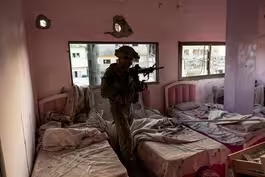
America's top diplomat lays out vision for post-war Gaza
Video has Closed Captions
Clip: 11/8/2023 | 5m 11s | Israel's ground invasion grinds on as Blinken lays out vision for post-war Gaza (5m 11s)

Explaining the staggering rise in babies born with syphilis
Video has Closed Captions
Clip: 11/8/2023 | 5m 24s | Explaining the staggering rise of syphilis in newborn babies (5m 24s)

How the White House views Israel's military campaign
Video has Closed Captions
Clip: 11/8/2023 | 7m 15s | How the White House views Israel's military campaign (7m 15s)

Opera Philadelphia pushes forward amid financial uncertainty
Video has Closed Captions
Clip: 11/8/2023 | 6m 48s | Opera Philadelphia pushes forward amid financial uncertainty (6m 48s)

Reproductive rights drive wins for Democrats
Video has Closed Captions
Clip: 11/8/2023 | 9m 24s | Reproductive rights drive wins for Democrats, leaving clues for future elections (9m 24s)

West Bank Palestinians try to save homes
Video has Closed Captions
Clip: 11/8/2023 | 7m 36s | West Bank Palestinians try to save their homes from Israeli extremists (7m 36s)

Why school board elections are garnering national attention
Video has Closed Captions
Clip: 11/8/2023 | 4m 51s | Why school board elections are garnering national attention (4m 51s)
Providing Support for PBS.org
Learn Moreabout PBS online sponsorship
- News and Public Affairs

FRONTLINE is investigative journalism that questions, explains and changes our world.

- News and Public Affairs

Amanpour and Company features conversations with leaders and decision makers.












Support for PBS provided by:
Major corporate funding for the PBS News Hour is provided by BDO, BNSF, Consumer Cellular, American Cruise Lines, and Raymond James. Funding for the PBS NewsHour Weekend is provided by...