
November 8, 2024 - PBS News Hour full episode
11/8/2024 | 57m 46sVideo has Closed Captions
November 8, 2024 - PBS News Hour full episode
November 8, 2024 - PBS News Hour full episode
Problems playing video? | Closed Captioning Feedback
Problems playing video? | Closed Captioning Feedback
Major corporate funding for the PBS News Hour is provided by BDO, BNSF, Consumer Cellular, American Cruise Lines, and Raymond James. Funding for the PBS NewsHour Weekend is provided by...
Support provided by:

November 8, 2024 - PBS News Hour full episode
11/8/2024 | 57m 46sVideo has Closed Captions
November 8, 2024 - PBS News Hour full episode
Problems playing video? | Closed Captioning Feedback
How to Watch PBS News Hour
PBS News Hour is available to stream on pbs.org and the free PBS App, available on iPhone, Apple TV, Android TV, Android smartphones, Amazon Fire TV, Amazon Fire Tablet, Roku, Samsung Smart TV, and Vizio.
Providing Support for PBS.org
Learn Moreabout PBS online sponsorshipGEOFF BENNETT: Good evening.
I'm Geoff Bennett.
AMNA NAWAZ: And I'm Amna Nawaz.
On the "News Hour" tonight: President-elect Trump makes his first big White House pick, naming campaign adviser Susie Wiles his chief of staff.
What we know about the woman behind his historic return to the Oval Office.
GEOFF BENNETT: Plus, we hear from voters who share their views on the future of the country in the wake of the election.
PASTOR MARTY CALDERON, Trump Supporter: I pray that people can work together.
But he's going to be there for four years.
What can we do to make things better?
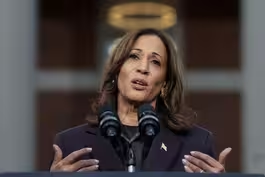
AMNA NAWAZ: And how Kamala Harris' loss is once again prompting the question, what will it take to elect a woman to the nation's highest office?
AMNA NAWAZ: Welcome to the "News Hour."
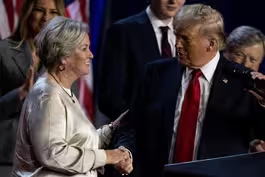
President-elect Donald Trump began putting his new team in place, announcing that his campaign manager, Susie Wiles, will be the White House chief of staff when he takes office next year.
GEOFF BENNETT: Wiles is the first woman to be appointed to that position.
And during his victory speech Wednesday morning, Mr. Trump praised Wiles for helping engineer his sweeping victory.
DONALD TRUMP, Former President of the United States (R) and Current U.S. President-Elect: Susie likes to stay sort of in the back, let me tell you, the ice maiden.
We call her the ice maiden.
(CHEERING) DONALD TRUMP: Come on, Susie.
Chris -- come here, Chris.
Susie likes to stay in the background.
She's not in the background.
GEOFF BENNETT: A veteran of Florida politics, Wiles ran successful campaigns for Senator Rick Scott and Florida Governor Ron DeSantis before running Donald Trump's winning bid for reelection.
For a closer look, we're joined now by Marc Caputo, national political reporter for The Bulwark and previously covered politics in his home state of Florida for years.
Marc, it's great to have you here.
MARC CAPUTO, The Bulwark: Hi.
Thanks.
GEOFF BENNETT: So in a traditional White House, the chief of staff oversees strategy, coordination, policy decisions.
It's arguably the most important personnel decision a president can make.
What if anything can we take away from Donald Trump's selection of Susie Wiles to serve as his chief of staff?
MARC CAPUTO: Donald Trump wants to stick with a winning team.
He enjoyed great success against what seemed like great odds this cycle.
His two previous presidential campaigns were always marred by sort of infighting, drama, and in some cases, like, a great amount of incompetence.
One of the reasons he was so thrilled in that clip that you played from his election night victory speech was that he had a winning team that didn't really have any of that.
Now, there was a little drama at the end, but that was more of Donald Trump's fault.
That was Donald Trump's fault, not the fault of his campaign co-managers.
The thing about Susie Wiles is that she has had a reputation of being a winner.
She's not a braggart.
As he said, she likes to stay behind the scenes.
She is known for being sort of egoless.
She serves the principal and she makes sure to kind of execute their will without getting too much in the way.
You didn't hear any leaks of her sort of reining back Donald Trump or talking down to him or any sort of appearance of folks in the campaign trying to sort of defend their reputations when it looked like things were going south.
None of those things happened.
And a lot of that is attributable to Wiles, the people that she hired, and the sort of the drama-free environment that the campaign itself ran on, now, not Donald Trump, but the campaign itself.
GEOFF BENNETT: Susie Wiles worked in Florida politics for decades for a number of moderate politicians.
She's even described herself as a moderate.
Why Donald Trump then?
MARC CAPUTO: Well, she worked for Donald Trump in 2016 running his Florida campaign, when people thought and when the polling showed that he wouldn't win Florida.
And he won, and Trump was very happy about that.
But Susie Wiles' first big race in Florida was Rick Scott's in 2010, when he ran for governor.
And, at that time, Rick Scott looked like he had no prayer of winning the state.
He did.
Wiles got a lot of the credit.
Then, in 2016, you had Donald Trump run his race.
In 2018, Ron DeSantis ran his gubernatorial race, and when things were going real south for him, who did he call?
He called Susie Wiles.
Now, the two of them had a falling out.
That wasn't Wiles' fault.
That was a result of Governor Ron DeSantis' paranoia an inability to accept the fact that people were giving her a measure of credit for his win, which he just couldn't stand.
So he tried to wreck her reputation and her career.
She got back on her feet, got back on President Trump's reelection campaign in 2020, working in Florida again.
She helped him win the state.
Obviously, he lost that race.
But he realized in 2021 when he was in a real bad spot, no one thought he could make comeback,it was after January 6, and he wanted to give it another whirl.
And he wanted to make sure he had someone confident, somebody he could trust, someone who wasn't going to sort of self-promote and cause him trouble.
And really only one name rose to the top of the list.
That was Susie Wiles.
And President Trump was very happy he made that decision.
GEOFF BENNETT: Wiles has said that her specialty is creating order from chaos.
It raises the question.
MARC CAPUTO: Yes.
GEOFF BENNETT: Democrats had said that if Donald Trump were to win reelection, that there'd be no guardrails.
He'd surround himself with loyalties who would do his bidding.
Would it be a mistake to perceive Susie Wiles as a guardrail, potentially?
MARC CAPUTO: That's a difficult question to ask, because what we don't have insight into and what Wiles wouldn't talk about are those times where she may have -- and undoubtedly she had just kind of statistically - - an adviser advises a principal.
And eventually, the principal, even Donald Trump, is going to take the adviser's advice.
So there were undoubtedly times where she told him, please don't do this or try to kind of nudge the ship of S.S. Trump in the right way.
It's a very difficult process if you talk to people who have been advisers, who are advisers or confidants of Trump.
And so she undoubtedly did that.
However, Donald Trump also does what he wants to do.
And there's always that fundamental tension that runs through his organizations.
So to the degree of comparing Susie Wiles to a guardrail, I think it's fair.
But it's also important to remember that Donald Trump is an 18-wheeler and sometimes he careens down the hill at top speed.
And there's no amount of guardrails that can necessarily prepare against that.
We have seen in this election cycle, though, that whatever you want to call it, the guardrails, good advisers, selflessness, luck or Zen, Susie Wiles played a really key role in that, perhaps the key role.
GEOFF BENNETT: Marc Caputo, national political reporter for The Bulwark, thanks again for joining us.
MARC CAPUTO: Thanks, Jeff.
I appreciate it.
AMNA NAWAZ: The day's other headlines start in the Netherlands.
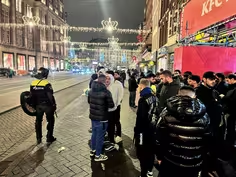
Dutch authorities are investigating what led to a wave of attacks last night on Israeli soccer fans in Amsterdam.
It followed days of tensions leading up to the game.
Stephanie Sy has our report.
STEPHANIE SY: The game between Israel's Maccabi Tel Aviv and the Dutch Ajax team ended in a tie.
What happened after, outside the lines, was a clear loss.
Hundreds of riot police deployed across the city after chaos and violence erupted, this a scene showing a mob running with clubs, and this an eyewitness video capturing Israeli fans running in fear.
One says "I'm not Jewish" as he was repeatedly punched and kicked to the ground.
Israel's embassy in Washington posted this footage showing a cornered Israeli fan.
More than 60 people were arrested and five victims were hospitalized and released.
But tensions had been mounting for days, and the aggression was not one-sided.
Video from the night before the game shows Israeli soccer fans cheering as someone tears down a Palestinian flag.
And police chief Peter Holla told reporters that Maccabi Tel Aviv fans had attacked a taxi driver and burned a Palestinian flag the day before the game.
Israeli fans were also captured chanting "Eff the Arabs" as they descended an escalator ahead of the match.
In violence following the game, the mayor of Amsterdam said the assailants actively sought out Israeli fans.
It's unclear whether the attacks were preplanned.
FEMKE HALSEMA, Mayor of Amsterdam, Netherlands (through translator): Boys on scooters crossed the city in search of Maccabi Tel Aviv supporters.
It was a hit-and-run.
STEPHANIE SY: Fans who witnessed the violence described what they saw as they returned to Israel today.
KOBI ELIYAHU, Maccabi Tel Aviv Fan: It was very frightening.
I saw people get beaten.
I saw people get inside hotels and lock themselves.
I saw people threw -- they throw people into the water, the freezing water.
And they drove on people.
They stab people.
STEPHANIE SY: Dutch and Israeli officials decried the attacks as antisemitic.
Israeli Prime Minister Benjamin Netanyahu compared it to an attack on Jews in 1938 Berlin that preceded the Holocaust.
BENJAMIN NETANYAHU, Israeli Prime Minister (through translator): Tomorrow, 86 years ago was Kristallnacht, an attack on Jews just for being Jews on European soil.
It's back now.
Yesterday, we saw it on the streets of Amsterdam.
STEPHANIE SY: Following the mayhem, Amsterdam has banned demonstrations for three days and granted police emergency power to stop and search suspects.
For the "PBS News Hour," I'm Stephanie Sy.
AMNA NAWAZ: In Southern California, firefighters are making progress and extinguishing a wildfire that's destroyed some 130 structures, mostly homes.
For nearly three days, the Mountain Fire has blown through more than 30 square miles in Ventura County outside Los Angeles.
Wind gusts are finally starting to ease, allowing some residents to return to the charred remains of their homes, while others assess what they have lost.
KATHLEEN BOWCOCK, California Resident: The fire was there.
There was black, heavy smoke with debris just flowing at us.
And I didn't know if our neighbors got out and my phone didn't work, so I couldn't - - I didn't know if anybody was stuck.
DAWN DELEON, California Resident: First, it skipped us and it started burning our neighbor's house, passed us.
We thought we were OK, evacuated anyway, and today came back and the house was gone.
AMNA NAWAZ: Meantime, on the other side of the country, fires are burning in parts of New Jersey.
At least four blazes have broken out across the state, which is dealing with high winds and dry conditions after a month without any significant rain.
The FBI, the Federal Communications Commission, and other agencies are investigating a wave of racist text messages that are being sent anonymously to Black Americans.
They have been reported in several states, including New York, Alabama, California, Ohio, Pennsylvania, and Tennessee.
The exact wording varies, but the messages, like this one, often tells recipients they -- quote -- "have been selected to pick cotton at the nearest plantation," instructing them to be ready with their belongings.
Some also include instructions to appear at specific locations.
Middle schoolers and high school students are among the recipients.
A federal judge struck down the Biden administration's effort to provide citizenship to some undocumented spouses of U.S. citizens.
A district judge in Texas said the administration stretched its interpretation of immigration law -- quote -- "past its breaking point."
President Biden announced the policy in June.
It would have allowed undocumented migrants who are married to citizens and stepchildren of citizens to apply for a green card without having to leave the country first.
It would have benefited nearly 500,000 immigrants, but had already been put on hold and would have faced an uncertain future under the new Trump presidency.
The United Nations Human Rights Office says close to 70 percent of fatalities from Israel's war in Gaza have been women and children.
In a report published today, the U.N. says it's verified the details of more than 8,100 people killed in Gaza between last October and early September of this year.
Of those, more than 2,000 were women and more than 3,500 were children.
The report also says that most of the fatalities came in attacks that killed five or more people and about 80 percent were in residential buildings.
U.N. officials blame Israel's use of weapons in densely populated areas for the destruction.
AJITH SUNGHAY, U.N. Human Rights Office: Given the pattern of strikes throughout Gaza and the fact that they have not only killed and injured so many people, but also destroyed fundamental social structures and support networks of Palestinians in Gaza, there is serious concerns that Israeli forces have intentionally attacked the very basic fabric of Palestinian society.
AMNA NAWAZ: Israel says it's been targeting Hamas militants in Gaza after Hamas' October 7 attack last year, in which 1,200 people were killed and more than 250 taken hostage.
The Justice Department unsealed criminal charges today in a murder-for-hire plot to assassinate president-elect Donald Trump.
The complaint alleges that Farhad Shakeri was tasked by an Iranian official with formulating a plan to surveil and then kill Trump in the weeks before the election.
Shakeri has spent time in American prisons for robbery.
He remains at large and is believed to be in Iran.
Separately, a Ukrainian official tells "PBS News Hour" that Elon Musk joined a phone call this week involving the president-elect and Ukrainian President Volodymyr Zelenskyy.
The official said that Zelenskyy thanked Musk for his Starlink satellite service, which provides Internet access in Ukraine.
On Wall Street today, stocks closed out a blockbuster week with modest gains.
The Dow Jones industrial average added more than 250 points to close just shy of 44000.
The Nasdaq added about 17 points.
The S&P 500 tacked on 22 points, capping its biggest weekly gain since last November.
And the 2025 Grammy nominations are in.
Beyonce leads this year with 11 nods, making her the most nominated artist of all time.
"Texas Hold 'Em" raked in three nominations for record song and country song of the year.
It's from her album "Cowboy Carter," which itself is up for both album and country album of the year.
Today's nominations bring Beyonce to a total of 99 Grammy nominations over her career.
Post Malone follows this year with seven nominations, as do Billie Eilish and Kendrick Lamar.
Taylor Swift collected six nominations, along with first-time nominees Sabrina Carpenter and Chappell Roan.
And we want to bring you the story we have all been talking about in the newsroom today.
A police chief in South Carolina says there is -- quote -- "almost no danger to the public" after 43 monkeys escaped from a medical research compound.
The problematic primates broke loose from the Alpha Genesis facility in Yemassee, South Carolina.
Police say a new employee didn't fully shut an enclosure, allowing the rhesus macaque to escape.
Police are advising residents to close their windows and doors and call 911 if they see one.
Still to come on the "News Hour": how Americans' views on female leaders played into this year's presidential election; David Brooks and Jonathan Capehart weigh in on what's ahead with Trump elected to another term; and the fashion industry tries to preserve artisan craftwork after clothing factories move overseas.
GEOFF BENNETT: In this deeply polarized country, there have been a range of reactions in response to former President Trump's reelection this past week.
To better understand how many in the country feel, Judy Woodruff checked in with some of the people she's met during her ongoing reporting project, America at a Crossroads.
CHRIS VITALE, Trump Supporter: You know, I won't tell you that I'm not surprised.
I'm surprised it was as big as it was.
But I am happy.
This is the person I wanted to win.
This is the mandate I wanted America to see.
LEWIS TERRY, Harris Supporter: Last night when, I went to sleep, there was still hope.
But when I woke up this morning, I saw that he actually won.
It was a feeling of, here we go again.
We're back to -- we're moving back in time.
JUDY WOODRUFF: Some very different and very strong reactions from some of the Americans we have met across the country about what took place this week.
JERI LEVASSEUR, Trump Supporter: The first day we had early voting here in Massachusetts.
I voted for Donald Trump.
And I was excited throughout his campaign because I saw him as hope.
PASTOR MARTY CALDERON, Trump Supporter: I think it was a very comfortable and very happy feeling that he's going to be back in charge.
BEAU HANCOCK, Trump Supporter: Well, I was really, really excited.
And to be honest, I always had faith.
I was never really doubtful that he would win.
DIANE DOYLE SMITH, Harris Supporter: I'm still in shock, but I didn't cry this time, like I did when he originally won.
So that's something.
JUDY WOODRUFF: Why do you think you didn't cry?
DIANE DOYLE SMITH: I have lost my naivete of, I mean, about Americans and the goodness of them.
RYN BOTSFORD, Harris Supporter: I woke up really early, just like -- I just roused.
And I just checked my phone, being like, oh, it's going to be totally fine.
And then I was just awake.
And I held my son.
And it's not the future that I wanted to give to him.
JEFF BROOKS, Harris Supporter: One of the reasons that I didn't vote for Donald Trump was because of the last election.
So I feel like I need to stand on that now, that these are the election results.
This is what the American people want.
And we go from here.
JUDY WOODRUFF: Supporters of former President Trump found many issues to vote for, top among them, the economy.
MARTY CALDERON: With the prices and the different and the variety of things that we are already purchasing, from food, groceries to gas.
CHRIS VITALE: I expect it will open up opportunities for jobs in manufacturing.
I suspect it'll keep a lot of jobs in the area.
JUDY WOODRUFF: So, for you, is it mainly the economic piece of this that matters to you?
Is that fair to say?
CHRIS VITALE: The economics certainly a big part of it.
Another part of it would be the concerns I had over -- it seemed like there were many on that side of the aisle that wanted to control speech, that wanted to shut people down, that wanted to censor.
JERI LEVASSEUR: Well, the other thing is illegals coming across this country.
There are so many people here we don't know.
BEAU HANCOCK: You know, being male and white in recent years, we have been told that we're the problem in society.
And we're always the ones causing issues.
Everything that's going bad, everyone that's "oppressed" -- quote, unquote -- is being oppressed by white men.
And DEI and all these things that are meant to lower the amount of white men in any sphere are things that Trump ran on.
JUDY WOODRUFF: Harris supporters, as well as one woman who voted for Jill Stein as a protest against U.S. support for Israel, felt concerned about where things might be headed over the next four years, including on the economy.
RAYA ABDELAAL, Community Activist: I know so many people that can't afford rent.
They can't afford to have food.
They're working two, three jobs.
It's a serious issue.
And then we have people like Trump that's going to come in.
And he's like -- he's a businessman.
His only interest is his business.
That's only going to make things worse for American people.
LEWIS TERRY: The tariff that he's going to put on China for import, not just China, but on imports that's coming in, that's going to cost people like me, who -- a lot of things I have in my home says made in China or made here, made there.
And if this is going to be a tariff on it, we're going to have to pay more money for these things.
DIANE DOYLE SMITH: I think it's going to be terribly different, maybe not for me.
I'm an older postmenopausal white retired woman.
But I had friends that text me yesterday that their transgender children were up all night having panic attacks and crying.
I have a niece who's in a gay marriage.
I can imagine the Supreme Court is going to be going after that.
RYN BOTSFORD: I am wildly concerned for my family specifically.
I'm wildly concerned about a lot of things, but I gave birth to our son.
My wife is my legal wife and spouse and is on his birth certificate.
I am very concerned that, legally, my marriage will be dissolved and that my wife will not have the same legal rights to our son.
JEFF BROOKS: My hopes are that what other people see in him is what will happen.
My hopes are that I'm wrong on how I'm reading him and that this is going to be a turning point.
My fear is that the worst of this will result in us being more separated, us feeling that other Americans are the enemy and we're not all one team together.
JUDY WOODRUFF: Some Trump supporters said they hoped this could be an opening for the president-elect to find common ground with the other side.
MARTY CALDERON: I would hope that that's an effort within his Cabinet and within the people that he puts in leadership, that we have to work together.
I mean, there's no ifs, ands or buts about that.
We have to work together.
CHRIS VITALE: You know, this guy is a dealmaker.
He likes to make deals with people.
He is on the same page as a lot of Democrats.
And yet they cannot seem to find common ground.
JERI LEVASSEUR: I mean, if Kamala got in, I would have been, OK, here we go, what am I going to do?
But I wouldn't go out in the streets and burn cars and turn things over.
I would try to see, what is she going to do to make it better for everybody?'
BEAU HANCOCK: I would say the election points to the fact that we're not as divided as we might have thought, that it's not about identity politics.
It's not about -- I'm sure millions of Americans who voted for Trump don't like him as a person.
But it shows that we have things in common.
We have beliefs in common.
We want legal immigration.
We want a good economy.
We don't care that he might -- I think I said the same quote a few months ago, last time we talked.
We don't care that he might say some off-color things.
We don't care if he has a mean tweet.
DIANE DOYLE SMITH: I see no hope of him unifying the American people.
I think he's a rotten human being.
Every time he speaks, he denigrates a certain group, whether it's immigrants or -- I could go on and on.
We all know what he's like.
JEFF BROOKS: If I'm at work and I'm rooting for Larry to get the promotion, but Darren gets it, then either way I'm not personally invested.
That's the logical part of me.
The emotional part is, I'm concerned.
I'm concerned of where we're going to wind up at the end of this.
LEWIS TERRY: I have seen a lot of hate come out of people.
When Trump was in office, when Trump lost the election, I have seen a lot of hate come out of people.
And some of the hate that I saw coming out of people were some people that I knew for years.
RYN BOTSFORD: I am unwilling to compromise who I am as an individual for somebody else's comfort.
I am unwilling to go back in the closet.
I am unwilling to go back to being a woman, instead of the nonbinary person that I am.
But building bridges where they can be built, yes, absolutely.
RAYA ABDELAAL: I think we all struggle with the same things at home, paying our bills, holding down a job, taking care of our families.
Health care is a big issue for all of us.
We have the same problems and we have a -- in my opinion, a common enemy, which is these politicians that use us to gain power and money and whatever it is that they're going for.
JERI LEVASSEUR: They should all have the betterment of this country first and foremost.
CHRIS VITALE: I think Democrats have an opportunity to work with Trump to put the brakes on some of these mega-mergers, multi-borderless corporations that pay taxes into the Netherlands or Ireland or something like that.
They have an opportunity to bring some of that back to this country.
MARTY CALDERON: I pray that people can work together, OK?
You know what?
The person you want in there is not in there, but he's going to be there for four years.
What can we do to make things better?
How can we work together to make America better?
JUDY WOODRUFF: For the "PBS News Hour," I'm Judy Woodruff in Washington.
AMNA NAWAZ: For the second time in eight years, a woman ran for president and lost to the same man.
Despite strong support among women of color, Vice President Kamala Harris lost ground with nearly every other demographic group compared to Joe Biden in 2020.
A number of factors separate Hillary Clinton's run from Harris', and a number of factors went into Donald Trump's win.
But, once again, the question is being asked, is America ready for a woman in the White House?
Errin Haines editor-at-large for The 19th News, and Kelly Dittmar is with the Center for American Women and Politics at Rutgers University.
Welcome to you both.
And, Errin, I will start with you.
There's a number of factors at play, we know, the economy, a truncated campaign, frustration with the incumbent.
But what do you take away from what we saw with voters in terms of how much gender played a role, that there was a woman at the top of the Democratic ticket?
ERRIN HAINES, Editor at Large, The 19th News: Well, I wrote about how this election, how elections are not just about either the candidate, but really about who we are as a country.
And, again, what do we know about who we are as a country this year?
That America is still not yet ready to elect a woman to lead our country.
The issue of gender, not necessarily something that Vice President Kamala Harris was emphasizing, but it was absolutely looming over this race.
And when you think about American voters really prioritizing the economy, immigration, maybe not seeing a woman as the person that embodied the characteristics of strength or power around those issues, I think that this was absolutely an election that was gendered.
We definitely saw former President Trump coming back into the White House on a message of his particular brand of masculinity.
I think that we cannot have a conversation about this election without having a conversation about the role -- the ongoing role of gender in our politics and continuing to ask the question, what is it going to take for a woman -- for this country to ever elect a woman president?
AMNA NAWAZ: Kelly, pick up on that point that Errin made about Trump's campaign, which was clearly geared to appeal towards men.
And he did very well with them.
He won some 54 percent of the male vote.
But it was one group in particular, white women, which is the single largest voting bloc at some 40 percent of the electorate, who did help propel him to victory, some 53 percent of white women voting for him.
What did you see in that?
What fueled that vote?
KELLY DITTMAR, Center for American Women and Politics, Rutgers University: We need to kind of shift away from the question of, is America ready for a woman?
I mean, the majority of women voted -- or majority of voters voted for a woman in 2016.
But to really understand both white women's voting behavior and voting behavior across the board is to look at, what are the racism and sexism in our electorate that is allowing us to continually vote for somebody who's proven that he is misogynist in both his own personal behavior, but also in his policy priorities, has tapped into racial resentment within our communities, and that these things aren't disqualifying?
And for white women, in particular, we have seen time and again, it's not disqualifying enough in part because they have a racial privilege that is being protected by this brand of politics.
And we're going to have to grapple with that, I think, continually to get to the point not only where we can elect a woman, but where we can elect candidates who are trying to move us forward when it comes to racial and ethnic inclusion, gender progress and gender equity.
AMNA NAWAZ: And, Errin, I know you have reported on this and written on this extensively.
This is the second time there's been a woman at the top of the ticket, but the only first time that there's been a Black woman at the top of the ticket.
What role did you see that both racism and sexism that we know are still very real animating forces in America played in this election?
ERRIN HAINES: I think they definitely played a role.
But I do want to talk about, I mean, the 92 percent of Black women that showed up to vote for Vice President Kamala Harris, how excited and energized they were about her unprecedented campaign, how hard that they worked to try to get her elected.
I mean, Black women have long been regarded as the backbone of the Democratic Party.
And so to see somebody who shared their lived experience at the top of the ticket felt for a lot of the Black women that I talked to, a lot of the voters, a lot of the organizers, a lot of the longtime kind of political folks that have been around in the Democratic Party, to see that, for them really represented kind of a return on their investment, I mean, their investment being their voting loyalty over so many years to the Democratic Party.
And so circling back with a lot of those same Black women, where they are right now is that they are feeling abandoned by a party that they have supported so heavily and so loyally for so long, and really wondering what it is about Black women that other groups somehow are not necessarily able to stand with, and white women, in particular.
Because I think that we saw, when Vice President Harris became the candidate for the Democratic presidential nomination, there were some white women who were publicly reckoning with 2016.
White women did not in the majority support Hillary Clinton then, somebody who shared their lived experience, and wondering if they were going to make a different choice this time around and stand with Black women and other Democrats in voting for Kamala Harris.
But that did not end up being the case.
And you have to ask, how much of that -- I mean, we know the history of white women and what they have chosen to do with suffrage since they got it, they first got it in 1920, and, frankly, at the expense of so many Black women suffragists who also stood shoulder to shoulder with them, but were then thrown under the bus when the 19th Amendment was passed more than a century ago.
I think that that history absolutely looms over this election for so many Black women.
When it came down to white women choosing between their race and their gender, I think we see how that played out.
AMNA NAWAZ: Kelly, it is worth taking a look at the last 50 years in the U.S.
Yes, gender equity has made a lot of progress, right?
But facts are still facts.
Women are still paid some 84 cents on the dollar compared to men.
Women make up less than 12 percent of C-suite roles.
Women are half the U.S. population.
They only make up less than a third of Congress.
Is it reluctance that you see or an inability, largely, among the general population to see women as leaders?
KELLY DITTMAR: Yes, I think, as you know, we have made progress.
I think it's a little bit of both, but it's also some backlash.
Susan Faludi wrote a book called "Backlash" that we can tap into again and look at in this election and in how Donald Trump waged his campaign, which was in fact taking that progress that you have pointed to and reminding a subset of voters that this is somehow threatening, right?
And that's true along lines of race as well.
Since the day Donald Trump began campaigning, he tapped into white male grievance politics, saying, for example society is becoming too soft and feminine.
That's something his supporters are more likely to believe, based on Public Religion Research Institute data, or men are being punished just for being men, gender is a binary, and we shouldn't move beyond that.
So we saw that in the anti-trans rhetoric throughout the campaign for Donald Trump and other Republicans down the ballot.
And so, while we see these gains, we have to remember that progress is not inevitable.
It takes the effort and momentum from everybody, including groups like white women, to push back against those who are saying that this progress is somehow bad and threatening to their own communities.
AMNA NAWAZ: That is Kelly Dittmar of Rutgers University, Errin Haines from The 19th News.
Thank you to you both.
Good to speak with you.
KELLY DITTMAR: Thank you.
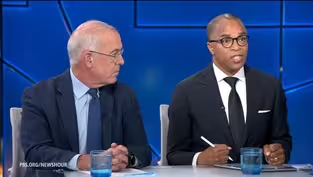
GEOFF BENNETT: For more on Donald Trump's reelection, we turn now to the analysis of Brooks and Jonathan.
That's New York Times columnist David Brooks and Jonathan Capehart, associate editor for The Washington Post.
Welcome back.
JONATHAN CAPEHART: Hey, Geoff.
DAVID BROOKS: Good to be here.
GEOFF BENNETT: So we have had a few days to assess the implications of Donald Trump's sweeping victory, winning the Electoral College and the popular vote, the first time a Republican has done that in some two decades.
David, what does his really decisive victory reveal to you about this country?
DAVID BROOKS: Yes.
I think since 2016, we have entered a new political era.
And the period between 1980 and 2016 was the information age.
And we decided that America was moving to a postindustrial economy led by college grads.
So, so many of our policies were oriented to favor college grads.
Education policy, let's get everybody near four-year colleges.
Immigration policy, let's provide college grads with cheap labor, even though less skilled people are going to face some labor competition.
Trade policy, we allowed manufacturing jobs to go overseas while service jobs were not threatened in that way.
Geographic policy, we had a laissez-faire attitude where talent congregated in Austin and Dallas and Washington and Boston.
And we didn't really worry about all those places left behind.
And so, to me, we had a policy that favored college grads and disfavored everybody else.
And basically in 2016 and emphatically last Tuesday, a lot of people said, I have had enough, we need to change.
GEOFF BENNETT: Jonathan, do you see that same kind of realignment, that the new fault line in our politics is education level?
JONATHAN CAPEHART: It's one of them.
I mean, I don't disagree with anything that David just said in terms of his analysis, but we cannot ignore what was being discussed in the last segment there with Errin Haines and Professor Dittmar.
The role of racism and sexism, misogyny, grievance, white nationalism, that was very much a part of Donald Trump's campaign.
And I think we need to acknowledge it.
We need to talk about it.
And then I think, as a country, we need to confront it.
We have never done it in our history.
We probably won't do it now.
But I think we need to acknowledge the fact that the incoming president of the United States openly ran on racist messages about fellow citizens, noncitizens, people who have always come to this country seeking a better life long before "Build the wall."
So, yes, we could talk about education realignment.
We can talk about political realignment.
But until we talk about the grievances that Donald Trump exploited, as Professor Dittmar said, we're going to be in this mess for a while.
GEOFF BENNETT: What about that, David, that that wasn't disqualifying?
DAVID BROOKS: Yes, a million things have shocked me that have not been disqualifying about Donald Trump.
I personally think Donald Trump is clearly a misogynist.
I think he's clearly a racist.
I think that's been in his family for generations, frankly.
But to make that argument, somehow, you also have to explain why the gender gap went down, why Kamala Harris did worse among women than Joe Biden did.
Somehow, you have to explain why Trump got more Black voters than any Republicans since Richard Nixon.
Somehow, you have to explain how he massively improved Republicans standing among Hispanic voters.
And so he created this broad network.
And the way I would explain those phenomenon is race and sexism were clearly major facts in American life.
But I think in our politics, class is rising in salience and race and gender are falling in salience.
And when you say people had to choose between their race or their gender for -- about white women, you're ignoring that they have brains and that they have economic views, they have social views, they have a million other views.
And so those views are part of how people make their decisions, not just an ethnic identity.
JONATHAN CAPEHART: It's all part of the stew.
And all I'm arguing is don't ignore the potatoes and the carrots while also focusing on the meat.
DAVID BROOKS: OK, I'm all for eating.
I'm on a protein diet right now, so I'm... (LAUGHTER) GEOFF BENNETT: One thing about this election stood out to me, and it's this.
In state after state, you had voters that backed both Donald Trump and ballot initiatives that advanced progressive goals.
So you had these laws protecting abortion rights that were backed by the majority of voters in most states.
You had voters in two red states, Alaska and Missouri, they approved measures to raise the minimum wage, to ensure paid sick leave.
And yet those states also voted for Donald Trump.
So voters clearly had in their minds a different picture of what the presidency meant.
JONATHAN CAPEHART: I mean, this is maybe the new form of ticket-splitting.
Before, it would be you would vote for the president of one party and then vote for the governor or the senator of another party.
Maybe it's breaking down along issue lines.
I don't know.
But, clearly, maybe those folks don't view the presidency as seriously because it feels so removed, whereas your vote, wait, my state's going to raise the minimum wage, I get to have a say in that?
Fine, I will vote for that.
Or reproductive rights, fine, I will vote for that.
Recreational marijuana, fine.
I will vote for that.
GEOFF BENNETT: How do you see it?
DAVID BROOKS: Yes, well, I will come back to my class analysis.
If you're working class, you might like a Republican against on some things.
But you also like rising the minimum wage.
You also like eliminating the tax on tips.
And the whole country is shifting to left on abortion, left and right.
And so these things are not inconsistent if you look at it, who's a populist?
And populists, they like -- they want to funnel money to working-class people, who are the kind of people who are working at minimum wage jobs.
It's also been interesting to watch the Californians vote left for president.
But on the ballot initiatives, they -- well, they threw out two progressive attorney generals and they -- in Northern California, they adopted very aggressive criminal penalties against shoplifting and vagrancy.
And so they shifted right based on the issues they're feeling at the moment.
And that's my basic view, which is why it's so important to learn from the electorate.
They are telling us something about their own lives.
And it's complicated.
GEOFF BENNETT: Well, as Democrats second-guess what went wrong, the speaker emerita, Nancy Pelosi, told The New York Times in an interview, she said, "Had the president," Joe Biden, "gotten out sooner, there may have been other candidates in the race.
The anticipation was that if the president were to step aside, that there would be an open primary.
And as I say, Kamala may have, I think she would have done well in that and been stronger going forward, but we don't know that.
That didn't happen."
Do you think that's right, or that there were just more fundamental issues about how Democrats were perceived that ended up being too much of an obstacle?
JONATHAN CAPEHART: Oh, that's for me?
(LAUGHTER) JONATHAN CAPEHART: Look, I -- this is the thing that Democrats do that drives me nuts, the finger-pointing and the blame-gaming almost immediately.
Look, what happened, happened.
And to go back and second-guess decisions that were made.
I just don't think are helpful.
I think what would be helpful is to start thinking about, how does the party recover?
How does the party go about doing what David is saying and sifting through the information that we got through the - - from the voters and then plan accordingly?
Because I don't -- as despondent -- not despondent.
As sad as I am about how the election went and particularly how people voted, it is my hope that the Democratic Party can figure out a way to reach those voters, not just the ones who didn't vote for them, but for the folks who didn't show up at all, because the one thing that I noticed is that Donald Trump and Vice President Harris got fewer votes than their counterparts in the previous election.
There's -- we also should be talking about that.
Why did so many people sit out?
GEOFF BENNETT: Well, what are you watching for as Donald Trump puts together his team and then prepares to take office again with the experience of knowing how to use the levers of power and potentially having a Republican Senate -- well, he will have a Republican Senate, but potentially a Republican House?
DAVID BROOKS: Yes, I'm looking to see how organized he is.
In the first term, there was no policy process.
And he passed some things, but it was all policy chaos.
Is it going to be like that again?
Will Republicans -- I'm most interested in NATO and in Ukraine.
Will he have, in my view, a sensible foreign policy team that -- of course, they're not going to want to spend as much as the Democrats were spending, but they still need to put pressure on Putin?
And, on tariffs, Donald Trump was vastly helped because there was an inflation.
And if he imposes 20 percent tariffs, we will have a lot of inflation.
And are the Republicans really going to walk into that eyes open?
I just don't know.
GEOFF BENNETT: Same question, Jonathan.
JONATHAN CAPEHART: They might be.
He might be more organized this time.
The one thing I'm watching for and worry about is whether the Republican majority, let's just -- assuming they also get the House - - overreach.
They are there -- if anything, they are always guilty of overreaching.
And it's just a matter of at what point will the American people say, you know what, you have gone too far?
And maybe his comments, Trump's comments today about beginning mass deportations immediately because we must do this, maybe that will be like the first sign of overreach.
GEOFF BENNETT: OK. DAVID BROOKS: By July 1, he will overreach.
I guarantee it.
(LAUGHTER) GEOFF BENNETT: David Brooks and Jonathan Capehart, thanks to you both.
JONATHAN CAPEHART: Thanks, Geoff.
DAVID BROOKS: Thank you.
AMNA NAWAZ: In the 1980s, about 70 percent of all clothes sold in the United States were made here in the country.
Today, it's down to just 3 percent, with most factories moving overseas.
One of the casualties, traditional craftwork, like weaving fabric, cutting leather and polishing gemstones.
The fashion industry is now trying to preserve these crafts.
Special correspondent Pavni Mittal from New York for our arts and culture series, Canvas.
GEORGE KALAJIAN, Owner, Tom's Sons International Pleating: You see, the cardboard is off, so you have to push it toward me.
PAVNI MITTAL: It is only her third day at work and Auden Mucher ]is getting a master class.
GEORGE KALAJIAN: We are going to take our hand like this.
PAVNI MITTAL: George Kalajian is teaching her the age-old technique in pleating fabric.
He gathers cardboard folds to mold the material underneath.
This handiwork and precision takes years to master.
AUDEN MUCHER, Apprentice: This isn't something you can learn online, especially with a tactile skill, here you need to be doing it by hand.
You can't learn it any other way.
And it's not really taught in schools either.
So you have to find a craftsman, master to be able to learn from.
PAVNI MITTAL: Tom's Sons International Pleating is a multigenerational business.
Kalajian's grandfather started it in Lebanon.
In the 1970s, when the civil war broke out, the family moved to New York City.
Experts in pleating, they work with the biggest names in high fashion.
Over the years, business has been shrinking, as companies are increasingly producing overseas.
Kalajian says immigrants made New York the fashion capital.
Now that American dream is hanging by a thread.
GEORGE KALAJIAN: We have centuries and centuries of knowledge that comes to this melting pot of New York City, where all of this technique and craft mixed together.
One by one, the artisans have been either dying or retiring or moving on.
And, as a result, the knowledge is going with it.
It's the technique.
The technique is what is dying.
Technique is something that enables you to make something efficiently and effectively.
PAVNI MITTAL: The Garment District in the heart of Manhattan was once the country's sartorial capital, packed with hundreds of thousands of workers making most American clothes.
Over the years, costs rose, work declined and most studios emptied out, leaving a few thousand artisans and traces of the industry that gave the area its name, along with an art installation in this statue, remnants of a glorious past.
Just like this district in New York City, fashion hubs around the world are seeing a decline in craftwork.
To address this, many high-end labels are investing in training the next generation of artisans, starting workshops, expanding apprentice programs and even partnering with fashion schools here in the United States.
In this workshop, traditional craftsmanship melds with modern technology.
The nerve center of creativity and innovation for iconic jewelry brand Tiffany and Co.
It's also where it trains its next generation of makers.
It's running a two-year program teaching skills like welding metal using laser machines.
The first cohort graduates soon.
Many hope to land a job at Tiffany's.
Programs like these are part of a larger recruitment strategy.
Tiffany's is owned by the world's largest luxury conglomerate, LVMH.
It is facing a record shortfall of thousands of craftspeople across dozens of brands like Louis Vuitton and Dior.
To meet its needs, it is expanding its flagship apprenticeship program, training and recruiting 2,400 artisans over the next two years.
Historically, these were based in Europe.
Now, LVMH is bringing them to the United States.
ALEXANDRE BOQUEL, LVMH: We have so many skills in the U.S. and you have so many people that are basically attracted by craft.
And we have certainly the opportunity to find new talents.
When we started the program in the U.S., we had so many candidates and we have very good results, because almost 90 percent of the person at the end of the day, at the end of the training have a diploma and almost 70 percent of the people are recruited into (INAUDIBLE) PAVNI MITTAL: Some young artisans are also taking on the mantle to save the crafts.
Gigi Burris O'Hara is a milliner.
She sources materials locally and all hats are handmade.
Once a thriving industry, it's now down to a few suppliers.
Many closed during the pandemic.
To revive it, she started a nonprofit, Closely Crafted.
It's running after school programs to inspire young talent to go behind the scenes.
GIGI BURRIS O'HARA, Founder, Gigi Burris Millinery: The work force is -- primarily are in their late 40s, 50s and 60s.
And so there's been a tremendous gap between individuals that are in this aging work force and the new individuals that are coming up.
We're talking about 10 to 20 years' difference.
And if we continue to see that work force age out, we are not going to capture that generational knowledge.
So, the time is now.
It is very critical that we can get young people placed into these jobs, that we can make these jobs stable and livable.
PAVNI MITTAL: Some initiatives are focusing on inclusivity.
Custom Collaborative helps low-income and immigrant women build careers in sustainable fashion, teaching basic skills and mentoring them when they start working.
MALAIKA AHLAM, Trainee, Custom Collaborative: They do teach you all the ins and outs of business.
And one day I would love to own my own business.
And I feel like the program offers all the training, the ins and outs, as well as the financial power.
NGOZI OKARO, Founder, Custom Collaborative: With this exercise, we're going to learn how to pivot.
PAVNI MITTAL: Custom Collaborative has trained more than 75 women in eight years, many recycling material to make clothes.
NGOZI OKARO: We're fully sustainable so everything that we make comes from a fabric that was donated or headed for landfill.
So, like, this silk came to us from a lingerie company.
PAVNI MITTAL: Ngozi Okaro the founder and an activist.
She says being eco-friendly is only part of it.
Their larger goal is to make the industry more equitable.
NGOZI OKARO: We do hear a lot from companies here in the U.S. and here in New York that there is a need for what we're providing.
And I think, especially when you get to the sustainability part of it, people are so focused on making sure that their garments that they buy and that they wear didn't infringe on anyone's rights, that they are not going to pollute the landscape.
And so we have an opportunity to really reshape sustainability and to make it better and bigger and bolder and more inclusive.
PAVNI MITTAL: Artisans are hoping the revival of craft will change the very fabric of the industry.
In this age of fast fashion, they want to restore value to creating with time, love and passion.
For this, they need to raise awareness and alter customer demands.
That, they say, will move the needle.
For the "PBS News Hour," I'm Pavni Mittal in New York.
GEOFF BENNETT: And there's a lot more online, including our "PBS News Weekly" show that looks back at this historic week in politics.
Digital producer Deema Zein spoke with correspondents Lisa Desjardins and Laura Barron-Lopez about what comes next after this Trump victory.
You can find that on our YouTube page.
AMNA NAWAZ: And don't forget to watch "Washington Week With The Atlantic" tonight.
Moderator Jeffrey Goldberg is here with a preview.
Jeff?
JEFFREY GOLDBERG, Moderator, "Washington Week With The Atlantic": Thanks, Amna.
Coming up tonight on "Washington Week," we will be discussing how Donald Trump won back the White House and what he will do with the power he's been given.
That's tonight on "Washington Week" here on PBS.
GEOFF BENNETT: And on "PBS News Weekend": how the Biden administration's handling of the war in Gaza shaped voters' choices.
And that is the "News Hour" for tonight and this week.
I'm Geoff Bennett.
AMNA NAWAZ: And I'm Amna Nawaz.
On behalf of the entire "News Hour" team, thank you for joining us.
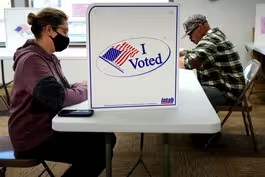
Americans discuss their election votes and views on future
Video has Closed Captions
Americans voters explain their election choices and discuss views on the future (9m 33s)
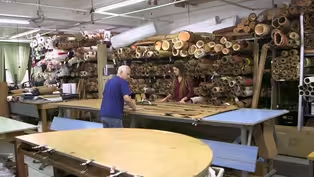
Fashion industry attempts to preserve artisan craftwork
Video has Closed Captions
New York fashion industry tries to preserve artisan craftwork as factories move overseas (7m 4s)
Some question what it will take to elect a woman president
Video has Closed Captions
Harris loss causes some to question what it will take to elect a woman president (8m 15s)
Who is the woman behind Trump's return to the Oval Office?
Video has Closed Captions
Who is Susie Wiles, the woman behind Trump's historic return to the Oval Office? (6m 7s)
Providing Support for PBS.org
Learn Moreabout PBS online sponsorship
- News and Public Affairs

FRONTLINE is investigative journalism that questions, explains and changes our world.

- News and Public Affairs

Amanpour and Company features conversations with leaders and decision makers.












Support for PBS provided by:
Major corporate funding for the PBS News Hour is provided by BDO, BNSF, Consumer Cellular, American Cruise Lines, and Raymond James. Funding for the PBS NewsHour Weekend is provided by...