Vermont This Week
November 8, 2024
11/8/2024 | 26m 46sVideo has Closed Captions
Republican victories crack Democrats’ veto-proof majority in Vermont Statehouse
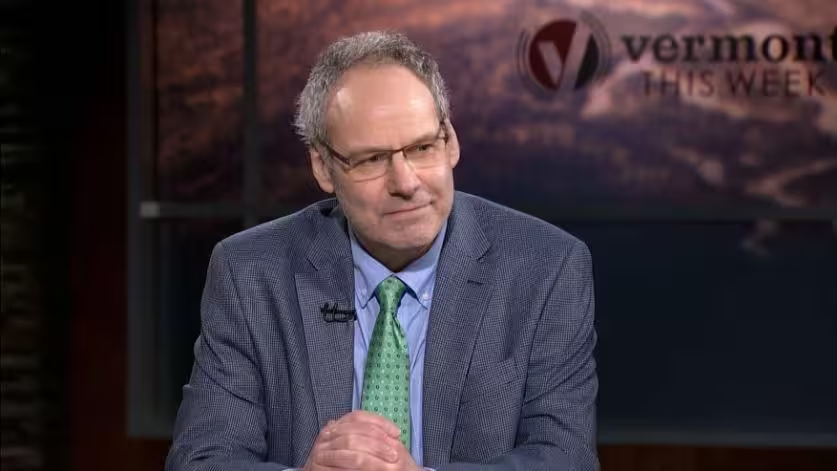
Republican victories crack Democrats’ veto-proof majority in Vermont Statehouse | Lt. Gov. David Zuckerman concedes to John Rodgers | More Vermonters voted for Trump in 2024 than in either previous election | Panel: Mitch Wertlieb - Moderator, Vermont Public; Peter Hirschfeld - Vermont Public; Sarah Mearhoff - VTDigger; Mark Davis - Vermont Public.
Problems playing video? | Closed Captioning Feedback
Problems playing video? | Closed Captioning Feedback
Vermont This Week is a local public television program presented by Vermont Public
Sponsored in part by Lintilhac Foundation and Milne Travel.
Support provided by:


Vermont This Week
November 8, 2024
11/8/2024 | 26m 46sVideo has Closed Captions
Republican victories crack Democrats’ veto-proof majority in Vermont Statehouse | Lt. Gov. David Zuckerman concedes to John Rodgers | More Vermonters voted for Trump in 2024 than in either previous election | Panel: Mitch Wertlieb - Moderator, Vermont Public; Peter Hirschfeld - Vermont Public; Sarah Mearhoff - VTDigger; Mark Davis - Vermont Public.
Problems playing video? | Closed Captioning Feedback
How to Watch Vermont This Week
Vermont This Week is available to stream on pbs.org and the free PBS App, available on iPhone, Apple TV, Android TV, Android smartphones, Amazon Fire TV, Amazon Fire Tablet, Roku, Samsung Smart TV, and Vizio.
Support the crew
Help Mitch keep the conversations going as a member of Vermont Public. Join us today and support independent journalism.Providing Support for PBS.org
Learn Moreabout PBS online sponsorshipVoters deliver an historic election night for Vermont Republicans.
As Senate and House victories crack Democrats.
A veto proof majority in the legislature.
They voted for balanced, and they voted for moderation.
They told us they can't afford the direction we've been going.
And they want lawmakers to set clear priorities, focus on the needs of all working families, small business owners and communities large and small.
Plus, incumbent David Zuckerman concedes to John Rogers in the race for lieutenant governor.
And though Harris easily won the state unofficial election results show more Vermonters voted for Trump in 2024 than either of the last two times he ran for president.
That and more ahead on Vermont this Week.
From the Vermont Public studio in Winooski, this is Vermont this Week, made possible in part by the Lintilhac Foundation and Milne Travel.
Here's moderator Mitch Wertlieb.
Thanks so much for being with us.
I'm Mitch Wertlieb.
It's Friday, November 8th, and joining us on the panel today, we have Peter Hirschfeld from Vermont Public, Sarah Mearhoff from VtDigger, and Mark Davis from Vermont Public.
Thank you so much all for being here.
And sorry it's such a boring week to have you here.
Nothing to see here, folks.
Let's just move on.
obviously stunning stuff happened, this week with the elections, Republican victories cracking Democrats veto proof majority in the state House.
Let's hear from, Jason Baluchi and then, Senator Phil Baruch talking about what happened on Tuesday.
There's going to be greater representation on the committees and a greater necessity for the legislature to work with the governor.
We hear the message from voters, and we will sit down with it.
We'll get comfortable with it, and we'll go back at it in January.
I'm going to work very hard with everybody that comes in, and we will see, what we can agree on.
Yeah, we're going to see what they can agree on, but it is going to be a very different looking legislature.
when they reconvene.
Pete Herzfeld, you've been covering the state House for so long and I have to ask, first off the bat, you know, we were talking about concerns Vermonters had coming into this election affordability, property taxes, all sorts of things.
And we knew that that folks were upset.
But did you see this sort of thing coming?
And we'll talk about what actually happened here.
But did you see this coming, this kind of red wave?
No.
I thought that Republicans would pick up seats in both the House and the Senate, as I think anybody who's been following this election did.
the magnitude of those gains, I did not see coming two years ago on this show, the Friday after the election, one of the questions we were asking is, is Vermont becoming a one party state?
Right.
We saw Republicans drop to their lowest numbers in the House in the history of the state.
and suddenly we find ourselves in a situation, where the party has rebounded in ways, that really are without precedent in recent memory.
We've never seen either party make gains of the sorts that we saw on Tuesday in at least three decades.
And, suddenly you have a resurgent, energized GOP that is ready to make its mark in Montpelier.
And to be clear here, the veto proof majority is gone.
But Democrats still have a majority.
But we have a graphic to show you about just how much has changed here.
And let's take a look at that.
You can see from 20 2324 this is the Senate make up.
Now look at it coming into next year.
How that has changed.
It seems even more dramatic when you get to the house numbers.
We're going to put that graphic up for you in a moment.
Again, 2023 to 24.
And now look what's happened.
It is a balance.
It is really shifted here.
Mark Davis, when you take a look at these numbers here, what was what was driving this, do you think, you know, we talked a little bit about affordability, but what are some of the issues you think really made these gains happen for Republicans in Vermont?
I think this is about property taxes.
And I think it was about Governor Scott, to the affordability, this is, you know, the education debate, the education funding debate that we've seen in the state, the huge increase in taxes that were felt pretty much across Vermont last spring.
there was a real moment here.
And if ever it was time for a Republican Party to seize on an issue widespread discontent, the taxes are too high, I think was this was their chance.
I think it's also impossible to under, to exaggerate how important the influence of the governor here was.
He did a lot of reporting on this this week.
He took a far, far more active role, campaigning, for candidates in the Senate, in the House than he ever has before.
He bankrolled them, he campaigned with them.
He recruited them in some instances.
We haven't seen that from the governor before.
It's almost felt like a party of one in some respects.
He sort of started to take over the Vermont Republican Party and posted results.
Sarah, Murph, I have to wonder if it's almost like Phil Scott pretty much knew he was going to win reelection.
He did win that handily.
But is this an even bigger victory for him?
What Mark was just talking about this effort to to get what he wanted to say, where more moderate Republicans into the House and Senate.
That seems like the real victory here for him.
Oh, absolutely.
I mean, there I don't think there was a legitimate question of whether Phil Scott would win reelection this year.
Let's just be honest about it.
And he indeed even blew his former election margins out of the water.
I just did a, story that's coming out today on the fact that he won by over 50 points over us or Charles did.
That's stunning.
I mean, that that is a gigantic margin.
and we've talked to so many times about the fact that Governor Scott is the most highly approved governor in the country, according to numerous polls.
But, yeah, absolutely.
The real bet that he made this year was selling the message to Vermonters.
You like me so much.
Well, my agenda can't happen if we continue with this Democratic supermajority.
You have got to get allies of mine into the state House.
And it it worked.
I mean, the evidence is very clear.
I want to stick with you on this, though.
But then I want to open it up to the rest of the panel here, because this is very interesting.
Now, we talked about property taxes, tons of sticker shock throughout the state, no matter whether you're Republican or Democrat.
Folks are upset about this.
And it's a lot of money to pay for property taxes tied to education funding.
But now the governor has what he wants.
This balance now isn't the ball in the Republicans court, to some extent.
And Governor Phil Scott, what have you heard him say about what his solution might be?
You know, what's so funny is that when I asked, his campaign manager, Jason Miller, about this, he said that that's going to be coming in the next couple of weeks.
We've got to meet, with the policy staffers and talk about those policy proposals.
So throughout this campaign cycle, to be frank, I have not heard those concrete policy proposals of how to actually address these issues.
But you're right.
And that's exactly what, Democratic leaders said in, a pretty bristly way in their statements this week.
I would say, that, you know, what you wanted, Phil Scott, you wanted, equal weight at the table.
You got it.
And now you have to actually show up with some plans.
Jason Baluchi I asked him to respond to those same, same things that Democrats were saying, because that's been the line, right?
Phil Scott has been telling you for eight years that the only reason he can, forward his affordability agenda in Montpelier is because of this darn Democratic supermajority that's standing in his way.
And Democrats like you say, say, hey, he's got no more excuses.
Jason Baluchi said the governor is happy to embrace that responsibility, but he needs Democrats to work with him in ways that they have not in the past.
So there's that still that asterisk there, right, that that Phil Scott is going to say, we can do this, but there are going to be instances where he says, and you're going to have to do it this way or it's not going to work.
The administration, Phil Scott, his people have been extraordinarily powerful messengers.
Right.
we see this guy having highest approval marks in the country year after year after year, despite, health insurance premiums more than doubling during his time in office, despite the cost of a house in Vermont almost doubling, despite the education fund going up by $800 million.
so they've got a lot of tricks up their sleeve in terms of how they're going to proceed these next few months.
and I can assure you, they have contingency plans if things don't go exactly the way they want it to.
Yeah.
He turned that word supermajority into a sort of a household term in Vermont.
I doubt most people a couple of years ago are familiar with that idea.
It's going to be interesting to see how he operates with allies with the critical mass of of Phil Scott.
Republicans, I think, for lack of a better word, those approval ratings that we've talked about for years, there's sort of always been this question.
Well, where are Phil Scott's coattails?
Where if he's so popular, why can't he drag other people with him?
Where are his successors?
Where might other people be to take the mantle from him?
When the time comes, we might start to see that.
Now we're going to talk a little bit.
I think, about the lieutenant governor who fits into this category as well.
But to see a governor operate with with people who are aligned with him, who owe their office to what he's done, I think it's going to be fascinating to watch.
I also just spin on the note that Pete had on about messaging.
It is so clear that Republicans hit the nail on the head with messaging this cycle, and not just in Vermont.
This is not happening in a vacuum, too.
I mean, we saw a shift to the right nationwide, right, in this election.
And clearly, Vermont Republicans, whether they even knew the extent of how right they were on that during the campaign cycle, I frankly think is up for debate because they even seemed shocked, pleasantly shocked on Tuesday night.
but I talked to David Glidden, the chair of the Vermont Democratic Party, this week, and he admitted that, the governor was consistently hitting on this point of affordability, affordability, affordability.
And when Democrats went door knocking, they were happy to talk about the environment.
They were happy to talk about reproductive health access.
They did not have a counterpoint on affordability.
And he he convinced Republican candidates to stick exclusively to the issue of affordability.
Right.
We didn't see any culture war debates happening in these down ballot races.
We saw Republican candidates talking about taxes, talking about the cost of living.
that's one of the things that has hurt them in a state like Vermont.
That's not a road you want to go down.
It's not a recipe for electoral success.
And what Phil Scott did this year is show a new playbook to the Vermont GOP, which has, for a number of years been going further and further right in terms of the people that are, in control in elected, you know, chairmanships in that organization.
and he's hoping that this is a lesson for them, that this is a new model that they can follow so that this isn't a one year, one off, that this is something that they can sustain over time.
I do want to unpack some of what, you and Sarah were just talking about there.
This idea about, you know, does this reflect what happened nationally?
You know, I have some doubts about that.
There were what I call Vermont Republicans.
And then, of course, what we saw happen nationally.
We can get into that in a moment.
I do want to talk about David Zuckerman, too, but quickly, before we, you know, get off this topic of what the legislature will look like, in 2025, I want to know from all of you if you think that this change here is going to have any impact on the race for House speaker, because we saw an, I guess, an odd challenge from, independent Laura Sibley of Dover saying that she would like to challenge, Jill Kruczynski for the House speakership.
this is something that the people don't vote on.
It happens in the legislature.
Is there any chance now that that's not such a long shot for, Cecelia?
Sir, I think that with the shift that we saw, that definitely the the probability has changed.
I think also that, Representative Sebelius, it's she's not a Republican, and I would not say that she is a universal friend of all Republicans in the building.
And so I would not place my money on 100% of Republicans getting behind her easily.
That being said, clearly, I think there is a message that was sent to, Vermont legislative leadership that, it was almost, I would say, a referendum on on the, the track that they have been taking over the past two years.
And I think that they're kind of reading the room on that.
Yeah.
the other thing is that in these down ballot races, I'm quite shocked, actually, how many longtime incumbents and committee chairs were unseated.
And those are allies of Speaker Quincy's and that's interesting.
And so I would be thinking very hard about that, frankly, if I were on her leadership team.
Are you thinking about folks like Chris Bray, for example?
and some others from the Senate?
But, Diane Lamphere was unseated.
She's the chair of House Ways and Means.
We could go down a whole other rabbit hole about the loss of institutional knowledge.
I mean, Senator Jane Kitchell willingly retires this year.
those are two of our four money chairs out of their seats.
there's a whole downstream impact of that.
But, Mike McCarthy was also unseated.
He is someone that's very close, I would say, with Joe Quincy.
this is this is definitely a shift.
I think, in the alliances in the building.
Mark, let's talk about David Zuckerman for a moment.
He has conceded formally to John Rogers, but also pointing out that there's an oddity in, the legislature about because neither of them, Zuckerman nor John Rogers, got 50% of the vote.
Yeah.
Speaking a rabbit hole.
So we could probably do one on the definition of the word concede it.
effectively, yes.
As you noted, he's knocked it over 50%.
The Vermont Constitution says, therefore, that has to be decided by the legislature, usually thought of as a rubber stamp.
No big deal sort of situation.
the David Zuckerman has noted that they would be within their rights to, to do something different.
There was a third party candidate, Liberal candidate, who took, a decent chunk of the votes in diamond Stone.
Yeah.
stone.
Forgive me.
Right.
So there is a there is an argument that could be made that was made a little bit this week that well, if you added those votes to David Zuckerman's votes, he would be the winner.
to be clear, he's saying he won't lobby legislators for it.
He recognized that John Rogers won this race.
We've seen statements from the Democratic Party chair to recognize the will of the people.
So it seems extraordinarily unlikely that this would get contested a couple weeks from now.
It's it's perhaps a distinction without a difference at a certain point here.
But he he did leave just a little bit of that wiggle room.
That race is interesting because I think it distracted all of us in a way.
That was the closest race we thought, you know, and it was, you know, it was a we saw the graphic there, 49% to 47%, but it kind of took the attention away.
It feels like from everything else that was happening, like Pete was talking about earlier, not seeing this, this huge red wave, coming.
and it absolutely happened.
most statewide incumbents, though, did win reelection in Vermont.
Bernie Sanders, Becca ballot easily won their U.S. Senate and House seats.
But, you know, things could be changing, certainly for our senior senator, Bernie Sanders, chairman, currently of the health, Education and Labor Pension Committee, probably going to be stripped of that when, things get back.
in 2025, in Washington.
So his role may be diminished there.
But, Mark, I want to stick with you briefly on this question of Bernie Sanders.
While his role may be diminished in the US Senate, for chairmanships and things like that, he has made some pretty bold statements about the election nationally.
and what do you think his role may be moving forward for the Democratic Party?
I know he's not a Democrat, but I know for sure.
And yeah, he's going to lose that chairmanship, no doubt.
But Bernie's power has never really been rooted in someone who pulls the levers in Capitol Hill in a way that say, Senator Leahy was right.
His his popularity, his influence, his power comes from his message comes in those two presidential campaigns.
Bernie, I think, wakes up this Wednesday as one of the most popular, well known Democrats left on the national stage.
President Biden is going to be stepping away.
The vice president just lost.
there's going to be a real rebuilding moment here for the Democratic Party.
and that moment, that conversation is already starting to focus on the loss of working class voters.
it's starting to focus on sort of the Democratic establishment, and, and, and those are two targets that Bernie Sanders has several decades worth of receipts for speaking out against.
He put out a really, really interesting, aggressive statement Wednesday, pretty much blasting the Democratic Party on those two points, on losing working class voters, on losing touch with them.
It's the same thing Bernie's been saying for a very long time.
so that conversation might really be coming.
His way at a time when there is a leadership vacuum, I think, in the National Democratic Party.
it's interesting.
I he's 83 years old.
I actually asked him on Election day, is this the last time we see you on a ballot in Vermont?
He's getting that age.
And he chafed at that even more than he usually chafes at questions like that.
And as the days went on this week, I was like, he may have seen this coming or that if Kamala Harris were to lose his profile, his influence might only grow.
The statements he's putting out this week are certainly hinting that he's going to be center stage here the next couple of years.
And that chafing, I guess, maybe really shows that, maybe he's trying to tell you, like, I'm still Bernie.
I've still got it.
I'm still doing what I do.
What do you think about, his message moving forward?
Are Democrats nationally going to listen?
Do you think, we're going to find out, right.
there's no shadow cabinet in a smoke filled room that makes the big decisions about where the Democratic Party goes from here.
As Mark said, it's going to be a free for all, and there going to be all kinds of people vying for influence.
When these critical decisions are made about what direction is this party going to go in?
and I think it's a similar conversation to the one that Democrats are going to be having in Vermont.
Sanders statement kicked off with him saying it should come as no great surprise that a Democratic Party which has abandoned working class people would find that working class people have abandoned them.
And, you wonder if that's not a statement that is going to be in the back of the minds of Vermont Democrats as they think about what went wrong in 2024 and how they can get it right in the future.
And, you know, not for nothing.
But Vermont's junior senator, Peter Welch, was echoing a lot of those same messages.
He was sort of desperately trying to tell the Harris campaign in those last couple of weeks before the election, pound the economic message, tell people while you while why the Democratic Party will be better for your pocketbook.
And he was saying, you know, don't talk so much about the danger that Trump poses.
so he was kind of reflecting that too, I so I think Peter Welch is sort of maybe not the same as Sanders, but a little bit on board with that same kind of message.
You think?
Yeah.
No, I think that's fair to add on to the statement Pete read, from Bernie.
He gave an interview to The Times a couple of days later in which he explicitly called out what he says is an overreliance on identity politics and Democratic Party.
Fascinating.
Strong statement from from something of a liberal icon.
This is this is gonna be a fascinating debate to watch.
And I think Bernie's gonna be right in the middle of it.
Interesting, too, that more Vermonters voted for Trump in 2024 than the other previous two times that he ran for president.
so, Sarah, if you were talking before about mirroring sort of what happened here in Vermont and nationally, is there a correlation here?
I mean, do you do you see some sort of shift in the way that that the people are thinking about democracy, about what it means to elect someone like Donald Trump?
in this kind of atmosphere?
I don't know if every voter, when they hit the booth is necessarily thinking about capital democracy.
To be completely honest with you.
I think that a lot of people, when they filled out their ballots this year, were thinking, I'm hurting, my family is hurting.
I can't pay my bills.
I can't afford the groceries I used to be able to.
I need a new roof and I can't get it over my head.
I think that's what people were really thinking about, frankly.
And, I think that a lot of people, voted for change, whether whether that will transpire the way they think it will or not.
I don't know about that.
but I think that's what really was on people's minds when they cast their votes this year.
And I think that you can draw some parallels between, what happened nationally and then what happened, in Vermont, I've seen some reporting nationally about, worldwide, even not just in the United States.
many elections this year saw, a mass shooting out of incumbents.
This is a trend that's happening all around the world.
And I think that there is just a growing movement of people saying what what we have is not working, and we need to change in some fashion.
Well, we're going to find out about a lot of things at the time.
We're going to tape here.
we know that President Trump has won.
That's the executive branch.
We know that Republicans have taken back the Senate.
We do not know which party has control of the U.S. House at this moment.
Assuming let's say let's take a hypothetical here.
The Republicans do win the House.
Now.
They've got control of all of it.
There has been talk about a federal abortion ban.
There has been talk about some other sweeping changes that could happen.
Now, Vermont has it written into its constitution, protected right to, reproductive freedoms.
But, Sarah, would that go away with a federal abortion ban?
it all comes down to enforcement, really.
Right.
I mean, if the federal government takes, a posture of really fierce crackdowns, if they were to institute a national abortion ban, it depends on how they choose to execute it.
Right.
and so I think that you could and, you know, quite an extreme scenario.
See, a level of federal surveillance on Vermont doctors.
You could see a surveillance on people's travel.
people's use of their, menstrual cycle, tracking apps and whatnot, their location on their phones.
this is kind of like the the really, like, deep in the rabbit hole kind of think.
Right.
or there could be a more hands off approach, say, like, you know, marijuana remains illegal on the federal level, but it's legal here in Vermont, and people partake of it.
Right?
So it really depends.
I mean, so much of the the federal government action really just comes down to, it's a decision on how, to execute.
Well, there's also talk about and in the Department of Education, things like that.
So, you know, again, there could be some big changes coming.
Yeah.
I mean, and we've also heard about the biggest mass deportation in the history of the United States.
we have an agricultural economy in this state, the dairy industry in particular, that is in many ways almost wholly reliant on labor, on the labor of Vermonters, who are not in this state legally.
if we were to see that mass deportation materialize, you know, to the nth degree, there's a scenario in which Vermonters are arrested in the communities that they live in.
Many of them have been there for a long time now.
They have children that are in our schools.
and there's a dairy industry that is relying on them.
So so there's a potential for one federal action that could have significant humanitarian and economic impacts on the state.
And, of course, closely related to that, we have a border as well.
It's not the one most people think about when they hear these conversations nationally.
But there has been an uptick in crossings across that border.
so you have that we have an Ice facility here in Vermont as well.
So I think as you're referencing the mass deportations, we we would maybe be a part of that.
but again, we don't know.
And, and we're going to find out and I'm not trying to scare anybody.
It's just that, you know, it's been a pretty, let's say, interesting ten years.
And that's, to put it mildly, you know, we've seen things happen that I don't think anybody could predict have happened.
And it's something to consider.
And, you know, just circling back to this, abortion situation, California Governor Gavin Newsom has called that the state legislature in California in order to put protections for reproductive freedom in that state.
So it's not as though, people are saying that this couldn't possibly happen.
And we're going to have to see how this all shakes out.
Of course.
just final thoughts from the three of you on, what has happened here.
And also, let's bring it back to Vermont very briefly.
Can the Democrats and Republicans work together here because everyone's going to be watching them now.
Politics is the art of compromise.
Nobody ever gets what they want with a compromise.
But isn't that the challenge before both parties right now?
sure it is.
And I think it comes at a time of great urgency.
I think specifically in the education funding, issue, which is has escalated, I think, dramatically in the past couple of years.
They're going to have to do something.
I mean, the early forecasts are that the school budget situation that was quite severe last year might be quite as bad, if not worse, this year.
There are some issues that are going to demand immediate attention.
Will they come together?
I defer to the state House experts on that.
Really?
Well, one of Laura Sebelius main points and running for speaker is she's concerned about the toxic relationship between the administration and law in the legislative branch.
If there's going to be meaningful bipartisanship, meaningful progress on these issues, the oil and water nature of some of those relationships is going to have to get fixed.
And I mean, I have linking it back with the the federal staff, one of the talking points of the Trump campaign has been dissolving the U.S. Department of Education.
And if that happens, I mean, our our education funding system, forget about it.
Another wrinkle there.
we've run out of time.
So much to talk about.
But thank you so much, everyone.
Sarah Mearhoff from VTDigger and for Vermont Public, Peter Herdhfield and Mark Davis, I'm Mitch Wertlieb, thank you so much for tuning in to Vermont this week.
I hope you'll do so next week as well.
Have a great week.
In the meantime, we'll see you next week.

- News and Public Affairs

Top journalists deliver compelling original analysis of the hour's headlines.

- News and Public Affairs

FRONTLINE is investigative journalism that questions, explains and changes our world.












Support for PBS provided by:
Vermont This Week is a local public television program presented by Vermont Public
Sponsored in part by Lintilhac Foundation and Milne Travel.