
Now Entering... Marion
2/13/2026 | 26m 45sVideo has Closed Captions
Welcome to Marion, Indiana. Home to sports legends, historical legends, and a growing arts scene.
Welcome to Marion, Indiana. Home to sports legends, historical legends, and a growing and vibrant art scene. Today we’ll learn from historians about Marion’s unique history with the abolitionist movement, and find out why Harley motorcycles are called “hogs” today.
Problems playing video? | Closed Captioning Feedback
Problems playing video? | Closed Captioning Feedback
Now Entering is a local public television program presented by Ball State PBS
Now Entering... Marion
2/13/2026 | 26m 45sVideo has Closed Captions
Welcome to Marion, Indiana. Home to sports legends, historical legends, and a growing and vibrant art scene. Today we’ll learn from historians about Marion’s unique history with the abolitionist movement, and find out why Harley motorcycles are called “hogs” today.
Problems playing video? | Closed Captioning Feedback
How to Watch Now Entering
Now Entering is available to stream on pbs.org and the free PBS App, available on iPhone, Apple TV, Android TV, Android smartphones, Amazon Fire TV, Amazon Fire Tablet, Roku, Samsung Smart TV, and Vizio.
Providing Support for PBS.org
Learn Moreabout PBS online sponsorship(music) Welcome to Marion, Indiana, home to sports legends, historical legends, and a growing and vibrant art scene.
From being the Home of the Hog to the Kennedy Arts Center, to their basketball state championships, Marion has the secret sauce to an amazing blend of art, history, and athletics.
Get ready for the tip-off, because you are Now Entering... Marion.
Now Entering is made possible by Nick McKinley State Farm, Marion Design Co., Grant County Visitors Bureau, Los Amores Restaurant & Cantina, Atlas Foundry, the Kennedy Art Center, Tashema Davis Art, and by the Community Foundation of Grant County, First Farmers Bank & Trust, and Norris Insurance.
With additional support from the Psychedelic Cellar, the Marion Arts Commission, Abide Collective, Greater Grant County, Bobby Browder Edward Jones, and Dillman's Furniture & Mattress.
- (Andy) It was right after World War I in the late 1910s.
Motorcycling was coming back and everybody had come back from the war and the popularity was pretty good.
- A local motorcycle aficionado named Glenn Scott had a Harley-Davidson dealership in downtown Marion and decided that hosting a motorcycle race would be a great way to draw people to the community.
- And they got a bunch of sponsors together and a plan and pitched it to the sanctioning body at the time.
- They're telling all the leading manufacturing motorcycle teams, "You're not competing in Marion, you're not competing."
- (Andy) And at that time Harley was fairly dominant along with the Indian and Excelsior, all three American companies.
- (Loretta) They've built the racecourse just outside the city limits in Marion on roads that exist today.
They're just paved into county roads.
- (Kelsey) The first year they had over 15,000 attendees to that motorcycle race.
- (Loretta) In 1919, we're not at the Home of the Hog yet, but it's a big year.
The very first year Harley-Davidson sweeps the podium.
They get first, second, and third place.
- (Andy) They were known as the Wrecking Crew at that time.
I think they had some really bad wrecks in the 1910s on the board tracks, if you wrecked, the odds of surviving would not look good.
- (Kelsey) The second year Harley-Davidson won.
The winner was a man named Ray Weishaar.
And Ray, when he arrived in Marion had wanted a piglet.
- (Loretta) He's telling everybody, "I want a piglet before I leave here."
- (Andy) Hog farming is pretty big in this part of North Central Indiana, so that's not a stretch to believe that story.
- As soon as Ray won, his first question was, "Where's my pig?"
And he named his piglet Little Johnny, and he took Little Johnny on a victory lap around the racetrack.
He and his wife took very good care of Little Johnny from what the newspapers tell us.
- And this little piglet, he's kind of a staple.
When you see the Wrecking Crew, you knew Johnny was nearby.
And it wasn't long before reporters started using that.
So, now the Wrecking Crew, they've become the Hog Boys and the Harley Hogs.
- (Kesley) And over time it became a term for Harley-Davidson Motorcycles, which is why we call Harley-Davidson's Hogs today.
- (Andy) Really neat.
Historically, that hog has become such a big thing, because it's associated with that brand name.
- I mean, they throw it in wherever they can, right?
They're owning it.
And not long after that, Harley-Davidson's like, "There's something here.
We got to use this, right?"
So, now we have the Harley Owners Group, which is worldwide.
They're stock, it's H.O.G.
Not HD, HOG.
- All started in Marion.
- (Bill) I was thinking that the origins of Marion, and I would like to say that it was the arrival of the Miami Indians.
First with the Land Ordinance of 1787, then the Northwest Territory, then there was the Louisiana Purchase, all part of America's expansion.
The problem was that there were people already there.
Thomas Jefferson and William Henry Harrison, they established a policy designed to set up an exploitive relation with trading posts, and the idea was to get them indebted and dependent on the trading posts, which indeed did happen.
So, Harrison and the Army moved in with explicit orders to force the indigenous people, in this case Miamis, to move off of this land and secure the land by treaty.
First allowing them to settle and wiping out their debt.
But if that failed, they were to forcibly remove them.
And that's what happened, and that was the Battle of the Mississinewa.
The ostensible reason that Harrison put out was that somehow the Miamis were allied with Tecumseh, and Tecumseh was really a military genius, a Shawnee by background, all right?
So, he was organizing a massive resistance, and this impelled William Henry Harrison to get the move on and get these people out of here.
The Miamis were actually misrepresented in this case, because they refused to join with Tecumseh.
They said they would rather be a neutral party and try to work something out.
And I don't think Harrison was in the mood to listen to that.
Major, major event in the history of the United States.
The battle itself was one action in that, but it was still important.
What it ended up with is the Miamis removed, and in 1870 they were no longer recognized as a tribe.
All recognition went to the folks that were first in Kansas and then in Oklahoma.
So, it's a long, and I think rather tragic tale.
- Kennedy Art Center is a local art gallery.
Its mission is to make art visible, help fund the shows, facilitate the shows, brand the shows.
- So the Kennedy Arts Center to me is a very special place.
I've had some great moments here.
It's fairly new.
It's only been here for a little over two years.
The art scene in Marion right now is a little dispersed, but it is growing, and the focus of the Marion Arts Commission is to bring arts and artists to the city of Marion.
- We have lots of really amazing artists that do really awesome things, and I think they kind of show their art in bigger cities, but they stay and make art here.
And it is really, really awesome stuff.
- We had the exhibit for People Make Place go up in early October.
- (Henrik) It was one of those things that it started small and then it just got bigger and bigger and bigger.
Initially it started with this seed of paper, and so I was thinking about paper and the ways that paper carries stories in our lives.
So, it started with a little collection box right over there, and all kinds of people came in and donated pieces of paper that had a story attached to them.
We told people that these would be photographed and then they'd be ground up in a machine called a Hollander machine that turns them into a paper.
And those went to Tashema Davis' middle school art students.
And so, they used oil pastel to draw on those with images of what made Marion home.
- (Tashema) Some kids drew an actual house and then other kids drew things that makes them feel like home.
I remember I had a kid who was into boxing, so he drew boxing gloves.
And then other kids, like school is home for them, so they would draw the Giant or Marion Giants and those type of things.
- And then those got collaged into these maps of the people here.
So, they're maps of Marion, maps of Grant County, but just according to the stories here.
(Music) - I have my third Ma exhibit, and it's going to be here at the Kennedy Arts Center, and I'm super excited about it.
I love painting brown skin, and I particularly love painting women, because that's the subject I know best.
And I was kind of bored with just painting things that I loved.
I wanted to make it meaningful or impactful, so I decided to turn it onto the community, and I asked the community if they had 10 women of color that they would like to nominate.
A lot of people got on board and I ended up painting 10 women, and then I was asked to do the show again and asked to do the show again.
So, this is the third time.
The art scene started off pretty rough here in Marion, and I was determined to show art.
And I think it was kind of hard in the beginning to say that Marion had an art scene, because I felt like everyone was still in hiding, like, "Oh, we don't have anywhere to display.
Or we don't have anywhere to sell our work.
Or nobody cares here."
And I'm like, "That's not true.
We do care."
So, I made it my mission to do something about it.
- Marion supports the arts.
Our mayor is an artist.
We have city council members who are artists, and so we have people in our local government that are creatives and understands the importance of an arts community.
It's a bit cliche to state, but the reason why I believe Marion has its current art scene is it's a vibe.
It really is.
- What I've come to realize is I think Marion has faced a lot of adversity.
I think a lot of art has come from fighting against that adversity.
When there's adversity, you make art to feel better about it.
You make artist therapy or you make art to make the place more vibrant.
- (Matt) There are people that see Marion as this arts community, and that's what we're working on is trying to get people to recognize who we are and what we are.
- Coming up.
We hear about Marion's legendary basketball history and learn about Marion's ties to a free Black settlement from the 1800s.
But first a word from our sponsors.
- Nick McKinley State Farm State farm proudly serves Marion, Indiana and all Grant County communities since 2016.
Nick McKinley's office specializes in auto, home, renters, and life insurance.
Nick McKinley, State Farm.
Learn more at.
NickHasMyBack.com.
- Marion Design Co is a creative studio rooted in downtown Marion.
Partnering with people and organizations to tell meaningful stories through design.
Services include brand identity, graphic and web design, and services that support your brand story.
More at MarionDesign.Co.
- Grant County, Indiana, home to Marion, brings the region together with lots to do and places to enjoy.
Whether you're here for a day trip, a weekend stay, a tournament, or festival, there's plenty to do and an easy home town feel.
- Los Amores Restaurant and Cantina in downtown Marion's Boston Hill Center serves authentic Mexican cuisine with a lively music scene.
Open 11 to 9 Monday through Thursday and 11 to 10 Friday and Saturday.
Catering is available for weddings, parties and all celebrations.
- Atlas Foundry was established in Marion, Indiana in 1893 by M.F.
Gartland and has been run by the Gartland family for over 130 years.
The foundry produces gray iron castings for industries like agriculture, trucking, water infrastructure and stadium seats.
The Kennedy Art Center's mission is: make art visible.
Located in the heart of Marion, Kennedy Art Center celebrates the artists, designers, and creatives of Grant County through rotating gallery exhibits, public events and shared creative experiences.
Learn more at KennedyArtsCenter.Co.
Fine artist Tashema Davis is a full time artist and art teacher, published author and illustrator.
Tashema specializes in commissioned work, portraits, murals and children's books.
Tashemas online gallery is at TNicole.com and on Facebook and Instagram at Tashema Davis Art.
Thank you to our sponsors.
Now, let's get back to Marion.
- (Morrell) If you cut a Marion resident open, it bleeds basketball.
That's all we talk about.
That's what we live.
So, ever since you were a young age, you dream of being a Marion Giant.
Indiana as a whole takes high school basketball specifically really serious.
And in this small town of Indiana, this was one of the only sources of entertainment people had for a long time.
So, that Friday Night Fever, people would look forward to that.
And Marion has one of the largest high school basketball arenas in all of the United States.
As far as I know it's been there all of my life.
And I know that the Giants specifically, I think is credited to Stretch Murphy, one of the tallest players in early high school basketball.
And that has truly stuck with the city the whole entire time.
This idea of us being the Giants.
It's truly shown to be true.
Marion has had the privilege to win eight state championships, and we are actually tied for first in the state.
The Purple Reign area in the Cit of Marion was before my time.
But the stories and the legends that I hear from that seem like such a magnificent time for the city, because we're able to pack out a 7,500 people arena every single weekend, filled with fans and citizens alike that were just so enthusiastic about the Marion Giants.
And in order to be able to win three state titles in a row was a tremendous accomplishment that no other city or school had done at the time.
- The Marion Giants had just picked up their fourth state championship.
- The game is over.
- Giant history.
- With their third successive state championship - The purple and gold reigns supreme.
- The culture around the town during that time had to be magnificent.
When you hear the stories and you go to the barbershops and you go to the parks, when you go to any place in Marion, those that were alive did get to experience that.
They talk about it like it just happened yesterday.
So, it was such a enthusiastic time that the culture of our city was really built around the success of the high school basketball team.
I did play basketball.
I got to play at Marion for one season, and it was great.
What inspired me to want to play basketball, growing up in Marion, since you come out of the womb you get handed a basketball.
In my professional life now when I get to travel around the United States.
And when you mention Indiana and mention Marion specifically, one of the first things that comes up, "Oh, basketball."
People, I think one of the sayings is that in 49 other states it's just basketball, Indiana, this is like our heartbeat.
- My name is Jamie Pitt, and I'm the director of the Marion Public Library and History Center.
- Hi, I am Kelsey Winters.
I am the head of museum services and special projects at the History Center of Marion Public Library.
- (Jaime) So, the library was started in the late-1800s, but the permanent building wasn't built until 1902.
It sits at the corner of Washington and Sixth Street, and it was established through funding from Andrew Carnegie.
He gave the town $50,000, with the agreement that the city continue investing in the library throughout the continuing years.
So much history, so much history in that building.
It's over 100 years old.
The rooms are fantastic.
There's a Carnegie room.
The architecture is just beautiful.
It's a beautiful building.
The Carnegie Library lasted a long time, but we eventually ran out of space.
I heard a staff member this week say, "We were shelving books on the window sills," and so it became necessary for us to build a larger library.
And so, in the 1990s the new library was opened, but then we had all this open space in the Carnegie building, and that's when the decision was made to make it into a history center and museum.
- (Kelsey) When the current library building was constructed, they moved everything over there and then had this beautiful library building they needed to fill, and they decided to open a local history museum.
When our museum opened in the mid-'90s, it opened with an already existing collection that had been held by the Grant County Historical Society.
They had had a small museum at Matter Park for a number of years, and then in the '70s that museum was demolished and the items were put in storage.
So, when our museum opened at the end of that century, they had an already existing collection that needed a home, and we were able to provide that for them.
- (Jaime) There have been recent renovations to both the museum and the library.
The Carnegie Building was built in 1902.
It's over 100 years old, and we are looking at repairing the masonry work this year.
Our courtyard and our children's courtyard were improved this past year.
We've added color, we added AstroTurf, we added colorful benches and planters, and we just wanted to make it a space for the community so that it would be more inviting for them.
They love the library, and that's why we do so much community outreach.
We get to be a part of what Marion is doing.
The library will continue to focus on community-based programming.
We'll continue to invest in our local history and keep working on that Carnegie building, bringing it back to its former glory.
That's the goal.
- The Weaver Settlement was a free Black community that was founded in the 1880s.
The settlement was, my ancestors, they were builders, they were farmers, they were doctors, lawyers, school teachers, clergymen.
This settlement produced institutions that anchored the community.
It anchored it in such a way that they not only survived, but the settlement thrived.
- The Underground Railroad, I think, was a major development with the anti-slavery movement in general.
It involves the Quakers, the Society of Friends.
Its said that over 90% of the original settlers of Grant County were members of Quaker meetings, so they brought their anti-slavery attitudes with them.
They were bringing former slaves across the river, okay, all the way up to northern Indiana, and then across up to Detroit, and then across into Canada.
And it was widely participated in by Quakers in this area.
- (Torri) So, the Weaver-Pettiford family came to settle in Marion by no coincidence.
This was not by accident, it was planned.
They worked with the abolitionist movement, so it was very strategic and courageous that they came here.
And they set up in Grant County primarily, from my understanding, because they were sold land, the Quakers sold them land.
And so, during a time when land ownership was very rare for Black folks and often resisted.
- There were people who were escaping slave states and seeking their freedom in the north.
There were people who came to Weaver on the Underground Railroad.
There were a number of white abolitionists in the community around Weaver.
- (Bill) Okay, so by the time the Civil War rolled around, it was a thriving farm community.
- (Torri) The first Pettiford Weaver family reunion was August the 17th, 1919.
That would have been the third Sunday in August.
And we have had a reunion every year since, and it's always on the third Sunday in August.
First of all, we'll be celebrating our 107th family reunion this year, and I believe it's on August the 16th this year, 2026.
The first thing we do with our reunions is we honor our ancestors and our elders, and then we go into storytelling from the past, the present.
The reunions basically are the heartbeat of our legacy.
The first family reunion was at my great-great-great grandmother's house, and grandfather, Martha and Joseph Pettiford.
So, the story that had been passed down to me from my grandmother was that the youngest child was at home and one of her older brothers came home.
And when he came home, the car dropped him off and he had to walk down the long driveway, they called it a lane back then.
And as he walked she ran to the house.
She was outside playing, and she was yelling, "Mama, mama, there's some man in coming down our lane."
And she didn't know who he was.
And so, when my great-great-great grandmother looked out, she recognized that it was her son.
And because her daughter, her youngest daughter didn't know that that was her brother, that touched her, as well as she missed her own children.
And so, from that day forward she reached out to all of her children and said she wanted everyone to return home on the third Sunday in August.
- There are a large number of people in Marion and throughout Grant County, but specifically in Marion, who trace their ancestry to the town of Weaver still.
- (Bill) As the county changed, like the gas boom and so on, a number of folks from Weaver moved to town.
Now, they still kept their connections with Weaver, but then they participated in growth and development of Marion in some very significant ways.
- (Torri) I've lived in Marion my entire life, with the exception of a few years.
But I did return, and I'm glad that I live here in Marion, because there's not a street that I ride down, there's not a corner I turn where I don't have some memory of my family.
When I think what it means for me to be a descendant of the Pettiford-Weaver family, the first word that comes to mind is pride.
Just prideful.
Prideful, and I'm full of gratitude.
- (Morrell) Marion has changed in the last five years, because we've invested heavily into three things.
One being public safety.
We've made that a paramount issue for us to make sure our police and fire are well-funded.
Second, we've invested into quality of life.
We have invested into our park systems.
We have over 15 parks now.
And lastly, we've done a major haul in investment into housing.
So, those three things put together has really shifted the narrative of the city and what the landscape of Marion looks like.
- (Loretta) What I love about being a business owner here and how we can foster that growth.
From an economic development standpoint, my job with the Growth Council, I feel like it's really easy for a business to come here with an idea, to get in the sandbox and play and develop a skill set.
And then once you figured it out, there's plenty of resources right at our disposal.
Marion's the county seat.
- So, Marion supports the arts, and it starts at the top.
And thankfully, we have leadership here in our community that are creators themselves and they want to support other creatives.
And they understand that that then helps local businesses downtown.
- We have an economic developer that's a DJ, a mayor that's also a drummer, a city council member that's also a bassist, and that exists throughout Grant County.
These labels that just cross over, we don't have to pick a thing.
- The concert series that the Marion Arts Commission is going to be funding this summer, that is intentionally set up so that we get families, people that are just looking for something to do on a Friday evening to come downtown to eat at one of our local restaurants, to enjoy some free music.
And then if you want to go grab a pint over at The Old Fitz, have a beer there.
You want ice cream, you can walk right down the alley.
We're trying to create something where if you have a family, if you're single in your 20s, or if you're 70, everyone can come down and have fun.
- (Morrell) I love Marion, because it is a city that's been through many trials and tribulations and ups and downs, and the people here still stand tall and work hard every day to make sure that this small town in Indiana lives on and continues to be an important part of the overall makeup of the state.
- I love Marion, because people here love working together and collaborating on ideas that just get bigger and more spontaneous is more people get involved.
- So for me, Marion, the biggest thing that I absolutely love would be community.
I think here in Marion, a lot of us are like-minded and a lot of us want to see beautiful, positive things happen.
- I love Marion, because the people here are really invested and continuing to make our community a better place.
And there's a really large supportive community of people who want to collaborate together.
- I love Marion, because it is an open, limitless place.
- I love Marion, not because it's the place where I grew up, but it's also where my family settled.
It's where my ancestors carved out land with their own hands.
It's a place where I can continue their legacy.
Now Entering is made possible by Nick McKinley State Farm, Marion Design Co., Grant County Visitors Bureau, Los Amores Restaurant & Cantina, Atlas Foundry, the Kennedy Art Center, Tashema Davis Art, and by the Community Foundation of Grant County, First Farmers Bank & Trust, and Norris Insurance.
With additional support from the Psychedelic Cellar, the Marion Arts Commission, Abide Collective, Greater Grant County, Bobby Browder Edward Jones, and Dillman's Furniture & Mattress.
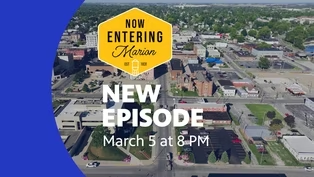
Now Entering... Marion Trailer
Video has Closed Captions
History, sports, art, and more! Marion, Indiana has it all. (30s)
Providing Support for PBS.org
Learn Moreabout PBS online sponsorship












Support for PBS provided by:
Now Entering is a local public television program presented by Ball State PBS