
Nursing Homes Latest, Sen. Jim Tedisco, Parole Reform
Season 2021 Episode 6 | 26m 46sVideo has Closed Captions
Reports say the Cuomo administration had long-sought data on nursing homes for months.
Reports say the Cuomo administration had long-sought data on nursing homes for months but didn't disclose it for political reasons. Reporters Karen DeWitt and Bill Mahoney discuss. Republicans in the state Legislature want Democrats to hold hearings on COVID-19 in nursing homes. Sen. Jim Tedisco joins to explain. Hear about potential changes Democrats are considering for the state's parole system.
Problems playing video? | Closed Captioning Feedback
Problems playing video? | Closed Captioning Feedback
New York NOW is a local public television program presented by WMHT
Support for New York NOW is provided by WNET/Thirteen and the Dominic Ferraioli Foundation.
Nursing Homes Latest, Sen. Jim Tedisco, Parole Reform
Season 2021 Episode 6 | 26m 46sVideo has Closed Captions
Reports say the Cuomo administration had long-sought data on nursing homes for months but didn't disclose it for political reasons. Reporters Karen DeWitt and Bill Mahoney discuss. Republicans in the state Legislature want Democrats to hold hearings on COVID-19 in nursing homes. Sen. Jim Tedisco joins to explain. Hear about potential changes Democrats are considering for the state's parole system.
Problems playing video? | Closed Captioning Feedback
How to Watch New York NOW
New York NOW is available to stream on pbs.org and the free PBS App, available on iPhone, Apple TV, Android TV, Android smartphones, Amazon Fire TV, Amazon Fire Tablet, Roku, Samsung Smart TV, and Vizio.
Providing Support for PBS.org
Learn Moreabout PBS online sponsorship[ THEME MUSIC ] >> On this week's edition of "New York Now," an update on what New York knew about COVID-19 in nursing homes and when.
Karen DeWitt from New York state public Radio and bill Mahoney from politico New York join me with analysis.
Then Republicans still want more information on nursing homes from the Cuomo administration.
>> Republican Senator Jim Tedisco joins me to discuss.
Plus, democrats say the State's parole system is stacked against people of color and could use an update.
Assemblymember Carmen De La Rosa shares her perspective.
I'm Dan Clark and this is "New York Now."
[ THEME MUSIC ] >> Welcome to this week's edition of "New York Now."
I'm Dan Clark.
We've got an update this week on the State's handling of nursing homing during the COVID-19 pandemic and the data surrounding that.
It turns out the Cuomo administration withheld some of that data for more than six months for political reasons.
Let's get into it.
With me in studio, Karen DeWitt from New York state public Radio and Bill Mahoney from politico New York.
Thank you both for being here.
>> Sure.
>> Let's rehash quickly the New York Post's that broke Thursday evening.
Basically what happened is during a meeting, closed door meeting with democrats this week, Melissa DeRosa, the Governor's top aide, said that they had the data since August when they asked for it originally but they didn't want to release it because they were worried that Trump's DOJ might come after them.
>> That just raises so many questions.
One, were they obstructing a federal investigation?
And also the admission that they had the data and that they withheld it from the public.
And was that the real reason why, or was it because Governor Andrew Cuomo wrote a book how he fixed COVID and it would have looked bad for him?
The other bigger question it raises this was supposed to be a private meeting.
One of those democratic lawmakers apparently went in there, recorded it, and handed it over to the press.
What does that say about the trust between the legislature run by democrats and Governor Cuomo right now?
That I found really surprising.
>> Though, I'm not totally surprised by it based on the Senators and I think it was just Senators in the meeting assembly people, the top health people.
We had people like Gustavo Rivera who is an outspoken enemy of the Governor.
I don't think that he recorded the meeting.
I have my suspicions.
I won't air them here.
Bill, how are people reacting to this aside from the obvious?
>> Well, there's obviously a lot of blowback.
Republicans pounced on this, I think, quicker than they've pounced on anything we've seen in Albany since the Eliot Spitzer scandal many years ago at this point.
But we saw calls from the state chair last night, state chair Nick Langworthy, calling on Cuomo to be impeached.
Others calling him to resign saying he's lost all trust in government.
Tom Reed put out a statement calling for every member in Congress to call him and calling the Biden administration to do a full investigation into how New York has handled stuff.
Certainly, this was the easy easiest softball to toss to republican political operatives that we have seen in a very long time.
It's not a great place for Cuomo to be in POLITICALLY.
Granted legally, there's a whole separate question which we'll have to see how this shakes out.
The post framed this story, as we mentioned, as them withholding this data to keep the Department of Justice from getting its hands on it and looking into them perhaps.
>> Which raises-- >> If you look at the quotes and hear how they're clarifying and there's a couple of possibilities and we don't have a clear context with how they were said.
>> Right.
>> You could it read it one way, yes, they were obstructing justice and that would be bad.
That could lead to criminal charges and you could read it to some quotes and some of the quotes being framed as them saying they didn't want Trump to take to twitter and harass them for weeks and months and deal with that political headache, which is bad in itself, but it's nowhere near-- stopping the president from harassing you on twitter is not a criminal offense.
There's a lot to be sussed out in terms of what was said >> They also said they were too busy dealing with the Department of Justice investigation to give the information to law makers, which doesn't really seem like that good of a reason.
It seems like they could have done both and then I think, as the post reported, they were busy with the vaccine rollout.
Couldn't they have assigned someone?
Look at these numbers, take out the data?
they have a whole health department there and makes you wonder in light of the nine people who resigned from the health department, the top epidemiologist, what is the health department doing, or what are they letting them do?
>> the key piece, too, the conversations referenced in the story, the requests from the legislature for the data.
A lot of the DOJ requests, these were last August.
People began asking for this information last April and May.
This is not like they were asked for this information and suddenly the Department of Justice came calling at the same time and they couldn't do anything.
This was something sought by the public well before the federal government got interested.
>> It was not a surprise for them to be asked for this in August.
I believe that was at the time the empire center, a nonprofit, also foiled for that information, freedom of information law.
I should point out to the audience, foil does not require agencies to create spreadsheets for people.
It just requires them to release what they already have on hand.
Now they have that data.
They got it through winning a lawsuit in court.
It just begs the question if they had it on hand, what exactly was their strategy here?
I think you're both right.
The bigger question for me is where this shakes out legally.
Because if they were trying to stonewall the DOJ at the time, that brings up the question to me of DOJ obviously had some sort of investigation.
Is it still ongoing to this day?
Is the Biden DOJ carrying it over, and where does that stand?
>> Yeah.
That's excellent questions.
I think it just raises so many questions that it seem like there has to be some kind of independent investigation.
They were just gleeful, within minutes, my email was just lit up with every Republican I ever-- anybody in state government saying, you know, essentially off with his head.
>> he should resign immediately.
>> Speaking about off with his head, how do you think this plays politically for the Governor, Karen, or even Melissa DeRosa, his top aide?
Both of them seem pretty impenetrable when it comes to politics, but this might be a nail in the coffin.
>> That's a rare slip for her.
>> Yes.
>> she's been very professional and sometimes behind the scenes, she gets a little angry, but in terms of being a really competent administrator and so, you know, I hate to say this, but you have to wonder is she going to be the fall person for that because she's the one who said it.
It's hard to say how this plays out.
Maybe it will blow over.
The Governor has been tough lined throughout the whole COVID pandemic and he's been very careful not to answer questions about this.
He selectively selects reporters during his briefings and it seems anybody who is on the nursing home beat never gets their questions asked mysteriously.
Even though they raise hands in the zoom they're never call on.
He's been trying to avoid the topic.
I'm not sure after last night how much longer can really avoid just giving some kind of press conference or an accounting of this.
>> Bill, I'd like you to look into your crystal ball for a second.
How do you think this all plays with the legislature?
Democrats have been threatening to subpoena the Cuomo administration for six plus months now.
They've not moved forward with that.
We said they a closed-door meeting the Governor's office this week.
Is this going to push them to do something to provide maybe some transparency, or do you think that they put it off even longer?
>> This is all changing very rapidly and there's a chance that whatever I say can be very dated between the time I'm talking now and the time this airs.
>> Yes, we're talking Friday morning.
>> Twelve-hour window, everything could change.
[LAUGHTER] >> I guess the question is, we'll have to see.
It seems like a lot of the democrats have taken the perspective that if the Cuomo administration voluntarily shares this data the next couple of weeks, no need to go to court and start the whole even bigger headache of fighting via subpoena to get their hands on it if they're going to wind up getting pit it doesn't seem like they're willing to press too hard and launch a war with Cuomo.
Another key question is what they do with the Governor's emergency powers.
Back-- way back the day we had our first case in New York, they passed a bill that basically let him act as a one-man government for making a lot of decisions relating to the pandemic.
Those are due to expire in April.
And I'm sure it will come up in the coming weeks about whether or not that should be renewed.
I have not seen any evidence that legislators actually want to have those powers handed to them.
If they have to be in session every single day making decisions about restaurants should close at this time or hair salons in this part of the state need to close, all they're going to do is anger everybody affected by their decisions and they would rather have the Governor be the one taking responsibility for any missteps they make.
>> Right.
>> It seems like this is piling up enough where the pressure is increasing where there will be some pressure for them.
Who knows?
Maybe they will let this expire in April and not do anything to take it back retroactively and by the time may comes around, there won't be too many decisions with COVID because they'll move past this a little bit.
>> We have to leave it there.
We're out of time.
Bill Mahoney from Politico New york, and Karen DeWitt from New York public Radio, thank you both as always.
>> Thank you.
>> As we said, Republicans continued their calls for a deeper probe into the State's handing of COVID-19 at nursing homes.
And the data surrounding that.
It's now been two weeks since the AG's office released a report detailing the pandemic in those facilities.
And as we told you that report found that choices made by the Cuomo administration may have skewed the data on nursing homes and added to the spread of the virus.
And Republicans think the legislature should now hold public hearings in response to that report.
They were Albany this week with Congressman Tom Reed from the southern tier to call for a new investigation.
>> Now it is incumbent upon us as leaders of New Yorkers to stand together to come here, to stand before you to say the job is not done.
>> But to hold more hearings, Republicans would need support from democrats who hold the majority in the legislature.
I spoke this week with the Republican Senator Jim that disco, who has been at the forefront of the issue.
Senator Jim Tedisco for being here.
>> Dan, it's good to be with you.
>> Of course.
I think it's fair to say that you've been one of the most outspoken advocates in terms of trying to get more information about the State's handling of nursing homes.
But for people watching at home that may not have a family member in a nursing home or may not be following the issue, they may just not know what you're looking for.
So tell me, what don't we know right now that you would like to know from the Cuomo administration?
It's been Republicans and democrats and the New York state legislature but most importantly it's been our constituents.
New York that we represent and Senate and assembly districts.
This rises above politics.
The big answer-- the holistic answer to that is we want to know exactly why this happened.
To do that, we have to know the numbers of those who died in the nursing home, those who got sick enough to be taken to a hospital and died, and we need the data surrounding it.
Simply put, we've been asking for that probably for eight, nine or more months, and we foiled for it.
We've asked questions.
We've asked hearings about it.
Why do we need those numbers?
To give closure to the family members who lost loved ones but to make sure this does not happen again on an uptick of this virus or another pandemic that comes around the corner.
It is shameless that we have not gotten these numbers and we had to sue the Governor and we had to have a judge who said, and this is her words, Kimberly O'Connor, the judge, it was a total violation of the open govern's law.
You have to give us those numbers, and those have to be given by-- I know this interview is going to be shown over the weekend, but they have to be given by Wednesday of this past week.
>> So what do you do with that data?
I know you said that you want to stop this from happening in nursing homes again, but is this an opportunity for legislation, or is it an opportunity for more legal action?
I guess what's the end goal here?
But here's why we need not only the numbers and we know it's around 14 or 15,000.
Hopefully, we'll get the exact numbers right now.
But we need the data surrounding that.
Now the data surrounding that is the day and the date that every one of these deaths took place.
From what nursing home it took place, we want to match that up, first and foremost, with the Governor's executive order of march 24th, which as you know, mandated that individuals who had COVID could not be discriminated against and had to be put into nursing homes.
We want the numbers not only in the nursing homes but those who got sick enough to go to the hospitals because the hospitals didn't cause these deaths.
It was where they got the contagion.
Those numbers can lead us to potentially understanding that we can't be putting people who may be asymptomatic but still are defined as having COVID into nursing homes.
Also, we want to look at those who were working in the nursing homes and may have had COVID but were asymptomatic said, okay, it's okay for you to work in there or it may be how many people were traveling around, workers, from two, three, four different nursing homes and moving into those nursing homes and carrying COVID?
Was it the isolation aspect where they weren't doing that properly in nursing home at the that time?
Was it the sanitary conditions?
Was it the lack of numbers of workers to take care of patients and keep them from getting this virus?
that is the significance of these numbers.
>> obviously, that's a lot of information.
Democrats are in the majority in both the Senate and the assembly.
When, or if we do get this information, do you have confidence that they'll actually act on it?
It's been six months since they've been saying that they're considering subpoenas to the state department of health, and it strikes me if they do get the data that you're seeking, they may not do anything with it?
>> Yeah.
There's no guarantee that my colleagues are going to work well in terms of a drilling down and getting these answers but we're going to hold their feet to the fire just the same way we're holding the Governor's feet to the fire.
They've been asking for these questions.
As I've said, this rises above politics.
Let me close by saying this.
I know the Governor will be embarrassed.
He already is embarrassed by these huge numbers.
It's not 8,000.
It's close to 14 or 15,000.
I know it's going to probably impact his record of positiveness and a great affect in dealing with this COVID virus.
That does not rise above the fact that the family members deserve closure, and we deserve to get those answers so we can stop this from ever happening again.
We're not going to stop until we get those answers.
>> Do you think he should apologize to families of nursing home residents who died or were infected by COVID-19?
Obviously last year when the virus started, nobody knew what was going to happen.
As the Attorney General's report said, there were things the state could have done that could have avoided some of those deaths.
>> Yeah.
I think he should apologize because I think a lot more lives would have been saved.
He spent a lot of time writing books, putting football fans in football stadiums.
there's a whole bunch of family members who wanted to visit their loved ones.
He could have worked on a plan for a quick test to give the one-on-one and using CDC guidelines to put them in nursing homes to visit loved ones who are dying, by the way, not only of COVID but because of heartbreak and we've been begging him to do that.
There's a lot the Governor has to apologize for and he should apologize.
One of the things I think I'm going to be doing is creating a bill that creates a penalty, at least a misdemeanor if a state-elected official, including a Governor, violates the open government law, I think that's got to be a misdemeanor now.
Not just a violation.
Not just a slap on the wrist.
What this Governor has done and the Commissioner has done and DOH has done is criminal in terms of what I see it as.
He knows he lied.
He knows he had these numbers for six or seven months.
He can meet with all of his democratic colleagues he wants.
It's never going to change the cover-up he put in place and that is shameful.
>> All right, Senator Jim Tedisco, we'll look out for it.
Thanks so much for being here.
>> Thanks for having me.
Those bills still need to go to the floor and pass the assembly to become law.
Speaking of laws, democrats are hoping to approve a series of changes this year to the State's parole system.
They say it should be easier for older and low-risk people to be released from prison on parole and support for those ideas appears to be growing.
Assemblymember Carmen De La Rosa joined me this week to explain.
[ THEME MUSIC ] Assemblymember De La Rosa, thanks so much for being here.
>> It's a pleasure.
Thank you for having me.
>> Of course.
Anytime.
We're talking about parole reform in New York.
A lot of people in New York don't have firsthand experience with the criminal justice system, so they may not be aware of what the State's parole system is like and you are one of many democrats who would like to see the parole system changed.
Tell me from your perspective what's wrong with the parole system in New York right now.
>> Well, I think the basic premise of what's wronged with the parole system is that not everyone has access to it.
In New York state, we incarcerate people without the possibility of parole.
We also know that when people come before the parole board, they're oftentimes not judged based on their transformation, what they've learned while they've been incarcerated and they're judged based on the incidents that landed them there in the first place.
Understanding that our system of justice is broken and that people of color in this state are disproportionately targeted by the criminal justice system, we know that parole kind of mirrors those disparities with white individuals having more of a-- of a possibility for parole, we've seen data that shows 41% of white individuals versus 34% of African-American individuals or LatinX individuals have parole versus-- versus the-- the, you know, people of color.
So we know that this system is unjust.
This system disproportionately targets people of color.
We want to see some changes in that system that is not based on racism and other systematic disparities that we've seen.
>> So you sponsor a bill that's commonly called elder parole.
It would allow people individuals age 55 and older to be eligible for parole, to get a hearing for parole.
Tell me a little bit about the bill and where the idea came from.
So it's a bill that's been around.
The idea is that if you are 55 years or older and you served more than 15 years on a 25-year or longer sentence, that you would be eligible to come before the parole board and procedure case to be paroled out of prison.
The idea is an idea that the advocates in the criminal justice realm have been fighting for many years.
We've heard from the superintendent at docs that even being in prison at the age of 55 renders you a senior because of the lack quality of health care that's available in our system and many of the comorbidities of many people that people who are incarcerated already have.
The idea is that people would come before the parole board and plead their case for parole.
>> So why age 55?
I know you explained it a little bit.
For people that I know that are 55, they seem very young.
I can see that opponents of bill may push back on the age.
Why did you settle on 55?
>> Yeah.
I explained a little bit before.
It's basically because of the aging process that happens within our prisons.
We foe that when a person is 55 years old, if they have comorbidities, Diabetes, asthma, cancer, these rates are really, really high in our prison system, and those people will age faster within-- within prison.
We've heard this data also being agreed upon by the superintendent of docs so it's important for people to understand that they don't have regular access to things like dentists or general practitioners to have yearly checkups or even access to good food, which actually we know has detrimental impact on our health.
Can you tell me a little bit about that?
I understand that it would grant a presumption of parole to people who may be eligible.
I think that you have some better details than me.
>> Yeah.
Absolutely, that's basically what it does.
They're kind of companion bills.
They mirror each other in many ways.
It's ability to have people to have opportunity to come to the parole board even if they're not 55.
We believe in a system of justice that is restorative.
People are incarcerated.
They have the opportunity to change their lives.
We have seen incidents where people have become actually change agent the within prison walls.
They're the people that are educating others.
They're mentors, and they're actually creating change within the prison walls and so those people should be considered for parole and we think that this is a huge part of reforming parole in New York state.
>> So I imagine some Republicans and the law enforcement groups may be against these proposals.
They usually cite against proposals that make access to parole a little bit easier.
what would you say to them?
>> These bills are necessarily because as I said in the beginning of the interview, we know our justice system systematically targets people of color.
I was in Manhattan that was the war on drugs in Washington heights, for example.
Some may argue that some of these people have been handed down long sentences based on policies that were popular at that time.
I would like to think that we would aim for a system of justice that allows for that change to take place and for the person to be able to be brought back into society in order to continue to positively impact the communities where they come from.
>> So in the backdrop of all this is the COVID-19 pandemic and obviously we have seen outbreaks in the State's prisons and county jails all around New York state throughout the pandemic.
There are about 5,000 incarcerated people who have tested positive for the virus, I believe how do you think the state has done in terms of handling virus in the State's prisons and jails?
I understand that you recently visited fishkill correctional which is where one of the outbreaks was worse in the state this year.
>> Yes.
I think there hasn't been equity in the COVID-19 pandemic when it comes to incarcerated people.
First of all, we would like to see a protocol for testing that is more rapid, that takes place more commonly.
We also know that when a person, and I saw it for myself at fishkill, is determined to be COVID positive.
They're put in the shoe unit, solitary confinement.
Many people expressed to me that they felt like they were being punished for being sick and they did not create COVID-19.
I think it is not conducive to the mental and physical health of people that are incarcerated to be put in solitary confinement and in addition to that, we most recently have had to fight in order to ensure that we get a vaccine rollout plan within the prisons because they were kind of an afterthought in this process.
So I would like to see, you know, Governor Cuomo, the legislature use more of the clemency powers.
If there are people who are facing terminal illness while incarcerated, those people should be given clemency to live out the rest of their short life that is left for them.
With their families or in the care of a hospital, rather than risking sort of that timeframe being exacerbate by the COVID-19.
>> All right.
Well, we will keep an eye on it.
Assemblymember De La Rosa, thanks so much for being here.
>> Thank you so much for having me.
Thanks for watching this week's "New York Now."
have a great week and be well.
[ THEME MUSIC ]
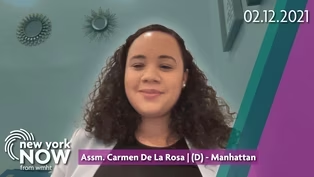
Assemblymember Carmen De La Rosa on New York's Parole System
Video has Closed Captions
Clip: S2021 Ep6 | 7m 25s | Assemblymember Carmen De La Rosa shares her perspective on New York State's Parole System. (7m 25s)
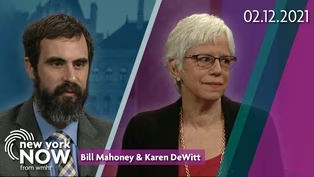
Reporters Roundtable: Karen DeWitt, Bill Mahoney
Video has Closed Captions
Clip: S2021 Ep6 | 8m 53s | Karen DeWitt and Bill Mahoney discuss the nursing home COVID-19 situation in New York. (8m 53s)
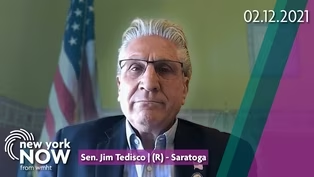
Senator Jim Tedisco on COVID-19 Nursing Homes Hearings
Video has Closed Captions
Clip: S2021 Ep6 | 6m 56s | Sen. Jim Tedisco joins to discuss potential COVID-19 nursing homes hearings. (6m 56s)
Providing Support for PBS.org
Learn Moreabout PBS online sponsorship
- News and Public Affairs

Top journalists deliver compelling original analysis of the hour's headlines.

- News and Public Affairs

FRONTLINE is investigative journalism that questions, explains and changes our world.












Support for PBS provided by:
New York NOW is a local public television program presented by WMHT
Support for New York NOW is provided by WNET/Thirteen and the Dominic Ferraioli Foundation.