
Nursing Homes Probe, NY's Environmental Goals, Schools
Season 2021 Episode 4 | 26m 46sVideo has Closed Captions
New York Attorney General Letitia James releases a scathing report on COVID-19 deaths.
Get news on New York Attorney General Letitia James releases a scathing report on COVID-19 deaths at New York's nursing homes, Gov. Andrew Cuomo lifting COVID-19 restrictions in several areas of the state, along with Karen DeWitt from New York State Public Radio and Darrell Camp from TALK1300 providing analysis and details from the weeks' news.
Problems playing video? | Closed Captioning Feedback
Problems playing video? | Closed Captioning Feedback
New York NOW is a local public television program presented by WMHT
Support for New York NOW is provided by WNET/Thirteen and the Dominic Ferraioli Foundation.
Nursing Homes Probe, NY's Environmental Goals, Schools
Season 2021 Episode 4 | 26m 46sVideo has Closed Captions
Get news on New York Attorney General Letitia James releases a scathing report on COVID-19 deaths at New York's nursing homes, Gov. Andrew Cuomo lifting COVID-19 restrictions in several areas of the state, along with Karen DeWitt from New York State Public Radio and Darrell Camp from TALK1300 providing analysis and details from the weeks' news.
Problems playing video? | Closed Captioning Feedback
How to Watch New York NOW
New York NOW is available to stream on pbs.org and the free PBS App, available on iPhone, Apple TV, Android TV, Android smartphones, Amazon Fire TV, Amazon Fire Tablet, Roku, Samsung Smart TV, and Vizio.
Providing Support for PBS.org
Learn Moreabout PBS online sponsorship[ THEME MUSIC ] >> On this week's edition of "New York Now," a bombshell report from the state A. G. 's office on COVID-19 deaths at New York's nursing homes, including new data.
Karen DeWitt from New York state public Radio and Darrell Camp from talk 1300 join me to discuss.
Then state lawmakers kicked off hearings this week on the state budget.
Bob Snyder from the state school board's association joins us with an education update, and we'll dive into spending on environmental goals with Julie tieing from the New York league of conservation voters and Peter Iwanowicz from environmental advocates from New York.
I'm Dan Clark and this is "New York Now. "
[ THEME MUSIC ] >> Welcome to this week's edition of "New York Now. "
I'm Dan Clark.
After months of waiting, we now know more about how many nursing home residents died from COVID-19 in New York.
On Thursday morning, the State's death tally at nursing homes was at about 8,700.
Stay with me, that's going to change.
Then the state A. G. 's office issued a scathing report saying the actual number might be twice as high.
But that didn't sit well with the state health department, so they released a new count Thursday of how many nursing home residents died both at nursing homes and at the hospital.
According to the data, another 3,800 nursing home residents died in hospitals than we knew.
With that, the new death toll for nursing homes is now at 12,700.
And this is information that lawmakers have been asking about for months.
Here's Senate investigations chair James Skoufis this week before it was released >> I think it's an insult to the legislature that the department of health is stonewalling us, and we should not be waiting for a very basic set of answers and not just on the deaths in hospital statistics, but we sent a letter with a whole host of questions that has largely been ignored.
>> And now some Republicans are calling on the state health Commissioner to resign.
Let's discuss with this week's panel.
Karen DeWitt is from New York state public and Darrell Camp is from talk 1300.
Thank you both for being here >> Is into to be here.
>> Karen, let's talk more in depth about the report first.
There were other parts of this report other than the undercount.
It talked about conditions at nursing homes that may have contributed to the higher death rate than we knew about.
Can you talk about that a little bit?
>> Yeah.
I feel like that part of the report got overshadowed because of the Cuomo administration's stonewalling on the numbers for so long and driving everybody crazy that that became the big story.
But if you look at the conditions at the nursing home that the A. G. investigator found, it reads like something are out of the 1800s.
>> It does.
>> they took patients who had COVID and put them with other patients.
Some of them they treated with Tylenol.
They continued to have communal dining.
They didn't follow PPE protocols and it just seemed like they-- it was honestly either ignorance or I hate to say it, they didn't care, but they didn't do any of the things to protect a lot of the residents there.
While the A. G. doesn't say it contributed to their deaths, they said it may have.
You just have to wonder what was the department of health doing all these years that it came to this in the nursing homes, that they were so unprepared and really didn't know any of the things they were supposed to be doing.
>> It was just sad more than anything reading the report and seeing that these patients were put at risk because of low staffing levels at a lot of homes.
There weren't enough staff for the number of patients.
The staff didn't follow infection control protocols apparently, and then one thing that really stuck out to me was that some of the staff were pressured to work even if they had symptoms or were diagnosed with the Coronavirus, which obviously if PPE can only go so far.
>> Yeah.
>> There's always that risk there that you can could infect somebody.
I think you're exactly right.
If we weren't so obsessed about the nursing home death count, I think that would have been the bigger story.
I imagine for law makers it probably will be the bigger story in the next few months.
Maybe they'll do something legislatively.
Darrell, I want to go to you.
How are lawmakers responding to the report?
we have the death count.
We have the conditions at nursing homes.
>> Well, I spoke to democrats and Republicans yesterday on several levels of government and what you would expect from Republicans is essentially what they said.
They would like for Howard Zucker to resign and the Governor, they're not necessarily calling for him to resign universally, but a lot of them say, hey, he's been dishonest so he's kind of complicit as well.
John McDonald actually had a very unique position on this.
So that's probably pragmatic.
However, not holding people accountable long term sets a bad precedent, I think.
>> He's one of the few health care professionals in the legislature too.
>> Yes.
>> So he knows something.
>> His opinion really matters about these kinds of things.
She went into detail about how there was a financial incentive and how some operators may have misinterpreted what the government had said and they took it as we need to go out of our way to accept these people as opposed to not refusing them.
>> I remember that back in the spring.
There was a financial incentive, when they would receive more money if they accepted these patients.
That's something that maybe the legislature can look at.
>> If you're a for-profit nursing home, you know, you have fewer staff, more patients.
You make more money.
>> Exactly.
>> Maybe when things are going okay, that's all right, but it just shows.
You know, like I said, you have to wonder whether the department of death investigators all these years have they been looking at what goes on at nursing homes and what might motivate them to look the other way?
I think that's a bigger story that Ed ins to be looked into.
I hope I can do it and certainly other reporters can do that as well.
>> The health commissioner came out with a statement later Thursday.
A very long statement basically saying, you know what, the A. G. 's report is right about all of these horrible conditions at nursing homes but also none of this is my fault.
What did you think about that?
>> Well, yeah.
That's what I found very stunning.
Like, how can it not be their fault?
They're supposed to be regulating.
Shouldn't they know what's going on?
It was a pandemic and it was nothing that we experienced.
I think it has to be looked at.
There has to be a real and deep investigation looking at everything that happened.
>> Go ahead.
>> He set up a strawman, too, in his response.
He was arguing a point that the report and reporters didn't make that point being the overall count of deaths.
No one was saying the overall of deaths was higher.
We're saying where they died was different.
>> Uh-huh.
>> Being in the nursing homes as opposed to when where in the hospitals where nursing home residents were transferred out of their residences.
I don't think he really responded in good faith because it seemed pretty clear to me that everyone understood we were talking about where people had died.
Not the overall death count.
>> I should say we've been asking for this number for months, the number of people that died both in nursing homes and at the hospitals.
The health department consistently said to people that it wasn't available.
That they weren't going to give it to us.
Suddenly on Thursday, the A. G. 's report came out and they had it like that, six hours later.
It's a pandemic.
Maybe this wasn't the best decision.
This is how many people who died in nursing homes, it wouldn't have become such a big issue.
Frankly now, it's been national news and it may seem crass to talk about politics right now but Governor Cuomo, he wrote a book on how he fixed COVID.
He won an Emmy.
This looks really bad for him.
>> Governor Cuomo said it was a political hit from Republicans and the far right every time.
Bernadette for weeks was on him about the nursing home deaths and numbers.
The march 25th issue, and he said it was political.
Tish James is a democrat.
Is it still political in >> I know.
And an ally of Cuomo which is amazing.
She was very quiet about that.
There were no leaks.
All of a sudden, it just showed up 10:00 in the morning on a Thursday.
I thought it was interesting.
>> Karen, hearings started this week from the legislature.
We have the education budget hearing.
You spoke it week from Bob Snyder from the school board association for the show.
Give us quick highlights and then we will play the interview.
>> Well, school funding is a big deal.
Governor Cuomo wants to use some funds earmarked for pandemic relief to make up for the state schooling.
Bob Schneider, among others,not happy about that.
>> All right.
Let's take a look at the that interview.
[ THEME MUSIC ] >> Thank you for having me, Karen.
I mean, how are schools doing?
We have pivoted since the beginning of this pandemic.
You know, how we had to go from in classroom to full remote and there was some stops and starts and some things didn't work that well.
Others did.
But now, here we are almost a year later and our teachers, our administrators, our school board members, support staff, 83% of our schools at the end of December for that first part of the year were either in classroom full time or had the hybrid approach, which was remote and in classroom.
>> What about vaccinations?
It's been a very difficult rollout, both nationally and at the state level.
And it's most important that the teachers get vaccinations, we know, because the under age 16 aren't getting them right now.
Are the teachers getting them at the rate that's going to make them safe so that they don't have to be out sick with COVID or very ill?
>> That's still a work in progress, as you can see from the news.
The vaccine supply, it needs to be built up and the distribution's still have to occur.
Nothing definitive.
I believe they're group 1B, and that is still in process.
They need to get those vaccines sooner rather than later.
I would say this.
You asked earlier, how are we doing?
If you remember back Matt summer when we were planning based on department of health and state education department guidelines, the detailed plans, we had to plan a lot of different things in the classroom and in the school building and to transport the children in.
We did it right.
So the cases, overall, in school districts are much lower than the communities, the surrounding communities that these school districts are in.
That's a testament to the teachers and all the other folks.
They had put those protocols, those plans, processes and procedures in place and when there were cases, they acted accordingly.
The good news is the case level is down, but to your point, we need to get the vaccines into the arms of all the teachers and other people that are in that building live when the building's open.
>> Well, onto school funding.
It seems like as a reporter I spend an awful lot of time talking about this.
I know you do being part of the school boards.
Governor Cuomo did something interesting this year.
He presented two different budgets and one is, if the federal government gives New York a full bailout, $15 billion, then everybody gets funded, including schools, just as planned.
If the federal government doesn't come through, then there would be a 5% across-the-board cut.
Schools would take a hit.
So how do you, as your school boards, plan for what to do in the future?
Because you really don't know which scenario is going to happen, right?
>> Right.
As we have been in the past, through this pandemic when we are setting our budgets and school districts and school boards are in the process of doing that right now, we're planning, and we're using that lower worst case scenario number the state aid runs, the school's budget annually using that revenue, the state aid and also the local revenue, they're using that lower worst case scenario, the $6 billion the Governor referred to.
And the good news is this is the first volley in a budget negotiation.
We're going to hear more.
The legislature has to weigh in.
We have to weigh in.
A lot of other groups have to weigh in.
Hopefully, this changes as we get closer to when the budget-- the final budget is released by the Governor.
We know that there's a federal stimulus negotiation that's going to start.
We have no guarantees.
That's why the Governor had to go with these two budgets.
So a lot of uncertainties and we are concerned also, Karen with that federal stimulus, that new round of potential funding even with the one before it that we received in December.
>> Right.
>> We're a little uncomfortable with that >> Yeah.
I wanted to ask you about that.
>> We're all for that, helping the school districts the way the Governor's doing that as far as using some of that money.
The money wasn't intended for that.
If you plan outward into the next year, the following year, since it's a one-shot, all of a sudden, we have state aid numbers that have been supplanted by that federal stimulus.
The federal stimulus isn't there anymore.
Now we've got cuts, large cuts in state aid and we're worried about that down the road.
Then all of a sudden, we're hit with huge cuts and we have to budget for even worse scenarios in the future.
This is resting on the backs of our students and we're not proponents of that.
So we hope that as I said, by the end and when the negotiations are said and done.
It will be a different-looking budget and the stimulus, the more positive stimulus comes to the state.
>> Well, I'm sure we'll talk again before next September.
Thank you very much for coming on.
We really appreciate it.
>> Thank you, Karen.
I appreciate it also.
Thank you.
[ THEME MUSIC ] >> We should know more about school aid in the next few weeks.
In fact, a lot of state spending is a big question mark right now because of the budget deficit.
That includes funding for the State's environmental goals which are pretty ambitious.
I spoke this week with Julie Tighe from the New York league of conservation voter and Peter Iwanowicz from New York about how the State's fiscal crisis could affect the environment.
Peter and Julie, thanks so much for being here to talk about environmental goals and priorities in the state.
>> Thank you for having us on.
>> Great to be here.
>> So Peter, I want to go to you first.
The Senate recently passed a constitutional amendment for the right to clean water in New York.
It's coming up in the assembly and then will go to voters on the ballot.
Tell us what this would mean for New Yorkers.
What would it actually do?
>> So the question that's going to be before voters on the ballot this November is should we add into our bill of rights a lane that basically says that each person has a right to clean air and water and a healthful environment.
That's essentially an addition to the bill of rights that New Yorkers have been asking for.
It's poised to get second passage in the legislature which is really exciting.
It's been around for a number of years it's going to be a great ballot question for New Yorkers to go to the polls this fall to say, yes, I want clean water.
Yes, I want clean air.
This is the value set I want for myself and my family and our community.
>> So that's something we'll be looking out for in the assembly sometime soon.
I want to talk to you both primarily about the state budget.
The Governor has unveiled his state budget proposal, his strategy to fill the State's $15 billion budget gap.
Include some environmental projects.
Quite a bit of them actually.
Julie, you want to start with you.
Given the State's budget deficit, are we seeing any proposals for cuts to environmental programs and policies from the Cuomo administration this year?
>> Actually, much like this happened in 2020, Governor Cuomo maintained commitment to the environment despite the fact that there is this challenging fiscal environment.
You know, we're part of coalition called New Yorkers for clean water and jobs.
As part of that, we asked for the Governor to maintain a $300 million environmental protection fund.
His budget does that.
We asked him for another down payment on addressing clean water, like Peter was referencing, how we need to do investments in clean water infrastructure.
The Governor has proposed another $500 million for clean water infrastructure.
He has pre-posed a $440 million four-year program for New York parks 100 to continue their investment in parks as they're approaching their 00-year anniversary.
Those are all great commitments that we're happy from the Governor to see.
One of the items that was a priority for both of our organizations, I believe, and many others is a proposed $3 billion bond that didn't forward last year.
The Governor has not proposed that now.
We did hear from his Director of division of budget, Robert, this week that the Governor is very committed to the bond act.
I think they want to see and see what happens with funding from the federal government before we decide whether or not we can move forward with it this year or if it needs to wait until 2020.
Either way, I think when they're ready to advance that, we have a strong coalition of people.
Not just from the environment but also from the business community, from labor who are interested in seeing that advance.
Supporting, you know, protecting our environment here in New York.
That's a tremendous, tremendous leadership that we've seen on that front.
>> With a bond act just for background, it would have provided billions of dollars for funding for environmental projects across the state.
Do you think the legislature should go around the Governor and try to pass it on their own?
This is obviously such a big priority.
It was a huge priority last year.
It fell off to the wayside because of the State's finances.
>> I believe the legislature and the Senate need to work together and be mindful of the financial situation when deciding whether or not they should proceed with that.
I think that's something we will be watching for and working with both the legislature and the Governor to see the best path.
>> Peter, speaking of the Governor's budget proposal, the state is on track, hopefully to meet its emissions reduction goals.
It has a goal of reducing emissions by 40% by 2030 and higher standards in the years after.
Based on what we've seen of the Governor's budget, I think that people might be worried that because we have this huge budget deficit that might detail rail some of the State's goals.
Are we see any of that in the Governor's budget proposal?
Where do things stand on that?
>> There's a couple places in the Governor's budget proposal that are concerning of whether or not we are fully appreciating these emissions goals under our new climate law.
We're continuing to see the Governor pull money away from clean energy programs to plug budget holes.
He's been doing that for a number of years.
This budget continues that.
We're going to work with the legislature so they don't raid those clean energy funds to fit a budget hole that we actually put those funds to work and put people to work with those funds.
So that's a concern of ours.
And what we really have not seen so far is that deep level of commitment to reorienting all of state government decisions, they need these goals.
A provision of that climate law that requires it, and we have yet to see that really manifest itself in this budget.
Those are things that we will be asking to do more of.
There's another piece of the budget that I want to touch on.
It's the availability of cash to support these programs.
But what we've saw so far with this current budget and still two months left and it could actually happen in those two months, but we have not seen the $500 million that was agreed to as an appropriation last spring.
Actually be put out the door for projects to fund clean water infrastructure.
It's been a great program.
It helps communities fix their pipes and it's put a lot of people to work, and we're hopeful that we'll see a grant program come out in the next 60 days, but the problem can be, you know, when the legislature and the Governor agreed on big appropriations, cash is short and cash hasn't been backed out into these programs.
That's a problem.
>> So Peter, do we know why that funding hasn't been released?
is it one of the withholding from the state division of budget because of the State's budget deficit?
Is there another reason?
>> No.
It's simply that.
I think they're looking for cash to put into the COVID crisis, rightly so.
But it's time to sort of start addressing these issues and get back to the matter at hand, which is, you know, we have more than $500 million worth of projects that could be put to work right now if that money was let out.
It's a great opportunity not only for clean water and the environment but it's a huge opportunity to put people to work.
Jobs is what we need.
It's a great win-win for the environment and the economy.
>> You know, that makes me think, Julie, about how people often see green energy projects as a good thing but they don't really understand the tangible costs of them.
What are we looking at financially in terms of projects in the State's future?
How can you help people understand that these things cost money and they're for the greater good for the future of the State's environment?
>> I think what's really important is actually the Governor announced in the state of the state that we are now at 100 renewal energy projects that the state is advancing and including in that over 4,000 megawatts of offshore wind between projects that have been approved and projects they just awarded this week to EQUINOR for two projects off Long Island and Massachusetts.
Those are our items that we are seeing move forward that will start generating jobs in the very near future.
It's taken a long time.
Last year, we actually updated the State's renewable energy siting program to make it easier, to make it faster.
I think we're going to start to see the benefits of that very shortly.
One of the areas we haven't talked about yet is transportation.
There's a lot of things that we need to do to address transportation emissions, which are actually the number one source of greenhouse gas emissions in our state at this point, and there's a number of things that I think will be coming out of the transportation advisory panel's recommendation to the climate action council, which is the process that we're going through to come up with a plan to tackle climate.
Including, you know, advancing a clean car standard to get to 100% zero emission cars, advancing a clean truck standard to get to zero emission trucks and, you know, we are hopeful for a low carbon fuel standard which would help to pay for all of those items including electrification by making fossil fuel provider pace for credits from clean fuel providers like electricity.
>> Julie, are those ideas that the department of environmental conservation can do administratively, or would the legislature have to give approval?
Do we see the legislature moving on any of those item?
S >> So many some of the rules, like the clean cars and clean trucks, DEC has a great amount of regulatory authority to take those actions and then in fact, the state of New York is either required to follow what's called the California car standards or to go with EPA standards and New York is known as a California car state.
For that, they can 100% move forward administratively and they have done so in the past and I would expect that we will see that in the future here.
Some of other items, it is possible, a low carbon fuel standard is more likely to require legislation.
It's possible that they have the authority now but I think that we are seeking legislation on that front.
>> All right.
Peter Iwanowicz from environmental advocates of New York and Julie Tighe from the New York league of conservation voters the thank you for being here >> Thank you.
>> Thank you.
>> All right.
See you back here next week.
Until then, thanks for watching this week's "New York Now. "
have a great week and be well.
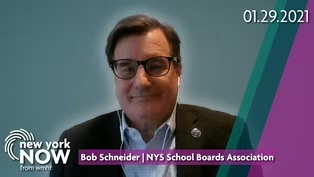
Bob Schneider, New York State School Boards Association
Video has Closed Captions
Clip: S2021 Ep4 | 6m 24s | Bob Schneider joins with an update on New York State school budget troubles. (6m 24s)
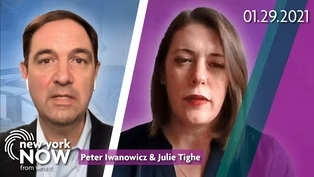
Julie Tighe and Peter Iwanowicz on Environmental Priorities
Video has Closed Captions
Clip: S2021 Ep4 | 9m 31s | Julie Tighe and Peter Iwanowicz discuss New York States' Environmental Priorities. (9m 31s)
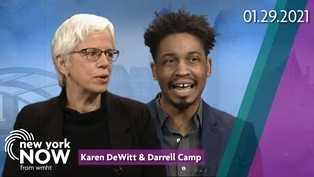
Reporters Roundtable: Karen DeWitt & Darrell Camp
Video has Closed Captions
Clip: S2021 Ep4 | 8m 4s | Reporters Karen DeWitt & Darrell Camp give details and analysis of the weeks' news. (8m 4s)
Providing Support for PBS.org
Learn Moreabout PBS online sponsorship
- News and Public Affairs

Top journalists deliver compelling original analysis of the hour's headlines.

- News and Public Affairs

FRONTLINE is investigative journalism that questions, explains and changes our world.












Support for PBS provided by:
New York NOW is a local public television program presented by WMHT
Support for New York NOW is provided by WNET/Thirteen and the Dominic Ferraioli Foundation.