
Nursing Homes Update, NY HERO Act, Mental Health Funding
Season 2021 Episode 5 | 26m 46sVideo has Closed Captions
Lawmakers continue to pressure the Cuomo administration for info on nursing home deaths.
Lawmakers continue pressure on the Cuomo administration to release more data and information on the state's handling of nursing homes during the COVID-19 pandemic. We'll have details and analysis with Jesse McKinley from the New York Times and Bernadette Hogan from the New York Post. Hear from others about the NY HERO Act and funding cuts from the state could spell disaster for mental health.
Problems playing video? | Closed Captioning Feedback
Problems playing video? | Closed Captioning Feedback
New York NOW is a local public television program presented by WMHT
Support for New York NOW is provided by WNET/Thirteen and the Dominic Ferraioli Foundation.
Nursing Homes Update, NY HERO Act, Mental Health Funding
Season 2021 Episode 5 | 26m 46sVideo has Closed Captions
Lawmakers continue pressure on the Cuomo administration to release more data and information on the state's handling of nursing homes during the COVID-19 pandemic. We'll have details and analysis with Jesse McKinley from the New York Times and Bernadette Hogan from the New York Post. Hear from others about the NY HERO Act and funding cuts from the state could spell disaster for mental health.
Problems playing video? | Closed Captioning Feedback
How to Watch New York NOW
New York NOW is available to stream on pbs.org and the free PBS App, available on iPhone, Apple TV, Android TV, Android smartphones, Amazon Fire TV, Amazon Fire Tablet, Roku, Samsung Smart TV, and Vizio.
Providing Support for PBS.org
Learn Moreabout PBS online sponsorship[ THEME MUSIC ] >> On this week's edition of "New York Now," pressure mounts on the Cuomo administration for more information on COVID-19 deaths at New York's nursing homes >> we had a subpoena drafted.
>> Jesse McKinely from "the New York Times" and Bernadette Hogan from the "New York Post" are with me in studio to discuss.
Then lawmakers want to protect workers from the spread of airborne diseases like the Coronavirus.
Assemblymember Karines reyes joins me to explain the New York hero act; and funding cuts to counties could general noise health and substance use services.
I'm Dan Clark and this is "New York Now."
[ THEME MUSIC ] >> Welcome to this week's edition of "New York Now."
I'm Dan Clark.
Pressure is mounting on the Cuomo administration to release more information on the State's handling of COVID-19 at nursing homes, Including a more detailed breakdown of residents killed by the virus.
You'll remember that last week, state health Commissioner Howard Zucker came out with a number of residents who died at hospitals, Something we didn't know before.
But lawmakers are looking for more, like the number of COVID-19 cases at nursing homes which we don't know, and what happened behind closed doors that led to some of the State's most controversial decisions during the pandemic and if they don't get that information in the next few weeks, democrats say they might issue a subpoena to get it.
but others don't want to wait.
Republicans in the state legislature drafted their own subpoena this week.
They're in the minority in both the Senate and the assembly, so they can't issue it on their own but they're hoping they can pressure democrats to move forward.
>> We've had a subpoena drafted and if any of my colleagues in the Senate majority are really serious about issuing a subpoena and launching a thorough investigation, all they have to do is sign and send it.
>> But sources tell"New York Now" that democrats have no immediate plans to issue a subpoena to the Cuomo administration.
Let's discuss that and more with Jesse McKinley from the New York "Time"s and Bernadette Hogan from"the New York Post."
Thank you both for being here.
>> Of course.
>> Bern, let's start with you.
We haven about talking about a subpoena to the Cuomo administration for six months from democrats in the Senate.
Why haven't they pulled the trigger?
What are they saying?
>> The threat of subpoena was first raised in August when lawmakers had a legislative hearing where state DOH Commissioner Zucker was testifying in regard to health matters and specifically nursing homes because lawmakers were trying to seek answers that many reporters, advocates of residents in nursing homes were seeking from us.
And one of those major topics was how many people actually died in long-term care facilities but not only that, how many people got so sick that they were transferred to hospitals and died there.
So this is something that the state used to report.
They stopped reporting this figure of how many people died outside of those facilities back in May.
So lawmakers have been threatening this for roughly since this summer.
What is that?
Six months.
This is also subject to a lawsuit that I suppose we can later talk about that was just won by a nonprofit, the empire center, that said the state department of health has to release that total figure.
Now lawmakers, again, were threatening this in the summer.
They never went through with it, but again, the Specter was raised last Monday saying if you guys don't produce the accurate total, that the data that we're seeking, we subpoena you to release that information because you have it.
It's submitted to the state.
>> Right.
Jesse, do you think they go through with the subpoena later this month?
They have given a February 25th deadline.
That's the health budget hearing.
Do you think democrats actually do that?
And more fissure their relationship with the government?
>> I don't.
I don't think it's likely that the democrats are going to war on this yet.
I will say the last week was not a good news week for the Cuomo administration.
Between LeTitia James' report that came out last Thursday, I think, which basically showed that the Cuomo administration has been withholding data.
Between our reporting about the DOH and the departures there between our data reporting showing that they're basically cherry-picking numbers, it goes on and on.
I think the Cuomo administration has kind of lost track of the narrative this week and I think he got a lot of applaud for being science, data, science, date Taj facts matter, words matter, et cetera, and the last week has shown that's not what's going on.
>> You had a story with two other reporters, the "New York Times" that showed several high profile departures over the department of health over the course of the pandemic.
I think what is going on is with the Cuomo administration for now over ten years he has had a reputation for being a tough boss, you know, for being heavy-handed not only inside of agencies that he controls but in relationships with, say, bill de Blasio, et cetera and I think that attitude of I know best, my way or the highway, has rubbed a lot of people the wrong way.
Particularly in agencies like the state department of health where you are talking about a bunch of people who have trained in public health, who have given their lives over to this kind of profession that is about the public well being, and that in this case, you know, the heavy hand in this of the Cuomo administration has resulted and those people saying this is not for me.
I'm going to go.
Does your reporting indicate that they haven't really relied on the department of health?
Or, how does that pan out?
>> We had multiple instances of people telling us that they were learning about policies inside the department of health from the news conferences.
So as you and I and Bern were watching those news conferences in the room, people over at the Corning tower were learning it at the same time, which is kind of mind-blowing, right?
That these people should have been kind of in the loop, knowing about it, setting the policy, informing it, that they were finding out about it in realtime.
>> I cannot imagine being those state workers having my entire job to be to respond to a public health emergency and then kind of be put on the back burner in terms of the Governor's top aides.
I want to go back and I realize that we were talk about, something we don't mention a lot when we are talking about this is how this affected the families of nursing home residents who died.
There was a press conference this week from the Republicans.
We heard from a family but Bern, I know you talked to families of nursing home resident.
How do they feel about the Governor at the moment?
>> I mean, it's a combination of devastation and a lot of anger because they did lose somebody and they're very upset by it but not only that, it's become now a political topic.
It's something that they're watching press conferences not only with the Governor but with other lawmakers and it's also come up in Washington and they feel like they're not being heard and they're not really, you know, their loss has just become another number.
>> Do we see the legislature reacting?
we talked about the subpoena?
.
Do we see lawmakers, both Republicans and democrats moving forward, are they moving forward with anything?
>> They are.
At the start of next week, state Senate democrats they have a package of roughly ten bills that will, hopefully if they pass and the Governor signs, would button up a lot of these issues or clean up issues in long-term care facilities that, frankly, have stemmed far beyond the start of the pandemic, including, again, accurate tallies of data, how many people died in facilities, also other things like ombudsman program, which are essentially in-house advocates that, you know, volunteers that would be able to assist residents with issues, et cetera, if a family member can't be there.
Lawmakers are doing something.
However, again, they first started raising these questions back in the summer and a lot-- they could have put in legislation and passed it in both houses, one house at least maybe months ago.
So it just-- they are doing something, but in regards to the subpoena, like Jesse said, I don't know if it will come to that.
>> Also this week, restaurant workers are now eligible for the COVID-19 vaccine.
This was after our colleague, Josefa Velasquez, asked the Governor on Monday about why he would open indoor dining in New York City and not make those workers eligible for the vaccine.
A day later the Governor announced that the Biden administration is going to be boosting our vaccine supply by about 5% so he made the restaurant workers eligible.
Jesse, what happened?
>> I think that's known as a flip-flop or perhaps an about face or perhaps a 180.
I mean, depending on-- pick your term of choice, but he called that cheap and insincere when Joseph asked that question and 24 hours later, it turns out, oh, well, we'll actually do this.
I don't know if he felt political pressure.
Keep in mind, I think what you're saying in the broader context is, you know, there's some frustration, I think, inside the Cuomo administration that there is not enough vaccine and they're not getting the supplies they need to vaccinate people and that's beginning to roll out and you can kind of see it in his rhetoric.
He's obviously frustrated with the pace of things.
He's obviously frustrated with the criticism and he's obviously frustrated with the fact that he doesn't really have the levers to kind of correct the problem immediately.
>> Right.
Exactly.
We'll see how it works out in the next couple of weeks with restaurant workers now getting the vaccine.
Brenda Hogan from "the New York Post," Jesse McKinley from the "New York Times," Thanks so much for being here.
>> Thanks.
>> Sure.
So you probably remember that at the start of the pandemic, there were all these questions about how to keep workers safe from the virus.
And it turns out that in New York, there really aren't strong workplace protections to prevent the spread of airborne diseases like the Coronavirus lawmakers are hoping to change that with a new bill called the New York hero act.
I spoke this week with one of its sponsors, assemblymember Karines Reyes.
Assemblymember Reyes, thanks so much for being here >> Thank you for having me.
>> You are sponsoring legislation called the New York hero act which would protect workers from the spread of disease in the workplace.
It was inspired by the COVID-19 pandemic.
Tell me exactly what the bill would do.
>> Sure.
So the New York hero act, as we're calling it, would provide enforceable I standards, basic minimal standards in terms of workplace safety.
It would speak to the requirement of PPE, this infection, social distancing, mechanical barriers in the workplace.
It would also create worker committees so workers have input and a voice in creating these standards for every individual industry, and it would create enforceable I rules.
A mechanism of enforcement for the department of labor and the department of health.
And it would provide some injunctive relief for workers who may speak out against-- may speak up against unsafe work conditions.
>> So what's in place now?
It surprises me that we don't have this minimum standard for workers right now.
There are these minimum protections.
Are workers even protected right now under federal or state law?
>> Well, OSHA and the federal department and the Department of Labor have been using CDC guidelines to kind of create some-- some structure for employers to follow but there isn't any concrete guidelines and they aren't enforceable I.
And we know that the CDC guidelines are just that.
They're guidelines but they're not very clear as to what employers should be doing in order to protect employees.
I think that it's important that we provide these guidelines because, look, we are in the pandemic that's unprecedented.
We've never experienced anything like this.
And many, many employers have no idea how to protect their employers-- their employees against airborne infectious diseases.
Unless you're in a health care field, that's something that you would have never thought about if you were in retail, or if you're in a warehouse or agriculture.
These are things that you never had to contend with, and I think it's important that as a state, you provide guidelines for employers.
>> I imagine some business groups may be concerned about the cost of implementing something like this.
Obviously, there's no cost of keeping workers safe but you have to buy things like PPE, install new safety standards in your location wherever you are.
What would you say to those business groups and small business owners that are struggling right now and may not be able to afford these costs?
>> We argue that the cost of providing PPE and this infection protocols and perhaps barriers are minimal compared to, one, the loss of life that we've experienced and also the loss of businesses, with frequent shutdowns with employees getting sick.
It means that those losses for businesses could be permanent in many cases as many businesses shut down.
To be proactive, we think is also-- is not just the right thing to do but it's also cost effective for the economic stability of our state.
>> So I should have edges inned at the top, you're a registered nurse which gives you a really unique point of view on all of this.
The state attorney general's office released a report that we heard about last week about the conditions at nursing homes and how some of them made the virus outbreak worse if some places.
Some nursing homes were not prepared with PPE and keeping their staff safe.
How would your bill affect those workers?
Would it protect nursing home workers from catching the virus and sub subsequently spreading it?
Because it would create those standards for that specific industry.
That's the idea.
We don't want to create rules that perhaps don't fit every industry.
We want to make sure that the Department of Labor has the flexibility to create those standards, depending on the workplace conditions and the industry, the amount of workers and the type of protections they're going to need based on the exposure to either the public or the environment, and one of the biggest issues that I found with nursing homes that we have been talking about for a very long time is the staffing ratios, and I think that was glaring in the AG's report that nursing homes that had better staffing ratios, their patients fared better because at the end of the day, when you have limited staff that is coming in contact with multiple numbers of residents and the potential to spread that is so much higher, and I think that we need to really look at how we staff health care facilities moving forward.
Not just nursing homes but of course, hospitals as well.
>> I was going to ask you about that.
There's a bill moving in the legislature right now that would require minimum staffing at nursing homes and maybe hospitals that might be different.
Definitely nursing homes.
How do you feel about that legislation?
Do you think there should be a minimum staff-to-patient ratio?
>> Absolutely.
And studies have shown-- multiple studies, independent studies have shown that when a nurse or a health care providers have to take care of less patients, then they can provide better care and the outcomes for patients are better.
I think that in the interest of us making sure that we keep everybody safe that we uphold the dignity of every patient that we care for, that we make sure that we have the staff to provide that care.
And in California is the only other state that has those ratios that are enforceable I, and they have had better patient outcomes because of that.
>> All right.
Well, we will be watching that and we will also be watching the New York hero act, which is moving through the legislature right now.
Assembly Reyes, thanks so much for being here.
>> Thank you, Dan.
[ THEME MUSIC ] so we'll see where that bill goes in the next few weeks.
In the meantime, state legislature held a budget hearing this week on state spending for mental health.
And that includes money that flows to counties which were on the frontline when it comes to a lot of essential services.
They help organize mental health services, substance use and addiction treatment and a lot more.
That could all change if the State's massive budget deficit leads to cuts for counties.
I spoke this week with Kelly Hanson from the state conference of local mental hygiene directors.
Kelly Hanson, thanks so much for being here.
>> Thank you, Dan.
>> Anytime.
So I want to primarily talk to you about funding cuts and the State's withholdings, but first, I would like for you to explain what these county officials do in terms of mental health, substance abuse and people with developmental disabilities?
I feel like the public may not know that counties have this role.
>> Uh-huh.
Oh, absolutely.
So our organization in Albany is called the conference of local mental hygiene Directors and what we do is we represent the county mental health commissioners in each of the 57 counties and department of mental hygiene in the City of New York, and so while their title says Commissioner of mental health, their responsibilities much broader than that.
So our Commissioners are responsible for development, oversight, and planning for integrated services to adults and children in their communities who are affected by mental illness, substance abuse disorder and developmental disabilities.
So they have very much an oversight and systems perspective role in the county.
>> So some very important services for people in every county of the state.
Last year, the state withheld 20% of state funding to counties and obviously affected your work.
Some cuts may be coming down the road as well depending on what the state gets from the federal government.
First, tell me how you're doing in terms of the cuts and the funding.
I know some of it has been restored.
Others are permanent.
Tell me what those cuts down in the future would look like for you.
So your viewers know, what this funding is it's funding from the state to the county to be able to implement all of those plans and the integrated services that I mentioned earlier.
And so for three quarters so far, the county's state age dollars have been cut by 20% each quarter and it's a withhold is what we've been advised in anticipation based on activity from Washington, if that funding would be able to be restored.
That funding provides a lot of support and services in the community.
For example, it pays for crisis services.
It pays for Narcan kits and it pays for recovery programs in the schools.
It pays for care management for youth and young people, who are struggling with addiction and mental health needs.
So you know, the First Quarter that was cut, you know, our members are county officials they're very good at cobbling together to see what you could do where whatever action you took would not impact direct services to the communities.
Housing was funded at 100%, which is fantastic.
Now we are all anticipating that we get some good news from Washington because those services I mentioned before could be in jeopardy if, in fact, Washington doesn't come through.
So we're very much hoping that 15 billion will be coming through from the feds back to New York.
>> You mentioned crisis services and the Governor has a really interesting proposal this year to set up these crisis stabilization centers around the state.
So what these centers would be basically 24/7 places where people who are experiencing a mental health crisis or substance abuse crisis could go and receive services and treatment.
I'm wondering, because this brought up the question for me, what do people do now when they're in crisis?
What do you think of the Governor's idea?
>> Right.
Right now, if someone is in crisis, they can contact a crisis line.
They can contact a suicide hotline and we have crisis teams, mobile crisis teams.
Not every county has them but can triage and make a decision as to being able to, you know, address it in person.
We also-- people will call 911 in.
In many counties there's a connection with mobile crisis.
If you need mobile crisis to go out at the same time if they're available.
A model that seems to be appearing in the Governor's bill that has been established in many parts of the country is called a crisis stabilization center, and we've had-- and duchess county had a crisis stabilization center for several years now and essentially what it does is it creates a location for individuals who are experiencing mental illness issues at a higher level, having substance use issues to actually go to that location and be stabilized.
So under the Governor's bill, some of the services would be, you know, engagement, telehealth would be there, oasis license.
There would be, you know, mild to moderate withdrawal assistance.
They would have to have psychiatry, practitioners or psychiatrists, and as I mentioned before, peers.
Peers are individuals with lived experience and their skills are incredible in terms of being able to engage people, but you know, I think part of putting the bill in place was necessary for a couple of reasons.
When duchess first started, one of the big questions was, how do we license this entity?
It's different from anything we've seen and the bill would move toward that end.
And also ultimately, hopefully, be able to access some-- perhaps some medicate reimbursement.
>> Speaking of Medicaid, the Governor has a proposal this year to expand telehealth and I was surprised to learn that Medicaid recipients don't have the same access to telehealth as people who have private insurance.
Can you briefly explain what the Governor's trying to do there?
And do you think it goes far enough?
>> Sure, sure.
I think, you know, the commercial world has been further ahead on telehealth, I think, than the Medicaid world.
But with COVID, if there's any silver lining in COVID, it showed how much telehealth improved the ability to be able to reach folks and access folks.
When the Governor's executive orders relaxed all of those other requirements that you have to see a face to face.
You can only do video only and not phone only, who can bill for providing telehealth, so-- so what the Governor's done, my understanding of the bill is that it's been a very comprehensive approach across all types of entities.
Behavioral health wasn't the only one.
But we were, you know, some of best things that have come out of that is increased access to services to care.
So traditionally there's a relatively high no-show rate for appointments, for clinic services, for therapy services, et cetera, and our members and others were saying that no-show rates went down significantly.
People were not missing appointments.
They were engaged in care.
It was also, you know, sometimes helpful for the clinician to talk with the individual.
You can see their surroundings.
You can see how, you know, how is their house looking, how are they doing.
So there have been a lot of benefits.
We were concerned that it would expire and we're happy to see that this role and it makes a huge difference in services, again, when the need is just going through the roof and it will be lasting, the need for services.
>> All right, Kelly Hanson from the New York state conference of local mental hygiene Directors.
Thanks so much for being here.
>> Thank you, Dan.
[ THEME MUSIC ] But join us back here next week for an update on parole reform in New York and more on the State's nursing home.
Until then, thanks for watching this week's "New York Now."
have a great week and be well.
[ THEME MUSIC ] Funding for New York NOW is provided by WNET.
And by the Dominic Ferraioli Foundation.
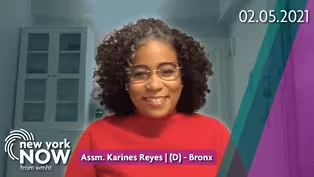
Assemblymember Karines Reyes on the NY HERO Act
Video has Closed Captions
Clip: S2021 Ep5 | 6m 2s | Assemblymember Karines Reyes discusses the NY HERO Act. (6m 2s)
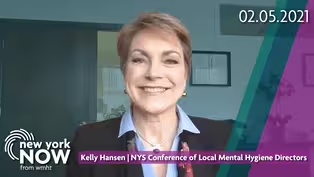
Kelly Hansen, Conference of Local Mental Hygiene Directors
Video has Closed Captions
Clip: S2021 Ep5 | 8m 14s | Funding cuts from the state could spell disaster for mental health. (8m 14s)

Reporter's Roundtable: Jesse McKinley & Bernadette Hogan
Video has Closed Captions
Clip: S2021 Ep5 | 9m 21s | Reporters Jesse McKinley and Bernadette Hogan provide details and analysis of the news. (9m 21s)
Providing Support for PBS.org
Learn Moreabout PBS online sponsorship
- News and Public Affairs

Top journalists deliver compelling original analysis of the hour's headlines.

- News and Public Affairs

FRONTLINE is investigative journalism that questions, explains and changes our world.












Support for PBS provided by:
New York NOW is a local public television program presented by WMHT
Support for New York NOW is provided by WNET/Thirteen and the Dominic Ferraioli Foundation.