
NY Leaders Endorse Kamala Harris and Close Prisons
Season 2024 Episode 34 | 26m 46sVideo has Closed Captions
NY leaders endorse Vice President Kamala Harris' presidency, state prison closures discussed.
New York elected officials head to the Democratic National Convention to support Kamala Harris' presidential bid. Jasmine Gripper of the Working Families Party shares why NY backs Harris and discusses the impact on the state. Additionally, State Sen. Julia Salazar addresses the closure of two upstate prisons, discussing the conditions and future of New York's correctional system.
Problems playing video? | Closed Captioning Feedback
Problems playing video? | Closed Captioning Feedback
New York NOW is a local public television program presented by WMHT
Support for New York NOW is provided by WNET/Thirteen.
NY Leaders Endorse Kamala Harris and Close Prisons
Season 2024 Episode 34 | 26m 46sVideo has Closed Captions
New York elected officials head to the Democratic National Convention to support Kamala Harris' presidential bid. Jasmine Gripper of the Working Families Party shares why NY backs Harris and discusses the impact on the state. Additionally, State Sen. Julia Salazar addresses the closure of two upstate prisons, discussing the conditions and future of New York's correctional system.
Problems playing video? | Closed Captioning Feedback
How to Watch New York NOW
New York NOW is available to stream on pbs.org and the free PBS App, available on iPhone, Apple TV, Android TV, Android smartphones, Amazon Fire TV, Amazon Fire Tablet, Roku, Samsung Smart TV, and Vizio.
Providing Support for PBS.org
Learn Moreabout PBS online sponsorship[ THEME MUSIC ] Welcome to this edition of "New York Now."
I'm Shantel Destra.
This week, democrats from across the country made their way to Chicago for the party's National Convention.
Just a few weeks ago, Vice President Kamala Harris became the presumptive democratic nominee following president Joe Biden's decision to drop out of the race.
Since then, support for Harris from within the party has continued to grow and the convention highlighted the energy around her campaign.
Elected officials representing New York on both the state and national level also joined in on the festivities.
Governor Kathie Hochul delivered a speech highlighting her New York roots while making parallels to the candidates at the top of the party's ticket.
Kamala Harris and Tim Walz grew up with those same values.
[ Cheers and Applause ] and those values have always defined the people of my state.
And in addition to the democratic support, the Vice President has also secured the endorsement of the working families party.
To unpack the party's support for Harris on the national and local level in New York state, we sat down with Jasmine Gripper, codirector of the New York working families party.
[ THEME MUSIC ] Thank you so much for joining us today, Jasmine.
Thanks for having me.
Now I know the working families party has endorsed Vice President Kamala Harris in her run for presidency.
So can you help us understand how the New York delegates, in particular, came to the decision to support Harris and why?
Yeah.
The working families party is national, and we are growing.
We have more and more states that are part of the party.
And so the national working families party led the process.
New York sent two delegates to the National Convention.
We had our own convention here in New York state where we chose to, at the time, we actually chose to endorse the democratic candidate, and that was because we understood there was a lot at stake in this election.
We're talking about two different realities, under a Trump presidency or a Harris presidency.
So the working families party understood this was important.
We can't sit this election out and we need to get behind the democratic nominee, and we're proud to be supporting Vice President Harris.
What are some of the policy stances that the Vice President currently has that really stood out to the party?
How do you see those stances impacting New York?
Yeah.
We're really excited around her commitment to young children.
She's talked about the child tax credit.
She's talked about making bold, huge investments in child care, and these are the things that working families in New York absolutely need.
We need access to high quality, affordable child care.
It's something that the state has been struggling to fully invest in and an infusion of resources from the federal government will put us on the right track.
New York families need support and I'm happy to hear that Vice President Harris is priortizing this.
And what are some of the issues that the party may not be in lockstep with the Vice President on, and how is the party hoping to work with the Vice President should she, you know, be elected to come to a compromise on those issues?
Yeah.
We have been talking to our folks over and over again is there are no perfect candidates.
And we have been saying over and over again that endorsements are about a strategy and not a love letter.
We do not love everything about Vice President Harris, but strategically this is the right person to endorse in this election cycle, and so that is why she's getting our endorsement, and our plan is that we get her into office and then we work to continue to push her on the issues where we disagree.
Every time we won big on advocacy in this country is because people have mobilized are.
People have put public pressure and public demand on public officials to deliver.
So election day is just the beginning of our democratic process.
It continues after people are in office and we hold them accountable, and we absolutely will hold her accountable.
What is the party's position on Vice President Kamala Harris' running mate, Tim Walz?
Yeah.
We're really excited.
She made a great decision.
So clearly seeing her make great decisions very early in picking Tim Walz.
He's a public school teacher, a Governor who invested in universal school bills, something that the Governor of New York has yet to do, someone who prioritized taxing the ultra wealthy to invest in children and pay family sick days and pay sick days.
So really think she picked the right person as her running mate.
Someone that actually offers progressive values and has delivered for working families in his state.
Happy to see him taking the helm with her to set progressive policy on a national agenda.
And the party has been encouraging voters to cast their ballot on the working families party line.
So can you help me understand what type of impact you're hoping this will have on the race?
Yeah.
The beautiful thing about New York is that we have fusion vote computing and so we've been mostly dominated by a two-party system.
But in New York, you can vote for other parties and candidates are allowed to be listed on more than one party and the votes fuse for their vote total.
So what we're asking voters to do is when you go to the ballot on election day, vote on Row D, the working families line and vote for Vice President Harris and Tim Walz on the working families party line.
This is a way to say we're going to vote our values.
It's a way to send a message to democrats that not any blue will do.
We want to support democratic party.
We want to support the democratic nominee, but we also want to send a message that we want them to fight for progressive values.
We want them to fight for working families.
We want them to prioritize our children and our education.
We want them to prioritize reproductive justice for women, and so we want to prioritize ending the war and having a cease-fire.
This is a way for New Yorkers to vote, participate in our election and also send a message at the same time.
And you know, historically, New York has been a blue state when it comes to presidential races.
So what role do you see New York playing in ultimately securing the presidency for Harris?
Yeah.
I think it will continue to be a blue state in the presidential election, but New York actually has a really huge responsibility in terms of the congressional delegation.
Two years ago when people were worried about a red wave across the country, there was no red wave anywhere except for New York and it was quite embarrassing for our state.
We lost the house because New York sent the largest Republican delegation to Washington.
And so the reality is we want to take back the house and taking back the house is through New York and the congressional races, and so we're really excited about battleground New York.
New York has had a chance to determine who is going to be in leadership in the House of Representatives and the congressional races are extremely important and New Yorkers have a role to play, and I think people are not used to seeing us as a swing state but clearly, this is on the line.
Will Republicans or democrats control the house will be determined by New York.
I'm glad you brought up those competitive congressional races.
There's also a slew of downballot races and even races for the state legislature.
Can you tell us about some of the endorsements that the working families party has made in those races, and how you plan to garner support amongst voters?
Yeah.
We're talking to the congressional delegation and the candidates actually this upcoming week to make sure we're coordinating a strategy to win.
So we're going to meet with John Mannion and Josh Riley and pat Ryan, and we're going to also talk to the Senate and assembly candidates that overlap with those races.
We plan to work really hard in those districts to deploy resources, deploy capacity and be a part of a winning strategy to take back the house through central New York and Hudson valley.
And what are some of the geographical areas across the state that the working families parties may see as vulnerable?
How are you hoping to mitigate that challenge?
Yeah.
I mean, we're in all of the purple districts from Long Island to-- and there are even some parts of New York City, central New York and Hudson valley, we're talking to voters and we want to make sure that they're coming out and they're participating.
New Yorkers are worried about the high cost of housing.
That's true.
Not just in New York City but across the state.
New Yorkers are worried about the high cost of child care.
We see that over and over again.
Families are spending too much of their money on child care.
It costs more than the tuition at CUNY and SUNY at this point.
It's a huge financial burden to parents.
We're listening to the issues that matter to voters and we want to make sure that they understand where the solutions are going to come from, and the Republican party is not delivering any of those solutions.
And how receptive, would you say, the candidates you mentioned are to those issues from what you are hearing from voters?
Yeah.
They, too, want to step up and meet the needs of their constituents.
That's why they're running for office.
That's why they want to step up and be a part of our democracy and represent their communities.
We feel we have solutions.
There's ways we can make our communities better and government is meant to work for all of us.
Not just the wealthy and the one percent.
Lastly, you know the working families party was super ecstatic about the funding provided in the state budget for campaign finance initiatives that really helped to boost small donors in races.
What impact are you hoping that will have on races this year as well as races in the years to come?
Yeah.
We've already seen the impact of campaign finance reform in the primaries.
That people were able to run who probably thought they didn't have a path to running because they didn't have access to wealth and resources.
So publicly financing elections means that your small dollars are your mom, your aunt, your uncle, your neighbor can go much further and go a long way.
What we see that doing is that candidates are now spending more time talking to their neighbors, talking to their constituents, and courting small dollar donations.
That's what we want.
You should be accountable to the constituents who vote you in and not to the people who are wealthy and well connected.
We have already seen it shape the field if our democratic primaries.
I remember meeting a candidate who was considering running and our first conversation was like, I'm not sure if I can raise enough money.
This was a young woman, a woman of color, who felt like maybe this democracy isn't meant for me to participate at this level.
But because of campaign finance, she was able to run and she was able to win her democratic primary here in Albany in AP109, so really excited about public financing of elections.
Now in the general, we see everyone taking advantage from progressives, to democrats, to Republicans.
Everyone is using the new system and we do believe just creates a level playing field that your wealth or your personal connections don't determine if you can run for office, but if you have a connection to the community, that's enough to get you started and to have a credible race.
And are there any other reforms that the party is hoping is put forth when it comes to campaign finance that you will be working towards in the next Legislative Session and beyond?
I think we're going to talk to candidates and see how they felt about the system across the board from incumbents to new candidates who are using it.
Were there any hiccups in I'm sure there are ways to improve it.
Number one priority is that the system continues to be funded and continues to be expanded and that's the most important thing that we continue to do.
Absolutely.
Well, certainly a lot to look forward to as we head into the final days of this election season, but we thank you so much for taking the time to speak with us today.
Thanks for having me.
We were speaking with Jasmine Gripper, codirector of the New York working families party.
Thank you.
[ THEME MUSIC ] And for more information about the work of the working families party, heading into election day, you can visit our website.
That's at NYnow.org.
Now turning to another important topic.
The state budget provided funding for the state department of corrects and community supervision to close up to five prisons across New York state as prisons mitigate the realities of decreasing prison population and worsening conditions.
Recently, the state department announced the closure of two upstate prisons this fall.
To learn more about the impact of that decision, we sat down with state Senator Julia Salazar, who chairs the Senate community on crime victims, crime, and correction.
Here's that conversation.
[ THEME MUSIC ] Thank you so much for joining us today, Senator.
Great to see you.
Thanks for having me.
Of course.
Now the state budget authorized the state department of corrections and community supervision to look at closing up to five prisons in New York state.
So can you help us understand why the legislature thought it was important for the department to have that authority?
Absolutely.
So-- for context, in the executive budget this year, the Governor included in her executive budget, the ability for her to authorize the closure of up to five prisons over the course of the next year.
So at this point, between now and April.
And it had been the Governor's public plan and DOC's public plan to do this and this past April, we collectively included this in the enacted budget, and for myself and others in the legislature, we-- we have, I think, multiple opinions about why it's important to close facilities.
I do agree with the rationale from DOC and executive that our prisons are currently struggling with recruiting enough staff, both correction staff and correction officers but also program staff, medical personnel.
That's a really serious issue that there are not enough doctors, nurses, psychologists to provide care in DOC's facilities and additionally, some of these facilities like great meadow have been operating with a really low population.
So this is sort of a way of right-sizing correctional facilities and then additionally to speak for myself, I think that when it is responsible to do so, we should be looking at closing prisons and prisons shouldn't be essentially a jobs program.
The catch, though, is that we have to do so responsibly, mitigate the impact on local communities and have a plan for transition when prisons are closed because of the significant impact it can have on so many people.
And as you mentioned, it was announced recently that later this fall two upstate prisons, the great meadow correctional facility and the Sullivan correctional facilities will be closing.
So I wanted to understand more about your perspective on that decision to close the those two prisons upstate.
Yes.
So this decision was entirely made by the Governor and DOCS in terms of what facilities are closing.
Even though I personally, as the chair of the committee, I support their decision regarding great meadow and Sullivan.
Great meadow, it's a facility that I visited within the last year and a half, and it's a facility that has had a lot of issues.
A very high rate of reported violence, both against incarcerated individuals, by correction staff and also against corrections staff.
A lot of reports of abuse, but additionally, we know that the facility even as of early this year, before closures were announced, was only 27% full in terms of their capacity and population.
That is the lowest of any DOCS facility by far, and there have been a ton of vacancies at the facility, which, you know, it poses a humanitarian crisis in some cases when almost a third of the health services positions are vacant and people can't get urgent medical care, and similar challenges at Sullivan.
Sullivan is a smaller facility, medium security facility, but they have struggled with even greater gaps in filling their health services position.
So the health care has really been deeply inadequate at Sullivan as well.
It's a common-- common problem among facilities, but particularly acute with Sullivan and great meadow.
There's also been pushback on the decision from unions representing state correction officers.
They argue that it may put officers at risk and there needs to be more of a long-term solution to address the conditions at state prisons of the so I was just curious if you had any response to those specific concerns from those unions.
I sympathize with the concerns.
There absolutely should be a comprehensive plan.
Not only for these two closures but for any future, additional closures of prisons, which I think if we are actually meeting our public safety goals and policy-- public safety policy is effective that we will see more closures of state prisons, and so we have to be prepared with a plan every time that is specific to the facility, to the local population, the locality that will be impacted by the closure, to their economic needs.
The impact-- and also the impact on families and workers, of course, as well as the incarcerated population.
And so what I would like to see and eager to work on and beginning to work on is a sort of comprehensive just transition for corrections.
So a way of deliberately changing and improving how the state addresses closures.
The state does have and has had a prison redevelopment commission which convened by Governor Hochul a few years ago, a couple years ago after a series of six closures, to look at the-- previous closures, including those ones, and its impact on communities and how the state can basically execute these closures more effectively and even -- I think there's an opportunity for the closure of prisons to have the need to have benefits for community and have a positive impact, but that is only going to happen if we are intentional and deliberate about it and bring in the stakeholders.
People who are directly impacted by these closures, listen to them and implement their recommendations.
And what would you say to New Yorkers who may be worried or concerned about the closure of these prisons and conditions of prisons across the state?
I know you mentioned the possibility of a positive impact.
What might that look like?
Yeah.
One positive impact that I look forward to when I visit prisons across the state, I see that it's not unique unfortunately to Sullivan and great meadow that they're always understaffed.
Particularly program staff, medical staff, other support staff and certainly correction officers, the department has struggled with recruitment and retention and that is something that these closures, I expect will address.
When, you know, the impact that the staff shortages is profound.
It is an impact that is felt by staff in facilities, that they are stretched too thin, that they're having to work overtime and just generally in every way makes their jobs harder when there aren't enough staff in general and it certainly has an impact, I think a negative impact on trying to address violence in facilities when we don't have adequate staff operating programs that seek to address harmful or violent behavior.
We-- it also presents challenges for DOCS complying with the law in terms of how facilities are operated and mandates in facilities.
So I really anticipate a positive impact from these closures on conditions in facilities, on violence in facilities, and also on the wellbeing of both, generally speaking, staff and incarcerated individuals who will have more support that they really need.
And lastly, as chair of the state Senate committee on crime victims, crime and correction, I'm curious if there were any ways that you were looking to continue to tackle the upkeep of state prisons?
You know, looking into the next Legislative Session in the few months ahead.
Absolutely.
I have introduced legislation that we have referred to as a rights behind bars bill, a comprehensive bill seeking to address issues in facilities, conditions particularly, rights that are not really being respected and tried to improve conditions both for incarcerated individuals and for staff.
There has been a lot of discussion about the lack of air conditioning in facilities, for example and this has to do with the age of most of these buildings and how cost prohibitive it is without dedicated funding for DOCS to upgrade their infrastructure and to incorporate air conditioning into facilities.
The inspector general just released a report regarding health compliance, which is to say that many facilities, DOCS across the state are not complying with the solitary confinement act and they should be.
We want to make sure that facilities are complying with the law and the law is as clear as possible for the sake of people's human rights and not causing individuals to deteriorate while they are incarcerated.
As we know solitary confinement can do.
There really is so much work for us to do-- ahead of us to try to reform the system of incarceration in New York state and including the fact that there is essentially prison slavery in our state.
Earlier this year, myself and Senator Skoufis and Senator Myrie co-chaired a legislative hearing on the DOCS system for employing incarcerated individuals, paying them extremely low wages, less than a dollar per hour in order to do work that is-- is often very exploitative certainly, but also not really meaningful or enriching to the individual, not giving them skills to be able to use after incarceration and so we really want to examine that work on legislation to change that, so that we're not seeing de facto slavery persist in New York's prison system as well.
Well, certainly a lot to look forward to.
It sounds like there's a lot of work ahead.
Unfortunately, that's all the time we have for now.
Thank you.
It's really been a pleasure.
Thank you.
And we were speaking with state Senator Julia Salazar, chair of the state Senate committee on crime victims, crime, and correction.
[ THEME MUSIC ] and for more information on the future of prisons in New York state, you can visit our website.
Again, that's at NYnow.org.
Well, that does it for this edition of "New York Now."
thank you for tuning in and see you next week.
[ THEME MUSIC ] Announcer: funding for "New York Now" is provided by WNET.
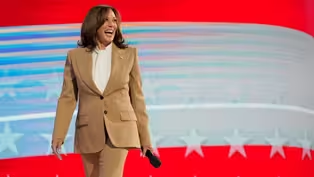
New York's Role in Kamala Harris' Presidential Bid
Video has Closed Captions
Clip: S2024 Ep34 | 11m 56s | NY's Working Families Party discusses endorsing Kamala Harris for President and the 2024 election. (11m 56s)
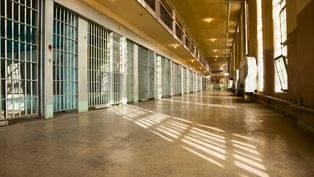
New York to Close 2 Prisons: What It Means for the Future
Video has Closed Captions
Clip: S2024 Ep34 | 13m 36s | What the closure of two prisons means for the future of New York. (13m 36s)
Providing Support for PBS.org
Learn Moreabout PBS online sponsorship
- News and Public Affairs

Top journalists deliver compelling original analysis of the hour's headlines.

- News and Public Affairs

FRONTLINE is investigative journalism that questions, explains and changes our world.












Support for PBS provided by:
New York NOW is a local public television program presented by WMHT
Support for New York NOW is provided by WNET/Thirteen.