NYC-ARTS
NYC-ARTS Full Episode: April 13, 2023
Season 2023 Episode 580 | 27m 46sVideo has Closed Captions
A visit to the AKC Museum of the Dog, the Bush-Holley House and Asia Society Museum.
A visit to the AKC Museum of the Dog, one of the only museums dedicated to the depiction of dogs. Then a trip to the Bush-Holley House in Greenwich, once the home to the Cos Cob artist colony. A look at "Comparative Hell: Arts of Asian Underworlds" on view at Asia Society Museum.
Problems playing video? | Closed Captioning Feedback
Problems playing video? | Closed Captioning Feedback
NYC-ARTS is a local public television program presented by THIRTEEN PBS
Major funding for NYC-ARTS is made possible by The Thea Petschek Iervolino Foundation, Jody and John Arnhold, The Lewis “Sonny” Turner Fund for Dance, The Ambrose Monell Foundation, Elise Jaffe...
NYC-ARTS
NYC-ARTS Full Episode: April 13, 2023
Season 2023 Episode 580 | 27m 46sVideo has Closed Captions
A visit to the AKC Museum of the Dog, one of the only museums dedicated to the depiction of dogs. Then a trip to the Bush-Holley House in Greenwich, once the home to the Cos Cob artist colony. A look at "Comparative Hell: Arts of Asian Underworlds" on view at Asia Society Museum.
Problems playing video? | Closed Captioning Feedback
How to Watch NYC-ARTS
NYC-ARTS is available to stream on pbs.org and the free PBS App, available on iPhone, Apple TV, Android TV, Android smartphones, Amazon Fire TV, Amazon Fire Tablet, Roku, Samsung Smart TV, and Vizio.
Providing Support for PBS.org
Learn Moreabout PBS online sponsorshipPaula: Coming up ON NYC-Arts, a visit to the American kennel club museum of the dog, one of the only museums dedicated solely to the depiction of dogs.
Alan: it's an art museum, first and foremost.
This is a collection, possibly one of the greatest collections of dog art in the world.
It comprises about 1700 objects, primarily fine artwork, either paintings, drawings, sculptures, posters, a whole variety of things, all dedicated to the dog.
Paula: Then, a trip to the Bush-Holley house in Greenwich, whose historic rooms evoke the work of the artists who lived here at the turn of the century.
Debra: The Bush-Holley house today portrays two stories in its history.
The house began life as a home for prosperous merchants in the 18th century and then gained recognition later as a boarding house for American artists and writers.
Paula: And a look at the exhibition, Comparative Hell: arts of Asian underworlds, on view at the Asia society museum.
The exhibition features more than 50 works, from silk paintings dating to the 10th century to an abstract installation from this decade.
These works look at the various conceptions of Hell and take viewers on a journey through the underworld.
>> Funding for NYC-Arts is made possible by -- Thea Petschek Iervolino foundation.
Jody and John Arnhold.
The Lewis Sonny Turner fund for dance.
The Ambrose Monell foundation.
Elise Jaffe and Jeffrey Brown.
Charles and Valerie Diker.
The Milton and Sally Avery arts foundation.
The Nancy Sidewater foundation.
Elroy and Terry Krumholz foundation.
And Ellen and James S. Marcus.
This program is supported, in part, by public funds from the New York City department of cultural affairs in partnership with the city council.
Additional funding provided by members of 13.
NYC-Arts is made possible in part by first republic bank.
>> First republic bank presents, first things first.
At first republic bank, first refers to our first priority.
The clients who walk through our doors.
The first step?
Recognize that every client is an individual with unique needs.
First decree.
Be a bank whose currency is service in the form of personal banking.
This was first republic's mission from our very first day.
It's still the first thing on our minds.
>> And by Swann auction galleries.
>> Swann auction galleries.
We have a different way of looking at auctions, offering vintage books and fine art since 1941.
Working to combine knowledge with accessibility, whether you are a lifelong collector or a first-time buyer, or looking to sell.
Information at swanngalleries.com.
♪ Paula: Good evening and welcome to NYC-Arts.
I'm Paula Zahn on location at MAD, the museum of arts and design located in Columbus circle.
The museum has long been a champion of the work of artists, designers, and artisans who apply the highest level of ingenuity and skill.
Since the museum's founding in 1956 by philanthropist Aileen Osborn Webb, MAD has celebrated the many ways materials can be transformed, from traditional techniques to cutting edge technologies.
Craft front and center is a fresh installation of some of the museum's permanent collection of more than 3500 objects.
On view are more than 60 historic works dating from the golden age of the American crafts movement to the present day.
Also on view is a special exhibition called Generation Paper: a fashion phenom of the 1960's.
It explores the era's short-lived phenomenon of paper fashion through more than 80 rare garments and accessories all crafted from non-woven textiles.
These fashions were introduced in 1966 as a promotional campaign for Scott paper company, combining bold graphic design with space-age innovations.
From A-line dresses to bikinis, these iconic silhouettes became examples of the potential of paper-like materials.
These included rayon, polyester, and other synthetic blends.
Highlights include garments that drew upon a promotional campaign for viking -- the appliance manufacturer -- from kitchen countertops to carpet patterns, a knitted paper mini-dress by Mars of Ashville, designs for a series by graphic artist Harry Gordon that incorporate striking black and white photography, and Campbell soup company's Souper dress with a soup can motif that tapped into the pop-art movement made famous by Andy Warhol.
In addition to providing a whimsical look at fashion, the exhibition reminds visitors of a time in history defined by the space race, counterculture, and the beginnings of important social and political movements that began in the 1960's.
Generation paper will be on view until August 27.
On our program tonight, we'll visit the American kennel club museum of the dog, located at 101 park avenue near grand central terminal.
After changing locations several times since its founding in 1982, the museum has found its way back home, reuniting with the AKC under one roof.
One of the only museums dedicated solely to the depiction of dogs, its permanent collection is one of the finest and largest holdings of canine-related fine art and artifacts in the world.
It comprises paintings, watercolors, drawings, prints, ceramics, and bronzes.
The museum celebrates the important role dogs play in society as well as the more personal human-to-canine bond.
Curator Alan Fausel is our guide.
Alan: The one thing you have to realize when you come here is the fact that it's an art museum, first and foremost.
This is a collection, possibly one of the greatest collections, of dog art in the world.
It comprises about 1700 objects, primarily fine artwork, either paintings, drawings, sculptures, ceramics, a whole variety of things, all dedicated to the dog.
We've had several exhibitions.
We have a robust schedule.
Some that come to mind are the women and dogs in the arts.
We found that in going through the collection, how many women were involved and were really good dog artists.
And we want to show that off.
We've had hollywood dogs.
We have a number of posters.
We have presidential dogs.
And we do that every four years, to talk about the different pets and dogs that different presidents owned.
We recently hosted an exhibition of dogs of war and peace , where we have a lot of images of dogs and how they helped on the battlefield and off the battlefield, as well as therapy dogs and helping people come back.
Particularly poignant was the wounded warrior dogs by James Mellick, an Ohio artist who crafted these allegories of dogs and reflecting the injuries, the suffering that not only the handlers, but also the dogs incurred.
One of the great joys of bringing this museum to New York was the reception we've had for the library.
The library's always packed.
We have an activity center, we have about 4000 volumes of the AKC library.
We not only have a great collection, but we also have state of the art digitally interactive displays.
You can train a virtual dog.
I think I just heard her, Molly.
We took a 10-year-old lab out in Los Angeles, put it in a motion capture suit, and then filmed her there.
So all the motions and the reactions are in real time, the way the dog would've done it.
Probably the most popular is the find your match, not the dog you should have, but the dog you look like.
It takes your photograph, and through ai decides what dog you look like.
We have a meet the breeds table where you can learn about all 200 breeds in the AKC.
The oldest work here is a 30 million-year-old fossil of hesperocyon, which was an early dog.
Most of our paintings start around 1670's and then go on to today and show a variety of different activities that dogs engage in.
Queen Victoria was probably really the most important person in the 19th century in elevating the status of the dog, rather than just being a working dog in the field, to be a dog in the home.
It became very popular to have dogs as pets.
I think the crowd favorite here is silent sorrow, a very sad painting.
It shows Caesar, Edward VII's dog after the king had passed away.
Edward VII inherited his mother's, Queen Victoria's, love of dogs.
Edward VII stipulated that Caesar was in his funeral procession, ahead of nine heads of state.
It was important to him.
It's painted by Maud Earl and it shows his dog Caesar leaning his head on his master's armchair as the armchair slowly fades into the background in obscurity.
Another work we have here, which is probably one of the greatest American dog paintings is sensation and bang bang.
It's painted by John Martin Tracy.
It's a magnificent painting out in the woods.
This is by far his best work, the light filtering through the trees, the atmosphere that he brings to it, it's just a stunning work.
There were two pointers that were imported by the Westminster kennel club back in the 19th century.
One of them, sensation, is the dog that eventually became the logo for the Westminster kennel club, which you see at their shows all the time.
Another popular piece is not a painting, but it's some actually queen.
Queen is a carousel dog, by the Looff factory, probably around 1890's that shows a mastiff.
It hit me after looking a lot of dog paintings throughout my life, I'm starting to look at dogs differently.
And I would see things that I didn't see in the dog that the painter was telling me.
And really all of a sudden it was like a moment where I said, this is really the goal of art.
Whether it be a dog painting or a conceptual work or an abstract work, is to make you see the world differently through the artist's eyes.
And that's what you learn.
You learn about dogs.
You say, I never really noticed that.
That's an interesting thing.
♪ Paula: Next, we'll travel to the Bush-Holley house in Greenwich, Connecticut, just an hour north of New York City.
This stately colonial building is one of the few remaining in Greenwich from the early decades of the 18th century.
This historic site is the centerpiece of the Greenwich historical society, which has documented the town's passage from a colonial New England settlement to an affluent suburb.
In maintaining the house for visitors, the society has preserved the meeting place of the cos cob art colony which flourished here.
Currently on view through September 3 is Sports: More than just a game.
The exhibit shows how athletes in Greenwich and surrounding communities broke boundaries, tested limits, and found common ground through athletic achievement.
The exhibit features memorabilia, sports equipment, and personal effects from some of America's most celebrated athletes who made their homes in Greenwich.
They include Olympic champions Dorothy Hamill and Donna de Varona, baseball great Tom Seaver, and football legend Steve Young.
The exhibition provides a look at how sporting culture shaped the town's unique history.
♪ Debra: The Bush-Holley house today portrays two stories in its history.
The house began life as a home for prosperous merchants in the 18th century and then gained recognition later as a boarding house for American artists and writers.
Today, it's a national historic landmark and one of 18 sites in the Connecticut art trail.
Since acquiring Bush-Holley house in 1957, the historical society expanded the site by building an archive and research library to house a wonderful collections of Greenwich history and then transformed a barn into an education center.
The storehouse and post office, which sits next door was adopted as the exhibition gallery, for changing exhibitions on history and art.
The Bush story begins with David Bush, who came here to with his wife to build a tide operated gristmill.
He also improved the harbor so that ships can come right up to the docks, and this made the lower landing a really wonderful commercial enterprise for him.
He was a very wealthy man and I think you can see that in Bush-Holley house.
A scrap of the wallpaper has the British tax stamp on the back.
It reminds us of one of the causes of the American revolution.
One sign of David's extraordinary wealth was the enslaved people who lived here, the African Americans, and there's one room in the house that portrays the kind of ways in which slaves lived in the 18th century, particularly in New England, where they tended to be housed in attics and cellars of the main mansion houses.
The story of the Holleys begins in many ways with the railroad coming to Greenwich in 1848, it began to bring residents up from New York for summertime activities.
So the Holleys saw an opportunity to take on Bush-Holley house as a boarding house, it was known as the old house.
The artists and writers who came here self-identified as the cos cob art colony.
This was Connecticut's first art colony, particularly known for its innovative and experimental style and that tone was set by John Henry Twachtman, the American impressionist artist, who was the first to come here and teach summer classes in 1892.
He was followed by J. Alden Weir and Theodore Robinson who had known Claude Monet.
They came here really helping to translate French impressionism into an American idiom.
The life of the artist was to go out during the daytime and do their paintings and then gather back in the late afternoon.
Twachtman would often say, "don't paint what you see, paint what you feel."
Another of the artists that came here was Childe Hassam, who stayed here off and on over a 20-year period.
The rooms in Bush-Holley house cost from $8 to $20 to rent for the week and the best bedroom was the $20 room, the one where Childe Hassam would stay with his wife Maude.
You can see hanging there an etching that he made of the federal mantel piece with a woman clad in kimono.
Some of the most extraordinary things that you can see in Bush-Holley house today are a set of etchings that he made, almost 30 of them when he was here in 1915.
One of them at the Dutch door shows a woman standing in front of the Dutch doors of Bush-Holley house and you can feel almost a sense of the summer inviting you out into the outside.
I'm standing in a room, which was an art studio it became the permanent studio of Elmer Macrae.
He was a young student who came here in 1896.
He fell in love with the Holleys' daughter, Constant and married her in 1900.
He would often give exhibitions in this studio that attracted hundreds of people and his exhibitions would be critiqued in the New York papers.
Macrae painted the extraordinary picture of his twin daughter constant feeding the ducks, which hangs in the hallway of Bush-Holley house.
1912, when that painting was done was kind of an important year because at the same time, Elmer Macrae was one of the early organizers of the international exhibition of art in New York in 1913, known as the armory show.
That show was significant, that it introduced European modernists to the vast American public for the first time.
It also had a huge impact on the cos cob artists here, and you can see that in a painting hanging in Macrae's studio of "gay head on Martha's Vineyard," which shows him really trying to understand a new way to translate and to see landscape.
He began creating more decorative works of art such as the painting of the irises.
One of the paintings hanging in the hallway is of Clarissa, she was painted in 1912 by Childe Hassam.
The bookcase is still there as well as the hallway and the stair.
Bush-Holley house is a wonderful 18th century house that has so much character that comes from its early history in the 1830's, but what's probably most extraordinary is to come here and see the art on the wall from the artists at the turn of the 20th century, who fell in love with this house and this village.
♪ Paula: For more information on cultural events in our area, please sign up for our weekly email.
Top five picks will keep you up-to-date all year round.
Be sure to connect with NYC Arts on Facebook, Instagram, and Twitter.
Now a look at the exhibition, "Comparative Hell: Arts of Asian Underworlds," on view at the Asia society museum on park avenue and 70th street.
For centuries, the spiritual realm of evil and suffering has inspired artists throughout Asia.
The works come from many countries, including Cambodia, India, Japan, Nepal, Iran, Turkey, and many more.
The exhibition features more than 50 works, from silk paintings dating to the 10th century, to an abstract installation from this decade.
These works look at the various conceptions of Hell and take viewers on a journey through the underworld.
Buddhist, Hindu, Jain, and Islamic thought place human existence within a larger framework that includes both Heaven and Hell.
However, there are numerous theories on just how many levels of Hell exist.
The depiction of the "Wheel of Life" captures the Buddhist conception of the various realms that can lead to punishment or to the bliss of enlightenment.
Judgement is a prevalent theme across religious traditions.
The threat of punishment in Hell serves as an incentive for people to conform to societal norms, instill virtuous behavior, and encourage atonement for sins.
Judgment is determined by the Gods and kings who reign over Hell.
One example is this statue of Yama.
In contrast, the Japanese tradition features the frightening figure, Datsueba, also known as the Hag of Hell.
For centuries, Asian artists have created terrifying scenes of punishment as illustrations in manuscripts and for display in religious centers.
Whether in human or demonic form, the tormentors undertake swift and brutal punishment of the damned.
For the lucky few, there was the possibility of an escape from Hell.
Compelling tales of the damned who begged to be saved, family members who attempted to intervene on their behalf, and Gods who interceded, gave hope to the living, and the previously condemned.
For contemporary artists such as Lu Yang, Luis Lorenzana, and others, Hell is a metaphor for the social, political, and economic pitfalls of society.
The visual arts remain an important way for cultures to express their beliefs and anxieties about human behavior and the afterlife.
The exhibition is on view through May 7.
Next week on NYC-Arts, a backstage conversation with director Bartlett Sher and writer Aaron Sorkin about Lincoln center's new production of the legendary musical "Camelot."
Bartlett: When the music was first done it came into the culture so powerfully because of John F. Kennedy and the representation of Kennedy as kind of memory both before he died and after the assassination.
And Jackie Kennedy really lifted this idea of Camelot as this kind of myth that was important to us.
Paula: What are the universal themes of the original show?
Aaron: As flawed as we are, humans have a capacity for goodness and greatness.
Paula: And a visit to the Brooklyn museum and "Monet to Morisot: The Real and Imagined in European art."
Lisa: This exhibition brings together a really important part of Brooklyn's European collection.
It's 19th and early-20th century European art.
We have organized it under the broad theme of the real and the imagined, which was really evocative and flexible in terms of these disparate works.
♪ Paula: I hope you've enjoyed our program tonight.
I'm Paula Zahn on location at the museum of arts and design.
Thank you so much for watching.
Have a good night.
To enjoy more of your favorite segments on NYC-Arts, visit our website at NYC-Arts.org.
Vijay: My primary way of playing piano is by improvising.
Alice: You are in some respects on sacred ground.
Dee: A woman came to see me perform and said how would you like to play Billie Holiday?
Jodi: I think one of the essential things we learned is that Matisse used pens to compose his work.
Renee: Viewers are surprised when you're doing a piece 100 years ago and think, oh my gosh this could be now.
Anne: The cardboard guitar is the very first of that moment of realization.
Ivo: Suddenly you come and present something and get applause.
Great.
You know?
♪ >> Funding for NYC-Arts is made possible by -- Thea Petschek Iervolino foundation.
Jody and John Arnhold.
The Lewis Sonny Turner fund for dance.
The Ambrose Monell foundation.
Elise Jaffe and Jeffrey Brown.
Charles and Valerie Diker.
The Milton and Sally Avery arts foundation.
The Nancy Sidewater foundation.
Elroy and Terry Krumholz foundation.
And Ellen and James S. Marcus.
This program is supported, in part, by public funds from the New York City department of cultural affairs in partnership with the city council.
Additional funding provided by members of 13.
NYC-Arts is made possible in part by first republic bank.
>> First republic bank presents, first things first.
At first republic bank, first refers to our first priority.
The clients who walk through our doors.
The first step?
Recognize that every client is an individual with unique needs.
First decree.
Be a bank whose currency is service in the form of personal banking.
This was first republic's mission from our very first day.
It's still the first thing on our minds.
>> And by Swann auction galleries.
>> Swann auction galleries.
We have a different way of looking at auctions, offering vintage books and fine art since 1941.
Working to combine knowledge with accessibility, whether you are a lifelong collector or a first-time buyer, or looking to sell.
Information at swanngalleries.com.
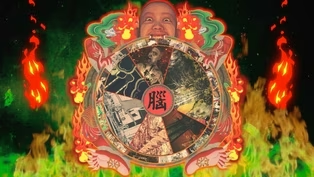
Comparative Hell: Arts of Asian Underworlds at Asia Society
Clip: S2023 Ep580 | 3m 41s | A look at "Comparative Hell: Arts of Asian Underworlds" on view at Asia Society Museum. (3m 41s)
Providing Support for PBS.org
Learn Moreabout PBS online sponsorship













Support for PBS provided by:
NYC-ARTS is a local public television program presented by THIRTEEN PBS
Major funding for NYC-ARTS is made possible by The Thea Petschek Iervolino Foundation, Jody and John Arnhold, The Lewis “Sonny” Turner Fund for Dance, The Ambrose Monell Foundation, Elise Jaffe...