NYC-ARTS
NYC-ARTS Full Episode: April 18, 2024
Season 2024 Episode 612 | 27m 47sVideo has Closed Captions
A profile of Conrad Tao and a look at the exhibition "Käthe Kollwitz" on view at MoMA.
A profile of 29 year old Conrad Tao, a composer and pianist who has spent the last decade pushing the boundaries of classical music. Then a look at the exhibition "Käthe Kollwitz" on view at MoMA. This is the first major retrospective devoted to Kollwitz in a New York museum and includes more than 120 works. Finally, a look at a highlight in the American Folk Art Museum collection.
Problems playing video? | Closed Captioning Feedback
Problems playing video? | Closed Captioning Feedback
NYC-ARTS is a local public television program presented by THIRTEEN PBS
Major funding for NYC-ARTS is made possible by The Thea Petschek Iervolino Foundation, Jody and John Arnhold, The Lewis “Sonny” Turner Fund for Dance, The Ambrose Monell Foundation, Elise Jaffe...
NYC-ARTS
NYC-ARTS Full Episode: April 18, 2024
Season 2024 Episode 612 | 27m 47sVideo has Closed Captions
A profile of 29 year old Conrad Tao, a composer and pianist who has spent the last decade pushing the boundaries of classical music. Then a look at the exhibition "Käthe Kollwitz" on view at MoMA. This is the first major retrospective devoted to Kollwitz in a New York museum and includes more than 120 works. Finally, a look at a highlight in the American Folk Art Museum collection.
Problems playing video? | Closed Captioning Feedback
How to Watch NYC-ARTS
NYC-ARTS is available to stream on pbs.org and the free PBS App, available on iPhone, Apple TV, Android TV, Android smartphones, Amazon Fire TV, Amazon Fire Tablet, Roku, Samsung Smart TV, and Vizio.
Providing Support for PBS.org
Learn Moreabout PBS online sponsorship♪ >> coming up on NYC arts, a profile of composer and pianist Conrad Tao, who pushes the boundaries of classical music.
Conrad: Improvising was a way of being a composer before I had any training.
I had a minidisk recorder and PNO and I would improvise and create fantasies.
It feels like throwing a stone in the water, observing the ripples and trying to find or follow a radiated continuity out of that seed of an idea or that stone.
>> then a trip to MOMA in an exhibition which reflects commitment to Expressionism and part for social change.
This is the first major retrospective denoted to them in a New York museum and includes more than 120 drawings, prints and sculptures.
Focusing on motherhood, grief and resilience, they brought visibility to the working class and the necessity of a female point of view.
And a highlight from the collection of the American folk Art Museum.
>> the head by Asa Aimes is one of my favorite pieces because of its theory beauty and the sense of quietness in the figures phase, which is at odds with the markings in the scalp.
It is explicit as part and has a poignancy that is lent to it by the artists own story.
Funding is made possible by Jodi and John Arnold, the Lewis Sonny Turner found.
The Ambrose's foundation.
Charles and Valerie, the Milton and Sally Avery foundation.
The Nancy side water foundation, LN in James Marcus.
This program is supported in part by public funds from the New York City Department of affairs in partnership with the city Council.
Additional funding by members of 13 and Swann.
>> we have a different way of looking at auctions.
Offering books and fine arts since 1941, looking to combine with accessibility.
Information at Swann Galleries.com.
♪ >> good evening and welcome to NYC arts.
I am Paul of at the historic Society on Central Park West.
A place to experience 400 years of history through exhibitions, immersive films and thought-provoking conversations among renowned historians and public figures.
New York historical, the first museum in New York City was founded in 1804 by a small group of prominent New Yorkers conscience of the significance of their time in New York City.
It was and is the center of the American experience and the founders knew collecting documents and objects would preserve the American story.
It's museum and Library holdings include more than 14 million documents, works of art, artifacts and ephemera that cover four centuries of American history in art.
Photographs, furniture, silverware and clothing.
The collection includes drawings, paintings and sculpture.
The New York historical Society's extensive collection of Tiffany studio lamps was a gift of pioneering collector Dr. Neustadt, an Austrian immigrant and his wife.
In 1935, they found a strange old-fashioned lamp in a Greenwich antique shop and purchased it for $12 and $.50.
Their modest discovery sparked a decades long quest in which they amassed more than 200 Tiffany lamps, perhaps the largest collection in the world.
The lamps made by Tiffany studio are icons of early 20th century American design, proclaiming itself an alliance of arts and crafts, they pioneered artistic lighting for the recent innovation of incandescent lightbulbs, softening intensity with shimmering glass that poetically rendered the natural world.
The sumptuous lamps marketed to wealthy Americans during national prosperity peaked in popularity between 1900 and 1910.
Lewis Tiffany was the artistic genius behind Tiffany Studios, one of a succession of New York firms that flourished under his direction.
However, he was not the exclusive designer of lamps, windows and luxury objects.
The head of the women's glass cutting department from 1892 to 1909 has been revealed as the designer of many of the firms glass shapes.
The lamps reflect the enormous talent of designers and artisans who worked anonymously to fulfill Tiffany's aesthetic vision.
For Tiffany and designers, color range over line and form.
Color is of the first importance, he declared.
In many flowers, their form is distinctly a secondary consideration which comes after the satisfaction in the colors, Hughes that Glo and Flickr and strike like embers.
In the flames of a driftwood fire.
To streamline the work, Clara designed multiple lampshades of the same shape, such as the rose which shared the same style of border.
Each shade remain highly distinctive.
Tiffany and Driscoll designed lamps at a pivotal moment when the advent of electricity was revolutionizing the American home, workplace and urban landscape.
Their earliest lamps used fuel, typically kerosene and the bases had to conceal reservoirs.
Electrification would liberate lamp designs and make a lighter more elegant silhouette.
On today's program, a profile of a composer and pianist who spent the last decade pushing the boundaries of classical music.
29-year-olds Conrad Tao has a list of a call's too long for one introduction.
He has collaborated as a soloist and composer with the world most procedures orchestras including the New York Philharmonic and Los Angeles Philharmonic.
Our focus is on the intimate side of Conrad's work, whether it is his contemporary improvisations or his take on box Goldberg variations.
In each case, Conrad draws on his body of work to make one bold musical statement ♪.
♪ >> sometimes, I think that the whole reason I ended up on the path that I am on is that I started so young I do not remember it.
When I was 18 months old I started picking out nursery tunes at my family's upright Baldwin and things snowballed from there.
Improvising at first was just my way of being a composer before I had any music theory training.
I had a mini disc recorder, PNO and I would improvise and create fantasies.
It feels like throwing a stone in the water and observing the ripples to try to find or follow some sort of radiant continuity out of that initial seed of an idea or initial stone.
It is not a composition in the sense that every note has been defined, but in the sense that there is a defined form, a certain range of PNO that I want to reach, a cord I want to reach.
How I get to that goal can shift a lot from a personal desire to challenge myself, so that is what is lovely about a composition that has deliberately left open room for a moment to moment decision making.
♪ >> improvising with others is really different from improvising on my own, because it is inescapably social.
With the westerlies, it is a matter of listening closely, pulling out tones from the air, hearing music in the environment and trying to bring that out.
♪ >> my style at the PNO is informed by all kinds of music at this point.
I still play the traditional repertoire a lot.
In fact, it is the bulk of what I do.
I proselytize a little about the value of engaging with contemporary music because it changes one's relationship with full music.
Finding ways for the music to speak beyond the conventions of the genre is an expression of love for the music.
It made going back to Beethoven, Mozart, Schubert, so satisfying.
All of these composers are using notation.
One marking in a Schubert score mean something different in a Brahm score.
And the way I think about things is informed by improvisation.
I think of every single score as a window of possibility, it is not about aiming for a single point, it is a different kind of precision.
♪ >> Bach's Goldberg variations are the first music I ever heard and I saw Caleb choreograph.
So in some ways, it is as simple as reflecting my friendship with Caleb, but on some level, we are referencing the explicit counterpoint of the music.
♪ >> but also, the fact that the addition of a tap dance layer opens up space for Caleb to offer non-pitched percussive sound which really works well because bock is rhythmically dense and it is like every else I'm interested in, how can you honor historical work by offering a new gloss on it?
My most recent studio album group out of pieces with explicit political and musical content in them.
Which side are you on takes the lyrics penned by Florence Reese to the melody of an old Baptist him right after and act of police intimidation.
They immediately take the melody and fling it into a blender or a kaleidoscope, it is a cacophonous symphony of variations on that melody.
And another thing that really drew me to the piece was that they asked for an improvised cadenza.
It is my way of building the peace to its thunderous climax.
I feel like I'm searching for one single answer to the question of what music is and yet, it is so obvious from the evident greatness around us that the single answer I'm searching for would have to be a prison.
The experience of finding things in addition to what I already knew has been nothing but joyous and challenging in all happy ways and inspiring.
♪ Paula: now, a look at the exhibition Katie call wits On View.
In the early decades when artists were experimenting with abstraction she wrote me committed to art for social change.
Born in 1867, she murdered two -- she moved to Berlin.
Though she trained as a painter she quickly moved to drawing and.
Focusing on themes of motherhood, grief, and resistance, Kathe Kollwitz brought visibility to the working class and the necessity of a female point of view.
This is the first major retrospective devoted to Kathe Kollwitz in New York and includes more than 120 drawings, prints and sculptures.
It is one of the largest exhibitions of the work in the U.S. in more than 30 years.
Examples of the artist most iconic works including the peasant war cycle from 1900 and war cycle created after the end of World War I.
These cycles produced some of her most well-known prints and drawings including sharpening the site.
The widow, the mothers, the people, and her many self-portraits.
Known for creating more than 50 self-portraits during her life, Kathe Kollwitz likes to present herself in stark terms.
Her piercing gaze projects determination and an emotional depth that is the hallmark of her work.
The exhibition is on view until July 20.
For more information on cultural events, sign for our free weekly email at N.Y.C.
arts.org/email.
Top five picks will keep you up-to-date all year.
Connect with N.Y.C.
arts on Facebook, Instagram and TikTok.
Now, a visit to the American folk Art Museum across from Lincoln Center.
Since 1961, this museum has been celebrating creativity of artists whose talents have been refined through personal experience rather than formal training.
The collection includes more than 8000 works of art from for centuries representing nearly every continent.
Let's look at a highlight from the collection.
>> I'm Stacey Hollander, welcome to the American folk Art Museum.
I would like to talk about one of the most surprising and unique works of art.
A sculpture from the mid-19th century by a little-known artist from Evans in the Erie County, New York.
This piece is unique not only in Asa Ames body of work but also in sculpture.
This beautiful young girl, her features are fine and typical of Ames work.
There is a quietude that is typical of his work.
Just a sense of innocence and beauty in the work that he did.
This piece is solid wood, so all the details are carved into the surface and then beautifully painted.
What distinguishes it are the markings on her scalp.
These are indicative of a major movement in America of pseudoscience.
It was an examination of the human brain and attempts to divide human behavioral spectrum into 27 faculties.
Each faculty was numbered and associated with a particular part of the cranium.
There was a belief that if you felt bumps on someone's head you could tell how finally developed that faculty was, whether it controlled sexual appetite, hunger, aggressiveness, secretiveness.
Asa Ames was suffering from consumption which had no cure before the invention of antibiotics.
The head was carved around 1850.
He was living with a doctor of alternative therapies who was trying to set up a water cure clinic to cure consumption, so it is possible that they carved the head for the doctor who was involved with phrenology.
They known today for a small body of work, 12 or so carvings all in would.
A remarkable image survives of them actually at work, carving what appears to be a self portrait.
In the 1850 census the only document we have of Asa Ames, he listed his occupation as sculpture in which suggested that he thought of himself as a fine artist and not artist in would, which was more of an applied trade.
The head happens to be one of my favorite artworks in the collection because of its.
Beauty and the sense of quietness in the figure's face which is at odds with the strange markings on the scalp.
It has a poignancy lent by the artists own story.
I hope you've enjoyed learning a little bit about Asa Ames and the head that he carved.
There are many fascinating works of art to discover, please visit us soon.
♪ Paula: I hope you have enjoyed our program.
I am Paula on location at the New York historical Society.
Please join us next time.
>> next week, a visit to the American Museum of Natural History and its revitalized forum.
>> the great canoe is the largest of its size in the world.
It shows the coming together of people who did not have a friendly relationship.
They have renewed that reconciliation.
>> a look at the exhibition and transatlantic modernism now on view.
Including paintings, sculpture, film and photography.
It gives us a glimpse into the black experience in the 20th century.
Known for his large photographs.
>> it starts a love affair with large farm cameras.
Ansell Adams, Elliot Porter came out of that.
The tradition of the slow approach to subject matter and nature.
How do you take a photograph in nature and transcend banality.
It moves to a sense of contemplation, mystery, wonder.
Things that I sought early modernists doing.
♪ >> funding for N.Y.C.
arts is made possible by Jodi and John Arnold, the Lewis Sonny Turner fun for dance.
The Ambrose foundation, police and Jeffrey Brown, Charles and Valerie, the Milton and Sally foundation, the Elroy and Terry foundation.
Nancy said water foundation and Ellen and James Marcus.
This program is supported in part by public funds from the New York City Department of cultural affairs in partnership with city Council.
Additional funding provided by members of 13 and Swann auction galleries.
>> we have a different way of looking at auctions, offering vintage books and fine arts since 1941, combining knowledge with accessibility.
Whether you are a long-time collector, a first-time buyer or looking to sell, information at Swann galleries.com.
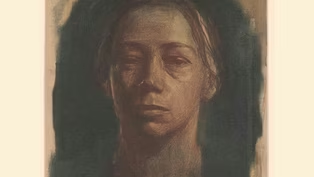
"Käthe Kollwitz" at the Museum of Modern Art
Clip: S2024 Ep612 | 2m 28s | A look at the exhibition "Käthe Kollwitz" on view at the Museum of Modern Art. (2m 28s)
Providing Support for PBS.org
Learn Moreabout PBS online sponsorship
- Arts and Music
The Best of the Joy of Painting with Bob Ross
A pop icon, Bob Ross offers soothing words of wisdom as he paints captivating landscapes.














Support for PBS provided by:
NYC-ARTS is a local public television program presented by THIRTEEN PBS
Major funding for NYC-ARTS is made possible by The Thea Petschek Iervolino Foundation, Jody and John Arnhold, The Lewis “Sonny” Turner Fund for Dance, The Ambrose Monell Foundation, Elise Jaffe...