NYC-ARTS
NYC-ARTS Full Episode: April 20, 2023
Season 2023 Episode 581 | 27m 45sVideo has Closed Captions
A conversation with Bartlett Sher and Aaron Sorkin about the new production of "Camelot."
A backstage conversation with director Bartlett Sher and writer Aaron Sorkin about Lincoln Center’s new production of "Camelot,” a fresh take on the legendary Lerner & Loewe musical. Then a visit to the Brooklyn Museum for “Monet to Morisot: The Real and Imagined in European Art," which focuses on artworks created in the 19th and early-20th centuries.
Problems playing video? | Closed Captioning Feedback
Problems playing video? | Closed Captioning Feedback
NYC-ARTS is a local public television program presented by THIRTEEN PBS
Major funding for NYC-ARTS is made possible by The Thea Petschek Iervolino Foundation, Jody and John Arnhold, The Lewis “Sonny” Turner Fund for Dance, The Ambrose Monell Foundation, Elise Jaffe...
NYC-ARTS
NYC-ARTS Full Episode: April 20, 2023
Season 2023 Episode 581 | 27m 45sVideo has Closed Captions
A backstage conversation with director Bartlett Sher and writer Aaron Sorkin about Lincoln Center’s new production of "Camelot,” a fresh take on the legendary Lerner & Loewe musical. Then a visit to the Brooklyn Museum for “Monet to Morisot: The Real and Imagined in European Art," which focuses on artworks created in the 19th and early-20th centuries.
Problems playing video? | Closed Captioning Feedback
How to Watch NYC-ARTS
NYC-ARTS is available to stream on pbs.org and the free PBS App, available on iPhone, Apple TV, Android TV, Android smartphones, Amazon Fire TV, Amazon Fire Tablet, Roku, Samsung Smart TV, and Vizio.
Providing Support for PBS.org
Learn Moreabout PBS online sponsorship♪ ♪ >> Coming up on NYC art, a backstage conversation with director Bartlett Sher and writer Aaron Sorkin about Lincoln Center's new production, of the legendary musical Camelot.
>> When the musical was first done it came into the culture so powerfully because of John F. Kennedy and the representation of Kennedy as kind of a memory of but before he died and after the assassination and Jackie Kennedy really lifted this idea of Camelot as this myth that was important to us.
>> One of the universal themes of the original show, as far as we are humans have the capacity for goodness and rightness.
>> -- greatness.
>> This is the time of King Arthur and we reach for the stars.
>> And a visit to the Brooklyn Museum, the real and imagined in European art.
>> This exhibition brings together important parts of Britain -- our European collection.
In this 19th and 20th century European art.
We have organized it under the broad theme of the real and the imagined, which was really evocative and flexible in terms of these disparate works.
>> Funding for NYC arts is made possible in part by the tail particularly the foundation, Jody and John Arnhold, the Lewis Turner fund for dance, The Ambrose Monell Foundation, Elise Jaffe and Jeffrey Brown, Charles and Valerie Diker, the milky -- the Milton and salary every arts tradition, the Nancy Sidewater foundation, the Elroy and Teri Krumholz foundation and Ellen and eight -- James S markets.
This is supported in part by public funds from the New York city Department of cultural affairs in partnership with the kids -- city Council.
Additional funding provided by members of 13.
NYC arts is made possible in part by first public bank.
First Republic Bank presents first thing first.
-- thanks first.
That refers to our first priority, the clients who walk through our doors.
The first step, denies that every client is an individual with unique needs.
First decree, be a bank whose currency is service in the form of personal banking.
This was First Republic's mission from our very first day.
It is still the first thing on our minds.
>> And by Swann auction Galleries.
>> Swann auction Galleries, we have a different way looking at options, offering vintage books and fine arts since 1941, working to combine knowledge with accessibility, with a URA first-time buyer, a collector or looking to sell, find information on our website.
♪ ♪ >> Good evening and welcome to NYC arts.
I am policy on.
On location.
The Museum of arts and design located in Columbus Circle.
The museum has long been a champion of the work of artist -- artists, designers and artisans who apply the highest level of ingenuity and skill.
Since its founding in 1956, MAD has celebrated a range of ways materials can be transformed from traditional techniques to cutting-edge technology.
Craft front and center is a fresh installation of some of the museum's permanent collection of more than 3500 objects.
On View are more than 60 historic works dating from the golden age of the American classroom into the present day.
Exhibition -- exhibitions have included Beth Lichtman, collectibility.
Glittering displays of access using hundreds of individual glass elements.
A meditation on time and mortality, it is also a sobering look at the impact of consumer culture and how it affects the planet.
Garment 10, costume as contemporary art, was the first global survey dedicated to the use of clothing as a medium of visual art.
The exhibition used the language of fashion to address issues such as gender, class, race, and ethnicity.
Flower craft was devoted to the ephemeral art of floral design.
It featured the creative visions of several -- six botanical artists working at the forefront of their fields.
They engaged with all stages of the plant lifecycle from seed to germination.
To interpret nature in sculptural form.
On our program tonight, a backstage debt -- visit to the theater.
One of the most eagerly anticipated productions of the current Broadway season is the revival of the legendary musical Camelot.
The show made its premiere on Broadway in 1960, with a production starring Richard Burton, Julie Andrews and Robert Goulet.
♪ >> Look at Center theater's current revival promises a fresh take on a classic tale.
With a revised book written by Oscar and Emmy winner Aaron Sorkin, and a production directed by Tony award winner Mark Bashir.
The beloved elements of the story remain intact though the book has changed.
The romantic triangle between Arthur, Guinevere and Lancelot.
The Quest to establish democracy and justice.
And the bittersweet longing for the world to remain as it once was.
>> But if I ever leave you >> The gorgeous stork features the timeless ballad if ever I would leave you, and the iconic title song Camelot.
♪ >> I recently spoke with them to discuss about how they went about reimagining in mid century Broadway favorite for today's audiences.
>> Welcome.
Good to see.
Congratulations on the revival.
I got to see the show, loved it, you may be laugh, you made me cry, you may be think.
But before we talk about your adaptation of Camelot, I would love for the two of you to give me context about the original production.
Lerner and Lowe had come up the great success of my fair Lady.
You thought that -- one would have thought that would have given Camelot a soft landing on opening night.
How bumpy was the right?
-- right?
>> They took on the very difficult task of adapting the once and future King.
The first review was four and a half hours long.
And often what happens in the world of making these musicals is you are searching for what it is you're making.
This one was very difficult to find what they were after.
Three of them got sick and it was crazy.
Kind of legendary.
>> What led to you reviving Camelot here at the Lincoln Center?
>> We were in the middle of doing my fair Lady for a gala and we decided to do a concert version of Camelot.
Initiated by the fact that I asked Lin-Manuel Miranda, who wrote Hamilton, to play Arthur.
He wanted to do it because it is his mother's favorite musical.
It took the original book and presented the full musical itself.
In doing that, it became clear that the music is amazing and the book for the musical once kind of creaky.
You could immediately see what make Camelot sort of difficult recipes.
>> It's very happy, we had just had a great experience with to Kill a Mockingbird together on Broadway.
I love musicals, I love Camelot.
But I had always known that Camelot is one of those shows where the book is problematic.
It was a great story to tell the legend of King Arthur.
So I immediately said yes and my big idea, it does not have anything to do with updating it for 2023, I want us to take all of the supernatural elements out of the show.
I did not want there to be any magic.
>>?
Why?
>> Because it is such a moving story, it could land even better with an audience if they were no magic wands involved.
We felt like that is a human just like I am and we can wish for the stars as King Arthur insists that the Roundtable can be real.
By the same token, people Israel and you don't need to be a sorceress to be evil.
>> The supernatural elements in the original are hard to pull off and don't really serve the larger story anyway when you work with a writer like Aaron, following his impulses and his intuition for it is where we start.
>> You have gone public with the fact that you suffered a stroke back in November, a couple months before going into rehearsals.
How much pressure did that.
?
-- create?
>> I was already under a lot of pressure.
I do not feel any more pressure.
The concern of mine when it happened was that because I had lost a lot of Michael -- my coronation on the right side, typing had become difficult.
I was worried about not being able to dictate.
It was just as hard to write in longhand.
Could not write my own name.
But I got better fast.
>> You must have been relieved that he recovered.
>> The show is likely in -- luckily in great shape.
We were ready to move forward and we were in the planning and production.
We were hugely concerned.
>> Telus who is starring.
-- tell us who is starring.
>> Andrew Burnett as Arthur, Jordan Donica as Lancelot and I think those three are getting us through the piece.
They have been extraordinaire.
>> Deacon Matthews placed Maryland and Eleanor.
You may not know his name but you will recognize him, he is a phenomenal actor.
>> One of the experience for revivals for many people who come is that it is a memory exercise between what they remember and what they are now expensive and how they might be different and how everything is different.
>> There was something that the three of them had to be which the was no three did not necessarily have to be, which is funny.
>> What I wasn't expecting was how funny Arthur is.
Was he that funny in the original production?
>> I'm glad you thought he was funny.
I wasn't born yet for the original production.
But for the script, no, the three leads were not written funny.
>> For the past year I have treated with cruelty.
>> Yes ma'am.
Those docs were fast.
>> Why won't you leave make?
>>'s bark was worse than his bite jacket that was not my experience.
>> Let's talk about what was behind staging this production.
What I did not know was just how much big at the Lincoln Center theater stage is than your average Broadway stage.
>> It's safe to say, and maybe I am biased, but it's unquestionably the best states to work on in New York and one of the best stages in the world.
It has this great thing that is unique.
It's huge.
You can do all of the epic that you need, but also because it is a thrust the audience is extremely close to the work.
It is both epic and intimate.
>> I'm really fascinated by your working dynamic.
We have had that expansive collaboration before.
But once Aaron presented you with his version of the book, then what happened?
?
>> This is where people don't understand the writer versus the director.
We had to work and work with actors, that's what I did, I wanted to better reveal what I had in front of me and how it was working.
What you don't do and look at it and say that works and that doesn't work at it.
You have to get people in a room and you have to.
And then we all sit and discuss which things can go where and how that operates.
But to observe the intuitive crate of impulses, it is time to make -- my job to make sense of those.
>> I love musicals, and my college degree is in musical theater.
>> But you had never done a biscuit before.
>> Never.
>> It's about time.
♪ >> There were a number of challenges.
I was working with a collaborator who is no longer alive.
And one that I respect.
So I was really collaborating with those songs.
And then you have to give over certain moments to the music and score.
♪ >> Perhaps a climactic moment in a scene.
These numbers and musicals are best when words what do the trick anymore, you have to say and then aside from that, it seems in musicals -- scenes and musicals can't be quite as long as what I am used to.
What I'm used to writing.
>> There are things that are going to happen, they have to say certain things.
What we often call you ramping into a song and watching a human right of ramp into a song because he knows he will have to start with if ever I would leave you >> You're not English.
>> Neither are you.
>> I think that changed when I became Queen of Anglin.
-- England.
>> It's a super fun exercise for me to watch how he builds himself towards structuring the scene and then see and having to make sense of when the words fall off and you have to go to song.
>> It's fun, it's like a punchline that has already been written and you have to write this out.
♪ >> How did you ramp up to how they handle the vocal parts?
Did you ever think of cutting the song?
>> I cut it in a number of drafts.
The reason why is because you asked that question.
>> I can answer for you, with respect.
>> Were there any other songs that were potentially on the chopping block?
>> Yes.
>> Where did they land?
>> Back in the show.
Every song that was in the show in 1960 is in the show now.
The way I handled how to handle a woman, I hope the audience enjoys.
>> How to handle a woman is a negatively beautiful song, so you end up in this complicated how do you set something up, because you are dealing with time, think of things differently now than we did then and the ramp is very delicate.
>> How to handle a woman gets mocked before the song is sung.
>> So that takes a little bit of the sting out of it.
>> How do much more of this new suppose there is -- how much more of this do you suppose there is?
>> What the difference between your old -- the old one and the revival?
>> The main theme is humans that have a capacity for goodness and greatness.
>> As cover mice as human beings are.
>> As flawed as we are, human nature oftentimes will take us off the right path.
But no matter how many times that happens we should keep trying and reaching and going.
>> This is the time of King Arthur and we reach for the stars.
>> When the music was first done it came into the culture so powerfully because of John F. Kennedy, and the representation of Kennedy as kind of a memory of both before he died and after the assassination and Jackie Kennedy really lifted this idea of Camelot as this kind of lost myth that was important to us.
And I think coming back to it now, the question Aaron poses in the script is which part of our stories do we have to hold onto in order to observe and lean towards goodness?
To lean towards justice and decency.
That is where it becomes so powerful.
This sense that the audience is asking themselves what Camelot as an idea means to them now.
And what the future can be and where our values can come from.
>> A civilized king.
Dedicated with all my limited ability to the belief that we should be governed by law.
I do not wealth, station, power, nor human emotion.
To use the power of my throne to avenge a person, how can that be just?
>> What is the thread that runs through your work.
Your repertoire is so broad.
>> There must be some kind of threat.
This Arthur grows up to be Martin Sheen on the West Wing.
>> How do you see that, how did she come to that?
>> Most of the characters I write, the strongest element was my father.
I father passed away recently but he was an incredibly decent man and decency was important to him.
And between that and the fact that the first show that he ever took me to wasn't Man of La Mancha, that man -- was Man of La Mancha, that had a big effect on me.
I think I just keep trying to write it.
>> What are your hopes and aspirations?
>> It's beautiful to make and powerful for audiences who are responding beautifully.
You want that experience to continue for as long as possible for everyone.
♪ To feel like the thing that you wanted to make and the message and ideas that you wanted to explore our being as fully shared with an audience as possible.
>> What I hope is that people come see Camelot and by the end of the show, have the same feeling that I used to have, the same feeling that I still have when I go see Broadway shows.
The feeling that you are just a little bit taller than you were when you walked into the theater.
Then I'll be very very happy.
>> You choose to like each other -- use to still like each other?
>> You have another revival in you as a team.
I wish you both the best of luck.
And continue with the strong recovery and thank you for creating such magic.
>> Thank you so much.
>> My pleasure.
♪ >> Next, we will take a trip to the book -- Brooklyn Museum from Monet to Morrison.
The real and imagined in European art.
The exhibition focuses on artworks created in 19th and early 20th century -- 20th centuries.
In Europe this was a.
When artistic techniques, subject matter and patronage underwent profound changes.
Featuring some 90 words from the museum's collection, it includes artists such as Claude Monet, Barrett Marcel, Paul Cézanne, a booster of Don -- abuse rundown, and others.
The Senior curator is our guide.
♪ >> I am Lisa small, the senior curator of European art at the Brooklyn Museum and a curator of Monet to so, the real and imagined in European art.
This exhibition brings together really important parts of Brooklyn's European collection.
It is 19th and early 20th century European art.
The great pair in the exhibition is in the performing labor section, two paintings, one pipe Raton and one by me leg, and they both are depicting someone working in the field and resting from labor.
What is fascinating is thinking about the ways that people at the time interpreted that.
What they thought was going on in these paintings and how they are realistic or not realistic.
♪ >> One it shows three women returning home from a long day, they are kind of softly lit by beautiful glowing twilight and he presents them in a very, very classic sort of way.
They look like ancient sculptures.
They are all beautifully moving through space.
The idea being that they are content with their lot in life, working fields every day.
It is a timeless kind of image.
The idea that the French countryside was always this way and it will always be this way and that is fine.
The other shows a shepherd in the field and there is a timeless sense about it as well, but for a number of reasons many critics at the time felt that he was very very harsh in how he was depicting that, showing them hunched over, looking as though they might at any minute start to revolt.
That was a real issue in 19th century France.
♪ >> It's just interesting when you look at this and you think about who was collecting these works at the time.
These kinds of paintings became very popular with American collectors in fact, as many of them were industrialists and many of them lived and worked in urban environments and found it very reassuring to see these pictures of people doing labor in the countryside.
It's a wonderful insight into the 19th century mindset.
♪ >> Next week on NYC arts, a visit to the American folk Art Museum, and the exhibition material witness: Folk and self-taught artists at work.
>> Material witness is organized into four areas.
From the earth, clay, stone, and mineral pigments, an opportunity to focus on portraiture and think about what makes up paint.
The second section is matter in hand and that is where I focused a lot on process.
The third section, alchemy and light, is about photography and tentative photos.
And finally, in the spirit is focused on how artists work with materials and see them and use them as conduits for communing with spiritual realms in a process that is often transformative.
>> A trip to the Brooklyn Museum and East of sun, west of moon.
11 vivid paintings by Oscar Yi Ho, a cadet very artist born in Liverpool -- contemporary artist worn in Liverpool and based in Brooklyn.
>> There very antagonistic, their depictions of Asian people and East nation culture.
Infused with this history.
>> And a testament to New York's maritime heritage, up-tempo.
>> This is the only opportunity that you have to take a tumble right in New York City.
It is profoundly authentic and just about as much fun as you can have.
♪ >> I hope you have enjoyed our program tonight.
I am Paul is on, on location at the Museum of art and design.
Thanks for watching, have a good night.
♪ >> 24 NYC arts is made possible by the tail picture even Galena Federation.
The Lewis Cine Turner fun for dance.
The Ambrose Monell Foundation, Elise Jaffe and Jeffrey Brown, Charles and Valerie Diker, the Milton and Sally Avery arts foundation, the Nancy Sidewater foundation, Elroy and Teri Krumholz foundation and Ellen and James S markets.
-- Marcus.
This program is supported in part by public funds from the New York City Department of cultural affairs a partnership of the city Council.
Additional funding provided by members of 13.
This is made possible in part by first public bank.
>> First Republic Bank presents first things first.
I First Republic Bank, first refers to our first priority, the clients who walk through our door.
The first step, recognize that every client is an individual with unique needs.
First decree, BA bank whose currency is service in the form of personal banking.
This is -- was our mission from the very first day and it is the first thing on our minds still.
>> And by Swann auction Galleries.
>> Swann auction Galleries has a different way of looking at auctions, offering vintage books and finances 1991 combining knowledge with accessibility whether you are a LIFO collector, a first-time buyer or looking to sell, information at Swann Galleries.com.
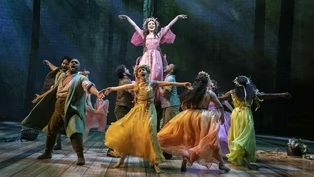
“Camelot” with Aaron Sorkin and Bartlett Sher
Clip: S2023 Ep581 | 15m 13s | A conversation with Bartlett Sher and Aaron Sorkin about the new production of "Camelot." (15m 13s)
Providing Support for PBS.org
Learn Moreabout PBS online sponsorship

- Arts and Music
The Best of the Joy of Painting with Bob Ross
A pop icon, Bob Ross offers soothing words of wisdom as he paints captivating landscapes.











Support for PBS provided by:
NYC-ARTS is a local public television program presented by THIRTEEN PBS
Major funding for NYC-ARTS is made possible by The Thea Petschek Iervolino Foundation, Jody and John Arnhold, The Lewis “Sonny” Turner Fund for Dance, The Ambrose Monell Foundation, Elise Jaffe...