NYC-ARTS
NYC-ARTS Full Episode: April 27, 2023
Season 2023 Episode 582 | 27m 46sVideo has Closed Captions
A visit to AFAM for "Material Witness: Folk and Self-Taught Artists at Work."
A visit to the American Folk Art Museum for "Material Witness: Folk and Self-Taught Artists at Work," which explores how artists gravitate toward certain media and methods. Then to the Brooklyn Museum for “East of sun, west of moon,” an exhibition of the work of Oscar yi Hou. And a visit to the South Street Seaport Museum to see the W.O. Decker, the last surviving New York-built wooden tugboat.
Problems playing video? | Closed Captioning Feedback
Problems playing video? | Closed Captioning Feedback
NYC-ARTS is a local public television program presented by THIRTEEN PBS
Major funding for NYC-ARTS is made possible by The Thea Petschek Iervolino Foundation, Jody and John Arnhold, The Lewis “Sonny” Turner Fund for Dance, The Ambrose Monell Foundation, Elise Jaffe...
NYC-ARTS
NYC-ARTS Full Episode: April 27, 2023
Season 2023 Episode 582 | 27m 46sVideo has Closed Captions
A visit to the American Folk Art Museum for "Material Witness: Folk and Self-Taught Artists at Work," which explores how artists gravitate toward certain media and methods. Then to the Brooklyn Museum for “East of sun, west of moon,” an exhibition of the work of Oscar yi Hou. And a visit to the South Street Seaport Museum to see the W.O. Decker, the last surviving New York-built wooden tugboat.
Problems playing video? | Closed Captioning Feedback
How to Watch NYC-ARTS
NYC-ARTS is available to stream on pbs.org and the free PBS App, available on iPhone, Apple TV, Android TV, Android smartphones, Amazon Fire TV, Amazon Fire Tablet, Roku, Samsung Smart TV, and Vizio.
Providing Support for PBS.org
Learn Moreabout PBS online sponsorship>> Coming up on "NYC Arts," a visit to the American folk Art Museum and the exhibition material witness, folk and self-taught artist.
>> Material witness is organized into four areas, the first theme is from the earth, clay, stone and mineral pigments, so it was an opportunity to focus on portraiture and to think about what makes up paint.
The second section is called matter in hand and that's where I focus a lot on process.
The third section, alchemy and lighting is about the history of photography and hand scented photos.
And in the spirit is focused on how artists work with materials and see them and use them as conduits for commuting with spiritual realms and an process that's transformative.
>> a trip to the Brooklyn Museum and East of sun, west of moon.
11 vivid paintings by a contemporary artist, born in Liverpool, now based in Brooklyn.
>> my work is purposely endocrine is stick.
There are depictions of Eastern Asian people in Western culture.
I may contemporary paintings infused with the history.
>> and a look at a testament to New York City's maritime heritage, the tugboat.
>> she is the only opportunity that you have to take a tugboat ride in New York City.
It is profoundly authentic at it is just about as much fun as you can have.
>> funding for NYC arts is made possible by Jody and John Arnhold.
The Lewis Cine Turner fund for dance, the Ambrose foundation.
Jeffrey Brown.
Charles and Valerie.
The Milton and Sally Avery arts foundation.
The Nancy water foundation.
The crumble foundation and Ellen and James.
This program is supported in part by public funds from the New York Department of cultural affairs in partnership with the city Council.
Additional funding provided by members of 13, NYC arts is made possible in part by First Republic Bank.
>> First Republic Bank's first things first.
At First Republic bank first refers to our first priority, the client who walk through our doors, the first step, recognize that every client is an individual with unique needs.
First decree, be a bank whose currency is service in the form of personal banking.
This was First Republic's mission from our very first day.
It's still the first thing on our minds.
>> and by Swann auction Galleries.
Lexis-Swann auction Galleries.
We offer vintage books and fine arts since 1941, working to combine knowledge with accessibility, whether a lifelong collector first time buyer looking to sell.
Information at Swann Galleries.com.
♪ >> good evening and welcome to NYC arts, I'm Paula on location at the Museum of arts and design located in Columbus Circle.
The museum has long been a champion of the work of artists, designers and artisans who apply the highest level of ingenuity and skill.
Since the museum's founding in 1956 by the philanthropist, they have celebrated the many ways materials can be transformed from traditional tech thanks to cutting-edge technologies.
Craft front and center is a fresh installation of some of the museum's permanent collection of more than 3500 objects.
On View are more than 60 historic works dating from the Golden age of the American crafts movement to the present day.
The concept of craft as a way to integrate body, mind, and spirit , was embraced by many artists coming-of-age in the 1960's and 1970's.
Each artist represented here is respectful of individual identity and the dignity in making works by hand.
Crafts people respond to the world around them in unique ways , often charged with insight and emotion, their work speaks of relationships, nostalgia and memories.
Included in the exhibition is a look at one of the most overlooked, yet indispensable materials.
Here, works and would are organized by geographic region or continent where each trace species is found.
Labels indicate the origin and whether a tree is endangered, threatened or sustained.
Selected from the collection, these artworks show us the beauty and value of wood, placing them in context with a larger ecosystem of relationships.
On our program tonight, a visit to the American full color Museum material witness, folk and self-taught artists at work.
The exhibit features nearly 150 works drawn from the museums extensive collection and explores how hard it is -- how artists from for centuries gathered toward certain media and methods.
This the first in a series of exhibits at the museum that will feature works that promote an expansive history of American art.
Featured artists include Jimmy Lee Sutton, M.R.I.
Phillips, Jesse Aaron, Minnie Evans, Judith Scott, and Ronnie Holly, who all work with a variety of mute cereals, included founded and collected everyday objects, sculpture, textiles and photography.
Material witness will be On View through October 29.
>> I'm broke, and I am the assistant curator at the folk Art Museum.
This is material witness artists at work.
Material witness focuses on the materials and the substances like clay, wood, rock, stone, metal that artists work with to make the objects that are in this Museum's collection.
I liked the idea of witness to materials because we have several works in the show and in our Museum's collection where the makers identity is unknown.
In the case of a group of so-called memory wears that are featured in the show, we have a selection of ceramic jugs and vessels that the maker has encrusted literally with hundreds of found objects, everything from skeleton keys to buttons from clinical campaigns to small figurines, objects like these have been found on gravesites on African-American graves in the southern U.S., but we don't know the makers identity.
I think about objects like these as witnessing that process of making and even holding the stories of their makers or the lives that they may have been documenting.
I was really drawn to opportunities to show multiple works by the same artists across their career, such as three carvings by the woodcarver Jesse Aaron.
Art making is a lot of work and many of the artists featured here work to other jobs full-time for most of their lives in many cases, other than full-time art making.
Work is an interwoven part of the stories behind all of these objects.
Material witness is organized into four areas.
The first theme is from the earth.
The focus is clay, stone and mineral pigments, so it was an opportunity to focus on portraiture and to think about what makes up paint.
This was a really exciting opportunity to put two works from our collection into conversation on the subject of portraiture.
One in 1815 oil painting by Am I Phillips, where the pigments that the artists used for the vibrant reds and greens are so outstanding against the relatively muted background, and that works in conversation with a self-portrait by the artist Jimmy who sourced his own pigments and mixed those together with binding agents that he also developed through a process of experimentation, using everything from clay that he was sourcing to berries, axle grease, coffee grinds, and this is a process of experimentation over time.
The second section is called matter in hand, and that's where I focused a lot on process.
We don't always take about full can self-taught artists having studio practices the same way we might think of an art school trained professional artists, say.
However, whenever and whatever under circumstances they created, I wanted to highlight how their practice evolved over time in that dialogue of relationship of exploring materials.
This is a work that the artist used entirely ballpoint pen and pencil to create this elaborate labyrinth and world and what she called filigree art.
It was excited to think about how just working with everyday materials that you might find around the house, ballpoint pens in different colors, they created this fantastical composition.
The third is a case study called all coming in lighting and it's about the history of photography and specifically hand tinted photos.
Here we put into conversation a group of 20th-century hand tinted 35mm photos with 19th-century tent type, all of which have been hand tinted.
So finally, the fourth section is called in the spirit.
That in the spirit section is focused on how artists work with materials and see them and use them as conduits for communing with spiritual realms, otherworldly realms in a process that's often transformative.
The process may begin with round objects and assembling and scavenging for different materials and bringing them together to create a work of art in which each part is transformed into a greater whole.
I hope the visitors will walk away with a sense of the amount of work that goes into not just making the given art object, but also evolving a practice over time of working with materials.
♪ >> next we will visit the Brooklyn Museum and the exhibition east of sun, west of moon.
It features 11 vivid paintings by Liverpool boy and contemporary artist Oscar.
The museum is a fitting destination for the now Brooklyn-based artists first solo Museum exhibition.
The paintings highlight queer Asian American subjects in the long-standing biases against East Asian and LGBTQ communities in the United States.
NYC already spoke with the artists who provided us with detailed insight into his work.
>> My work is purposely adequate mystic.
There are a lot of depictions of East Asian people in Western culture.
I make contemporary paintings infused with the history.
So this exhibition is east of Thaw, west of moon, and it comes from a poem that I wrote for the show and has the sense of being in between these two huge celestial bodies, the sun and the moon, the East and the West as well.
These are the kind of melding of calligraphy poetry painting.
I have actually been working in this tradition without knowing it, but I think the few perfections are the good way to examine the work.
For this you have him holding a whip.
This with Biz actually connected to the back of his head.
It's an extension of this, which was the hairstyle worn by Chinese men in the 19th century, and it's what they wore when they came to America.
In the history of gay people in America, when it began it was not a pleasant one.
There was a lot of vitriol and animosity.
So they became a target.
They were seen as being effeminate or deviant.
In this painting I had to abrade these as a whip, almost as a weapon.
In I had this really exaggerated caricature of masculinity.
I call it almost a form of male drag.
It's the exploration of history and the relationship between East Asian and gender.
My given name in Chinese refers to an idiom involving a bird cry.
So for my practice I use the kindest symbol of a bird, often a crane to symbolize myself.
This one is kind of a self-portrait and essentially I'm dressed up as go cool.
Go cool was the protagonist of a Japanese animated series called Dragon Ball Z.
It was kind of the first experience that a lot of kids at that time would've had engaging with East Asian visual culture.
As it was being transported into the West.
I guess the painting deals with this idea of East Asian economic or for.
Within the culture.
We think of the this all perception of what a Chinese man should look like if we look at celebrities, you had Bruce Lee, you had Jackie Chan, you have Goku, even though he was animated.
We are alluding to the perception that all Chinese people look the same.
This is the largest painting in the show, it's around seven feet tall, essentially it depicts a modified American flag within the red stripes are buried text.
It's English lettering that has been horizontal.
In the text appropriate, the higher the letter that the subject is American when he was naturalized as an American citizen, but it replaces everything in America with the word empire.
I had this subject to be at the bottom of the frame to convey this looming, giant un-attainability of Americanness .
There are stars embedded also in the red stripes, and these stars are sequenced to the Rainbow pride flag.
It's kind of an illusion of nationalism, which is the D founding of LGBT politics and rights.
I wanted to draw upon the iconography of the American flag without making the simile of the flag.
I hope viewers will get maybe a little more understanding of Asian American history, portraiture is a special vehicle to express messages and ideas and histories and concepts.
So I hope viewers appreciate what I have to say.
♪ >> next, we will visit the South Street Seaport Museum and its beloved to vote, W O Decker.
Built in 1930 and refurbished in the decades following, this unique vessel is a testament to New York City's maritime heritage.
It is directly linked to the cities local prominence today and has even been listed on the National Register of Historic Places.
You can get on board the W O Decker on Saturdays and Sundays for a cruise around New York Harbor heading for lady liberty.
♪ >> the South Street Seaport Museum is a 50-year-old institution that exists in the original port of New York.
It is located in the buildings and adjacent to the peers and with a fleet of ships that are representative of the original port.
I'm not allowed to have favorites, but if I had a favorite and if that favorite was W O Decker, would be because she is so cute.
Everybody falls in love with her.
She's 50 and a couple feet long built in 1930's.
She is the last surviving building New York to.
Built for the purposes of shifting barges.
Not the kind that you commonly see today that are a lot larger, she has spent her whole life in New York City.
She is a born and bred New Yorker and she has been a part of the museum's fleet for a number of years but for the last decade she has not been able to operate because she was in need of restoration.
Last year we were able to bring her fully back online so she had a robust restoration and was certificated by the Coast Guard as a passenger vessel.
Not only is she unique in that she is the last of her type, she is the only opportunity that you have to take a tugboat ride in New York City.
In the experience is not posh.
It is probably a little wet, smells a little big diesel, but it is profoundly authentic and is as much fun as you can have on the harbor.
For me, to see New York Harbor, which I tend to look at through some measure of historical lens, to see it from the deck of a 1930 tugboat is a particularly magical experience.
To go past the 19th century Statue of Liberty underneath the 19th-century Brooklyn Bridge in a tug from the early 20th century is really a special experience.
W O Decker sales with a Coast Guard licensed Captain and with a crew and the crew varies depending on the trip, but it almost always includes volunteer sailors.
We like to say that we preserve the artifact and the scales because to do only one and out the other is to do half the job.
50 years from now W owed Decker will be here, so will a group of people know how to operate her.
That kind of engagement makes this a really special place.
♪ >> and now, another curators choice.
>> Welcome to the American Museum.
I'm for curator for the 20th and 21st century art at the museum.
He was born in the Bronx in 1914, his parents were Italian immigrants.
His words are reflecting social reality and are carrying messages of hope, of liberty, and the respect for the rise of workers.
They were a union organizer and started to paint the mid-40's.
Early on he helped his father to deliver ice in the organization of his large-scale canvases with a lot of horizontal lines and stacking of subjects in architecture referred to his experience working with his father when he was placing and replacing ice cubes in the refrigerators.
It was made from sketches he made in the subway on his way back from work.
He said, I ride the subway every day, back-and-forth to my machine shop job.
I would ride and ride and sketch and sketch.
I love the subway, it pulls the city together, pulls people together in a magic way.
The subway riders at night after a hard day's work, everyone is separate, alone, but very much together.
It's noisy with the creaks and squeals, but peaceful because we moved to a rhythm that gets inside us.
That's comforting, the noise of the city itself.
The subway that makes the city work makes the city great.
This painting is a large-scale painting as many of the canvases are by him.
Some are as white as 10 feet.
He said specifically that those paintings were meant to be seen by a lot of people at the same time.
So it's one of the reasons why he wanted to have it enlarged, and also full of details.
You can learn something about the personal life of each of those subjects.
If paintings were carrying two messages, I think the main messages that were there were to fight for the labors rights and also, I forget the celebration of New Yorkers.
♪ >> I hope you enjoyed our program tonight.
I am Paola on location at the Museum of arts and design.
Thank you so much for watching.
Have a good.
>> Next week on NYC arts, the visit to one of the greatest states of the Hudson Valley.
>> it is the home to the Rockefeller family.
Four generations of family have lived in the home and it was considered the family seat for John Davis Rockefeller Senior.
>> Look at China Institute Galleries landmark exhibition, flowers on a river, the Art of Chinese flower and bird painting , 1368, 1911.
The more than 100 works cover a wide range of natural topics, such as flowers, birds, fish and insects.
The beddings are not intended to solely imitate nature, but use different styles to convey the personality and ideas of the artist.
And, a trip to the South Street Seaport Museum to look at the flagship of the collection, the waiver tree.
>> waiver tree is in 1885 iron sailing ship.
Many people would refer to her as a ship.
A tall-masted sailing ship.
She is, for us, the connection between New York and the rest of the world.
♪ >> funding for NYC arts is made possible by Jody and John Arnhold.
The Lewis Cine Turner fund for dance.
The Ambrose Monell Foundation.
Elise Jaffrey and Jeffrey Brown.
Charles and Valerie Diker.
The Milton and Sally Avery arts foundation, Nancy side water foundation.
Elroy foundation and Ellen and James S Marcus.
This program is supported in part by public funds from the New York City Department of funds for cultural affairs in partnership with the city Council.
Additional funding provided by members of 13.
NYC arts is made possible in part by First Republic Bank.
>> First Republic Bank presents, first things first.
At First Republic bank first refers to our first priority, the clients who are through our doors.
The first step, recognize that every client is an individual with unique needs.
First decree, be a bank whose currency is service in the form of personal banking.
This was First Republic's mission from our very first day.
It's still the first thing on our minds.
>> And by Swann auction Galleries.
>> Swann auction Galleries, we have a different way of looking at a gallery since 1941, working to combine knowledge with accessibility, whether a lifelong collector, first-time buyer or looking to sell, information at Swann Galleries.com.
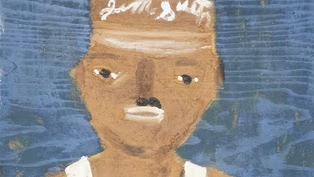
"Material Witness" at AFAM Preview
Preview: S2023 Ep582 | 1m 4s | A visit to AFAM for "Material Witness: Folk and Self-Taught Artists at Work." (1m 4s)
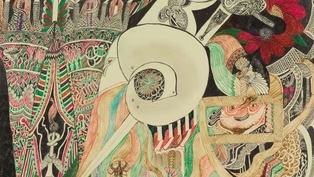
"Material Witness" at the American Folk Art Museum
Video has Closed Captions
Clip: S2023 Ep582 | 6m 32s | A visit to AFAM for "Material Witness: Folk and Self-Taught Artists at Work." (6m 32s)
Providing Support for PBS.org
Learn Moreabout PBS online sponsorship

- Arts and Music
The Best of the Joy of Painting with Bob Ross
A pop icon, Bob Ross offers soothing words of wisdom as he paints captivating landscapes.











Support for PBS provided by:
NYC-ARTS is a local public television program presented by THIRTEEN PBS
Major funding for NYC-ARTS is made possible by The Thea Petschek Iervolino Foundation, Jody and John Arnhold, The Lewis “Sonny” Turner Fund for Dance, The Ambrose Monell Foundation, Elise Jaffe...