NYC-ARTS
NYC-ARTS Full Episode: April 4, 2024
Season 2024 Episode 610 | 27m 47sVideo has Closed Captions
A profile of artist Jeffrey Gibson and a look at "Beatrix Potter: Drawn to Nature."
A profile of artist Jeffrey Gibson, whose beadwork, ceramics, sculptures and paintings are inspired by his cultural heritage. Then a look at the exhibition "Beatrix Potter: Drawn to Nature" at the Morgan Library & Museum. Finally, a visit to the American Kennel Club Museum of the Dog, one of the only museums dedicated solely to the depiction of dogs.
Problems playing video? | Closed Captioning Feedback
Problems playing video? | Closed Captioning Feedback
NYC-ARTS is a local public television program presented by THIRTEEN PBS
Major funding for NYC-ARTS is made possible by The Thea Petschek Iervolino Foundation, Jody and John Arnhold, The Lewis “Sonny” Turner Fund for Dance, The Ambrose Monell Foundation, Elise Jaffe...
NYC-ARTS
NYC-ARTS Full Episode: April 4, 2024
Season 2024 Episode 610 | 27m 47sVideo has Closed Captions
A profile of artist Jeffrey Gibson, whose beadwork, ceramics, sculptures and paintings are inspired by his cultural heritage. Then a look at the exhibition "Beatrix Potter: Drawn to Nature" at the Morgan Library & Museum. Finally, a visit to the American Kennel Club Museum of the Dog, one of the only museums dedicated solely to the depiction of dogs.
Problems playing video? | Closed Captioning Feedback
How to Watch NYC-ARTS
NYC-ARTS is available to stream on pbs.org and the free PBS App, available on iPhone, Apple TV, Android TV, Android smartphones, Amazon Fire TV, Amazon Fire Tablet, Roku, Samsung Smart TV, and Vizio.
Providing Support for PBS.org
Learn Moreabout PBS online sponsorship♪ >> coming up on NYC Arts, a profile of artist Jeffrey Gibson, whose beadwork, ceramics, sculptures, and paintings are influenced by Cherokee and Choctaw tradition.
>> when you are a foreigner, you don't entirely understand what you are looking at were hearing all the time so you have this kind of subjective comprehension of the world around you that is an estimated gas.
>> a look at Beatrix Potter, now on view at the Morgan Library and Museum.
It looks at the life and work of one of the best-known authors of children's books in the 20th century.
On View are sketches from Peter rabbit and potters paintings of the real-life places that inspired Mr. McGregor's garden in the tale of Benjamin Bunny.
And a visit to the American kennel club Museum of the dog.
>> it is an art museum first and foremost come out one of the greatest collections of dog art in the world.
It comprises 1700 objects, primarily fine artwork, paintings, drawings, sculptures, posters, a whole variety of things all dedicated to the dog.
>> funding for NYC Arts is made possible by Thea foundation, Jody and John Arnhold, the Lewis Turner fund for dance, the Ambrose monell foundation, Jeffrey Brown, Valerie diker, the Milton and Sally every arts foundation, the Nancy side wwatr foundation, and Elion and James Marcus.
This is supported in part by public funds from the New York City Department of cultural affairs in partnership with the city Council.
Additional funding provided by members of 13 and Swann auction Galleries.
>> Swann auction Galleries.
We have a different way of looking at auctions, offering vintage books and fine arts since 1941, working to combine knowledge with accessibility, whether you are a lifelong collector, first-time buyer, or looking to sell.
♪ ♪ >> good evening and welcome to NYC Arts.
I am Paula zahn on location at the New York historical Society and Central Park West.
Here, visitors can experience 400 years of history through groundbreaking exhibitions, all of which tell the stories of New York as well as the American experience.
The exhibition on view in this gallery presents long-standing favorites from the museum's permanent collection alongside recent acquisitions and loans.
Its aim is to raise questions, create unexpected connections, and reconsider established mediums.
The result is more inclusive rethinking of both American art and how museums present our cultural history.
Here, a well-known portrait of George Washington by Rembrandt from 1854 is shown next to a portrait from 1796, known as corn planter, by painter -- These two leaders negotiated directly with each other in the multinational world of early North America.
Here, diverse indigenous powers interacted with the British, Spanish, French, Dutch, and Germans as well as the African people forcibly removed from their homelands.
The mixed race Dutch Seneca chief known as corn planter 4-wood the British during the Revolutionary war and later served as his nation's ambassador to the United States.
Washington served as the commander of the Continental Army in the war against the British and their allies.
This so-called porthole portrait, which includes a stone frame borrowed from classical portraiture, shows him gazing off frame as if toward the future of the nation he would one day found.
Tonight on our program, we will meet artist Jeffrey Gibson, born in Colorado Springs.
He grew up all over the world thanks to his father's career with the Department of Defense.
He spent his childhood in Korea and Germany before eventually moving back to the states.
After graduating from the Art Institute of Chicago, he went on to study in London at the Royal College of Art.
His beadwork, ceramics, sculptures, and paintings are influenced by Cherokee and Choctaw tradition.
Inspired by, sampled and remixed -- inspired by sampled in the mixed pop music, he combines his cultural heritage with minimalism and abstraction.
His studio is located in Hudson, New York in an old elementary school, which Gibson and his has been converted into studio space, now home to a growing artistic community.
Art is in Bard College and recipient of the MacArthur Fellowship, Gibson has now been selected to represent the United States at the 2024 Venice -- He will be the first indigenous artists to have a solo exhibit and at this prestigious event.
♪ Jeffrey: growing up as a foreigner is something that I think about a lot now.
You know, when you are a foreigner, you don't entirely understand what you're looking at or what you're hearing all the time so you have this kind of subjective comprehension of the world around you that is an estimated gas.
I think about that a lot in terms of how I use materials because I use a lot of materials that I think many people may not know the context that I am drawing them from or what the culture is or the history is.
My mother's family lives in Oklahoma.
My father's family lives in Mississippi, and those Choctaw and Cherokee cultures are extremely different.
When I would go there, it would be to visit my family.
I never wanted to observe my family.
You want to be a participant in your family so we don't look at each other and think, that is Native American.
And then I began thinking, what was it about the quilts that grandma made or what was it about the jewelry that she wore were the dresses that she made, what did the song mean that she would sing?
And then it becomes something culturally specific, I suppose, but otherwise, it is just kind of inherently familial.
It starts from a place of I want to take part in all of these things.
I want to know how to be.
And then that part off a pattern, it starts off design, color choices, starts off the challenge of what you can actually do with beads.
I wanted to make found object work in over the course of time, sometimes, they are mashed together.
I am interested in exploring the transformative nature of materials and how the language can shift from a beaded triangle to a painted triangle to a woven triangle and what those three different versions of a triangle mean.
There's this period of club music that with the transition of analog music into digital, it was the sampling and the turntables where people could sample music that really had an impression on me so this kind of repetitive nature of repeating and taking something from one context and sticking it into another one and making something new.
I can spend the time in my studio mashing up, remixing, reconstructing, and I can invite other people to take part in that with me.
I think it is important just to be transparent about the process.
We acknowledge the assistance all the time, as much as we can.
If it was just me making, for instance, a punching bag, we would be seeing one a year.
The lines between craft and what has historically been thought of as fine arts, the decorative embellishment, all of those things in this environment are equalized.
If you look at powwow garments, they are so loud and colorful.
With that as my inspiration in many ways, there was no limit to the combinations of colors.
It is more thinking about what the color does in combination with each other so it's really either kind of pop or electric or reflective or optic.
I do have an attraction between the idea of minimalism and how animal is in leads towards maximal density.
-- minimalism leads towards maximal density.
I thought minimal was this void on filled with things and now I realize that the removal of information is in an effort to actually be able to see how much is present in a very small space or limited palette.
The idea is to slow down the color red and understand how many shades of red there are, slow down blue and understand how many tones of blue, and then of course, it opens right back up into including every single color.
My training is as an entirely process based abstract artist but the text was always meant to name this entirely subjective language of abstraction and at some point, when the audience was not able to get the content that I felt I was putting into the abstraction, I decided to just start putting the text directly on it.
Most of the titles, for instance, come from appropriated lyrics.
And then it just kind of hit.
There was something about the understanding that these words describe what you are looking at, became a really big part of the work for me.
People who were looking at my work at the time would always question, well, how does this relate to who you are?
How does this relate to you as a Native American person, as a gay person?
is the subjectivity somehow representative of that experience?
And it seemed no matter how hard I would say, no, it's not, it almost compounded more for people to look for connections in the work, and at some point, I decided to own the words Native American, to own the words gay, and not give them any kind of power over determining who I am, but I was fine with the work being described in that way because it is true.
This is my experience and in the 20th century, and even today, that is very much how we describe each other.
♪ Jeffrey: I acknowledge that we are all very, very layered, complicated people.
In our contemporary world, we don't always have the opportunity to explore that or to share that with each other, but it's what you can do in art.
♪ Paula: now, a look at the exhibition, Beatrix Potter, drawn to nature, On View at the Morgan Library and Museum.
Born in London in 1866, Beatrix Potter became one of the most loved children's book authors of the 20th century with her debut work, the tale of Peter rabbit, in 1902.
The exhibition focuses on Potter's love of the natural world, which began with summers spent in Scotland and the Lake District in northwest England.
The Potters were a family of nature lovers and Beatrix Potter began studying and drawing insects, animal anatomy, and mushrooms from an early age.
Organized by the Victorian Albert Museum in London, the exhibition brings together more than 150 artworks, books, manuscripts, and artifacts from several institutions across the U.K. including the national trust.
.
with the collection of Potters letters, these objects show how she blended scientific observations and storytelling to shape the world of Peter rabbit.
During her lifetime, Potter published more than 60 books, but is perhaps best known for the 23 tales which featured such whimsical characters as Peter rabbit and his family.
Mrs. tiggy, old brown, and many more.
On View are sketches for Peter rabbit and Potters paintings of real-life places that inspired Mr. McGregor's garden in the tale of Benjamin Bunny.
Also included are tiny letters Beatrix wrote in the voices of her characters that she sent to the children of her friends and family.
With the proceeds from her books, Potter purchased Hilltop Farm and continued expanding its grounds which shaped her land conservation efforts.
A Potter death in 1943 granted her entire property to be preserved by the U.K. national trust.
The exhibition is On View until June 9.
Next, we will visit the American kennel club Museum of the dog, located at 101 Park Avenue near Grand Central terminal.
After changing locations several times since its founding in 1982, Museum has found its way back home, reuniting with the AKC under one roof.
One of the only museums dedicated solely to the depiction of dogs, its permanent collection is one of the finest and largest holdings of canine related fine art and artifacts in the world.
It comprises paintings, watercolors, drawings, prints, ceramics, and bronzes.
The museum celebrates the important role dogs play in society as well as the more personal human to canine bond.
Curator Alan will be our guide.
Alan: one thing you have to realize when you come here is the fact that it is an art museum, first and foremost.
This is possibly one of the greatest collections of dog art in the world.
It comprises about 1700 objects, primarily fine artwork and paintings, drawings, sculptures, ceramics, a whole variety of things, all dedicated to the dog.
We have had several exhibitions, a robust schedule.
Some that come to mind are the women and dogs in the arts.
Going through the collection, we found out how many women were involved, really good dog artists, and we wanted to show that off.
We have had Hollywood dogs, a number of posters.
We have presidential dogs.
We do that every four years and talk about the different pets and dogs that presidents owned.
Recently, we had an exhibition of dogs of war and peace.
We have a lot of images of dogs, how they have helped on the battlefield and off the battlefield as well as therapy dogs and helping people come back.
Particularly poignant was the wounded warrior dogs by James Mellik, reflecting the injuries and suffering that not only the handlers but also the dogs incurred.
One of the great joys of bringing this museum to New York was the reception we have had from the library.
The library is always packed.
We have an activity center.
We have about 4000 volumes of the AKC library.
We not only have a great collection but we also have state-of-the-art, digitally interactive displays.
You can train a virtual dog.
We took a 10-year-old lab out in Los Angeles and put it in a motion capture suit so all the emotions and reactions are in real time the way the dog would have done it.
Probably the most popular is the find your match.
Not the dog you should have but the dog you look like.
It takes your photograph and through AI sides what dog you look like.
We have a meet the breeds table where you can learn about all 200 breeds in the AKC.
The oldest work here is a 30 million-year-old fossil of an early dog.
Most of our paintings start around 1670s, and then go onto today and show a variety of different activities that dogs engage in.
Queen Victoria was probably the most important person of the 19th century in elevating the status of the dog.
Rather than just being a working dog in the field, to be a dog in the home.
It became very popular to have dogs as pets.
I think the crowd favorite here is silent sorrow, a very sad painting.
It shows Edward vii's dog after he passed away.
Caesar was in his funeral procession, ahead of nine heads of state.
It was painted by Maud Earl and it shows him with his head on the armchair as the armchair fades into obscurity.
Another work we have here which is probably one of the greatest American dog paintings is sensation, painted by John Mark Tracy.
It is out in the woods.
This is by far his best work.
The light filtering through the trees, the atmosphere that he brings to it is just a stunning work.
There are two pointers that were recorded by the Westminster kennel club in the 19th century.
One of them is the dog that eventually became the logo for the Westminster kennel club which you see at their show all the time.
Another popular piece is not a painting but it's actually Queen.
Queen is a carousel dog from the 1890's that shows a Mastiff.
After looking at a lot of dog paintings throughout my life, I'm starting to look at dogs differently.
And I would see things I did not see in the dog that the painter was telling me and really, all of a sudden, I had a moment where I said, this is really the goal of art, whether it be a dog painting or conceptual work or abstract work is to make you see the world differently through the artists eyes and that is what you learn.
You learn about dogs and say, I never really noticed that.
That is an interesting thing.
♪ Paula: now, a visit to the American folk Art Museum, located across from Lincoln Center.
Since 1961, this museum has been celebrating the creativity of artists whose talents have been refined through personal experience rather than formal artistic training.
It's collection includes more than 8000 works of art from four centuries, representing nearly every continent.
Let's look at a highlight from the collection.
♪ >> welcome to the American folk Art Museum.
My name is Valerie Russo.
I am a curator at the Museum.
Ralph was born in the Bronx in 1914.
His parents were Italian immigrants.
His works are reflecting social reality.
And they are carrying messages of hope, of liberty, and the respect for the rise of workers.
Ralph was a union organizer and started to paint in his mid-40's.
Early on, he helped his father to deliver ice and the organization of his large-scale canvases with a lot of horizontal liens and stacking of objects and architecture referred to his experience working with his father, where it was placing and replacing ice cubes in the refrigerators.
It was made from sketches he made in the subway on his ride back from work.
He said, I drive the subway every day back and forth to my machine shop job.
I would ride and ride and sketch and sketch.
I loved the subway.
It pulls the city together, pulls people together in a magical way.
Here, I show the subway riders at night after a hard days work.
Everyone is separate, alone, but very much together.
It is noisy with the creeks and squeals, but peaceful, too.
Because we moved to a rhythm that gets inside us.
That is comforting.
That is the noise of the city itself.
The subway makes the city work, makes the city great.
This painting is a large-scale painting, as many of the canvases by Ralph.
Some of them are as wide as 10 feet.
He said specifically that those paintings were meant to be seen by a lot of people at the same time, so it's one of the reasons why he wanted to have them large and also full of details.
You can learn something about the personal life of each of those objects.
His paintings were carrying two messages.
I think the main message is that he was there to fight for the laborers rights and also I think it is a celebration of New Yorkers.
♪ Paula: next week on NYC Arts, a profile of an artist whose work brings the arts in the South Asian diaspora to the United States.
>> our lives, survives, inspires.
It is complicated.
It is messy.
It is very much like life.
For me, art is very much about knowledge, construction, how I process things that are around me, whether it is history, politics, daily living, all of it enters into the space of art.
Paula: and a visit to the Met in its recently reopened suite of 45 galleries dedicated to European paintings from 1300 to 1800.
>> in each of the 45 galleries, we invite our visitors to explore a particular theme or to look more deeply at a singular artists work.
Landscape is a theme we explore.
Travel, place, time, artists, people are really the structure to this installation.
♪ Paula: I hope you have enjoyed our program tonight.
I am Paula on location at the New York historical Society.
Thanks for watching.
Please join us next time.
♪ ♪ ♪ ♪ >> funding for NYC Arts is made possible by Jody and John, the Lewis Turner fund for dance, the Ambrose foundation.
Jeffrey Brown, Charles, the Milton and Sally Avery arts foundation, Terry foundation, the Nancy foundation, and Ellen and James Marcus.
This program is supported in part by public funds from the New York City Department of cultural affairs in partnership with the city Council.
I just know funding provided by members of 13 and by Swann auction galleries.
>> we have a different way of looking at auctions, offering vintage books and fine arts since 1941, working to combine knowledge with accessibility, whether you are a lifelong elector, first-time buyer, or looking to sell.
Information at Swann galleries.com.
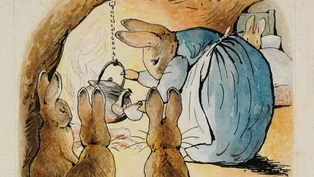
"Beatrix Potter: Drawn to Nature" at the Morgan
Video has Closed Captions
Clip: S2024 Ep610 | 2m 48s | A look at the exhibition "Beatrix Potter: Drawn to Nature" at the Morgan Library & Museum. (2m 48s)
Providing Support for PBS.org
Learn Moreabout PBS online sponsorship

- Arts and Music
The Best of the Joy of Painting with Bob Ross
A pop icon, Bob Ross offers soothing words of wisdom as he paints captivating landscapes.











Support for PBS provided by:
NYC-ARTS is a local public television program presented by THIRTEEN PBS
Major funding for NYC-ARTS is made possible by The Thea Petschek Iervolino Foundation, Jody and John Arnhold, The Lewis “Sonny” Turner Fund for Dance, The Ambrose Monell Foundation, Elise Jaffe...