NYC-ARTS
NYC-ARTS Full Episode: April 6, 2023
Season 2023 Episode 579 | 27m 46sVideo has Closed Captions
A profile of photographer Edward Burtynsky and a look at the work of Winfred Rembert.
A profile of Edward Burtynsky, a photographer known for his large format photographs of industrial landscapes. His work integrates critical reporting with visual aesthetics, bearing witness to the impact of humans on the planet. Then a visit to the Hauser & Wirth gallery for the art of Winfred Rembert, who crafted narrative paintings in his signature medium of carved, tooled and painted leather.
Problems playing video? | Closed Captioning Feedback
Problems playing video? | Closed Captioning Feedback
NYC-ARTS is a local public television program presented by THIRTEEN PBS
Major funding for NYC-ARTS is made possible by The Thea Petschek Iervolino Foundation, Jody and John Arnhold, The Lewis “Sonny” Turner Fund for Dance, The Ambrose Monell Foundation, Elise Jaffe...
NYC-ARTS
NYC-ARTS Full Episode: April 6, 2023
Season 2023 Episode 579 | 27m 46sVideo has Closed Captions
A profile of Edward Burtynsky, a photographer known for his large format photographs of industrial landscapes. His work integrates critical reporting with visual aesthetics, bearing witness to the impact of humans on the planet. Then a visit to the Hauser & Wirth gallery for the art of Winfred Rembert, who crafted narrative paintings in his signature medium of carved, tooled and painted leather.
Problems playing video? | Closed Captioning Feedback
How to Watch NYC-ARTS
NYC-ARTS is available to stream on pbs.org and the free PBS App, available on iPhone, Apple TV, Android TV, Android smartphones, Amazon Fire TV, Amazon Fire Tablet, Roku, Samsung Smart TV, and Vizio.
Providing Support for PBS.org
Learn Moreabout PBS online sponsorshipPaula: Coming up a photographer and artist.
Edward Cullen it starts with the love affair -- the slow approach to subject matter and nature.
How do you take a photograph in nature and somehow transcend its kind of banality and that moves you to a sense of contemplation, mystery wonder, all those kinds of things that I saw the kind of early modernists doing.
And in a a look at the work of Wynford and has Singha church -- signature.
Produced the last three decades of his life the objects including some that have never been displayed before take visitors on a journey through key chapters of the artist's personal history.
Funding for NYC arts is made possible by THEA PETSCHEK IERVOLINO FOUNDATION JODY AND JOHN ARNHOLD THE LEWIS "SONNY" TURNER FUND FOR DANCE ELISE JAFFE AND JEFFREY BROWN CHARLES AND VALERIE DIKER THE MILTON AND SALLY AVERY ARTS FOUNDATION THE NANCY SIDEWATER FOUNDATION ELROY AND TERRY KRUMHOLZ FOUNDATION AND ELLEN AND JAMES S. MARCUS THIS PROGRAM IS SUPPORTED, IN PART, BY PUBLIC FUNDS FROM THE NEW YORK CITY DEPARTMENT OF CULTURAL AFFAIRS IN PARTNERSHIP WITH THE CITY COUNCIL ADDITIONAL FUNDING PROVIDED BY MEMBERS OF THIRTEEN.
NYC-ARTS IS MADE POSSIBLE IN part by First Republic Bank.
>> FIRST REPUBLIC BANK PRESENTS 'FIRST THINGS FIRST.'
AT FIRST REPUBLIC BANK, FIRST REFERS TO OUR FIRST PRIORITY.
THE CLIENTS WHO WALK THROUGH OUR DOORS.
THE FIRST STEP?
RECOGNIZE THAT EVERY CLIENT IS AN INDIVIDUAL WITH UNIQUE NEEDS.
FIRST DECREE.
BE A BANK WHOSE CURRENCY IS SERVICE IN THE FORM OF PERSONAL BANKING.
THIS WAS FIRST REPUBLIC'S MISSION FROM OUR VERY FIRST DAY.
IT'S STILL THE FIRST THING ON OUR MINDS.
>> AND BY SWANN AUCTION SWANN AUCTION GALLERIES.
WE HAVE A DIFFERENT WAY OF LOOKING AT AUCTIONS, OFFERING VINTAGE BOOKS AND FINE ART SINCE 1941.
WORKING TO COMBINE KNOWLEDGE WITH ACCESSIBILITY, WHETHER YOU ARE A LIFELONG COLLECTOR OR A FIRST-TIME BUYER, OR LOOKING TO SELL.
INFORMATION AT SWANN GALLERIES DOT COM.
Paula and welcome to NYC-ARTS.
I'm Paula Zahn on location at MAD, the Museum of Arts and Design located in Columbus Circle.
The museum has long been a champion of the work of artists, designers, and artisans who apply the highest level of ingenuity and skill.
Since the museum's founding in 1956 by philanthropist Aileen Osborn Webb, MAD has celebrated the many ways materials can be traditional techniques to cutting- edge technologies.
"Craft Front & Center" is a fresh installation of some of the museum's permanent collection of more than 3,500 objects.
On view are more than 60 historic works dating from the golden age of the American Crafts movement to the present day.
At the core of the exhibition is a presentation of rarely seen textiles that link three generations of pioneering quilt artists.
The installation features designs by Ruth Clement Bond for a series of Tennessee Valley Authority quilts that celebrate African-American contributions to modern society.
Made in the 1930's by women in rural Alabama, the style of their jagged yet elegant lines was considered pivotal in the history of American quilt-making.
Faith Ringgold's story quilt - "Shades of Alice" - is a fusion of painting, craft, and literary traditions.
Her radical separate Dutch fabric borders of patchwork quilts the white panels at the top and bottom are woven by hand by the artist which describes Alice's adventures through the eyes of a young black girl as an activist, she spent of her career fighting for more representation of women of color in galleries and museums.
Some of her story quilts have also been turned into children's books.
Creating an uplifting message for young readers.
Also on view is lyric wealth the lollipop which captures a vivid slice of black American life frequently using fabric from Ghana, Nigeria, she portrays everyday people as well as historical figures.
Through the use of disciplines which use quotes that look like panties -- paintings.
Craft artists have galvanize the art world to broader definitions of fine art to include a greater diversity of artists and materials.
On our program tonight, a profile of Edward Burtynsky, a Canadian photographer and artist known for his large format photographs of industrial landscapes.
From Kenya to China, from India to the Gulf of Mexico, his works depict the increasing threat to nature and human existence.
These images represent over 40 years of dedication to bearing witness to the impact of humans on the planet.
Burtynsky skillfully integrates critical reporting with visual aesthetics, achieving a balance of content and form.
At times the aerial images he records transform into painterly abstraction.
His photographs are included in the collections of more than 80 major museums around the world, including the National Gallery of Canada, the Museum of Modern Art, the Metropolitan Museum of Art and the Guggenheim Museum in New York.
They can also be found in the collections of the Tate Modern in London and the Los Angeles County Museum of Art.
NYC-ARTS had the opportunity to speak with Burtynsky on a recent visit to the Howard Greenberg Gallery on East 57th Street.
♪ Edward: If I look at the theme that underlies my work for 40 years, it really starts with a kind of a love affair with photography and the large format .
Coming out of that Edward Weston, Ansel Adams, Elliot Porter kind of tradition of that slow approach to subject matter and nature.
How do you take a photograph in nature and somehow transcend its mystery wonder, all those kinds of things that I saw the kind of early modernists doing.
And in a way a lot of my work is about this lament for the loss of the natural through agriculture, all of these things are changing that natural world.
I'm kind of championing nature and saying we must be careful with it because ultimately if we destroy it, we destroy ourselves.
The work I show is not about the individual it's about the collective impact we are having on the planet.
Every time I take a picture, I'm really thinking about it.
I'm really waiting for everything to be perfect, the light, the composition, make sure the focus was perfect, make sure the exposure was exact cuz you can't go back and remake it.
And then I started doing aerial work and I tried shooting with film and all the ways in which I tried to shoot with film were failing and I was renting helicopters and planes and it wasn't fast enough and the cameras were then I tried a digital camera in 2006 and lo and behold it was like, wow, I can shoot hundreds of frames before I have to change the tip.
The quality was there and I was there and I was trying to make images in a helicopter or in a fixed-wing airplane that looked like I had the camera on a tripod with the hood over my head and carefully contemplative, you know, coming to that image.
So that was kind of liberating.
It was kind of like all of a sudden I, I'm no longer tied to gravity and anywhere I can stick a tripod onto level ground, all of a sudden my subject could be anywhere at any height, at any distance.
When I started thinking about Africa, I was just completing a project on China.
Now they are very different but at the same time what was interesting about it was I had just photographed the industrial revolution and I'm starting to hear that China's now offshoring to African countries.
So I started doing a combination of the kind of unspoiled beauty of Africa and the industrialization of Africa.
When I was in Ethiopia I learned about this area it, it's referred to the Danika Basin and it's interesting cuz we couldn't really get any aircraft there and it was a military zone as well.
So the only thing that we really could do is to bring a drone.
It's regularly over 130 degrees Fahrenheit.
But what's incredible is in this extraordinary heat, these workers would break chunks of salt off and put them on the camels and after a whole day's work, the camels would be taking all of the salt harvested that day back to the town where they would be sold.
So it was getting ahead of their journey, waiting with a drone and knowing they are going to have to come through there.
And then when everything just aligned, I lifted the drone and then shot.
When I did the sand dunes near Sossusvlei , it was late afternoon and I was looking at it and I'm thinking, this is a great area, wrong time of day.
I said, this will look great first thing in the morning when the sunrise comes up.
And knowing that particular range of mountains and that particular feel of the landscape and the way the background of it was extraordinary.
One of my very, very first shoots in Africa was the massive area where they grow tea.
And there was something really visual and textural about them too in the grid that it creates was this surreal landscape.
And it fit into my aesthetic and my themes because when I look at what is the thing that we as humans have done to change the planet more than anything else, it is agriculture.
And you can still see the jungle where it was now all flipped into these geometric tea plantations.
And then it occurred to me that the other one that's even more of a life force is water because no water equals no life.
It's a simple as that.
I was looking at water from all kinds of ways, from, you know, how we use it in agriculture and how we redirect it and the building of dams and uh, places where the Colorado River doesn't make it to the Delta anymore.
This is the absence of water that used to be there.
It used to be full of life.
Also, you know, water is a very sacred element to many religions in the Hindu religion, the Kumala Festival is this ritual of going to the JIS and then dipping yourself because they believe in reincarnation that any of your ancestors or any of your family members who may be stuck between a transition from being a human to the next, wherever you're going in life, this releases them.
It's a release for their ancestors.
And millions would make this pilgrimage.
But I was also interested in the kind of unusual events that occur like in the spring when there's a lot of water coming down the Tibetan plateau.
One of the biggest things that destroys the efficiency of a dam is the silting.
What they do once a year in the spring, they just open up all the gates and all the water starts rushing down the river.
And what happens is that it starts to create a momentum that lifts all the silt up and pushes it down the river.
As I was going there and I was learning more, I was seeing the cities that were being destroyed and looking at how people were being displaced by the 600 kilometer long reservoir That would be the consequence of this dam.
And so there's a photograph I took of a guy with a donkey and that was his town and he was just leaving town with his donkey because it's like a wasteland and he's leading to go to higher ground and then this is all going to go underwater.
So it was kind of interesting to travel through these towns where people have lived for, you know, millennia and they're leaving these towns to go to these modern towers, you know, up on the hill.
♪ As I was doing that, I was also starting to see the industrial factories and what else was happening and that's when I started to expand what I was doing and looking at the ship building in China and looking at the chicken factories in China and looking at where our coffee makers come from.
So there was this kind of endless compliant workforce that allowed China to become the manufacturer for the world.
And so all these things were just looking at that scale of workforce and trying to find images that really tell that story.
You know, like one of the shoe factory that I went to had 250,000 workers and they all lived at the site and for dinners they would pulse out from the factories, you know, 25,000 workers at a time and they would feed 25,000 workers on three floors in about 40 minutes.
It's kind of like the scale of what I was seeing is just like we have no idea.
none of these projects are comprehensive, but they're more like visual meditations and the things that I could kind of uncover that were interesting both visually and the story that they tell.
I want to be relevant Tory, not accusatory, I want to show that world that has to exist for us to have this urban existence, that there is another world that we don't see.
And I wanted to be the medium to connect us to that world.
Paula: For more information on cultural events in our area, please sign up for our free weekly email at N.Y.C.
-- arts.org/email.
Top Five Picks will keep you up to date all year round.
And be sure to connect with NYC-ARTS on Facebook, Instagram and Twitter.
Now on view at the Hauser and Wirth gallery on East 69th Street is "All of Me," an exhibition of the work of the late American artist Winfred Rembert.
This immersive tribute to Rembert's life and artistry includes more than 40 works made in his signature medium of carved, tooled and painted leather.
Produced during the last three decades of his life, the objects on view, including seven that have never been displayed before, take visitors on a journey through key chapters of the artist's personal history.
Born in 1945 in Americus, Georgia, Winfred Rembert grew up Jim Crow South.
In 1965, he was jailed after a civil-rights demonstration.
and two years later survived a near lynching.
This pivotal, harrowing experience was followed by seven years in the Georgia prison system.
During this time, Rembert learned how to tool leather from a fellow inmate.
After his release from prison, Rembert moved North, eventually settling in New Haven, Connecticut where he lived for the remainder of his life.
In 1996, at the age of 51, and with the encouragement of his wife Patsy, he began to document his memories of life in Georgia in an outpouring of narrative paintings.
Many of the works tell the story of life in a country marked by racism and bigotry.
Rembert described this time in his autobiography "Chasing Me to My Grave: An Artist's Memoir of the Jim Crow South."
The book was awarded the 2022 Pulitzer Prize for biography.
But the exhibition also presents the artist's celebration of joyful moments from his youth and warm memories of family and community.
Also included are works dedicated to the important women in his life, in particular his wife, who is portrayed in a double portrait, "Patsy and Me."
It serves as a testament to their enduring love and a recognition of Patsy's unwavering encouragement of his talents.
Rembert continued to make art for nearly 25 years until has death in 2021 at the age of 75.
"Winfred Rembert: All of Me" is on view through April 22nd.
And now this week's curator's choice.
A visit to the American Folk Art Museum.
Since 1961, this museum has been celebrating the creativity of artists whose talents have been refined through personal experience rather than formal artistic training.
Its collection includes more than eight thousand works of art from four centuries and nearly every continent.
Stacy: Jean Marcel St. Jacques identifies as a 12th generation afro creole from Louisiana.
Around 16 years ago when he returned to New Orleans with his family, he bought a house that had been a rooming house for single male musicians run by a woman named Mother Sister.
And he bought this rooming house, but shortly after he moved in, New Orleans experienced the enormous heartbreaking devastation of Hurricane Katrina.
Jean Marcel St. Jacques' home was destroyed and rather than giving into despair, he gathered the detritus of his home and started fashioning what he called wooden quilts, paying homage to his great-grandfather, who was a Hoodoo man and a junk collector, and his great-grandmother, who was a quilt maker.
If you look closely at the pieces of wood, they are studded with nails and all the other kinds of architectural and construction elements that you would see in a home.
He uses house paint to paint these pieces of wood, but he was always mindful of the palette of his great grandmother and her strip quilts.
When I asked him about the process that he uses in coloring and making and constructing his wooden quilts, he said, "well, like any good Creole cook, the secret is in the roux, but I ain't telling you all what that is."
Jean Marcel has embedded two self-portraits among the pieces of wood and it shows him in his guise as a spiritual leader practicing what he calls folk magic, as the descendant of a Hoodoo Man.
The title of this piece, "Mother's Sister may have sat in that chair when she lived in this house before me," it's referring to Mother's Sister, who ran the boarding home for single musicians and there are two sides that fashion a chair.
One is upright and one is down, so he has in fact instilled physical remains of her presence in his home into this piece that he has created to pay homage to his ancestors and to his own Louisiana history and to the suffering of those who survived Hurricane Katrina in his Treme neighborhood of New Orleans.
Paula: Next week on NYC-ARTS, a visit to the American Kennel Club Museum of the Dog, one of the only museums dedicated solely to the depiction of dogs.
Alan: It's an art museum, first and foremost.
This is a collection, possibly one of the greatest collections, of dark art in the world.
-- dog art in the world.
It comprises about 1700 objects, primarily fine artwork, either paintings, drawings, sculptures, posters, a whole variety of things, all dedicated to the dog.
Paula: Then a trip to the Bush-Holley House in Greenwich whose historic rooms evoke the work of the artists who lived here at the turn-of-the-century.
Debra: The Bush-Holley House today portrays two stories in its history.
The house began life as a home for prosperous merchants in the eighteenth century and then gained recognition later as a boarding house for American artists and writers.
Paula: And a look at the exhibition Comparative Hell: Arts of Asian Underworlds, on view at the Asia Society Museum.
The exhibition features more than 50 works, from silk paintings dating to the 10th century to an abstract installation from this decade.
These works look at the various conceptions of hell and take viewers on a journey through the underworld.
I hope you've enjoyed our program tonight.
I'm Paula Zahn on location at the Museum of Arts and Design.
thanks so much for watching.
Have a good night.
>> To enjoy more of your favorite segments on NYC-Arts visit our website at nyc-arts.org.
♪ Paula: LEONARD, WHAT A PRIVILEGE TO BE ABLE TO SIT DOWN AND TALK WITH YOU.
LEONARD LAUDER: I LOVE BEING WITH YOU HERE, TOO, PAULA.
Paula: Where are we?
MICHAEL TILSON THOMAS: WE'RE AT A MOMENT TO TAKE NOTHING FOR GRANTED.
By the iconic names.
♪ Funding for NYC arts is made possible by THEA PETSCHEK IERVOLINO FOUNDATION JODY AND JOHN ARNHOLD THE LEWIS "SONNY" TURNER FUND FOR DANCE ELISE JAFFE AND JEFFREY BROWN CHARLES AND VALERIE DIKER THE MILTON AND SALLY AVERY ARTS FOUNDATION THE NANCY SIDEWATER FOUNDATION ELROY AND TERRY KRUMHOLZ FOUNDATION AND ELLEN AND JAMES S. MARCUS THIS PROGRAM IS SUPPORTED, IN PART, BY PUBLIC FUNDS FROM THE NEW YORK CITY DEPARTMENT OF CULTURAL AFFAIRS IN PARTNERSHIP WITH THE CITY COUNCIL.
ADDITIONAL FUNDING PROVIDED BY MEMBERS OF THIRTEEN.
NYC-ARTS IS MADE POSSIBLE IN part pay First Republic Bank.
First Republic think represents first things first the first step recognize that every client is an individual with unique needs.
First decree.
Be a bank whose currency is service in the form of personal banking.
This was First Republic's mission from our very first day.
It's still the first thing on our minds.
And by Swann Auction Galleries.
Action Galleries we have a different way of looking at options offering vintage books and fine art since 1941.
Information at Swann Galleries.com
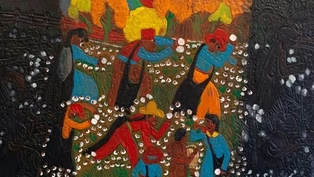
Clip: S2023 Ep579 | 3m 11s | A look at the narrative artwork of Winfred Rembert at the Hauser & Wirth Gallery. (3m 11s)
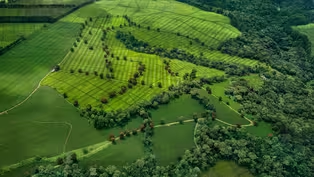
Clip: S2023 Ep579 | 10m 36s | A profile of Canadian photographer Edward Burtynsky. (10m 36s)
Providing Support for PBS.org
Learn Moreabout PBS online sponsorship
- Arts and Music
The Best of the Joy of Painting with Bob Ross
A pop icon, Bob Ross offers soothing words of wisdom as he paints captivating landscapes.













Support for PBS provided by:
NYC-ARTS is a local public television program presented by THIRTEEN PBS
Major funding for NYC-ARTS is made possible by The Thea Petschek Iervolino Foundation, Jody and John Arnhold, The Lewis “Sonny” Turner Fund for Dance, The Ambrose Monell Foundation, Elise Jaffe...