NYC-ARTS
NYC-ARTS Full Episode: February 15, 2024
Season 2024 Episode 605 | 27m 47sVideo has Closed Captions
A visit to the Metropolitan Museum of Art for "Look Again: European Paintings 1300-1800."
A visit to the Metropolitan Museum of Art for "Look Again: European Paintings 1300-1800." The 45 renovated galleries invite visitors to reunite with old favorites, such as masterworks by Rembrandt, Caravaggio, El Greco and Goya – and discover recent gifts and lesser-known artists. Then a profile of double-bassist Nina Bernat, recipient of a 2023 Avery Fisher Career Grant Award.
Problems playing video? | Closed Captioning Feedback
Problems playing video? | Closed Captioning Feedback
NYC-ARTS is a local public television program presented by THIRTEEN PBS
Major funding for NYC-ARTS is made possible by The Thea Petschek Iervolino Foundation, Jody and John Arnhold, The Lewis “Sonny” Turner Fund for Dance, The Ambrose Monell Foundation, Elise Jaffe...
NYC-ARTS
NYC-ARTS Full Episode: February 15, 2024
Season 2024 Episode 605 | 27m 47sVideo has Closed Captions
A visit to the Metropolitan Museum of Art for "Look Again: European Paintings 1300-1800." The 45 renovated galleries invite visitors to reunite with old favorites, such as masterworks by Rembrandt, Caravaggio, El Greco and Goya – and discover recent gifts and lesser-known artists. Then a profile of double-bassist Nina Bernat, recipient of a 2023 Avery Fisher Career Grant Award.
Problems playing video? | Closed Captioning Feedback
How to Watch NYC-ARTS
NYC-ARTS is available to stream on pbs.org and the free PBS App, available on iPhone, Apple TV, Android TV, Android smartphones, Amazon Fire TV, Amazon Fire Tablet, Roku, Samsung Smart TV, and Vizio.
Providing Support for PBS.org
Learn Moreabout PBS online sponsorship♪ >> Coming up on NYC Arts, a visit to the Metropolitan Museum and its 45 renovated galleries dedicated to its collection of European paintings from 1300 to 1800.
>> Each of the 45 galleries, we invite our visitors to explore a particular theme, or to look more deeply at a singular artist's work.
Landscape is a theme we explore.
Travel, place, time, artist, people are really the structure to this installation.
♪ >> And a profile of a bassist, recipient of the 2023 career grant award.
>> The bass has somewhat remitted solo repertoire.
There are composers that wrote for the base but they are not well known.
I am super passionate about transcriptions.
This process is like in between being a performer and a composer.
♪ >> Funding for NYC Arts is made possible by Thea Petschek Foundation, Jody and John Arnhold, the Lewis Sonny Turner fund.
The Ambrose Monell fund, Elise Jaffe and Jeffrey Brown.
The Milton and Sally Avery arts foundation.
The Nancy Sidewater foundation.
This program is supported in part by public funds from the New York City Department of cultural affairs, in partnership with the city Council.
Additional funding provided by Members of Thirteen.
And Swann auction Galleries.
>> We have a different way of looking at auctions, offering vintage books and fine arts since 1941, working to combine knowledge with excess ability.
Whether you are a lifelong collector, first time or looking to sell, information at SwannGalleries.com.
♪ >> Good evening and welcome to NYC Arts.
I am on location at ICP, with a bit of a cold that compromises my voice.
My apologies.
The international Center of photography is what ICP is.
It is now in its new home on Essex Street on the lower East side.
Here, its Museum and school are combined under one roof, making it a dynamic cultural center that offers programs in all aspects of talk if he and digital media -- of photography and digital media.
ICP was founded in 1974 to champion the legacy of concerned photography.
Socially and politically minded images that are capable of generating change.
This year, ICP celebrates its 50th anniversary with the exhibition ICP at Fifty, from the collection 1845-2019.
On view are over 170 works, spanning nearly 175 years of photography from ICP's archive, including the work of such artists.
♪ Also currently on view is "David Seidner: Fragments 1977-99."
It is the first major survey of the work of this 20th century artist, from cutting edge fashion photography to documentation of the New York art world.
The images on view are mostly drawn from his own archive, which has been a part of ICP's collection since 2001.
Known for capturing avant-garde fashion in the 1980's and 1990's, designers such as Yves Saint Laurent, he was a prolific photographer for publications such as Harper's Bazaar, neutral Times Magazine, vanity fair and international editions of Vogue.
In addition to commercial and editorial work, Seidner was committed to his own practice.
The exhibition includes some lesser-known highlights, including his early fine art photography and fragmented portrait studies.
These include images of groundbreaking dancers and choreographers, portraits of well-known contemporary artists in their studios, and from his final project, abstract studies of orchids.
Those Seidner's work has largely faded from view since his passing from AIDS related illnesses in 1999, the exhibition shows the complexity of his work and career.
It also shows ICP's interest in celebrating artists who combine disciplines and reimagine the medium of photography.
On tonight's program, we visit the Metropolitan Museum of Art, which recently reopened its suite of 45 galleries dedicated to European paintings from 1300 to 1800.
The reopening follows the completion of an extensive skylight renovation that begin in -- that began in 2018.
With more than 700 works from the museum's holdings of reopening invites visitors to reunite old favorites such as masterworks by Rembrandt, Caravaggio, and Goya, and also to discover lesser-known works.
The galleries are organized chronologically and by themes that encourage the consideration of European paintings within the greater arc of history and artistic production.
The galleries also give renewed attention to women artists and those who were frequently omitted from the canon.
The curator in charge of the Department of European paintings, who oversaw the installation of the galleries, will be our guide.
>> We have reinstalled the main suite of European paintings at the Museum that runs from around 1300 to 1800.
And a series of 45 galleries that span approximately two acres.
We recognized one of the leveling planes that we could all return to for orienting ourselves is chronology, that people would know when they are in the 15th, 17th, 18th centuries.
That would give some spine to the experience.
In each of the 45 galleries, we invite our visitors to explore a particular theme or to look more deeply at a singular artist's work.
Landscape is a theme.
Travel, place, time, artists, people are really the structure to this installation.
The roof above us is glass on this floor.
It is one of the great privileges of having our galleries here, is that we can light them with natural light from above.
The advantage of that is at different times of day you get different effects of light.
On a great day, the animation that is present, the sense of lived, the momentary, the fleeting and the galleries as light shifts, is really magical.
In a vast complex as the Metropolitan Museum, people have a limited amount of time.
No one can see everything here in one day, so what we have done in each gallery is signal what we call a collection highlight.
They allow people to see the work by Giotto or Duccio or in this gallery, Rembrandt.
We have tried to systematize the experience.
We have opened up spaces so that galleries build upon galleries, so that people always in any given space can look left, right, forward or behind, so there is some residual experience when they go to the galleries.
One of the great privileges of working with a collection is to see how the dialogue between works marks certain experiences.
Behind me, a visitor can see a self-portrait by Rembrandt.
Through the door they can see a self-portrait by van Dyck.
And next to that, a self-portrait by Rubens.
Three of the greatest painters of their time, seen in concert band in dialogue with each other.
Those are the experiences that installations allow viewers to consider.
People imagine that we are mixing everything up and no longer allowing artists to represent their work, their style, the full range of their career, but in fact if you look here, that is in fact what we are examining.
We are looking at a retrospective of Rembrandt.
In the adjacent gallery here, you can see more works by Vermeer than anywhere else in the world.
We have put them all together for people to sit down and contemplate and enjoy.
We have tried to diversify the representation of works in our galleries.
We have tried to bring in artists who otherwise are not canonical in their geographic period.
We reflect in many ways interesting ideas of their time.
We have tried to present a greater variety of subjects and of narratives in the gallery.
Included in that is works by women artists.
And we are also pleased to be able to show for the first time some important works that have come in in the last couple years, such as the works of the Italian still life painter and religious painter.
Orsola Caccia is a wonderful example of the shifting narratives our collection invites viewers to consider.
We have Velasquez's Juan de Pareja looking at Madrid school 17th century Spanish painting.
Pareja was an artist that was enslaved in Velasquez's workshop but was later freed and had his own practice, and it really is an extraordinary figure to think about.
We also have a gallery that looks at new Spain, that looks at viceregal Mexico and Peru.
It is the first time that a collection of that work has been integrated into the narrative of European painting.
Those works are truly extraordinary.
Very fresh, very different from what we traditionally show in these galleries.
It is a new collection even for the museum, and a wonderful indication of some of the directions that our collection is growing in.
The residences that historic practice has on current practice is something we are very mindful of.
We have only one work by a living artist.
It is a large painting of the studio by Kerry James Marshall, a work of incredible complexity, beauty, and narrative strength.
And it anchors a gallery that examines this question of the artist's studio.
It was a wonderful thing for us to think about as an idea, but also a wonderful moment for us to bring works from different parts of our collection of paintings together with it.
We have the largest collection of works by El Greco outside of Spain.
And we also have some of the rightist early Picassos.
-- the greatest early Picassos.
To juxtapose his work from that period with El Greco is a marvelous thing and some thing that is single or about what we can do here in the European paintings department at the Met.
♪ >> Next on our program, we celebrate the 2023 career grant awards.
This past year, the ceremony took place in March at WQXR.
These individual grants of $25,000 will give professional assistance and recognition to talented instrumentalists who have potential for major careers in classical music.
In 2023, there were five recipients.
A double bassist.
♪ A guitarist.
A flutist.
A pianist.
As well as the Isidore strain quartet -- string quartet.
Born in Iowa city, Iowa, Nina began studying the double bass under the instruction of her father.
She has continued her studies at the Juilliard school.
Winner of multiple international prizes and competitions, she has established herself as a formidable musician.
With a particular interest in chamber music, Nina has abused with the Jupiter Symphony chamber plays, Champlain chamber music Festival, and taken part in Juilliard's ChamberFest.
>> I started bass when I was seven years old only, which is pretty young for a bass player.
My dad is a professional bass player, so that is kind of the answer to how I landed on that instrument.
It was just a natural decision after enjoying playing piano and being a music loving child.
♪ My dad was my teacher until I came to Juilliard, so it was a very easy thing to choose the bass.
The most special thing about it is it belonged to my father before it belonged to me.
♪ About two years ago, he gave it to me to play in a couple important competitions.
Since then, I have kind of held onto it.
It is attributed to someone who is a very famous violin maker.
It also dates this instrument back some 300 years.
It's a joy to be able to play on an instrument that is such a piece of history.
♪ I'm currently a second year Masters student at Juilliard, so I will be graduating in the spring.
Once I got to Juilliard, my teacher was Tim Cobb in the New York Philharmonic.
I still study with him now.
It has been six years.
He has been a great role model and support for me.
♪ The past two years I have been studying with a cellist.
She has been an amazing mentor.
♪ The bass has somewhat remitted solo repertoire.
There are composers that wrote for the bass, but they are not well-known composers.
One of the solutions to that problem that I am super passionate about is doing transcriptions.
This is where studying with a cellist comes in handy.
I will take cello parts or any instrument, really, and transcribe it for bass.
This process is kind of like in between being a performer and a composer, where I'm at my instrument, seeing what works and seeing what doesn't, putting things up an octave, changing may be some chords.
♪ I find that to be a really exciting thing to do.
And it is a way of opening up the repertoire base to really anything.
Like, anything is possible.
♪ I performed Chopin's piece originally written for cello and piano.
It was transcribed by my father, actually, so I have a very special relationship to this piece.
Its original version was for piano and cello accompaniment.
So basically the piano is doing all the fancy things that Chopin writes for piano and the cello is accompanying.
But a cellist named Leonard Rose came along and decided that the cello should have a bigger part in this piece.
And then it underwent a final transformation to become a bass and piano piece.
I performed it with a studio pianist.
♪ It is quite interesting, and the rehearsal process is like chamber music.
And in some ways like Sonata playing, in that it feels like I am the right hand and she is the left-hand in some ways on the piano, and to get these two voices to speak together is the cool part of the universal process.
-- of the rehearsal process.
♪ Receiving the career grant has been--it's kind of bananas to me that I'm able to join such a prestigious list of musicians who have gone on to change the music world as we know it.
♪ I feel that this comes with big response ability to represent the bass as a solo instrument as well as represent women playing the bass.
I hope it gives me the opportunity to kind of act as that role model or Trail Blazer in conditioning some pieces for the solo bass in order to expand that repertoire.
♪ ♪ ♪ [APPLAUSE] ♪ >> Next on NYC Arts, a trip to the New York historical Society for a look at the exhibition Hudson River school.
>> Kane walking stick Hudson River school brings together two discrete sets of landscape paintings.
The question it poses is what is the relationship between these two bodies of work, and what story do they tell together about North American land and about landscape practice?
♪ >> A visit to the American Folk Art Museum, and the exhibition "Unnamed Figures: Black Presence and Absence in the Great American North," which examines how stories and its people have often gone untold.
>> Black artists and Black creators are very often excluded from the world of fine art.
Even when we see someone like Joshua Johnson, we see someone who says, well, I had to teach myself.
To have access to Black artists and that legacy of Black artistic production, we have to look into the kind of art that would be considered folk art.
>> And a look at the sculpture of Augustus St-Gaudens.
>> The Metropolitan has 50 works by Saint Gardens -- St-Gaudens.
We are presenting early cameo portraits to models for and reductions after his great Civil War monuments.
♪ >> I hope you enjoyed our program tonight.
I am on location at ICP, the International Center of Photography.
Good night.
And see you next time.
♪ >> Funding for NYC Arts is made possible by The Ambrose Monell foundation.
Elise Jaffe and Jeffrey Brown.
Charles and Valerie Diker.
The Milton and Sally Avery arts foundation.
The Nancy Sidewater foundation.
And Ellen and James S. Marcus.
This program is supported by funds by the New York City Department of cultural affairs, in partnership with the city Council.
Additional funding provided by members of Thirteen, and Swann auction Galleries.
>> We have a different way of looking at auctions, offering vintage books and fine arts since 1941, working to combine knowledge with accessibility.
Whether you are a lifelong collector or looking to sell, information at SwannGalleries.com.
♪
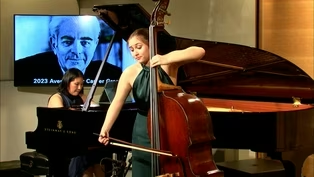
Avery Fisher Career Grant Award: Nina Bernat
Clip: S2024 Ep605 | 10m 23s | A profile of double bassist Nina Bernat, winner of a 2023 Avery Fisher Career Grant Award. (10m 23s)
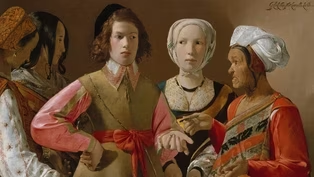
Look Again: European Paintings 1300-1800
Clip: S2024 Ep605 | 8m | A visit to the Metropolitan Museum of Art for "Look Again: European Paintings 1300-1800." (8m)
Providing Support for PBS.org
Learn Moreabout PBS online sponsorship












Support for PBS provided by:
NYC-ARTS is a local public television program presented by THIRTEEN PBS
Major funding for NYC-ARTS is made possible by The Thea Petschek Iervolino Foundation, Jody and John Arnhold, The Lewis “Sonny” Turner Fund for Dance, The Ambrose Monell Foundation, Elise Jaffe...