NYC-ARTS
NYC-ARTS Full Episode: February 8, 2024
Season 2024 Episode 604 | 27m 47sVideo has Closed Captions
A visit to the Jewish Museum for ”RBG Collars: The Photographs of Elinor Carucci.”
A visit to the Jewish Museum and the exhibition "RBG Collars: The Photographs of Elinor Carucci,” which honors the late Supreme Court Justice, Ruth Bader Ginsburg. Next, a profile of photographer and activist LaToya Ruby Frazier, whose work is steeped in the social documentary tradition of Walker Evans and Gordon Parks. Then a look at a highlight in the collection of the American Folk Art Museum.
Problems playing video? | Closed Captioning Feedback
Problems playing video? | Closed Captioning Feedback
NYC-ARTS is a local public television program presented by THIRTEEN PBS
Major funding for NYC-ARTS is made possible by The Thea Petschek Iervolino Foundation, Jody and John Arnhold, The Lewis “Sonny” Turner Fund for Dance, The Ambrose Monell Foundation, Elise Jaffe...
NYC-ARTS
NYC-ARTS Full Episode: February 8, 2024
Season 2024 Episode 604 | 27m 47sVideo has Closed Captions
A visit to the Jewish Museum and the exhibition "RBG Collars: The Photographs of Elinor Carucci,” which honors the late Supreme Court Justice, Ruth Bader Ginsburg. Next, a profile of photographer and activist LaToya Ruby Frazier, whose work is steeped in the social documentary tradition of Walker Evans and Gordon Parks. Then a look at a highlight in the collection of the American Folk Art Museum.
Problems playing video? | Closed Captioning Feedback
How to Watch NYC-ARTS
NYC-ARTS is available to stream on pbs.org and the free PBS App, available on iPhone, Apple TV, Android TV, Android smartphones, Amazon Fire TV, Amazon Fire Tablet, Roku, Samsung Smart TV, and Vizio.
Providing Support for PBS.org
Learn Moreabout PBS online sponsorship♪ >> coming up on NYC Arts, a visit to the Jewish Museum in the exhibition.
The photographs of Eleanor Carew G, which honors the Supreme Court Justice Ruth Bader Ginsburg.
>> wearing the colors as a way to distinguish herself from the down, the more boring appearance, and to feminize herself.
And then, she started getting gifts, she started getting collars that were commission.
And they became another symbol for her without words.
She was a woman of words.
This was visual messages.
Something I really relate to as a visual artist.
>> profile of photographer and activist Latoya Ruby Frazier.
>> it is a duty, privilege, and honor to use these cameras to serve others and bring a real human story forward in a complex situation.
>> funding for NYC Arts -- four "NYC Arts" is made possible by the Louis Sonny Turner fund for dance.
The ambrose monell foundation.
Charles and Valerie diker.
The Milton and Sally Avery arts foundation.
Elroy and Terry foundation.
The Nancy side water foundation, and Ellen and James S Marcus.
This program supported in part I public funds from the New York City Department of Public affairs, in partnership with the city Council.
Additional funding provided by members of 13 and by Swann auction Galleries.
>> Swann auction Galleries, we have a different way of looking at auctions offering fine arts since 1931.
Working to combine knowledge with accessibility.
Whether you are a lifetime buyer or looking to sell, information at Swann Galleries.com.
♪ >> good evening, and welcome to NYC Arts.
Bay -- I'm phillipe with a bit of a cold that compromises my voice.
The international Center of photography's is now in its new home on Essex Street on the lower East side.
Here it's museum and school are combined under one roof, making it a dynamic cultural center with ambitions, programs and all aspects of photography and digital media.
It was founded in 1974 by this photographer to champion the legacy of concern photography.
Socially and politically minded images that are capable of generating change.
This year ICP celebrates its 50th anniversary with the exhibition "ICP at 50" from the collection 1845, 2019.
On View are over 170 works that spanned nearly 175 years of photography.
Included here is the work of such pivotal photographers.
Ansell Adams, Jacob Reese, Gordon Parks, Ruth Orkin, and the war photography, Robert Capa .
Also notable are historical significant images of the 20th century.
This photo taken of the surface of the moon in 1966.
And a photo of the young presidential candidate, John F. Kennedy, on the campaign trail.
ICP at 50 also takes time to tht forms of photography.
1839, a new photographic technology was announced in Paris.
These images were made by exposing a prepared copperplate for up to 20 or 30 minutes, then developing it over hot mercury.
Given the polished plates support, these photographs have distinctive reflective appearance.
Primarily used for making portraits, it provided a way for individuals to record and present themselves, their family, style, and character in a newly accessible way.
As technology progressed in the mid-19th century, new techniques became less expensive and easier to produce.
Amber types were printed on a translucent glass plate, which revealed the image when placed against a dark background.
As both processes were very fragile, the resulting photographs were sent to friends and family through the mail and were almost exclusively housed in predictive, decorative cases.
A popular format for portraits in the mid-19th century was the visiting art.
They consisted of silver print mounted to a thick card, and then printed with logos or other details about the photographic studio.
In addition to prints of friends and families, people also collected photographs of historic figures, such as Queen Victoria, Abraham Lincoln, and abolitionist, Sojourner Truth.
By holding and selling these cards, she supported her own work, demonstrating control of her image when many black Americans were likely never to be photographed during their lifetime.
Around 1870, the cabinet guard, a larger version, was introduced.
These often included even more elaborate studio and blessing and other branding colored cards and embellished edges.
Over time, inventors patented new cameras with multiple lenses , so that a sheet with many small portraits could be easily printed and then cut apart.
These miniature portraits quickly replaced calling cards and found a place in specially crafted photo albums.
The very first of their kind.
On our program tonight, we look at portraits of one of our country's most notable jurists.
Although justices of the Supreme Court are not known for their choices, Ruth Bader Ginsburg was an exception.
As the second woman to sit on the Supreme Court since its first assembly over two centuries ago, Ginsburg is being honored with a special exhibition at the Jewish Museum.
On View are 24 photographs of the callers she wore to embellish a traditional black robe.
The Israeli born photographer elinor, was selected to capture the striking neckwear shortly after Ginsberg's death in 2020.
Alongside the photos is a selection of jewelry from the museum's collection.
Reinforcing how Ginsberg has contributed to the rich legacy of the Jewish experience as told through art and artifacts.
She recounts the challenges of photographing the callers of RBG, as Ginsberg was known for her most ardent fans.
♪ >> for me, she was an inspiration of a woman who has worked hard.
She was about justice, yet also a mother, a wife.
She was the daughter of an immigrant, so for me, she was everything.
A month after the passing of Justice Ginsburg, I was approached by Catherine, the photo director of Time Magazine to go to the Supreme Court and photograph the collars we made of Ginsberg.
I expected to see big-time designers with diners.
It was very much a collection of the people, of things that I could even see my grandma making or wearing.
And that was really inspiring to see the lace, to see the crochet, to see the beads and shells.
They are not fancy or super expensive stones.
She started wearing the collar as a way to distinguish yourself from the black gown, the male, more boring appearance and to feminize herself.
And then she started getting gifts.
She started getting collars that were commissioned, and then they became another symbol for her without words.
She was a woman of words, but this was visual messages.
Something I really relate to as a visual artist.
When you see the collar from afar, it's beautiful.
But when you go closer, there are little imperfections.
Some threats are coming out.
That was a way to maybe feel a little closer to Ruth Bader Ginsburg, to the woman who wore them.
The collar with the words of Martha Ginsberg, it's not sacrifice, it's family, was the one that really moved me.
I couldn't do the career that I have about my husbands and kids.
Many people think about a as Marty Ginsberg living for Ruth Bader Ginsburg, but he was talking about both of them, doing things for the family.
It does look very different when it's folded or when it's open.
We cannot see the words of Marty because they are worn to the back of the neck.
So there is also intimacy there.
The chief designer of a female owned fashion company was in charge of this important commission for Ruth Bader Ginsburg's 85th birthday.
Four layers of the collar each represent the family member with Ruth Bader Ginsburg on the top.
And then Marty, it's a fabric similar to a men's tie.
And then the kids, Jane and Jim, there is something warm or sweet about it.
It represented a family.
I went to Columbia Law school where Ruth Bader Ginsburg finished on the top of her class and was the first woman tenure Professor at Columbia Law school.
And they told us about wanting to honor Ruth Bader Ginsburg 25th year in the Supreme Court, and that they were looking for a lace maker and they found a way.
Alayna spent 300 hours creating this caller -- collar.
It was a very big challenge to create the number 25 as perfectly as it is.
There was a history of lace actually worn by more powerful men in the history of judges.
But it is a woman craft and was throughout history.
The community of lace makers really mourn her passing.
Ruth Bader Ginsburg was a fan of the Opera and talked about going to the opera as her time to rest.
This was a rough -- a replica that the Metropolitan Opera created for Ruth Bader Ginsburg and wrote her name on it.
This one is different in its shape and the material.
It is more male.
It almost looks like a tie.
The others are softer.
I think what I love about this body of work of the collars in this exhibition is that people can take it to different directions.
If you're interested in law, the stories, if you're interested in fashion.
If you are a feminist or a fan of Ruth Bader Ginsburg.
If you are Jewish or not Jewish, if you are interested in Judaism.
It's about an individual, but it's also about America.
>> for more information on cultural events in our area, please sign up for our free weekly email at N.Y.C.
-- arts.org/email.
Top five picks will keep you up-to-date all year round.
Be sure to connect with Enright -- NYC Arts on Facebook, Instagram and TikTok.
♪ Phillipe: next on our program, we will meet photographer, video artist and asked if -- activist, Latoya Ruby Fraser.
She grew up in Braddock, financial Vena where she began photographing her family and hope that hometown at the age of 16.
Her home is steeped in the social documentary.
Frazier's photographs tell the stories of people who are usually forgotten, live in the invisibility through her images.
Her project with residents of Flint, Michigan, documenting the effects on the ongoing water crisis there, appeared in elle Magazine in 2016.
Her work addressing environmental justice, health care in equity, and racism, has appeared in the New York Times Magazine, the New Yorker, and other major publications.
Frazier has had solo exhibitions of her work in the U.S. and Europe.
There -- and is also the recipient of the MacArthur Fellowship.
NYC Arts spoke with Frazier several years ago at the retrospective of her work at Gavin Brown enterprise in Harlem.
♪ Latoya: My work gives a framework to what it's like being a working craftsperson -- working-class person.
Andrew Carnegie created and established his first still male in Brat are.
-- Braddock.
It has been operating since 1875.
It is located outside of Pittsburgh alongside the river.
You talk about America, and who built America, and the fact that America is built by a, still, even if we look at the infrastructure and space we are in today, everything is anchored in steel.
I was raised between these two very strong women, my grandmother Ruby, and my mother, Cynthia.
My grandmother grew up there in the 1930's.
This would have been when Braddock was prosperous, very diverse.
It had a lot of wealth.
My mother grew up there in the 1960's.
She was someone who witnessed the segregation and the racism.
And I grew up there in the 1980's, which would be after they closed all the surrounding factories, and unions were broken up, and the war on drugs breaks out in the community.
I was coming-of-age when that was happening, and I was a witness to that.
Just looking at them is what pushed me to create a family album that most Americans wouldn't want.
I think all Americans know the kind of images that are in the notion of family, it's just socially and culturally we are taught never to talk about those.
Once I started coming home with my camera, my mother became immersed and engaged.
She was a collaborator from the very moment.
And I think a lot of it comes out of my understanding of the Meisel Brothers and their documentary films.
They believe if a person is overlooked and ignored by society and all the setting has this camera turned on them, they will engage.
Because, otherwise they would be invisible and voiceless.
We are traditionally taught in the history of Art in the history of photography that the photographers never relinquish the power to the subjects.
And so I was also trying to bring the same type of vulnerability and transparency out and prove that this has always been a part of that legacy of photographing family and making photographs with social commentary about America.
Laying that bear to the viewer was essential to me.
I'm just as much a part of this situation in crisis.
I consider myself an advocate and not so much an activist.
I think that's very different.
I'm an advocate and a storyteller.
You think about the Harlem family, which was public -- published in life magazine.
Think about his collaboration with Ralph Ellison on invisible man.
A collaboration between black artists, black photographers, black poets and writers trying to tell another story and narrative from the inside to the American public so they can see it clear for what it is.
It is the everyday person, the everyday man, woman and child that are experiencing the brutality and the pitfalls of capitalism, of inequality, of living in these small towns that have been abandoned by the state .
They are the ones, these individuals and families are the ones that can express it and articulate it the best.
>> when you think about water, you don't consider government.
In fact, you don't consider people at all.
Even though we plants and machines talc and eyes and purify, when you think about it, you only, in your most remote mind, if at all, thick about God.
Something nature intended.
When he think about water, you don't consider poison, because poison isn't something you consider for yourself.
You don't think about murder.
LaToya: the water crisis became public knowledge in April of 2014.
And because Obama came on May 4 in 2016, and they had that image of him sipping that water, which was supposedly Flint River water , the American consciousness and psyche believed that the water crisis was over.
It was in 2016 that I received a phone call from Elle magazine, a magazine that's about women, health, and beauty, to build out a section for the September issue to actually have inside of it, before you got to the fashion spreads, 10 pages, under interrupted, of photo essays -- uninterrupted, of photo essays talking about the water crisis.
It was important for me to pivot slightly out of the generational connection between my grandmother, mother, and me, to this other generation three women.
Which was René Cop, her daughter, and Shea's daughter Zion.
What it's now for them to figure out the relationship to water and live with contaminated and poisoned water.
Shea is a school bus driver and is also active in organizing public protest as well.
She is a singer, she is a poet.
She had so much charisma and hope and faith, and just such a positive outlook regardless of the circumstance.
-- circumstance that has completely created a man-made disaster because of inequality and racism.
Why not collaborate with her and get her voice, her words, and her perspective.
She made it very clear to elle magazine.
She said, don't come.
She understands how the media shapes stereotypes and discourse around Black women, Black families, and Black communities.
I really relied on Shea being my eyes.
I was simply being an empathic witness, being led by her through this town.
It is a duty, a privilege, and in honor to be able to use these cameras to serve others, and to bring a real human story in a complex situation.
♪ Phillipe: next on "NYC Arts" a visit to the Metropolitan Museum at its 45 renovated galleries dedicated to its collection of European paintings from 1300-1800.
>> in each of the 45 galleries we invite our visitors to explore a particular theme, or to look deeply at a singular artists work.
Landscape is the theme the Explorer.
Travel, place, time, artists, people are really the structure to this installation.
Phillipe: and a profile of this double bassist, recipient of the 2023 Avery Fisher career grant award.
>> the base has somewhat limited solo repertoire.
There were composers that wrote for the base, that they are not well-known composers.
I am super passionate about doing transcriptions.
This process is kind of like in between being a performer and a composer.
♪ ♪ Phillipe: I hope you have enjoyed our program tonight.
I am on location at ICP, the International Center of photography.
Good night and see you next time.
To enjoy more of your favorite segments on it "NYC Arts", visit our website at NYC-arts.org/em.
>> good evening and welcome to NYC Arts.
>> I am at the studios in Lincoln Center.
♪ >> Leonard, what a privilege to be able to sit down and talk with you.
Where are we?
>> we are at a moment to take nothing for granted.
Phillipe: it's a pleasure to be with the curator of this exhibition for Pope.
We are in the midst of some of the greatest sculptures by the hour contest by the iconic names.
>> classical and modern dance are extremely different.
I have so much more to learn before I can articulate the differences.
>> when I listen to the lyrics I suddenly thought, that's what I want to do with my life.
>> my pictures reside in very intimate, very private moments.
>> my primary way of playing piano is by improvising.
>> you are on sacred grounds.
>> a woman came to see me performance that, how would you like to play Billie holiday?
>> one of the essential things we learned is that they used pins to compose his work.
>> you are always surprised when you are doing opera and you do a piece that was a 100 years ago and think, this could be now.
>> that was the very first of that moment of realization.
>> you come and present something I do get applause.
Great.
You know.
♪ ♪ >> funding for NYC Arts is made possible by Jody and John Arnhold.
The Lewis Cine Turner fund for dance.
The Ambrose Monell Foundation.
Elise Jaffe and Jeffrey Brown.
Charles and Valerie diker.
The Milton and Sally Avery arts foundation.
Elroy and Terry Krumholz foundation.
The Nancy side water foundation and Ellen and James S Marcus.
This program is supported in part I public funds from the New York City Department of Public affairs.
In partnership with the city Council.
Additional funding provided by members of 13 and by members of 13 and Weissman auction galleries.
>> Swann auction galleries.
We offer vintage books and fine arts since 1941, working to combine knowledge with accessibility.
Whether you are a lifelong collector or looking to sell, information at Swan galleries.com.
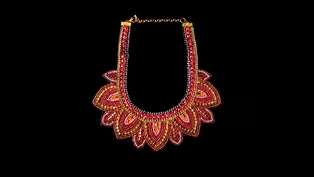
"RBG Collars: The Photographs of Elinor Carucci”
Clip: S2024 Ep604 | 6m 39s | A visit to the Jewish Museum for ”RBG Collars: The Photographs of Elinor Carucci.” (6m 39s)
Providing Support for PBS.org
Learn Moreabout PBS online sponsorship













Support for PBS provided by:
NYC-ARTS is a local public television program presented by THIRTEEN PBS
Major funding for NYC-ARTS is made possible by The Thea Petschek Iervolino Foundation, Jody and John Arnhold, The Lewis “Sonny” Turner Fund for Dance, The Ambrose Monell Foundation, Elise Jaffe...