NYC-ARTS
NYC-ARTS Full Episode: January 18, 2024
Season 2024 Episode 601 | 27m 46sVideo has Closed Captions
A profile of artist Shahzia Sikander. Then a look at the exhibit "Africa & Byzantium."
A profile of artist, Shahzia Sikander. Born in Lahore, Pakistan, Sikander moved to the US in the 1990s. Over the subsequent years, her practice has expanded to include paintings, video installations, prints, and sculpture. Then a look at the exhibition “Africa & Byzantium” at the Metropolitan Museum of Art, which focuses on the connection between North Africa and the Byzantine world.
Problems playing video? | Closed Captioning Feedback
Problems playing video? | Closed Captioning Feedback
NYC-ARTS is a local public television program presented by THIRTEEN PBS
Major funding for NYC-ARTS is made possible by The Thea Petschek Iervolino Foundation, Jody and John Arnhold, The Lewis “Sonny” Turner Fund for Dance, The Ambrose Monell Foundation, Elise Jaffe...
NYC-ARTS
NYC-ARTS Full Episode: January 18, 2024
Season 2024 Episode 601 | 27m 46sVideo has Closed Captions
A profile of artist, Shahzia Sikander. Born in Lahore, Pakistan, Sikander moved to the US in the 1990s. Over the subsequent years, her practice has expanded to include paintings, video installations, prints, and sculpture. Then a look at the exhibition “Africa & Byzantium” at the Metropolitan Museum of Art, which focuses on the connection between North Africa and the Byzantine world.
Problems playing video? | Closed Captioning Feedback
How to Watch NYC-ARTS
NYC-ARTS is available to stream on pbs.org and the free PBS App, available on iPhone, Apple TV, Android TV, Android smartphones, Amazon Fire TV, Amazon Fire Tablet, Roku, Samsung Smart TV, and Vizio.
Providing Support for PBS.org
Learn Moreabout PBS online sponsorship♪ Paula: Coming up on NYC-ARTS, a profile of artist Shahzia Sikander, whose work brings the arts of the South Asian diaspora to the United States.
>> Art survives, inspires.
It is life.
For me, it is very much about knowledge, construction, how I process things that are around me, whether it's history, politics, daily living.
All of it enters into the space of art.
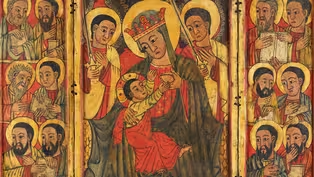
Paula: a look at the exhibition Africa & Byzantium now on view at the Met which brings together the art, religion, literature, history, and archeology of this region in ancient times.
Objects in the exhibition include a range of media from monumental frescoes, mosaics, panel paintings, ceramics, and illuminated manuscripts.
♪ And a visit to the studio of Artist Faith Ringgold.
Faith Ringgold: These are people who I associate with my life growing up in Harlem.
The musicians, the artists, the politicians, all of these truly great people.
>> FUNDING FOR NYC-ARTS IS MADE POSSIBLE BY THEA PETSCHEK IERVOLINO FOUNDATION JODY AND JOHN ARNHOLD THE LEWIS SONNY TURNER FUND FOR DANCE THE AMBROSE MONELL FOUNDATION ELISE JAFFE AND JEFFREY BROWN CHARLES AND VALERIE DIKER THE MILTON AND SALLY AVERY ARTS FOUNDATION ELROY AND TERRY KRUMHOLZ FOUNDATION THE NANCY WIDEWATER FOUNDATION AND ELLEN AND JAMES S. MARCUS.
THIS PROGRAM IS SUPPORTED, IN PART, BY PUBLIC FUNDS FROM THE NEW YORK CITY DEPARTMENT OF CULTURAL AFFAIRS, IN PARTNERSHIP WITH THE CITY COUNCIL.
ADDITIONAL FUNDING PROVIDED BY MEMBERS OF THIRTEEN AND BY SWANN AUCTION GALLERIES.
♪ >> SWANN AUCTION GALLERIES.
WE HAVE A DIFFERENT WAY OF LOOKING AT AUCTIONS, OFFERING VINTAGE BOOKS AND FINE ART SINCE 1941.
WORKING TO COMBINE KNOWLEDGE WITH ACCESSIBILITY, WHETHER YOU ARE A LIFELONG COLLECTOR OR A FIRST-TIME BUYER, OR LOOKING TO SELL.
INFORMATION AT SWANNGALLERIES.COM.
♪ ♪ Paula: Good evening, and welcome to NYC-ARTS.
I'm Paula Zahn, on location at the Alice Austen House on Staten Island.
John Haggerty Austen, a retired Quaker dry-goods merchant, bought this property in 1844 and it became the family home for more than 100 years.
While Staten Island had been a summer refuge for New Yorkers trying to escape the heat and crowded conditions in Manhattan, the Austens put love and care into the new home they called Clear Comfort, which they came to enjoy all year round.
The house is named for John's granddaughter, Alice Austen, who came to live at the house after her father abandoned the family.
The eldest child of the Austen family, Alice's mother, Elizabeth, enjoyed reading, drawing, painting watercolors, and collecting first-edition books.
After returning to Clear Comfort with Alice as an infant, she shared a bedroom with her until her death in 1900.
Alice's photographs give us detailed documentation of her personal space, revealing her love for it.
After her mother's death, Alice continued to collect items to the point where movement through the room was difficult.
The Austens were a multi-talented family, including aunts, uncles, and cousins, each guiding the young Alice to becoming the pioneering photographer we celebrate today.
Her early work provided an intimate glimpse into the social circles of a young, middle class Victorian woman, while presenting a relatively unknown world of a woman photographing other women.
In these private images, Alice often mocks the accepted conventions of Victorian life.
She explored what she called the larky life, creating scenes of friendly antics, same-sex embraces, and playful compositions.
Many of Alice's female friends were considered New Women as they pursued their own personal and professional interests - whether bicycling, playing tennis, or achieving financial independence.
Alice also traveled from her home at Clear Comfort to the streets of Manhattan to document immigrant street workers, providing a glimpse into a world that was foreign and intriguing.
New York was the landing dock for waves of immigrants.
Overcrowded boats would have entered New York Harbor, passing Clear Comfort near the end of their journey.
In 1896, a portfolio of 12 of Alice's images, entitled The Street Types of New York, established her as one of the earliest female street photographers.
On view today in the house's contemporary gallery space is an exhibition called Heap-o Livin': The Photography of Lora Webb Nichols.
Nichols, who was born in 1883, lived out west in the mining town of Encampment, Wyoming.
The images specifically focused on the role of pioneer women in the early 20th century.
They chronicle the domestic, social, and economic aspects of this sparsely populated frontier throughout the early 20th century.
Currently on view at the Noble Maritime Collection on Staten Island is an exhibition called Picturing the Water, which explores Alice Austen's deep connection to both local and international waterways and the vessels that traveled across them.
Alice took over 1,500 photographs of ships and waterways, including views of the New York Harbor from her home.
These images are a curated selection by Victoria Munro, Executive Director of the Alice Austen House, who spent a year closely studying Alice's nautical work.
This is the first time that many of these newly printed photographs have been made accessible to the public.
The exhibition is on view through May 18.
On our program tonight, a profile of artist Shahzia Sikander.
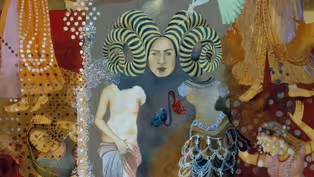
Born in Lahore, Pakistan, Sikander moved to the United States in the 1990s and received her MFA at the Rhode Island School of Design in 1995.
Over the subsequent years, her practice, which has expanded to include paintings, video installations, prints, and sculpture, has been pivotal in presenting the art of the South Asian diaspora to the United States.
Sikander has received such prestigious awards such as a MacArthur Fellowship, and the U.S. Department of State Medal of Arts.
Her work has been a staple of the local and international art scene for almost three decades.
She has had solo exhibitions at such institutions as the Morgan Library and Museum in New York, the Museum of Fine Arts in Houston, and the Guggenheim Museum Bilbao in Spain.
Here in New York, her work has also been featured twice in Times Square Arts' iconic series, "Midnight Moment," and she currently has a video installation on view at Moynihan Train Hall.
Organized in collaboration with the Cincinnati Art Museum and Cleveland Museum of Art, a major survey of Sikander's work will appear at the Palazzo Soranzo van Axel in Venice later this year.
NYC-ARTS spoke with Sikander at Pace Prints in Chelsea, where she was working on some of her latest projects.
♪ Shahzia Sikander: My name is Shahzia Sikander, and I am a painter, a visual artist, a multimedia artist based in New York City.
We are at Pace Editions, and I'm working on multiple prints for an exhibition in May of 2024.
Art lives, survives, inspires.
It's complicated, it's messy, it's very much like life.
And for me, art is very much about knowledge construction, how I process things that are around me, whether it's history, politics, daily living, all of it enters into the space of art.
Even as a child, art allowed me to communicate more readily, more easily, more immediately and urgently by drawing than by expression or by speaking.
Women are so centered in my practice.
I'm always thinking, how will women tell the story about themselves, versus somebody else's idea about us?
So how do you center women?
And oftentimes, women in my work are proactive, intelligent, connected to the past in playful creative ways, catalysts that move the narrative forward, catalysts of change, as well.
So what is femininity?
For me, it's really always this tension between women and power.
The Madison Square Park project has been such an incredible opportunity.
The sculpture on the roof of the Courthouse emerges out of a lotus plant, which also functions as its plinth.
The feminine is at the center of both the sculptures Witness and NOW.
NOW is a reference to the National Organization of Women and the urgency of allowing women to be represented in public spaces, visually, sculpturally.
Witness uses mosaics on the skirt.
That was my way of bringing my practice of mosaics right back into the new sculptural direction.
It was part of my project that I wanted to use the sculpture in two places and see how that could activate the conversation.
This character which is coming right out of my painting practice.
So I was keen to see if the painting could exist as a sculpture, as well.
Gopi-Contagion was part of the "Midnight Moment" in Times Square.
The excerpt focuses on the sort of particle systems that look like birds or bats that descend at midnight.
They are the silhouettes of the hair or the shape of the head of these female characters that I had painted a while ago.
It's this contagion, the residual of a female space or female form.
So I was invited again to do another round of billboards, and I will be showing another animation, Reckoning, and I'm really looking forward.
♪ So different techniques that are unfolding here at Pace Editions, primarily color graph.
Because I was working with a lot of different collage processes using fabric and paper to create the plates to do relief printing, so etchings and soft ground.
And then making works out of paper.
Paper pulp, images born out of paper.
So all these different directions.
Some will yield editions, and some may be one-of-a-kind works of art.
Promiscuous Intimacies is the first sculpture that I made.
It was actually taken from a small detail that is in a painting that I made 20 plus years ago.
I worked with models and photographed them and the piece was made from clay into bronze.
We were able to show that at the Sean Kelly exhibit in fall of 2020.
And later that sculpture has traveled.
It has been really interesting to see how it activated my work in ways that were not necessarily being discussed 20 years ago.
I had a survey exhibition of the works that I'd done in the 1990's organized by the Rhode Island School of Design's Museum, which opened at the Morgan Library.
A lot of young people that came to see the works, it was the first time that they were seeing it.
For me, that was very fruitful.
Moving into mosaics, and moving into stone and marble, and sculpture and bronze, and all of these materials that have more permanence that can exist and can be outside, outdoors.
What happens when you are no longer within the confines of a gallery or a museum, but your work is going to be outside?
What are the stakes for that?
♪ Simultaneous to the multiplicity and dynamism of drawing, which is the foundation and the core of all these different words and my practice.
Being Asian, Asian American, or Asian anything in the West is such a heightened place to be in, because there's this paradox of being highly visible and then invisible.
It's such a broad category in which so many different cultures, ethnicities, nations, communities, languages have to vie to be recognized.
Initially, in the early years of being in the U.S. in the 1990's, I remember how these categories, I would always try to defy these categories, or find myself being boxed into one and wanting to like break out of it.
And over the years I feel like, you know, the more categories, the merrier because it's such a n American phenomenon, American identity, and American consciousness, these multitude of hyphenated identities.
How can I make art that can swim in and out of all of these categories, and even the categories that have yet to happen?
What is more important to me is how we reckon with the otherness in a shifting world.
Art is part of everything that we make or consume or give back.
It has consequence, it has resonance.
And in that way, it's that art becomes history.
Imagination or art can be a source of abundance.
I love that fluidity and mobility that I think creativity offers.
♪ Paula: Now on view at the Metropolitan Museum of Art is Africa and Byzantium.
The exhibition brings together art, religion, literature, history, and archeology of a fascinating region of the world in ancient times.
In 330 AD, the Roman emperor Constantine moved the imperial capital from Rome to a city further east.
The emperor's New Rome -- modern-day Istanbul -- became more commonly known as Constantinople, and the eastern Roman Empire, or Byzantium, encompassed parts of Europe, Asia, as well as Africa.
The exhibition focuses on art from the fourth to the seventh century, when early Christianity developed in northern Africa.
It also explores the religious and artistic traditions that flourished in the eighth to the 15th century in Tunisia, Egypt, Sudan, and Ethiopia.
Objects in the exhibition include a range of media, from monumental frescoes, mosaics, panel paintings, ceramics, and illuminated manuscripts.
Highlights include Early Byzantine icons from the Holy Monastery of Saint Catherine's , located at the foot of Egypt's Mount Sinai.
This is believed to be the oldest Christian monastery still operating in the world.
Intricately carved ivories from late antique Nubia.
Gold, amethyst, and pearl jewelry from Alexandria, Egypt.
And richly colored limestones and marble mosaics from Tunisian museums, having been brought to the U.S. for the first time.
The final section of the exhibition explores Byzantium's continued legacy in Africa, and the ways in which artists of African descent continue to find inspiration in Roman and Byzantine traditions.
Africa & Byzantium is on view at the Met through March 3.
♪ Faith Ringgold is a painter, sculptor, teacher, activist, and recipient of more than 80 awards and honors.
Born in Harlem in 1930, she was one of a small group of Black women who helped galvanize the Black and Feminist Art Movements in New York in the 1970's.
Her work is in the permanent collections of numerous museums in the U.S. and abroad.
Now let's look back at a visit to Ringgold's studio.
At the time, she was reflecting on her work in mosaic tile that was commissioned by the MTA's Art Underground program.
♪ Faith Ringgold: So I said, oh boy, I want to do 125th Street.
Because 125 Street is where all the people are, that's the center.
And I went in there, and got it.
It worked for me.
These are people who I associate with my life growing up in Harlem, the musicians, the artists, the politicians, all of these truly great people who influenced my life and made me know that I could do anything I wanted.
Cause they're doing it.
125th Street was just the center of culture in those days.
And I saw them all and we all lived together.
You know, like WEB Dubois lived right up the street from me.
And Thurgood Marshall.
Oh my goodness, we used to see those people all the time.
You know, those people were just neighborhood people.
We used to wait until 3:00 in the morning and then we would go up to 155 Street and catch Duke Ellington coming out of the 155 Street subway.
And he would stop at the little diner right there on the corner.
And we would be in there waiting for him.
And he would come in and order a pint of ice cream to go, and we would sit there and drool over him.
But you couldn't run up to these people and start yelling about "would you give me an autograph?"
No, they don't do that.
Just, you know, be cool.
And we did.
But we also got there to see him.
He was so wonderful.
There's no law saying you can't get rid of perspective.
There's no law saying you can't get rid of chiaroscuro.
If you want things to be flat, and I do, I want to use the colors.
I want them seen.
I don't want the light in the shade.
I levitate all of them.
Well, it is a certain kind of freedom.
Which I think is just the most important thing in the world.
It's also an interesting way to use the space.
Inject the people in the space.
Have them moving through it.
>> How come you didn't put yourself up fly in on the wall?
>> I have myself flying sometimes somewhere.
Please, I don't leave myself out of anything.
[LAUGHTER] That's an idea.
I should have done that.
I should have put myself over there with the artists.
Didn't give it a thought.
Paula: Next week on NYC-ARTS, a visit to the American Folk Art Museum and the exhibition Unnamed Figures: Black Presence and Absence in the Early American North.
RL Watson: Black artists, Black makers, Black creators were very often excluded from the world of fine art.
Even when we see someone like a Joshua Johnson, we see someone who says, Well I had to teach myself.
To have access to Black artists and that legacy of Black artistic production, we have to look into the kind of art that would be considered folk art.
Paula: a preview of Carnegie Hall's city-wide festival, Fall of the Weimar Republic: Dancing on the Precipice.
>> It's very difficult to comprehend what happened between 1918 and 1933.
The explosion of going in different directions in any artform: literature, paintings, architecture.
Paula: And a profile of composer and pianist, Vijay Iyer.
Vijay Iyer: Music is this force that creates community.
It's a power that we have as a species, to do that.
♪ ♪ Paula: I hope you've enjoyed our program tonight.
I'm Paula Zahn, on location at the Alice Austen House on Staten Island.
Thanks for watching, see you next time.
♪ ♪ >> FUNDING FOR NYC-ARTS IS MADE POSSIBLE BY THEA PETSCHEK IERVOLINO FOUNDATION JODY AND JOHN ARNHOLD THE LEWIS SONNY TURNER FUND FOR DANCE THE AMBROSE MONELL FOUNDATION ELISE JAFFE AND JEFFREY BROWN CHARLES AND VALERIE DIKER THE MILTON AND SALLY AVERY ARTS FOUNDATION ELROY AND TERRY KRUMHOLZ FOUNDATION THE NANCY WIDEWATER FOUNDATION AND ELLEN AND JAMES S. MARCUS.
THIS PROGRAM IS SUPPORTED, IN PART, BY PUBLIC FUNDS FROM THE NEW YORK CITY DEPARTMENT OF CULTURAL AFFAIRS, IN PARTNERSHIP WITH THE CITY COUNCIL.
ADDITIONAL FUNDING PROVIDED BY MEMBERS OF THIRTEEN AND BY SWANN AUCTION GALLERIES.
>> SWANN AUCTION GALLERIES.
WE HAVE A DIFFERENT WAY OF LOOKING AT AUCTIONS, OFFERING VINTAGE BOOKS AND FINE ART SINCE 1941.
WORKING TO COMBINE KNOWLEDGE WITH ACCESSIBILITY, WHETHER YOU ARE A LIFELONG COLLECTOR OR A FIRST-TIME BUYER, OR LOOKING TO SELL.
INFORMATION AT SWANNGALLERIES.COM.
Paula Zahn Presents "Africa & Byzantium" at the Met
Clip: S2024 Ep601 | 2m 50s | A look at the exhibition “Africa & Byzantium” now on view at the Met. (2m 50s)
Clip: S2024 Ep601 | 10m 48s | A profile of artist, Shahzia Sikander, whose practice includes painting, mosaic, & more. (10m 48s)
Providing Support for PBS.org
Learn Moreabout PBS online sponsorship

- Arts and Music
The Best of the Joy of Painting with Bob Ross
A pop icon, Bob Ross offers soothing words of wisdom as he paints captivating landscapes.











Support for PBS provided by:
NYC-ARTS is a local public television program presented by THIRTEEN PBS
Major funding for NYC-ARTS is made possible by The Thea Petschek Iervolino Foundation, Jody and John Arnhold, The Lewis “Sonny” Turner Fund for Dance, The Ambrose Monell Foundation, Elise Jaffe...