NYC-ARTS
NYC-ARTS Full Episode: January 25, 2024
Season 2024 Episode 602 | 27m 47sVideo has Closed Captions
A visit to the American Folk Art Museum for Unnamed Figures.
A visit to the American Folk Art Museum for "Unnamed Figures: Black Presence and Absence in the Early American North." The exhibit reveals the complexities of the region’s history and focuses on figures who appear in—or are omitted from—these early American images. Then a look at Carnegie Hall's citywide festival ”Fall of the Weimar Republic: Dancing on the Precipice.”
Problems playing video? | Closed Captioning Feedback
Problems playing video? | Closed Captioning Feedback
NYC-ARTS is a local public television program presented by THIRTEEN PBS
Major funding for NYC-ARTS is made possible by The Thea Petschek Iervolino Foundation, Jody and John Arnhold, The Lewis “Sonny” Turner Fund for Dance, The Ambrose Monell Foundation, Elise Jaffe...
NYC-ARTS
NYC-ARTS Full Episode: January 25, 2024
Season 2024 Episode 602 | 27m 47sVideo has Closed Captions
A visit to the American Folk Art Museum for "Unnamed Figures: Black Presence and Absence in the Early American North." The exhibit reveals the complexities of the region’s history and focuses on figures who appear in—or are omitted from—these early American images. Then a look at Carnegie Hall's citywide festival ”Fall of the Weimar Republic: Dancing on the Precipice.”
Problems playing video? | Closed Captioning Feedback
How to Watch NYC-ARTS
NYC-ARTS is available to stream on pbs.org and the free PBS App, available on iPhone, Apple TV, Android TV, Android smartphones, Amazon Fire TV, Amazon Fire Tablet, Roku, Samsung Smart TV, and Vizio.
Providing Support for PBS.org
Learn Moreabout PBS online sponsorship♪ Paula: Coming up on "NYC ARTS,"a visit to the American Folk Art Museum and the exhibition Unnamed Figures: Black Presence and Absence in the Early American North.
>> Black artists, Black makers, Black creators were very often excluded from the world of fine art.
Even when we see someone like a Joshua Johnson we see someone who says, Well I had to teach myself.
To have access to Black artists and that legacy of Black artistic production, we have to look into the kind of art that would be considered folk art.
Paula: A preview of Carnegie Hall's city-wide festival, Fall of the Weimar Republic: Dancing on the Precipice.
>> It's very difficult to comprehend what happened between 1918-33.
The explosion of going in any artform, literature, paintings.
Paula: And a profile of composer and pianist, Vijay Iyer.
>> Music is this force that creates community.
It's a power that we have as a species, to do that.
♪ >> FUNDING FOR "NYC ARTS" IS MADE POSSIBLE BY, THEA PETSCHEK, IERVOLINO FOUNDATION.
JODY AND JOHN ARNHOLD.
THE LEWIS SONNY TURNER FUND FOR DANCE.
THE AMBROSE MONELL FOUNDATION.
TN PART, BY PUBLIC FUNDS FROM THE NEW YORK CITY DEPARTMENT OF CULTURAL AFFAIRS IN PARTNERSHIP WITH THE CITY COUNCIL ADDITIONAL FUNDING PROVIDED BY MEMBERS OF THIRTEEN AND BY SWANN AUCTION GALLERIES.
>> SWANN AUCTION GALLERIES.
WE HAVE A DIFFERENT WAY OF LOOKING AT AUCTIONS, OFFERING VINTAGE BOOKS AND FINE ART SINCE 1941.
WORKING TO COMBINE KNOWLEDGE WITH ACCESSIBILITY, WHETHER YOU ARE A LIFELONG COLLECTOR OR A FIRST-TIME BUYER, OR LOOKING TO SELL.
INFORMATION AT SWANNGALLERIES.COM.
♪ ♪ Paula: Good evening and welcome to "NYC ARTS."
I'm Paula Zahn on location at the Alice Austen House on Staten Island.
John Haggerty Austen, a retired Quaker dry-goods merchant, bought this property in 1844 and it became the family home for more than a hundred years.
While Staten Island had been a summer refuge for New Yorkers trying to escaping the heat and crowded conditions in Manhattan, the Austens put love and care into the new home they called Clear Comfort which they came to enjoy all year round.
Renovations in the late 19th century transformed the home from a modest Dutch farmhouse to a Victorian Gothic Cottage.
Today the house is named for Alice Austen John's granddaughter -- who photographed a changing world at the end of the 19th and early 20th centuries.
She received a camera at age eleven, skillfully developing her craft to become one of the first women photographers to work outside the confines of a traditional studio.
Elizabeth Alice Austen, or Alice as she was known, was born in 1866 and was not the ordinary Staten Island socialite.
She was a master tennis player, the first woman on Staten Island to own a car, and the founding president of the Staten Island Garden Club.
Alice was a trailblazer who broke away from the constraints of her Victorian environment.
She forged an independent life that questioned the boundaries of acceptable behavior and social rules for women.
Over the course of 40 years, Alice Austen produced thousands of images, registering 150 with the United States Copyright Office.
Photography became her art and her craft she devoted much of her early life to it with the skill of a professional, despite never making a living off her work.
A visit to the Austen's parlor would have been reserved for the family and visitors on special occasions.
Drawing from the Victorian aesthetic, the Austens decorated the room with souvenirs from international travels, antiques, and family heirlooms.
They would be displayed here along with bibles containing records of family births, deaths and marriages.
These mementos were carefully watched over by portraits of relatives surrounded by gilt frames.
In the late 19th century, photography became integrated into the daily life of Victorian Americans and the Austens were advocates of its use for entertainment, decoration and documentation.
Highlights of objects in the parlor include an easy chair that once belonged to the Austen family.
This early style of important furniture influences New York's Chippendale styles.
The ball and claw feet in particular were a favorite of American manufacturers as the claw was modeled after an eagle.
On the desk you can view reproductions from the Alice Austen letter archive.
These letters offer a unique insight into the private relationships Alice maintained with friends, relatives and her inner circle of companions.
Next to the fireplace is a set of nine children's books once belonging to Alice.
Each book is inscribed warmly to Alice or by Alice.
These volumes contain stories for boys about travel and adventure while the girls stories emphasize the importance of domestic pursuits.
On our program tonight, a visit to the American Folk Art Museum, located across the street from Lincoln Center.
Currently on view is Unnamed Figures: Black Presence and Absence in the Early American North.
The exhibition explores the untold stories of the Black experience behind the art of New England and the mid-Atlantic from the late 1600s through the early 1800s.
Featuring a diversity of media including painting, needlework and photography, the exhibition reveals the complexities of the region's history and invites viewers to focus on figures who appear inor are omitted fromthese early American images.
Unnamed Figures delves into themes including slavery, resistance, community building, and memory-making.
It provides a deeper understanding of the experience of Black individuals and the reasons their stories have often gone untold.
RL Watson, one of the curators of the exhibition, will be our guide.
>> This exhibit is titled Unnamed Figures: Black Presence and Absence in the Early American North.
When we look back on this period, it is very tempting to fall into an easy dichotomy of north versus south.
While slavery was something that was in the south, racism is something that is in the south, and the north becomes this land of the free.
What I can say about slavery and what I can say about the cultures of racism is that they do not develop overnight.
Looking into the experience of of Black Americans in the North is very instructive for those wanting to study, like, Hey, how did we, how did we get here?
What are some of the things in our northern heritage that we also need to reckon with?
When we look back into the record, we see that Black artists and Black makers, Black creators were very often excluded from the world of fine art.
Even when we see someone like a Joshua Johnson, three of whose pieces we have on display in the show, we see someone who says, well, I had to teach myself.
To have access to black artists and that legacy of Black artistic production, we have to look into the kind of art that would be considered folk art.
So if you look at John Bush's Powderhorn, for instance, or Thomas Comeraw's pottery, or Moses Williams' silhouettes, we are looking at art that would be considered, oh, well, that's not, that's not fine art.
That's not, that's not the art that we want to see on museum walls.
That's not what we're looking for.
We have that just wonderful opportunity to take a closer look at Black artistic production in the period rather than saying, oh, well, it didn't exist because we don't have fine art.
And I can say, you know, with much excitement, that some of these pieces are to me, fine.
They're very fine.
You know, in terms of, I was like, Ooh, this needle work, the intricacy, the attention to detail, um, we can see again and again and again in the works of these Black artists.
That experience of an exclusion from fine art is yes, part of the Black experience, but like all American things, we share some of these realities.
And so early American white artists also would've experienced a dearth of opportunities to go and get that training, to get that practice.
And so we see a lot of less trained artists producing images that give us insights into the time period insights into their lives.
The way that we look at art has to also be in step with the the mission of the project, which is to uncover, recognize, and honor these folks who have been unnamed.
And so we considered not only images that featured Black presence, where there is a clear Black figure being depicted, but also images where there was no one.
You'll find images in the show where you might walk by and go, well, I don't see any Black people there.
I don't, how is this related?
Well, in those cases, it was useful to do the historical research by geographic area.
There are traces of Black presence in this town that we can find in these diverse documents that are not represented in this image of the same town.
Why is that?
What I hope for the show is that it can offer folks with an opportunity to raise questions.
When we look not only at the pieces we have displayed here, but also any work of art, what's missing, and is this authentic?
Is it intended to be an authentic representation?
And so asking these questions that may at first seem to be ancillary, became for us, the center modus operandi for our research.
And boy, oh boy, I did not expect us to find half as many names as we found.
The show features not only our research into each individual artwork, but it also features our research into the names of some of these figures that may have occupied those spaces and are either not pictured or are pictured but those pictures raise questions about the politics of representation, what it means to be represented, both by Black artists, what it means to represent yourself in a system that is extremely destructive towards one's productions of one one's own identity.
Who am I in this place?
Can I stand and give an account of myself that is going to combat some of the racist imagery, some of the racist perceptions of folks who look like me?
♪ Paula: For more than 130 years, New York's Carnegie Hall has been the ultimate destination for the world's greatest performers and for audiences to experience the best in live music.
Programming on its three stages includes concert series curated by acclaimed artists and composers, performances of both classical and new work, as well as jazz, world music and popular repertory.
This season Carnegie's citywide festival is "Fall of the Weimar Republic: Dancing on the Precipice.
The festival looks at the arts and culture that flourished during one of the most complex and consequential chapters in modern history.
This was a period in German history that lasted less than 15 years, from the end of WWI to 1933, when Hitler dissolved the republic and proclaimed himself the dictator of Germany.
>> It's very difficult to comprehend what happened between 1918 and 33, the explosion of going in different directions in any art form literature, paintings.
If you just look at classical music, there was Richard Strauss who believed in transformation.
Then you had Stravinsky, who just had written the most outrageous piece of music from that time, The Rite of Spring " >> It has been such a thrilling time because you've got experimentation in art, identity politics and music just bubbling and crashing against each other.
You know, there's an idealism about changing the world, which maybe one can only have when everything has been destroyed.
I think that feeds into an ability in oneself to be a shape-shifter.
>> I call James Reese Europe one of the big bangs of jazz, and his sounds made it around the world.
In the early 1900's when he arrives in New York, the Black musician is simply a minstrel, and he jumps out of it and forms the Clef Club and they became a hit.
So he's the band that's now getting the city to start to put the music into their bodies.
World War I happens, and James Reese Europe signs up.
The music that they're playing of the time is kind of like military band music, but now he's adding all this syncopation to it.
When they arrive in France, they're playing in every town they visit, for the people who also they're trying to help liberate.
So we are hearing a sound of liberation.
Those soldiers who were fighting for German were also hearing this music, too, and I'd say that when Kurt Weill also hears these songs, he knows, This is the way we can tell the story of the people, not necessarily on there on the hill, but the people down here in the hood.
>> 100 years after the Weimar Republic, there's a lot to be learned from that time.
Especially as we have seen in the last couple of years, how fragile democracy can be.
I think it's important to show people in the Weimar Republic Festival that complexity is one of the ingredients of music and we shouldn't shy away from it.
Paula: With over 30 concerts at Carnegie Hall including classical, jazz, cabaret, opera and art song it's one of the most ambitious festivals to date including exhibitions, film screenings and events presented by cultural partners from across the city.
With over 50 events taking place in the Hall and over 100 events in total, it is an exciting offering this season.
The festival began this month and continues through May.
For more information and a full calendar of events and venues, please visit Carnegie Hall.org/Weimar.
♪ Composer, pianist, and MacArthur Fellow Vijay Iyer is an eclectic and masterful musician.
Respected as one of the foremost jazz pianists of his generation, he is equally at home composing for string quartets and electronic media.
He has written music spanning several genres, for orchestras, filmmakers and even poets.
He brings a spirit of experimentation and collaboration to all of his projects.
We can look forward to his upcoming performances at Harlem Stage on March 1 and 2.
The event is called Eternal Spirit: Vijay Iyer and Friends Celebrate the Music of Andrew Hill.
We spoke with Iyer in one of his favorite places -- the Musical Instruments Gallery at The Met.
♪ >> My name is Vijay Iyer.
I live in New York City and I make music.
This space has, a number of ancestors of my instrument of choice, so it's good to get to know them a little.
I also played violin for a long time and the string instruments here are really interesting.
♪ I'm also really interested in, instruments from other parts of the world.
My heritage is from India and so looking at all these instruments from different parts of Asia and Africa too has been really, uh, inspiring for me.
My primary way of playing the piano is by improvising.
♪ I was partly self-taught in that sense, but my main role-models for how to do that were people like Thelonious Monk, Duke Ellington, McCoy Tyner, Bud Powell, Herbie Hancock, Geri Allen.
They all come from the African American community.
They all made music defiantly, against all odds.
They were exuberantly creative and brilliant innovators.
You know improvisation is something we all do all the time.
It's the way you walk down the street or drive a car or converse with people.
Another example is if you go out dancing, you know.
Nobody told you exactly what to do or whom to do it with.
So it's very normal, the experience of improvising.
So it's very normal, the experience of improvising.
And so, I guess no one ever told me not to.
So that's what I do.
♪ Improvising with rules is also something we're very familiar with.
There are a lot of examples from everyday life you can imagine.
Like basketball.
Basically basketball is this extremely regulated situation with an unforeseen outcome.
So that's kind of what we do when we play together, it's not that different.
We have some ideas about how it could go, but we also try to open ourselves to what's happening right now and respond to each other.
And that's infinite, that process.
You know there's nothing- there's no limit to it.
♪ What I found is that, uh, just making something with somebody else brings out some version of you that you might not have access to otherwise.
So it's this transformative process where we kind of become something new.
And not just do that, but through that process build something.
And that takes patience and it takes a lot of attention.
Even when there's repertoire involved, like when we're playing my compositions or someone else's or, um, playing a raga or playing some kind of groove, something.
It's still about, uh, what you do now.
♪ People often ask after we perform, What percentage of that was improvised?
and I think I understand the impulse to ask that question.
The person who was observing wants to know if I was making choices that she was experiencing.
So it's kind of about compassion.
It's about empathy, it's about to what extent we were there together.
You know, music is this force that creates community.
It's a power that we have as a species, to do that.
So, um, that's what I'm trying to do.
♪ Paula: Next week on NYC-ARTs, a trip to Poster House in Chelsea, the first museum in the U.S. devoted solely to the art, history and impact of the medium.
>> You just see an image and you understand the purpose of the poster right away.
In fact, that's what makes a good, effective poster.
If a poster doesn't communicate its purpose to you in less than a second, it's failed.
Paula: And a visit to Moynihan Train Hall, a visionary transformation of the nation's busiest transportation hub which includes dynamic and colorful installations of public art.
>> Elmgreen and Dragset have created a work that they've called The Hive, a sculpture that hangs down from the ceiling comprised of dozens of high-rise buildings of all shapes and sizes.
They've sort of been inspired by buildings from all over the world, as well as their own architectural inventions.
♪ Paula: I hope you've enjoyed our program tonight.
I'm Paula Zahn on location at the Alice Austen House on Staten Island.
Thanks for watching, see you next time.
To enjoy more, visit our website at NYC-Arts.org.
♪ >> MY PICTURES RESIDES IN VERY INTIMATE, VERY PRIVATE MOMENTS.
>> MY PRIMARY WAY OF PLAYING PIANO IS BY IMPROVISING.
>> YOU ARE IN SOME RESPECTS ON SACRED GROUND.
>> A WOMAN CAME TO SEE ME PERFORM AND SAID HOW WOULD YOU LIKE TO PLAY BILLIE HOLIDAY?
>> I THINK ONE OF THE ESSENTIAL THINGS WE LEARNED IS THAT MATISSE USED PENS TO COMPOSE HIS WORK.
>> VIEWERS ARE SURPRISED WHEN YOU'RE DOING A PIECE 100 YEARS AGO AND THINK OH MY GOSH THIS COULD BE NOW.
>> THE CARDBOARD GUITAR IS THE VERY FIRST OF THAT MOMENT OF REALIZATION.
>> SUDDENLY YOU COME AND PRESENT SOMETHING AND GET APPLAUSE.
GREAT.
YOU KNOW?
♪ >> ♪ >> FUNDING FOR IS MADE POSSIBLE BY THEA PETSCHEK IERVOLINO FOUNDATION.
THIS PROGRAM IS SUPPORTED, IN PART, BY PUBLIC FUNDS FROM THE NEW YORK CITY DEPARTMENT OF CULTURAL AFFAIRS IN PARTNERSHIP WITH THE CITY COUNCIL.
ADDITIONAL FUNDING PROVIDED BY MEMBERS OF THIRTEEN AND BY SWANN AUCTION GALLERIES.
>> SWANN AUCTION GALLERIES.
WE HAVE A DIFFERENT WAY OF LOOKING AT AUCTIONS, OFFERING VINTAGE BOOKS AND FINE ART SINCE 1941.
WORKING TO COMBINE KNOWLEDGE WITH ACCESSIBILITY, WHETHER YOU ARE A LIFELONG COLLECTOR OR A FIRST-TIME BUYER, OR LOOKING TO SELL.
INFORMATION AT SWANNGALLERIES.COM.
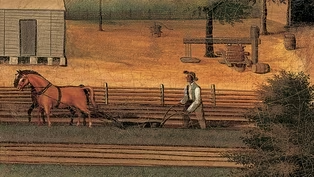
"Unnamed Figures" at the American Folk Art Museum
Clip: S2024 Ep602 | 6m 55s | "Unnamed Figures: Black Presence and Absence in the Early American North" at AFAM. (6m 55s)
Providing Support for PBS.org
Learn Moreabout PBS online sponsorship

- Arts and Music
The Best of the Joy of Painting with Bob Ross
A pop icon, Bob Ross offers soothing words of wisdom as he paints captivating landscapes.











Support for PBS provided by:
NYC-ARTS is a local public television program presented by THIRTEEN PBS
Major funding for NYC-ARTS is made possible by The Thea Petschek Iervolino Foundation, Jody and John Arnhold, The Lewis “Sonny” Turner Fund for Dance, The Ambrose Monell Foundation, Elise Jaffe...