NYC-ARTS
NYC-ARTS Full Episode: July 13, 2023
Season 2023 Episode 588 | 27m 46sVideo has Closed Captions
NYC-Arts talks with photographer Joel Meyerowitz and a look at "Material Witness" at AFAM.
NYC-ARTS talks with renowned photographer Joel Meyerowitz about his long career and continuing love for his art form. A visit to the American Folk Art Museum for "Material Witness: Folk and Self-Taught Artists at Work," which explores how artists gravitate toward certain media and methods.
Problems playing video? | Closed Captioning Feedback
Problems playing video? | Closed Captioning Feedback
NYC-ARTS is a local public television program presented by THIRTEEN PBS
Major funding for NYC-ARTS is made possible by The Thea Petschek Iervolino Foundation, Jody and John Arnhold, The Lewis “Sonny” Turner Fund for Dance, The Ambrose Monell Foundation, Elise Jaffe...
NYC-ARTS
NYC-ARTS Full Episode: July 13, 2023
Season 2023 Episode 588 | 27m 46sVideo has Closed Captions
NYC-ARTS talks with renowned photographer Joel Meyerowitz about his long career and continuing love for his art form. A visit to the American Folk Art Museum for "Material Witness: Folk and Self-Taught Artists at Work," which explores how artists gravitate toward certain media and methods.
Problems playing video? | Closed Captioning Feedback
How to Watch NYC-ARTS
NYC-ARTS is available to stream on pbs.org and the free PBS App, available on iPhone, Apple TV, Android TV, Android smartphones, Amazon Fire TV, Amazon Fire Tablet, Roku, Samsung Smart TV, and Vizio.
Providing Support for PBS.org
Learn Moreabout PBS online sponsorshipPZ: Coming Up on NYC-ARTS... a profile of renowned photographer Joel Meyerowitz, a vibrant presence in the art world since the 1960s... Joel Meyerowitz: I remember walking through Paris and suddenly you smell baking croissants on the air, butter and sugar.
Ah!
And you immediately you want a croissant or a cookie or something, right?
And then you take two steps and it's gone.
To me that's what photography is.
You walk along the street and something happens and you get it.
It is a visual that is as precise as that fragrance that is only in the air of the doorway.
PZ:...a visit to the American Folk Art Museum and the exhibition "Material Witness: Folk and Self Taught Arts at Work"... Brooke Wyatt: "Material Witness" focuses on of course the materials and the substances like clay, wood, rock, stone, metal that artists work with to make the objects that are in this museum's collection.
FUNDING FOR NYC-ARTS IS MADE POSSIBLE BY THEA PETSCHEK IERVOLINO FOUNDATION JODY AND JOHN ARNHOLD THE LEWIS "SONNY" TURNER FUND FOR DANCE THE AMBROSE MONELL FOUNDATION ELISE JAFFE AND JEFFREY BROWN CHARLES AND VALERIE DIKER THE MILTON AND SALLY AVERY ARTS FOUNDATION THE NANCY SIDEWATER FOUNDATION ELROY AND TERRY KRUMHOLZ FOUNDATION AND ELLEN AND JAMES S. MARCUS THIS PROGRAM IS SUPPORTED, IN PART, BY PUBLIC FUNDS FROM THE NEW YORK CITY DEPARTMENT OF CULTURAL AFFAIRS IN PARTNERSHIP WITH THE CITY COUNCIL ADDITIONAL FUNDING PROVIDED BY MEMBERS OF THIRTEEN.
PZ: Good evening and welcome to NYC-ARTS.
I'm Paula Zahn on location at El Museo del Barrio at Fifth Avenue and 104th Street.
It is the nation's oldest museum dedicated to preserving the art and culture of Puerto Ricans and all Latin Americans in the United States.
Having celebrated its 50th anniversary in 2019, it was a historic milestone for an institution that started in a classroom and is now at the top of New York City's Museum Mile.
During the spring of 1969, a collective of Black and Puerto Rican parents, teachers and activists in Central and East Harlem got together to speak out about the needs of the community and their families.
They demanded from their school district more study materials and lessons that reflected the students' racial and cultural backgrounds.
Raphael Montanez Ortiz, a local artist and high school teacher, took the lead and created materials for schools on Puerto Rican art and history.
But instead of just making a few posters or worksheets, Ortiz re-imagined the project and founded what is now known as El Museo del Barrio.
The name of the museum translates to "the museum of the neighborhood," a nod to the fact that it would be "of and for the people of East Harlem," also known as "El Barrio."
By introducing young people to this cultural heritage - with special programs and events - often bi-lingual -- El Museo is creating the next generation of museum-goers, while satisfying the growing interest in Caribbean and Latin American art by a broad national and international audience.
Currently on view is "Something Beautiful: Reframing the Coleccion," one of the museum's most ambitious presentations in more than two decades.
It features over 500 artworks, including new acquisitions and artist commissions, with the displays rotating over the course of a year.
Artists Maria Gaspar and Glendalys Medina were commissioned to create new works reflecting and responding to the exhibition.
Gaspar's Force of Things includes a new body of work that marks the demolition of the largest single-site jail in the country - Cook County Department of Corrections.
The exhibition responds to the violent conditions of incarceration with artwork that examines what is often unseen and invisible.
It was created from debris salvaged from the actual site.
Medina's work invites viewers into a ceremony that is the spiritual center of Taino life.
As a Nuyorican artist based in East Harlem, Medina has repeatedly returned to show how knowledge is shared and remixed, and how changes in social structures can empower individuals.
Other artists who are in the spotlight of this exhibition include Papa Colo, Antonio Lopez, Jorge Soto Sanchez, and Myrna Baez.
Best known for his groundbreaking fashion illustrations, Antonio Lopez took thousands of snapshots of models and friends that speak to the closeness he developed with his subjects.
He made these images with an Instamatic, an inexpensive Kodak camera, and arranged them into the storyboard-like grids seen here.
The set on this wall is from a trip that Lopez and his life partner Juan Ramos took to their native Puerto Rico in 1974 on assignment from Interview magazine.
From studies in Madrid and New York, Myrna Baez created a unique artistic language with references to tropical landscapes as well the rapid pace of the modern world.
Groundbreaking experimentation was key to her practice.
The works on view show her masterful command of and playful approach to a range of mediums, whether experimenting with sprayed acrylic of collaged texts or as collaged textures.
They can be understood as visual allegories as well as portraits of a place or a person.
On tonight's program we'll meet renowned photographer Joel Meyerowitz - a vibrant presence in the art world.
He grew up in the Bronx and graduated with a degree in painting from Ohio State University in 1959.
He began taking photographs a few years later.
Although he has focused on a variety of themes throughout his career, he is perhaps best known as a street photographer, in the tradition of such masters as Henri Cartier-Bresson and Robert Frank.
He has also been instrumental in advancing the recognition of color photography as an art form.
In the wake of 9/11, Meyerowitz was the only photographer to be given unrestricted access to Ground Zero.
The dramatic images that he captured there have become the foundation of a major national archive.
An exhibition of selected photographs from this collection has been shown all over the world.
His work can be found in museums and public collections including the Met, MoMA, and the Whitne y. NYC-ARTS spoke with Meyerowitz during a visit to the Howard Greenberg Gallery.
Joel Meyerowitz: When you first pick up a camera, it's not so easy to go out on the street and take pictures of strangers, because there's always a little bit of fear, I don't belong here, or they're not gonna like it if I take a picture... How can I be in their intimate space?
So in a way it's like dance, it's very balletic, you have to find these partners, who don't really know that you're photographing them, while you move in and out of their lives and make photographs for yourself that use their face, their energy, their posture, their figure, their dress, their color, whatever it is that excites you at the moment.
My father was a really street smart guy, born in New York City, kind of tough guy on the streets.
And when I was a little kid, he often said to me, when I would go with him anywhere, he would he would just give me a little nudge and say: "watch that over there!"
or "take a look at that!"
And every time he said "look at that!"
something happened.
It's as if he could predict that two people were going to embrace, you know, and dance around each other, and throw up their arm...
I mean, how did he know?
And in a way, I'm sure that he created an appetite in me for the unexpected qualities of ordinary life, that people will do spontaneous, extraordinary, you know, unexpected things suddenly.
And if you were quick enough to watch it, you would experience pleasure, visual pleasure, human pleasure.
I've been asked so many times: "how do you know when to take a photograph?"
And I I remember walking through Paris, and just walking down the street, and suddenly you smell baking croissant on the air, butter and sugar, and you, oh, and you immediately, you want, you want a croissant or a cookie or something right?
And then you take two steps, it's gone!
So in the air, on the street, was this little zone, for a moment, where the fragrance was so rich and compelling... To me that's what photography is: you walk along the street and something happens, and you get it, it's a visual that is as precise as that fragrance that is only in the air of the doorway.
You go right through it.
So when something makes itself felt to me, when I get an impulse, I raise the camera.
I don't even hesitate.
It has to be like that, that's photography, it's about a fraction of a second...
So I think, impulse, intuition, recognition, desire, passion, appetite... -- name it... you can call it anything you want!
-- those are the things that are in play, photographically, because photography is about time.
Cameras have their own characteristics.
A small camera that fits in your hand, you know, you just move it around and you carry it with you put in your pocket in your bag it's it's part of you.
But sometimes that small camera doesn't really do the job you wanted to do if you're finding yourself in nature let's say.
Nature is slower, there's more time in it... Like if the street photography is jazz... *jazz sounds* ... the view camera and nature is like the cello, it's very slow, and you you you stand in nature and you can look around and draw your energy from everything out there.
And so a large format camera, like an 8 by 10 inch Deardorff camera, gives you a whole other experience.
It's slower, you put it down, you put the cloth over your head, and you enter this world on a screen, upside down, and it has a whole other kind of magic to it.
And you can trust that it will describe every single thing in the frame: there'll be no blur, there will be no movement.
It'll be the space and light and depth, you know, this time...
The question often comes up: how does one develop a body of work?
How do you find your way into a new theme or a new subject?
Sometimes it takes time and then the artist recognizes: "oh, I've been making that picture a few different a few different times now!"
Obviously something interesting there, more so than I thought!
And this happened to me with the work that's called 'Between the Dog and the Wolf' or in the French expression Entre chien et loup... And I didn't know that expression, but many years ago a French friend of mine, upon seeing a sequence of these pictures made at the end of the day, when the light is fading and things become slightly more indeterminate, these images appeared in my work and I showed them to my friend and my friend said: "oh, Entre chien et loup."
And I said: "what?
what's that?"
He said: "you know, the dog, between the dog and the wolf..." He said: "you know, the dog is the familiar, you know, domestic animal, and the wolf is the same, sort of, but it's unknown, it's unexplained, it's savage," he said, "so when things go from the known to the unknown, there's a shift, an emotional shift, as well as a tonal shift..." And I thought, "oh, Daniel, that's beautiful!"
I love that expression, because I find myself often, as a swimmer, in a pool, which is the dog, it's very safe...
But I also would swim in the ocean, miles out in the open ocean, and the open ocean...
It's wild and I had been making photographs of pools near the sea and I thought, what an interesting way of addressing this subject, to put the pools and and the ocean and the dusk hour together really was a way of concentrating on on Entre chien et loup...
But beyond that, there are also just places on land where the light is fading and you suddenly have... you feel goosebumps or you feel a little bit of a shiver of uncertainty that alerts your senses.
And you think...
I think... "Ah, what's going on here?"
And and out of that comes the possibility for a new photograph.
At this moment in my life I find myself making still lifes.
I have no idea why I'm choosing these objects, but they have character, or mystery, or something and when I put two or three or four of them together, it's as if there's a dialogue between them.
Maybe I can breathe life into them by finding some associative qualities in them that doesn't look like conventional still life photography, but looks like I'm making it.
Maybe I could find out more about myself through these dumb objects.
This is a really engaging photographic question for someone at my age right now.
When I started to make still lifes, it happened quite by accident, because I was doing a book commission in France and I visited Cezanne's studio in Aix-en-Provence and in the studio I was amazed that the walls were painted this particular gray and after a while the thought about this gray -- "why gray, when he was a painter who made color paintings?"
-- it prompted me to go back to the studio and ask them if I could take Cezanne's objects down and put them on his table to photograph them.
And really I wasn't trying to make art, I have to be clear.
I was just taking the the objects, putting them on the table against the grey wall, I wanted to see what the relationship was between the object and the space, the color space of the grey wall, and what did it do for Cezanne, who played one of the most important turning point roles in the history of modern art?
And then once once I did that, and I'm living in Italy now, it occurred to me: "Oh, Giorgio Morandi is in Bologna...
It's only three hours away.
I'm gonna go Bologna and go to Morandi's studio... Because Morandi was also very important to me when I was an art history student and a painter, so I went to Morandi's studio and the same thing happened and I was able to ask the curators there if I could take his objects and do the same thing as the the color was completely different: he was working in a very warm tone, kind of golden, Tuscan, colorful Italian environment.
And Cezanne was in a very cool, sort of more rational French environment.
So to pit these two against each other and to look at their objects, in a way introduced me to the feeling that: "Oh, each object does have character or identity, persona... something," you know.
And and perhaps I was having a dialogue with these men, through their objects...
So in a way working with with Cezanne and Morandi in this very basic way, introduced me to an appetite for reconsidering the way objects relate to each other in space.
Where it goes from there, I don't know.
I'm grateful for the energy I have right now and the willingness to take on something totally outside of my experience and see if I can find my voice in this time of my life with these objects in this medium I love so much as I love photography.
For more information on cultural events in our area, please sign up for our free weekly email at "NYC dash ARTS, dot org, slash e-mail."
Top Five Picks will keep you up to date all year round.
And be sure to connect with NYC-ARTS on Facebook, Instagram and Twitter.
Next a visit to the American Folk Art Museum located across the street from Lincoln Center.
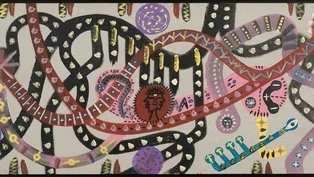
Included in their extensive permanent collection are multiple works by the contemporary artist Lonnie Holley.
Based in Atlanta, Holley is known for his sculptures made with recycled and found objects.
He is also known for his acclaimed career as a musician.
Curator Brooke Wyatt spoke with NYC-ARTS about Holley's work as presented in the museum's exhibition "Material Witness: Folk and Self-Taught I'm Brooke Wyatt, and I'm the Luce Assistant Curator at the American Folk Art Museum.
This is "Material Witness: Folk and Self-Taught Artists at Work."
"Material Witness" focuses on, of course, the materials and the substances like clay, wood, rock, stone, metal, that artists work with to make the objects that are in this museum's collection.
Lonnie Holley is working in Atlanta, currently making large scale paintings and sculptures, and he is also a sound artist and musician.
In that work, he's very collaborative working with other artists.
For "Material Witness" I wanted to highlight how Lonnie Holley collaborates with materials that he uses.
The sculpture on view here is called "Cleaning Up After the Games.
Holley has manipulated wire to create these silhouette forms that repeat throughout the piece, and put those together with a plethora of found objects.
Upon closer inspection, you can identify a metal dust pan, a plastic bottle, some plastic cutlery, all manner of fiber and fabric, pieces of artificial flowers or greenery worked together to create this form and space.
Lonnie Holley's transformed, you know, what some people would consider trash into a work of art that has its own kind of life and then invites viewers to interact with it in space.
It was exciting to show also a painting of Lonnie Holley's that dates from 1991.
It's not a painting where you see those silhouette forms that Holley returns to so much.
But you do see the way the artist has applied paint to this composite or plywood surface, and I see it as very sculptural, the way that he moves around the picture plane in terms of the composition and his use of color and form.
I wanted to think about a relationship between Lonnie Holley working in paint, Lonnie Holley working with sculpture and found objects because crossing those different domains is so fundamental to his process.
Next week on NYC-Arts a visit to the Parrish Art Museum on the East End of Long Island for a look at the work of American Impressionist painter, William Merritt Chase... Alicia Longwell: William Merrit Chase had a long and rich relationship to the East End of Long Island.
You might even say that he staked his claim to this landscape early on and that he saw more possibilities in it than the untutored eye.
a trip to the Brooklyn Museum and its Arts of China Galleries which represent 5,000 years of artistic accomplishment... Joan Cummins: The Arts of China Gallery is set up roughly chronologically with the earliest material at one end and the later material at the other end.
But there is in fact a sprinkling of contemporary art throughout the galleries.
and a close look at the sculpture of Augustus Saint-Gaudens in the American Wing of the Met.
Thayer Tolles: I'm here today to talk about Augustus Saint-Gaudens who is arguably the greatest American sculptor of the late 19th century.
The Metropolitan has 50 works by Saint-Gaudens and we're very fortunate to be able to present his work in such a comprehensive way.
I hope you enjoyed our program tonight.
I'm Paula Zahn on location at El Museo del Barrio.
Thanks so much for joining us.
Good night.
To enjoy more of your favorite segments on NYC-Arts visit our website at nyc-arts.org.
WENDY WHELAN: CLASSICAL AND MODERN DANCE ARE EXTREMELY DIFFERENT, AND I HAVE SO MUCH MORE TO LEARN BEFORE I CAN REALLY ARTICULATE THE DIFFERENCES.
SHELDON HARNICK: AND WHEN I LISTEN TO YIP HARBURG'S LYRICS IN THAT, I SUDDENLY THOUGHT THAT'S WHAT I WANT TO DO WITH MY LIFE.
GREGORY CREWDSON: MY PICTURES RESIDES IN VERY INTIMATE, VERY PRIVATE MOMENTS.
VIJAY IYER: MY PRIMARY WAY OF PLAYING PIANO IS BY IMPROVISING.
ALICE GREENWALD: YOU ARE IN SOME RESPECTS ON SACRED GROUND.
DEE DEE BRIDGEWATER: A WOMAN CAME TO SEE ME PERFORM AND SAID HOW WOULD YOU LIKE TO PLAY BILLIE HOLIDAY?
JODI HAUPTMAN: I THINK ONE OF THE ESSENTIAL THINGS WE LEARNED IS THAT MATISSE USED PENS TO COMPOSE HIS WORK.
RENEE FLEMING: VIEWERS ARE SURPRISED WHEN YOU'RE DOING A PIECE 100 YEARS AGO AND THINK OH MY GOSH THIS COULD BE NOW.
ANNE UMLAND: THE CARDBOARD GUITAR IS THE VERY FIRST OF THAT MOMENT OF REALIZATION.
IVO VAN HOVE: SUDDENLY YOU COME AND PRESENT SOMETHING AND GET APPLAUSE.
GREAT.
YOU KNOW?
♪♪♪ ♪♪♪ FUNDING FOR NYC-ARTS IS MADE POSSIBLE BY THEA PETSCHEK IERVOLINO FOUNDATION JODY AND JOHN ARNHOLD THE LEWIS "SONNY" TURNER FUND FOR DANCE THE AMBROSE MONELL FOUNDATION ELISE JAFFE AND JEFFREY BROWN CHARLES AND VALERIE DIKER THE MILTON AND SALLY AVERY ARTS FOUNDATION THE NANCY SIDEWATER FOUNDATION ELROY AND TERRY KRUMHOLZ FOUNDATION AND ELLEN AND JAMES S. MARCUS THIS PROGRAM IS SUPPORTED, IN PART, BY PUBLIC FUNDS FROM THE NEW YORK CITY DEPARTMENT OF CULTURAL AFFAIRS IN PARTNERSHIP WITH THE CITY COUNCIL.
ADDITIONAL FUNDING PROVIDED BY MEMBERS OF THIRTEEN.
Lonnie Holley at the American Folk Art Museum
Video has Closed Captions
Clip: S2023 Ep588 | 3m 34s | A visit to "Material Witness: Folk and Self-Taught Artists at Work" at AFAM. (3m 34s)
Providing Support for PBS.org
Learn Moreabout PBS online sponsorship













Support for PBS provided by:
NYC-ARTS is a local public television program presented by THIRTEEN PBS
Major funding for NYC-ARTS is made possible by The Thea Petschek Iervolino Foundation, Jody and John Arnhold, The Lewis “Sonny” Turner Fund for Dance, The Ambrose Monell Foundation, Elise Jaffe...