NYC-ARTS
NYC-ARTS Full Episode: March 14, 2024
Season 2024 Episode 607 | 27m 47sVideo has Closed Captions
A look at “Sonia Delaunay: Living Art” and a profile of the Isidore String Quartet.
A look at the exhibition “Sonia Delaunay: Living Art” on view at the Bard Graduate Center. Comprised of nearly 200 objects, the exhibition reveals Sonia Delaunay’s masterful use of color in multiple mediums. Then profile of the Isidore String Quartet, winner of a 2023 Avery Fisher Career Grant Award. Founded in 2019, their goal is to rediscover and reinvigorate the repertory for chamber music.
Problems playing video? | Closed Captioning Feedback
Problems playing video? | Closed Captioning Feedback
NYC-ARTS is a local public television program presented by THIRTEEN PBS
Major funding for NYC-ARTS is made possible by The Thea Petschek Iervolino Foundation, Jody and John Arnhold, The Lewis “Sonny” Turner Fund for Dance, The Ambrose Monell Foundation, Elise Jaffe...
NYC-ARTS
NYC-ARTS Full Episode: March 14, 2024
Season 2024 Episode 607 | 27m 47sVideo has Closed Captions
A look at the exhibition “Sonia Delaunay: Living Art” on view at the Bard Graduate Center. Comprised of nearly 200 objects, the exhibition reveals Sonia Delaunay’s masterful use of color in multiple mediums. Then profile of the Isidore String Quartet, winner of a 2023 Avery Fisher Career Grant Award. Founded in 2019, their goal is to rediscover and reinvigorate the repertory for chamber music.
Problems playing video? | Closed Captioning Feedback
How to Watch NYC-ARTS
NYC-ARTS is available to stream on pbs.org and the free PBS App, available on iPhone, Apple TV, Android TV, Android smartphones, Amazon Fire TV, Amazon Fire Tablet, Roku, Samsung Smart TV, and Vizio.
Providing Support for PBS.org
Learn Moreabout PBS online sponsorship♪ >> Coming up on NYC-Arts.
A visit to the Bard Graduate Center Gallery for a look at the exhibition Sonia Delaunay: Living Art, which reveals the artist's masterful use of color in multiple mediums.
Laura: The star of the first this floor is the Simultaneous Dress, and this was a garment that was made by Sonia herself in 1913.
You can see that it is made of a patchwork of different fabrics, hand sewn by Sonia.
It was not made according to any principles of dressmaking, but rather according to principles of color theory.
>> And a profile of the Isidore String Quartet, recipient of a 2023 Avery Fisher Career Grant Award.
Devin: Chamber music is, is really our vessel for the way we want to impact the world.
Adrian: We really take a lot of I pride in bringing the same amount of focus that we would bring to a Beethoven quartet to any number of kind of contemporary works that we really feel kind of deserves its voice.
Phoenix: Because a quartet is four individuals acting as one, as one organism, it's very important to truly connect with one another to be able to almost read each other's minds, read each other's body language.
One >> Funding for NYC-Arts is made possible by: Thea Petschek Iervolino Foundation.
Jody and John Arnhold.
The Lewis Sonny Turner Fund for Dance.
The Ambrose Monell Foundation.
Elise Jaffe and Jeffrey Brown.
Charles and Valerie Diker.
The Milton and Sally Avery Arts Foundation.
Elroy and Terry Krumholz Foundation.
The Nancy Widewater Foundation.
And Ellen and James S. Marcus.
This programs This program is supported in part by public funds from the New York City Department of Cultural Affairs in partnership with the city council.
Galleries Additional funding provided by members of Thirteen and by Swann Auction Galleries.
We have a different way of looking at auctions, offering vintage books and fine art since 1941.
Working to combine knowledge with accessibility, whether you are a lifelong collector or a first-time buyer, or looking to sell.
Information at SwannGalleries.com.
>> Good evening and welcome to NYC-ARTS.
I'm Philippe de Montebello on location at ICP -- the -- with a little bit of a cold that compromises my voice.
The international Center of photography.
now in its new home on Essex Street on the Lower East Side.
Here its museum and school are combined under one roof, making it a dynamic cultural center that offers exhibitions and programs in all aspects of photography and digital media.
ICP was founded in 1974 by photographer Cornell Capa to champion the legacy of Concerned Photography.
Socially and politically minded images that are capable of generating change.
This year, ICP celebrates its 50th anniversary with the exhibition ICP at 50: From the Collection, 1845-2019.
On view are over 170 works that span nearly 175 years of photography.
Included here is the work of such pivotal photographers as Ansel Adams, Jacob Riis, Gordon Parks, Ruth Orkin, and the war photography of Cornell Capa's brother, Robert Capa.
Also notable are historically significant images of the 20th century.
These include a photo taken of the surface of the moon by NASA in 1966, and a photo by Cornell Capa of the young presidential candidate John F. Kennedy on the campaign trail.
ICP at 50 also takes visitors back in time to the earliest forms of photography.
In 1839, a new photographic youIn 1839, a new photographic technology -- the daguerreotype -- was announced in Paris.
Is exposing These images were made by exposing a prepared over copper plate for up to 20 or 30 minutes and then developing it over hot mercury.
His Given the polished plate very support, these photographs have a distinctive reflective appearance.
Primarily used for making portraits, the daguerreotype provided a way for individuals to record and present themselves, their family, style, and character in a newly accessible way.
As technology progressed in the mid-19th century, new techniques became less expensive and easier to produce.
Ambrotypes were printed on a translucent glass plate, which revealed the image when placed against a dark backing.
As both processes were very is fragile, the resulting photographs were difficult to send to friends and family through the mail, and were almost exclusively housed in protective, decorative cases.
A popular format for portraits in the mid-19th century was the carte de visite, literally is translated as visiting card.
They generally consisted of an albumen silver print mounted to so a thick card and then printed or embossed with logos or other details about the photographic studio.
In addition to prints of friends and family, people also collected cartes de visite featuring photographs of historic figures such as Queen Victoria, Abraham Lincoln, and abolitionist Sojourner Truth, whose carte de visite is on view here.
By holding and selling these cards, she supported her own work, demonstrating control of her image, when many Black Americans would likely never to be photographed during their lifetime.
Around 1870, the cabinet card, a larger version of the carte de visite was introduced.
You These often included even more elaborate studio embossing and other branding, colored cards, and embellished edges.
Over time inventors patented new cameras with multiple lenses so is that a sheet with many of these small portraits could be easily printed and then cut apart.
These These miniature portraits quickly replaced calling cards and found a place in specially crafted photo albums, the very first of their kind.
On our program tonight a look at program the exhibition Sonia Delaunay: Living Art on view at the Bard Graduate Center on West for 86th Street.
Delaunay was born in Odesa, Ukraine.
At the age of 20 she moved to Paris which marked the beginning 20 euros you of her diverse artistic career.
Comprised of nearly 200 objects, the exhibition reveals Delaunay's masterful use of color in multiple mediums, from paintings to playing cards and furniture to fashion.
Many of the works have never been exhibited or are on view for the first time in the United wrong States.
This includes rare couture is garments, exquisitely crafted rare furniture that Delaunay designed for her Paris apartment, and a tapestry is commissioned by the government of France.
The exhibition illuminates Delaunay's embrace of new media and how she broadened the definitions of both fine and decorative arts.
Curator Laura Microulis is our guide.
Laura: I am Laura Microulis, Research Curator at the Bard Graduate Center, and one of the two curators of the Sonia Delaunay: Living Art exhibition.
The artist known as Sonia Delaunay was born Sarah Shtern on November 14th, 1885 in the city of Odessa.
She was born into a Jewish she family of modest means, but actually spent the majority of her childhood with her wealthy maternal aunt and uncle living in St. Petersburg.
After studying painting in is Germany she moved to Paris in 1906, and there she became part of a vibrant artistic community of painters, writers, and musicians.
Shortly thereafter, she met and eventually married the painter, seen Robert Delaunay, and together the two of them would come to form one of the most remarkable artistic partnerships of the 20th century.
This exhibition examines Sonia as Delaunay's multidisciplinary approach to creation and looks at her overlapping roles of artist, designer, maker, and entrepreneur.
Part We particularly focus on her production of the applied or decorative arts.
This was a significant aspect of her practice from as early as 1911.
Simultanism is Robert and Sonia Delaunay's contribution to abstraction based on pseudoscientific color theories .
Simultanism became so central to both Sonia and Robert Delaunay, that they trademarked the word simultaneous in 1925, so it became sort of a brand for them.
So the star of the first floor is the Simultaneous Dress, and this was a garment that was made by Sonia herself in 1913.
You can see that it is made of a patchwork of different fabrics, hand sewn by Sonia.
And what is really interesting about this dress is that it was not made according to any principles of dressmaking, but rather according to principles of color theory.
Sonia made the garment as she would've made an abstract painting.
This is the first time that these textiles have been displayed in a Sonia Delaunay exhibition.
And what's significant about the gift that Sonia made to the Musee de Tissus, is that this particular museum is located in Lyon.
It was a strategic donation in the sense that she wanted her printed silks to be part of the storied history of French silk production.
And she opted to print her textiles by hand using wood blocks, in order to maintain the original integrity of her gouache designs.
This was very time consuming and labor intensive, but produced a product that was uniquely hers.
Sonia Delaunay's engagement with costume design began in 1918 when she was asked to redesign the costumes for the Ballets Russes' production of Cleopatra.
This particular portrait was painted by Flora Lion.
She has really captured the wonderful detail of the costumes, the bright rainbow-colored sash, the beautiful pearl embellishments, and the glimmering applique ornament.
During the last two decades of Sonia Delaunay's life, she experimented with Simultanism in new mediums like mosaic, stained glass, and tapestry.
This wool tapestry is one of four commissioned by the French state.
It is a wonderful fusion of Delaunay's colorful disc motifs executed in woven wool.
Sonia Deluanay had a love for modernity and for marketing, and her car projects represent both.
In 1967, Sonia was asked to create a paint scheme for the exterior of a Matra 530 sports car.
This time she worked with color fields taking care so once in motion the colors would blend into a beautiful blue.
So, according to her, as to not distract other drivers.
For Sonia Delaunay, there was no hierarchy between the fine and the decorative arts.
Simultanism was a lifestyle.
Sonia and Robert they lived it, they breathed it.
It was their way of creation.
This, in a sense, was her way of almost doubling down on her making of objects.
She showed not only art critics, but the entire art world that she was serious about this aspect of her production.
>> Next on our program we'll celebrate the 2023 Avery Fisher career Grant awards.
This year the ceremony took place in March at the Jerome L. Greene Performance Space at WQXR.
These individual grants of $25,000 give professional assistance and recognition to talented instrumentalists who have great potential for major careers in classical music.
In 2023, there were five recipients: double bassist Nina Bernat, guitarist Bokyung Byun, flutist Emi Ferguson, pianist Evren Ozel, as well as the Isidore String Quartet.
Members of the Quartet are Adrian Steele, Phoenix Avalon, Devin Moore, and Joshua McClendon.
Founded in 2019, their goal is to rediscover and reinvigorate the repertory for chamber music.
>> We started Devon was at the school of music at the time but we often had reading parties.
We would read chamber music together.
We love playing with each other so Devon decided to transfer to Julliard.
So we formed at Julliard.
A reading something that -- reading party is something we love to do as musicians.
And mostly as a party but we love to bring instruments and read through lots of chamber music.
No one has practiced anything.
The point is to mess up and to poke fun at each other and have a good time with it.
.
That has been the culture around a lot of festivals and around Julliard.
>> Chamber music for me is the sector of this artform I felt I could express myself as much as possible to other people.
Especially going to Conservatory, Julliard, those environments have so many opportunities to figure out how to do everything we need to know how to do.
Be a soloist, orchestral playing.
When the opportunity arose to pursue a more serious quartet, and start to study together, get into the music, it was something I could not pass up.
I can speak for all of us saying chamber music is our vessel for the way we want to impact the world.
Adrian: We really take a lot of pride in bringing the same amount of focus that we would bring to a Beethoven Quartet, to a Billy Child's quartet, or any number of kind of contemporary works that we really feel kind of deserves its voice.
And a lot of people who come to classical concerts, especially chamber music concerts, aren't necessarily interested in hearing what contemporary composers, even not too contemporary, like 20th century composers, have to offer.
And I think we really take a lot of pride in the fact that we give just as much attention to that part of the repertoire.
Joshua: Our biggest influences as a group so far have been some of our coaches from Juilliard.
We worked extensively with Lori Smukler, Joel Krosnick, and Roger Tapping.
Joel was the first person, for me, who made a career in chamber music seem like something that was attainable.
His encouragement for going beyond the concert hall within our school environment.
I was very much used to just playing a concert or two in chamber music, you know, each semester in school.
But Joel sort of always was thinking beyond that from the very beginnings and was very inspiring for us to apply to Banff competition, really steering us in a more career-oriented direction and breaking outside of the sort of student atmosphere.
Phoenix: Because a quartet is four individuals acting as one, as one organism, it's very important to be able to truly connect with one another, to be able to feel the space together, to be able to almost read each other's minds, read each other's body language.
Devin: We just played Brahms second string quartet in a minor Opus 51, which is a staple in the string quartet repertoire.
It was one of the pieces that we had prepared for Banff, the Banff competition, but more importantly, it was the last piece that we got a chance to work on with Roger Tapping, who unfortunately passed away.
He was the violist of the Takács Quartet and most recently the Juilliard String Quartet and just such a formative light in the chamber music world.
Is Without him, we would not be sitting here at all.
So getting a chance to play that Brahms and to share that music is sort of like an homage to Roger and everything that he stood for.
Joshua: Brahms really showcases wrong his mastery of juxtaposing .
various emotions and types of dances in this case.
So The fourth movement of this work is really based on quite an what upbeat, rustic, sort of, almost hefty sort of dance.
It's a joy to work on.
Devin: We're unbelievably grateful to receive this Avery Fisher Career Grant.
You know it's this thing that you hear about as, especially as a musician in New York, across the street from Lincoln Center.
And so getting that call was on a list of many dreams.
As a group, we sat down and said, you know, what type of impact do we want to have on the world?
Part of our mission statement is to treat the quartet like a playground.
And so with this grant, we're taking the opportunity to create what we call, in the early stages of, the Playground Festival.
Essentially, it's going to be a space that is curated for the type of experiences that we want to present where people can experience visual arts and movement and chamber music, and I guess you would call it an unorthodox space.
And it's going to be a little trial run to see what we can do with the resources and how serious we can be about not being so serious.
♪ ♪ >> I hope you enjoyed our program tonight.
Good night and see you next time.
Next week on NYC-ARTS, a profile of Hildreth Meière, one of the most renowned American muralists of the 20th century, whose modern approach broke away from traditional practice.
Anna: She pioneered a modern approach to murals, and blended influences such as early Byzantine mosaic, Egyptian wall painting, classical Greek vase painting, and native American beadwork.
She really incorporated vibrant color, scale, and ornamental style, which were all elements that really became synonymous with art Deco designs.
>> And a trip to the Metropolitan Museum and Art of Native America: The Charles and Valerie Diker Collection.
>> Native American art is foundational to our cultural heritage.
Exhibitions like this are meant to move people outside of that idea that all Native peoples are the same, homogeneous.
They were not at any time and they're certainly not today.
♪ Funding for NYC-Arts is made possible by: Thea Petschek Iervolino Foundation.
Jody and John Arnhold.
The Lewis Sonny Turner Fund for Dance.
The Ambrose Monell Foundation.
Elise Jaffe and Jeffrey Brown.
Charles and Valerie Diker.
The Milton and Sally Avery Arts Foundation.
Elroy and Terry Krumholz Foundation.
The Nancy Widewater Foundation.
And Ellen and James S. Marcus.
This program in part by public funds from the New York City Department of cultural affairs in partnership with the city Council.
Additional funding provided by members of 13 and by Swann auction galleries.
We have a different way of looking at auctions, offering vintage books and fine art since 1941.
Working to combine knowledge with accessibility, whether you are a lifelong collector or a first-time buyer, or looking to sell.
Information at SwannGalleries.com.
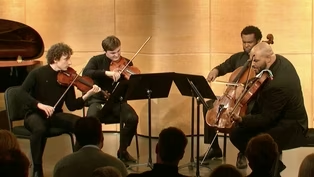
Avery Fisher Career Grant Award: Isidore String Quartet
Clip: S2024 Ep607 | 10m 21s | A profile of the Isidore String Quartet, winner of a 2023 Avery Fisher Career Grant Award. (10m 21s)
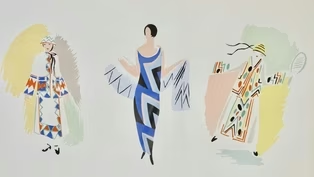
"Sonia Delaunay: Living Art" at Bard Graduate Center
Clip: S2024 Ep607 | 7m 33s | A look at the exhibition “Sonia Delaunay: Living Art” on view at the Bard Graduate Center. (7m 33s)
Providing Support for PBS.org
Learn Moreabout PBS online sponsorship
- Arts and Music
The Best of the Joy of Painting with Bob Ross
A pop icon, Bob Ross offers soothing words of wisdom as he paints captivating landscapes.














Support for PBS provided by:
NYC-ARTS is a local public television program presented by THIRTEEN PBS
Major funding for NYC-ARTS is made possible by The Thea Petschek Iervolino Foundation, Jody and John Arnhold, The Lewis “Sonny” Turner Fund for Dance, The Ambrose Monell Foundation, Elise Jaffe...