NYC-ARTS
NYC-ARTS Full Episode: March 28, 2024
Season 2024 Episode 609 | 27m 47sVideo has Closed Captions
A trip to the Noguchi Museum, "Indian Skies," and a profile of Samuel Zygmuntowicz.
A visit to the Noguchi Museum in Queens to explore the legacy of world-renowned sculptor, Isamu Noguchi. Then a look at the exhibition "Indian Skies: The Howard Hodgkin Collection of Indian Court Painting" on view at The Metropolitan Museum of Art. And a profile of contemporary violin maker Samuel Zygmuntowicz, who demonstrates the delicate process of making an outstanding instrument.
Problems playing video? | Closed Captioning Feedback
Problems playing video? | Closed Captioning Feedback
NYC-ARTS is a local public television program presented by THIRTEEN PBS
Major funding for NYC-ARTS is made possible by The Thea Petschek Iervolino Foundation, Jody and John Arnhold, The Lewis “Sonny” Turner Fund for Dance, The Ambrose Monell Foundation, Elise Jaffe...
NYC-ARTS
NYC-ARTS Full Episode: March 28, 2024
Season 2024 Episode 609 | 27m 47sVideo has Closed Captions
A visit to the Noguchi Museum in Queens to explore the legacy of world-renowned sculptor, Isamu Noguchi. Then a look at the exhibition "Indian Skies: The Howard Hodgkin Collection of Indian Court Painting" on view at The Metropolitan Museum of Art. And a profile of contemporary violin maker Samuel Zygmuntowicz, who demonstrates the delicate process of making an outstanding instrument.
Problems playing video? | Closed Captioning Feedback
How to Watch NYC-ARTS
NYC-ARTS is available to stream on pbs.org and the free PBS App, available on iPhone, Apple TV, Android TV, Android smartphones, Amazon Fire TV, Amazon Fire Tablet, Roku, Samsung Smart TV, and Vizio.
Providing Support for PBS.org
Learn Moreabout PBS online sponsorship♪ Paula Coming up on NYC-ARTS, a trip to the Noguchi Museum in Queens.
>> Noguchi really wanted to change sculpture in a way that made it a force for civic good.
He wanted to make it an active part of our everyday lives.
Paula Then, a look at the exhibition "Indian Skies: The Howard Hodgkin Collection of Indian Court Painting," on view at the Met.
Hodgkin built a collection of 122 Indian court paintings.
Hodgkin's collection includes portraits, palace scenes, royal hunts, religious epics, devotional subjects, and nature studies.
And a profile of a modern-day violin maker who has spent his career creating violins for some of the world's most talented musicians.
Samuel Zygmuntowicz: Every violin I make, I keep really exhaustive records on every aspect about it that I can.
If an instrument of mine comes back and I really like it, I want to make another one like that, I have some record of what I did.
♪ >> Funding for NYC-ARTS is made possible by Thea Petschek Iervolino Foundation, Jody and John Arnhold, The Lewis "Sonny" Turner Fund for Dance, The Ambrose Monell Foundation, Elise Jaffe and Jeffrey Brown, Charles and Valerie Diker, The Milton and Sally Avery Arts Foundation, Elroy and Terry Krumholz Foundation, the Nancy Widewater Foundation, and Ellen and James S. Marcus.
This program is supported, in part, by public funds from the New York City Department of Cultural Affairs in partnership with the City Council.
Additional funding provided by Members of Thirteen and by Swann Auction Galleries.
>> We have a different way of looking at auctions, offering vintage books and fine art since 1941.
Working to combine knowledge with accessibility, whether you are a lifelong collector or a first-time buyer, or looking to sell.
Information at swanngalleries.com.
♪ Paula Good evening and welcome to NYC-ARTS.
I'm Paula Zahn at the New-York Historical Society on Central Park WEst.
It's a place to experience 400 years of history through groundbreaking exhibitions, immersive films, and thought-provoking conversations among renowned historians and public figures.
New-York Historical, the first museum in New York City, was founded in 1804 by a small group of prominent New Yorkers who were conscious of the significance of their time in history.
New York was and still is very much the center of the American experience, and the founders knew that collecting documents and objects would preserve that American story.
Its museum and library holdings include more than 14 million documents, works of art, artifacts, and ephemera that cover four centuries of American history and art.
Included are photographs, furniture, silverware and clothing, and its art collection includes drawings, paintings and sculpture.
It is also the home of the Center for Women's History, the first of its kind within the walls of a museum.
The goal of the Center is to highlight often overlooked stories of women who had an impact on American history.
Currently on view is the exhibition "Women's Work."
It examines how trends in American economic, legal and political history have influenced which jobs, both paid and unpaid, have been performed by women.
It also explores the impact of race, ethnicity, social class, legal status, and sexual orientation.
Women of all social and economic classes participated in trade in 18th-century New York.
One of the documents on view is a tavern license of innholder Mary Dickson from 1762.
Married women might work within family businesses, and unmarried or widowed women supported themselves by trading imported goods or operating small shops.
In the 19th century, increasing numbers of American women entered the literary marketplace.
Because one could write at home and the work was considered "genteel," many women turned to writing for financial support, publishing novels, poems, cookbooks, etiquette guides and articles for periodicals of the day.
On view is an elegant inkstand with pens made of bronze, glass, copper, hair, wood, textile, and gold.
Women also wrote to influence public opinion on subjects such as abolition and feminism.
This beaded pincushion from the late 1800's was made by a woman of Iroquois heritage.
In the latter half of the 19th century, Iroquois bead workers began supplying pincushions, purses, and other keepsakes to the non-Native tourists flocking to Niagara Falls.
Blending Indigenous methods, Western materials, and popular motifs, the bead workers also developed a sophisticated business model in order to meet demand.
This photo from the early 1900's shows students at the Henrietta Industrial School learning millinery skills In the Black -- skills.
In the Black neighborhood of San Juan Hill, today's Lincoln Square, the Charitable Children's Aid Society ran an industrial school that taught vocational skills to young in class people.
Black women faced racial discrimination that limited their employment opportunities to work as domestics.
Shown holding a mortar and pestle, Ann Haviland created signature scents that made her name as a professional perfumer.
In addition to personalized fragrances, Haviland offered room fragrances, gave interviews on the uses of perfume, and ultimately launched a mainstream business.
Haviland marketed herself as an artist, partnering with early film actresses and dispensing lifestyle advice in fashion magazines.
This lantern slide from the late 1920's is also connected to the film industry.
As an actor, Mary Pickford projected an innocent persona, but behind the scenes she was a formidable businesswoman.
She starred in and produced her own films beginning in 1916.
Just a few years later, she pushed back against the control that the studio system placed on actors and co-founded United Artists with D.W. Griffith and Charlie Chaplin.
Another successful businesswoman was Madam CJ Walker.
This entrepreneur, philanthropist and activist who passed away in 1919, was widely thought to be one of the first women to become a self-made millionaire.
Walker created her hair care formulas specifically for African American women and trained thousands of other women to follow her path to financial independence.
She also used her immense fortune to support anti-lynching efforts, the NAACP, and the National Association of Colored Women.
Women's Work is on view through the summer.
On our program tonight, a trip to The Noguchi Museum in Queens.
Founded in 1985 by world-renowned sculptor, Isamu Noguchi, the museum is a culmination of his legacy.
Although he was born in Los Angeles, Noguchi spent most of his childhood in Japan, only returning to the United States for high school and college.
He began sculpting at the age of 18 and early in his career turned to abstraction.
Noguchi's relationship with organic forms and materials sparked a lifelong love of nature and public spaces.
Beyond his stonework, Noguchi is also known for his Akari light sculptures, as well as set designs for the ground-breaking choreographer, Martha Graham.
The museum features Noguchi's classic monolithic sculptures along with drawings, models, and photographs from his fruitful seven-decade career.
♪ Dakin Hart: Noguchi was born in 1904.
He was born in Los Angeles, California.
His mother was an Irish woman from New York.
She was born in Brooklyn.
His father was a traveling poet from Japan.
Noguchi wasn't even named until he was almost three years old.
His mother just called him boy or yo.
His identity was complicated from the very first moment of his birth.
He was biracial, chose to be multicultural his whole life, but at a time when it was much harder.
He enrolled at Columbia in premed.
His mother felt that he was destined for bigger things than being a doctor.
Um, and by that she meant being an artist.
He was a spectacular academic sculpture at nineteen, twenty, and then very quickly realized that he was becoming the poster boy of a passe art form.
He really wanted to, uh, change sculpture in a way that made it a force for civic good.
He wanted to make it a, an active part of our everyday lives.
That's why he never stopped making furniture.
His Akari lamp series.
He made playgrounds, he made playground equipment.
He made sets for theater and dance.
He had long collaborations with people like Martha Graham.
The museum was founded in 1985, but Noguchi had been here for almost 10 years.
He bought a derelict factory building, which is the red brick building behind me, and started using it for storage and staging.
Sculpture is all about physical inconvenience.
Everything is big and heavy and takes up space and requires equipment to deal with.
So sculpturors always need more room.
He decided that in order to encapsulate his perspective or his point of view, his way of thinking of things, um, that the best thing to do was to build an institution.
And so he began to turn his private garden and space into a display space.
When the museum opened, it was seasonal.
When Noguchi would be here himself, you could ring the bell and he'd come down and walk you through.
One of the things that you'll notice when you come to our museum probably right away, is that we don't have wall labels.
We do that, not because Noguchi hated wall labels.
When the museum first opened, there were labels identifying all the sculptures somewhere near them in a kind of traditional museum fashion, gradually he just removed them.
And it's because he wanted your experience of the work to be primary.
The fastest way to kill an artwork is to pretend that you've solved it.
The museum is really about a direct and intimate relationship with these objects and these things, and more importantly, the larger sense of an environment that they create.
They really produce an atmosphere and we're standing in this garden, which isn't even two thirds of an acre.
It is teeny tiny.
It is a postage stamp.
He called the museum an oasis on the edge of a black hole.
The black hole is New York city and the urban maelstrom.
And as small as it is, you come here and you just soak it in and you soak it in through osmosis.
It's like visiting a forest, not like going to the museum.
Maybe Noguchi's most successful sculpture overall are his Akari lanterns.
He called them lanterns rather than lamps because he said he wanted them to be, as moveable as butterflies.
The traditional paper lanterns in Gifu City specifically are made with a particular kind of continuous bamboo ribbing and washi paper that is made with interior bark of a Mulberry tree and it produces a laid paper that's just more durable, more flexible and more resilient than classic laid cotton paper.
"Breakthrough Capestrano" is made out of Japanese basalt.
A basalt column is a single crystal of basalt.
Noguchi worked with harder and harder stones because he wanted the material to resist him.
What he really liked was stones that had already been marked by some process that he would then incorporate into the work.
You can see the lines of drill holes.
Those drill holes were made manually with hand drills, and then they'll push two bamboo wedges into the hole and fill the hole with water.
The bamboo wedges expand enough to crack the stone.
Noguchi loved that and he loved the product of this breaking process.
So he would take these stones , columns, and set them upright, cut off the bottom so that it would stand up and then make his few adjustments to turn them into "sculpture," in air quotes.
"The Well" that's right behind me, this wonderful variation on tsukubai that is a circulating fountain.
The water just cascades out over the stone.
That's another one of those basalt columns just lobbed off with a coring drill, making a hole in it.
Some of these sculptures are eroding, but the trees are growing.
Their relationship to each other is changing constantly over time.
He planted all of the trees.
So the magnificent katsura tree that provides the canopy that dominates the garden, it really was a sprig.
It was a quarter inch sapling, and now you see what that's become.
And that's why the heart and soul of the Noguchi Museum is this garden.
♪ Paula: Now on view at the Metropolitan Museum of Art is "Indian Skies: The Howard Hodgkin Collection of Indian Court Painting."
Born in London in 1932, Howard Hodgkin had an enduring relationship with India, having visited there for the first time in 1964.
Over the course of 60 years, Hodgkin, and acclaimed British painter, built a collection of 122 Indian court paintings.
The exhibition also includes two paintings inspired his own creativity.
It includes two paintings by him.
Inspired by his memories of India's vibrant landscapes.
One colorful painting, "Small Indian Sky," from 1990, was the inspiration for the name of the exhibition.
♪ Court painting, both devotional and secular, has a long history in India.
The Hodgkin collection includes works from the 16th to the 19th century.
The works on display highlight the richness and diversity of Indian culture.
The paintings are arranged chronologically by region, starting with the earliest works of the 16th-century Mughal and Deccan courts, followed by the later Rajput and Pahari schools.
The exhibition reflects Hodgkin's personal taste while remaining true to the scholarly traditions around Indian painting.
Hodgkin's collection includes portraits, palace scenes, royal hunts, illustrations of religious epics, devotional subjects, and nature studies.
He was particularly drawn to paintings of elephants, and the exhibit includes an entire section devoted to depictions of the majestic animals.
♪ Paula: "Indian Skies: The Howard Hodgkin Collection of Indian Court Painting," is on view through June 9th.
♪ Paula: And now, another feature profile.
♪ Samuel Zygmuntowicz: I was interested in sculpture and art from as little as I can remember.
I was always doing sculpture.
I think I was good at it and everyone assumed that I'd be a professional artist.
When I was thirteen, I read a book about a violin maker and I kind of got interested in instrument making.
It uses all the attributes of art, but it's for a practical purpose and it has a really clear metric.
It either performs well as a violin for the musician or it doesn't.
It's dependent on knowledge and skill.
If someone comes to me to have a violin made, there is kind of a process where I want to understand, first of all, why did they come to me?
Presumably, they've heard instruments of mine.
I want to see their violin.
I have to understand what they want.
Are they a soloist or are they a very aggressive strong player?
Are they someone who is a more subtle player or softer?
Then I will you know go back to my shop and then it's up to me to decide what I will make for them that will serve their needs.
All around me here, there's my wood stock or some of my wood stock.
And it's you know it's kind of like a collection of you know wine or something.
It comes from all over Europe and I've been buying wood from the beginning of my career.
It has to sit for a long time, but then I can go through that and I pick wood based not just visually but on its density, its stiffness, how I think it will behave in this model.
First, I have to make what's called the rib structure which is the sides, and those are bent out of very thin wood around a form, which I've designed.
From the ribs, from the sides I've made, I will then create the outline of the instrument, saw out the top and the back.
While the ribs are bent, the top and the back, even though they have an arch, that's carved in because it's a compound arch, in many directions, whereas the ribs are just bent.
The arching is critical to the tone color.
Probably the most important part of the violin is the front, the top.
That's the part that vibrates the most.
And that's made out of spruce which is, of the European woods, it's the wood that is strongest per unit of weight.
What's challenging is while I'm making it, I'm relating to it in a visual and a tactile way, but when it's working as a violin, it's going to be vibrating in a way that, you know, is not visible to the eye but that is very real.
It's like a long chess game.
I won't know if I've made the right calls until the instrument's been strung up and been played for a while.
It crosses a line, from being a something that you've just made, like the same way you'd make a chest of drawers or build a house, to being something that is vibrating in response to a human interaction.
It's not alive exactly, but it's like it's alive.
♪ Samuel: Every violin I make I keep really exhaustive records on every aspect about it that I can.
Wood choice, model, arching, thicknesses, weights, tap tones, varnishes, bass bar dimensions.
If an instrument of mine comes back and I really like it, I want to make another one like that, I have some record of what I did.
On the other hand if someone comes in and it's like, well, you know, it's just not as open as it should be, or it's not as focused, I can look at my notes and I can see, well, I may have been a little conservative on that one.
I might have a little room to take a little wood out, or that one might be a little too flexible, maybe I should put in a little reinforcement.
You never really understand something until you have to explain it to somebody else.
So it puts me on the spot all the time when I teach.
Most of the great shops, historically, including Stradivari, were studios, they were not a single loan artist.
People working collaboratively will ultimately work at a higher level of development than a single craftsperson or a single artist.
You could say, on the one hand I'm training my competition.
On the other hand, I feel that it's a tribute to the system that I practice.
I'm not a magician, I build things based on, with a method and based on skill and if I can convey that then it's sort of, you could say, proof of concept.
Art never exists in a vacuum.
What are the sources of knowledge that go into it?
What are the quality of the people that enter the field?
And then it's pulled forward by the demands of the clientele, of the audience.
I've had wonderful opportunities working with great musicians.
I got contacted by Isaac Stern to make a copy of his Guarneri del gesu.
To actually meet Isaac Stern for me was like, it's like meeting the Pope or something.
He is legendary.
When the instrument was finally done, I brought it to Mr. Stern, who was incredibly gracious.
♪ When Mr. Stern passed away, the two instruments that I'd made for him were part of his estate and they were auctioned off.
That violin was recently sold to Chad Hoopes, who's a wonderful soloist in his 20's, and I think it's a really fitting placement, and I think Mr. Stern would be very pleased.
♪ It was an odd feeling to see that my work has now left my purview.
It has now entered the world where it lives its own life and it has its own history.
And I feel like I've seen my own work go from, you know, a decent alternative for a musician to being something that is sought after and that has a place in the history of violin-making.
♪ Paula: Next week on NYC-ARTS, a profile of artist Jeffrey Gibson whose beadwork, ceramics, sculptures and paintings are influenced by Cherokee and Choctaw tradition.
Jeffrey Gibson: You know, when you are a foreigner, you don't entirely understand what you're looking at or what you're hearing all the time, so you have this kind of subjective comprehension of the world around you that is an estimated guess.
Paula: A look at "Beatrix Potter: Drawn to Nature," now on view at the Morgan Library & Museum.
It looks at the life and work of one of the best-known authors of children's books in the 20th century.
On view are sketches for "Peter Rabbit" and Potter's paintings of the real-life places that inspired Mr. McGregor's garden in "The Tale of Benjamin Bunny."
And a visit to the American Kennel Club Museum of the Dog.
Alan Fausel: It's an art museum, first and foremost.
This is a collection, possibly one of the greatest collections, of dog art in the world.
It comprises about 1700 objects, primarily fine artwork, either paintings, drawings, sculptures, posters, a whole variety of things, all dedicated to the dog.
♪ Paula: I hope you've enjoyed our program tonight.
I'm Paula Zahn on location at the New-York Historical Society.
Thanks for watching, and please join us next time.
♪ >> Funding for NYC-ARTS is made possible by Thea Petschek Iervolino Foundation, Jody and John Arnhold, The Lewis "Sonny" Turner Fund for Dance, The Ambrose Monell Foundation, Elise Jaffe and Jeffrey Brown, Charles and Valerie Diker, The Milton and Sally Avery Arts Foundation, Elroy and Terry Krumholz Foundation, The Nancy Widewater Foundation, and Ellen and James S. Marcus.
This program is supported, in part, by public funds from the New York City Department of Cultural Affairs in partnership with the City Council.
Additional funding provided by Members of Thirteen and by Swann Auction Galleries.
>> Swann Auction Galleries, We have a different way of looking at auctions, offering vintage books and fine art since 1941.
Working to combine knowledge with accessibility, whether you are a lifelong collector or a first-time buyer, or looking to sell.
Information at swanngalleries.com.
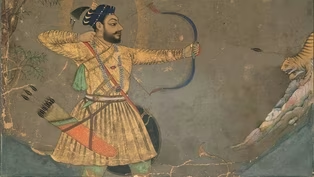
Paula Zahn Presents "Indian Skies" at the Met Museum
Clip: S2024 Ep609 | 3m 9s | A look at "Indian Skies: The Howard Hodgkin Collection of Indian Court Painting." (3m 9s)
Providing Support for PBS.org
Learn Moreabout PBS online sponsorship
- Arts and Music
The Best of the Joy of Painting with Bob Ross
A pop icon, Bob Ross offers soothing words of wisdom as he paints captivating landscapes.














Support for PBS provided by:
NYC-ARTS is a local public television program presented by THIRTEEN PBS
Major funding for NYC-ARTS is made possible by The Thea Petschek Iervolino Foundation, Jody and John Arnhold, The Lewis “Sonny” Turner Fund for Dance, The Ambrose Monell Foundation, Elise Jaffe...