NYC-ARTS
NYC-ARTS Full Episode: May 16, 2024
Season 2024 Episode 616 | 27m 47sVideo has Closed Captions
A profile of photographer Joel Meyerowitz, and a visit to the South Street Seaport Museum.
NYC-ARTS talks with photographer Joel Meyerowitz about his long career and continuing love for his art form. Then a trip to the Rubin Museum of Art for "Reimagine: Himalayan Art Now," featuring the work of 32 contemporary artists in conversation with objects from the permanent collection. And a visit to the South Street Seaport Museum to see the last surviving New York-built wooden tugboat.
Problems playing video? | Closed Captioning Feedback
Problems playing video? | Closed Captioning Feedback
NYC-ARTS is a local public television program presented by THIRTEEN PBS
Major funding for NYC-ARTS is made possible by The Thea Petschek Iervolino Foundation, Jody and John Arnhold, The Lewis “Sonny” Turner Fund for Dance, The Ambrose Monell Foundation, Elise Jaffe...
NYC-ARTS
NYC-ARTS Full Episode: May 16, 2024
Season 2024 Episode 616 | 27m 47sVideo has Closed Captions
NYC-ARTS talks with photographer Joel Meyerowitz about his long career and continuing love for his art form. Then a trip to the Rubin Museum of Art for "Reimagine: Himalayan Art Now," featuring the work of 32 contemporary artists in conversation with objects from the permanent collection. And a visit to the South Street Seaport Museum to see the last surviving New York-built wooden tugboat.
Problems playing video? | Closed Captioning Feedback
How to Watch NYC-ARTS
NYC-ARTS is available to stream on pbs.org and the free PBS App, available on iPhone, Apple TV, Android TV, Android smartphones, Amazon Fire TV, Amazon Fire Tablet, Roku, Samsung Smart TV, and Vizio.
Providing Support for PBS.org
Learn Moreabout PBS online sponsorship♪ >> coming up on NYC Arts.
A profile of a photographer, a vibrant presence in the art world known mostly for his street photography and for advancing the record mission of color photography as an art form.
>> I remember walking through Paris and suddenly smell base -- bacon croissants on the air.
You are immediately, you want a cookie or something.
You take to steps and it's gone.
To me, that's what photography is.
You walk along the street and something happens.
You get it.
It's the visual that's as precise as that fragrance that's only in the air of the doorway.
>> a look at the exhibition, reimagine Himalayan art now.
It's on view at the Rubin Museum .
The exhibit includes paintings, sculpture, sound, video, installation, and performance.
The works reimagine the forms, symbols, and narratives found within the living cultures of Tibet, Nepal, and other Himalayan regions.
And a visit to the South Street Seaport Museum and its beloved tugboat.
>> The only opportunity that you have to take a tugboat ride in New York City.
It's profoundly authentic.
About as much fun as you can have in the New York harbor.
♪ >> funding for NYC Arts is made possible by thea p -- The Louis Sonny Turner fun for dance.
The Ambrose Monell Foundation.
Police Jaffe and Jeffy Brown.
Charles and Valerie diker.
The Milton and Sally Avery arts foundation.
Elroy and Terry Krumholz foundation.
The Nancy side water foundation.
Ellen and James as Marcus.
This program is supported in part by public funds from the New York City Department of cultural affairs, in partnership with the city Council.
Additional funding provided by members of 13 and salon -- swann auction Galleries.
>> offering vintage books and fine arts since 1941, working to combine knowledge with accessibility.
Information online.
♪ >> good evening and welcome to NYC Arts.
On tonight's program, we meet renowned photographer with a vibrant presence in the art world.
He grew up in the Bronx and graduated with a degree in painting from Ohio State University in 1959.
He began taking photographs a few years later.
Although he was focused on a variety of themes throughout his career, he is perhaps best known as a street photographer in the tradition of such masters as Robert Frank.
He's also been instrumental in advancing the recognition of color photography as an art form.
In the wake of 9/11, he was the only photographer to be given understood that access to Ground Zero.
The dramatic images that he captured their have become the foundation of the major national archive.
An exhibition of selected photographs from this collection has been shown all over the world.
His work can be found in museums and public elections including the Met, MoMA.
NYC Arts spoke with him during a visit to the Howard Greenberg gallery.
>> When you first pick up a camera, it's not so easy to go out on the street and take pictures of strangers because there's always a little bit of fear.
I don't belong here or they are not going to like it if I take a picture.
How can I be in their intimate space?
in a way it's like dance.
Very poetic.
You need to find these partners who don't really know that you are photographing them.
While you move in and out of their lives and make photographs for yourselves that use their face, their energy, their posture, their figure, their dress.
Whatever it is that excites you at the moment.
My father was a really streetsmart guy.
Born in New York City.
Tough guy on the streets.
When I was a little kid, he often said to me when I would go with him anywhere, he would just give me a little nudge and say, watch that over there or, take a look at that.
Every time he said, look at that.
Something happen.
It's as if he could predict that two people would embrace and dance around each other.
How did he know?
in a way, I'm sure that he created an appetite in me for the unexpected qualities of ordinary life.
That people will do spontaneous, extraordinary, unexpected things suddenly.
If you were quick enough to watch it, you would experience pleasure.
Visual Pro -- pleasure, human pleasure.
I've been asked so many times, how do you know when to take a photograph?
I remember walking through Paris .
Just walking down the street.
Suddenly, you smell baking croissants on the air.
Butter and sugar.
You are immediately, you want to croissant or a cookie or something.
You take two steps and it's gone.
So in the air on the street was this little zone for a moment where the fragrance was so rich and compelling.
You walk along the street and something happens.
You get it.
It's a visual that's as precise as that fragrance that's only in the air of the doorway.
You go right through it.
So when something makes itself felt to me, when I get an impulse, I raise the camera.
I don't even hesitate.
It has to be like that.
That's photography.
It's about a fraction of a second.
So I think impulse, intuition, recognition, desire, passion, appetite.
Name it.
You could call it anything you want.
Those are the things that are in play photographically.
Photography is about time.
Cameras have their own characteristics.
A small camera that fits in your hand, you just move it around and you carry it with you, put it in your pocket or your bag.
It's part of you.
Let sometimes, that small camera doesn't really do the job you wanted to do if you are finding yourself in nature.
Let's say, nature is slower.
There's more time in it.
If street photography is jazz, the view camera and nature is like the cello.
Very slow.
New stand in nature and you can look around and draw your energy from everything out there.
So large-format camera like an eight by 10 inch camera gives you a whole other experience.
It is slower.
You put it down.
You put the cloth over your head.
You enter this world on a screen upside down.
It has a whole other kind of magic to it.
You can trust that it will describe every single thing in the frame.
There will be nobler.
There will be no movement.
It will be the space and light and depth.
This time.
The question often comes up, how does one develop a body of work?
how do you find your way into a new theme or a new subject?
sometimes it takes time and then the artist recognizes, I've been making that picture a few different times now.
Obviously something interesting there.
More so than I thought.
This happened to me with the work that's called between the dog and the wolf.
In the French expression [ speaking French] I didn't know that expression.
Many years ago, a French friend of mine, upon seeing a sequence of these pictures made at the end of the day when the light is fading and things become slightly more indeterminate.
These images appeared in my work.
I showed them to my friend.
My friend said -- I said, what's that?
he said, between the dog in the wolf.
You know, the dog is the familiar domestic animal.
The wolf is the same sort of.
But it is unknown.
It's unexplained.
It is savage.
He said, when things go from the known to the unknown, there's a shift, and emotional shift as well as a tonal shift.
I thought, that's beautiful.
I love that expression.
I find myself often as a swimmer in a pool which is the dog.
Very safe.
But I also would swim in the ocean.
The open ocean is wild.
I had been making photographs of pools near the sea.
I thought, what an interesting way of addressing this subject.
To put the pools and the ocean and the dust cowered together really was away of concentrating on this.
But beyond that, there are also just places on land where the light is fading and you suddenly have come you feel goosebumps or you feel a little bit of a shiver of uncertainty.
That alerts your senses too, something's going on here.
Out of that comes the possibility for a new photograph.
At this moment in my life, I find myself making still lives.
I have no idea why I'm choosing these objects.
But they have character, mystery, something.
When I put two or three or four of them together, it's as if there's a dialogue between them.
Maybe I can breathe life into them by finding some associative qualities in them that doesn't look like conventional still life photography but looks like I'm making it.
Maybe I can find out more about myself through these objects.
Really engaging photographic question for someone at my age.
When I started to make still lives, it happened quite by accident.
I was doing a book commission in France.
I visited a studio.
In studio, I was amazed that the walls were painted this particular gray.
After a while, the thought about this gray, why gray?
he was a painter who made color paintings.
It prompted me to go back to the studio and ask them if I could take the objects down and put them on his table to photograph them.
I wasn't trying to make art.
I have to be clear.
I was just taking the objects, putting them on the table.
I wanted to see what the relationship was between the object and the space, the color space of the gray wall.
What did it do for him, who played one of the most important turning point roles in the history of modern art?
once I did that, and I'm living in Italy now.
It occurred to me, Georgia Randy is in Bologna.
I'm going to go there and go to his studio because he was also very important to me when I was in art history student.
I was able to ask the curators there if I could take his objects and do the same thing.
The color was complete lead different.
He was working in a very warm tone, golden, Tuscan, colorful Italian environment.
Cézanne was in a very cool, rational French environment.
So to pick these two against each other and to look at their objects and a -- in a way introduced me to the feeling that, each object does have character, identity, persona, something.
And perhaps I was having a dialogue with these men through their objects.
So in a way, working with Cézanne and Morandi in this very basic way introduced me to an appetite for reconsidering the way objects relate to each other in space.
Where it goes from there, I don't know.
I'm grateful for the energy I have right now and the willingness to take on something totally outside of my experience and see if I can find boy voice -- my voice in this time of my life, with these objects, in this medium I love.
I love photography.
♪ >> currently on view at the Rubin Museum of Art is reimagine Himalayan art now.
The exhibition presents the work of 32 contemporary artists from the Himalayas including those who have left their homeland, in conversation with objects from the permanent collection.
These pairings create visual, somatic, material connections that invite new ways of understanding Himalayan art and culture.
The exhibit includes painting, sculpture, sound, video, installation, and performance.
23 of these works are new commissions and many of these artists are exhibiting their works in the United States for the first time.
The works reimagine the form, symbols, and narratives found within the living cultures of Tibet, and a pal -- new pal, and other regions.
Throughout the museums six floors, the 50 works are connected through symbols and stories from Himalayan cultural heritage.
The works explore the artists personal and collective histories and examine themes such as identity, spiritual practice, sense of belonging, grief, and memory.
A multimedia artist born in Shanghai who lives and works in Tokyo examines the Buddhist concept of the self in binary wheel.
This piece is one of several immersive video installations by the artist included in the exhibit.
Incorporating new technologies in pop culture as well as Buddhist and Hindu -- Hindu belief systems.
His work export the idea that virtual existence can extend or replace physical existence.
There's a painting on cloth depicting the wheel of life.
A Tibetan American artist born and raised in New York City uses paint, tapestry, and sculpture to evoke and reconstruct memories of Tibetan culture.
In her new commission, five horses outfitted in silk emerge ghostlike, covered in depictions of her grandfather's memories and stories of Tibet.
The artist created the horses armor from recycled sorry silk on looms she built herself while the horses are made from willow branches.
The work is inspired by richly decorated saddles from the 18th or 19th century.
In the protectors, a reimagining of a scene from Gulliver's travels, one of his favorite stories from childhood.
The installation features traditional Nepalese masks, military toys from 1990's Nepal, and a body cast of the artist.
The bronze of the protective deity dating from mid-14th to mid 14th century Tibet directly inspired the piece.
The ads a bench and brings attention to a group of artists who have important stories to tell about how Himalayan culture informs their work as well as their perspectives on social issues that affect us all.
Reimagine Himalayan art now is the Rubin final exhibit added 17 Street location.
The show is on view through October 6.
♪ Next, we visit the South Street Seaport Museum and its beloved tugboat W O Decker.
Built in 1930, and refurbished in the decades following, this unique battle is a testament to New York City's maritime heritage.
It's directly linked to the city's global prominence today and has even been listed on the National Register of Historic Places.
You can board the W.O.
Decker on Saturdays and Sundays starting May 25.
For a cruise around New York harbor heading for Lady liberty.
♪ >> the Seaport Museum is a 50-year-old institution that exists in the original port of New York.
It's located in the buildings and adjacent to the peers and with a fleet of ships that are representative of the original port.
I'm not allowed to have favorites.
If I had a favorite and if the favorite were W.O.
Decker, it's because she is so cute.
Little tiny wooden tug.
Everybody falls in love with her.
50 feet long.
Built in 1930 in New York.
She's the last surviving New York builds tug.
Built for the purposes of shifting barges.
Not the kind that you commonly see today.
She's a born and bred New Yorker.
She's been a part of the museum fleet for a number of years.
For the last decade, she hasn't been able to operate because she was in need of restoration.
Last year, we were able to bring her back online.
She had a robust restoration and was certificated by the Coast Guard as a passenger vessel.
Not only is she unique in that she's the last of her tight but she's also the only opportunity that you have two take a tugboat ride in New York City.
The experience is not posh.
It's probably a little wet, smells like diesel.
But it's profoundly authentic and it's as much fun as you can have a New York harbor.
I tend to look at the harbor through a measure of a historical lens.
To see it from the deck of a 1930 tugboat is a particularly magical experience.
To be able to go out past the 19th century statue of liberty, under the Brooklyn bridge is really a special experience.
W.O.
Decker sales with the Coast Guard licensed captain and crew.
The crew varies on the type of trip we are doing.
It always includes molecules errors -- volunteer sailors.
50 years from now, W.O.
Decker will be here and so too will be a group of people who know how to operate her.
That kind of engagement makes us a really special place.
♪ >> next week on NYC Arts.
A profile of the Metropolitan opera.
The unique and captivating vocal power is harnessed into one collective voice by its director.
>> we try to present ourselves as one character in any given opera but we are composed of 80 individuals.
We figure out how to create a character as a chorus by our musical expression of the score.
♪ >> and a trip to the South Street Seaport Museum to discover the history of the Seaport and the newly restored flagship of the Museum's collection.
>> waiver tree is 1985 iron sailing ship.
Many people would refer to her as a tall ship.
A tall masted sailing ship.
For us, she is the connection between New York and the rest of the world.
♪ >> I hope you've enjoyed our program tonight.
Thanks for watching and see you next time.
♪ To enjoy more of your favorite segments on NYC Arts, visit our website at NYC Arts.
>> what a privilege to Bree able to sit down and talk with you.
>> I love being here with you.
>> where Army -- are we?
>> a moment to take nothing for granted.
>> the curator of this exhibition for hope.
>> we are in the midst of some of the greatest sculptures by the iconic names.
>> my pictures reside in very intimate, private moments.
>> my primary way of playing the print -- piano is by improvising.
>> you are on sacred ground.
A woman came to see me perform >> and said, how would you like to play Billie holiday?
>> one of the essential things that we learned is that Matisse used pens to compose his work.
>> you are doing a piece that's 100 years ago when you think, this could be now.
>> the cardboard guitar is the first of that moment of realization.
>>, and present something and you get applause.
Great, you know?
♪ >> funding for NYC Arts is made possible by Jody and John Arnhold.
The Lewis Sonny Turner fun for dance.
The Ambrose Monell foundation.
Elyse Jaffe and Jeffrey Brown.
Charles and Valerie diker.
The Milton and Sally Avery arts foundation.
Elroy and Terry Krumholz foundation.
The Nancy side water foundation.
Ellen and James S Marcus.
This program is supported in part by public funds from the New York City Department of cultural affairs, in partnership with the city Council.
Additional funding provided by the members of 13 and by Swann auction galleries.
>> we have a different way of looking at auctions, offering vintage books and fine arts since 1941.
Working to combine knowledge with accessibility.
Information at Swann galleries online.
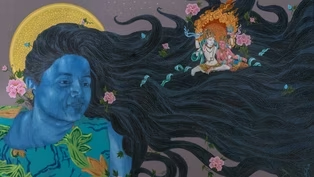
"Reimagine: Himalayan Art Now" at the Rubin Museum
Clip: S2024 Ep616 | 4m 16s | A visit to the Rubin Museum of Art for "Reimagine: Himalayan Art Now." (4m 16s)
Providing Support for PBS.org
Learn Moreabout PBS online sponsorship
- Arts and Music
The Best of the Joy of Painting with Bob Ross
A pop icon, Bob Ross offers soothing words of wisdom as he paints captivating landscapes.














Support for PBS provided by:
NYC-ARTS is a local public television program presented by THIRTEEN PBS
Major funding for NYC-ARTS is made possible by The Thea Petschek Iervolino Foundation, Jody and John Arnhold, The Lewis “Sonny” Turner Fund for Dance, The Ambrose Monell Foundation, Elise Jaffe...