NYC-ARTS
NYC-ARTS Full Episode: May 2, 2024
Season 2024 Episode 614 | 27m 47sVideo has Closed Captions
A trip to the Met, a visit to the Jewish Museum, and then a look at "Pacita Abad."
A trip to the Met for “New York Art Worlds, 1870-1890,” featuring artists from the American Aesthetic Movement. Then a visit to the Jewish Museum and the exhibition "RBG Collars: The Photographs of Elinor Carucci,” which honors the late Supreme Court Justice, Ruth Bader Ginsburg. Finallly, a look at the exhibition “Pacita Abad” on view at MoMA PS1 in Queens.
Problems playing video? | Closed Captioning Feedback
Problems playing video? | Closed Captioning Feedback
NYC-ARTS is a local public television program presented by THIRTEEN PBS
Major funding for NYC-ARTS is made possible by The Thea Petschek Iervolino Foundation, Jody and John Arnhold, The Lewis “Sonny” Turner Fund for Dance, The Ambrose Monell Foundation, Elise Jaffe...
NYC-ARTS
NYC-ARTS Full Episode: May 2, 2024
Season 2024 Episode 614 | 27m 47sVideo has Closed Captions
A trip to the Met for “New York Art Worlds, 1870-1890,” featuring artists from the American Aesthetic Movement. Then a visit to the Jewish Museum and the exhibition "RBG Collars: The Photographs of Elinor Carucci,” which honors the late Supreme Court Justice, Ruth Bader Ginsburg. Finallly, a look at the exhibition “Pacita Abad” on view at MoMA PS1 in Queens.
Problems playing video? | Closed Captioning Feedback
How to Watch NYC-ARTS
NYC-ARTS is available to stream on pbs.org and the free PBS App, available on iPhone, Apple TV, Android TV, Android smartphones, Amazon Fire TV, Amazon Fire Tablet, Roku, Samsung Smart TV, and Vizio.
Providing Support for PBS.org
Learn Moreabout PBS online sponsorship♪ Host: Coming up on "NYC-ARTS," a trip to the Met and the exhibition New York Art Worlds, 1870-1890, a period that saw the development of a modern and cosmopolitan art world.
Sylvia Yount: This is an exhibition that opened last December in our Luce Study Center gallery.
We're thinking about what was happening at the moment in 1870, who were the leading artists, who was defining taste at that time, the changes that occurred too in the transformation of the art world, you know, with all the new wealth after the Civil War.
The development really of an infrastructure for an art world proper.
I would say art worlds, there wasn't just one community.
There were many different communities that came together in the city in those years, in the 1870s and 1880s.
Host: then, a visit to the Jewish Museum and the exhibition RBG Collars: The Photographs of Elinor Carucci which celebrates Ruth Bader Ginsberg, one of the country's highest jurists -- ♪ Elinor Carucci: She started wearing the collars as a way to distinguish herself from the black-gowned and male more boring appearance and to feminize herself.
And then she started getting gifts, the collars that were commissioned and they became another symbol for her.
Without words, she was a woman of words, but this was visual messages, something that I really relate to as a visual artist.
Host: and a look at the exhibition Pacita Abad, now on view at MoMA PS 1 in Queens.
♪ Abad made the plight of political refugees central to her practice.
The exhibition features over 50 works, most of which have never been on public view.
They include vibrant paintings, works on paper, and trapuntos the painted and stitched canvases she began making in the 1980s.
♪ Announcer: Funding For "NYC-Arts' Is Made Possible By -- Thea Petschek Iervolino Foundation, Jody and John Arnhold, The Lewis "Sonny Turner Fund for Dance, The Ambrose Monell Foundation, Elise Jaffe and Jeffrey Brown, Charles and Valerie Diker, The Milton and Sally Avery Arts Foundation, Elroy and Terry Krumholz Foundation, The Nancy Widewater Foundation, and Ellen and James S. Marcus.
This program is supported, in part, by public funds from the New York City Department of Cultural Affairs in partnership with the City Council.
Additional funding provided by Members of Thirteen and by Swann Auction Galleries.
>> Swann Auction Galleries, We have a different way of looking at auctions, offering vintage books and fine art since 1941.
Working to combine knowledge with accessibility, whether you are a lifelong collector or a first-time buyer, or looking to sell.
Information at swanngalleries.com.
♪ Host: Good evening and welcome to NYC-Arts.
I'm Philippe de Montebello.
On our program tonight, a visit to The Metropolitan Museum of Art and the exhibition New York Art Worlds, 1870-1890.
This This exhibit looks at work from these two decades, which saw the development of a modern and cosmopolitan art world, known as the American Aesthetic Movement.
The exhibition features more than 50 works-- most drawn from the Met's American Wing Galleries.
They include paintings, sculpture, illustrated books, and decorative objects -- such as painted tiles, stained glass and textiles.
Notable artists represented here include Winslow Homer, Augustus Saint-Gaudens, and Louis Comfort Tiffany.
Also on view is the work of several women and artists of color such as Cecilia Beaux, Edith Mitchill Prellwitz, and Charles Ethan Porter each of whom was able to achieve professional success during this unique period in the New York art world.
Sylvia Yount, Curator in Charge of the American Wing, will be our guide.
Sylvia Yount: I'm Sylvia Yount.
I'm the Lawrence A. Fleischman Curator in Charge of the American Wing at the Metropolitan Museum.
This is an exhibition that opened last December in our Luce Study Center gallery.
It's an exhibition that has a long gestation period.
It was originally intended to be shown in 2020, which was the year of the Met's one hundred fiftieth anniversary.
Something else happened in 2020 and the project was scuttled.
And the narrative then was really thinking about what was happening at the moment in 1870, who were the leading artists who was defining taste at that time.
I wanted to think about the changes that occurred too in the transformation of the art world, you know, with all the new wealth after the Civil War.
The development really of an infrastructure for an art world proper.
I would say art worlds.
I mean, we're very deliberately using that plural, because there wasn't just one community.
There were many different communities that came together in the city in those years, in the 1870s and 1880s.
So many people are a part of this.
It's not just the artists, it's the critics, it's the collectors, it's the dealers.
And again, this is the moment when that is really developing as a new kind of infrastructure in the city of New York.
We are very lucky, very privileged to have a very deep and wide-ranging collection that speaks to this moment, produced at this time by a range of both canonic artists as well as lesser known artists.
People like Winslow Homer, Augustus Saint-Gaudens, Louis Comfort Tiffany, John La Farge.
The kind of positive of delaying the show for two years was that we had made a lot of new acquisitions actually, and particularly around the time of our anniversary year, we were able to bring in some wonderful gifts of works.
So adding a lot more texture to that, more canonic narrative.
So that was exciting to think about how we might expand the narrative and really kind of hone in on that role of the artists.
You know, the artists at the center of this movement.
So we're talking about institutions and of course talking about the Met and the role the Met played in helping the development of those artists' career.
But in those years it was a lot more interesting what was going on in the artist studios, you know, and then some of these new burgeoning galleries, not in the institutions, not in the established institutions.
There was this greater interest in kind of creativity and experimentation, collaboration across a lot of different kinds of art forms, but primarily intended for the domestic environment.
So the other name for this is the Household Art Movement.
And it was a time when you had painters and sculptors, people who were academically trained, experimenting in the decorative arts and design as well.
So a very rich period again, of innovation, experimentation, collaboration that was really happening right here in New York.
It's not just an exhibition of paintings and sculpture or even works on paper, but it has a real range of works from across the American Wing's collection, which is a collection of decorative arts and so-called fine arts and specifically works that are not on regular view because they're light sensitive.
So we have some wonderful textiles by the very important, innovative textile designer, Candace Wheeler, who is also an important business partner of Louis Comfort Tiffany in the first real interior decorating firm that was established in this country, so-called Associated Artists.
We also have stained glass works by John La Farge, a very important artist also working collaboratively in many cities in this country but based primarily in New York.
And then we have works that we often show in our permanent collection galleries upstairs on the second floor.
Iconic works by someone like Thomas Eakins, his painting of his wife and his setter dog, Harry.
That's normally seen in one context in our paintings galleries.
And one of the beauties of doing projects in this Luce Center Gallery where you can have a little bit more of a close looking at different types of objects is to think about a changing context.
You know, reframing the narrative a little bit, of bringing a different lens of interpretation to thinking about these very familiar works.
The 1870s was a very rich, the late 1870s, I would say, a very rich time in the New York art world.
It was really a kind of the development of a modern and cosmopolitan art world that we'd recognize today with creatives and taste makers at the center of that.
It was a time of challenging the establishment.
So artists coming back from training in Europe, primarily in Paris, and kind of invigorated and wanting to recreate that bohemian and creative collaborative atmosphere they enjoyed there.
So working in studios, setting up new kind of artist organizations where more people could participate with a broader range of artists, including women and artists of color.
We have some wonderful works in the installation by artists who really embody that.
Helena de Kay Gilder, Edith Mitchill Prellwitz, Charles Ethan Porter, the only known Black American artist to be engaged in the aesthetic movement in the Household Art Movement.
We have a really unusual painted tile by him in the exhibition.
He's experimenting, he's trying to find his own voice, and he's doing both decorative work and then very beautiful still lives.
And that's how he's best known today.
In the 1890s, he really flourishes as a still life painter.
And one of the things we wanted to do by having a work by him in this installation and as well as some of the other women, is to underline the fact that this was just the beginning for them.
And they continued to work as artists in both New York and other parts of the country.
And we have those later works in the collection as well.
So if this can be a way that visitors might discover someone new in this context, but then spends time in the Wing and find the fuller rage of those artists, that would be really exciting to us.
♪ HOST: Next, we'll look at portraits of one of our country's most notable jurists.
Although Justices of the Supreme Court are not known for their sartorial choices -- Ruth Bader Ginsburg was an exception.
As the second woman to sit on the Supreme Court since its first assembly over two centuries ago, Ginsburg is being honored with a special exhibition at the Jewish Museum.
On view are 24 photographs of the collars she wore to embellish her traditional black robe.
Israeli-born photographer Elinor Carucci was selected to capture the striking neckwear shortly after Ginsburg's death in 2020.
Alongside the photos is a selection of jewelry from the Museum's collection, reinforcing how Ginsburg has contributed to the rich legacy of the Jewish experience as told through art and artifacts.
Carucci recounts the challenges of photographing the collars of RBG -- as Ginsburg was known to her most ardent fans.
Elinor Carucci: For me, she was an inspiration of a woman who always worked hard.
She was about justice yet also a mother, a wife.
She was a daughter of an immigrant.
So for me she was, she was everything.
A month after the passing of Justice Ginsburg, I was approached by Catherine Pomerantz, uh, the photo director of Time Magazine, to go to the Supreme Court and photograph the collars of Ruth Bader Ginsburg.
I expected to see like big time designers or diamonds or, it was 's very much a collection of the people of things that I could even see my grandma making or wearing.
And that was really inspiring to see the lace, to see the crochet, to see the beads and shells and not, you know, not fancy or super expensive stones.
She started wearing the collars as a way to distinguish herself from the black gown, the male more boring appearance, and to feminize herself.
And then she started getting gifts.
She started getting collars that were commissioned and they became another symbol for her without words.
You know, she was a woman of words, but this was visual messages.
Something I really relate to as a visual artist, when you see the collar from far, it's beautiful, but then when you go closer there are little imperfections.
Some threads are coming out.
So that was a way to maybe feel a little closer to Ruth Beta Ginsburg, to the woman who wore them.
The collar with the words of Marty Ginsburg, It's not sacrifice, It's family, was the one that really moved me.
I couldn't do the career that I have without my husband and kids.
Many people think about it as Marty Ginsburg talking about living New York and moving to DC with Ruth Bader Ginsburg, but he was talking about both of them doing things for the family.
It does look very different when it's folded or when it's open.
We can't see the words of Marty because they're worn to the back of the neck, so there is also intimacy there.
Miyako Nakamura, the chief designer of M.M.LaFLeur, a female-owned fashion company, was in charge of this important commission for Ruth Bader Ginsburg's 85th birthday.
The four layers of the collar each represent a family member with Ruth Bader Ginsburg on the top, and then Marty.
It's a fabric similar to a man's tie.
And then the kids, Jane and Jim.
There is something more warm or sweet about it, and it represents a family.
I went to Columbia Law School where Ruth Bader Ginsburg finished on a top of her class and was the first woman, tenured professor at Columbia Law School, and they told us about wanting to honor Ruth Bader Ginsburg 25th year in the Supreme Court, and that they were looking for a lacemaker and they found Elena Kanagy-Loux.
Elena spent 300 hours creating this collar.
It was a very big challenge to create the number 25 as perfectly as it is.
There was a history of lace actually worn by more powerful men in the history of judges, but it is a women craft and was throughout the history and the community of lacemakers really mourned her passing.
♪ Ruth Bader Ginsburg was a fan of the opera and talked about going to the opera as her time to rest.
♪ This was a replica that the Metropolitan Opera created for Ruth Bader Ginsburg and wrote her name on it.
This one is different in its shape and the material, and it is more male.
It almost looks like a tie.
The others are softer.
I think what I love about this body of work, of the collars and this exhibition, is that people can take it to different directions.
If you're interested in the history of law, you can read more about the stories; if you're interested in fashion, if you are a feminist, if you are a fan of Ruth Bader Ginsburg, if you are Jewish, if you're not Jewish, if you're interested in Judaism, it's about an individual, but it's also about America.
♪ Host: Now, a look at the exhibition Pacita Abad on view at MoMA PS1 in Queens.
Born in the Philippines in 1946, Pacita Abad fled to the United States in 1970, escaping political persecution from the authoritarian regime of Ferdinand Marcos Sr. ♪ Driven by this experience, Abad made the plight of political refugees central to her practice.
The exhibition features over 50 works most of which have never been on public view.
They include vibrant paintings, works on paper, and trapuntos," the painted and stitched canvases she began making in the 1980s.
These works are what Abad is best known for within the artistic community.
While engaged with artistic and political dialogues throughout her life, the inventiveness of her work is only now coming to prominence.
This is among the first major presentations of Abad's multifaceted work, which had not previously received broad recognition.
In 1977, Abad enrolled in the Art Students League in New York to study anatomy, still life, and figurative painting.
Although she became a US citizen in 1994, she lived in a variety of countries including: Bangladesh, Yemen, Sudan, Papua New Guinea, and Indonesia.
Local artisans from across the globe inspired her with their techniques and materials, which helped her create her iconic trapuntos.
♪ The works in the exhibition feature themes that span the three decades of Abad's career.
In the Immigrant Experience, a series of mixed media paintings, Abad depicts communities from Asia to Latin America.
The series Masks from Six Continents was inspired by Indigenous mask making tradition.
These works are being shown for the first time in over 30 years.
Abad's works often utilized textiles, demonstrating her appreciation of the decorative arts, which had been historically undervalued.
The exhibition highlights the significance of her immigrant experience and the development of her practice celebrating a variety of art forms.
The exhibition is on view at MoMA PS1 until September 2nd.
And now another curator's choice.
Since 1961, the American folk Art Museum has been celebrating artists who have been refined through experience rather than training.
This collection includes more than a thousand works of art from centuries representing nearly every continent.
Stacy C. Hollander: The American Folk Art Museum has one of the most important collections of quilts in the country, and one of our most significant recent acquisitions is a Crazy Quilt that was made by a woman named Clara Leon.
Clara Leon was an immigrant from Germany, one of the thousands of Jewish immigrants who came to the United States in the second half of the 19th century.
She landed in New York City, met her husband, Pincus Leon, and the two of them moved to the New Mexican territories, to Las Vegas, New Mexico.
The quilt that Clara Leon made, probably in the 1880s, reflects the idiom of the Crazy Quilt.
This was a kind of construction that was introduced after the American Centennial Exposition that introduced Japanese decorative arts to American audiences for the first time.
So, women saw porcelains with crazed and crackled surfaces and glazes and exotic motifs like spiderwebs and quarter fans, and they very quickly introduced this new aesthetic into their quilt making.
So Clara Leon, one of 36 Jewish families in the pioneer frontier community of Las Vegas, New Mexico, coming to America without a tradition of quilt making at all, and interpreted and adapted the Crazy Quilt to reflect this new aesthetic that was introduced at the Japanese pavilion of the Philadelphia Centennial.
The center of the quilt is emblazoned with a large letter 'L' for her family name, Leon.
Also included is a musical staff and notes, and this reflects the musical background of her family.
In fact, one of the family's stories is that when Clara and her family made the journey by covered wagon, included onboard the covered wagon was her piano.
Aesthetically, she did something with the borders that's unusual.
There is a floral band on each side of the quilt, and typically this would be identical top, bottom, left, right.
But in fact, she's reflecting the seasons.
So there are autumn leaves, spring flowers, summer daisies, and winter sprays.
Quilts have always been a medium for women to express their own thoughts and their own participation in American life.
And Clara Leon clearly took that to heart when she decided what motifs and what techniques were going to be used in her beautiful quilt.
Host: Next week on "NYC-ARTS," a visit to the Bard Graduate Center Gallery for a look at the exhibition Sonia Delaunay: Living Art.
Laura Microulis: The star of the first floor is the Simultaneous Dress, and this was a garment that was made by Sonia herself in 1913.
You can see that it is made of a patchwork of different fabrics, hand sewn by Sonia.
It was not made according to any principles of dressmaking, but rather according to principles of color theory.
Host: profile of Claire Chase, whose love of the flute has inspired a remarkable career in contemporary classical music.
Chase: Density 2036 is the farthest thing from your grandmother's flute recital that I hope you can imagine.
♪ Host: and a look at the exhibition Walton Ford: Birds and Beasts of the Studio, now on view at the Morgan Library and Museum.
Ford's monumental watercolors play with the perception of wild animals in the human imagination.
With drawings of animals and birds selected by Ford from the Morgan's holdings, this exhibition sheds new light on the museum's collection from the perspective of a living artist.
The end of the presentation features works selected by Ford from the Morgan's extensive holdings including work by, John James Audubon, Eugène Delacroix, Dorothea Maria Gsell and many more.
♪ Host: I hope you've enjoyed our program tonight.
I'm Philippe de Montebello.
Thanks for watching and see you next time.
To enjoy more of your favorite segments on NYC Arts, visit our website at N.Y.C.-arts.org.
♪ ♪ ANNOUNCER: funding for NYC Arts is made possible by -- Thea Petschek Iervolino Foundation Jody And John Arnhold The Lewis Sonny Turner Fund For Dance The Ambrose Monell Foundation Elise Jaffe And Jeffrey Brown Charles And Valerie Diker The Milton And Sally Avery Arts Foundation Elroy And Terry Krumholz Foundation The Nancy Widewater Foundation And Ellen And James S. Marcus This Program Is Supported, In Part, By Public Funds From The New York City Department Of Cultural Affairs In Partnership With The City Council Additional Funding Provided By Members Of Thirteen And By Swann Auction Galleries.
>> Swann Auction Galleries.
We Have A Different Way Of Looking At Auctions, Offering Vintage Books And Fine Art Since 1941.
Working To Combine Knowledge With Accessibility, Whether You Are A Lifelong Collector Or A First-Time Buyer, Or Looking To Sell.
Information At Swann Galleries .com.
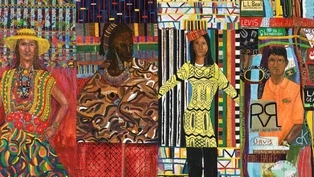
Clip: S2024 Ep614 | 3m 28s | A look at the exhibition "Pacita Abad" on view at MoMA PS1 in Queens. (3m 28s)
Providing Support for PBS.org
Learn Moreabout PBS online sponsorship

- Arts and Music
The Best of the Joy of Painting with Bob Ross
A pop icon, Bob Ross offers soothing words of wisdom as he paints captivating landscapes.












Support for PBS provided by:
NYC-ARTS is a local public television program presented by THIRTEEN PBS
Major funding for NYC-ARTS is made possible by The Thea Petschek Iervolino Foundation, Jody and John Arnhold, The Lewis “Sonny” Turner Fund for Dance, The Ambrose Monell Foundation, Elise Jaffe...