NYC-ARTS
NYC-ARTS Full Episode: May 4, 2023
Season 2023 Episode 583 | 27m 46sVideo has Closed Captions
A visit to Kykuit and South St Seaport and a look at China Institute Gallery's reopening.
A visit to Kykuit, former home to the Rockefeller family and one of the great estates of the Hudson Valley. Then a look at China Institute Gallery's "Flowers on a River: The Art of Chinese Flower-and-Bird Painting, 1368-1911." Finally, a trip to the South Street Seaport and the newly-restored Wavertree.
Problems playing video? | Closed Captioning Feedback
Problems playing video? | Closed Captioning Feedback
NYC-ARTS is a local public television program presented by THIRTEEN PBS
Major funding for NYC-ARTS is made possible by The Thea Petschek Iervolino Foundation, Jody and John Arnhold, The Lewis “Sonny” Turner Fund for Dance, The Ambrose Monell Foundation, Elise Jaffe...
NYC-ARTS
NYC-ARTS Full Episode: May 4, 2023
Season 2023 Episode 583 | 27m 46sVideo has Closed Captions
A visit to Kykuit, former home to the Rockefeller family and one of the great estates of the Hudson Valley. Then a look at China Institute Gallery's "Flowers on a River: The Art of Chinese Flower-and-Bird Painting, 1368-1911." Finally, a trip to the South Street Seaport and the newly-restored Wavertree.
Problems playing video? | Closed Captioning Feedback
Where to Watch NYC-ARTS
NYC-ARTS is available to stream on pbs.org and the PBS app.
Providing Support for PBS.org
Learn Moreabout PBS online sponsorship♪ ♪ Coming Up on NYC-ARTS, a visit to Kykuit, one of the great estates of the Hudson Valley.
Christ Kykuit is the home to the Rockefeller family.
There were four generations of family to have lived in this home, and it was considered the family seat for John Davison Rockefeller Sr. >> A look at China Institute Gallery's landmark exhibition, "Flowers on a River: The Art of Chinese Flower-and-Bird Painting, 1368-1911."
The more than 100 works cover a wide range of natural topics such as flowers, birds, fish, and insects.
The paintings are not intended to solely imitate nature but use different styles to convey the personality and ideas of the artist.
And a trip to the South Street Seaport Museum for a look at the flagship of its collection, the Wavertree.
>> Wavertree is an 1885 iron sailing ship.
Many people would refer to her as a tall ship, so a big tall-masted square-rig sailing ship.
And she is for us the connection between New York and the rest of the world.
>> FUNDING FOR NYC-ARTS IS MADE POSSIBLE BY THE AMBROSE MONELL FOUNDATION, THE A PETSCHEK IERVOLINO FOUNDATION, JODY AND JOHN ARNHOLD, THE LEWIS âSONNY -- Sonny Turner FUND FOR DANCE, ELISE JAFFE AND JEFFREY BROWN CHARLES, AND VALERIE DIKER.
THE MILTON AND SALLY AVERY ARTS FOUNDATION, THE NANCY SIDEWATER FOUNDATION, ELROY AND TERRY KRUMHOLZ FOUNDATION, AND ELLEN AND JAMES S. MARCUS.
THIS PROGRAM IS SUPPORTED, IN PART, BY PUBLIC FUNDS FROM THE NEW YORK CITY DEPARTMENT OF CULTURAL AFFAIRS IN PARTNERSHIP WITH THE CITY COUNCIL ADDITIONAL FUNDING PROVIDED BY MEMBERS OF THIRTEEN.
NYC-ARTS IS MADE POSSIBLE IN PART BY FIRST REPUBLIC BANK.
>> FIRST REPUBLIC BANK PRESENTS 'FIRST THINGS FIRST.'
AT FIRST REPUBLIC BANK, FIRST REFERS TO OUR FIRST PRIORITY.
THE CLIENTS WHO WALK THROUGH OUR DOORS.
THE FIRST STEP?
RECOGNIZE THAT EVERY CLIENT IS AN INDIVIDUAL WITH UNIQUE NEEDS.
FIRST DECREE.
BE A BANK WHOSE CURRENCY IS SERVICE IN THE FORM OF PERSONAL BANKING.
THIS WAS FIRST REPUBLIC'S MISSION FROM OUR VERY FIRST DAY.
IT'S STILL THE FIRST THING ON OUR MINDS.
>> AND BY SWANN AUCTION GALLERIES.
>> SWANN AUCTION GALLERIES.
WE HAVE A DIFFERENT WAY OF LOOKING AT AUCTIONS, OFFERING VINTAGE BOOKS AND FINE ART SINCE 1941.
WORKING TO COMBINE KNOWLEDGE WITH ACCESSIBILITY, WHETHER YOU ARE A LIFELONG COLLECTOR OR A FIRST-TIME BUYER, OR LOOKING TO SELL.
INFORMATION AT SWANN GALLERIES DOT COM.
♪ ♪ >> Good evening and welcome to NYC-ARTS.
I'm Philippe de Montello on location at the Hudson River Museum in Yonkers --just a 35-minute train ride north from Grand Central Station.
Located on the banks of the Hudson River, it is the largest museum in Westchester County.
Its offerings include exhibitions of American art from the 19th century to the present day.
The state-of-the-art planetarium.
An outdoor amphitheater.
and Glenview, a Gilded Age home on the National Register of Historic Places.
I'm here in The Sitting Room of Glenview, the mansion built in 1877 for Wall Street financier, John Bond Trevor, his wife Emily Norwood Trevor and their family.
Charles W. Clinton, architect of the Park Avenue Armory in Manhattan, designed Glenview as a magnificent castle-like perch surrounded by the beauty of the natural world, with views of the Hudson River and the Palisades.
It's one of the first suburban homes, made possible by the new commuter train lines.
The Glenview mansion is a magnificent representation of the early Gilded Age.
It features design and decor of the era's Aesthetic Movement embracing straight-lined furniture and handcrafted woodwork, often medieval in appearance and simply decorated.
The first floor contains six fully restored period rooms: the Great Hall, the Dining Room, the Library, the Parlor, the Sitting Room, and the Billiard Room, all of which are open to the public.
The Great Hall has retained most of the home's original features, including an encaustic tiled floor made by Maw and Co.
Here, over a century ago, John and Emily Trevor' guests stood waiting to be announced.
This impressive room is anchored by a fireplace with its original under mental and ceramic tiles featuring Guinevere designed by J Moyer Smith and fairytales.
By Daniel co-chair.
-- copier.
The Sitting Room served as a cozy den where the Trevor family shared hobbies.
.
Objects On View include a collectors cabinet, a stereographic scope and a music box.
Photographs on this table are part of an initiative to include the African American narrative that has often been missing from museum collections and exhibitions.
These are prominent members of the Yonkers community, who helped make it the vibrant city it is today.
The Trevor family lived at Glenview for over 40 years and maintained strong ties and philanthropic contributions to the community.
Upon Emily's's death in 1920, the Glenview mansion was purchased by the city of Yonkers.
It became home to the Hudson River Museum in 1924.
Now a visit to another historic Hudson Valley estate located north of Yonkers in Sleepy Hollow.
Kykuit, the Rockefeller Estate, is the Dutch word from lookout a , fitting name for this house located on the highest point in the Pocantico Hills with commanding views of the Hudson River.
The classical revival-style villa was completed in 1913 for John D Rockefeller, founder of Standard Oil, and in his day, the richest man in America.
Home to four generations of Rockefellers, today the house and extensive gardens, enriched by the families sculpture collection, is open to the public for tours.
Visitors can also enjoy the nearby Union Church of Pocantico Hills with its stained-glass windows by Henri Matisse and Marc Chagall, commissioned by the Rockefeller family.
♪ ♪ Donna Darby: Kykuit is the home to the Rockefeller family.
There were four generations of family to have live in this home, and it was considered the family seat for John Davison Rockefeller Sr.
The word Kykuit is an old Dutch word, it means lookout or overlook.
It is fitting because we are on the top of a hill, we sit 500 feet above sea level, perfect area for a beautiful home.
The house is done in the classical style and the gardens are gardens that you might find at an Italian villa.
The original building of Kykuit was in 1909, when the family moved in.
David did the façade in 1913 with a pediment right below the roof reminiscent of the ancient Roman temples.
Within that pediment sit two large figures, one being Apollo, the god of the arts, and the other being Demeter, the goddess of agriculture, and that was a symbol of unity between nature and culture, something that this estate was meant to embody.
There were two important architects that we had working on this home: one being Ogden Codman, who was responsible for the interiors of this home.
You William Welles Bosworth created all the gardens that you would see throughout this estate.
The ones that surround the house are much more formal, and the further out you go, the further your eye looks, they become more informal and graduate into the landscape.
John D Rockefeller Junior was the one who put a lot of classical sculpture on the ground.
Oceanus is the largest fountain we have on this estate.
It was placed here in 1913.
It was fashioned after the Oceanus that you would find in the Boboli Gardens in Florence, Italy.
Oceanus being the king of the river gods, commanding the seated figures to pour forth water into the oceans.
There are three figures there, they represent the rivers of the Old World: the Ganges, the Euphrates, and the Nile.
And the reason it was placed in the east looking to the west is because we are going to link the Hudson River, the river of the New World, to the rivers of the Old World.
Nelson Aldrich Rockefeller was the grandson of John D. Rockefeller Sr.
He resided here as third generation of family.
And what he gave to this estate was sculpture and art.
We have five art galleries in the downstairs area of this home, filled with modern art, We have more than 70 pieces of outdoor sculpture alone, ranging from Henry Moore to Alexander Calder to Noguchi.
He was passionate about art, a great collector of the arts.
And he considered himself an environmental artist, and by that he meant he was going to study the environment, find where the best location for each of his outdoor pieces would be, so that sculpture would enhance nature, and in turn nature would enhance that piece of sculpture .
Triangular Surface in Space by the artist Max Bill.
It is set at the end of the rose pergola.
It overlooks the Hudson razor -- River and it is as if it is a telescopic view of the Hudson.
The inner garden is flanked by two sunken gardens.
When Nelson lived here he exchanged the sunken gardens and he put in sunken swimming pools, which makes the piece that he put in between the two pools, perfectly situated.
Aristide Maillol's Bather Putting Up Her Hair looks as if she is going to jump into the water, and when Nelson lived here, she could have.
Nelson Rockefeller wanted everybody to enjoy what he had enjoyed throughout his life.
So he put in his will, that when he passed away, this home would be given to the National Trust for Historic Preservation, along with 87 acres surrounding this estate that would be open to the public and tours would be given to the public by Historic Hudson Valley.
Kykuit, the Rockefeller Estate is open to the public May through Mid-November.
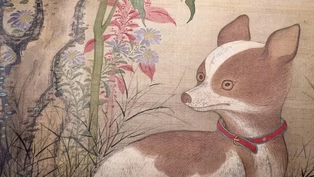
>> China Institute Gallery has reopened to the public with their landmark exhibition of Chinese flower and bird paintings.
This is the largest survey of its kind outside of China, and the first in the U.S. since the onset of the pandemic.
Flowers on a River: The Art of Chinese Flower-and-Bird Painting, 1368-1911, showcases masterpieces of Chinese painting across five centuries.
The more than 100 works come from the Tianjin Museum and Changzhou Museum.
Flower and bird paintings are known as huaniaohua, and according to Chinese tradition, the paintings cover a wide range of natural topics such as flowers, birds, fish, and insects.
The paintings are not intended to solely imitate nature but use different styles to convey the personality and ideas of the artist.
The Ming and Qing periods saw the rise of women artists who excelled in flower and bird painting.
The exhibition includes the work of eight women artists, featuring scrolls by two of the most acclaimed, Ma Quan and Yun Bing.
Born into families of artists during the Qing dynasty, they rose to prominence through the legacies of their fathers and were celebrated as great talents.
Few women artists made a living through art, such as Miao Jiahui who was an art teacher and uncredited artist.
She was a ghost artist who provided her work for Empress Dowager Cixi to sign.
Flowers are -- flowers on a river explores the natural world in the context of the human experience.
The depictions of flora and fauna provide an essential escape to the world of nature.
One of the highlights of the exhibition is the Qing dynasty hence grow up flowers on a river, 6097, from which the exhibition takes its name.
The 42-foot horizontal scroll is by one of the greatest artists in Chinese history, Zhu Da, commonly known as Bada Shanren.
A prince of the Ming family, Bada Shanren began his career in 1680, excelling in painting and calligraphy.
His epic scroll Flowers on a River, was painted when he was 72 years old.
It depicts the lifespan of a lotus flower from a seedling to a blossom.
Shanren's work is considered a masterpiece and was only seen outside of China in 2013.
The exhibition is on view through June 25.
♪ ♪ >> The story of New York City begins at its waterfront, the original center of trade.
The South Street Seaport Museum chronicles the history of the area through its historic buildings and collection of ships.
The flagship of the collection is the newly restored Wavertree.
Built in 1885, Wavertree circled the world four times before the end of her sailing career and represents the type of cargo ships that used to line South Street.
Another ship in the museum's collection is the Ambrose.
Launched in 1908 and active until 1932, it served as a floating lighthouse to guide ships safely in and out of the ports of New York and New Jersey.
As witness to the largest period of immigration in US history, the Ambrose served as a beacon of hope for some six million immigrants passing her station.
In this segment, Captain Jonathan Boulware, the museum's director, spoke with NYC-ARTS about Wavertree and the history of the seaport.
Capt.
Jonathan Boulware: The South Street Seaport Museum is a 50 year old institution that exists in the original port of New York.
It is located in the buildings and adjacent to the piers and with a fleet of ships that are representative of the original port of New York.
So New York was a port before it was a city.
For us, place really matters where we are doing our work is in actually the original accounting houses that are the first world trade center of the city of New York.
The shipping piers and the ships and their connection to the rest of the world is what built New York.
So we really tell the first chapter of the story of modern New York.
The street of ships is a term that's used to describe South Street, really from the Battery up to Brooklyn Bridge and beyond.
The image of the Street of Ships is that of the bowsprits, the head rig, the spar that comes off the bow of the ship and meeting with the city, hanging over the buildings that are there.
It is that connection between waterborne transportation and the growing metropolis that represents really the birthplace of New York as we know it.
They say ships were, in the 19th century, the engines of trade.
They were bringing raw materials in and manufactured goods out, but they were also instruments of globalization, they were instruments of connection.
They were the instruments of the migrations of peoples, of cultural exchange.
Wavertree is our flagship.
She is an 1885 iron sailing ship.
Many people would refer to her as a tall ship, so a big tall-masted square rig sailing ship.
And she is for us the connection between New York and the rest of the world.
So she was a globe trotter.
She was a- what's called a tramp for most of her life.
So a tramp was the name for a ship that would carry any cargo, anywhere in the world as long as it paid.
On the day that Wavertree was launched in Southampton, England in 1885 she was a profoundly normal ship, no more special than a Mack truck or a freight car today.
But she is the last surviving ship of her type in the world.
She has outlasted all of her sisters.
She did so actually because of what I think you could call a series of happy accidents, which might not have seemed happy at all at the time.
In 1910 during her second attempt to try to round Cape Horn, the Cape at the southern end of South America, and probably the most violent and dangerous body of water in the world, she was dismasted.
Which means that her tall sailing rig came falling down to the deck, iron and wood and steel and cable and cordage and canvas all came crashing down, destroying the ship's ability to sail.
Remarkably, killing no one.
She was declared by her owners a functional loss.
She was converted first to a floating warehouse.
She was then converted by having her decks cut out into a sand barge.
She was found by the South Street Seaport Museum.
And so in 1970 she came here to great fanfare and she has been lovingly preserved by volunteers and staff of the museum ever since.
Wavertree just completed in 2016 a completely unprecedented restoration project funded by the city of New York, a 16 month, $13 million restoration that brought her really as close to sailing condition as she has been since she was dismasted in 1910.
Life on a sailing ship in the 19th century was a pretty grim business.
So let's first think about what's the function of these ships?
The job is to get a small pile of coal, a couple thousand tons of coal, or its equivalent, halfway around the world or die trying, right?
So the inversion of importance of money and human life between the 19th century and now can't be overstated.
Crews were expendable, sailors were expendable, cargos and ships were not.
It was a rigid class hierarchy and you can see a really stark example of that in the cabin door that leads to the cap insulin.
Inside the saloon, she's a Victorian ship, so posh, you know, cushions and nice chairs and a pump organ and a settee and a tea service made of silver and so on.
On that side of the door, it's brightly finished with varnish and nice panels.
On the other side of the door: painted white utilitarian, work-a-day.
And so too was the lifestyle.
Aboard the ship, the captain enjoyed a pretty comfortable existence.
The sailors lived forward, toward the bow of the ship, and lived many men to a small cramped thing, sleeping perhaps on a straw mattress, eating salted meat out of a wooden barrels.
One of the impacting things about Wavertree, about seeing her, is just walking down to the pier and seeing the majesty of her tall masts and the rigging that's necessary to make a ship like that work.
But the real gem is to get into Wavertree and go down into the hold space, which is open this year for the first time ever and be able to take in the size and the scale of a huge cargo sailing ship from the 19th century.
It's like being inside the belly of a whale or in a cathedral.
At one turn, incredibly beautiful, the construction is breathtaking and yet its , function was to do a very mundane and dirty job.
And this is where I would say that Wavertree is truly unique.
There is not another ship in the world that has a space inside like the one that Wavertree has.
She isn't the ship that built in New York, but she is of the class of ship that made New York what it is.
And so for us, particularly as the last of her type, she represents a New York's connection to the rest of the world.
That in the 19th century from an East River pier, you could get on a ship like Wavertree.
You could go out the Narrows, turn left, go right, go straight, and end up anywhere in the world.
Next week on NYC-ARTS a visit to the Brooklyn studio of Jose Parla, a Cuban-American artist whose acclaimed works span a variety of mediums, including painting, sculpture, video and large-scale murals.
>> I like the idea of translating a place or an experience from being in a place into a painting.
So I've imagined myself dissecting a wall instead of painting a canvas and imagining that what I'm discovering by painting is the accumulation of the many years of what other people have done to a wall.
>> And a profile of versatile jazz pianist and composer, Vijay Iyer.
>> Music is this force that creates community.
It is a power that we have as a species to do that.
>♪ ♪ >> I hope you enjoyed our program this evening.
I'm Philippe de Montebello on location at the Hudson River Museum.
Thanks for watching and see you next time.
To enjoy more of your favorite segments on NYC-ARTS, visit our website at NYC-arts.org >> GOOD EVENING AND WELCOME TO NYC-ARTS.
I'M PAULA ZAHN.
>> I'M PHILIPPE DE MONTEBELLO AT THE TISCH WNET STUDIOS AT LINCOLN CENTER.
>> LEONARD, WHAT A PRIVILEGE TO BE ABLE TO SIT DOWN AND TALK WITH YOU.
>> I LOVE BEING WITH YOU HERE, TOO, PAULA.
>> WHERE ARE WE?
>> WE'RE AT A MOMENT TO TAKE NOTHING FOR GRANTED.
>> WELL IT'S A PLEASURE TO BE HERE WITH THE CURATOR OF THIS EXHIBITION FULL OF HOPE.
WE ARE IN THE MIDST OF SOME OF THE GREATEST SCULPTURES BY THE ICONIC NAMES.
>> CLASSICAL AND MODERN DANCE ARE EXTREMELY DIFFERENT, AND I HAVE SO MUCH MORE TO LEARN BEFORE I CAN REALLY ARTICULATE THE DIFFERENCES.
>> AND WHEN I LISTEN TO YIP HARBURG'S LYRICS IN THAT, I SUDDENLY THOUGHT THAT'S WHAT I WANT TO DO WITH MY LIFE.
>> MY PICTURES RESIDES IN VERY INTIMATE, VERY PRIVATE MOMENTS.
>> MY PRIMARY WAY OF PLAYING PIANO IS BY IMPROVISING.
>> YOU ARE IN SOME RESPECTS ON SACRED GROUND.
♪ ♪ >> FUNDING FOR NYC-ARTS IS MADE POSSIBLE BY THE AMBROSE MONELL FOUNDATION, THEA PETSCHEK IERVOLINO FOUNDATION, JODY AND JOHN ARNHOLD, THE LEWIS SONNY TURNER FUND FOR DANCE, ELISE JAFFE AND JEFFREY BROWN, CHARLES AND VALERIE DIKER, THE MILTON AND SALLY AVERY ARTS FOUNDATION.
THE NANCY SIDEWATER FOUNDATION, ELROY AND TERRY KRUMHOLZ FOUNDATION, AND ELLEN AND JAMES S. MARCUS.
THIS PROGRAM IS SUPPORTED, IN PART, BY PUBLIC FUNDS FROM THE NEW YORK CITY DEPARTMENT OF CULTURAL AFFAIRS IN PARTNERSHIP WITH THE CITY COUNCIL.
ADDITIONAL FUNDING PROVIDED BY MEMBERS OF THIRTEEN.
NYC-ARTS IS MADE POSSIBLE IN PART BY FIRST REPUBLIC BANK.
>> FIRST REPUBLIC BANK PRESENTS 'FIRST THINGS FIRST.'
AT FIRST REPUBLIC BANK, FIRST REFERS TO OUR FIRST PRIORITY.
THE CLIENTS WHO WALK THROUGH OUR DOORS.
THE FIRST STEP?
RECOGNIZE THAT EVERY CLIENT IS AN INDIVIDUAL WITH UNIQUE NEEDS.
FIRST DECREE.
BE A BANK WHOSE CURRENCY IS SERVICE IN THE FORM OF PERSONAL BANKING.
THIS WAS FIRST REPUBLIC'S MISSION FROM OUR VERY FIRST DAY.
IT'S STILL THE FIRST THING ON OUR MINDS.
>> AND BY SWANN AUCTION GALLERIES.
>> SWANN AUCTION GALLERIES.
WE HAVE A DIFFERENT WAY OF LOOKING AT AUCTIONS, OFFERING VINTAGE BOOKS AND FINE ART SINCE 1941.
WORKING TO COMBINE KNOWLEDGE WITH ACCESSIBILITY, WHETHER YOU ARE A LIFELONG COLLECTOR OR A FIRST-TIME BUYER, OR LOOKING TO SELL.
INFORMATION AT SWANN GALLERIES DOT COM.
China Institute Gallery's "Flowers on a River"
Video has Closed Captions
Clip: S2023 Ep583 | 3m 25s | A look at the China Institute Gallery's exhibition "Flowers on a River." (3m 25s)
Providing Support for PBS.org
Learn Moreabout PBS online sponsorship
- Arts and Music

Art21 showcases today's contemporary visual artists and their groundbreaking creations.







 New Episode
 New Episode

 New Episode

Support for PBS provided by:
NYC-ARTS is a local public television program presented by THIRTEEN PBS
Major funding for NYC-ARTS is made possible by The Thea Petschek Iervolino Foundation, Jody and John Arnhold, The Lewis “Sonny” Turner Fund for Dance, The Ambrose Monell Foundation, Elise Jaffe...