NYC-ARTS
NYC-ARTS Full Episode: May 9, 2024
Season 2024 Episode 615 | 27m 46sVideo has Closed Captions
A trip to Bard Gradate Center, then a profile of Claire Chase and a look at "Walton Ford."
A visit to the Bard Gradate Center for “Sonia Delaunay: Living Art." Comprised of nearly 200 objects, the exhibition reveals Delaunay’s masterful use of color in multiple mediums. Then a profile of Claire Chase, an award-winning flutist and a champion of contemporary classical music. Finally, a look at the exhibition "Walton Ford: Birds and Beasts of the Studio" on view at the Morgan Library.
Problems playing video? | Closed Captioning Feedback
Problems playing video? | Closed Captioning Feedback
NYC-ARTS is a local public television program presented by THIRTEEN PBS
Major funding for NYC-ARTS is made possible by The Thea Petschek Iervolino Foundation, Jody and John Arnhold, The Lewis “Sonny” Turner Fund for Dance, The Ambrose Monell Foundation, Elise Jaffe...
NYC-ARTS
NYC-ARTS Full Episode: May 9, 2024
Season 2024 Episode 615 | 27m 46sVideo has Closed Captions
A visit to the Bard Gradate Center for “Sonia Delaunay: Living Art." Comprised of nearly 200 objects, the exhibition reveals Delaunay’s masterful use of color in multiple mediums. Then a profile of Claire Chase, an award-winning flutist and a champion of contemporary classical music. Finally, a look at the exhibition "Walton Ford: Birds and Beasts of the Studio" on view at the Morgan Library.
Problems playing video? | Closed Captioning Feedback
How to Watch NYC-ARTS
NYC-ARTS is available to stream on pbs.org and the free PBS App, available on iPhone, Apple TV, Android TV, Android smartphones, Amazon Fire TV, Amazon Fire Tablet, Roku, Samsung Smart TV, and Vizio.
Providing Support for PBS.org
Learn Moreabout PBS online sponsorship[gentle upbeat music] - [Philippe] Coming up on "NYC Arts", the visit to the Bard Graduate Center, and the exhibition Sonia Delaunay Living Art.
- The star of the first floor is the Simultaneous Dress, and this was a garment that was made by Sonia herself in 1913.
It was not made according to any principles of dress making, but rather according to principles of Color Theory.
- [Philippe] A profile of Claire Chase, whose love of the flute has inspired a remarkable career in contemporary classical music.
- "Density 2036" is the farthest thing from your grandmother's flute recital that I hope you can imagine.
[discordant flute music] - [Philippe] And a look at the exhibition, Walton Ford Birds and Beasts of the Studio, now on view at the Morgan Library and Museum.
Ford's monumental watercolors play with the perception of wild animals in the human imagination.
With drawings of animals and birds selected by Ford from the Morgan's Holdings, this exhibition sheds new light on the museum's collection from the perspective of the living artist.
- [Narrator] Funding for "NYC Arts" is made possible by... Thea Petschek Iervolino Foundation.
Jody and John Arnhold.
The Lewis "Sonny" Turner Fund for Dance.
The Ambrose Monell Foundation.
Elise Jaffe and Jeffrey Brown.
Charles and Valerie Diker.
The Milton and Sally Avery Arts Foundation.
Elroy and Terry Krumholz Foundation.
The Nancy Sidewater Foundation.
And Ellen and James S. Marcus.
This program is supported in part by public funds from the New York City Department of Cultural Affairs, in partnership with the City Council.
Additional funding provided by Members of Thirteen.
And by Swann Auction Galleries.
- [Presenter] Swann Auction Galleries.
We have a different way of looking at auctions, offering vintage books and fine art since 1941, working to combine knowledge with accessibility.
Whether you're a lifelong collector, a first time buyer, or looking to sell, information at swanngalleries.com.
[upbeat big band music] - Good evening, and welcome to "NYC-Arts".
I'm Philippe De Montebello.
On our program tonight, a look at the exhibition, Sonia Delaunay Living Art.
It is on view at the Bard Graduate Center on West 86th Street.
Delaunay was born in Odessa, Ukraine.
At the age of 20, she moved to Paris, which marked the beginning of her diverse artistic career.
Comprised of nearly 200 objects, the exhibition reveals Delaunay's masterful use of color in multiple mediums.
From paintings to playing cards and furniture to fashion.
Many of the works have never been exhibited, or are on view for the first time in the United States.
This includes rare couture garments, exquisitely crafted furniture that Delaunay designed for her Paris apartment, and a tapestry commissioned by the government of France.
The exhibition illuminates Delaunay's embrace of new media, and how she broadened the definition of both fine and decorative arts.
Curator Laura Microulis is our guide.
[pleasant music] - I'm Laura Microulis, Research Curator at the Bar Graduate Center, and one of the two curators of the Sonia Delaunay Living Art exhibition.
The artist known as Sonia Delaunay was born Sarah Stern on November 14th, 1885 in the city of Odessa.
She was born into a Jewish family of modest means, but actually spent the majority of her childhood with her wealthy maternal aunt and uncle, living in St. Petersburg.
After studying painting in Germany, she moved to Paris in 1906, and there she became part of a vibrant artistic community of painters, writers and musicians.
Shortly thereafter, she met and eventually married the painter Robert Delaunay.
And together, the two of them would come to form one of the most remarkable artistic partnerships of the 20th century.
This exhibition examines Sonia Delaunay's multidisciplinary approach to creation, and looks at her overlapping roles of artist, designer, maker and entrepreneur.
[soft lighthearted music] We particularly focus on her production of the applied or decorative arts.
This was a significant aspect of her practice from as early as 1911.
[soft lighthearted music] Simultanism is Robert and Sonia Delaunay's contribution to abstraction, based on pseudo-scientific color theories.
Simultanism became so central to both Sonia and and Robert Delaunay, that they trademarked the word "simultanee" in 1925, so it became sort of a brand for them.
[soft string music] So the star of the first floor is the Simultaneous Dress, and this was a garment that was made by Sonia herself in 1913.
You can see that it is made of a patchwork of different fabrics, hand sewn by Sonia.
And what is really interesting about this dress is that it was not made according to any principles of dress making, but rather according to principles of color theory.
Sonia made the garment as she would've made an abstract painting.
This is the first time that these textiles have been displayed in a Sonia Delaunay exhibition.
And what's significant about the gift that Sonia made to the Musée des Tissus, is that this particular museum is located in Lyon.
It was a strategic donation in the sense that she wanted her printed silks to be part of the storied history of French production.
And she opted to print her textiles by hand using wood blocks, in order to maintain the original integrity of her wash design.
This was very time consuming and labor intensive, but produced a product that was uniquely hers.
[upbeat music] Sonia Delaunay's engagement with costume design began in 1918 when she was asked to redesign the costumes for the Ballet Russes production of Cleopatra.
This particular portrait was painted by Flora Lion.
She has really captured the wonderful detail of the costumes, the bright rainbow colored sash, the beautiful pearl embellishments, and the glimmering applique ornament.
[upbeat music continues] During the last two decades of Sonia Delaunay's life, she experimented with simultanism in new mediums, like mosaic, stained glass and tapestry.
This wool tapestry is one of four commissioned by the French state.
It is a wonderful fusion of Delaunay's colorful disc motif, executed in woven wool.
[upbeat music continues] Sonia Delaunay had a love for modernity and for marketing, and her car projects represent both.
In 1967, Sonia was asked to create a paint scheme for the exterior of a Matra 530 sports car.
This time she worked with color fields, taking care so once in motion the colors would blend into a beautiful blue.
So according to her, as to not distract other drivers.
For Sonia Delaunay, there was no hierarchy between the fine and the decorative arts.
Simultanism was a lifestyle.
Sonia and Robert, they lived it, they breathed it.
It was their way of creation.
This, in a sense, was her way of almost doubling down on her making of objects.
She showed not only art critics, but the entire art world that she was serious about this aspect of her production.
[soft piano music] [gentle upbeat music] - Claire Chase was enchanted by the flute since the age of three.
Her love of the instrument has inspired a remarkable career in contemporary classical music.
The founding member of the International Contemporary Ensemble, she has been a champion of new music around the world.
She's also in great demand as a soloist.
Chase was named a MacArthur Fellow in 2012, and awarded the Avery Fisher Prize in 2017.
She's currently in the middle of a 23-year commissioning and performance cycle called "Density 2036".
Begun in 2013, the project's goal is to create an entirely new repertoire for the flute.
One that pushes both audience's perceptions, and the limits of the instrument itself.
A deeply committed educator, Chase is also a professor, in the Department of Music at Harvard.
"NYC-Arts" spoke with her about four of the "Density 2036" commissions completed in 2019.
[mysterious flute music] - "Density 2036" was an idea that I had in 2012, inspired by Edgar Varese's seminal 1936 flute solo, called "Density 21.5".
And my personal story with this piece is that my teacher, when I was 12 or 13 years old, a wonderful, wonderful man named John Fonville came into my flute lesson, and he put these two pages of music on the music stand, and I said, "This is weird, what is this?"
And he said, "Don't judge.
Do you wanna hear it?"
I said, "Of course, I wanna hear it."
So he said, "Okay, kiddo, stand back."
[Claire chuckles] I was like, I've never that before, a flute performance before.
And he proceeded, over the next four and a half minutes, to completely blow my mind.
I had never experienced music, and I'd never experienced the flute.
I'd never experienced resonance that way.
Like whatever music that is, I don't know what we call that music, but I wanna do that music, and I want to learn to transmit that kind of experience that John transmitted for me.
And the piece itself, I like to think of it as an anthem.
[mysterious flute music] It is brash at times.
There's screeching, wailing sounds.
It's incredibly intimate and poetic and tender.
[mysterious flute music continues] That was written in '36.
What are we gonna be doing in 2036?
What will that piece be, or what will that collection of pieces be, that will take the flute from its previous identity, and hurl it into the future?
[somber flute music] What if I just decided to create an entirely new program of music every year between 2013 and 2036, with the idea that we would have only one rule.
And that is that each year, the cycle needs to be a complete departure from the last.
I've never imposed a theme.
It's very important to me that we're giving platforms to people from many different career stages, who come from many different musical backgrounds, who identify differently, and most importantly, who are pushing the art form forward.
It's a big team of people that work collaboratively on this.
We really care for every sound and every action, that we hope will give the audience an immersive experience, that is the farthest thing from your grandmother's flute recital that I hope you can imagine.
The show opener, it's called "Magic Flu-idity", by Olga Neuwirth, an Austrian composer.
My dual partner is Nathan Davis, who is an extraordinary percussionist, also a composer and sound artist.
So the piece is reduced from a flute concerto that Olga wrote for me last year, based on Bach's "4th Brandenburg Concerto".
And so people who are familiar with the Brandenburg 4th will probably hear little nods and winks to the original Bach.
[discordant flute music] And so if you could imagine, an orchestral force, winnowing down to just one little desktop.
So, Nathan has quite a complex job.
[erratic flute music] It's devilishly difficult.
But playing with Nathan is just a joy.
[wondrous flute music] One more time.
[mysterious flute music] [mysterious flute music continues] So, Pamela Z is an absolutely phenomenal performer, electronic pioneer, composer.
Just hydra-headed woman of so many trades.
I was nervous when I asked her, but I was so delighted that she accepted.
[Pamela speaking] - I visited her over the summer in her studio in San Francisco.
We improvised a little bit.
I made some sounds, she had me record some things.
And then she said, "I wanna put you in my little recording booth, and just interview you."
And I thought, "Okay, maybe she's gonna use this for a podcast or something like that".
[low toned flute music] Then I got the piece, and the entire tape part is my voice.
[Claire chuckles] But she constructed little melodies with fragments of my voice, and the flute part musicalizes those naturally musical elements.
[erratic vocals and flute music] I've also coached with this wonderful theater artist, Sauri Zukara, who has helped me with the placement of the different stations.
You see the different flutes on stage.
Big Bertha, the contrabass flute, has her own bed.
So, Sauri has worked with me on telling this non-narrative story.
I mean, they're stories that I'm telling myself in my head.
But the audience isn't supposed to, you know, follow things from A to B and B to C. [erratic vocals and flute music] It's more like little vignettes, that I think of as dialogues with your previous selves.
And some of it's humorous, and some of it is kind of demonic and dark.
[Claire chuckles] [mysterious flute music] Phyllis Chen is another composer, performer, electronic musician, instrument inventor.
[pensive flute music] And so she wrote this piece based on my heartbeat.
She strapped a stethoscope to my chest, and used that sound to construct the electronic part.
[pensive flute music] [pensive flute music continues] And then that electronic part drops out.
About halfway through the piece, a person comes up on stage, and a fixes a stethoscope to my live heartbeat.
And I play the remainder of the piece with, you know, whatever hummingbird heart is coming through.
[pensive flute music continues] To hear it pumped through a sound system and on subwoofers is quite a humbling experience.
[pensive flute music continues] Sarah Hennies is another absolutely incredible artist who works at the intersection of lots of different disciplines.
She's a beautiful percussionist in her own right, and sound artist and composer.
And so this piece that she's written is part of a series that she's working on called the "Reservoir Series".
That deals with the idea of our unconscious as a kind of reservoir of feelings, many of which are unwanted, and some of which are traumatic memories.
[tense emotional flute music] The piece for us is called "Reservoir 2: Intrusion", involves flutists in the middle of the space, and five or more voices that move in and into round.
And I'm so privileged to be working with this phenomenal young group, Constellation Corps.
They are a group of philosophers, poets, movement artists, vocalists, theater artists.
[emotive flute music] We are interconnected, whether we're conscious of it or not.
So the more conscious we are of how interconnected we are, especially in a situation of heightened awareness, which our performance is, the more interesting things get.
It's dangerous to be that open, for the performer and for the listener.
And it's especially risky with so-called contemporary music, because we've never heard it before.
I love that Highwire act.
I totally live for it.
[soft mysterious flute music] [upbeat lighthearted music] - Now a look at the exhibition, Walton Ford: Birds and Beasts of the Studio, on view at the Morgan Library and Museum.
Born in 1960, Ford Lives and works in New York City.
Several years ago, he made a gift to the Morgan, of 63 studies and sketches that are being shown publicly for the first time.
[mellow music] Ford's monumental watercolors play with the perception of wild animals in the human imagination.
This exhibition examines the artist's working process, illuminating the importance of cultural and scientific research to his practice.
With drawings of animals and birds selected by Ford from the Morgan's Holdings, this exhibition sheds new light on a museum's collection from the perspective of the living artist.
[soft music] "Birds and Beasts of the Studio" opens with a selection of Ford's drawings inspired by his visits to the American Museum of Natural History on the Upper West Side.
To this day, he visits the museum to explore its archives, field studies, documents, and taxidermy specimens.
This reveals the extensive scientific research that grounds Ford's artistic practice.
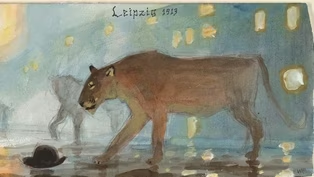
The exhibition presents Ford's studies and watercolors that imagine encounters between lions and humans.
These works include a series that features the Barbary lion.
Now an extinct subspecies, the Barbary lion fought gladiators in ancient Rome, and was the inspiration for the MGM iconic "Ars Gratia Artis" logo.
[soft piano music] Also on view are compositional sketches from a series inspired by the escape of eight lions in Leipzig in 1913.
[soft piano music continues] Another series features the story of a black panther that escaped the Zurich Zoo, and spent weeks alone in the countryside.
In dozens of paintings and drawings, Ford visualizes the panther surviving in the snowy Alps.
On some pieces depict the panther from the point of view of Swiss villagers, others imagine the animal's viewpoint.
The end of the presentation features work selected by Ford from the Morgan's extensive holdings.
The artist's choices highlight his expertise in depictions of animals throughout the centuries, providing insights into the creative process in many of these works.
The selection features some of the Morgan's finest animal drawings, including works by John James Audubon, Eugene Delacroix, Dorothea Maria Gsell, and many more.
[soft piano music continues] The exhibition is on view until October 20th.
Next week on "NYC-Arts", a profile of photographer Joel Meyerowitz, known mostly for his street photography, and for advancing the recognition of color photography as an art form.
- I remember walking through Paris, and suddenly smell baking croissants on the air.
Butter and sugar and oh... And immediately, you want a croissant, or a cookie or something, right?
And then you take two steps, and it's gone.
To me, that's what photography is.
You walk along the street, and something happens.
And you get it.
It's a visual that is as precise as that fragrance that is only in the air of the doorway.
- [Philippe] A look at the exhibition, "Reimagine: Himalayan Art Now".
It is on view at the Rubin Museum in Chelsea.
The exhibit includes painting, sculpture, sound, video, installation, and performance.
The works reimagine the forms, symbols, and narratives found within the living cultures of Tibet, Nepal, Bhutan, and other Himalayan regions.
And a visit to the South Street Seaport Museum, and its beloved tugboat, the W.O.
Decker.
- She's the only opportunity that you have to take a tugboat ride in New York City.
It is just about as much fun as you can have on New York Harbor.
- I hope you've enjoyed our program tonight.
I'm Philippe De Montebello, thanks for watching, and see you next time.
[soft lighthearted music] [soft lighthearted music continues] [soft lighthearted music continues] - [Narrator] Funding for "NYC-Arts" is made possible by... Thea Petschek Iervolino Foundation.
Jody and John Arnhold.
The Lewis "Sonny" Turner Fund for Dance.
The Ambrose Monell Foundation.
Elise Jaffe and Jeffrey Brown.
Charles and Valerie Diker.
The Milton and Sally Avery Arts Foundation.
Elroy and Terry Krumholz Foundation.
The Nancy Sidewater Foundation.
And Ellen and James S. Marcus.
This program is supported in part by public funds from the New York City Department of Cultural Affairs, in partnership with the City Council.
Additional funding provided by Members of Thirteen.
And by Swann Auction Galleries.
- [Presenter] Swann Auction Galleries.
We have a different way of looking at auctions, offering vintage books and fine arts since 1941.
Working to combine knowledge with accessibility.
Whether you're a lifelong collector, a first time buyer, or looking to sell, information at swangalleries.com.
"Walton Ford: Birds and Beasts of the Studio" at the Morgan
Video has Closed Captions
Clip: S2024 Ep615 | 3m 47s | A look at the exhibition "Walton Ford: Birds and Beasts of the Studio" at the Morgan. (3m 47s)
Providing Support for PBS.org
Learn Moreabout PBS online sponsorship
- Arts and Music
The Best of the Joy of Painting with Bob Ross
A pop icon, Bob Ross offers soothing words of wisdom as he paints captivating landscapes.














Support for PBS provided by:
NYC-ARTS is a local public television program presented by THIRTEEN PBS
Major funding for NYC-ARTS is made possible by The Thea Petschek Iervolino Foundation, Jody and John Arnhold, The Lewis “Sonny” Turner Fund for Dance, The Ambrose Monell Foundation, Elise Jaffe...