NYC-ARTS
NYC-ARTS Full Episode: November 2, 2023
Season 2023 Episode 598 | 27m 46sVideo has Closed Captions
A profile of Ballet Hispánico and a look at "Max Beckmann: The Formative Years."
A profile of Ballet Hispánico, the nation’s premiere organization celebrating Latino dance. Then a look at Neue Galerie's exhibition, "Max Beckmann: The Formative Years, 1915-1925." It focuses on the 10 years when the artist moved away from his Impressionistic origins to a new style. Then a ride-along with Manhattan florist Lewis Miller who likes to brighten up New York with his art.
Problems playing video? | Closed Captioning Feedback
Problems playing video? | Closed Captioning Feedback
NYC-ARTS is a local public television program presented by THIRTEEN PBS
Major funding for NYC-ARTS is made possible by The Thea Petschek Iervolino Foundation, Jody and John Arnhold, The Lewis “Sonny” Turner Fund for Dance, The Ambrose Monell Foundation, Elise Jaffe...
NYC-ARTS
NYC-ARTS Full Episode: November 2, 2023
Season 2023 Episode 598 | 27m 46sVideo has Closed Captions
A profile of Ballet Hispánico, the nation’s premiere organization celebrating Latino dance. Then a look at Neue Galerie's exhibition, "Max Beckmann: The Formative Years, 1915-1925." It focuses on the 10 years when the artist moved away from his Impressionistic origins to a new style. Then a ride-along with Manhattan florist Lewis Miller who likes to brighten up New York with his art.
Problems playing video? | Closed Captioning Feedback
How to Watch NYC-ARTS
NYC-ARTS is available to stream on pbs.org and the free PBS App, available on iPhone, Apple TV, Android TV, Android smartphones, Amazon Fire TV, Amazon Fire Tablet, Roku, Samsung Smart TV, and Vizio.
Providing Support for PBS.org
Learn Moreabout PBS online sponsorship♪ >> coming up, on NYC Arts, the profile of America's premier Latino dance company, whose repertoire comes from many dances and countries.
>> the mission is to bring together different communities to celebrate, share, explore the joys and heritage of Latino cultures.
>> and a look at an exhibition, the formative years now On View.
Featuring 100 work's -- works, it is comprised of paintings, drawings, and photos.
It focuses on the 10 years when the artists style moved away from impressionistic origins to the style of new objectivity.
And a right along with Miller, who brightens up New York by sharing art with the public.
>> I want people to interact with them but also take a blossom, take some home.
The more we can have soft moments of beauty and joy, even if it is for 10 minutes, the job is done.
>> funding for NYC Arts is made possible by Jody and John Arnhold, the Lewis sunny Turner fund for dance, Jeffrey ground, just Jeffrey Brown, the Milton and Sally Avery arts foundation, the Nancy site water foundation, and Ellen and James S Marcus.
This program is supported in part with the city Council.
Additional funding provided by members of 13 and a Swan auction Galleries.
>> we have a different way of looking at auctions, offering fine arts since 1940 one, working to combine knowledge with accessibility.
Information at Swan Galleries.com.
>> good evening and welcome to NYC Arts.
I am on location at the Hispanic society Museum and Library.
In the interest of truth in advertising, read off the bat I should say I am the chairman of the board of this institution after having been at the Metropolitan Museum of Art for 40 years.
I would not choose this position if it were not an outstanding institution.
It is located in upper Manhattan in Washington Heights neighborhood, the society provides free of charge access to the most extensive Hispanic art and literature collection outside of Spain and Latin America.
Here in the magnificent Maine court is an exit patient called a collection without Borders.
It brings together works from the Hispanic society that celebrates the art and culture of Spain, Portugal, Latin America, and the Philippines.
Many works were acquired by the Hispanic society founder and this was in the early 20th century.
Others were acquired through purchase or donation after his death in 1955.
The highlight of the Hispanic society Museum and Library is this gallery that houses the monumental gallery of paintings known as the vision of Spain.
Huntington commissioned the paintings in 1911 for a new gallery to be built on the west side of the main building.
It had already been the subject of traveling exhibitions in the United States organized by the Hispanic society in 1909 and 1911.
The 1909 exhibition attracted some 160,000 visitors within one month.
Nearly 12 feet tall and 200 feet and combined length, the canvases were built in various locations in Spain between 1912 and 1919.
In the gallery the viewers surrounded by the people customs and traditions of various regions of Spain.
Both Sorolla and Huntington noted that the series represented a Spain that was already on the point of disappearing.
All of the canvases were restored in 2006-2007 prior to an exhibition tour in Spain.
From November 2007 to February 2010, Sorolla's Vision of Spain was exhibited in Valencia, Seville, Málaga, Bilbao, Barcelona, and Madrid.
On public view for the first time in Spain, Sorolla's masterwork created a sensation that attracted over two million visitors, making it the most visited exhibition in Spain's history.
It is here in New York.
The fully renovated Sorolla Vision of Spain Gallery was inaugurated in 2010 upon the return of the paintings to the U.S.
Upon the museum's re-opening last spring, the first exhibition in the United States by the Spanish artist Luz Camino was held in the Sorolla Gallery.
Jewels in a Gem: Luz Camino at the Hispanic Society Museum celebrated not only her 50 year career, but also her unique designs, fine craftsmanship, and passion for unusual materials.
Camino and Sorolla had a shared approach to vibrant colors as well as their heritage.
Both artists used Spanish elements including flowers, fruits, castanets, and imagery inspired by flamenco.
The Hispanic Society is now celebrating Pablo Picasso on the 50th anniversary of his death.
The Picasso Celebration 1973-2023 will involve as many as 50 exhibitions and events across Europe and North America showing Picasso's work and his artistic legacy.
One of the exhibitions, Picasso and the Spanish Classics, is on view at the Hispanic Society.
It explores Picasso's response to Spanish literature, in particular his images inspired by two 17th century literary masters, Luis de Gongora y Argote and Miguel Cervantes.
It includes rarely seen works by the artist, alongside 17th century editions and manuscripts .
It also highlights Picasso's vision of the ideal woman, as well as his depiction of the iconic figures from Cervantes novel, Don Quixote.
The exhibition is on view through February 4.
On our program tonight, we'll go behind the scenes with America's premiere Latino dance company.
Founded in 1970 by the late Tina Ramirez and now under the direction of Eduardo Vilaro, it is called ballet Hispánico and brings communities together to celebrate Hispanic cultures.
Its repertory draws from many traditions and many countries from classical ballet to Spanish flamenco, Latin social dances to Afro-Cuban rhythms.
Through performances, dance training programs, and community outreach, Ballet Hispanico inspires people of all ages and backgrounds.
♪ Eduardo Vilaro: Ballet Hispánico's mission is to bring together individuals and communities to celebrate, share, explore the joys, the heritage of Latino cultures.
And so in that mission, the vision is about opening up this dialogue for everyone to explore what it is to be Latino today.
I've been associated with the organization since 1985.
First as a dancer and then as the artistic director.
Ballet Hispánico has been around since 1970, when Tina Ramirez, our founder, wanted to give voice to the art -- two the Latino artist.
And she began with a handful of young ladies who wanted to learn how to dance professionally.
Michelle Manzanales: The Ballet Hispánico School of Dance has been around for almost 50 years.
It's about giving access to the art form for anyone.
Students can come and study all different genres, whether it be ballet, flamenco, hip-hop.
We have these traditional dance forms that we celebrate: classical Spanish dance, flamenco, but also fusion.
We're honoring history, but we're also taking it to the future.
Eduardo Vilaro: I consider Ballet Hispánico a contemporary Latino dance company, which means we are looking at the culture in a contemporary way.
And the dancers are highly trained in classical dance, because that's our heritage.
♪ Melissa Fernandez: I trained strictly in classical ballet in the Cuban tradition from five years old to about 15.
I went to an arts high school, New World School of the Arts in Miami, which offered not only a strong base in classical ballet, but also the classical modern forms like Graham, Limon, Taylor, Cunningham.
I think something that really helped me prepare for this role that I'm now in Ballet Hispánico was the idea that I couldn't just box myself in into one category.
I wasn't just a ballet dancer, I wasn't just a modern dancer.
♪ Michelle Manzanales: Our dancers at Ballet Hispánico, because they work with so many different choreographers, we want them to be that blank slate that is willing to take the risk to go into these different roles, to these different styles of dance, it's like being a chameleon, they have to be able to transform themselves.
Melissa Fernandez : Obviously we're always gonna stay true to our Latin roots, so there will be many, many pieces that you see were there's an influence of salsa, or rumba, or Mambo, cha cha cha.
And then we have contemporary modern.
And I think that's what Ballet Hispánico represents, a fusion of cultures and styles.
♪ I don't belong here ♪ Eduardo Vilaro: Danzón is a contemporary ballet that was created in collaboration with Paquito D'Rivera.
I found it so riveting, the fusion of jazz with strings.
Of course we added a lot of more Latin rhythms, when we put it together.
And danzón itself is a fusion of African and Spanish, and also many different forms of music in Cuba.
A lot of the challenges of bringing in a new dancer to work like this is style.
So each choreographer has their own style in their genre.
And for me you know to get a dancer to be very technical and at the same time grounded in Afro-Cuban movement is a challenge.
Sometimes it's easy to coach the technical aspects.
The artistry, the intention, that is something else.
And it is a wonderful process, because it's there that that the artist learns a lot of themselves and then reflects it back.
And that reflection is in the performance and it's beautiful.
>> spiral your back.
That is it.
This was lovely.
Johan Rivera: None of the dancers are actually alike when it comes to personality, like charisma, quality of movement.
So I need to work around the 360 view of like how this dancer can use the material and now make it his own.
As a dancer myself, it's like I said something when I was doing that alone.
Now I want that person to have the opportunity and the space to find their own message to share.
>> Think about the progression of like going down as like descending from the material.
Nick Fearon: I wasn't too familiar with the Latin styles of dance coming into Ballet Hispánico, but it was something that everyone else was very familiar with so they taught me very quickly.
The culture is definitely a big aspect to Ballet Hispánico in general.
Because I'm not Latino myself, I'm Irish and Polish, so, it's not only about embracing the Latin culture but it's about bringing your own culture in and embracing that, as well.
Michelle Manzanales: An exciting part of being a dancer for Ballet Hispánico is getting the opportunity to explore these different voices.
And if you look at our dancers, they're so diverse, and that diversity, coupled with the choreographer's voice, coupled with Ballet Hispánico's mission altogether, that's what makes it so rich.
♪ Eduardo Vilaro: Every choreographer that comes to Ballet Hispánico to make a piece gets that conversation with me about culture And they divert .
Differently.
We've run the range from my work that is full of Latino Caribbean movement, to Ron K. Brown, that is much more Afrocentric, to Tania Pérez-Salas, which is very abstract, and to Annabelle Lopez Ochoa, who grew up in Belgium with a parent who's from Colombia.
So it's very rich for us, because it really shows us that the depth of how culture affects each artist.
Like Michelle's piece Con Brazos Abiertos is a perfect example.
♪ Michelle Manzanales: Con Brazos Abiertos is really just -- was a dream come true for me.
The work is really about telling the story of what it is like to live between two cultures.
For me as a Mexican-American person growing up in Texas, it allowed for me to sort of reflect on that and then bring this piece to life from those experiences.
The music ranges, it's very eclectic which is how I feel, I'm not one thing, I'm not just mariachi music and I'm not just pop music of the 80s, I'm somewhere in between.
♪ The sombrero was a fun thing to explore, the sort of cultural stereotypes but then also deconstructing it, manipulating it, and using the hat as a symbol.
Melissa Fernandez: She uses her early stages of vulnerability as a young dancer, as a young choreographer, and then slowly it evolves to show how her insecurities bloom into acceptance and admiration for her culture.
♪ We are not only dancers.
We're artists, but we're also teaching artists.
One of the great missions of Ballet Hispánico is to go out into the community and teach workshops and engage children and adults, all ages, all socio-economic levels.
Eduardo Vilaro: When we do work in the community, it's about saying, this artform is yours.
Even if you are not Latino.
You don't have to learn to speak Spanish.
You learn to move, another language that that breaks barriers of color and social status.
And you know when you grab someone's hand and you lead them onto the dance floor, even the person that's most inhibited, lets go just a little bit.
And if we can find those pockets of letting go and open them even more, that's what Ballet Hispánico is about right now.
♪ >> Now a look at Max Beckmann: The Formative Years, 1915-1925 on view at Neue Galerie.
This exhibition focuses on the shift in Beckmann's work during the crucial decade following World War I.
Born in Leipzig, Germany, he was 30 when the war broke out.
Featuring 100 works by Beckmann, the exhibition comprises of paintings, drawings, and significant print portfolios.
It focuses on the 10 years when the artist's style moved away from his Impressionistic origins to the style of the Neue Sachlichkeit, or New Objectivity, that defined his later work.
Beckmann became one of the most admired practitioners of representational painting.
This status is confirmed by the prominent representation of his work in the 1925 Neue Sachlichkeit exhibition in Mannheim, Germany.
The dramatic shift in his approach can be traced back to his experience during World War I.
With the outbreak of hostilities, Beckmann spent time in East Prussia as a volunteer nurse.
Even though his involvement was short-lived, he was profoundly affected by his combat experience.
In July 1915, he suffered a nervous breakdown and was discharged from service.
Beckmann moved to Frankfurt to recover, and his work changed.
The painterly and romantic compositions of the pre-war years were replaced with more angular forms.
His palette became darker, and his use of paint more subdued.
Landscape near Frankfurt with Factory is a striking depiction of the city where Beckmann sought refuge during World War I and remained until 1933.
He increasingly returned to the subject of the landscape, favoring areas on the periphery of a city.
♪ Beckmann's post-war subjects reflected more scenes of violence, and he confronted political intolerance and exposed poverty and social injustice.
He developed a new approach to art, and one that helped him process painful memories and acknowledge recent artistic developments that he had previously criticized.
♪ The Bark, which shows a tower of figures boating and sunbathing in Italy, limbs are tangled together, sticking out at severe angles, as the unsuspecting bathers begin to sink into the water.
This painting and others like it, including Galleria Umberto, are Beckmann's response to the rise of Fascism in Italy.
The works point to the change in political tides in a general way without referring to them explicitly.
♪ Max Beckmann: The Formative Years, 1915-1925 is on view through January 15, 2024.
♪ Manhattan florist Lewis Miller likes to brighten up New York by sharing his art with the public.
His pop-up arrangements, known as flower flashes, have appeared all over the city.
Since the start of the pandemic, he's created several flashes to honor healthcare workers and the resilient spirit of New York City.
We joined Miller and his crew a couple of years ago on one of their early morning adventures.
♪ Lewis Miller: Flowers were always part of my DNA.
I come from a family of gardeners, but I went from landscaping, horticulture to the flower world and here I am.
The flower flash was something that was kind of bopping around my brain for a while.
It did not have a name, it was sort of more this vague idea of how to take flowers and fuse them in a urban city environment.
So it finally got to the point a couple years ago where I was very satisfied with business, things going super well, and kind of needing to feel creatively energized again, but also feeling the need in my own way to give back.
I'm clearly surrounded by flowers on a daily basis, as are my clients, and we tend to get immune to how beautiful they are and what an expression of joy they are to people.
And it's really about taking that which is so beautiful and ephemeral and kind of merging it with the texture and the grit of our urban city life and creating something that's very spontaneous, very fleeting, and sort of abstract.
♪ We spend a great deal of time, you know, really finding locations that feel New York first.
So that combined with the season, what's looking good, and also, the flower flashes are an accumulation of old flowers in the flower market, stuff that's left over from the studio, and stuff that's left over from events, so we have to work with that as well.
These flashes happen very quickly.
We plan it to a certain extent, then we just do it and see what happens.
There's a little anxious energy, you know, it's usually dark.
A lot of times it's cold.
The flowers are for New Yorkers.
They are for the people, and I want people to take them and interact with them.
Obviously, take a picture, but take a blossom, take some home.
New York is New York.
All these people piled on top of each other.
To me, you know, the two biggest luxuries in the city are nature and space, so the more that we can have these kind of soft moments of just beauty and joy for no other reason, even if it's for an hour or ten minutes, its job is done.
♪ >> Next week on NYC-Arts, a visit to the New York historical Society and the exhibition Kay WalkingStick/Hudson River School, which features landscape paintings by the renowned Cherokee artist alongside 19th century paintings from the Society's own collection.
♪ A look at the exhibition Barkley L. Hendricks: Portraits at the Frick, now on view at Frick Madison.
Hendricks revolutionized contemporary portraiture by combining portraits of Black figures with traditions of European painting.
He created paintings in numerous media, as well as drawings, collages, and sculptures.
He was also an accomplished photographer.
♪ And a profile of modern violin maker who has spent his career creating violins for some of the world's most talented musicians.
Samuel Zygmuntowicz: Every violin I make, I keep really exhaustive records on every aspect about it that I can.
If an instrument of mine comes back and I really like it, I want to make another one like that, I have some record of what I did.
♪ >> I hope you enjoyed our program this evening.
I'm Philippe de Montebello on location at the Hispanic Society Museum & Library.
Good night and see you next time.
♪ ♪ >> FUNDING FOR NYC-ARTS IS MADE POSSIBLE BY THEA PETSCHEK IERVOLINO FOUNDATION JODY AND JOHN ARNHOLD THE LEWIS SONNY TURNER FUND FOR DANCE THE AMBROSE MONELL FOUNDATION ELISE JAFFE AND JEFFREY BROWN CHARLES AND VALERIE DIKER THE MILTON AND SALLY AVERY ARTS FOUNDATION ELROY AND TERRY KRUMHOLZ FOUNDATION THE NANCY SIDEWATER FOUNDATION AND ELLEN AND JAMES S. MARCUS.
THIS PROGRAM IS SUPPORTED, IN PART, BY PUBLIC FUNDS FROM THE NEW YORK CITY DEPARTMENT OF CULTURAL AFFAIRS IN PARTNERSHIP WITH THE CITY COUNCIL.
ADDITIONAL FUNDING PROVIDED BY MEMBERS OF THIRTEEN AND BY SWANN AUCTION GALLERIES.
>> Swann auction galleries.
WE HAVE A DIFFERENT WAY OF LOOKING AT AUCTIONS, OFFERING VINTAGE BOOKS AND FINE ART SINCE 1941.
WORKING TO COMBINE KNOWLEDGE WITH ACCESSIBILITY, WHETHER YOU ARE A LIFELONG COLLECTOR OR A FIRST-TIME BUYER, OR LOOKING TO SELL.
INFORMATION AT SWANNGALLERIES.COM.
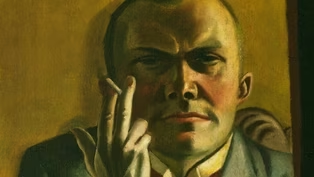
Max Beckmann: The Formative Years, 1915-1925 at Neue Galerie
Clip: S2023 Ep598 | 3m 58s | A look at Neue Galerie's exhibition, "Max Beckmann: The Formative Years, 1915-1925." (3m 58s)
Providing Support for PBS.org
Learn Moreabout PBS online sponsorship

- Arts and Music
The Best of the Joy of Painting with Bob Ross
A pop icon, Bob Ross offers soothing words of wisdom as he paints captivating landscapes.











Support for PBS provided by:
NYC-ARTS is a local public television program presented by THIRTEEN PBS
Major funding for NYC-ARTS is made possible by The Thea Petschek Iervolino Foundation, Jody and John Arnhold, The Lewis “Sonny” Turner Fund for Dance, The Ambrose Monell Foundation, Elise Jaffe...