NYC-ARTS
NYC-ARTS Full Episode: November 9, 2023
Season 2023 Episode 599 | 27m 46sVideo has Closed Captions
A trip to N-YHS and then a look at an exhibition on view at Frick Madison.
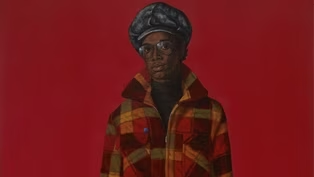
A trip to the New-York Historical Society and the exhibition “Kay WalkingStick/Hudson River School,” which features landscape paintings by the renowned Cherokee artist displayed in conversation with 19th century paintings from the Society’s own collection. Then a look at “Barkley L. Hendricks: Portraits at the Frick,” now on view at Frick Madison, which presents fourteen works by the artist.
Problems playing video? | Closed Captioning Feedback
Problems playing video? | Closed Captioning Feedback
NYC-ARTS is a local public television program presented by THIRTEEN PBS
Major funding for NYC-ARTS is made possible by The Thea Petschek Iervolino Foundation, Jody and John Arnhold, The Lewis “Sonny” Turner Fund for Dance, The Ambrose Monell Foundation, Elise Jaffe...
NYC-ARTS
NYC-ARTS Full Episode: November 9, 2023
Season 2023 Episode 599 | 27m 46sVideo has Closed Captions
A trip to the New-York Historical Society and the exhibition “Kay WalkingStick/Hudson River School,” which features landscape paintings by the renowned Cherokee artist displayed in conversation with 19th century paintings from the Society’s own collection. Then a look at “Barkley L. Hendricks: Portraits at the Frick,” now on view at Frick Madison, which presents fourteen works by the artist.
Problems playing video? | Closed Captioning Feedback
How to Watch NYC-ARTS
NYC-ARTS is available to stream on pbs.org and the free PBS App, available on iPhone, Apple TV, Android TV, Android smartphones, Amazon Fire TV, Amazon Fire Tablet, Roku, Samsung Smart TV, and Vizio.
Providing Support for PBS.org
Learn Moreabout PBS online sponsorship>> coming up on NYC arts, a visit to the New York historical Society and the exhibition which features landscape paintings by the renowned Cherokee artist alongside 19th century paintings from the Society's own collection.
>> the question that poses is what is the relationship between these two bodies of work and what story do they talk together about North American land and landscape practice?
>> a look at the exhibition, now at -- On View at Frick Madison.
They combined portraits of black figures with European painting.
He created paintings in numerous media as well as drawings, collages, and sketches.
He was also an accomplished photographer.
And the profile of a modern violin maker who spent his career creating violins for some of the world's most talented musicians.
>> At the file and I make, I have really exhaustive records on every aspect of it.
If an instrument of mine comes back, I really like it, I have some record of what I did.
>> Funding for NYC Arts is made possible by -- foundation.
The Lewis Sonny Turner fund for dance, the Ambrose foundation and Jeffrey Brown, Charles and Valerie, the Melton and Sally Avery arts foundation.
The Nancy side water foundation, and Ellen and James.
This program is supported in part by public funds from the New York City Department of cultural affairs in partnership with the city Council.
Additional funding provided by members of 13 and Swan auction galleries.
>> We have a different way of looking at auctions, offering vintage books in fine arts, working to combine knowledge with accessibility, whether you are a lifelong collector or looking to sell.
Information at the website.
♪ >> good evening.
I am on location at the Hispanic Society museum and library.
In the interest of truth in advertising, I should say right off the bat that I am the chairman of the board of this institution.
Having been at the Metropolitan Museum of Art for more than 40 years, I would not have chosen this position if this were not an outstanding institution in its own field.
It is located in upper Manhattan in Washington Heights neighborhood.
The society provides free of charge access to the most extensive Hispanic art and literature collection outside of Spain and Latin America.
Here in the magnificent Maine court is an exit -- Mainn court is a selection of works from the Hispanic Society that celebrate the art and culture of Spain, Portugal, Latin America, Goa, and the Philippines.
Many of these works were acquired by the Hispanic society's founder, archer Milton Huntington, and this was in the early 20th century, while others were acquired through purchase or donation after his death which was in 1955.
The court was designed by Charles Pratt Huntington under the direction of the museum's founder who wanted to re-create the 16th-century Spanish Renaissance in terra-cotta.
Paintings from the 16th through the 20th century hang in the open arches and under the arcade representing religious figures, portraits of individuals of various backgrounds in addition to a few abstract works.
One of the highlights On View is the young man from the coast by José Augustine Arrieta, Mexico's best known painter of scenes of everyday life in 19th-century Puebla, the city in which he lived most of his life.
In the 19th century, the Gulf Coast region near Veracruz was populated by the largest Afro Hispanic ethnic group in the area at that time.
Hence the title.
The painting depicts a young man of African descent holding a basket of tropical fruits including a yellow mango, avocados, prickly pear, pineapple, and a melon.
Dressed simply in a billowing white shirt and blue striped white overalls, the young man presents his offerings with a slight smile on his lips, silhouetted against a neutral background.
He is considered one -- it is considered one of his most outstanding and singular achievements.
Beyond the beauty of the dignified subject of this masterpiece, the painting evokes the centuries of abuse endured by enslaved men and women in Mexico before the abolition of slavery in 1829.
An example of a more contemporary work in the collection is a painting with object B.
Born in Barcelona in 1912, he trained at the Royal Academy of San Jorge.
In addition to painting, he studied music and philosophy.
His style develops from naturalism and Expressionism and then goes to abstraction.
That will become even more radical over time.
Typical of his work, meer uses shades of gray, ocher, and white over a rocky eroding texture.
The subject of the painting is a door with a handle that cannot be turned.
The door appears more like a rock, a rock that is impossible to access.
The painting was included in an important traveling exhibition in New York in 1962, titled "modern Spanish painting."
On our program tonight, we look at Hudson River school at the New York historic society.
It features landscape paintings by the charity artist kay walkingstick.
Featuring more than 40 works including paintings as well as objects such as woven baskets and ceramic jars, the exhibition explores the relationship between indigenous art and the standard history of Art in America.
Curator Wendi will be our guide.
The exhibition is On View through April 14, 2024.
>> Kay WalkingStick Hudson River school brings together two discrete sets of landscape paintings.
One by the contemporary Cherokee artist Kay WalkingStick and the other by a group of 19th century artists, primarily European-American men known as the Hudson River school.
The question that the exhibition poses is what is the relationship between these two bodies of work?
Do they support one another?
Do they conflict with one another?
do they tell the same story, different stories?
And what story do they tell together about North American land and about landscape practice?
Kay WalkingStick is a force in contemporary American art and one of the most renowned artists of her generation.
She is 88 years old and still building a remarkable career that at this point spans six decades.
The Hudson River school is generally credited with forging the American landscape tradition.
As kay said to me when we first met, how can you be a landscape painter in the United States and not think about the Hudson River school?
The answer is you cannot because their legacy looms so large.
But that does not mean that the Hudson River school paintings are not problematic.
Her work helps us to see some of those problems including its representation or lack of representation of the native communities already in this land.
inKay's -- in kay's current landscape practice, she lays vistas with patterns and she draws these patterns from native objects.
We are looking at a painting landscape that is a window onto an illusionist take world -- illusionistic world and these sit on the window glass so they pop off just a little bit off of the representational landscape and they act as a kind of barrier or speed bump so they stop your eye just a little bit from going straight into the land and this is one way that Kay re-characterizes North American landscapes that have been upheld by Hudson River school artists as ripe for settlement, as part of the story of American colonizers.
She reclaims this land as indigenous homeland.
We open the exhibition with her reinterpretations of a painting by Thomas and a painting by Durant.
The Thomas Cole painting that Kay decided to tackle is one of the most iconic paintings in American art history.
Every student of American Art history knows this painting.
It is in the collections of the Metropolitan Museum of art.
The title of her painting is "Tom, where are thee -- ?"
She is speaking directly to him and asking, how can you paint this land?
How can you paint the Connecticut River Valley and not acknowledge, not honor the native people who live there?
One of my favorite works in the exhibition's Niagara.
This was painted by Kay in 2022.
We had invited her to view our Hudson River school paintings at our storage facility in Jersey City and she was immediately drawn to two paintings in particular, both of Niagara Falls but in very different formats.
One by a woman named Louisa and another by John Trimble, just long and panoramic and all-encompassing.
It is a gorgeous landscape.
Kay positions the viewer at the brink of the falls.
She spills the water across two square panels.
We see this line where the water bends over the cliff that Kay describes as luminescent like blown glass, and we see the water falling in what she describes as clumps of cotton wool.
It is beautiful.
You can feel immersed in it.
It is 80 inches wide and you can almost feel the famous spray of Niagara prickling your skin but it's also so much more than a rapturous landscape because of that pattern that she overlays on top of it so she has taken Niagara Falls, which for decades has been upheld by so many European-American artists as a monument to American grandeur and power, and she has recharacterized it as indigenous homeland.
American art is a plurality, and I think that by attending to that plurality of voices, by looking at the conflicts, by looking at the connections, between different groups and across time, we can push this field productively forward.
♪ >> Currently On View at first Madison, -- frick Madison is an exhibit that Mary's subject and location.
Barclay L Hendrix portraits 14 works by the pioneering American artist Hendrix which revolutionized portraiture by combining portraits with European painting.
Frick Madison is a fitting venue.
It was the location of where in 1981, when the space was occupied, Hendrix first showed his art in New York City.
Born in 1945 in Philadelphia, Hendrix was inspired by a diverse array of sources including jazz, an African led indigenous art.
He created paintings in numerous media as well as drying collages and sculptures.
He was also an accomplished photographer and he often based his painted portraits on photos he had taken in his studio or on the street.
Beginning in the late 1960's, Hendrix drew inspiration from traditions of European art such as Byzantine icons and Renaissance paintings.
The Frick collection with its iconic portrait by Rembrandt, van Dyck, and others, was one of his favorite places to visit.
His vivid depictions of black subjects reflected the dignity and individuality of his sitters.
From 1969, it depicts his cousin, Kathy Williams.
To create it, he learned the centuries-old and painstaking technique of applying goldleaf and crafted a rounded top that echoes Renaissance art and architecture.
The title, taken from lyrics by Nina Simone, also evokes the traditional Christian Lord and mother.
Together, these elements transform what might otherwise be seen as simply contemporary portrait of a family member into a profound meditation on past and present with a touch of humor.
Hendrix often set his figures against achromatic expanse of color.
Another element inspired by Renaissance portraiture.
His backgrounds, such as in blood from 1975, were executed in Matt acrylics while the figures were painted in oil, resulting in a contrast that can only be fully appreciated in person.
The varnished faces and bodies glistened in the light as if on a separate plane from the background.
The exhibition also brings together a group of the artists so-called limited palette paintings in his white on white works in particular.
The figures brown skin tones and dark hued accessories become abstract shapes when viewed from afar while up close, the variation within the dark tones and the color white becomes evident.
He sought to make his work approachable and human.
He always requested that his paintings be hung relatively low so that they might meet the viewer's gaze eye to eye, acknowledging the inspiration of Renaissance painting.
He also wanted to create work with universal appeal.
Barclay L Hendrix portraits at the Frick are On View through January 7.
On our program tonight, NYC Arts visits the Brooklyn studio of a modern violin maker to discover the unique skills and delicate process involved in creating an outstanding instrument.
Regarded as one of the greatest contemporary makers, Samuel discovered his craft as a teenager and went on to study at the violin making school of America insult Lake City.
Ever since then, he has spent his career creating violins for some of the world's most talented musicians.
The history of the violin spans over 450 years.
It's sound, appearance were influenced early on by the skill of notable violin makers such as the Armani family and Antonio Stroud of Ari.
-- and Antonio stradivari.
In America, violin makers are drawn into the practice through personal passion and artistic interest which has led to an American Renaissance of the craft that began in the 1970's and continues today.
♪ >> I was interested in sculpture and art from as little as I could remember.
I was always doing sculpture.
I think I was good at it and everyone assumed I would be a professional artist.
When I was 13, I read a book about a violin maker and I kinda got interested in instrument making.
It uses all the attributes of art but it is for practical purpose and it has a very clear metric.
It either performs well as a violin for the musician or it does not.
It is dependent on knowledge and skill.
If someone comes to me to have a violin made, there is kind of a process where I want to understand first of all why did they come to me?
Presumably, they have heard instruments of mine.
I want to see their violin and understand what they want.
Are they a soloist, are they a very aggressive, strong player, are they someone who is a more subtle player, softer?
Then I will go back to my shop and then it is up to me to decide what I will make them to serve their needs.
All around me here, there is my Woodstock or some of my Woodstock and it is kind of like a collection of wine or something.
It comes from all over Europe.
I have been buying wood from the beginning of my career.
It has to sit for a long time but then I can go through that and I pick would not just visually but based on its density and stiffness, how I think it will behave.
First, I have to make what is called the rib structure which is the sides and those are bent out of thin wood around a form which I have designed.
From the sides I have made, I will then create the outline of the instrument and saw out the top and the back.
While the ribs are bent, the top and the back have an arch that is carved in because it is compound.
The arching is critical to the tone color.
Probably the most important part of the violin is the front, the top.
That is the part that vibrates the most.
That is made out of Spruce.
of the European woods, it is the wood that is strongest.
What is challenging is while I am making it, I am relating to it in a visual and tactile way, but when it is working as a violin, it's going to be vibrating in a way that is not visible to the eye but is very real.
It is like a long chess game.
I will not know if I have made the right calls until the instrument has been strong up and played for a while.
It crosses a line from being something that you just made like making a chest of drawers or a house, to being something that is vibrating in response to human interaction.
♪ >> it's not alive exactly, but it's like it's alive.
Every violin I make, I keep really exhaustive records on every aspect of it I can't wood choice, model, thicknesses, weights, varnishes, bass bar dimensions.
If an instrument of mine comes back and I really like it, I want to make another one like that, I have some record of what I did.
On the other hand, if someone comes in and it's like, well, you know, it is not as open as it should be or not as focused, I can look at my notes and see, well, I may have been conservative on that.
I might have a little room to take a little wood out.
Or that one might be a little too flexible.
Maybe I should put a little reinforcement.
You never really understand something until you have to explain it to someone else so it puts me on the spot all the time when I teach.
Most of the great shots historically, including strad ivari were studios.
People working collaboratively will ultimately work at a higher level of development than a single artist.
You could say on the one hand, I am training my competition.
On the other hand, I feel that it is a tribute to the system that I practice.
I am not a magician.
I build things with a method based on skill and if I can convey that, then that sort of is proof of concept.
Art is never existing in a vacuum.
The sort -- what are the source s of knowledge that go into it?
It is pulled forward by the demands of the clientele, the audience.
I have had on a full opportunities, working with great musicians.
I got contacted by Isaac Stern to make a copy of his.
To meet him for me was like -- I don't know.
It's like meeting the Pope or something.
He is legendary.
When the instrument was finally done, I brought it to him and he was incredibly gracious.
When Mr. Stern passed away, the two instruments I had made for him were part of his estate and they were auctioned off.
That violin was recently sold to Chad Hoopes, a wonderful soloist in his 20's.
I think it is a really fitting placement yet I think he would be very pleased.
It was an odd feeling to see that my work has now left my purview.
It has now entered the world where it lives its own life and it has its own history.
And I feel like I have seen my own work go from a decent alternative for a musician to being something that is sought-after and has a place in the history of violin making.
>> next week on NYC Arts, a profile of one of the most rundown American muralists of the 20th century whose modern approach broke away from traditional practice.
>> She pioneered a modern approach and blended influences such as early Byzantine mosaic, ejection wall painting, classical Greek vase painting, and Native American beadwork.
She really incorporated vibrant color, scale, and ornamental style, which were all elements that really became synonymous with Art Deco designs.
>> A look at the exhibition.
It's now on view at the Metropolitan Museum which explores the relationship between these two Masters of 19th-century French art.
I hope you enjoyed our program this evening.
I am Philippe on the case and that the Hispanic Society museum and library.
At night and see you next time.
♪ -- good night and see you next time.
♪ ♪ >> funding for NYC Arts is made possible by -- foundation.
Jody and John Arnhold.
The Lewis Cine Turner fund for dance.
The Ambrose foundation.
Jeffrey Brown, Charles and Valerie.
The Milton and Sally Avery arts foundation.
The Nancy side water foundation, and Ellen and James S markets.
This program is supported in part by public funds from the New York City Department of cultural affairs in partnership with the city Council.
Additional funding provided by members of 13 and by Swann auction Galleries.
>> Swann auction Galleries.
We have a different way of looking at auctions, offering vintage books and fine art since 1941, working to combine knowledge with accessibility, whether you are looking to sell, information at Swann Galleries.com.
Barkley L. Hendricks: Portraits at the Frick
Video has Closed Captions
Clip: S2023 Ep599 | 4m 9s | A look at “Barkley L. Hendricks: Portraits at the Frick,” now on view at Frick Madison. (4m 9s)

"Kay WalkingStick / Hudson River School" at N-YHS
Video has Closed Captions
Clip: S2023 Ep599 | 6m 34s | A trip to the New-York Historical Society for “Kay WalkingStick / Hudson River School.” (6m 34s)
Providing Support for PBS.org
Learn Moreabout PBS online sponsorship

- Arts and Music
The Best of the Joy of Painting with Bob Ross
A pop icon, Bob Ross offers soothing words of wisdom as he paints captivating landscapes.











Support for PBS provided by:
NYC-ARTS is a local public television program presented by THIRTEEN PBS
Major funding for NYC-ARTS is made possible by The Thea Petschek Iervolino Foundation, Jody and John Arnhold, The Lewis “Sonny” Turner Fund for Dance, The Ambrose Monell Foundation, Elise Jaffe...