NYC-ARTS
NYC-ARTS Full Episode: October 19, 2023
Season 2023 Episode 596 | 27m 46sVideo has Closed Captions
A profile of Hildreth Meière and a look at "Manet/Degas" at the Met. Then a trip to AFAM.
A profile of Hildreth Meière, a renowned American muralist of the 20th century. Then a visit to “Manet/Degas,” a major exhibition now on view at the Met, and a trip to the American Folk Art Museum for a look at marble objects by unknown artists in “Material Witness: Folk and Self-Taught Artists at Work.
Problems playing video? | Closed Captioning Feedback
Problems playing video? | Closed Captioning Feedback
NYC-ARTS is a local public television program presented by THIRTEEN PBS
Major funding for NYC-ARTS is made possible by The Thea Petschek Iervolino Foundation, Jody and John Arnhold, The Lewis “Sonny” Turner Fund for Dance, The Ambrose Monell Foundation, Elise Jaffe...
NYC-ARTS
NYC-ARTS Full Episode: October 19, 2023
Season 2023 Episode 596 | 27m 46sVideo has Closed Captions
A profile of Hildreth Meière, a renowned American muralist of the 20th century. Then a visit to “Manet/Degas,” a major exhibition now on view at the Met, and a trip to the American Folk Art Museum for a look at marble objects by unknown artists in “Material Witness: Folk and Self-Taught Artists at Work.
Problems playing video? | Closed Captioning Feedback
How to Watch NYC-ARTS
NYC-ARTS is available to stream on pbs.org and the free PBS App, available on iPhone, Apple TV, Android TV, Android smartphones, Amazon Fire TV, Amazon Fire Tablet, Roku, Samsung Smart TV, and Vizio.
Providing Support for PBS.org
Learn Moreabout PBS online sponsorship>> Coming up on "NYC-ARTS, "a profile of Hildreth Meière, one of the most renowned American muralists of the 20th century whose modern approach broke away from traditional practice.
>> She pioneered a modern approach to murals, and blended influences such as early Byzantine mosaic, Egyptian wall painting, classical Greek vase painting, and native American beadwork.
She really incorporated vibrant color, scale, and ornamental style, which were all elements that really became synonymous with art Deco designs.
>> a look at the exhibition Manet/Degas, now on view at the Met, which explores the relationship between these two masters of 19th century French art.
And a visit to the American Folk Art Museum.
>> Material Witness is organized into four thematic areas.
The first theme is From the Earth.
This group was a great opportunity to showcase how artisans who worked with a material like marble Day in day out also chose to keep working in that material after their workday was done, creating these end of day objects that could have been given as tokens of friendship.
>> FUNDING FOR NYC-ARTS IS MADE POSSIBLE BY -- THEA PETSCHEK IERVOLINO FOUNDATION.
JODY AND JOHN ARNHOLD.
THE LEWIS SONNY TURNER FUND FOR DANCE.
THE AMBROSE MONELL FOUNDATION.
ELISE JAFFE AND JEFFREY BROWN.
CHARLES AND VALERIE DIKER.
THE MILTON AND SALLY AVERY ARTS FOUNDATION.
ELROY AND TERRY KRUMHOLZ FOUNDATION.
THE NANCY SIDEWATER FOUNDATION.
AND ELLEN AND JAMES S. MARCUS.
>> This program was funded in part by public funds from the New York City Department of cultural affairs in partnership with the city Council.
Additional funding provided by members of 13 and SWANN AUCTION GALLERIES.
>> SWANN AUCTION GALLERIES.
We have a different way of looking at auctions, offering vintage books and fine art since 1941.
Working to combine knowledge with the success ability, whether your lifelong collector or a first-time buyer, or looking to sell.
INFORMATION AT SWANNGALLERIES.COM.
>> Good evening and welcome to "NYC-ARTS."
I'm Philippe de Montebello on location at the Hispanic Society Museum & Library.
In the interest of truth in advertising, I should say right off the bat that I am the chairman of the board of this institution.
And I should add that having been at the Metropolitan Museum of Art for more than 40 years, I would not have chosen this position if this was not an outstanding institution in its own field.
It is located in upper Manhattan in the Washington Heights neighborhood, the Society provided free of charge access to the most extensive Hispanic art and literature collection outside of Spain and Latin America.
Here in the magnificent Main Court is an exhibition called A Collection without Borders."
It brings together a selection of works from the Hispanic Society that celebrates the art and culture of Spain, Portugal, Latin America, Goa and the Philippines.
Many of these works were acquired by the Hispanic Society's founder, Archer Milton Huntington, and this was in the early twentieth century, while others were acquired through purchase or donation after his death which was in 1955.
The Court was designed by architect Charles Pratt Huntington under the direction of the museum's founder, who wanted to recreate a sixteenth-century Spanish Renaissance patio in terracotta.
Paintings from the sixteenth through the twentieth centuries hang in the open arches and under the arcade, representing religious figures, portraits of individuals of various backgrounds, in addition to a few abstract works.
Four cases display important objects from the Iberian Peninsula, Mexico, South America, and Asia.
A fifth case, or vitrine, features a sculpture by seventeenth-century Spanish artist, Luisa Roldán (16521706).
While many of these works are well-known, others are exhibited here for the first time in decades, together representing only a small fraction of the museum's vast collection.
One of the highlights is Francisco de Goya's Portrait of the Duchess of Alba, from 1797.
Here the 13th Duchess of Alba poses before her favorite artist who is known to have spent the summer at her estate in southern Spain.
The Duchess wears a black dress and mantilla, a sign of her recent widowhood.
The red military scarf worn belted around her waist belonged to her grandfather, from whom she inherited her titlea title which made her the highest-ranking noble in Spain, after the royal family.
She points to the ground assertively where an inscription reads, Solo Goya ( Only Goya ).
In addition, she is also shown wearing a ring with Goya's name.
The context behind this inscription has long been debated.
The Duchess of Alba's recurring appearance in several of Goya's works clearly attests to a special connection, whether their close relationship was between artist and patron, artist and muse, or something more.
Also on view in the Main Court is Saint Jerome, as depicted by El Greco (or The Greek,) who was active in Italy and Spain between 1541 and 1614.
This is only one of seven of his works in this collection, just to give you an idea of its span.
A native of Crete, he trained as a Byzantine icon painter before moving to Italy where he embraced the style of the Renaissance.
He later settled in Spain.
El Greco's unique style reflects his artistic journey, which combined Byzantine and Italian influences with Spanish spirituality.
He spoke several languages and was obsessed with the challenge of translating abstract concepts into concrete images.
Saint Jerome, a scholar from the 4th century, was best known for his translation of the Bible from Hebrew into Latin and is said to have retreated into the wilderness.
El Greco depicts him gazing at a crucifix and beating his chest with a stone, perhaps while seeking spiritual strength to resume his important work.
The skull and the hourglass symbolize the passage of time and mortality, while the ivy represents the struggle to achieve eternal life.
On our program tonight, a profile of Hildreth Meière, one of the most renowned American muralists of the 20th century.
During her 40-year career from the 1920s until her death in 1961, she pioneered a modern approach to murals that broke away from American academic tradition.
She blended influences such as early Byzantine Mosaic, Egyptian wall painting, Greek vase painting, and Native American beadwork into a style that came to be known as Art Deco.
Working with leading architects of her day, Hildreth designed about 100 commissions.
Her best-known works in New York City include Radio City Music Hall, The Red Room at 1 Wall Street, Temple Emanu-El, and many more.
She decorated buildings across the country from New Jersey to Nebraska.
Known for her willingness to explore new materials, Hildreth designed for a variety of mediums, ranging from mixed metal and enamel to glass mosaic.
The International Hildreth Meière Association was founded by her daughter Louise Meière Dunn.
We spoke with Anna Kupik, great-granddaughter of the artist, at Temple Emanu-El.
Anna Kupik: I am Anna Kupik and I am the President of the International Hildreth Meière Association, also known as IHMA, as well as the great-granddaughter of Hildreth Meière.
Today we're here at Temple Emanu-El in New York City in the Landmark District in Manhattan.
Temple Emanu-El is the largest synagogue in the world and can host 2,500 people.
Hildreth Meière was one of the most renowned American muralists of the 20th century.
Her career lasted for over 40 years, starting in the 1920s until 1961 when she passed away.
She pioneered a modern approach to murals.
Hildreth really broke away from academic tradition and blended influences such as early Byzantine mosaic, Egyptian wall painting, classical Greek vase painting, and Native American beadwork.
She really incorporated vibrant color, scale, and ornamental style, which were all elements that really became synonymous with Art Deco designs.
Hildreth and the architects that she worked with would have likely defined their stylistic approach as modernistic.
The term Art Deco wasn't really expressed until the mid 1960s.
She designed approximately 100 commissions, both secular and liturgical.
Generally, Hildreth's design process would start small in sketch form, and then she would also utilize smaller studies.
Hildreth provided the design, but she did not install the work herself.
Fabricators and installation firms would be hired.
And in the case of St. Bartholomew's and Temple Emanu-El Puhl and Wagner's Berlin factory was used to fabricate.
Hildreth got to visit the factory to learn everything that she could about the mosaic making process and its execution.
Hildreth was selected to provide the Byzantine style glass mosaic decoration for the eight-story high arch of the main sanctuary that encases the Bimah and the Arc housing the Torahs on the Eastern wall behind it.
Temple Emanu-El and the work at St. Bartholomew were completed in close succession.
Over 20 years after the dedication of St. Bart's, Hildreth was asked to design six figurative clear storied stained glass windows.
Unfortunately, Hildreth was only able to complete four out of the six proposed windows.
I feel she can be very proud of her first stained glass work and how all three of her commissions, the Apse, the Narthex, and those stained glass windows are in harmony.
John D. Rockefeller Jr. proceeded with building Radio City Music Hall, and the over Rockefeller Center complex despite the stock market crash.
Hildreth was asked to design three roundels for the 50th street facade, which are up 60 feet high above the Radio City Marquee.
The three roundels were chosen to represent the three forms of theater: song, drama, and dance.
The completed work also represents Hildreth's first time and the first time in general, that metal and enamel decoration were used on such a large architectural scale in the U.S. Hildreth was quite an enthusiastic fan of theater and ballet.
While she was attending performances, she would very intensely observe all the action on stage.
Among her subjects was the legendary actress Margaret Anglin, known for her role in Greek tragedies and Shakespearean dramas.
Anglin was so impressed by Hildreth's ability to capture the spirit of the performances that she asked Hildreth to attend her rehearsals.
Not only did Anglin purchase all of the Hildreth sketches, she encouraged Hildreth to relocate to New York City in order to design costumes for a series of plays that Anglin was appearing in.
And within a week, Hildreth met with Livingston and Platt, Anglin's costume and set designer in New York.
She designed costumes for the Canterbury Pilgrims a Reginald de Koven opera that debuted at the Metropolitan Opera in 1917.
One Wall Street was completed in 1931.
The primary goal of the commission was to create a really warm inviting reception room for the Irving Trust Company.
The challenge was that the room was irregular and faceted with undulating walls that echoed the curved limestone panels of the building's exterior.
The irregular shape makes it difficult to see a repeat in the abstract design, but the patterns are actually repeated on opposite walls.
And if you're ever in the Red Room, you should look for the stamps that indicate how they laid out those panels.
This commission allowed Hildreth to demonstrate talent for creating drama solely through the use of color.
The color gradation moves from the floor in an oxblood red to brilliant orange, and then into a gold glow.
Hildreth Meière's final corporate commission, final New York area commission, were the three large panels in marble mosaic to decorate the walls above the elevator banks at the Prudential Plaza in Newark, New Jersey.
Hildreth selected the Pillars of Hercules as her theme in recognition of the Prudential Insurance company's logo, the Rock of Gibraltar.
Once again, she created a narrative Art Deco design influenced by ancient Greek vase painting and mythology.
When the lobby for the Prudential Plaza was renovated in the late nineties, Hildreth's three panels were removed in place in storage.
Unfortunately, they faced extensive damage.
In 2013, Tony Schiavo, who had been the head mosaicist and was responsible for the original fabrication of the panels, came out of retirement to work with master mosaicist Steven Miotto of Miotto Mosaics on the restoration.
Once the restoration was complete, Prudential donated the center panel to the Newark Museum of Art where it can be seen today.
The International Hildreth Meière Association, also known as IHMA, was founded in 2004 by my grandmother Louise Meière Dunn, who was Hildreth's only child.
IHMA is uniquely positioned to educate the public since we have a firsthand account of her life, including diaries, letters, and pictures.
The house I grew up in in Stanford, Connecticut housed a lot of those sketches and studies and was her summer home.
So her spirit and her art was everywhere in the background of my childhood.
And I'm really thankful to have a consistent connection to Hildreth my whole life.
Most people think they need to go to Europe to see beautiful architecture and decorative art, but Hildreth brought it here to 17 states across the country.
She created something for everyone.
Hildreth created a huge body of work in a relatively short period of time.
She contributed to architectural structures and decorative art that are relevant today.
She created work that is not only representative of that Art Deco time period, but has stood the test of time and is now being appreciated by future generations.
♪ Currently on view at the Metropolitan Museum of Art is Manet/Degas, which explores the artistic conversation between these two masters of 19th-century French art.
Born only two years apart, Édouard Manet and Edgar Degas were friends and rivals whose work shaped the development of modernist painting in France.
Through more than 150 paintings, drawings, and etchings, the exhibit presents their work side by side, examining their lives and careers in parallel.
Manet/Degas begins with a look at the artists' formative years of artistic training and copying practices.
The two men reportedly met at the Louvre, where Degas was drawing in front of a portrait attributed to Velázquez, a work that Manet also copied.
They were among the first generations of artists to avail themselves of a comparatively recent inventionthe museum.
For artists who had previously studied black-and-white reproductions, the experience of seeing the actual works was a revelation.
The exhibition also touches on the central importance of the annual Salon as a proving ground and public stage for both artists.
The Salon would remain vital for Manet, but Degas ultimately abandoned it as he went on to play a leading role in organizing what became known as the Impressionist exhibitions.
The Salon of 1865 marked a turning point: Manet presented his daring Olympia, (on view here for the first time in the United States) while Degas's history painting, Scene of War in the Middle Ages, went unnoticed.
However, another work by Degas from that year, A Woman Seated beside a Vase of Flowers, perhaps inspired by the large bouquet in Olympia, indicated a new direction for the artist.
Manet and Degas continued to push each other to take risks throughout their careers.
The exhibition concludes by examining how the artists' relationship extended beyond Manet's premature death in 1883.
Deeply affected by Manet's death, Degas, who would go on to make art for another three decades, acquired eight paintings, along with drawings and an almost complete set of prints.
The exhibition features many works formerly in Degas's collection, including Manet's The Execution of Maximilian, which Degas methodically reassembled after it had been cut into pieces and dispersed following Manet's death.
While little written correspondence between Manet and Degas survives, their artistic output speaks volumes about how these major artists defined themselves with and against each other.
This exhibition offers a new perspective on the storied pair of artists.
Manet/Degas is on view at the Metropolitan Museum of Art through January 7th, 2024.
♪ Next, a visit to the American Folk Art Museum located across the street from Lincoln Center.
Included in their extensive permanent collection are several marble objects, made by unknown artists, whose subject matter ranges from humorous to poignant.
Curator Brooke Wyatt spoke with NYC-ARTS about these unique objects, which are presented in the museum's exhibition Material Witness: Folk and Self-Taught Artists at Work.
The exhibition will be on view through October 29th.
I'm Brooke Wyatt, and I'm the Luce Assistant Curator at the American Folk Art Museum.
This is Material Witness: Folk and Self-taught Artists at Work.
Material Witness focuses on the materials and the substances like clay, wood, rock, stone, metal, that artists work with to make the objects that are in this museum's collection.
This group was really fun to think about including in the show because it's a great example of a material, in this case, marble, being transformed into not what we would often think about as a marble sculpture, say a portrait bust or a figure on horseback or something.
Here we have a slab of marble turned into, for example, a marble book where the stone mason has incised on the book's spine, the title marble book.
Similarly, there is a big slab of marble that was possibly not big enough to be a tombstone, may have been carved by a memorial mason, however, using the scraps of marble to create humorous objects like a washboard made out of marble.
So if you could imagine doing the already difficult work of hand laundering using a washboard made of wood, typically, but this one in marble takes on this added humor.
This collection of objects also conveys a lot of poignancy as well.
There's a figure of a recumbent lamb.
I was visiting Greenwood Cemetery recently and saw many of these lambs.
During the Garden Cemetery movement in the mid-19th century, there was a movement in the establishment of cemeteries cemeteries just outside of city centers.
And these objects date from that time period.
And if you go to Greenwood or a cemetery from that period, you will see recumbent lambs like this one often on the graves of children, as the lamb signifies innocence and conveys a sense of mourning.
And a slightly later example that's also part of this group is from 1935, and it's an anatomical relief.
And again, it may have been carved by a tombstone carver or a memorial mason.
We don't know the artist's identity.
We see their initials HD carved on the face.
This group was a great opportunity to showcase how artisans who worked with a material like marble day in and day out also chose to keep working in that material after their workday was done, creating these end of day objects that could have been given as tokens of friendship, for example.
I really appreciated how this group ranges from humor to poignancy.
♪ >> Next week on "NYC-ARTS," a profile of 29-year-old Conrad Tao, a composer and pianist who has spent the last decade pushing the boundaries of classical music.
>> Improvising at first was just my way of being a composer before I had any sort of music theory training.
I had, like, a little mini-disc recorder and I had a piano and I would improvise and I would just kind of like create fantasies.
It feels a little like throwing a stone in the water and then observing the ripples and trying to find or follow just some sort of radiating continuity, I suppose, out of that initial seed of an idea or that initial stone.
>> a look at the exhibition Hub of the World: Art in 18th Century Rome, now on view at the Nicholas Hall Gallery.
The exhibition brings together more than 60 works by artists who lived in or traveled to Rome during that time.
They include Corrado Giaquinto, Giovanni Battista Piranesi, and Angelica Kauffmann.
and a visit to the Nevelson Chapel at St. Peter's Church, a sculptural environment created by Louise Nevelson, one of New York City's most celebrated artists.
Curator: Once you're inside, you're surrounded by Nevelson.
She was the grandmother of environmental art in America, and she really believed the importance of surrounding people with art.
I hope you enjoyed our program this evening.
I'm Philippe de Montebello on location at the Hispanic Society Museum & Library.
Good night, and see you next time.
♪ >> FUNDING FOR "NYC-ARTS" IS MADE POSSIBLE BY -- THEA PETSCHEK IERVOLINO FOUNDATION.
JODY AND JOHN ARNHOLD.
THE LEWIS SONNY TURNER FUND FOR DANCE.
THE AMBROSE MONELL FOUNDATION.
ELISE JAFFE AND JEFFREY BROWN.
CHARLES AND VALERIE DIKER.
THE MILTON AND SALLY AVERY ARTS FOUNDATION.
ELROY AND TERRY KRUMHOLZ FOUNDATION.
THE NANCY SIDEWATER FOUNDATION.
AND ELLEN AND JAMES S. MARCUS.
>> This program is supported in part by public funds from the New York Department of cultural affairs in partnership with the city Council.
Additional funding provided by members of 13 and by SWANN AUCTION GALLERIES.
>> We have a different way of looking at auctions, offering vintage books and fine art since 1941.
Working to combine knowledge with accessibility, whether you are a lifelong collector or a first-time buyer, or look cell.
>> INFORMATION AT SWANNGALLERIES.COM.
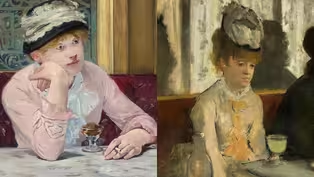
Clip: S2023 Ep596 | 3m 46s | A visit to the Metropolitan Museum of Art for the major exhibit “Manet/Degas.” (3m 46s)
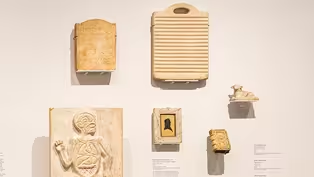
Marble Objects by Unknown Artists at AFAM
Clip: S2023 Ep596 | 3m 45s | A visit to AFAM for “Material Witness: Folk and Self-Taught Artists at Work.” (3m 45s)
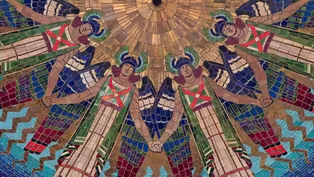
Clip: S2023 Ep596 | 9m 58s | A profile of Hildreth Meière, a renowned American muralist of the 20th century. (9m 58s)
Providing Support for PBS.org
Learn Moreabout PBS online sponsorship

- Arts and Music
The Best of the Joy of Painting with Bob Ross
A pop icon, Bob Ross offers soothing words of wisdom as he paints captivating landscapes.













Support for PBS provided by:
NYC-ARTS is a local public television program presented by THIRTEEN PBS
Major funding for NYC-ARTS is made possible by The Thea Petschek Iervolino Foundation, Jody and John Arnhold, The Lewis “Sonny” Turner Fund for Dance, The Ambrose Monell Foundation, Elise Jaffe...