NYC-ARTS
NYC-ARTS Full Episode: September 21, 2023
Season 2023 Episode 592 | 27m 46sVideo has Closed Captions
A trip to the Metropolitan Museum of Art for "New York Art Worlds, 1870-1890."
A trip to the Met for "New York Art Worlds, 1870-1890," featuring artists from the American Aesthetic Movement, including Winslow Homer, Louis Comfort Tiffany, and textile designer Candance Wheeler. Then a visit to Museum of the American Revolution for “Black Founders: The Forten Family of Philadelphia.” Then to the Brooklyn Museum for "Monet to Morisot" and a look at the work of Auguste Rodin.
Problems playing video? | Closed Captioning Feedback
Problems playing video? | Closed Captioning Feedback
NYC-ARTS is a local public television program presented by THIRTEEN PBS
Major funding for NYC-ARTS is made possible by The Thea Petschek Iervolino Foundation, Jody and John Arnhold, The Lewis “Sonny” Turner Fund for Dance, The Ambrose Monell Foundation, Elise Jaffe...
NYC-ARTS
NYC-ARTS Full Episode: September 21, 2023
Season 2023 Episode 592 | 27m 46sVideo has Closed Captions
A trip to the Met for "New York Art Worlds, 1870-1890," featuring artists from the American Aesthetic Movement, including Winslow Homer, Louis Comfort Tiffany, and textile designer Candance Wheeler. Then a visit to Museum of the American Revolution for “Black Founders: The Forten Family of Philadelphia.” Then to the Brooklyn Museum for "Monet to Morisot" and a look at the work of Auguste Rodin.
Problems playing video? | Closed Captioning Feedback
How to Watch NYC-ARTS
NYC-ARTS is available to stream on pbs.org and the free PBS App, available on iPhone, Apple TV, Android TV, Android smartphones, Amazon Fire TV, Amazon Fire Tablet, Roku, Samsung Smart TV, and Vizio.
Providing Support for PBS.org
Learn Moreabout PBS online sponsorship♪ Paula ZAHN: Coming up on NYC-ARTS, a look at the exhibition "New York Art Worlds, 1870-1890" now on view at the Met.
Sylvia Yount: This is an exhibition that opened last December in our Luce Study Center gallery.
We're thinking about what was happening at the moment in 1870, who were the leading artists, who was defining taste at that time, the changes that occurred too in the transformation of the art world, you know, with all the new wealth after the Civil War.
The development really of an infrastructure for an art world proper.
I would say art worlds, there wasn't just one community.
There were many different communities that came together in the city in those years, in the 1870s and eighties.
ZAHN: A visit to the Museum of the American Revolution and the exhibition Black Founders: The Forten Family of Philadelphia.
Matthew Skic: We're hoping that the "Black Founders: The Forten Family of Philadelphia" exhibit will encourage visitors to think about the American Revolution not just as a single moment in time, but a complex series of events that launched this ongoing effort to make the world a better place for all people.
ZAHN: and a visit to the Brooklyn Museum, for a look at exhibition Monet tomorrow so -- Morisot: The Real and Imagined in European Art.
Lisa Small: This exhibition brings together a really important part of Brooklyn's European collection.
Its 19th and early 20th century European art.
We have organized it under the broad theme of the real and the imagined, which was really evocative and flexible in terms of these disparate works.
>> FUNDING FOR NYC-ARTS IS MADE POSSIBLE BY THEA PETSCHEK IERVOLINO FOUNDATION JODY AND JOHN ARNHOLD THE LEWIS "SONNY" TURNER FUND FOR DANCE THE AMBROSE MONELL FOUNDATION ELISE JAFFE AND JEFFREY BROWN CHARLES AND VALERIE DIKER THE MILTON AND SALLY AVERY ARTS FOUNDATION ELROY AND TERRY KRUMHOLZ FOUNDATION THE NANCY SIDEWATER FOUNDATION AND ELLEN AND JAMES S. MARCUS THIS PROGRAM IS SUPPORTED, IN PART, BY PUBLIC FUNDS FROM THE NEW YORK CITY DEPARTMENT OF CULTURAL AFFAIRS IN PARTNERSHIP WITH THE CITY COUNCIL.
ADDITIONAL FUNDING PROVIDED BY MEMBERS OF THIRTEEN AND BY SWANN AUCTION GALLERIES.
SWANN AUCTION GALLERIES.
WE HAVE A DIFFERENT WAY OF LOOKING AT AUCTIONS, OFFERING VINTAGE BOOKS AND FINE ART SINCE 1941.
WORKING TO COMBINE KNOWLEDGE WITH ACCESSIBILITY, WHETHER YOU ARE A LIFELONG COLLECTOR OR A FIRST-TIME BUYER, OR LOOKING TO SELL.
INFORMATION AT SWANN GALLERIES DOT COM.
♪ ZAHN: Overlooking the nearby Greenwich Harbor, the Bruce Museum in Greenwich CT, is a world- class destination whose mission is to promote the understanding and appreciation of both art and science.
Last spring the museum opened a newly renovated and expanded building and continues to present a changing array of exhibitions and education programs.
Good evening and welcome to NYC-ARTS.
I'm Paula Zahn on location at the new Bruce.
In addition to its mission to present both art and science, the museum has an ongoing engagement with the local community as a vital resource for learning and entertainment for visitors from the area and beyond.
The centerpiece of the renovation is a 3-story wing that provides a new entrance, lobby and expansive exhibition galleries.
The design and construction took its inspiration from the geology of the region.
It features a façade of cast stone and glass -- inspired by the surfaces of Connecticut's rock quarries.
At its center, the interior courtyard also brings the surrounding nature into the space.
The museum was already ahead of its time when textile merchant Robert Moffat Bruce conceived of the museum and gave his house to the Town of Greenwich in 1908 for this purpose.
The first exhibition in 1912 featured works by local artists known as the Greenwich Society of Artists, which included members of the nearby Cos Cob Art Colony.
Among them were John Henry Twachtman, Theodore Robinson, Childe Hassam, Emil Carsen and Mina Fonda Ochtman.
Their works formed the core of the Museum's holdings and continue to be a strength of the collection.
Since then it has expanded to focus on global art from 1850 to the present, adding Ancient Chinese sculpture, Native American Art, paintings of the Hudson River School, modernist works on paper, and photography.
Another strength of the museum is its permanent gallery of minerals.
On view are 100 exceptional specimens in brilliant colors and fascinating crystal forms.
The gallery is made possible by Robert L. Wiener who assembled one of the world's most extensive mineral collections over the course of four decades.
Visitors can also learn the critical roles minerals play in everything from nutrition to smart phones.
In addition, the Museum's seven natural history galleries explore the story of nature's cycles.
From mammoth tusks to butterfly wings, exotic turtles to a replica of a feathered dinosaur, the exhibition is enjoyed by visitors of all ages.
The works in this gallery on the museum's 3rd floor celebrate the collection of Greenwich resident, William L. Richter.
It features a selection of French art from the 19th and early 20th centuries.
Among them are subjects such as landscapes, the human figure, and pure abstraction.
The works on view are examples of the vivid color and animated brushwork of the Impressionists and Post-Impressionists as well as the enigmatic symbolism of the Surrealists.
Included are works by Impressionist painters such as Cassatt, Renoir, Corot, Pissarro, Caillebotte, along with works by Cezanne, Gauguin and Sargent.
Nearby are works by Surrealists Giacometti, Klee and Miro.
Also on view are two promised gifts of outstanding works on paper by renowned artists of the 20th century.
The Picasso painting on paper, bouquet of flowers, dates to 1909 -- 1909-10.
This was from the early period in the artist's career when he first began working in a Cubist style, the fracturing of form and space that would become a hallmark of his career.
"Autoportrait" by Matisse is a line drawing in black ink on paper, and dates to 1944, near the end of the artist's career.
Matisse produced only a small number of self-portraits in his lifetime, this one showing a remarkable economy and elegance of line.
With just a few strokes, Matisse captures his identity as an artist.
On our program tonight, a visit to The Metropolitan Museum of Art and the exhibition "New York Art Worlds, 1870-1890."
This exhibit looks at work from these two decades, which saw the development of a modern and cosmopolitan art world, known as the American Aesthetic Movement.
The exhibition features more than 50 works-- most drawn from the Met's American Wing Galleries.
They include paintings, sculpture, illustrated books, and decorative objects -- such as painted tiles, stained glass and textiles.
Notable artists represented here include Winslow Homer, Augustus Saint-Gaudens and, Louis Comfort Tiffany.
Also on view is the work of several women and artists of color such as Cecilia Beaux, Edith Mitchill Prellwitz, and Charles Ethan Porter, each of whom was able to achieve professional success during this unique period in the New York art world.
Sylvia Yount: I'm Sylvia Yount.
I'm the Lawrence A. Fleischman Curator in Charge of the American Wing at the Metropolitan Museum.
This is an exhibition that opened last December in our Luce Study Center gallery.
It's an exhibition that has a long gestation period.
It was originally intended to be shown in 2020, which was the year of the Met's one hundred fiftieth anniversary.
Something else happened in 2020 and the project was scuttled.
And the narrative then was really thinking about what was happening at the moment in 1870, who were the leading artists who was defining taste at that time.
I wanted to think about the changes that occurred too in the transformation of the art world, you know, with all the new wealth after the Civil War.
The development really of an infrastructure for an art world proper.
I would say art worlds.
I mean, we're very deliberately using that plural, because there wasn't just one community.
There were many different communities that came together in the city in those years, in the 1870s and eighties.
So many people are a part of this.
It's not just the artists, it's the critics, it's the collectors, it's the dealers.
And again, this is the moment when that is really developing as a new kind of infrastructure in the city of New York.
We are very lucky, very privileged to have a very deep and wide-ranging collection that speaks to this moment, produced at this time by a range of both canonic artists as well as lesser known artists.
People like Winslow Homer, Augustus Saint-Gaudens, Louis Comfort Tiffany, John La Farge.
The kind of positive of delaying the show for two years was that we had made a lot of new acquisitions actually, and particularly around the time of our anniversary year, we were able to bring in some wonderful gifts of works.
So adding a lot more texture to that, more canonic narrative.
So that was exciting to think about how we might expand the narrative and really kind of hone in on that role of the artists.
You know, the artists at the center of this movement.
So we're talking about institutions and of course talking about the Met and the role the Met played in helping the development of those artists' career.
But in those years it was a lot more interesting what was going on in the artist studios, you know, and then some of these new burgeoning galleries, not in the institutions, not in the established institutions.
There was this greater interest in kind of creativity and experimentation, collaboration across a lot of different kinds of art forms, but primarily intended for the domestic environment.
So the other name for this is the Household Art Movement.
And it was a time when you had painters and sculptors, people who were academically trained, experimenting in the decorative arts and design as well.
So a very rich period again, of innovation, experimentation, collaboration that was really happening right here in New York.
It's not just an exhibition of paintings and sculpture or even works on paper, but it has a real range of works from across the American Wing's collection, which is a collection of decorative arts and so-called fine arts and specifically works that are not on regular view because they're light sensitive.
So we have some wonderful textiles by the very important, innovative textile designer, Candace Wheeler, who is also an important business partner of Louis Comfort Tiffany in the first real interior decorating firm that was established in this country, so-called Associated Artists.
We also have stained glass works by John La Farge, a very important artist also working collaboratively in many cities in this country but based primarily in New York.
And then we have works that we often show in our permanent collection galleries upstairs on the second floor.
Iconic works by someone like Thomas Eakins, his painting of his wife and his setter dog, Harry.
That's normally seen in one context in our paintings galleries.
And one of the beauties of doing projects in this Luce Center Gallery where you can have a little bit more of a close looking at different types of objects is to think about a changing context.
You know, reframing the narrative a little bit, of bringing a different lens of interpretation to thinking about these very familiar works.
The 1870s was a very rich, the late 1870s, I would say, a very rich time in the New York art world.
It was really a kind of the development of a modern and cosmopolitan art world that we'd recognize today with creatives and taste makers.
At the center of that.
It was a time of challenging the establishment.
So artists coming back from training in Europe, primarily in Paris, and kind of invigorated and wanting to recreate that bohemian and creative collaborative atmosphere they enjoyed there.
So working in studios, setting up new kind of artist organizations where more people could participate with a broader range of artists, including women and artists of color.
We have some wonderful works in the installation by artists who really embody that.
Helena de Kay Gilder, Edith Mitchill Prellwitz, Charles Ethan Porter, the only known Black American artist to be engaged in the aesthetic movement in the Household Art Movement.
We have a really unusual painted tile by him in the exhibition.
He's experimenting, he's trying to find his own voice, and he's doing both decorative work and then very beautiful still lives.
And that's how he's best known today.
In the 1890s, he really flourishes as a still life painter.
And one of the things we wanted to do by having a work by him in this installation and as well as some of the other women, is to underline the fact that this was just the beginning for them.
And they continued to work as artists in both New York and other parts of the country.
And we have those later works in the collection as well.
So if this can be a way that visitors might discover someone new in this context, but then spends time in the Wing and finds the fuller rage of those artists, that would be really exciting to us.
ZAHN: Next on our program, a visit to Philadelphia and the Museum of the American Revolution.
Currently on view is the special exhibition "Black Founders: The Forten Family of Philadelphia."
When James Forten walked the streets of 1770s Philadelphia as a young man, he was surrounded by the sights and sounds of transformation.
He heard the words of the Declaration of Independence read aloud for the first time in 1776, and in 1781 he set sail to fight for Independence.
Born a free person of African descent, Forten built upon his own life experience to become a changemaker -- becoming a successful businessman, philanthropist, and abolitionist.
In this portion of a film by our colleagues at WHYY, we learn the story of this exceptional family and the important role it played in the development of our nation.
The exhibition is on view through November 26th.
Matthew Skic: On July 8th, 1776, in the yard of the Pennsylvania State House, what we call Independence Hall today, James Forten was there as a nine-year-old child hearing the words of the declaration for the very first time.
And these are words that he would continually reference throughout his life.
Michael Idriss: For me as a kid growing up in Philadelphia, if I would've known that, that might have changed my whole trajectory of having a feel for the American Revolution.
Matthew Skic: The mission of the Museum of the American Revolution is to share compelling stories about the diverse people and complex events that shaped America's ongoing experiment in liberty, equality and self-government.
We're hoping that the black founders, the Forten family of Philadelphia Exhibit, will encourage visitors to think about the American Revolution, not just as a single moment in time, but a complex series of events that launch this ongoing effort to make the world a better place for all people.
This is a family of revolutionaries.
They are committed to the ideals of the American Revolution.
Erica Armstrong Dunbar: I think anybody living, surviving and thriving in the late 18th and early 19th century as black people were revolutionaries you had to be in order to live Matthew Skic: Here at the Museum of the American Revolution.
We've been sharing James Forten's story since we've opened.
So we thought it would be really wonderful to do a full scale exhibition on the family.
We were really kind of captivated by historian Julie Winches book, A Gentleman of Color, the first scholarly biography of James Forten.
No museum had ever done an exhibit on him or featured him in a major way.
Dr. Julie Winch: There is James Forten, the patriarch of the family, the Revolutionary War veteran, the self-made businessman, the man who is committed to the anti-slavery cause, but also to reforming America.
But you look at his family, he brings up his children with a similar commitment to reform.
Matthew Skic: Based on some intense genealogy work that we did alongside historian Julie Winch, we're able to find the branches of the family that still have living descendants.
Atwood "Kip" Forten Jacobs: What I know about the family history was limited.
It wasn't until that book that I realized just how, just how deep James was.
It's just amazing.
Dolly Marshall: I've always known about James Forten, but to tie my family line with his family line and to know who is who, um, it's just been so motivating and, um, rewarding.
Erica Armstrong Dunbar: We've begun to rethink the American narrative and who gets to be centered and who's marginalized?
Who gets to tell the story of America?
Many years ago, someone looking like me would not be telling this story.
The founding fathers were not all white men.
We should consider James Forten as one of those founders, Dr. Julie Winch: Once I started digging away, I found more and more material what a complex human being this man was from really his childhood, right through to the end of what was at that time, a very long life.
I mean, he is almost 76 when he dies.
Matthew Skic: James Forten was born in September of 1766 to parents who were free African Americans in the city at the time.
Michael Idriss: And it's important to make that note that Forten is born free.
So he grows up seeing the rollout of this early American experiment, and he is right in its backyard of inception.
Erica Armstrong Dunbar: The late 18th and early 19th century, Philadelphia witnessed an explosion of black freedom.
And when we think about the decades leading up to the beginning of the 19th century, we really see the numbers grow and expand.
By the time they take the 1790 census, there were technically a little over 6,000 Black people living in and around Philadelphia.
And by the 1830s, 1840s, that number would more than double.
And what's most important is that in this moment when we're thinking about freedom and the birth of a new nation, the majority of those Black men and women were free.
ZAHN: And now, this week's Curator's Choice.
The Real and Imagined in European Art focuses on artworks created in the 19th and early 20th century in Europe.
This was a period when artistic techniques subject matter and patronage underwent profound changes.
Featuring some 90 works from the museum's collection.
It includes artists such as Claude Monet, Berthe Morisot, Paul Cezanne, Auguste Rodin, and Edgar Degas.
Lisa Small: I'm Lisa Small.
I'm the senior curator of European art at the Brooklyn Museum and Monet to Morisot.
This exhibition brings together a really important part of Brooklyn's European collection.
It's 19th and early 20th century European art.
Rodin was the most significant sculptor in mid to late 19th century France.
And one of the objects we have here called "Age of Bronze" was actually one of his first big successes that got him a lot of attention and notoriety.
And it's an interesting work that went through a lot of mutations.
When he first developed it, it was called 'The Vanquished.'
And the model that posed for it was holding a spear in one hand, and it was meant to commemorate the Franco-Prussian war that had just concluded and sort of be an homage to all of the people who had died in that.
But he decided to remove the spear, but retain the gestures in the figure, which then became a little bit enigmatic, right?
Without the prop.
It became something that was a little more difficult to read.
And he retitled it "The Age of Bronze," thinking about man's awakening into a new consciousness.
But it was also very controversial.
It's a male nude, and it was based on a model that was posing for him.
Rodin's facility with conveying the contours of the body, the anatomy was considered so accurate that he was accused at the time of having made a sculpture based on the life cast of the model's body, which was a complete no-no at the time.
He had to go through many conversations to prove that he had not just cast the body of his common place model but rather had created the composition on his own.
It turned out to be a rather significant work in his career.
ZAHN: Next week on NYC-ARTS, a profile of guitarist Bokyung Byun, winner of a 2023 Avery Fisher Career Grant Award.
Bokyung Byun: Having won the Avery Fisher Grant, it will really allow me to follow the footsteps of all these great masters of the guitar and keep expanding the repertoire for the instrument.
ZAHN: a trip to the National Museum of the American Indian and the exhibition "Shelley Niro: 500 Year Itch."
Niro's Art, which she has been creating for more than 50 years, builds upon Mohawk philosophies in paintings, photographs, mixed media works, and films.
Her work confronts challenges facing indigenous people.
Then a trip to the Bush-Holley House in Greenwich, whose historic rooms evoke the work of the artist who lived here at the turn of the century.
Debra Mecky: The Bush-Holley House today portrays two stories in its history.
The House began life as a home for prosperous merchants in the 18th century, and then gained recognition later as a boarding house for American artisan writers.
ZAHN: I hope you enjoyed our program tonight.
Thanks so much for joining us.
I'm Paula Zahn on location at the Bruce Museum in Greenwich.
Good night.
ZAHN: To enjoy more of your favorite segments on NYC-ARTS, visit our website at NYC-arts/org.
♪ ♪ FUNDING FOR NYC-ARTS IS MADE POSSIBLE BY: THEA PETSCHEK IERVOLINO FOUNDATION JODY AND JOHN ARNHOLD THE LEWIS "SONNY" TURNER FUND FOR DANCE THE AMBROSE MONELL FOUNDATION ELISE JAFFE AND JEFFREY BROWN CHARLES AND VALERIE DIKER THE MILTON AND SALLY AVERY ARTS FOUNDATION ELROY AND TERRY KRUMHOLZ FOUNDATION THE NANCY SIDEWATER FOUNDATION AND ELLEN AND JAMES S. MARCUS.
THIS PROGRAM IS SUPPORTED, IN PART, BY PUBLIC FUNDS FROM THE NEW YORK CITY DEPARTMENT OF CULTURAL AFFAIRS IN PARTNERSHIP WITH THE CITY COUNCIL.
ADDITIONAL FUNDING PROVIDED BY MEMBERS OF THIRTEEN AND BY SWANN AUCTION GALLERIES.
SWANN AUCTION GALLERIES.
WE HAVE A DIFFERENT WAY OF LOOKING AT AUCTIONS, OFFERING VINTAGE BOOKS AND FINE ART SINCE 1941.
WORKING TO COMBINE KNOWLEDGE WITH ACCESSIBILITY, WHETHER YOU ARE A LIFELONG COLLECTOR OR A FIRST-TIME BUYER, OR LOOKING TO SELL.
INFORMATION AT SWANN GALLERIES .com.
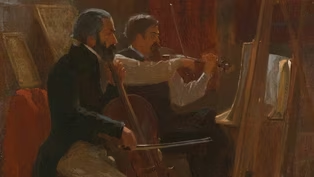
"New York Art Worlds, 1870-1890" at the Met
Clip: S2023 Ep592 | 7m 3s | A trip to the Metropolitan Museum of Art for "New York Art Worlds, 1870-1890." (7m 3s)
Providing Support for PBS.org
Learn Moreabout PBS online sponsorship

- Arts and Music
The Best of the Joy of Painting with Bob Ross
A pop icon, Bob Ross offers soothing words of wisdom as he paints captivating landscapes.











Support for PBS provided by:
NYC-ARTS is a local public television program presented by THIRTEEN PBS
Major funding for NYC-ARTS is made possible by The Thea Petschek Iervolino Foundation, Jody and John Arnhold, The Lewis “Sonny” Turner Fund for Dance, The Ambrose Monell Foundation, Elise Jaffe...