NYC-ARTS
NYC-ARTS Full Episode: September 28, 2023
Season 2023 Episode 593 | 27m 46sVideo has Closed Captions
A profile of guitarist, Bokyung Byun. Then a look at "Shelley Niro: 500 Year Itch."
A profile of guitarist, Bokyung Byun, winner of a 2023 Avery Fisher Career Grant Award, who brings her passion for the guitar around the globe. Then a look at "Shelley Niro: 500 Year Itch." It’s the first major retrospective of the multimedia artist, who has been creating work for more than 50 years. Finally, a trip to the Bush-Holley House in Greenwich, once the home to the Cos Cob artist colony.
Problems playing video? | Closed Captioning Feedback
Problems playing video? | Closed Captioning Feedback
NYC-ARTS is a local public television program presented by THIRTEEN PBS
Major funding for NYC-ARTS is made possible by The Thea Petschek Iervolino Foundation, Jody and John Arnhold, The Lewis “Sonny” Turner Fund for Dance, The Ambrose Monell Foundation, Elise Jaffe...
NYC-ARTS
NYC-ARTS Full Episode: September 28, 2023
Season 2023 Episode 593 | 27m 46sVideo has Closed Captions
A profile of guitarist, Bokyung Byun, winner of a 2023 Avery Fisher Career Grant Award, who brings her passion for the guitar around the globe. Then a look at "Shelley Niro: 500 Year Itch." It’s the first major retrospective of the multimedia artist, who has been creating work for more than 50 years. Finally, a trip to the Bush-Holley House in Greenwich, once the home to the Cos Cob artist colony.
Problems playing video? | Closed Captioning Feedback
How to Watch NYC-ARTS
NYC-ARTS is available to stream on pbs.org and the free PBS App, available on iPhone, Apple TV, Android TV, Android smartphones, Amazon Fire TV, Amazon Fire Tablet, Roku, Samsung Smart TV, and Vizio.
Providing Support for PBS.org
Learn Moreabout PBS online sponsorship>> Coming up on NYC Arts, a profile of guitars bulky and beyond, owner of a 2023 Avery Fisher career grant award, -- >> There thought -- it allowed me to follow the footsteps of these great masters of the tar and keep expanding the repertoire for the instrument.
>> A trip to the national Museum of the American Indian and the exhibition.
The art wish they have been creating builds on Mohawk philosophies with mixed-media works and films.
Her work confronts challenges facing indigenous people.
Then a trip -- The artist to live there at the turn-of-the-century.
>> The house today portrays two stories in its history.
>> The house began as a home for prosperous merchants in the 18th century.
Then it gained recognition as a boardinghouse for American artists and writers.
>> The Lewis County tourney fund for dance, the Ambrose Monell foundation.
The Milton and Sally every arts foundation.
Elroy and Terry crumbles foundation.
The Nancy side water foundation and Ellen and James S Marcus.
This program was supported by public funds for the New York City Department of cultural affairs in partnership with the city Council.
Additional funding provided by members of their team and I swan option -- by swan auction galleries.
>> Working to combine dollars with accessibility, whether you are a lifelong collector or a first-time buyer or looking to sell, information at swan Galleries' website.
>> Good evening and welcome to NYC Arts.
I am on location at the Bruce Museum in Greenwich, Connecticut.
For over a century, the museum has engaged its visitors by presenting exceptional exhibitions in art, science and the intersections between the two of them.
The recent major expansion of the building has increased opportunities for special presentations that reflect this relationship.
Recent exhibitions have included Lois Dodd, natural order.
For eight decades, Lois Dodd has produced a body of work grounded in direct observation of her immediate surroundings.
The exhibition takes its title from a painting which refers both to her enduring interest in nature and the underlying geometry of her subject matter.
Then is now, contemporary Black Art in America explores the way black artists of our time critically engaged with the past and the present, focused on the years 1968 to 2021, themes include slavery, the civil rights movement and reckoning with the racial conflicts of the present day.
Material matters, the sculptures of Eli Needleman featured the best-known work of this American artist, combining classical source material and folk art, the sculptures ranged from idealized animals to subjects drawn from everyday life.
And last but not least, Penguins past and present.
This exhibition told the story of one of the most remarkable birds on the planet.
Immersive dioramas and interactive displays showed how they adapted to some of the most extreme environments in the world.
Visitors also learned how penguins continue to survive in the face of ongoing threats whether natural or man-made.
Currently on view through 2026 is a striking work by the artist Gabriel do on the museum staircase and balcony.
Born and raised in Mexico City, the work represents exactly that intersection of art, craft and science.
In 2020, he began producing the large and intricate installations for which he is best known.
Using thousands of multicolor sewing threads, he captures the full color spectrum of light.
Meticulously constructed, the thread is interwoven through a series of hooks to create a unified network or plexus.
The result is connections between architecture, light and perception.
On our program tonight, we will celebrate the 2023 Avery Fisher career grant awards, this year, the ceremony took place in March at the Jerome Al Green performance space at W-2 Exar.
These individual grants of $25,000 give professional assistance and recognition to talented instrumentalists who have great potential for major careers in classical music.
This year there were five recipients, double bassist Nina Bernard.
This guitarist, flutist Annie Ferguson, pianist ever knows I'll as well as the Isidore string quartet.
Born in Seoul, Korea, this is one of the most sought after guitarists of her generation.
She began to play at the age of six and at 11, she took the stage for her first solo recital.
At 16, she moved to the United States on her own to study at Julliard.
Having performed worldwide since then to enthusiastic audiences, she is currently on the guitar faculty of California State University Fullerton.
This is also the first woman to win the JoAnn Valletta international guitar concerto competition named for the renowned conductor and champion of young professional musicians.
>> Was roomy to the guitar is actually very coincidental.
I start with piano but it did not right-click with me and my parents always wanted me to have some kind of musical education because they could not have it when they were younger.
We were just watching TV one day while folding laundry and just guitars popped up on the TV and I said I want to do just that.
It was all a coincidence after that that I started with the guitar.
Very early on, I started with this really renowned pedagogue in Korea.
There was a coincidence because after having learned guitar for a year or so, my parents had to move.
We had to find a new teacher and we were recommended to go find his teacher to study with and this was when we weren't even considering having guitar as a serious career.
So we just went -- walked into his guitar Academy.
From then on, I study with him for a long time.
Then I moved to China when I was 12 I myself to study with this, another renowned Chinese professor who gave a master class in Seoul which I attended and Hubert -- he invited me to come study with him.
My parents said this is up to you.
What do you want to do?
This is a great opportunity.
I said I want to try it.
I moved to Beijing for about two years.
What happened was after having studied in China I went back to Korea for a little bit just to kind of settle and see what I wanted to do next and my parents are not musicians so they didn't really know how to go about finding teachers and things like that.
Etc.. What they did was they emailed everyone they could find online with the videos there on YouTube.
This Los Angeles guitar Quartet said great, come study with me.
There I was, packing again and moved all the way to Los Angeles.
By myself.
Guitar in general is really popular in any country.
I think guitar was featured more often in the film music industry and Korea.
So I was very familiar with the sound and my mom would always listen to pop songs that would have acoustic guitar in it.
>> This particular guy, I was playing his guitar for a long time and I did a competition in Germany where his friend was in attendance and this friend came after me, chasing after me saying I know you're guitar.
My friend makes that so that is how we got to know each other.
He makes a frequent visitor to the U.S. and realized how small my hands were he said with a recent development, you can have -- you can't have shorter scale guitar without sacrificing volume.
This really allows my left hand to be a little bit more relaxed.
At the ceremony, I perform this song by Augustine Barrios.
He is known as the best guitarist from the jungles of Paraguay.
He composed of the piece as he was traveling a lot as a performer and composer and he was in Brazil when he fell in love with this woman and the piece is actually also titled the soul of Mario Esther.
So when I perform the piece, I try to kind of bring out the romantic quality of it, the essential quality of the piece as much as possible.
Having won the Avery Fisher grant allowed me to follow in the footsteps of all these great masters of the guitar and keep expanding the repertoire for the instrument and it will really allow me to commission and continue to work with composers.
[Applause] >> Now On View downtown at the Smithsonian National Museum of the American Indian is the 500 year itch.
The first major retrospective of his multimedia artist.
Born in Niagara Falls, New York, she was raised on the six Nations of the grand River reserve in Ontario, Canada.
The art that she has been creating for more than 50 years old upon Mohawk philosophies, paintings, photographs, mixed-media works and films.
Her work confronts challenges facing indigenous people.
The enduring impact of colonial wars and generational trauma.
Both successful and humorous, the exhibit is full of references to popular culture.
As she explores ideas central to her experience and identity as a Mohawk woman.
This land is my land, a photographic series from 1992 consists of 12 and tented photos, six of which were on display here.
In each, the panels to the left are hand colored self-portraits of her posing as various popular cultural stereotypes.
On the right, Nero poses as herself, the center images are family photographs from her personal archives.
The exhibition takes its name from one of those works.
Nero posing clearly in a blonde wig as a breeze lifts her dress in reference to the iconic image of Marilyn Munro from the movie the seven year itch.
This is a comment on the 500 anniversary celebrations of Christopher Columbus's discovery of the Americas in 1492.
As well as a response to the stereotypical views of indigenous women.
In her painting from 1987, she pictures herself accidentally spilling wine on a white customer.
Behind them, Brian Mulroney, the dent Prime Minister of Canada and his wife are portrayed as the suffering of the indigenous people.
As is typical of her work, she tempers hard truths with playfulness, complexity and wit.
The multimedia work time travel through us from 1999 features Nero's mother and daughters and represents the transfer of social, cultural and personal values from one generation to another.
The intricate beadwork highlights women's skillful artistic labor and the passing of knowledge forward, the image of the Journal refers to the turtle clan to connect with her maternal lineage.
>> Although Nero's work addresses such issues as gender inequity, cultural loss and oppression, she also shows her belief in the healing power of art and laughter.
The 500 year itch is On View through January 1 2024.
Next, we will travel just a short distance from this museum to the Batali house.
This historic site is the centerpiece of the Greenwich historical Society.
In maintaining the house for visitors, the society has preserved the meeting place of the archive which flourished during the early 20th century.
>> The Bush probably has today portrays two stories in its history.
The house began life as a home for prosperous merchants in the 18th century and then gained recognition later as a boardinghouse for American artists and writers.
Today, it is a national historic landmark in one of 18 sites on the Connecticut art trail.
Since acquiring Bush Holley House in 1987, the historical Society expanded the site by building an and research library to house some wonderful correction -- British history.
This was adopted as the exhibition gallery for changing exhibitions on history and art.
The Bush story begins with David Busch who came here with his wife to build a tide operated mill.
He improved the harbor so ships could come right up to the docks and this made the lower lending a wonderful commercial enterprise for him.
He was a very wealthy man and I think you can see that in Batali house.
A scrap of the wallpaper has the British tax stamp on the back and reminds us of one of the causes of the American Revolution.
One sign of David's extraordinary wealth was the enslaved people who lived here, the African-Americans.
There is one room that portrays the way that the slaves lived here.
The story begins in many ways with the railroad coming to Greenwich in 1848.
It began to bring residents up from New York for summertime activities so they saw an opportunity to take on Bush probably has as a boardinghouse.
It was known as the old house.
>> Artists and writers who came here self identified as this county.
This was Connecticut's first R. Kelly.
It's eagerly known for its innovative and experimental style.
He was the first to come here and teach summer classes in 1892.
He was followed by J Eldon we are and Leona Robinson who had no clone, they can be really hoping to translate this into an American idiom.
The what -- the life of the artist was to go out during the daytime and do their paintings and then gather back in the late afternoon.
They would often say don't pay what you see.
Paint what you feel.
Another child artist that came here stayed here off and on during a 20 year time.
The rooms in Batali house -- the bedroom was the $20 room.
The one where he would stay with his wife, mod.
You can see hanging there and etching he made of the federal mantelpiece with a woman let him kimono.
Some of the most extraordinary things you can see in Bush probably has today are a set of etchings he made, almost 30 of them when he was here in 1915.
One of them at the Dutch door shows a woman standing in front of the Dutch doors of Batali house and you can feel a sense of the summer inviting you out into the outside.
I am standing in a room which was an art studio.
It became the permanent studio of this young student that came here in 1896.
He fell in love with the Holly's daughter and married her in 1900.
He would often give exhibitions in the studio that attracted hundreds of people and is exhibitions would be critiqued in the New York papers.
He paid to the extraordinary picture of his twin daughter feeding the ducks which hangs in the hallway of Batali house.
-- Bush Holly house.
He was one of the organizers of the international exhibition of art known as the Armory show.
Show a was significant in that it introduced European modernists to the vast American public for the first time.
It also had a huge impact on the artists.
You can see that in a painting hanging at McRae's studio in Martha's Vineyard where shows him really trying to understand a new way to translate and see landscape.
He began creating more decorative works of art such as the painting of the irises.
One of the paintings hanging in the hallway is of Carissa.
She was painted in 1912.
The bookcase still there as well as the hallway and the stairs.
This is a wonderful 18th-century house.
It has so much character that comes from its early history.
What is probably most extraordinary is to come here and see the art on the wall from the artists at the turn of the 20th century who fell in love with this house in this village.
>> Next week on NYC Arts, a profile photographer and artist, Edward Bacsinszky.
>> The work as show is not about the individual, it is about the collective impact I am having.
Material witness, folk and self-taught artists at work.
>> Material witness focuses on the materials.
>> I hope you have -- enjoyed our programs on it.
I am on location at the Bruce Museum in Greenwich.
Good night.
>> Funding for NYC Arts is made possible by this foundation.
Jody and John Arnhold.
The Lewis County Turner fund for dance.
The Ambrose Monell Foundation.
The Milton and Sally every arts foundation.
Elroy and Terry Krumholz foundation.
The Nancy side water foundation and Ellen and James as Marcus.
This program is supported in part by public funds.
And by Swann auction Galleries.
>> Swann auction Galleries, we have a different way of looking at options, offering vintage works, working to combine knowledge with accessibility.
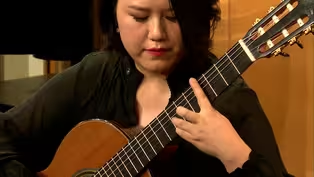
Profile: Avery Fisher Career Grant Award: Bokyung Byun
Clip: S2023 Ep593 | 10m 5s | A profile of guitarist, Bokyung Byun, winner of a 2023 Avery Fisher Career Grant Award. (10m 5s)
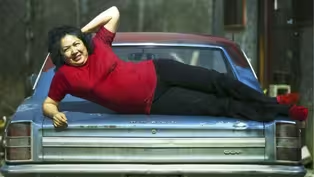
Clip: S2023 Ep593 | 3m 40s | A trip to the National Museum of the American Indian for “Shelley Niro: 500 Year Itch." (3m 40s)
Providing Support for PBS.org
Learn Moreabout PBS online sponsorship

- Arts and Music
The Best of the Joy of Painting with Bob Ross
A pop icon, Bob Ross offers soothing words of wisdom as he paints captivating landscapes.











Support for PBS provided by:
NYC-ARTS is a local public television program presented by THIRTEEN PBS
Major funding for NYC-ARTS is made possible by The Thea Petschek Iervolino Foundation, Jody and John Arnhold, The Lewis “Sonny” Turner Fund for Dance, The Ambrose Monell Foundation, Elise Jaffe...