NYC-ARTS
NYC-ARTS Full Episode: November 13, 2014
Season 2014 Episode 420 | 27m 46sVideo has Closed Captions
Leonard A. Lauder talks about his gift of Cubist art to the Metropolitan Museum of Art.
Paula Zahn speaks with philanthropist and art collector Leonard A. Lauder about the gift of his collection of Cubist art to the Metropolitan Museum of Art. Correspondent Christina Ha presents the latest art and culture news from the Noble Maritime Collection at the historic Snug Harbor Cultural Center on Staten Island.
Problems playing video? | Closed Captioning Feedback
Problems playing video? | Closed Captioning Feedback
NYC-ARTS is a local public television program presented by THIRTEEN PBS
Major funding for NYC-ARTS is made possible by The Thea Petschek Iervolino Foundation, Jody and John Arnhold, The Lewis “Sonny” Turner Fund for Dance, The Ambrose Monell Foundation, Elise Jaffe...
NYC-ARTS
NYC-ARTS Full Episode: November 13, 2014
Season 2014 Episode 420 | 27m 46sVideo has Closed Captions
Paula Zahn speaks with philanthropist and art collector Leonard A. Lauder about the gift of his collection of Cubist art to the Metropolitan Museum of Art. Correspondent Christina Ha presents the latest art and culture news from the Noble Maritime Collection at the historic Snug Harbor Cultural Center on Staten Island.
Problems playing video? | Closed Captioning Feedback
How to Watch NYC-ARTS
NYC-ARTS is available to stream on pbs.org and the free PBS App, available on iPhone, Apple TV, Android TV, Android smartphones, Amazon Fire TV, Amazon Fire Tablet, Roku, Samsung Smart TV, and Vizio.
Providing Support for PBS.org
Learn Moreabout PBS online sponsorshipFunding for NYC Arts is made possible by Rosalind P. Walter, Elise Jaffe and Jeffrey Brown, Jodi and John Arnhold, the Milton and Sally Avery Arts Foundation, and Elroy and Terry Krumholz Foundation.
This program is supported in part by public funds from the New York City Department of Cultural Affairs in partnership with the City Council.
Additional funding provided by members of Thirteen.
NYC Arts is made possible in part by First Republic Bank.
Flexibility.
Coordination.
Excellence.
First Republic Private Wealth Management.
It's a privilege to serve you.
Good evening and welcome to NYC Arts.
I'm Paula Zahn at the Tisch WNET Studios at Lincoln Center.
Tonight we share with you an exclusive behind the scenes look at a major event in the New York art world.
In fact, an unprecedented event in the international art world for that matter.
I recently had the privilege of talking with collector and philanthropist Leonard Lauder.
The occasion was the opening of the exhibition Cubism, the Leonard A. Lauder collection at the Metropolitan Museum of Art.
Over the past 40 years, Lauder has acquired masterpieces to create the most important collection in private hands of works by the four preeminent Cubist artists, Braque, Picasso, Leger, and Gris.
In April of 2013, Lauder pledged the entire collection, valued at $1 billion, to the Met.
This is the first time it's being shown in its entirety, 81 works of art.
As Met director Thomas Campbell has said, "In one fell swoop, this puts the Met at the forefront of early 20th century art, something that museum directors only dream about."
In my conversation with Lauder, we spoke about the importance of Cubism in the development of modern art, as well as his lifelong passion for collecting.
Leonard, what a privilege to be able to sit down and talk with you.
I love being here with you too, Paula.
Thank you.
We are so lucky to be the beneficiaries of your enormous generosity.
What are you hoping this gift will mean to the Met?
This gift to the Met was meant to be a transformative gift.
The Met has always been great in classical, great in impressionist, et cetera, et cetera, but they have missed really the heart of the 20th century.
What I wanted to do was to not only transform them, but catapult them into the 20th and 21st century, and that's where the action is, and that's where tomorrow is.
But more important, it's a great thing for the city of New York.
New York is the cultural center of the world, and we need something like that.
Let's talk about the roots of your collecting.
Did you know anything about Cubism when you started collecting Cubist paintings?
The roots of my collecting go back to the time I was a little six-year-old and collecting picture postcards.
When I was in elementary school, going to MoMA, New Museum of Modern Art, every afternoon to see the movies.
Before seeing them or after, I would walk through the galleries, and I got my education there.
There are no formal roots as much as there are roots that I cherished.
Take me to the time where you're working, and you've started your professional life, and you actually have a little bit of cash on hand to start buying paintings that you've fallen in love with.
Well, the active word is not a little bit of cash, little cash.
The first Cubist painting I bought was in 1976.
It was a Leger drawing, and that was the only one I had for a couple of years.
Then I bought another one, another painting from a dealer, but I didn't know really where I was going or what I had.
Something happened which was really extraordinary for me.
A friend of mine knew I was interested in Cubism and invited me to a lecture given at the NYU Institute of Fine Arts by Kirk Varnedoe, who was a great curator then.
He was flashing on the screen paintings which were the major paintings in the Cubist era.
All of a sudden, on the screen came one of my paintings, Notre Avenir est dans l'Air.
That's my painting, and it's the most important painting in the whole lecture and the pivotal painting.
That was an epiphany for me, and that moment in that darkened room changed my perspective and my future.
>>So, your mission started very early on in your collecting.
>>My mission was really not to own, but to preserve.
And so, from the very beginning, every time I bought a painting, I would say, "Will it make the cut?"
What does that mean?
What's the cut?
The cut is, will it be great enough to stay on the wall, nonstop, and not be taken down for something else to go on view?
I wanted a collection of paintings that would always be there for people to see, and that would then express the whole movement in a great way.
>>I know how fiercely committed you were to traveling all over the world to find that particular painting to enhance your collection.
You've studied, you've acknowledged you made mistakes, you've revised the collection along the way, but what role has luck played in your collecting?
>>Louis Pasteur said, "Chance favors the prepared mind."
I studied and studied and studied and studied.
I read the catalogue raisonné, which is a catalog which has every painting that was ever painted by Picasso or by Braque.
So, the moment something may have become available, I knew that it was great and that I wanted it, and I would hop on a plane and go and try to convince the owner to sell it.
>>There was a period of time where the Cubist art market was depressed, for about 50 years, in fact.
Help us understand why that was.
>>Well, what happened is that the man who was the great art dealer, Kahnweiler, of what we call the essential Cubists, Picasso, Braque, Gris, and the Leger, was a German national, and he had to flee Paris in 1914, and the French seized his entire inventory of 3,000 paintings as enemy alien property.
He tried to buy them back after the war.
They wouldn't sell them to him, but they put them all at auction, in three auctions, in '21 and '22.
My luck was this, that there were so many people who bought dozens of paintings at those French auctions, so that when these collections started to be broken up because the owner had died, there was a large inventory.
And so there was a great moment, and I was lucky, and I had the guts and the courage to borrow a lot of money to buy what I had to buy.
One of the great Cubist collectors was a man named Douglas Cooper, and he passed away, and his adopted son, Billy McCartney Cooper, wanted to sell the collection, or a good part of the collection, to someone who would give it a good home.
And he retained the noted art historian, Angelica Rudenstine, and a lady named Dorothy Krasinski.
They came to my home to vet my collection.
I never really asked them, but I believe the presence of Notre Avenir, that one masterpiece, was what gave them the idea, yes, anyone who could have that hanging on his walls has got to be a good collector, and Douglas' collection will be in a friendly home.
Did you understand the extent to which you were being scrutinized when they were looking at your collection?
I sort of got the idea when they walked around and walked around and walked around and walked around, and then they came back in after an hour and said, "Okay, you may buy it."
Now, what was it?
I couldn't buy the whole collection.
They invited me to go to Geneva, and I walked into this vast room, and there, sitting on the floor with these crates opened up and spilling out of the crates were paintings and drawings and watercolors and gouaches and this and that.
I felt like I was a kid in the toy store.
I had always had this dream as a little kid that the owner of the big toy store, F.A.O.
Sports, would say to me, "Leonard, you can go and have any toy in the store you want."
That was my daydream.
Suddenly, there I was in the toy store with this incredible collection, and I was shaking.
I didn't have enough money.
I said, "I'll take that and this and that."
Then one of them, Angelica, would say, "Leonard, you should take more."
They were urging me to build a collection, an experience that I will never forget.
What were the key pieces you bought?
Well, two or three.
There was a great portrait of Picasso's friend and mistress, Fernande, and beautiful, beautiful portrait, a large one.
There was a wonderful analytical cubist painting by Braque.
It was magnificent.
I had never seen anything of that quality before.
Can you take us back to 1900 and give us a sense of what was happening politically in Paris and culturally, and how this led to enormous changes in the world of art?
In 1900, Paris had their international fair, the Exposition Universelle.
It was incredible.
It had over 50 million visitors in 1900, and Paris was the center of cultural life.
Impressionism had already been launched and was doing well, as was post-Impressionism, but there were these artists who were starving, who were struggling.
Braque was starving, and he was a fauve painter.
They called the wild beast.
Picasso had just come to Paris from Barcelona, and he was starving.
They were so poor that they had to use the same canvas twice, one for one side, one for the other.
Now, these artists really had no market, and I mentioned to you that there was this dealer named Kahnweiler, was sent by his family to Paris to intern at a private bank, but he loved to go into artist studios.
He came back to his family home in Germany and said, "This is what I want to do.
I want to become an art dealer."
Imagine becoming an art dealer rather than a banker.
But they gave him the permission, and he started to underwrite artists.
The first artist was a Braque, and Braque told him that he had a Spanish friend named Pablo.
Then the two of them then became his core.
The third artist was a man named Fernand Léger, who was a house painter.
Léger's mother could not understand why anyone would want to give her son money to paint paintings when he could make a lot of money painting homes.
The last one was a Spanish painter named Juan Gris.
In the first show that Kahnweiler had to put on, the critics sniffed.
They said, "Ugh, just a bunch of little cubes."
And remember- They didn't get it at all.
They didn't get it, but they were the revolutionaries, and the revolutionaries at the end won because they were the creators of abstract art.
How would you describe cubism?
Imagine a diamond with different facets, and if you look at it this way or this way or this way, it changes.
And so what they would do, they would look at something and sort of paint it from different perspectives.
And then they would joke with each other, and they were also interested in things in common usage, like the masthead of newspapers.
And the one masthead that they loved was a newspaper called Le Journal.
And so that appears in all of their work.
So cubism is a discovery of vision.
Are there three or four paintings in the collection that you can talk to us about that still cause you to have that strong, visceral reaction to the canvases?
Let me think.
Okay, there are a few, okay?
Number one is the Picasso "Notre Avenir."
That is one of my favorite paintings because it was the defining moment of my collecting, and when I saw that I had a future doing this.
In there are so many different elements.
There's a J-O-U, which could be "jouer," a game, or it's really "Le Journal," the newspaper.
There is the pamphlet "Notre Avenir."
There's a scallop shell.
But there's also the fact that in the background of the painting is the early analytical cubism, and in the foreground it's the beginning of the next stage of cubism, synthetic cubism.
So it is the linchpin.
Another one is my larger "Léger," the typographer.
I had chased that painting all over the world.
Then it wound up in someone's collection in Switzerland.
Eventually they put it up for auction.
I bought it at Christie's.
Léger was in World War I.
He was a soldier there, and he was wounded.
He came out of the service in 1918, and he came back to Paris.
He said, "I want to gobble up Paris."
He was young and enthusiastic.
That painting is the translation from the earlier analytical cubist to something more futuristic.
It's almost mechanical.
And it's a gorgeous painting, and I love it.
That's probably one of my favorites.
Let me see.
Maybe the last one that I bought, which is now in the Met.
It's a Juan Gris.
If you look closely at the painting, with one eye you can see a checkered tablecloth.
With the other eye you can see a bull's head.
And it's also a play on the eye, so that each one of these paintings brings something else to the table.
Each one is extraordinary, and each painting has a different personality.
What has it been like to live with those paintings?
If you have great art, you can live with them forever.
One advice I would give to your viewers is this.
You'll know that something is good if you love it more each day that passes and you aren't bored with it.
Get something that speaks to you again and again and again.
I was married for 52 years.
I never tired of my wife.
We knew each other very, very well, and each day was a discovery for us.
And I think great collectors and great collections, each day is a discovery.
What a beautiful, beautiful thing to say.
What is it going to feel like for you to walk into the Met and see these paintings you've lived with for so many decades at home?
It's like going to see my children in kindergarten, then in grade school, then in high school, then in college.
I see them, and I'm proud of them, and I'm proud that my paintings on the wall, I'm proud of the Met, that they are celebrating them, because that is a great thing for them and for the city of New York.
And we have so much gratitude for your generosity.
Thank you.
Hello, I'm Rafael P. Roman, and welcome to This Week at Lincoln Center, where NYC Arts highlights special events happening in this vibrant home for the arts and artists from around the world.
This week at Lincoln Center, Lincoln Center Theater's production of The Oldest Boy, a new play by Sarah Ruhl.
You are Buddhist?
Kind of.
I'm Buddhist.
I was raised Catholic.
Directed by Rebecca Taichman, The Oldest Boy is about different cultures, competing ideas of faith and love, and a family's decision to either send their son, a recognized reincarnated Buddhist teacher, to a monastery in India, or keep him home.
With sets by Mimi Lien , costumes by Anita Yavich, and lighting by Japhy Weideman, The Oldest Boy runs through December 28th at the Mitzi E. Newhouse Theater For more information, please visit lct.org.
And for even more information about music, dance, theater, opera, and film here at Lincoln Center, you can visit their website at lincolncenter.org.
Good evening.
I'm Christina Ha with the NYC Arts News.
I'm at the Noble Maritime Collection at the historic Snug Harbor Cultural Center on Staten Island.
I'm aboard the houseboat studio of marine artist John A. Noble.
From this spot, for over 40 years, Noble created paintings, drawings, and lithographs of the New York Harbor and the working ships he loves so well.
Now harbored safely inside this museum, this floating studio was originally built out of parts from vessels Noble salvaged.
Today, the Noble Maritime Collection is located in a former dormitory of the famous old retirement home for mariners, Sailor's Snug Harbor.
The museum celebrates the people and traditions of the working waterfront of New York Harbor, as well as the work of John A. Noble.
From 1928 until 1945, Noble worked as a seaman on schooners and in marine salvage.
He spent a lot of time at the old Port Johnston coal docks that by the late 1920s had become the largest graveyard of wooden sailing vessels in the world.
No longer of use in a world of engine-powered metal ships, the very last days of these great vessels would become a compelling subject of Noble's art for the rest of his life.
The San Francisco Symphony and music director Michael Tilson Thomas celebrate their 20th anniversary in a concert that is a seven-city tour that includes a stop at Carnegie Hall.
The programs include repertory that reflects two of the conductor's abiding passions.
A foremost interpreter of the works of Gustav Mahler, Tilson Thomas leads the San Francisco Symphony in Mahler's Symphony No.
7 on November 19th.
On November 20th, acclaimed violinist Gil Shaham joins the orchestra for a second concert.
A new work by the young composer Samuel Adams is also on the bill, a testament to the conductor's enduring commitment to the work of American and contemporary composers.
This season, the Roundabout Theater presents two works by acclaimed British playwright Tom Stoppard.
Employing the usual Stoppard wit and elegance and dramatic shifts in time and locale, both plays question the nature of language, art, and reality.
Indian Ink cuts back and forth between two time periods and two continents, asking questions about what we remember and what is real.
She had a romance with my father.
Quite possibly.
Or with Captain Durant, or with His Highness the Raja of Jammapool, or someone else entirely.
Romola Garai and Rosemary Harris play sisters separated by 50 years in this Stoppard gem making its off-Broadway debut this season.
In The Real Thing, playwrights share the stage with their plays and actors play parts on and off stage.
I don't think that writers are sacred, but words are.
They deserve our respect.
If you get the right ones in the right order, you can nudge the world a little.
In a dizzying theatrical exercise, the audience is challenged to determine what is truth and what is fiction.
Maggie Gyllenhaal, Ewan McGregor, and Cynthia Nixon bat about Stoppard's dazzling dialogue in this Broadway revival of one of Stoppard's most popular plays.
She was Pablo Picasso's most painted subject, but her influence on the artist's late work has often been misunderstood.
Now an exhibition at Pace Gallery explores their relationship and the works it inspired.
Picasso and Jacqueline, The Evolution of Style, focuses on the prolific last two decades of Picasso's life when he was particularly inspired by his muse and wife, Jacqueline Roque.
The Pace exhibition takes a look at the artist's transformative exploration of expressionism through portraits he made of Jacqueline from first meeting her in 1954 to his death in 1973.
The exhibition also includes some 50 photos by David Douglas Duncan that capture the couple's everyday life.
Ballet Hispanico goes uptown to present the New York premiere of its first evening-length narrative ballet.
The company returns to the Apollo Theater in Harlem with CARMEN.maquia.
Choreographer Gustavo Ramirez-Sansano made his New York debut earlier this year with the company at the Joyce.
He brings his physically charged and sensual choreography to this modern take on the story of the passionate gypsy.
Ballet Hispanico's Carmen Macchia comes to the Apollo Theater for only one night.
And that's the NYC Arts News.
From the Noble Maritime Collection at Snug Harbor Cultural Center on Staten Island, I'm Christina Ha.
We hope you've enjoyed our program this evening.
I'm Paula Zahn at the Tisch WNET Studios at Lincoln Center.
Thanks for joining us.
Good night.
Next week on NYC Arts, a visit to the Museum of Modern Art.
The exhibition Henri Matisse, The Cutouts, includes about a hundred examples of the artist's innovative body of work in the technique called decoupage, or as Matisse called it, painting with scissors.
What we see here is really Matisse's brilliant final chapter.
We see him at the height of his creative powers.
So even though he's late in life, he's still taking risks, he's still inventing, and he's still reaching for something new.
And a presentation of our NYC Arts profile.
NYC Arts visits the School of American Ballet.
The school has become the training ground for some of the world's finest ballet dancers.
[music] Funding for NYC Arts is made possible by Rosalind P. Walter, Elise Jaffe and Jeffrey Brown, Jodi and John Arnhold, the Milton and Sally Avery Arts Foundation, and Elroy and Terry Krumholz Foundation.
This program is supported in part by public funds from the New York City Department of Cultural Affairs in partnership with the City Council.
Additional funding provided by members of Thirteen.
NYC Arts is made possible in part by First Republic Bank.
Flexibility.
Coordination.
Excellence.
First Republic Private Wealth Management.
It's a privilege to serve you.
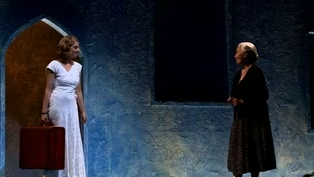
NYC-ARTS News: November 13 - 20
Clip: S2014 Ep420 | 5m 30s | Christina Ha presents the news from Noble Maritime Collection on Staten Island. (5m 30s)
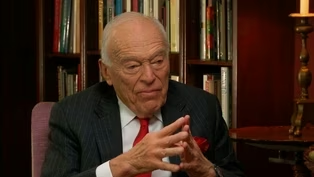
NYC-ARTS Profile: The Leonard A. Lauder Cubist Collection
Clip: S2014 Ep420 | 17m 51s | Leonard A. Lauder talks about his gift of Cubist art to the Metropolitan Museum of Art. (17m 51s)

This Week at Lincoln Center: “The Oldest Boy”
Clip: S2014 Ep420 | 1m 13s | A look at Lincoln Center Theater’s “The Oldest Boy,” a new play by Sarah Ruhl. (1m 13s)
Providing Support for PBS.org
Learn Moreabout PBS online sponsorship

- Arts and Music
The Best of the Joy of Painting with Bob Ross
A pop icon, Bob Ross offers soothing words of wisdom as he paints captivating landscapes.












Support for PBS provided by:
NYC-ARTS is a local public television program presented by THIRTEEN PBS
Major funding for NYC-ARTS is made possible by The Thea Petschek Iervolino Foundation, Jody and John Arnhold, The Lewis “Sonny” Turner Fund for Dance, The Ambrose Monell Foundation, Elise Jaffe...