
Oct. 13, 2022 | NewsDepth 2022-2023 | Episode 5
Season 53 Episode 5 | 26m 46sVideo has Closed Captions
President Biden visits Florida after hurricane. The beaches of Hawaii are disappearing.
In this week’s show, President Biden visits Florida after the hurricane. The beaches of Hawaii are disappearing because of erosion. California farmers are getting eco-friendlier. And we listen to some Brazilian Jazz.
Problems playing video? | Closed Captioning Feedback
Problems playing video? | Closed Captioning Feedback
NewsDepth is a local public television program presented by Ideastream
Oct. 13, 2022 | NewsDepth 2022-2023 | Episode 5
Season 53 Episode 5 | 26m 46sVideo has Closed Captions
In this week’s show, President Biden visits Florida after the hurricane. The beaches of Hawaii are disappearing because of erosion. California farmers are getting eco-friendlier. And we listen to some Brazilian Jazz.
Problems playing video? | Closed Captioning Feedback
How to Watch NewsDepth
NewsDepth is available to stream on pbs.org and the free PBS App, available on iPhone, Apple TV, Android TV, Android smartphones, Amazon Fire TV, Amazon Fire Tablet, Roku, Samsung Smart TV, and Vizio.
Providing Support for PBS.org
Learn Moreabout PBS online sponsorship(upbeat music) - [Gabriel] Coming up next on News Depth, President Biden visits Florida after the hurricane.
The beaches of Hawaii are disappearing because of erosion.
California farmers are getting eco friendlier.
And we listen to some Brazilian jazz.
News Depth is now.
(upbeat music) President Biden extended the Federal Disaster Declaration for Florida another 30 days, because the damage caused by Hurricane Ian last month.
Hello, everybody.
I'm Gabriel Kramer, in for Rick Jackson.
Thank you all for joining us.
President Joe Biden and first Lady Jill Biden toured the destruction that Hurricane Ian left behind in Florida.
Biden also met with Florida Governor Ron DeSantis, local officials, residents, and small business owners in some of the hardest hit areas.
Gloria Pazmino is in Fort Myers With more.
- Today, we have one job and only one job, and that's to make sure the people of Florida get everything that they need to fully thoroughly recover.
- [Gloria] President Biden toured Hurricane ravaged Florida one week after Ian carved a deadly path through the state.
More than a hundred people were killed by Hurricane Ian, and many have lost their homes.
- [Margaret] When we walked out, it was like something out of a a war zone.
It was just devastating.
- [Gloria] Biden met with survivors, who have lost their homes and businesses, and thanked those on the ground helping these devastated communities.
- And a search and rescue teams have knocked on nearly 70,000 doors, and rescued over 3,800 people.
- [Gloria] First Lady, Jill Biden, joined the president on an aerial tour getting a firsthand look at just how widespread the damage is.
Residents will be able to use the road to Pine Island that was damaged by the storm days ahead of schedule.
- [Gov.
Ron] Later today, the public will be able to access this bridge, and be able to get back.
- [Gloria] Earlier Wednesday, Biden extended the Federal Disaster declaration for Florida, adding another 30 days of aid to help the long road to recovery.
- [Pres.
Biden] We're not leaving.
We're not leaving till this gets done.
- Thank you, Gloria.
Hurricane Ian has unleashed mass destruction across multiple states, and the effects of the storm are far from over.
Hurricane Ian is now expected to deliver a sharp blow to Florida's economy, in the short run, and may even put a dent in the national economy.
Chris Wynn has the latest from the nation's capital.
- [Chris] The wrath of Hurricane Ian leaving nothing behind for many.
- It's really tough down here.
The unbelievable loss of life.
And we still have people that they hope are alive that they're still trying to rescue.
So, please pray for each of one of those.
- Fort Myers beach no longer exists.
I mean, it'll have to be rebuilt.
It'll be something different.
It was a slice of old Florida that you can't recapture.
- [Chris] On top of dealing with mass destruction comes a new threat, scams.
In hard hit Fort Myers, police are warning of possible repair, tree service, and water testing and treatment scams.
And in Orange County, officials are warning people to not fall for FEMA insurance scams.
- You walk into someone's house, and you try to prey on someone, who just took a hit like this, I can guarantee you, as the sheriff, you will walk in, you will be carried out.
I ain't playing.
- [Chris] Now, the impact of Ian has local economies on track to take a severe hit, the shut down of major tourist destinations, like theme parks and beaches, along with the disruption of energy production, and the destruction of crops in the region, including Florida's citrus industry is triggering the potential slash of up to three percentage points from Florida's third quarter gross domestic product growth, according to Oxford Economics.
- Thank you, Chris.
We just heard about the efforts put into the reconstruction of homes and businesses after natural disaster, but there are also repercussions that are harder to see, like the effects an event like that could have on a person's health.
A wildfire in Colorado last spring destroyed more than a thousand homes and businesses, but there are still questions from families whose homes did make it through the fire.
One of those homeowners feels like there wasn't enough advice and guidance given to families like hers.
She worries about her health, and she wonders if her family is safe to live there.
Kelly Reinke reports.
- [Kelly] Recovery looks different after the Marshall Fire in this Lewisville neighborhood.
(machine running) On one side, families are starting to rebuild their homes, on the other the damage is harder to see.
- [Diane] Everyone thinks when your house didn't burn that oh, you just move back in.
That's great.
That hasn't been how it is at all.
- [Kelly] Diane Ballard and her neighbors feel lucky to have homes, but given how close they were to the flames, they wonder if it's safe to live in them.
- [Diane] It got into all kinds of nooks and crannies of our houses.
We have neighbors who have ash in their kitchen cabinets that it came from behind, and worked its way in their outlets.
- [Kelly] Ballard and her family moved back in June after cleaning the house, ripping out the carpet, repainting the walls, and replacing windows.
She wonders if it wasn't enough.
- [Diane] I have physical symptoms.
I don't feel well in our house that have been there since we returned.
Later in the process, many months in, people started to realize we need to bring industrial hygienists into our houses to test for things that, once again, I wonder why no one mentioned this early on.
- [Kelly] She says one neighbor hasn't even moved back in yet, nine months later, because a company told them to remove the drywall, too.
- [Diane] We've brought our kids back into homes, and wonder what the long term health results will be for our families.
- [Kelly] Recovery hasn't been easy for them either, even when things may look normal on her side of the street.
- [Diane] Very challenging in so many ways that we had never expected.
- Thank you, Kelly.
All right.
Last week for our poll, we asked you which of these STEM careers you would most wanna learn about.
Let's check out the results.
Wow!
The results are all very close.
27% of you said that you would like to hear from an astronomer.
Second place is a tie.
20% voted to learn what a chemical engineer does.
And another 20% goes to environmental scientist.
19% of you want to learn how to become a computer system manager.
10% voted for epidemiologist.
And 4% of you are interested in being a statistician.
The 20% of you who voted to learn about an environmental scientist will like these next two stories, because, you guessed it, they're about the environment.
Much of Hawaii's economy is based on tourism, especially in Maui, which is known for its miles of pristine coastline.
Recent signs show just how alarmingly fast that famous beaches eroding away.
Dustin Dorsey has the story.
- [Dustin] The beautiful beaches of Maui and Hawaii draw millions of visitors from around the world every year.
San Jose resident, Steve Sordello and his wife, have been there all week, but instead of seeing this at their hotel in Lahaina, this is what Kaanapali beach looks like.
- We're literally sitting at the full on lounge chairs, watching palm trees fall into the ocean.
Then walking over to the palm trees towards the beach, we're seeing the sidewalk disappearing, more and more each day.
It's been a crazy week here.
- Maui native, Tiare Lawrence, captured this drone video showing toppled palm trees as the waves nearly crash onto the Kaanapali Alii hotel.
The walkway connecting the resorts on West Maui, impassable.
- Every year that goes by, it gets worse and worse, and worse.
- [Dustin] Lawrence blames the islands tourism industry, and climate change for the shorelines breaking down.
- [Tiare] It makes me sad for future generations that the state continues to do these temporary fixes that do more harm than good.
We've lost 13 miles of shoreline over the last 30 years, and sea level rise, island nations around the world are feeling the impacts of climate change.
- [Dustin] San Jose State geologists, Dr. Kimberly Blisniuk agrees, and says, "This rise is impacting even Bay area residents, who've never visited Hawaii".
The intergovernmental panel on climate change, says, "The sea level will increase 20 centimeters by 2050, making waves crash higher, eroding beaches by up to 15 yards, including here in the Bay Area".
Dr. Blisniuk says, "Our only option is to move buildings back".
- If we we stay on the shoreline, the shoreline will be eroded, and if you're build on, whether you have a road or a lighthouse or a house, when the land underneath your structure is eroding away, there's nothing you can do.
- [Dustin] Dr. Blisniuk says, "These images are reminders of the inevitability of climate change.
- Thank you, Dustin.
Erosion doesn't just happen on the shores of an ocean, it's also happening on lakes.
Take Lake Erie, for example.
It's been affected by weathering, erosion, and deposition.
Margaret Cavalier heads to Lake Erie to explain the difference between these three environmental impacts.
(arcade music) - In the summer, I like to head to the shores of Lake Erie.
No, not for a dip in the water, for a walk along the beach, and a hunt for sea glass.
Unfortunately, I haven't had much luck.
I'm more likely to leave with some smooth pebbles than a pretty piece of glass.
But still, Lake Erie is a great spot to learn about weathering, erosion, and deposition.
Let's start with weathering.
That's the breaking down of rocks, soils, and other substances into smaller pieces, especially by wind and water.
So, those pebbles I found, they probably weren't always so small or so smooth.
Being knocked around by the water, and pushed by waves into one another resulted in their rough edges being smoothed away.
Voila.
Weathering.
Zoom out from the pebbles and we can see erosion in action.
Erosion is a process of moving rocks and soil to a new location.
As waves from Lake Erie hit the shore, they start to knock down soft soil, and pull it away from its original place.
Erosion is a particularly dangerous process for folks whose homes are located on the shore.
Gravity is happy to lend a hand.
And as the soil gets pulled away by the water, large chunks of the shoreline can tumble right into the lake.
To keep this from happening, some communities along Lake Erie have installed what are called break walls, or breakwaters.
Those are usually large piles of rock that are not as easy for the lake to erode.
Of course, all of Lake Erie is an example of erosion.
During the Ice age, the glacier that covered Ohio, scooped right through the area, leaving the lake behind.
You can see good evidence of it over on Kelleys Island.
Check out these grooves left behind.
Erosion is a pretty destructive process.
Now where there's erosion, somewhere else there has to be deposition.
That is when the soil, rocks, and minerals that were eroded are dropped off, creating new land forms.
It's a constructive process.
So the sand on the beach is a great example.
It was brought to shore by the water making a beach and some dunes.
Lots of other areas of Ohio have rich soil good for farming, because it was deposited there by Ice Age glaciers.
All three of these processes, weathering, erosion, and deposition continuously tear down and build up earth surface.
But, enough with the lessons.
I wanna see if I can find some of that beach glass.
(earth bouncing) - Thank you for that explanation, Margaret.
And have fun looking at that beach glass.
All right, now it's time for a snack.
Did you know that the state of California is a number one producer of almonds in the entire world?
More almonds come from California than the rest of the countries in the entire world, all put together.
Farming, in that scale, comes with high water and energy usage.
The U.S. Department of Agriculture's Climate Smart Commodities program is allocating a total of $130 million in federal money to California farmers to lessen their impact on the climate, including lowering water usage, and carbon emissions.
Laura Haefeli has the details.
- [Laura] California farmers will tell you they feed the world.
- And if we take all that off, and the inside, we have the actual almond.
- [Laura] And when it comes to the almond, that's mostly true.
- California grows 80% of the almonds.
- [Laura] That's 80% of the world's almonds.
According to Kelli Evans, owner of Evans Farming, whose family has grown the nuts for decades.
- [Kelli] Well, our family has been farming since 1948.
It's changed dramatically, and is amazing how every generation sees such differences.
- [Laura] In recent years, almond growers like Kelli have worked to upgrade their systems to be more eco-friendly, including changing the way they water crops.
Instead of flooding the orchard, Kelli now uses a system that controls how much water crops get and when.
- [Kelli] This is gonna show me where my water levels are.
We use moisture sensors to tell us exactly how much to water.
- [Laura] But there's one problem with eco-friendly practices.
- They're extremely expensive.
- [Laura] That's where the federal government comes in.
A grant worth $130 million will go to farmers in California to develop or continue using more eco-friendly farming strategies, including lowering water usage and capturing carbon.
- [Kelli] We're helping improve our greenhouse emissions as a whole for everyone around us.
- [Laura] Evan says, "New irrigation systems, environmentally friendly tractors, and cover crops that capture carbon emissions are great for the environment, but tough on their pockets".
The grant money will help.
- And I think this grant is really going to help drive and create that industry.
- [Laura] Evan's farming grows for Blue Diamond, a company that controls a large share of California's almond crop.
If they can improve farming practices, it could make a major difference for California, as a whole.
- Thank you, Laura.
Hispanic Heritage month is almost over, but we do have one more Latino artist to feature.
For more than two decades, Moises Borges has been the Bossa Nova King of northeast Ohio.
While his percussion pal, Dylan Moffitt, has served as his long time partner supplying the samba beat.
Those are both styles of Brazilian jazz music.
And David C. Barnett learns about Brazilian culture, in this week's sketchbook.
(paper flipping) (pencil drawing) (samba music) - [David] I asked Borges how the Brazilian bossa nova and samba beats compare.
- [Moises] Bossa nova, it's a slower rhythm, and it's pretty much the same pattern as the samba sound.
For example, if you do a bossa nova, like.
(guitar playing) (Moises singing) It's very (guitar playing) subtle.
And then if you speed this up.
(guitar playing) Then you have the samba.
(guitar playing) - [David] Moises, we know that you're very proud of your Brazilian roots, including your indigenous Brazilian roots.
Give a little story about your family, about your heritage.
- My mother is part of the indigenous ethnicity in the south bay state called Potash.
There's a lot of other indigenous heritages over there, but she is South American indigenous with Africans.
So I get both backgrounds, the Africans and the Indigenous, plus with my dad, which comes with the white European chromosome on it DNA.
I love the fact that I have the indigenous, and the African heritage, which gives me purpose to share and learn more about their heritage and our history, and share, especially here, because I love Cleveland.
I love sharing this cultures with the local youth, and that's one of the reasons that I start that project with the Afro Brazilian Cultural Appreciation Initiative to be able to share that on schools, and bring all these programs up to the youth.
- [David] Dylan, how did Moises come to take you under his wing when it comes to Brazilian music?
- [Dylan] In a way, he led to me being able to offer a unique approach.
Like I would play, for instance, non traditional Brazilian instruments that created a similar effect.
And so, I think that's what I really like to do in the end of the day is pay respect to the tradition by speaking with the accent on the music, but also adding something unique, so that you're not copying, you're creating.
(Moises singing) (bossa nova music) - [David] These two plan to take the music to a different level, with a series of front yard concerts across northeast Ohio.
Moises, I understand that this had its origins last year during the pandemic.
You just went out and started playing, and what happened?
- [Moises] Yeah, this idea of the front lawn concerts, I started, because with the pandemics, everybody was inside, and there was all that problem, the social problem and fear to be close to each other.
And one day I was super, super, super bored here at the house, so I picked up my speakers, put in front of the house here in my street, and I posted on the Facebook group of the black club, and I was gonna be playing here.
They were very grateful to have us playing, and we were gonna be doing that again, as much as possible, this year starting today.
(Moises singing) (earth bouncing) - Thanks as always, David.
For Hispanic Heritage Month, we highlighted artists in Ohio.
We learned about a Spanish dance, some Latino painters, and now a Brazilian musician.
And I'm curious, which is your favorite art form?
Head online to vote in this week's poll.
You can choose between music, dance, painting, writing, sculpture, or theater.
But before you run to your computer to cast your vote, take a look at this artist.
He's made a career out of doodling.
I can see some of you doodling right now.
We're about to introduce you to a British artist, who takes doodling to a whole new level.
He doodled all over his house, and I mean everywhere.
Jeanne Moos reports.
- [Jeanne] What do you call a guy who makes a living doodling?
Hello there.
I'm Mr. Doodle.
- Mr. Doodle, aka, Sam Cox is a British artist, who covers everything from murals to his Tesla with doodles.
But what does Mr. Doodle dream of?
(quick orchestra music) Covering his entire house in doodles, we mean everything.
(quick orchestra music) This is a guy who's been doodling since he was three or four, and now he's finally living in a house bedecked with doodles inside and out.
(quick orchestra music) It took two years to accomplish.
- My ultimate lifelong dream.
(quick orchestra music) - [Jeanne] It's his master doodle.
What was the hardest thing to doodle over?
- I think, probably, the toilet was quite difficult.
Drawing around the toilet, getting all the in inside it.
- [Jeanne] These days he's flush with success.
One of his pieces sold for almost a million bucks.
Did you doodle your outfit?
- Yes, I did.
Yeah.
- [Jeanne] And he sells merchandise.
He credits street artist, Keith Haring as a major influence.
Online commenters had mixed feelings.
"Super cool project, but it would kill me living there".
And do you ever wake up and just wish there were like a solid gray wall there?
- (laugh) No, I really love living within the doodle world.
Makes me very happy.
- [Jeanne] In his video, debuting his doodled home, there's breaking news.
Doodles consuming entire planet.
Maybe the planet he's on.
(quick orchestra music) - Thanks, Jeanne.
That looks like so much fun.
I was always a doodler when I was in school.
The corners of all my notes were filled with pencil drawings.
For this week's Writing Question, I want you to send us a doodle.
So I guess it's more of a drawing question.
Head online to send us a doodle of something new you learned in school this week.
And don't forget to give us a title of your piece, and a description.
Last week we asked what name you would give to one of the new planets discovered by the James Webb Telescope.
Let's head to outer space by opening up our inbox.
(upbeat music) Heidi from Marion Local in Maria Stein starts us off with this celestial name.
"Dear News Depth, If astronomers discovered a new planet, I would name it Apollo.
I would name it Apollo, because all of the planets are named after gods and goddesses.
Apollo happens to be the name of the god, who is the god of pretty much anything.
Another fun fact about Apollo is that his name means destroyer.
To sum it all up, if astronomers discovered a new planet, I would name it Apollo".
Zach from Strongsville Middle School in Strongsville would name a planet after his dog.
"A name that I would give a new planet is Exo Duke.
I know it is a very weird name, but it has a meaning.
My dog's name is Daisy and we always call her Duke or Daisy Duke.
Also, the prefix exo means planet.
So if you were to analyze a name, it would translate to planet Daisy Duke.
That is what I would name a new planet, if I were able to".
Now that's an idea News Hound could get behind.
Grace from Harding Middle School in Lakewood is hopeful about finding life in a new planet.
If I got a chance to name a new planet, it would be Oriella.
I would name it Oriella, because it means full of life in Latin.
If astronomers do find another planet, they might find a new living creature.
So that is why I would name a new planet Oriella".
Luciana from Kinsner Elementary in Strongsville said, "Dear News Depth, I would name my planet Zymyth, because no other planets start with a Z, so it would be special.
Also, since in the name it says myth, people would think it's a myth, but it's really not".
And lastly, Mrs. Schulte's social studies class, where Frank Elementary in Perrysburg, wrote, "We would name the new planet Galaxten.
We would name it that, because it would be in a new galaxy far, far away.
We imagine that it would orbit around a star larger than our sun and have a medium climate.
Hopefully, there would be life on this planet".
Thank you all for those great suggestions.
If I could name a new planet, I would name it after all of you, because I learn so much from you, like how to make a difference in my community, thanks to this week's A plus award winners.
When you pull into the parking lot at Orange High School in Pepper Pike, you are greeted by banners that say, "To Learn, To Lead, To Make a Difference".
This week's A plus award winners exemplified that when they noticed a need at their high school, learn more about their classmates' needs, and founded the Orange High School Writing Center to make a difference.
In 2020, when Anna and Ethan were sophomores, they noticed that their school didn't have a writing lab, or any other way for students to show off their writing, or seek peer editing.
They told us that in middle school, Power of the Pen, which is an extracurricular writing competition, was very popular.
and they really missed it when they got to high school.
Being the true leaders that they are, Anna and Ethan, who are currently seniors, started to survey their classmates to learn more about the level of interest in the writing center at the high school.
They used a strategy called the Design Thinking Process, which guides you through a brainstorming process, the development of an idea, and the implementation of your plan to solve a problem.
The Design Thinking Process showed Anna and Ethan that their classmates at Orange High School wanted an opportunity to write creatively and to seek editing on their writing assignments from their classmates.
After hours of hard work, creative problem solving, and funding support from the Martha Holden Jennings Foundation, the Orange High Writing Center was born.
Students who participate in their writing center are invited weekly to sessions, where they can write short fiction, poetry, and longer form fiction pieces.
The participants are given a writing prompt, and they respond to the prompt, and can even share their work with their peers.
The group will also make appointments with their classmates to help them with their own writing.
Anna told us that to be one of the editors, the interested students have to submit a resume, a writing sample, and go through an interview.
She told us that in the last few months of the school year last year, they had nearly a hundred appointments with students looking for help.
The group also hosts Author Talks, featuring writers across all genres.
A genre is a category of writing characterized by similarities in form, style, or subject matter.
We were so inspired by Anna and Ethan that we asked them for some advice on how to make the most of our opportunities.
Ethan told us that you should always write about things you enjoy.
Nothing is stopping you from exploring, and sharing your ideas.
Anna told us that you should always follow your passion, make your own opportunity, and don't wait for an invitation.
We also want to congratulate the Orange High Writing Center, for placing third at the Future Problem Solving International Conference for their work this past summer.
Now they can add a News Depth A plus award to their honors.
Great work.
All right.
Now it's time to check in with our favorite cuteness correspondent, News Cat.
What do you have for us this week?
(drums beating) (rattle shaking) (safari music) (News Cat meows) News Cat, are you actually reading those papers?
You can't just sit on them.
There we go.
Must have found a story.
(keyboard keys clicking) Aha.
A story about a recreational tree climber, who is using his skills to rescue cats stuck in trees.
To hear the story of those brave kitties, click the Petting Zoo button on our website.
(upbeat music) (earth bouncing) Thank you as always, News Cat.
That's going to do it for us today, but we still wanna hear from you.
And there are plenty of ways to stay in touch.
You can send us a letter.
We're at 1375 Euclid Avenue.
That's Cleveland, Ohio.
Zip code here is 4 4 1 1 5.
You can email us at newsdepth@ideastream.org, or you can Tweet us.
Our handle is @NewsDepthOhio.
Plus, you can catch all of our special segments on YouTube.
Thank you as always for joining us.
I'm Gabriel Kramer.
We'll see you back here next week.
(upbeat music) - [Child] News Depth is made possible by a grant from the Martha Holden Jennings Foundation.
(upbeat music)
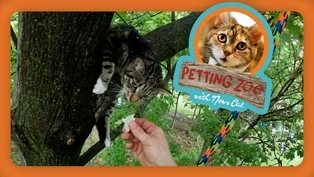
Petting Zoo: Recreational Tree Climber Rescues Cats
Clip: S53 Ep5 | 2m 40s | Petting Zoo: Recreational Tree Climber Rescues Cats (2m 40s)
Providing Support for PBS.org
Learn Moreabout PBS online sponsorship
- News and Public Affairs

Top journalists deliver compelling original analysis of the hour's headlines.

- News and Public Affairs

FRONTLINE is investigative journalism that questions, explains and changes our world.












Support for PBS provided by:
NewsDepth is a local public television program presented by Ideastream