
Oct. 6, 2022 | NewsDepth 2022-2023 | Episode 4
Season 53 Episode 4 | 26m 46sVideo has Closed Captions
People around the world are protesting against Iran’s morality police.
In this week’s show, people around the world are protesting against Iran’s morality police. College students have limited food options in Minnesota. Jeff St. Clair has an update on the James Webb Telescope. And a Guatemalan artist paints North East Ohio bright colors.
Problems playing video? | Closed Captioning Feedback
Problems playing video? | Closed Captioning Feedback
NewsDepth is a local public television program presented by Ideastream
Oct. 6, 2022 | NewsDepth 2022-2023 | Episode 4
Season 53 Episode 4 | 26m 46sVideo has Closed Captions
In this week’s show, people around the world are protesting against Iran’s morality police. College students have limited food options in Minnesota. Jeff St. Clair has an update on the James Webb Telescope. And a Guatemalan artist paints North East Ohio bright colors.
Problems playing video? | Closed Captioning Feedback
How to Watch NewsDepth
NewsDepth is available to stream on pbs.org and the free PBS App, available on iPhone, Apple TV, Android TV, Android smartphones, Amazon Fire TV, Amazon Fire Tablet, Roku, Samsung Smart TV, and Vizio.
Providing Support for PBS.org
Learn Moreabout PBS online sponsorship[Upbeat Music] - Coming up next on NewsDepth People around the world are protesting Iran's morality police.
College students have limited food options in Minnesota.
Jeff has an update on the James Webb Telescope and a Guatemalan artist paints Northeast Ohio's bright colors.
NewsDepth is now.
[Upbeat Music] Protests have broken out around the world opposing a strict hair code in Iran.
Hello everybody!
I'm Gabriel Kramer in for Rick Jackson.
Thank you for joining us.
Demonstrations were triggered by the death of 22 year old Mahsa Amini who died after being apprehended by the morality police in Tehran, the capital of Iran.
Mahsa Amini was arrested for violating Iran's strict hair code by improperly wearing her hijab.
A hijab is a head scarf Muslim women wear to cover their hair in public.
Iran has a body of law enforcement called the Guidance Patrol or morality police.
It was formed in the 1990s to ensure that the Islamic dress code and modesty was being practiced by everyone.
But this had a bigger impact on the women of Iran.
Protests against the morality police have happened all over the world, including Iran itself, France and England.
One of the largest protests took place in front of Colorado State Capital in Denver last week.
Jaleesa Irizarry was there.
- A lot of emotion outside of the Colorado State capital today as people gather to take a stand for women's rights in Iran.
A lot of the women I spoke to say now more than ever people in the US need to step up and show their support.
[Woman Singing] [Crowd Clapping In Harmony] [Crowd Cheering] Hair does not make a person but the freedom to choose how it's worn does.
[Crowd Cheering] On Sunday, people decided to be present in support for those who can't.
- So we are here to be the voice of the people of Iran.
- [Jaleesa] Noush knows for many thousands of miles away in Iran, freedom may feel like an illusion.
- [Speaker] All of these women and all the people on the streets, they're wanting human rights, they're wanting basic rights, women's rights, environmental rights, economic justice, and they're not getting that.
[Cars Honking] - [Jaleesa] Throughout the country, communities have rallied in the name of Mahsa Amini, a woman that died in police custody in Iran after being arrested for wearing her head scarf improperly.
- We've let it go far too long.
- [Jaleesa] For Lisa Andreas and her 11 year old daughter, Amelia, the news feels personal.
- Our brothers, our sisters, our cousins, our family have been fighting against the morality police for their bangs being shown, their fingernails.
They can't wear lipstick, they can't wear fingernail polish.
This young woman was doing absolutely nothing.
It is time for change.
- And I want the Irans to be free and not wear a hijab.
- [Jaleesa] Amelia may never get to see her family in Iran, but her mother believes here, - Freedom for Iran - [Crowd Chanting] Freedom for Iran she still gets a glimpse of what makes her country.
- [Woman Protester] Mahsa, we stand with.
- [Jaleesa] A community that fights for the freedom to choose what they believe.
- [Woman Protester] We stand with you.
- Iran's president did say Mahsa Amini's death needs to be investigated, but he also did say they need to deal decisively with the growing protests across the country.
- Thanks Jalessa.
Having something like the way you style your hair affects the way people treat you may sound like something that could never happen in the United States.
But it wasn't until 2019 that there was a law in place to protect people from being discriminated against for their hair.
It's called the Crown Act.
Less than half the states in the US have passed this new law.
South Dakota is not one of the 18 states that have passed a Crown Act.
A student there, Braxton Schafer, had to leave his school because of his hair.
But a photographer heard about the student and wanted to help boost his self-esteem.
Cooper Seamer reports.
- Once I heard about it, I was.
- [Cooper] Having to leave a Gorman High School for his hair is still something that's hard to talk about for Braxton Schafer.
- [Braxton] Kind of said that I already have to leave the school this early in.
- [Cooper] But in the month since that decision was made, he's been trying to move on and look forward to the future.
- And I want you to just kind of - [Cooper] In that time he's met Jermaine Horton, the Chicago based photographer heads The Art of Confidence, a nonprofit that works with youth after their confidence has been shaken, empowering them through photography.
- I heard about Braxton's story from the Crown Act.
Members of that organization reached out to me and they said, Hey, this is a story that I think you should take on and we would love to partner with you on.
- [Cooper] And he's helping Braxton out with a photo shoot of his own.
- It's been going pretty good and a lot better about what's been going on.
- [Jermaine] Then look straight out.
- [Cooper] Horton says it's important for him to help youth that have faced challenges because of their hair, health conditions, or self-esteem.
- [Jermaine] As children, this is the time when they learn to be who they are and start growing and understanding who they are as a person.
- [Cooper] By using photos, he wants to show everyone Braxton's true self.
- [Jermaine] My hope is that people get to see Braxton for who he is and not what they maybe fear him to be or not educated on or have understanding of who he is.
Two, Three.
If they had a chance to get to know him in just a short time that I have, He's a shy, introverted kid, you know, he's just a kid.
He wants to have fun and and be at teen and he loves his hair.
- [Cooper] For Braxton, he's looking forward to finding out what the future holds.
- And hoping just to move on, meet new friends, or focusing on school and football again.
- Thank you Cooper.
Okay, now let's talk about money.
For a fifth consecutive time, The Federal Reserve System is taking action aimed at tackling record high inflation.
The Federal Reserve or Fed, is a central bank to the United States.
It provides a nation with a safer and more flexible monetary system.
Last month, Fed Chairman, Jerome Powel, announced it raised interest rates again by another three quarters of a percentage point.
An interest rate is the extra fee you pay when you borrow money from a bank.
Today we'll take a look at what this means for borrowers.
From credit card users to car and home buyers.
Jenn Sullivan has the details.
- [Jenn] Aggressive action from the Fed.
On Wednesday, Federal Reserve chairman ,Jerome Powell, announcing the fifth consecutive interest rate hike this year.
- The FOMC raised its policy interest rate by three quarters of a percentage point.
- [Jenn] And economist aren't surprised and expect more rate increases are ahead of us.
The Fed taking drastic action to slam the brakes on the hot economy and historic inflation.
- They are obviously very concerned about inflation and raising rates very aggressively to slow the economy's growth rate down to try to quell that inflation.
- [Jenn] Higher interest rates means higher borrowing costs for all Americans on their credit cards, cars, student loans on their homes where mortgage rates have already top 6% and also a hit on retirement savings.
- [Woman] What's happening right now should be a warning bell that get out of debt that you have and don't take on as much debt.
Because whatever you take on, it's gonna cost you more.
- [Jenn] Experts say most consumers will feel the pain.
For those living paycheck to paycheck, it could mean making difficult decisions.
Personal finance author Michelle Singletary recommends holding off on big purchases until the overheated economy stabilizes.
- Is this the right time?
Can you wait before you jump into the housing market or to buy that new car cause it's gonna cost you more.
- [Jenn] Defense move does have a silver lining for some.
Economists Mark Zandy says higher rates could benefit savers.
- [Mark] Ultimately this should be a plus for you because you'll get a higher rate on that.
- Thanks Jen.
The students of the University of Minnesota are frustrated over the very limited options they find in their school cafeteria.
The university says a staffing shortage is impacting dining operations.
Marielle Moes takes us inside.
- We've been getting Lunchables and pizza.
That's about it.
- [Marielle] Donovan Verde is a freshman living at Middlebrook Hall on the U of M's West Bank.
He says this is what they're serving up in his dining hall right now.
Parents with students graduating in 2026 shared these photos taken by their kids within a private Facebook group.
- I need more than a lunchable to fill my diet.
- I usually eat at other dorm dining halls honestly.
- Iesha Terana packed your own lunch Wednesday.
Thanks to some grocery money from Dad.
- I wish the dining hall food was a lot better or just, like that they would have more options cause the options are really limited.
Like I'm vegetarian on campus so it's very limited for me.
- Other pictures shared in the parents' Facebook group showed empty buffets where unlimited food should be.
- I went there once at 9:00 PM to eat some dinner cause I know the dining hall was open and there was like nothing there except for like cookies.
- Another problem that these on campus dining halls are facing right now is staffing shortages.
Students tell us that the hours of operation for the dining hall have been cut back recently.
The University told WCCO they are short 142 employees right now and reducing hours as part of mitigating that problem.
As for the Lunchables, University dining said in a statement, "They are not a meal or meal replacement in residential dining.
In this case, the product was nearing the expiration date and a well meaning employee place them out for students to take for free."
Still students tell us they feel short changed.
- I feel like we should be getting a lot better food for how much we're paying to go here.
- Thank you Marielle.
Now I have some news for you that is out of this world.
The James Webb telescope, which was launched back in December 2021, has sent back images with amazing discoveries and with 150 million pixels a pic., scientists have been able to see all the details.
Ideastream's Jeff St. Claire has the update for this week's Spot on Science.
[Upbeat Music] - Astronomers are peering deeper and deeper into space with the clearest vision ever thanks to the James Webb telescope.
Part of the telescope's mission is to look for planets outside our Solar Systems.
They're called exoplanets, which raises the question, are we alone in the Universe?
- It's a question that's been around for thousands of years.
When people first looked up at the stars and wondered what is out there.
- Scientists like Sarah Seger are searching for habitable planets orbiting stars beyond our own Sun.
- We're just excited because we're the first generation who can explore exoplanets for signs of life.
- The James Webb telescope can peer into the atmosphere of an exoplanet as it passes in front of its parent star and measure whether it could possibly support life.
- It'll be our first like ever chance to look into the atmospheres of rocky worlds.
- Just a few months after it's launched, the James Webb telescope is already sending us images of far off Galaxies, dying stars, frozen planets, and the cosmic dance of the Universe.
Scientists are seeing further into space and learning more about how planets, stars, and even Galaxies form and perhaps whether life exists on other worlds.
- We want to understand our place in the cosmos.
We want to get some clues on how our earth formed and came to be and how life here arose.
And by finding life elsewhere will hopefully inform all of these things.
- And as they say, stay tuned for more.
[bounce sound] - Thank you, Jeff.
Now the telescope is making amazing discoveries every day and each new planet and host star needs to be named.
For this week's question, we wanna know what name would you give to one of those planets?
Go to our Website and share your other worldly names and don't forget to add your explanation of why you picked it.
For last week's episode, we asked you why it was important to put an emphasis on accessibility.
Let's see what you had to say by opening our inbox.
[Upbeat Music] Molly from Botkins Local School in Botkins wrote: Dear NewsDepth, Here's why I think it is important to put an emphasis on accessibility.
First, people shouldn't feel left out no matter what, and I think it's great that there's a park for any kind of kid so kids don't feel left out.
Also, you can make new friends with someone you thought you would never make friends with.
Joshua from Orrville Middle School in Orrville knows what he's talking about.
Accessibility is important because without physical accessibility you can't do a lot of things others can and that will cause too many problems.
Lingual accessibility is important because if we can't talk to each other then we can't do as much and get as much done.
Hannah from Crestview in Brunswick said: I believe that it is important to make sure that everyone can use something because it is important to treat others the way you want to be treated.
And though it may feel like you are not hurting someone's feelings when they see everyone doing something they cannot do, they feel left out.
That's why you should put an emphasis on accessibility.
Eddie and Beckett from Grant Elementary School in Lakewood teamed up for their answer.
Dear NewsDepth, I think it is important for special needs people to have accessibility to everything.
For example, I think they should have access to a pool like an entire area dedicated just with people with special needs.
Instead of stairs, it would have ramps and the slides would be wheelchair accessible, like they could go down and there could be an elevator that brings a wheelchair down.
That would be very high tech, but it could be possible.
And MacKenzie from Buckeye Intermediate in Medina has a very smart quote.
"Why I think it is important to emphasize people with disabilities and so they won't feel like they cannot do anything and they will feel wanted."
As Albert Einstein once said, "If you judge a fish by its ability to climb a tree, it will live its whole life thinking it's stupid."
Also, Albert Einstein had dyslexia, so anybody that is different can do anything.
Thank you as always for your letters and a way to show how you're always including everyone!
Let's get back to the news.
The University of Colorado is launching a dual degree program that is truly out of this world.
The first of its kind program is a collaboration between its medical and aerospace engineering schools.
Cole Sullivan has the story.
- [Cole] Discovery can't happen [Woman Laughs] without a lab like this.
- [Supervisor] I mean, as a supervisor, I think it's all cool.
- Here the cutting edge of medicine will meet its final frontier.
- Your resources, your environment, everything is so strange and so foreign and so limited like that has gotta be the holy grail of the hardest place to practice medicine.
- [Cole] Arian Anderson is a doctor at the CU School of Medicine.
He and engineering professor Ali Anderson created this program to teach medical students how to work in space.
- The demand for physicians who also, let's say speak the language of engineering is also rapidly growing in demand.
- [Cooper] Rapidly growing, as more and more people blast into space with plans for longer trips, trips where they might get sick.
- What do we need to do to reduce that risk or what do we need to bring with us to treat appendicitis?
So those questions so far haven't really been answered.
- [Cooper] The students in this first of its kind joint program will discover the answers.
There'll be doctors like Arian and engineers like Ally trained to prevent sickness that can come with flying through space.
- It naturally causes changes to the body as well as a lot of stressors that we wouldn't necessarily see otherwise.
- [Cooper] Working in a lab like this, the students will create treatments we've never needed before.
Medicine to power the new age of discovery.
- And I think the students coming out the other side are gonna be just brilliant, like scary, smart, and have all kinds of opportunities.
- Throughout the school year we will be interviewing professionals in a STEM field, so someone who has a job in science, technology, engineering, or math.
But we need your help to decide what careers to focus on.
So for this week's poll, we wanna know which of these jobs would you be most interested in learning about?
Head in line to pick between environmental scientist, computer system manager, chemical engineer, astronomer, epidemiologists, or statistician.
Last week we asked you to pick which of the impressive women we talked about on the show you found the most inspiring.
39% of you think that former First Lady, Michelle Obama, is inspiring.
A close second with 37% of the votes was Ohio native and first woman to run for President Victoria Woodhull.
Third place goes to former Army officer Rebecca Halsted with 18% of the votes and coming in fourth place with 6% as former Secretary of State, Hillary Clinton.
Well, how about we add this maritime archeologist to the list of impressive women.
Tamara Thomsen from the Wisconsin Historical Society has found not only one but two ancient canoes while scuba diving in Lake Mendota near Madison, Wisconsin.
These two canoes are considered to be the oldest shipwrecks that have been discovered in any other Great Lakes.
Naomi Kowles dives into this story.
- [Naomi] After four months.
- It gives me goosebumps.
- [Naomi] Tamara Thomsen could finally celebrate.
Seeing something that hasn't been seen for so much longer.
- Three Different test so for sure it is a 3000 year old canoe.
- [Naomi] This morning, Thomsen helped the Wisconsin Historical Society dive team delicately raised an ancient canoe from the waters of Lake Mendota.
- It's kind of the consistency of wet cardboard.
- [Naomi] Thomsen spotted the relic while scuba diving off the southwestern shores in May.
- Texted my boss, I'm like, You're not gonna believe this, This is not a joke.
I found another dugout canoe.
- [Naomi] Last fall, She helps recover a different 1200 year old canoe in the same lake.
This summer, the historical society sent sample from this canoe.
Radiocarbon dating places it from approximately 1126 BC predating the Trojan War.
It's an era that's difficult for Marlon Whiteagle to grasp.
He's able today to touch something made by his Ho-Chunk tribes distant ancestors.
- Shows that we had a society with transportation trade commerce that was was a part of our the, you know, the fabric of our society back then.
- [Naomi] The excavation process started on Monday, 30 feet deep out in Lake Mendota, and now this 3000 year old canoe heads next to the state archive preservation facility where it could take up to three years to complete preservation.
Historical society director Christian Overland admits.
this discovery, which is currently in several pieces, presents more questions than answers.
- To the new pathway and portal to the past to understand.
- [Naomi] But he says, in conjunction with the Ho-Chunk Tribe there will be much to learn, much to celebrate in the years to come.
- That's part of the story that we're gonna bring up out of the water and the investigation starts, the storytelling starts, history moves forward in a new way.
- Thank you, Naomi.
As we continue to celebrate Hispanic Heritage Month, we're highlighting yet another Hispanic artist in Ohio in this week's Sketchbook.
Héctor Castellanos Lara was born in Guatemala and he has made a tremendous impact on the northeast Ohio arts and culture community.
Since his arrival in 1990.
David C. Barnett takes us inside the artist studio.
[Swoosh] [Swoosh] [Light Guitar Misc] - [David] Since 1990, Héctor Castellanos Lara has made a tremendous impact on the arts community of northeast Ohio.
From his work on Parade the Circle and Chalk Festival in Cleveland's University Circle to his beloved Dia de Muertos celebrations in the Gordon Square Arts District.
Castellanos Laras loves to share his Latino heritage.
[Upbeat Music] One of his earlier exhibits hearken back to his beloved Guatemala.
- [Castellanos] People always asking me why I don't make a scenes from Guatemala, and Guatemala is one of the most important art that is very easy to recognize because the Mayan population, they dress with these beautiful dresses representing different local areas where they live.
All the ideas that I have in my paintings come from my, my mind, you know, from my head.
Usually don't go and take photographs or see the scene and draw it or sketch it.
No, I just sit in front of the paper or canvas and I start putting together what I remember.
You know, in this case, people from the market, people with sombreros, or people taking a good rest in a sidewalk.
Those scenes are part of the daily life in Guatemala.
- [David] In the late nineties, a chance meeting with the Cleveland Museum of Arts, Robin Van Leer, led Castellanos Laras to the pageant of a lifetime.
CMAs Parade the Circle.
[Jazz Music] - I have been part of the family working for almost 22 years with Parade the Circle.
Preparing floats, making giant puppets, also training school kids to teenagers, to adults and the Cleveland and Public Library also.
I did it for many years.
So much fun, so much creativity every year.
[Upbeat Music] Robin Vanier has this great event like Parade the Circle.
She has the Chalk Festival.
So that was another invitation directly to me and I say, Yeah, I would try this new media.
Since then, I haven't stopped.
- [David] Arts Education is a big part of his career as he works with area schools on projects like traditional saw dust carpets for the Holy Week of Easter.
His most recent activity is at the Art House in Cleveland's Brooklyn Center neighborhood.
Working with young immigrants, currently living in Akron and Canton, Castellanos Laras christened it, The Gateway Project.
- [Castellanos Laras] The idea was to welcome the refugees, welcome everybody, immigrants.
To go through this installation, and we are gonna have some wind chimes made it a bamboo material Like a, you can see that there's no walls, so you can come through different directions inside, and that was the main idea.
You know, we don't need walls.
One of the main things for me to tell them all the time is like, I don't stay with one discipline in the art.
You know you're a painter, that's great, you know, but explore other, other disciplines.
I really motivate them to explore more because that give you more chances, more opportunities in life.
Especially in the arts.
- Gracias David.
Now, one thing I really enjoy about the a plus award is seeing how all of you come up with creative solutions to solve some of life's little problems.
These five girls who their teachers call "the Mural Girls" did just that.
Their artistic abilities and unique problem solving earned Ava, Kendall, Addison, Lola, and Madeline, all seventh graders at Bay Middle School.
This week's a plus award.
Their sixth grade social studies teacher, Mrs. Guinter, wanted a more permanent display outside of her classroom rather than several bulletin boards.
Then a great solution came to mind, What if they replace the bulletin board with murals?
Ms. Guinter and Art teacher, Ms. Fortunato challenge their students to design murals featuring the themes of sixth grade social studies.
The Mural Girls, along with other classmates, all submitted sketches of their ideas for five murals to replace the bulletin boards.
Lola told us that she wanted to paint a mural featuring ancient India because she was inspired by the architecture.
Addison chose to paint a mural featuring five world religions because of the impact that religion has on millions of people across the globe.
The other three murals feature Mesopotamia, Egypt, and ancient China.
It wasn't as easy as just painting a picture on a wall.
The five artists told us that they use a grid method that was actually common for Renaissance artists to use in painting murals to enlarge their sketches.
We were amazed to learn that it wasn't just social studies and art that they were learning about.
They also had to use math to figure out the proper ratios of paint to mix, to create the perfect colors for other murals.
Ms. Fortunato told us that the five artists spent most of the first month of their summer vacation at school, painting the murals.
Both Ms. Guinter and Ms. Fortunato are both excited to be able to use a murals as teaching examples for this year's sixth graders.
Kendall told us that she really learned that even if you don't think something is perfect, you might realize that it actually is perfect, but in a different way.
Kendall, that's a great attitude to have.
The Mural Girls said that they're really proud of their work and they would definitely do it again, even though it took a lot of their time.
This week's A plus award winners are Ava, Kendall, Addison, Lola, and Madeline for using their artistic talents to solve a problem and teach a little bit of world history.
Now let's see what NewsCat is up to.
[Music] [Meowing] Oh, a wagging tail.
She must have found something good for us this week.
Let's see it NewsCat.
Oh, I love the sound of those typing paws.
What's this?
She found a snake that got to go for a walk.
Snakes can't walk in enough feet.
Oh, this one has robo-feet.
To find out how far this little reptile went, click on the petting zoo button on our Website.
(bounce sound) Thank you as always, NewsCat, and you know the drill.
We want to hear from you.
There are plenty of ways to stay in touch.
You can send a letter.
We're at 1375 Euclid Avenue.
That's Cleveland, Ohio.
Zip code here, 4415.
You can email us at Newsdepthideastream.org or you can tweet us.
Our handle is at NewsDepth Ohio.
Thank you all for joining us.
I'm Gabriel Kramer.
We'll see you right back here next week.
[Upbeat Music] - NewsDepth is made possible by Grant from the Martha Holden Jennings Foundation.
Clear call outs featured in NewDepth are funded by the Ohio Broadcast Media Commission [Upbeat Music].
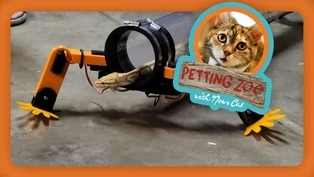
Petting Zoo: Snake Gets Robotic Feet
Clip: S53 Ep4 | 1m 13s | Petting Zoo: Snake Gets Robotic Feet (1m 13s)
Providing Support for PBS.org
Learn Moreabout PBS online sponsorship
- News and Public Affairs

Top journalists deliver compelling original analysis of the hour's headlines.

- News and Public Affairs

FRONTLINE is investigative journalism that questions, explains and changes our world.












Support for PBS provided by:
NewsDepth is a local public television program presented by Ideastream