
October 14, 2024 - PBS News Hour full episode
10/14/2024 | 57m 46sVideo has Closed Captions
October 14, 2024 - PBS News Hour full episode
October 14, 2024 - PBS News Hour full episode
Problems playing video? | Closed Captioning Feedback
Problems playing video? | Closed Captioning Feedback
Major corporate funding for the PBS News Hour is provided by BDO, BNSF, Consumer Cellular, American Cruise Lines, and Raymond James. Funding for the PBS NewsHour Weekend is provided by...
Support provided by:

October 14, 2024 - PBS News Hour full episode
10/14/2024 | 57m 46sVideo has Closed Captions
October 14, 2024 - PBS News Hour full episode
Problems playing video? | Closed Captioning Feedback
How to Watch PBS News Hour
PBS News Hour is available to stream on pbs.org and the free PBS App, available on iPhone, Apple TV, Android TV, Android smartphones, Amazon Fire TV, Amazon Fire Tablet, Roku, Samsung Smart TV, and Vizio.
Providing Support for PBS.org
Learn Moreabout PBS online sponsorshipAMNA NAWAZ: Good evening.
I'm Amna Nawaz.
GEOFF BENNETT: And I'm Geoff Bennett.
On the "News Hour" tonight: Civilians in both Gaza and Lebanon are once again caught in the crossfire, while the U.S. promises to send an air defense system to Israel.
AMNA NAWAZ: Vice President Kamala Harris works to shore up support from Black voters, while former President Donald Trump ramps up his dangerous political rhetoric.
GEOFF BENNETT: And how some prominent colleges are reaching out to students from rural areas that are often overlooked.
MARJORIE BETLEY, University of Chicago: These students are also not getting the same information that a lot of their peers are getting in more urban and suburban areas because colleges don't come visit them.
Welcome to the "News Hour."
A weekend of death and destruction gave way to another day of carnage in Gaza and Lebanon, as Israeli forces struck multiple sites in both places, killing dozens.
Israel suffered its own losses as its troops in the north came under fire from Hezbollah.
AMNA NAWAZ: That drone attack killed four Israeli soldiers, but much focus fell again on Gaza and an Israeli attack outside a major hospital in Gaza's north.
That is where Leila Molana-Allen begins our coverage tonight.
And a warning: Images and accounts in this story are disturbing.
LEILA MOLANA-ALLEN: Burned alive in a hospital bed, an I.V.
that was supposed to heal became shackles.
Last night, in Central Gaza's Deir al Balah, screams echoed through the night, as an Israeli airstrike hit a makeshift tent village outside Al-Aqsa Hospital, setting the tents and part of the building ablaze.
AOUNI KHATTAB, Displaced Gazan (through translator): There were people trapped inside the fire and we were unable to pull them out.
A human being burned alive in front of your eyes, and you can't rescue him.
He turned to ashes.
LEILA MOLANA-ALLEN: At least four people were killed and dozens injured.
Today, as the smoke cleared, doctors attempted to tend their burns without painkillers or ointments.
Survivors sifted through the rubble of their temporary homes.
UHM MAHMOUD WADHI, Displaced Gazan (through translator): Everything has burned, everything.
As you see, I'm a mother of seven daughters.
Where shall I go?
My tent has collapsed, destroyed.
All our clothes and belongings are gone.
Who should we speak to?
Where is the safety?
We are calling on all countries, the whole world, to stand by our side and stop the war on us.
We are exhausted.
We have had enough.
LEILA MOLANA-ALLEN: Nearby, in Nuseirat, a night of horror for displaced families, as the IDF struck an UNRWA school where families were seeking shelter.
The attack killed at least 22 people, including 15 children.
FATIMA AL AJAB, Displaced Gazan (through translator): (through translator): They were sleeping unarmed.
They're innocent.
This is little Rahad's blanket here.
She was only 2 years old.
This morning, they removed their bodies, but the fire was still everywhere.
Then there was another wave of airstrikes.
The injured and dead were everywhere.
We have had enough of this.
Have mercy on us.
They took their childhoods away.
They took our smiles away.
They have taken away every beautiful detail in our lives.
LEILA MOLANA-ALLEN: Fatima's son says all he wants is freedom from this war.
He doesn't fear death anymore.
He's seen too much.
ABDULLAH AL AJAB, Displaced Gazan (through translator): The fire was burning for three hours while we were carrying the dead and collecting their cut-off fingers, which we put in a box and took them to the hospital.
The children here are dying.
Everyone is going to die.
We're not going to keep going from place to place.
At least we will die in our country.
LEILA MOLANA-ALLEN: In Israel last night, an IDF base south of Haifa was hit by a Hezbollah drone.
The strike killed four soldiers and wounded dozens of others.
Even as the United States sends a new missile defense system to Israel, Israelis worry their air defense can't handle the increasing threat from drones.
REAR ADM. DANIEL HAGARI, Spokesperson, Israeli Defense Forces (through translator): We are required to provide better protection.
We will investigate this incident, learn and improve.
Our mission is to better protect our soldiers and citizens of Israel.
LEILA MOLANA-ALLEN: As IDF troops push further across the border into south Lebanon, Israeli soldiers posted videos of themselves inside Lebanese homes.
After multiple attacks on UNIFIL bases by Israeli troops left several U.N. peacekeepers wounded, Israeli Prime Minister Benjamin Netanyahu reiterated his demand that peacekeepers withdraw.
BENJAMIN NETANYAHU, Israeli Prime Minister (through translator): It is time for you to remove UNIFIL from Hezbollah strongholds and from the fighting areas.
The IDF has repeatedly asked for this and has been met with repeated refusals, all aimed at providing a human shield to Hezbollah terrorists.
Your refusal to evacuate the UNIFIL soldiers makes them hostages of Hezbollah.
LEILA MOLANA-ALLEN: The U.N. maintains they must stay under international law and that it's incumbent on Israeli and Lebanese forces to ensure their safety.
The IDF demanded the evacuation of a further 20 towns and villages.
Fully a third of the country is now under fire.
Yesterday, a century-old souk and mosque in Nabatiyeh were razed to the ground; 2,300 people in Lebanon are now dead, nearly 11,000 injured.
The IDF says it will tell Lebanese when they can return, but many of their homes and entire villages have been flattened and the bombing campaign is escalating across the country.
In the past few days, Christian towns in the north have been targeted for the first time, while, in the capital, the strike zone continues to expand often without warning.
Mohammad was left reeling after the streets housing his family home and his gym business in a calm central Beirut neighborhood were hit within five minutes of each other.
The area had become home to dozens of displaced families who fled from the south.
His family survived, but many in their building didn't.
MOHAMMAD SALAMOUN, Beirut Resident (through translator): We're all families here, no weapons or Hezbollah leaders or anything.
I don't know what they're thinking that they could kill us like this.
When you see people dead in body parts all over the place, you don't know how to feel, especially after the terror we experienced after the strike.
LEILA MOLANA-ALLEN: Some have decided they can't take it anymore.
Nearly 100,000 Lebanese have fled to Syria, taking their chances with a stagnant civil war there over an escalating one here.
After one airstrike too many, Widad and her teenage daughter left home with what they could carry.
WIDAD LAKHAL, Displaced From Lebanon (through translator): My heart is in Lebanon.
We will definitely return to Lebanon.
I consider my country to be Lebanon, frankly, but fear.
One can't trust Israel.
It targets all the places.
LEILA MOLANA-ALLEN: As the conflict spreads, this region is no longer boiling.
It is burning.
For the "PBS News Hour," I'm Leila Molana-Allen in Beirut.
AMNA NAWAZ: Watching the latest developments for us here is our foreign affairs and defense correspondent, Nick Schifrin.
So, Nick, let's begin with what Leila mentioned there about the U.S. deployment of an air defense system to Israel.
Tell us about that and how significant that is.
NICK SCHIFRIN: This is the first time, Amna, that U.S. forces will deploy into Israel since the October 7 attack.
About 100 service members will arrive with a THAAD battery.
That is the Terminal High Altitude Area Defense.
It defends against ballistic missiles, so it would be used alongside Israeli missile defense against Iranian attacks.
That's two weeks after 180 Iranian ballistic missiles really caused no damage, but, as you can see there, it got through U.S. and Israeli air defense.
So, THAAD would help defend Israel should Iran launch another attack to a response what we could expect any moment, which is an Israeli strike on Iran.
U.S. officials tell me that they continue to urge Israel not to attack nuclear energy sites, but instead to target military intelligence sites.
U.S. officials tell me they believe Israel's leadership is listening, but there's no guarantee about their final decision.
As for that THAAD battery, President Biden said it would be to -- quote -- "protect Israel."
But there are downsides.
The U.S. Army only has seven of them all over the world.
It's very expensive.
And there's no quick way to replenish missiles if U.S. troops do use them to help protect Israel.
AMNA NAWAZ: Let me ask you too about Gaza and Leila's reporting there.
We saw those horrific images from Deir al Balah.
We have seen now Israel intensify its assault in Northern Gaza.
The U.N. has condemned the large number of civilian casualties in recent days.
What's behind that Israeli intensification?
NICK SCHIFRIN: So, as for the strike itself, a National Security Council spokesperson released a statement this afternoon saying -- quote -- "What happened there is horrifying."
An Israeli Defense Forces statement says that they targeted -- quote -- "terrorists" operating inside a command-and-control center in a parking lot full of displaced persons next to the Al-Aqsa Hospital, and the fire was most likely caused by secondary explosions and that they are reviewing the incident.
Amna, you and I have talked about for the last year.
The Israeli rules of engagement allow Israel to target what it calls senior Hamas leaders or Hamas fighters even if surrounded by civilians, even if surrounded by women and children.
And Israel calls that Hamas using civilians as human shields.
But a U.N. report, as you were just suggesting, calls out Israel for -- quote -- "its concerted policy to destroy Gaza's health care system."
And that airstrike is part of a larger Israeli effort in Northern Gaza.
Israeli military has reentered Northern Gaza with tanks, issued evacuation orders for some 400,000 people as Hamas fighters have regrouped.
U.S. officials say that Hamas fighters have only regrouped because Israel has no strategy for the day after.
The U.N. also says that Israel's new campaign has blocked all aid into Northern Gaza since October the 1st, leading Israel's military to deny a plan that's now been made public that's been known as a retired general's plan to starve out Northern Gaza to create a permanent military zone.
Today, Israel published these images, some 40 trucks arriving into Northern Gaza.
U.S. officials have been pushing Israel to allow more aid to go in and warning that, if more aid didn't go in, the U.S. could declare Israel was blocking aid officially, and that could require U.S. law suspending some arms sales to Israel.
But bottom line is, that remains a threat, and Gazans say nowhere is safe.
AMNA NAWAZ: And quickly, Nick, before you go, on Lebanon, what is the Israeli goal there?
NICK SCHIFRIN: Israeli officials continue to say that they are trying to get some 60,000 people displaced from Northern Israel back into their homes.
And to do so, they have to go into Southern Lebanon to get rid of Hezbollah fighters and tunnels.
We saw this video released today, Israeli forces releasing what it said was a Hezbollah command-and-control bunker of weapons, food, motorcycles for an October 7-style attack.
But the bottom line is, the routes that Israel would need to go in with armored vehicles run right through those U.N. bases.
Today, the U.S. says UNIFIL must not be harmed, that Israel's invasion needs to be -- quote - - "limited."
But the last time Israel promised a limited invasion of Lebanon, it was 1982, they stayed for 18 years.
AMNA NAWAZ: Nick Schifrin, thank you very much.
NICK SCHIFRIN: Thank you.
AMNA NAWAZ: Turning our focus now to the 2024 presidential race, over the weekend, Vice President Kamala Harris made stops in North Carolina, while, out West, former President Donald Trump ratcheted up his political rhetoric.
But, tonight, both candidates are in opposite corners of one of the most important states in this election.
That's Pennsylvania.
Laura Barron-Lopez has our report.
LAURA BARRON-LOPEZ: This afternoon, Kamala Harris jetted off to the country's largest battleground state.
The vice president is doing in Pennsylvania as she did in North Carolina over the weekend, energizing Black voters.
Meanwhile, former President Donald Trump increased his extreme rhetoric, describing some American citizens as enemies.
DONALD TRUMP, Former President of the United States (R) and Current U.S. Presidential Candidate: I think the bigger problem is the enemy from within.
LAURA BARRON-LOPEZ: In a FOX News interview yesterday, Maria Bartiromo asked Trump whether or not Election Day would be peaceful.
DONALD TRUMP: We have some very bad people.
We have some sick people, radical left lunatics.
And I think they're the -- and it should be very easily handled by -- if necessary, by National Guard or, if really necessary, by the military.
RUTH BEN-GHIAT, NYU History Professional: This kind of terminology is the terminology of dictators.
LAURA BARRON-LOPEZ: Ruth Ben-Ghiat an American historian and scholar.
RUTH BEN-GHIAT: Initially -- and he's been doing anti-immigrant rhetoric since 2015 -- it was keeping people out so that you should militarize the border.
But now it's the enemy within.
And that enemy can be anywhere, even in the heartland, such as Aurora or Springfield.
And, thus, he's talking about using various types of armed forces, National Guard and, he says, even the military, to go and liberate these territories.
And this is very dangerous rhetoric.
It's turning armed force against a domestic population, and that's what dictators have done in the past.
LAURA BARRON-LOPEZ: Trump's choice language didn't stop at FOX News.
On Saturday, he described American towns as being invaded at a rally in Coachella, California.
DONALD TRUMP: We're like an occupied country.
We got people taking over parts of Colorado.
We have people taking over other states.
November 5, 2024, will be liberation day in America, liberation day.
RUTH BEN-GHIAT: This is a strategy.
The ultimate goal is to convince Americans that democracy is failing and that strongman leadership to fix everything, and Donald Trump will say, I alone can fix it, is supposed to be the answer.
And so as soon as he would take over and go back to the White House, all of our problems would be solved.
But this is based on a fictional reality that's been created by disinformation.
LAURA BARRON-LOPEZ: In Prescott Valley, Arizona, this weekend, Trump made a new immigration pledge, to add 10,000 agents to Border Patrol ranks and bump up their salaries.
DONALD TRUMP: After I win, I will be asking Congress immediately to approve a 10 percent raise, haven't had one in a long time, for all agents, at a $10,000 each retention and signing bonus.
So we're going to retain them.
We're going to retain them.
LAURA BARRON-LOPEZ: Across the country, at her own rally in Greenville, North Carolina, Harris, who released her own medical records on Saturday, took a swing at the former president's lack of transparency.
KAMALA HARRIS, Vice President of the United States (D) and U.S. Presidential Candidate: He refuses to release his medical records.
I have done it.
Every other presidential -- every other presidential candidate in the modern era has done it.
He is unwilling to do a "60 Minutes" interview, like every other major party candidate has done for more than half-a-century.
He is unwilling to meet for a second debate.
LAURA BARRON-LOPEZ: Back in Pennsylvania where the stakes couldn't be higher, this festival in Greeley described by vendors as three days of God, guns and motorcycles, drew huge crowds of Trump voters.
With November 5 just three weeks away, die-hard Trump supporters are counting down the days.
TODD HERHART, Voter: We're 23 days away from the election.
And the days drag.
It's like a 10-year-old waiting for Santa Claus to come.
The days just can't get here fast enough.
LAURA BARRON-LOPEZ: For the "PBS News Hour," I'm Laura Barron-Lopez.
GEOFF BENNETT: And we start the day's other news with the aftermath of the recent hurricanes.
FEMA has had to make what it calls operational adjustments to its work in North Carolina following threats to its personnel.
It follows reports over the weekend about a militia possibly targeting government employees.
A 44-year-old man was arrested and charged with a single misdemeanor offense.
He was later released on bond and local authorities tell the "News Hour" he was acting alone.
That's as FEMA is trying to stamp out disinformation about the federal government's response to hurricanes Helene and Milton.
Officials in Taiwan say that China launched large-scale military exercises today to warn against Taiwanese independence.
Taiwan's Defense Ministry says Beijing used several warships and 125 military aircraft.
That's a record for a single day to surround the island.
Officials in Taipei say they believe Beijing was simulating a blockade of Taiwanese ports and international shipping lanes.
SUN LI-FANG, Taiwan Defense Ministry spokesperson (through translator): This irrational and provocative military exercise threatens security in the Taiwan Strait.
It undermines the security of the Indo-Pacific region and threatens the rules-based international order.
GEOFF BENNETT: China says the drills were intended to punish Taiwan's president for saying in a speech last week that China has no right to represent Taiwan.
Authorities in Sri Lanka say that nearly 7,000 people have been evacuated and three people died in severe flooding.
Heavy downpours over the last several days have inundated streets, fields and homes in many parts of that island nation.
That includes areas in and around the capital of Colombo, where schools were closed today.
Sri Lanka has been dealing with severe weather conditions since May mostly caused by monsoon rains.
A NASA spacecraft lifted off today on a mission to explore Jupiter's moon Europa for signs of the building blocks of life.
MAN: Three, two, one, ignition, and liftoff.
GEOFF BENNETT: The unmanned Europa Clipper launched from Florida's Kennedy Space Center aboard a SpaceX rocket to begin its 5.5-year journey.
It'll cover 1.8 million miles before entering orbit around Jupiter.
Europa Clipper will then do dozens of flybys of the moon, looking at what's believed to be a vast ocean beneath its icy surface.
Scientists say that if conditions are found to be favorable, then it's possible life could exist on other ocean worlds much like Earth.
On Wall Street today, stocks rose to new all-time highs to start the week.
The Dow Jones industrial average gained about 200 points to close above 43000 for the first time ever.
The Nasdaq added more than 150 points on the day.
The S&P 500 tacked on 44 points for a new record close of its own.
And we have a passing of note.
Equal pay icon Lilly Ledbetter has died.
Her decision to speak up about not being paid the same as her male colleagues eventually paved the way for the Fair Pay Act in her name.
When she sued her old employer Goodyear Tires back in 1999 for gender discrimination, the Supreme Court ultimately told her in a 2007 ruling that she'd fallen outside of the statute of limitations.
The Lilly Ledbetter Fair Pay Act changed that, making it easier for workers to sue for pay discrimination.
In 2009, it was the very first bill that President Barack Obama signed into law.
And at the 2012 Democratic National Convention, Ledbetter made clear the fight for equal pay was far from over.
LILLY LEDBETTER, Political Activist: Women who faced pay discrimination, like I did, now can get their day in court.
That was the first step, but it can't be the last, because women still earn just 77 cents for every dollar men make.
Those pennies add up to real money.
GEOFF BENNETT: More than a decade later, the U.S. Census Bureau says that women still only make about 83 cents on the dollar compared to men.
Mr. Obama posted on social media today that: "Lilly Ledbetter never set out to be a trailblazer or a household name.
She just wanted to be paid the same as a man for her hard work."
Lilly Ledbetter was 86 years old.
Still to come on the "News Hour": we speak with the winner of the Nobel Prize in economics about his work on global inequality; a new initiative aims to connect more rural students to colleges; and how a growing number of Latinos who don't speak Spanish are reclaiming their identities.
AMNA NAWAZ: With just three weeks to go until Election Day, the presidential race is still in a dead heat, with both campaigns looking to cut into their opponents' margins.
For more on their strategies and policies, I'm joined now by our Politics Monday duo.
That is Amy Walter of The Cook Political Report With Amy Walter and Tamara Keith of NPR.
Great to see you both.
TAMARA KEITH, National Public Radio: Good to be here.
AMNA NAWAZ: All right, let's take a quick look now, set the stage.
Two new national polls to kind of tell us about the race.
The first is from NBC News.
Right now, you see Harris with 48 and Trump with 48 percent there.
The second is from ABC News, and you have got Harris with 49 percent there, Trump with 47 percent.
That is within the margin of error.
So, Amy, it's a close race, getting closer it seems by the day.
AMY WALTER, The Cook Political Report: Yes, it does feel that way.
If you think about where we were, say, in September, maybe at the end of September, it had been a pretty momentous few weeks for Kamala Harris.
She gets the nomination, the base rallies around her pretty quickly, we go right to the DNC, then she has a successful debate, but that momentum has since, I don't know whether the word is plateaued or hit a wall.
And there is some signs in those national polls that there's been a little backsliding as well, that Trump is doing much better with independent voters.
He's basically halved in that poll, as well as CBS.
All three networks came out with their national surveys.
So there's that sense that on the issues that voters -- there's also the fact that on the issues that voters are the most concerned about, like the economy, Trump still has a lead.
To me, the most important thing I found in that NBC poll is that voters look at Trump's presidency retroactively a lot rosier than they did a year ago, and probably a lot rosier than they did when he was sitting as president.
Harris' entire focus is on trying to make the case that he shouldn't be brought back into the White House.
But, right now, you saw most voters or a plurality of voters in that NBC poll saying they thought Trump's policies helped them.
They did not think that Biden's policies had helped them.
AMNA NAWAZ: And, Tam, we have been seeing the Harris campaign rolling out some major surrogates, right, President Obama last week, President Clinton this week, specifically trying to reach male voters, specifically Black men.
We saw some new economic proposals from the Harris campaign today.
How crucial is that demo for Harris to win?
TAMARA KEITH: That demographic is very important.
In a race that is going to be decided on the margins, we always say this, but in a race that's going to be decided on the margins, she can't afford to lose these voters.
And I was in North Carolina last week reporting in a part of the state where Black voter turnout really was down in 2022 and has been falling in recent years talking to voters.
I went to barbershops.
I talked to some voters who I talked to when Joe Biden was on the ballot, went back and talked to them again now that Kamala Harris is there.
You know, the euphoria that you're seeing at her rallies was not present in those barbershops.
And a couple of people I talked to said specifically that, while they were supporting Harris, they weren't sure that all of their male friends and family would, simply because they don't believe that their friends and family are ready for a woman leader, for a female president.
And they're talking to their friends about it and going back and forth about it, but this is actually a real concern that was voiced by former President Obama at a campaign event in Pittsburgh, where he said the enthusiasm, particularly among Black men, isn't what it was for him.
And he called it out and said that maybe there just are some people who aren't feeling it.
Now, does that persuade?
Does that move people to the polls?
AMNA NAWAZ: Yes.
TAMARA KEITH: I don't know.
But they are certainly being quite open about their challenges and she will be appearing with Charlamagne tha God doing a town hall style-event, again trying to reach that key demographic.
AMNA NAWAZ: So much more to unpack and that we won't have time to in this one conversation.
AMY WALTER: Yes.
AMNA NAWAZ: But, Amy, the Harris campaign also announced she's going to do an interview on FOX, sit down with Bret Baier in Pennsylvania on Wednesday.
AMY WALTER: Yes.
AMNA NAWAZ: Is it risky for the Democratic nominee to go on the pro-Trump network with three weeks left in the election?
AMY WALTER: Right.
So when we talk about fighting on the margins, the other margin is where she does with white voters, especially white voters with a college degree.
So, for as much as her coalition is not looking like the Biden coalition with voters of color, where she is doing better is than Biden did and probably, if this holds, then any other Democrat has ever done is with white college-educated voters.
Now, that -- again, you're not going to win over a lot of FOX voters, but pulling in at some of the margins.
I think what she's also trying to do is to get and sort of goad at Donald Trump to go out in the public a lot more.
She needs Donald Trump to be in the spotlight.
More specifically, some of the things that he says and does that what -- what Laura Barron-Lopez's piece just was about, we have to be careful because of the enemy within, making that a centerpiece of her campaign.
And one way to do that is to go on to sources of news that aren't necessarily friendly to her side.
AMNA NAWAZ: Well, Tam, to that point, in terms of what we heard from former President Trump, there has been a ramping up and escalation of some of the more dangerous kind of rhetoric, now saying, if he was reelected, he would go after the enemy within with the U.S. military.
That was yesterday he said that, the same day that his running mate, J.D.
Vance, once again refused to say in an interview that Trump lost the 2020 election.
I mean, these are antidemocratic messages, but not disqualifying for his supporters.
TAMARA KEITH: These are absolutely antidemocratic messages.
However, he is not trying to win over new voters.
He's not trying to expand into suburban women who didn't support him last time and probably won't support him this time.
He is not trying to win over people who will find that language alarming.
He is trying to excite people who aren't worried about that language at all, who want that, who are here for it, and who are excited about the idea of returning the country to something that it was in a different time.
That's why you have him running these ads on repeat with different narrators even targeted at different demographics talking about trans athletes and Harris supporting trans people, saying that she's for they/them, and not us.
This is messaging that is directly targeted at young male -- young white male voters and others who are uncomfortable with changes happening in society and who are looking to him to take him back and make America great again, if you will.
And so that language, yes, that's going to turn off the people who are already not going to vote for him, but it could excite the people who he needs to get off the couch.
In the competition with the couch, he is escalating the rhetoric to try to make the stakes higher for those people.
AMY WALTER: Right, and we're going to hear from Harris this week as well, who is going to lean into exactly that, which is we can't allow this kind of rhetoric, we can't let this person be back into the White House, sort of ramping up those same distress signals to her voters who might be sitting on the couch.
That's where both of them are right now.
Their greater fear is not that they're going to lose swing voters to the other side, they're going to lose them to just sitting at home.
AMNA NAWAZ: The competition with the couch, as Tam said.
AMY WALTER: Yes.
Yes.
AMNA NAWAZ: Amy Walter, Tamara Keith, always great to see you both, thank you.
TAMARA KEITH: You're welcome.
AMY WALTER: You're welcome.
GEOFF BENNETT: The Nobel Prize in economics was awarded today to a trio of economists who have published work that looks at what accounts for inequality between countries and how the role of institutions, government, and colonialism affected prosperity generations later.
The Nobel was awarded to James Robinson of the University of Chicago, Daron Acemoglu of MIT and his colleague and a frequent guest of this program Simon Johnson, also of MIT.
Simon Johnson joins us now to talk about the award and some of these findings.
Congratulations.
SIMON JOHNSON, MIT Sloan School of Management: Thank you very much.
GEOFF BENNETT: So recount the moment that you learned this morning that you were a Nobel Prize winner.
SIMON JOHNSON: Well, I woke up at 6:00, which is my usual getting up time, and just looked at my phone, again, routine, and saw there were some text messages.
And I didn't believe it, so I had to do a little bit of checking on the Internet before I finally was convinced that I had indeed won the prize with my colleagues.
GEOFF BENNETT: Yes.
And your work examines the different types of colonization and how it led to some nations being poor and others being rich.
What did you find?
What accounts for the prosperity gaps between nations?
SIMON JOHNSON: So, a big part of the prosperity gap, particularly between countries that were formerly colonized by the Europeans, is the way in which the Europeans took over those countries.
Now, in all countries, indigenous people were treated very badly.
Let's be clear about that.
But in some places, the European colonial authorities decided to bring more Europeans in, and then they wanted to make that attractive, so they'd give more rights to the people they're trying to bring in.
In other places, they didn't try to bring Europeans.
They just tried to control the local population, extract taxes, or, of course, run the slave trade and all kinds of other horrible activities.
And in those places, they set up very extractive institutions.
And the problem is, a lot of those - - these initial institutions, including the ones that are really very bad for most people, those have persisted or the effects have lasted in ways that we still live with today.
GEOFF BENNETT: What drew you to this type of research?
SIMON JOHNSON: Well, I personally came to this after 10 years of working in the former Eastern Bloc after the collapse of the Soviet empire.
I worked in Poland, other Eastern European countries, and I worked in Ukraine and Russia.
And I was frustrated with the fact that some of our standard economic tools were not really working as expected.
And I started to think about and to study corruption, the unofficial economy, and other things sort of about the structure of the economy.
And I met Daron and Jim, who were already leading lights in studying political economy, and we came up with this idea of digging deeply into what causes institutions, social, political, and economic arrangements, to be so different across countries.
GEOFF BENNETT: How do you see the role of institutions in economies across the world right now, given the rise of populism and authoritarianism across the globe?
SIMON JOHNSON: So I think there's a big challenge for institutions, a big challenge for democracy.
And part of the problem is that, over the past four decades, we have not delivered on the kind of shared prosperity that was previously promised and that was delivered on in the postwar period.
So people are disappointed, the middle class has been squeezed.
This is a definite problem in the United States, but it's in other industrial countries also.
So there's been a delegitimization of the institutions and a challenge to the way that politics has been organized, the way the economy has been organized.
And this is real.
And now artificial intelligence is arriving.
This is a major new challenge to economic opportunities for the middle class.
It's an opportunity to do things better, but it's not an opportunity that we have grasped yet.
It's -- right now, it's a serious challenge.
GEOFF BENNETT: What does that look like, harnessing technology and making it accessible to the greatest amount of people for the greatest good?
SIMON JOHNSON: Well, think about your iPhone, for example.
What is this or any mobile technology?
Is it helping people primarily with a lot of education, people who can be quite sophisticated in the use of computers?
Or is it empowering people who don't have a lot of education to acquire that education, to acquire those skills, to manage their lives better, to be more productive in all kinds of blue-collar and white-collar jobs?
That's a critical element.
If you can boost people's productivity and deliver higher wages because they have a trade union or their bargaining power is higher or just the demand for labor is very high, then you have got the basis of a genuine shared prosperity.
But if any technology that arrives, including all our digital technologies, undermine the middle class, and your - - if the focus of corporate America is replacing people with machines, with algorithms, then we have got a problem, because then you're going to be pushing even more people down out of the middle class.
GEOFF BENNETT: Winning a Nobel is such incredible validation of your work.
How might it influence your work moving forward, do you think?
SIMON JOHNSON: Well, Daron Acemoglu and I and David Autor, who's one of our colleagues at MIT, we have a research center called Shaping the Future of Work.
And I think we already have the agenda that we believe is going to carry us for some decades, which is how to get more good jobs in the United States and around the world.
It's simple to state the problem.
It's very hard to deliver.
I think it requires an all-of-society approach, certainly not just academics.
There's a lot of work for corporate people.
I work in a business school, many positive, productive, and hard conversations to be had there.
It's also, of course, a big issue for policymakers.
And I think it's something that we can confront.
We can do better.
At some episodes in the past, we have managed things so that technology delivered benefits for a broad cross-section of society.
But that's not what we have done in the past four decades.
So we need a course-correction, and that's what we're going to work on.
GEOFF BENNETT: Nobel Prize-winning economist Simon Johnson, thanks for joining us, and, again, congratulations.
SIMON JOHNSON: Thank you very much.
AMNA NAWAZ: Students in rural communities graduate from high school at a rate above the national average.
But when it comes to applying to college or getting their degrees, the same students' attendance and completion rates are well below their peers in urban and suburban areas.
Stephanie Sy reports from New Mexico on an initiative to help narrow the gap.
It is part of our series Rethinking College.
STEPHANIE SY: Questa is a remote majority-Hispanic village in northern New Mexico's Sangre de Cristo Mountains.
Its high school has just 18 seniors, yet on a recent fall morning, a bus full of representatives from selective universities had arrived for a recruiting visit.
MATT YBARRA, ROCA New Mexico: Your identity, your community, your upbringing, your experience is actually a strength and an asset and not a disadvantage.
STEPHANIE SY: College Access Advocate Matt Ybarra explained to 11th and 12th graders why the colleges had come.
MATT YBARRA, Because many of them have kind of identified they weren't built for you, they weren't built for students from small communities in Northern New Mexico, but they're realizing that they're missing that voice on their campus.
STEPHANIE SY: Last year, less than half of Questa graduates enrolled in college.
Those that did went to in-state schools, according to counselor Brian Salazar.
BRIAN SALAZAR, Counselor, Questa High School: These kids haven't had the exposure that there's opportunity out there.
STEPHANIE SY: In rural New Mexico, just 20 percent of young adults complete college, compared to 32 percent in urban areas.
HANNA NEGISHI LEVIN, Davis New Mexico Scholarship: A lot of them don't know what colleges are out there and what colleges exist.
STEPHANIE SY: There are a lot of reasons for that statistic, says Hanna Negishi Levin.
HANNA NEGISHI LEVIN: They don't know how to pay for college.
They don't know even what the process of applying looks like.
STEPHANIE SY: And they may never have thought about going out of state.
Marjorie Betley is an admissions officer at the University of Chicago.
She herself grew up in a small town in Georgia and can relate.
MARJORIE BETLEY, University of Chicago: These students are not getting the same information that a lot of their peers are getting in more urban and suburban areas, because colleges don't come visit them.
They don't get opportunities to ask questions.
They don't get opportunities to learn about different scholarships that might be available to them.
STEPHANIE SY: Traveling for hours to schools where there may be only a few dozen students to meet with takes real commitment and nonprofit funding.
WOMAN: We really want to give you a chance to think about college research.
STEPHANIE SY: The admissions officers held workshops, prompting students to consider the varied aspects of college like campus social life.
WOMAN: Take a look at the question.
Think about what comes to mind.
STEPHANIE SY: There were sessions on paying for college.
MATT YBARRA: We want to give you some practice with this.
STEPHANIE SY: Where students tried running the numbers.
MATT YBARRA: You're going to look at a financial aid package at the bottom.
STEPHANIE SY: And a college fair where kids could collect information about visiting schools and speak with college representatives one-on-one.
JANAE DOMINGUEZ, Student: My mom is actually really excited for me to go to college, because she didn't go to college.
I would be the first gen to even go to college.
STEPHANIE SY: Questa junior Janae Dominguez was curious about the out-of-state visitors, but even though she's a top student: JANAE DOMINGUEZ: Whenever I think about college, I think about tuition.
So I think about in-state college.
BRIAN SALAZAR: What did you think of the college fair today?
STEPHANIE SY: Counselor Brian Salazar says finances weigh on the minds of many here.
BRIAN SALAZAR: My upperclassmen are coming to me, like: "I want to go to college, Mister, but I don't know.
My parents didn't go.
My parents don't have money.
I'm being raised by a single parent."
And the economic challenges are big here.
We are part of the free lunch program because all of our students are below the poverty limit.
STEPHANIE SY: Matt Ybarra told the group they could qualify for serious tuition discounts.
MATT YBARRA: We do have some schools in the room that are going to cost $90,000 a year.
And before you give up on that, for many of you in this room, that $90,000 a year college is going to cost you zero dollars to go there.
STEPHANIE SY: But for Dominguez, who was raised by a single mother, the thought of traveling out of state is daunting.
JANAE DOMINGUEZ: I feel like it would also be hard to leave New Mexico because I have never been far away from my family, just start a new chapter in your life and go away from everything that you have known.
STEPHANIE SY: What do you hope college will mean for your future?
JANAE DOMINGUEZ: I hope that I could provide more, not that my mom doesn't provide, but I just think I want to be able to provide for myself and future kids.
I want them to be able to not have to worry.
STEPHANIE SY: About 30 miles south of Questa, Taos High School was the next stop for the bus tour.
At the college fair that was set up in the school gym, junior Santiago DeHerrera visited every table.
SANTIAGO DEHERRERA, Student: I want to become a doctor, but I also want to gain experiences of independence and being away from home.
STEPHANIE SY: DeHerrera has ambitions to go out of state for college, even though it would be a big change.
SANTIAGO DEHERRERA: Being part of a small community, just when you go to a bigger college, you would definitely feel a culture shock.
STEPHANIE SY: Negishi Levin says that can be a barrier for other students here who are first-generation.
HANNA NEGISHI LEVIN: It's difficult to get here.
It's difficult to leave here.
Culturally, this is a very specific and singular state.
And leaving New Mexico for any first-gen student, any low-income student often means you're the first in your family to go and experience something that is new, where the community looks really different.
STEPHANIE SY: Still, teacher Gregory Rael encourages his students to keep an open mind.
GREGORY RAEL, Teacher: We have a lot of students who stayed within our community who -- where the college path may not have been the path for them.
And so we want to just build that next set of traditions for a lot of our students that a four-year university or a college degree is something to strive for and is something to value.
STEPHANIE SY: The mind-set aside, rural students often face academic hurdles to getting into elite schools.
Rural college completion rates are 15 percent lower than in urban areas.
New Mexico ranks last in education among all U.S. states and third to last in child economic well-being, and many rural districts, including Questa, operate on a four-day school week with strained budgets.
MARJORIE BETLEY: These students might not have access to AP classes or dual enrollment or honors classes, which at the end of the day might limit which schools they can even apply to, depending on admissions requirements from different schools.
STEPHANIE SY: Dominguez says Questa doesn't have as many advanced classes as other places.
JANAE DOMINGUEZ: They don't really offer that stuff, so I feel like it's not enough, if that makes sense.
STEPHANIE SY: So there are certain courses that you just don't -- they don't offer here, it's too small of a school?
JANAE DOMINGUEZ: Yes.
STEPHANIE SY: Columbia admissions officer Paige Cook says they do take into account what resources applicants have access to at their high school.
PAIGE COOK, Columbia University: Those types of contextual information make my job a lot easier at trying to uncover if that student is doing as much as they can.
STEPHANIE SY: You want to see that they're doing as much as they can within the confines of the curriculum offered at their school?
PAIGE COOK: Exactly.
MARJORIE BETLEY: Do you have any questions?
STEPHANIE SY: Betley from the University of Chicago says the schools that came here are committed to improving access.
These are pretty competitive colleges to get into.
MARJORIE BETLEY: Yes.
STEPHANIE SY: So, you already have a lot of students applying.
MARJORIE BETLEY: What we don't have is something that's representative of the United States as a whole.
That's for sure.
When we looked at our first analysis of our class, we found 3 percent of our entire campus where students coming from rural and small town high schools.
More than 30 percent of the United States is rural and small town.
So they were massively underrepresented.
STEPHANIE SY: Is that because rural students were not applying or because they weren't being admitted?
MARJORIE BETLEY: It was actually a little bit of both, but mostly that they weren't applying.
When we looked at our pool, our pipelines, they were fairly scarce.
STEPHANIE SY: Betley leads a network of colleges trying to expand those pipelines.
Her message to rural students: MARJORIE BETLEY: You are wanted.
You are welcomed.
We value you.
You bring a really important perspective that a lot of our campuses are missing, and we want to support you.
STEPHANIE SY: Betley has seen progress at her institution, where the share of rural students has increased to 9 percent.
The hope is that these bus tours lead to long-term relationships between rural high schools and top-tier colleges.
For the "PBS News Hour," I'm Stephanie Sy in Northern New Mexico.
GEOFF BENNETT: There are 65 million people in the U.S. who identify as Hispanic or Latino, and within that large demographic group are many different and vibrant cultures.
Latin America plays a big part in those cultural identities and is predominantly a Spanish-speaking region.
But younger generations are asking, is language crucial to determining identity?
What about those Hispanic Americans who don't speak Spanish, sometimes referred to as No Sabo?
Laura Barron-Lopez tells us more.
LAURA BARRON-LOPEZ: While language can connect people to their culture and be a source of pride for some, for others, it can bring about embarrassment and anxiety.
According to the Pew Research Center, 78 percent of U.S. Hispanics say it's not necessary to speak the language to identify as Latino or to the culture.
Still, 54 percent of those who speak very little or no Spanish say other Latinos have made them feel badly about it.
We spoke to Latinos around the U.S. who shared their Spanish-speaking journeys with us.
Take a look.
GRASIE MERCEDES, New York: Hi.
I'm Grasie Mercedes, and I'm from New York.
My family is from Dominican Republic.
WENDY RAMIREZ, California: My name is Wendy Ramirez.
And I live in Los Angeles, California.
I identify as Latina, indigenous.
DIEGO PAYAN, California: My name is Diego Payan.
I currently reside in Northern California.
I identify myself as a second-generation Chicano.
CARMEN BLANCO, South Carolina: My name is Carmen Blanco.
I currently reside in Greenville, South Carolina.
I identify as Latina.
I also identify as African American.
GRASIE MERCEDES: Growing up, my grandmother would speak Spanish to me.
I would answer back in English.
And I grew up in the '80s and '90s at a time where assimilation was everything.
WENDY RAMIREZ: Spanish was my first language.
By the time that I got to high school, I lost my ability to speak Spanish.
I couldn't communicate with my mom really.
CARMEN BLANCO: My father is from Nicaragua.
I'm first-generation and my mother is African American.
So I didn't really grow up with it in the household.
My father was in that assimilation phase.
So English was really important for him.
DIEGO PAYAN: Growing up, I didn't speak Spanish fluently.
It wasn't really until my grandma, my abuela, passed away in 2016 where it really sparked my interest.
GRASIE MERCEDES: My Latina dad has been challenged because of my Spanish fluency.
I think it's extra hard being an Afro-Latina.
Looking the way I do, people don't assume I'm Dominican or have a Latin background.
DIEGO PAYAN: Definitely, shame is felt and given from family members, from community members.
And it's not a good feeling.
So I have taken it upon myself to learn more, because I want to connect with my abuelos.
I want to connect with family members and I want to be of service to my comunidad.
CARMEN BLANCO: There was always this feeling of being the only family member that was biracial and also not mastering the language.
So I definitely felt sometimes ostracized.
GRASIE MERCEDES: Not all Latinos speak Spanish.
Some Latinos speak Portuguese.
Some Latinos speak French.
So the fact that we're even saying that you need to speak Spanish to be considered Latino, I think, to me, is wrong.
DIEGO PAYAN: Well, I have always identified as a Latino and I have always been around the cultura and the comunidad.
CARMEN BLANCO: Since I have gotten older, I have recognized that there are different aspects to that culture and that I have been able to connect with the culture, although I may not have that fluency.
GRASIE MERCEDES: I think, as a person of color in the United States, it's often hard to feel truly American, because we are constantly othered and constantly put in a box.
And I think that's the experience of so many Latinos who are second- or first- or third-generation.
WENDY RAMIREZ: You know, it's not just the language, the music, the food, the culture, the traditions.
I mean, there's a lot of things that make Latinidad.
DIEGO PAYAN: Not speaking the language does not mean that you're not of value, that you don't matter, that you don't belong.
You have to give yourself grace for your story and how that's contributed to where your Spanish is today.
LAURA BARRON-LOPEZ: I'm joined now by Mark Hugo Lopez, director of race and ethnicity research at the Pew Research Center.
Mark, thank you so much for joining us.
MARK HUGO LOPEZ, Director of Race and Ethnicity Research, Pew Research Center: Thank you.
LAURA BARRON-LOPEZ: So I'm just going to say right off the bat I can't speak Spanish.
I was not taught Spanish by my parents.
I'm fourth-generation Mexican American, a Chicana, if you will.
And many Latinos, myself included, feel like they're stuck between two cultures.
And a lot of that is tied to fluency with the Spanish language.
Why is that?
MARK HUGO LOPEZ: Well, we are in a moment where, in the nation's Latino population, 65 million people, you have many who are recent immigrants who are in many cases Spanish-dominant.
You have many who are the U.S.-born children of immigrant parents who grew up speaking both English and Spanish and are today fluent in the language.
But that fastest growing group of Latinos today is actually the group that is of the third or higher generation, meaning they're born in the U.S. to U.S.-born parents.
And so we're in this mix of a refreshing of the population with new immigrants arriving who are Spanish-speaking, but at the same time a growing, prideful Latino population that also speaks mostly English.
LAURA BARRON-LOPEZ: In your study and some of the Latinos that we spoke to expressed embarrassment, if they had the language and lost it, or if they were never able to speak Spanish and said that they often faced jokes or teasing from other Latinos who were shaming them for it.
I experienced that myself in high school.
Other Mexican Americans would say I wasn't really Mexican because I couldn't speak it.
Why do you think this is such a common experience?
MARK HUGO LOPEZ: There's a certain amount of street credibility or credibility of, are you truly Hispanic?
Well, you're only truly Hispanic if you speak Spanish.
And that has been a common theme.
Those who are seen as truly of the group have to be Spanish speakers, close to their immigrant roots and proud of that.
You also see it in recent cultural events.
Like, there was an event a couple of years ago where a young boy was interviewed by a Spanish-language television after a soccer match in Los Angeles.
And the young boy didn't speak Spanish.
And immediately you could hear commentary from the studio in the background where people referred to him as a No Sabo kid, I Don't Know kid.
And so this is something that's been going on for some time and continues to this day.
LAURA BARRON-LOPEZ: I want to talk about that No Sabo kids trend, because that's a shaming for not being fluent, right?
And No Sabo kid is an incorrect translation of I Don't Know, so I don't know how to speak Spanish.
What started as a put-down has kind of changed, though.
How?
What is that new trend and are some Latinos reclaiming their cultural identity through it?
MARK HUGO LOPEZ: Absolutely, because, as you noted in from our report, 78 percent of Latino adults tell us that you don't have to speak Spanish to be considered Latino in the nation today.
That's unchanged from about 10 years ago, the last time that we asked this.
And so you look at this and you see that, yes, there are many Latinos who are proud to be Latinos, to identify and to be part of the culture.
And yet, at the same time, they're also proud to say they don't speak Spanish.
LAURA BARRON-LOPEZ: Right.
So how do different generations and age groups view this?
Is there a gap when you're asking older Latinos versus younger ones?
MARK HUGO LOPEZ: Older Latinos are more likely to be Spanish-dominant, particularly if they're immigrants, so that's perhaps no surprise.
But you do see that it's younger Latinos that are experiencing the shaming more so than older Latinos.
Particularly, college-educated young Latinos are the ones who are hearing it most.
More than 60 percent of them will tell us that they have been shamed at some point for not speaking Spanish.
That really speaks to this as a current phenomena.
It's something that's continuing to go on, but it's impacting young people.
Another part of this is data from the Census Bureau, where we see that among those who are -- Latinos who are ages 5 to 17, more than half speak only English at home.
Now, you look at older Latinos and you will see 70 percent-plus speak Spanish at home.
So there's a mismatch here in terms of the next generation and their ability to speak Spanish.
LAURA BARRON-LOPEZ: So many tie Hispanic heritage to the Spanish language, as you said, but there are some Latinos that don't speak the language.
They may speak Portuguese, other languages.
So what about those other languages and how they do or don't fit in to what it means to be Hispanic?
MARK HUGO LOPEZ: Well, the federal definition of Hispanic is one that's very clear about people who trace their roots to the Spanish-speaking countries of Latin America and to Spain.
Portuguese countries are not part of that definition.
But the colloquial definition or the general sense among the public is that, if you want to be Latino, you're Latino.
And so that includes people of Brazilian background.
So this is not just a story about Spanish speakers.
LAURA BARRON-LOPEZ: Is knowing the language of the culture important to keeping traditions alive?
MARK HUGO LOPEZ: There is a link.
In fact, when we have asked Latinos about this, more than half will say it is Spanish and speaking Spanish that's the most important way you can maintain your cultural links.
However, there are many other ways to do it as well.
And we also find that many Hispanic parents want their kids to speak Spanish.
But, again, going back to the data and the experiences, the proof is -- quote, unquote ---- "in the pudding."
Many U.S.-born Latinos are not necessarily picking up Spanish or not becoming fluent in it.
They may take courses in high school, for example, or college, but don't necessarily become fluent in the language.
LAURA BARRON-LOPEZ: I would just like to say that my family, and I believe yours, still has the culture.
So it's an important part of the upbringing.
But Mark Hugo Lopez of Pew Research Center, thank you for your time.
MARK HUGO LOPEZ: Thank you.
AMNA NAWAZ: And that is the "News Hour" for tonight.
I'm Amna Nawaz.
GEOFF BENNETT: And I'm Geoff Bennett.
For all of us here at the "PBS News Hour," thanks for spending part of your evening with us.

Colleges reach out to overlooked students from rural areas
Video has Closed Captions
Clip: 10/14/2024 | 8m 37s | How colleges are reaching out to often overlooked students from rural areas (8m 37s)
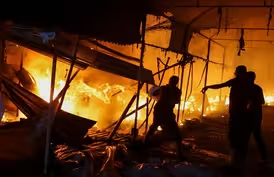
Israeli attack outside Gaza hospital kills at least 4
Video has Closed Captions
Clip: 10/14/2024 | 6m 9s | Israeli attack on tent camp outside hospital in Gaza kills at least 4, injures dozens (6m 9s)

Nobel-winning economist on causes of global inequality
Video has Closed Captions
Clip: 10/14/2024 | 5m 34s | Nobel-winning economist Simon Johnson on what causes prosperity gaps between nations (5m 34s)

Non-Spanish speaking Latinos reclaim culture after shaming
Video has Closed Captions
Clip: 10/14/2024 | 9m 46s | Young Latinos who don't speak Spanish are reclaiming their culture after facing shaming (9m 46s)
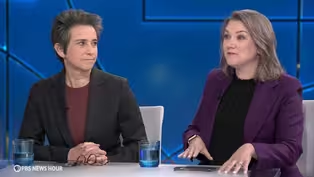
Tamara Keith and Amy Walter on latest campaign strategies
Video has Closed Captions
Clip: 10/14/2024 | 8m 2s | Tamara Keith and Amy Walter on campaign strategies with 3 weeks until Election Day (8m 2s)

Trump ramps up extreme rhetoric in final weeks of campaign
Video has Closed Captions
Clip: 10/14/2024 | 4m 41s | Trump ramps up his dangerous political rhetoric in final weeks of campaign (4m 41s)

U.S. providing air defense to Israel amid Iran tensions
Video has Closed Captions
Clip: 10/14/2024 | 4m 33s | U.S. providing powerful air defense system to Israel amid tensions with Iran (4m 33s)
Providing Support for PBS.org
Learn Moreabout PBS online sponsorship
- News and Public Affairs

FRONTLINE is investigative journalism that questions, explains and changes our world.

- News and Public Affairs

Amanpour and Company features conversations with leaders and decision makers.











Support for PBS provided by:
Major corporate funding for the PBS News Hour is provided by BDO, BNSF, Consumer Cellular, American Cruise Lines, and Raymond James. Funding for the PBS NewsHour Weekend is provided by...