
October 15, 2023 - PBS News Weekend full episode
10/15/2023 | 26m 45sVideo has Closed Captions
October 15, 2023 - PBS News Weekend full episode
October 15, 2023 - PBS News Weekend full episode
Problems playing video? | Closed Captioning Feedback
Problems playing video? | Closed Captioning Feedback
Major corporate funding for the PBS News Hour is provided by BDO, BNSF, Consumer Cellular, American Cruise Lines, and Raymond James. Funding for the PBS NewsHour Weekend is provided by...
October 15, 2023 - PBS News Weekend full episode
10/15/2023 | 26m 45sVideo has Closed Captions
October 15, 2023 - PBS News Weekend full episode
Problems playing video? | Closed Captioning Feedback
How to Watch PBS News Hour
PBS News Hour is available to stream on pbs.org and the free PBS App, available on iPhone, Apple TV, Android TV, Android smartphones, Amazon Fire TV, Amazon Fire Tablet, Roku, Samsung Smart TV, LG TV, and Vizio.
Providing Support for PBS.org
Learn Moreabout PBS online sponsorshipJOHN YANG: Tonight on PBS News Weekend, the latest from the Middle East as Israel readies its forces to watch a ground offensive to eliminate Hamas.
Then part two of our interview with defense secretary Lloyd Austin on the U.S. backing of Ukraine's ongoing war with Russia.
LLOYD AUSTIN, U.S. SECRETARY OF DEFENSE: They are very determined to continue to make progress and take their sovereign territory back.
And we are determined to provide them support as long as they are committed to doing that.
JOHN YANG: And the little known tactic used by the food and beverage industry to influence what we eat and drink.
(BREAK) JOHN YANG: Good evening.
I'm John Yang.
Even before Israel launches what's promised to be a massive assault on Gaza.
Palestinian officials say this week old war is already the deadliest Israeli-Palestinian conflict.
Gaza's health ministry says at least 2,600 Palestinians have been killed as Israel retaliates against Hamas for their brutal assault last week that left more than 1400 Israelis dead.
There is a flurry of activity in the region.
Secretary of State Antony Blinken is headed back to Israel on Monday.
The State Department said it would evacuate us citizens from Israel tomorrow by boat and National Security Adviser Jake Sullivan said President Biden will ask Congress for a $2 billion weapons package for both Israel and Ukraine.
Special correspondent Leila Molana-Allen has our report tonight and we want to warn you that some of the images may be disturbing.
LEILA MOLANA-ALLEN: In Israel, the hordes of tanks heading south are a preview of what's likely to come.
Israel's defense minister promised a punishing assault on the Gaza Strip.
YOAV GALLANT, Defense Minister, Israel (through translator): It will be a mighty war, it will be a deadly war.
It will be a precise war and it will be a war that will change the situation forever.
LEILA MOLANA-ALLEN: Since last night, we've been seeing a huge mastering of the Israel Defense Forces above and along Israel's southern border with Gaza, thousands of military vehicles, hundreds of thousands of troops coming here and the mass movement suggests that a ground invasion into Gaza is imminent.
As the wall staging ramps up, Hamas and the Israel Defense Forces continued to exchange rocket fire.
The southern Israeli town of Sderot, little more than a mile from Gaza continued to be a target for Hamas rockets.
Squaring a broader evacuation.
RAYA SCWARTZ, Resident of Sderot: We leave Sderot because the situation is very dangerous here.
LEILA MOLANA-ALLEN: And Israeli airstrikes continued to pummel Gaza.
Israel reported striking more than 100 military targets overnight, but those targets are surrounded by civilians.
In Gaza City overwhelmed emergency crews are using ice cream trucks to store bodies.
The morgues are all full.
Hospitals are days away from running out of fuel.
Doctors at the Kamal Edwan Hospital in northern Gaza had been told to evacuate.
But Dr. Hussam Abu Safiya says that would endanger children and babies in their care.
DR. HUSSAM ABU SAFIYA, Kamal Edwan Hospital (through translator): As you can see, this section is full of newborn cases.
There's no humanity in the world that can agree to disconnecting these children from this equipment and transferring them to another location LEILA MOLANA-ALLEN: Near the Rafah border crossing from Egypt to Gaza, aid convoys can't get in and foreigners still can't get out.
The U.S. has been trying to broker a deal.
On ABC This Week, National Security Adviser Jake Sullivan said evacuating American passport holders is a priority.
JAKE SULLIVAN, National Security Adviser: That has been difficult because of the ongoing operations.
And frankly, because Hamas has intervened in some cases, to make it hard for Palestinians, Palestinian-Americans and others to be able to travel to the border crossing and get through.
LEILA MOLANA-ALLEN: The U.S. is sending a second aircraft carrier strike group the USS Eisenhower to the eastern Mediterranean to help deter hostilities against Israel.
And on Israel's northern border with Lebanon, tensions have boiled over.
IDF forces responded to rocket fire from Hezbollah with shelling of their own.
And we're really seeing this building conflict start to escalate on multiple fronts.
Syria also fired into Israel today.
And the Israelis are putting on a massive show of force as they prepare for a war that they might have to fight on multiple borders.
John.
JOHN YANG: Laila did really terrific reporting.
I understand you were at the border between Israel and Gaza earlier today.
Tell us what you saw.
LEILA MOLANA-ALLEN: What I saw on the border today was really like nothing I've not seen in any war.
And I was actually speaking to a military expert today who said the same, the number of tanks rolling down being carried, mustering all across the highway, buses full of soldiers being stepped down as well.
I mean, the assembly is quite incredible.
The number of armored vehicles, jets flying through the air, drones flying everywhere.
This is a huge operation, and they're all getting ready for what they think is going to be for them a war of existence.
We're seeing these different conflicts getting involved, of course, we've got Gaza and the focus here is going across the border into Gaza, where they want to defeat Hamas, but on the other borders as well.
Lebanon, Syria, there are serious concerns that this could turn into a regional conflict and they are showing that they're ready.
JOHN YANG: Leila Molana-Allen in Tel Aviv tonight.
Thank you very much, and please stay safe.
LEILA MOLANA-ALLEN: Thank you, John.
JOHN YANG: In other news, another powerful earthquake rocked western Afghanistan today just a week after quakes killed thousands in the same region, this one registered 6.3 on the Richter scale.
It destroyed villages and killed at least four people, more than 150 are being treated for injuries.
Globally, groups are warning of a humanitarian crisis because of the quakes.
In Ukraine six people were killed in Russian attacks this weekend.
More than 100 Russian shells bombarded the southern region of Kherson disrupting power and water supplies.
Russian officials claimed they shut down Ukrainian drones that returned fire near the eastern border.
In Poland tonight, exit polling projects that the governing right wing Nationalist Party won more votes than any other in today's election, but lost the parliamentary majority it needs to form a government on its own.
The liberal opposition coalition supports abortion rights, LGBTQ plus rights and support for Ukraine.
Today, it was considered to be the most significant Polish election since the nation voted to topple communism in 1989.
Results aren't expected until Tuesday.
And Louisiana has elected a new governor Republican Attorney General Jeff Landry, an outspoken conservative backed by former President Donald Trump easily beat a crowded field.
He'll replace Democratic Governor John Bel Edwards who couldn't run for a third term.
It will put both the governor's office and the state legislature in Republican hands for the first time in eight years.
Still to come on PBS News Weekend, a look at the misinformation that spreads about the food week.
And the story of Lady Pink a groundbreaking graffiti artist.
(BREAK) JOHN YANG: While USA to Ukraine has gotten caught up in Capitol Hill politics.
Defense Secretary Lloyd Austin says he intends to support Ukraine as best he can.
Austin talked about that when he sat down with Nick Schifrin in Brussels this weekend.
Tonight, part two of that exclusive one on one interview.
NICK SCHIFRIN: I spent a week in what Ukrainians themselves defined as most critical frontline down toward Crimea in the direction of Melitopol.
And they've made a bit of progress there.
But they have not achieved what they describe as their own minimal objectives.
So what is your verdict at this point on the counter offensive?
LLOYD AUSTIN: This is going to be a tough fight.
They're going against a Russian adversary that was had the time to prepare positions dig in, positions in depth use extensive minefields.
And so as they work their way through that complex challenge, it's been a tough slog, it probably is not going as quickly as many people would like to see it go.
But I think they are very determined to continue to make progress and take their sovereign territory back from the Russians.
And we are determined to provide them support as long as they are committed to doing that.
NICK SCHIFRIN: There are some officials, I'll be honest, two are concerned that Ukraine will not make much progress if at all over the next few weeks or even months.
Do you share that concern?
LLOYD AUSTIN: Well, I think Ukraine will continue to make progress.
I think from talking to their leaders, I see determination, I see commitment.
You may know that every month I assemble some 50 countries, the Minister of Defense of 50 countries.
And as I continue to assemble that group, I see resolve, I see commitment, I see a willingness to support Ukraine for as long as it takes.
So that energy is still there, that that commitment still there.
And that's got to be reassuring for the Ukrainians.
NICK SCHIFRIN: If I could bring it to the operational level just for one question.
Ukrainians have split their forces between the east and the south, about give or take 50-50.
And that means that only a portion of the Ukrainian soldiers fighting the counter offensive are on that critical frontline that I described in the southwest, toward Crimea, toward Melitopol.
You may not want to judge them.
But is that a problem?
Is that a mistake?
LLOYD AUSTIN: You're right, I don't want to judge them.
And I won't.
It's my intent to support them as best we can.
And I think they're putting that support to get use.
And they're learning as I go along.
So it has evolved, it will continue to evolve.
But I have to come in the bravery, the commitment of the Ukrainian soldiers, and all those who are supporting them, they are really, really resilient.
NICK SCHIFRIN: You've got about $5.2 billion that you can use to send Ukraine weapons drawn down from U.S. stocks and about 1.6 billion of funds to replenish those stocks.
How long can that last?
LLOYD AUSTIN: In terms of how long it can last.
It just depends on what weapons systems and capabilities we go after.
But we're going to, again, I would remind you that it's not just us.
It's the other countries as well, in this case that are providing support to Ukraine.
NICK SCHIFRIN: You've obviously got European allied support, but you're struggling to the administration, the struggling to get the latest package through Congress.
Is there a plan B if you can't get money through Congress for Ukraine?
LLOYD AUSTIN: I won't speculate on a plan B. I will say as I engage members of Congress in both houses, I see strong support for Ukraine.
And I would, as I as I look at the polls, you know, across the country, there is still strong support for Ukraine.
Ukraine matters.
It matters not just for Ukraine, that offense of Ukraine, it matters for the world because this is about the rules based international order.
This is about a dictator in one country, choosing to invade his neighbor.
And we can't allow that to happen.
The international community does not want that for our future.
So Ukraine matters to the world.
NICK SCHIFRIN: It's also about freedom.
It's also about the kind of country that Ukraine wants to be not under the yoke of Russia, of course, you say there's, you know, when I'm talking about plan B, but there are still political problems within Congress, even if, even if the majority of lawmakers and Americans still want to support Ukraine.
Ukraine has a level of fire right now.
That is very, very high 90,000, 100,000 artillery shells a month.
Does Ukraine need to reconsider how it fight if the U.S. cannot sustain the support at the levels it has?
LLOYD AUSTIN: You know, countries and organizations will adapt to make best use of whatever materials and in weapons systems they have available.
And we've watched this fight, you know, trends -- transform over time.
Ukraine has become very capable and using things that they weren't using when we started this fight.
I think they will adapt going forward.
I think we were seeing that as we speak.
And, you know, that's to be expected.
NICK SCHIFRIN: And finally, sort of last question is Ukraine's future NATO?
LLOYD AUSTIN: You've heard the Sec-Gen say that it was.
You've heard a number of countries, all of the countries are in NATO say that they think so.
And so they are the ones that will determine that, but clearly, I see strong support for Ukraine right now.
NICK SCHIFRIN: But does the U.S. believe that Ukraine futures in NATO?
LLOYD AUSTIN: We've said that.
Yes.
NICK SCHIFRIN: Mr. Secretary, thank you very much.
LLOYD AUSTIN: Thank you.
JOHN YANG: News about food safety and can be hard to keep straight.
Take aspartame, the artificial sweetener that's been around for decades.
It was headline news this summer when the World Health Organization said aspartame could possibly cause cancer in humans although the U.S. Food and Drug Administration disagrees.
Pushback quickly popped up on social media, much of it from dieticians.
But their post didn't make clear that they were being paid by the American Beverage Association, a lobbying group whose members include Coca Cola and Pepsi.
Both marketers are products containing aspartame .
It's just one of the instances uncovered by a joint investigation by the Washington Post and the nonprofit newsroom The Examination which specializes in public health around the world.
Washington Post health columnist Anahad O'Connor worked on the investigation.
Tell us the scope of what you found.
How widespread is this?
ANAHAD O'CONNOR, The Washington Post: Yeah, so we analyzed thousands of posts on TikTok and Instagram and Facebook that were posted by registered dieticians, and found that it's actually quite common for them to post ads on behalf of food companies, beverage companies, and dietary supplement companies.
And in many of these ads and posts, we were quite surprised to see dietitians, promoting and defending artificial sweeteners encouraging people to eat ice cream and candy and other junk foods and dietary supplements and just basically promoting advice that runs counter to, you know, decades of scientific research on proper nutrition.
JOHN YANG: Obviously, the food and beverage industry has been around for a long time and they've been trying to influence what people eat and drink for a long time.
How is this different?
ANAHAD O'CONNOR: So what we found is that the food industry is really turning to social media because it's a very effective way of getting their message across to consumers.
There are many influential dieticians on TikTok and Instagram who have very large followings.
And people who follow them develop what are called parasocial relationships with them, they're very trusting of them because they're following them day in and day out, for example, compared to you know, a large advice from a large, faceless organization.
But we found that the food industry oftentimes will pay dieticians to promote industry friendly messages and you know, promote their products and, you know, promote this advice to eat foods.
That's pretty surprising.
JOHN YANG: Does the professional organizations of dietitians, do they have anything to say about this?
ANAHAD O'CONNOR: So the Academy has a code of ethics that says that dietitians should always disclose conflicts of interest and that they should refrain from accepting gifts or partnerships that can influence their professional judgment.
But so far, to our knowledge, the Academy has not penalized any dietitians for this sort of activity on these social media sites.
JOHN YANG: And what does the food and beverage industry say, how do they justify this?
ANAHAD O'CONNOR: So they say that, you know, they pay these dietitians because they are credentialed experts, and that in many cases, they disclose that they're engaged in paid partnerships.
But oftentimes, you know, what we found is that it's very difficult for consumers to know when the videos they're watching posted by these particular dietitians are ads, because they may say, you know, paid partnership down at the bottom of the video and you know, very small letters, or it may say hashtag ad somewhere buried in the caption.
But in the video itself, there are no audible disclosures, and they may not say the specific company or industry that is paying them.
So on these, you know, posts, where dietitians were paid by the American Beverage group to promote and defend artificial sweeteners.
Oftentimes, they did not say that specifically that they were paid by this industry, trade and lobbying group.
JOHN YANG: And the Federal Trade Commission, police's false claims on labels on in ads and so forth.
Do they have any power over this?
ANAHAD O'CONNOR: So the experts we talked to said that, you know, this social media landscape is really the Wild West, you know, there are, you know, countless influencers who are posting thousands if not millions of videos a day and the FTC does try to regulate and monitor it definitely requires influencers to disclose when they're being paid to promote products, but it's very difficult for them to regulate and to monitor this activity and they occasionally bring cases but, you know, it's very few and far between.
JOHN YANG: What prompted you to look into this?
ANAHAD O'CONNOR: So the Academy of Nutrition and Dietetics, which is the group that oversees dieticians, they've been criticized for years for their ties to big food companies like Nestle and Coca Cola, Pepsi, Hershey, they've taken millions of dollars in donations from these companies and they even allowed food companies to provide continuing education courses to their dieticians which they've had faced a lot of criticism for.
But we wanted to look at the very influential dietitians on social media with large followings to see, you know, is the advice that they're giving people influenced at all by the food industry.
And we were very surprised.
We found, you know, dozens of these posts is paid advertisements, essentially thinly veiled advertisements, we found 35 videos in which dieticians and health influencers were paid by the soda industry to, you know, defend aspartame and our other artificial sweeteners and criticize the World Health Organization for its recommendations.
JOHN YANG: You say it's hard to tell these things that they're their ads, what advice do you give people?
What should they look for?
ANAHAD O'CONNOR: So I think consumers have to be very skeptical.
If you see a dietitian or someone else, you know, promoting advice that sounds dubious or sounds questionable.
You should, you know, wonder or check, you know, is this -- essentially a thinly veiled ad is this person being paid to push an industry friendly message to me.
JOHN YANG: Anahad O'Connor, a health columnist for the Washington Post, thank you very much.
ANAHAD O'CONNOR: Thank you.
JOHN YANG: And on this last weekend of Hispanic Heritage Month, the story of a graffiti artist to help bring the medium into the mainstream and along the way gave voice to Latina artists.
It's part of our series Hidden Histories.
These days, the works of Lady Pink are in the collections of big New York City art museums like The Whitney and The Metropolitan.
But New York City subway cars were her first canvas.
Lady Pink, also known as Sandra Favara, is called the First Lady of Graffiti.
One of the pioneers in the male dominated 1970s and 80s graffiti art movement raising what was thought of as gang related vandalism into a serious art form.
SANDRA FAVARA, First Lady of Graffiti: It is more than just the style, it's a culture.
It's an entire culture.
It's an underground culture.
It's thousands and thousands of kids, everyone knows each other.
It's like family and the way you dress the way you talk the way you act the way you write.
So, that's all graffiti.
JOHN YANG: Born in Ecuador in 1964, to a seamstress and an architect, she always had artistic aspirations.
When she was seven, her family moved to Queens.
As a teenager, she began writing as spray painting graffiti is called she tagged her work Lady Pink because she was thought to be the city's only female graffiti artist at the time, and because she said she loved Victorian romances.
Graffiti artists competed to leave their work in the most dangerous and inaccessible places.
A subway train was the ultimate.
She said she loved the thrill but worried about arrest, something she depicted in a 1981 painting.
SANDRA FAVARA: Is called manic depression.
And it is my vision of what would have happened to me if I had been arrested as a teenager writing graffiti, I'd get thrown in jail with other real criminals.
We didn't consider ourselves hardcore criminals in any way.
We were just, you know, playing around.
But the reality of is that the people get hurt people get arrested your lives is ruin.
JOHN YANG: As the mainstream art world became more interested in graffiti, her work moved from subway cars to galleries in New York and Paris.
She was commissioned to create murals around the world, Ukraine, Sweden, and her native Ecuador.
Her recognition grew even more when she started the 1982 independent film "Wild Style," a love letter to graffiti artists that's regarded as the first hip hop movie.
Her artists praised for its Latina and feminist style and for tackling issues of social justice, becoming tools for activism and change.
Today, Lady Pink remains one of the most influential female artists in the field, and she passes her knowledge, skill and passion on to a new generation teaching mural painting at New York's Frank Sinatra School of the Arts.
On Instagram, you can see this story full of stunning images of yesterday's Ring of Fire solar eclipse, all that and more can be found online at instagram.com/newshour.
Finally, tonight, some incredible images of the universe from the Hubble Space Telescope.
They reveal new details from galaxies far, far away.
This is one of only five galaxies of its kind that emits strong radio waves and researchers hope images like this will help them figure out why.
Ever want to see where stars are born.
Well that's exactly what the bright pink spots are.
The blue regions are neighborhoods of young star and the dark red cloudy streaks are the main ingredient cold molecular gas.
And at the center of this galaxy lies a supermassive black hole like the one in our own Milky Way.
Astronomers also discovered in this galaxy, six supernovas, violent explosions of massive stars.
They're actually the source of many elements in the universe, including the iron in our own blood.
And we leave you with some more Hubble images to ponder as we say good night.
For all of my colleagues, thanks for joining us.
Have a good week.

Airstrikes pound Gaza as Israel musters huge force on border
Video has Closed Captions
Deadly airstrikes continue to pummel Gaza as Israel musters huge force on border (5m 2s)

The groundbreaking work of graffiti artist Lady Pink
Video has Closed Captions
The groundbreaking work of Ecuadorian American graffiti artist Lady Pink (2m 57s)

How ‘thinly veiled’ social media ads influence what we eat
Video has Closed Captions
How ‘thinly veiled’ social media ads are influencing what we eat and drink (6m 9s)

News Wrap: Western Afghanistan hit by another deadly quake
Video has Closed Captions
News Wrap: Aid groups warn of humanitarian crisis after repeated Afghan quakes (1m 57s)
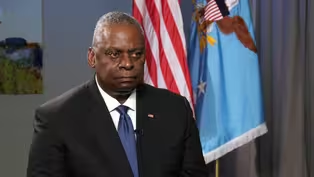
U.S. Defense Secretary Austin reaffirms support for Ukraine
Video has Closed Captions
U.S. intends to keep supporting Ukraine against Russia, says defense secretary (6m 3s)
Providing Support for PBS.org
Learn Moreabout PBS online sponsorship
- News and Public Affairs

Today's top journalists discuss Washington's current political events and public affairs.

- News and Public Affairs

FRONTLINE is investigative journalism that questions, explains and changes our world.












Support for PBS provided by:
Major corporate funding for the PBS News Hour is provided by BDO, BNSF, Consumer Cellular, American Cruise Lines, and Raymond James. Funding for the PBS NewsHour Weekend is provided by...