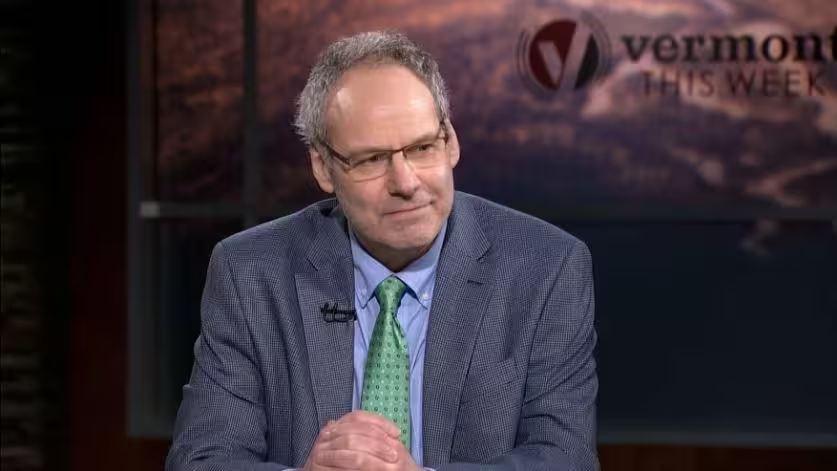
Vermont This Week
October 16. 2026
10/16/2026 | 26m 46sVideo has Closed Captions
Heating oil prices raising serious concerns | Affordability concerns top of mind for Vermonters
Heating oil prices raising serious concerns | Residents losing faith in Vt. as a good place to start life | Study intensifies debate over ‘Raise the Age’ reforms | Moderator - Mitch Wertlieb; Colin Flanders - Seven Days; Derek Brouwer - Vermont Public; Tik Root - Grist.
Problems playing video? | Closed Captioning Feedback
Problems playing video? | Closed Captioning Feedback
Vermont This Week is a local public television program presented by Vermont Public
Sponsored in part by Lintilhac Foundation and Milne Travel.
Support provided by:


Vermont This Week
October 16. 2026
10/16/2026 | 26m 46sVideo has Closed Captions
Heating oil prices raising serious concerns | Residents losing faith in Vt. as a good place to start life | Study intensifies debate over ‘Raise the Age’ reforms | Moderator - Mitch Wertlieb; Colin Flanders - Seven Days; Derek Brouwer - Vermont Public; Tik Root - Grist.
Problems playing video? | Closed Captioning Feedback
Where to Watch Vermont This Week
Vermont This Week is available to stream on pbs.org and the PBS app.
Support the crew
Help Mitch keep the conversations going as a member of Vermont Public. Join us today and support independent journalism.Providing Support for PBS.org
Learn Moreabout PBS online sponsorshipWith affordability top of mind for Vermonters.
Soaring heating oil prices are raising serious concerns.
Plus, polling shows residents are losing faith in Vermont is a good place to start life.
And a new study intensifies debate over the state's juvenile justice reform efforts.
All that and more ahead on Vermont this week.
From the Vermont public studio in Winooski.
This is Vermont this week, made possible in part by the Lintilhac Foundation and Milne Travel.
Here's moderator Mitch Wertlieb.
Hi, I'm Mitch Wertlieb.
It's Friday, October 16th, and with us on the panel today, we have Colin Flanders from seven days, Derek Brouwer from Vermont Public and Tik Root from Grist.
Thank you all for being here today.
You know, we've been talking about politics so much for the last few weeks.
Obviously, we've got elections coming up, but we're going to take a break from all that today to talk about some more issues that really affect all Vermonters.
And according to recent polling, the Vermont public did.
Question was asked about one of the top concerns in Vermont.
And 31% of Vermonters who took part in this poll said affordability is the most important problem facing the state of Vermont.
So noting that we're going to talk about one of those affordability issues, and this has to do with the cost of heating oil and teak root.
You wrote about this in grist recently.
Really comprehensive article about some of the issues here.
What are folks concerned about when it comes to heating oil prices right now, and what's driving these concerns?
In short, they're very high.
Last year, heating oil prices hit $6 a gallon.
That's compared to about 355 in January.
So this is a massive uptick in people's expense.
And for especially low income households or households on fixed incomes, this is going to be one of their massive expenses going into the cold season.
And, you know, a doubling almost of prices is nowhere near when Social Security checks go up, a few few percentage points with inflation.
So I think I think it's something that people are really concerned about from what I'm hearing.
Let me take a guess at what's driving some of these higher prices right now.
Is it the war in Iran?
Yeah, I think the war in Iran, you know, 10% of diesel goes to the the Strait of Hormuz.
And I think the the cutting off of that has been a huge factor.
But the other one that has hit the news more in the last week is the strikes between Ukraine and Russia on oil refineries.
Russia is a major supplier of diesel to the world and Ukrainian tax on their facilities have really, you know, hampered the world's diesel supply.
Sounds like a perfect storm happening at the worst time.
I mean right now, you know, it's October, we're getting towards November.
It's going to start getting real cold in the state of Vermont.
One of the things you wrote about in your article was Lie Heap, a program that a lot of low income Vermonters rely on.
Tell us a little bit about Leap, and what are some of the dangers that are posed to it right now?
Yeah.
So the low income Heating Energy Assistance Program is an important program for low income people across the country to help afford their heating and cooling needs.
And this year, it's about a $4 billion fund that goes out to states and it's distributed from the federal government.
But President Trump has repeatedly railed against Lieb.
He's tried to defund it multiple times.
And then last spring, he even withhold withheld a payment of lie heap temporarily for weeks until it finally got released.
So this question.
But why is he.
Why is he against this program?
Why does he want to end it?
Yeah, it's a bit unclear.
I think it's a lot of government cut spending cuts that he has been promoting across the board, you know, whether it be Doge, etc.. This is another part of the sort of safety net that that has been under threat since President Trump was elected.
Well, here in the northeast, you know, in Vermont, people really depend on on heat during the winter.
I do know that you're reporting on all the New England states about this.
You said that in the state of Massachusetts, there's actually been a declaring a state of emergency there.
The governor.
Yeah.
So, I mean, this is the interesting thing, is so lie heap is a set $4 billion amount that goes out to states, but with heating oil prices so high, that money is going to go a lot less far to not go nearly as far.
So there's a big question about what happens when that lie heap money runs out.
Well, I guess the first question is whether it actually arrives by the November 1st deadline, which the white House says that it will, but then it might not, you know, if it ends and it dries up in January or February, what happens then?
And I talked to Miranda Gray at the deputy commissioner of Vermont, DCF, who was in charge of the program, and she didn't really give a good indication of what Vermont's plan is.
But as you mentioned, if the money runs out, if the money runs out, what happens and what other supports the state is going to need to put in place.
But as you mentioned, other states are really proactively looking at this already with Massachusetts declaring a state of emergency, and they're unlocking about $150 million of extra funding from state resources.
And they were increasing the threshold by which you could qualify for assistance.
So I think there are things that states can do and might end up having to do if this federal money runs out in the gas, prices don't come down.
But unclear if the state of Vermont has the backup funding to deal with this.
If the money, which we don't know if we're going to get in time, runs out.
Is that what you're hearing?
Right?
Exactly.
They did not articulate a clear plan.
I mean, the other option is that on the federal level, the new Congress, after November elections could decide to pass supplemental heat funding.
So there have been calls from various members of Congress for an additional $3 billion going into this program.
Currently, it's unclear whether the outgoing Congress or the new Congress might pass that funding or whether President Trump would approve it.
But there are possible options, and there has been bipartisan support for that.
There was a letter from 31 senators sort of encouraging the federal government to at least release the money as soon as possible.
That was one of the most interesting things I found in your article was that this is bipartisan here because cold weather affects not just blue state red states.
It fits everyone.
So you're talking about a lot of politicians here who was saying, look, we've got to get this money to people in time.
Yeah.
It was it was central to Maine Senate debate a couple of weeks ago.
You know, that's a contested Senate race.
And it came up.
You know, Susan Collins has previously supported the war in Iran, and her opponent went after her for that.
And the effects on prices.
Really appreciate your article in grist on that.
Folks should be reading about that as we head into this cold season.
So let's open up this discussion of affordability here, because heating is just one part of it.
Colin Flanders, you've been writing about the the cost of Vermont's housing.
The housing market has been so hot in Vermont for a while.
Is it starting to cool a little bit?
It is.
Yeah.
And I apologize for continuing the metaphor of hot and cold, but we are going to say we're going to stick right with Vermont's housing market is cooling.
And I want to temper the word cooling.
By cooling we essentially mean it is not getting a lot hotter right now.
It is it is plateauing.
So what we've been seeing over the last year or so is that the median home price has started to climb at a rate that's a lot less than what we were seeing in 2020, 2021, 2022, when we were seeing a lot of these bidding wars push prices up to to exorbitant levels that we hadn't seen before.
And so that is good news in terms of the inventory that we're seeing.
We're seeing home stay on the market a lot longer.
It's kind of tilting the market back in favor of buyers a little bit.
So realtors say that they're seeing buyers demanding some of these common sense contingencies that we used to see before the pandemic, such as requiring an inspection or having a clause in there if it comes back appraised a lot less than what I've just offered, that we will figure out what to do instead of me just giving you all the money.
But the challenge is that we have plateaued at a level that is still really hard to break into for first time home buyers who don't have the equity built up over the last few years.
And so we the question is, can anything be done to help people break into the market so that they start building up equity and continue to move around and see home sales continue at a rate that we'd hopefully see?
I think moving around is good.
Realtors say they like the market better this way.
It's a lot better than when we were selling maybe 5000 homes in a year, which is low for Vermont.
Do we know why this is starting to plateau a little bit?
Yeah, I think there are some theories.
I mean, some realtors just say that people were holding on during the pandemic hoping, kind of waiting to see how high their equity might go.
And now that they're seeing things slow down a little bit, they're deciding, okay, my investment has paid off.
It's time.
I mean, life circumstances change in learning about this.
Some Realtors refer to kind of the four days the diapers, divorce, death and diamonds, which is marriage.
So these are life circumstances that change someone's life in a way that, okay, it's time for me to move, even if it might not be the most financially smart decision.
And I think people are seeing that mortgage rates are not coming down as hoped.
And so I think a lot of things are combining for people just to decide, now is the time.
I can't hold off anymore and there is some more housing stock coming online.
It's just not the lower end level that would really free up the market and allow people to get in, you know, like lower level condos, things that a first time homebuyer might be able to afford.
You totally anticipate.
On my next question, I was wondering about that because we know we've been talking on this program for so long now about these ideas of getting more housing built, and we keep hearing that it is coming.
Everybody seems to be on the side of that.
Whatever you feel about act 250, etc., but it sounds like you're saying it's not really happening fast enough at this point.
Yeah.
That's right.
I mean, housing permits over the last year have actually decreased a little bit compared to the year previous.
And it's not hard to understand why.
I mean, builders will continue to say that it doesn't make financial sense for them to build what used to be considered the starter home.
And a lot of those continue to be locked up by older Vermonters who are struggling to find a way to downsize.
We don't have enough senior housing.
A lot of these factors play in, but it is making it the I guess the silver lining would be maybe some of that is thawing, but I think we have reached a new normal, is what I've been told.
New normal.
That sounds like a tough new normal.
Derek Bauer, this brings us to this question that we had in the Vermont Public Polling about.
Is Vermont a good place to, you know, begin your life, start a family, or just, you know, get out on your own.
And a lot of people are saying, no, not really.
I mean, what were you hearing about this for, you know, people saying they're losing their faith a little bit.
Yeah.
You know, losing their faith is sort of an interpretation.
I came to of the results, having talked to some of the people who answered the poll, as well as some, some experts on it.
One of the interesting things about this question, and why I liked it, is because Vermont Public has actually asked it three times now.
And so we have some some longer term trends since since 2019, this third time we've asked it.
And this is the gloomiest of the of the responses we've, we've received so far.
The overall trends were similar.
People who identify as conservative are much more likely overwhelmingly likely to say you should leave.
Person should leave Vermont.
Older Vermonters are more likely to say it is a good place to start a life and career, and Democrats this time around were evenly split between the three three categories.
But one thing I heard in talking to a UVM expert who studies this kind of information, what really jumped out to her was actually this unsure it depends category, which is usually the least interesting category on a poll like this.
But what we saw this time around when the question was asked is actually the number of people who said unsure really spiked over previous years.
And and it is now the number of people who are unsure about whether how to advise a young person is actually higher than the number of Vermonters who say, you should definitely say you should stay and build your life here.
And one, you know, one thing that seems to indicate, I think I mean, obviously, affordability plays a huge piece into how people think about this question.
It's phrased in a way that asks about both life and career.
And so it brings to mind economic opportunity, but also issues of quality of life.
And so the results can be tricky to parse out for that reason, because people are trying to weigh these different factors.
And one of the common dynamics in Vermont that I don't think we saw change this time around was this is a really great place to live.
If you can afford it.
And what we're seeing, I think, is more people starting to question whether that, if you can afford it, is really a reasonable, reasonably attainable goal at this point.
Yeah.
And you're able to go back, as you said, to 2019 and compare some of those numbers.
And you're definitely seeing a trend here.
Again, getting into the more pessimistic range.
What about some of these percentages?
Derek I want to go over those again.
You mentioned the conservative folks were saying on a larger percentage that people should probably leave.
What percentage of that?
It's like over three quarters.
Over three quarters.
Yeah, that's pretty stark.
And, you know, did they give reasons for that?
That's not part of the poll.
Or is it just that that's the answer and you have to interpret it.
Yeah.
Yeah.
We the last time Vermont public asked this question, that was a similar trend that stuck out.
And we did some follow up reporting at that time about that aspect specifically.
And that speaks to both.
There kind of two things at play.
I think one is that conservative folks are typically seen as being more economically minded, perhaps, and so they may be more attuned to the affordability issues.
But also there is a sense of belonging that comes in here.
And Vermont is predominantly Democratic and progressive state.
And so conservatives may feel like they don't see themselves in the state in the same way as more liberal residents do.
And so that could be playing a piece as well.
Let's take a look at that graph again.
If you guys, if you can put that up on our screen here.
For those listening to the program, I do want to discuss this a little more because we've got some some dates here, Derek, that are pretty interesting.
If you look at 2026, the percentage of those saying, oh, people should leave 51%, 20, 22, four years.
Part of that it was only 42%.
And those those saying that you should stay in Vermont, start a life there in 2022.
That was a 36% finding.
And this year, 2026, only 23%.
What are those numbers tell you?
Yeah, I think what you can see there is the the the leave portion has it's gone up since 2022.
If you actually go back to 2019, it was close to 50% then.
And so I think we've seen the leave the leave portion has kind of remained around this like roughly half of respondents.
But the stay portion is what has is the is the notable decline.
This is more than ten points lower than it's ever been when we've asked this question, and is now less than a quarter of people saying you would advise a young person to stay in Vermont, which, you know, given given the demographic challenges the state has, is a very concerning number to to folks I talked to for the story, I have to wonder if you gentlemen are were surprised by these findings at all.
I mean, you saw these numbers and you've been reporting on these issues, heating and beyond that, anything surprising?
Well, no.
Having grown up in front to.
Yeah, these are definitely surprising.
I was going to at first I was thinking maybe this is pandemic related in this influx of people to Vermont and then out again, but it's really notable what you said about how the leaves stayed the same from 2019.
But then the other one went down.
But I would say these are all connected, right?
Like you were talking about this lack of starter homes and the starter homes that might exist in more rural areas are more likely to be on, say, oil heat.
Right.
And so, you know, the increase expected for this winter is over $1,200 for the over the course of the winter in someone's heating bill.
So let's call that 200 to $250 a month.
That is a significant portion of somebody's mortgage.
If they're trying to buy, if they're a young family or a young person trying to buy a home, you know, that could be that extra $250 a month could even be the difference between them being able to afford their mortgage or not.
And so I think it's not shocking to me that all these things are kind of tying together.
I think a lot of people who answer this question of probably, probably are older and have gone through raising kids here and are now looking at their kids and wondering how their kids are ever going to make a family here in Vermont.
And we've been reporting for years now about our declining birth rates and how earlier this year, I talked to more than two dozen people who are considering whether to start families here.
And the biggest reason many of them say they're probably not going to right now, they're holding off or might even move out of the state, is that they can't see themselves getting to a place financially where they can afford it.
The biggest piece of that is owning a home.
So just as we said, the affordability crisis and being able to buy a place, that's usually the first step before having kids.
And so I think when you are asked to build a successful life for a lot of people, that still means a family.
And Vermont is a tough place to do that right now.
The other thing, too, I was when I was thinking about the housing talk that we had before about building new homes, and you know, what it takes to everything that goes into that at the moment we're in right now.
I would think things like the cost of lumber, importing wood from from Canada, perhaps the tariffs, all these things are converging to make all of this more expensive, right?
Yeah.
And Vermont Public has done some good reporting on this too, in this similar taking a similar look at the heating oil.
And I think they Vermont Republic reporter recently spoke to a nonprofit agency who helps people who can't afford their heating oil and is hearing from a notable increased number of people who are considered middle income, who might not have ever called this number before, but are now looking at and think, I don't know if I can afford it.
And they said, the biggest reason is because all of their other prices around them have increased to the point where they can't afford their bills anymore.
And so I think it's just it's hitting all different walks of life.
I mean, that's a little scary.
That sounds a little bit to me.
Like we've seen the increase in people that are needing food shelf assistance over the last few years to all of these costs.
Keep going up a little bit, a little bit, a little bit, and then all of a sudden they're up a lot.
We haven't even talked about health care.
Those costs to are prohibitive for for families, birthing centers, things like that.
I do want to ask about you had mentioned before we actually came on air that some folks are turning now to going back to heating with wood wood pellets, but those are getting more expensive to.
Right.
Yeah.
No, I'm just starting to look into that.
And it does seem like there is a bit of a movement for people to try to find alternative forms other than.
But it's really hard.
You know, wood pellets coming from Canada might have tariffs.
Higher demand for wood might raise the prices.
You know, propane is still lower, but switching out your entire heating system to adapt to a spike in prices isn't really a realistic option either.
That's multi thousands of dollars that a family likely doesn't have.
And so you know I think people are feeling stuck is what I'm what I'm hearing.
I think like I think one Reddit post I saw was something to the effect of I'm playing chicken between heating oil prices and this cold weather.
And I don't know I don't know what to do.
And I think what really struck me was when I contacted the state, the lack of a plan.
Right.
Like I just it was a pretty alarming to me that they didn't know what they're going to do when this money, when the federal money runs out.
And is that because we don't have the money here in the state of Vermont, or because they would normally just get more money, perhaps from the feds, they don't think they're going to get this time.
What is that lack of planning?
That's what I'm trying to get at.
I don't know the answer because, you know, I asked that question a few different ways to the state, and they didn't say that the money didn't exist.
You know, I think there was some intimation that maybe there could be a way to find funds from some other place in the state.
But I think the general thought was they don't really want to cross that bridge until they they know for sure, and applications don't really ramp up or open until November.
And so they were going to sort of get a sense of what the demand was like.
You're really watching that November 1st deadline, though, right?
I mean, that's pretty important here for this like money.
Yeah.
Yeah.
I mean, the when President Trump delayed most of the 90% of the money comes in November 1st, and then another 10% comes in the spring.
And last spring, President Trump tried to withhold the the last 10% and didn't wasn't ultimately successful.
And DHS told me that this year that they or sorry, HHS told me that they are planning and able to meet the November 1st deadline.
Okay.
Thank you so much for your reporting on that in the update.
Colin Flanders, I want to ask about this changing topics here.
There is a study that came out recently.
It's kind of intensifying the debate over the Raise the Age reforms in Vermont.
Very briefly, let us know what raised the age is meant to do and what this new study is bringing up that people are arguing about.
Yes, a Raise the Age refers to this juvenile justice reform that attempts to treat more teenagers as kids in the eyes of the court system.
And so Vermont, in 2018, became the first state in the nation to raise what's known as the juvenile jurisdiction, which is essentially the age at which you if you get in trouble, you go to family court versus adult court, raise it over the age of 18.
So starting in 2020, people over 18 before your 19th birthday, if you get accused of most crimes, you are sent directly to family court where proceedings are confidential, where there is no punishment in terms of you're not going to go to prison, it's more rehabilitative.
And the second half of that law that we passed in 2018 was supposed to include 19 year olds as well.
And this is based on brain science that shows that up until your mid-twenties, your brain is still developing.
There's yeah, impulsivity is still a big challenge.
And so the thinking is that if you get these kids early, the vast majority of people who break the law and their teens can kind of age out of lawbreaking.
But if you put them in the court system, the adult court system, where they're going to interact with more people who have been breaking the law for a lot longer, they're more likely to.
Yeah, recidivism.
And so this study took took a look at the first half of this, the first half of the last six years, treating 18 year olds as kids in the eyes of the law.
And it showed that there has been a lot of success, that recidivism rates have have been pretty low in terms of how many kids have been convicted after their first offense.
And there's a lot of debate over what the study actually says, or whether you can apply those same lessons to 19 year olds.
For advocates of this law, they say it's clearly showing proof of concept, and it's time to expand it to 19 year olds.
The biggest opposition to that right now is Governor Phil Scott, who actually signed this law back in 2018, and then since then has been voicing concerns about it almost within a year or two after signing it.
To his credit, he said maybe he made a mistake.
In his mind, he thinks that we've moved to fast.
He kind of puts this in the bucket of Democratic policy experiments that we've put out there, but not really known how it's going to work.
I think it's important to keep in mind that we went through during the pandemic, we saw crime spike a little bit, and so this gets roped into that.
But the governor's position is a bit of a pretzel.
It's that we think 18 year olds.
This is seems to be maybe working for them.
We're okay keeping it with them, but we don't want to move on to 19 year olds because we think they are fundamentally different.
They are not in school.
A lot of them, and a lot of them don't live at home, according to the governor's office.
And so we need to treat them differently than 18 year olds.
Experts that I talked to are skeptical of that, thinking.
It's going to be so interesting to see where that goes because again, you know, you're seeing some some good initial returns, at least it looks like.
But yeah.
And we'll know we'll know next year.
This law set the kick in in July 1st, 2027 unless lawmakers delay it again.
If Scott does get reelected, there's going to be another fight.
Okay.
I'd like to finish up with some good news, if we could.
And Derek Brower, it sounds like there's a company here in Vermont called On Logic, which is being, I guess, acquired by a larger Japanese firm.
What is the story here?
What is on logic do, and what could this mean for the state of Vermont?
Yeah, on logic has been around since the early 2000.
They're based in South Burlington.
You can see their headquarters if you're driving on Interstate 89 over by the whale Tails.
They make industrial grade computers that are often used in outdoor environments or in factory floors, where there's a lot of vibration, things like that.
But there's a big opportunity in this world right now because AI is changing how computers and how robots work and so on.
Logic is has a big opportunity there.
But they were a small homegrown company, and now this Japanese electronics giant Omron has agreed to acquire them for $675 million.
And observers that I spoke to said that this is likely to give on logic the resources that it needs to continue to grow in the years ahead.
And they're not looking to to kill any jobs here in Vermont.
The company is going to stay here for exactly Reno.
Yeah, they have over 150 employees here and there are no plans to relocate.
Okay.
Thank you so much for that, Derek.
We're going to leave it there this week.
I want to thank our panel so much, Colin Flanders from seven days, Derek Brouwer from Vermont.
Public and Tik Root from Grist.
I'm Mitch Wertlieb.
I'll see you next week Friday right here for Vermont This Week.
Thank you so much for listening and watching.
 New Episode
- News and Public Affairs

Top journalists deliver compelling original analysis of the hour's headlines.

- News and Public Affairs

Today's top journalists discuss Washington's current political events and public affairs.

 New Episode
 New Episode
 New Episode
 New Episode


 New Episode


Support for PBS provided by:
Vermont This Week is a local public television program presented by Vermont Public
Sponsored in part by Lintilhac Foundation and Milne Travel.