Vermont This Week
October 18, 2024
10/18/2024 | 26m 45sVideo has Closed Captions
State to set up 3 family shelters as many lose motel housing
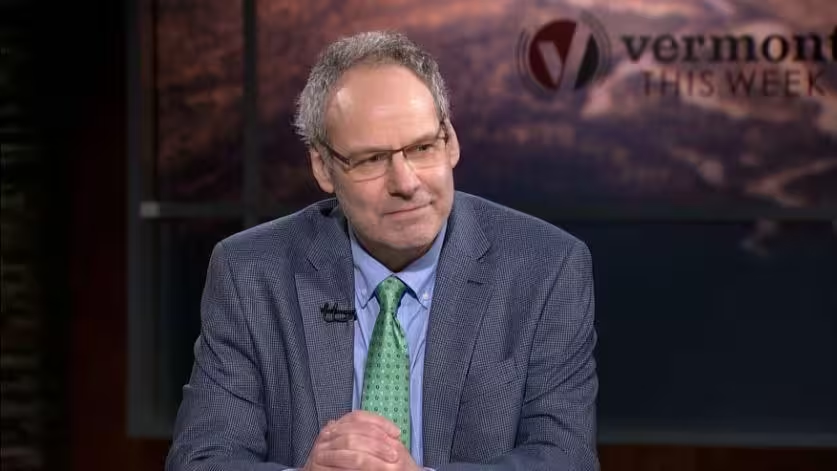
State to set up 3 family shelters as many lose motel housing | Woodstock program takes new approach to worker housing | Survey shows ongoing bad conditions for immigrant farmworkers | Panel: Mitch Wertlieb - Moderator, Vermont Public; Carly Berlin - Vermont Public/VTDigger; Anne Wallace Allen - Seven Days; Aaron Calvin - Stowe Reporter/News & Citizen.
Problems playing video? | Closed Captioning Feedback
Problems playing video? | Closed Captioning Feedback
Vermont This Week is a local public television program presented by Vermont Public
Sponsored in part by Lintilhac Foundation and Milne Travel.
Support provided by:


Vermont This Week
October 18, 2024
10/18/2024 | 26m 45sVideo has Closed Captions
State to set up 3 family shelters as many lose motel housing | Woodstock program takes new approach to worker housing | Survey shows ongoing bad conditions for immigrant farmworkers | Panel: Mitch Wertlieb - Moderator, Vermont Public; Carly Berlin - Vermont Public/VTDigger; Anne Wallace Allen - Seven Days; Aaron Calvin - Stowe Reporter/News & Citizen.
Problems playing video? | Closed Captioning Feedback
How to Watch Vermont This Week
Vermont This Week is available to stream on pbs.org and the free PBS App, available on iPhone, Apple TV, Android TV, Android smartphones, Amazon Fire TV, Amazon Fire Tablet, Roku, Samsung Smart TV, and Vizio.
Support the crew
Help Mitch keep the conversations going as a member of Vermont Public. Join us today and support independent journalism.Providing Support for PBS.org
Learn Moreabout PBS online sponsorshipState officials announced they're assembling three emergency family shelters.
Following the evictions of over 1000 people from Vermonts motel voucher program and weeks of intense pressure from municipal leaders, lawmakers and service providers to intervene.
The action that has been taken, that is causing these harms has been taken in the name of being more fiscally responsible.
It's actually not.
It's simply shifting those costs to, institutions and individuals who are less able to bear those costs than the state of Vermont is.
Plus, a program in Woodstock takes a new approach to worker housing.
And new survey shows Spanish speaking immigrant farmworkers on Vermont dairy farms are still dealing with poor conditions.
That and more ahead on Vermont this week.
From the Vermont Public studio in Winooski.
This is Vermont this Week, made possible in part by the Lintilhac Foundation and Milne Travel.
Here's moderator Mitch Wertlieb.
Thanks so much for being with us.
I'm Mitch Wertlieb.
It's Friday, October 18th.
And joining us on the panel today, we have Carly Berlin from Vermont Public and Vtdigger Aaron Calvin from the Stowe Reporter and Anne Wallace Allen from Seven Days.
Thank you all so much for being here today.
we're going to start with the story that we teased at the top.
Carly, it looks like up to a thousand people are being evicted, from the motel voucher program.
Here's what Governor Phil Scott had to say about this difficult situation.
It's come first.
The most vulnerable.
They're caught in the middle of this, situation.
That is the challenge we face with almost every community.
very difficult to put in an emergency shelter anywhere.
Okay, so the governor there expressing some real worry about kids being the most vulnerable here.
And, Carly, you've been covering this situation extensively.
Advocates for the homeless, though, are saying to the governor, you know, these shelters could have gone up sooner.
Is that right?
Right.
I mean, these evictions, this current round of evictions from the motel program started over a month ago.
Over a thousand people have been evicted, like you said over the last month, with more to come.
300 children are, you know, part of that number already?
these these new limits on the program that are that are causing this right now, were, you know, passed as part of the budget, this, you know, finalized earlier this year in the spring.
And so advocates have said, you know, why?
Why have we waited this long for for any kind of intervention to be, to b taken on the part of the state and what's the situation with the shelters themselves?
They're not quite set up yet.
Right.
And there's three different locations they're looking at.
That's right.
So there is, the former state police barracks and Williston and the Waterbury Armory, that the state is working to stand up, by November 1st.
That's their goal.
So that's a pretty short time frame here.
Over the next couple of weeks.
There's another location in Montpelier.
They haven't determined that yet.
So we don't know exactly where in Montpelier that is.
But the state doesn' have an operator set up for it for any of these three sites right now.
You know, when I asked the governor about, his confidence that they would have these shelters ready within two weeks, earlier this week, he said, you know, he was confident that they'd be able to pull something together.
But so far, we don't kno who'd be running these places.
It wasn't there some resistance initially, to setting up these shelters.
And the governor seems to have had a change of heart there.
What happened?
You know, state officials have been saying over the last month since these eviction started that they've been, you know, assessing the need on the ground and trying to determine how many people might actually need shelter.
You know, how many have maybe been able to find some other kind of accommodation, for the fall before the program loosens back up this winter in December.
and so it appears that that they've come to, you know, some understanding, some threshold where they've decided to to act here, you know, that that's we've understood that this has been on the table, but this week was really, you know, the turning point where we now know that these are in the works.
I mean, this might be difficult to determine, but was it the pressure from so many people, you know, saying we've got to do something now?
Advocates have really been speaking up about this, you know, advocates, lawmakers, municipal leaders, like, you know, this pressure it's been mounting from a lot of different directions.
You know, when we asked the governor this week why why now?
That wasn't the reason he gave.
But I think, you know, perhaps that pressure has been, you know, really, really pressing here.
Yeah, we're going to have to watch the weathe over the next couple of weeks.
It's really going to be a difficult situation.
But thanks for bringing us up to date on that.
Aaron Calvin, also, the issue of homelessness, cropping up in the Moyle County, there's an increase there.
What's happening?
Yeah, I mean, the focus on homelessness often takes place in Vermont's, you know, urban areas like Burlington, for example.
But the situation in the more rural areas, like the Royal County is, a little quieter, but no less desperate.
Yeah.
talking to local service providers, you know, they're stretched to the very limits of their resources.
They opened a new homeless shelter in Hyde Park this summer.
it immediately filled up, and they've been turning away 5 to 7 people every single day.
Wow.
and, you know, service providers have assured me also, you know, Carly did a little bit of reporting on this as well, but these are not people who are from out of state.
These aren't people who are even from Burlington.
These are local people that have been pushed out of the extremely tight housing market.
they've been living in these hotels since 2020.
They're kept being more and more extensions.
So even when many of them were warned that they would be asked to leave around September, they didn't quite believe it and they didn't have a lot of options anyway.
So, I know some hotels that participate in the program are even allowing people to stay a little longer because there is really nowhere else to go.
And service providers like Capstone, Community Action and United Way are, finding no other alternative but to try to hand out tents.
And they're having trouble getting donations for tents.
So that's the kind of situation we're looking at and different challenges to, I would think, in these more rural, remote areas.
And as you were saying, in some of the more populated centers like Burlington, not that it's not difficult.
There too.
Right?
But things are less dense.
There's less public transportation, you know, like we were talking about these shelters that they're going to stand up.
How are they going to get there?
You know, they could go to Williston, they could go to Waterbury, but they're going to have to try to figure out how to get there first.
And while Salem, I want to talk about perhaps some some good news when it comes to things like housing, there's a program happening in Woodstock.
It's takin kind of an innovative approach to to worker housing.
What can you tell us about that?
Yeah.
This is, a rare spot of good news in the housing situation.
And a it's being led by the Woodstock Community Trust, and it's called Local Deeds.
It's a program that help people with their downpayment.
It will pay up to 16% of a down payment if they're going to have at least one person in the house who is employed locally.
I think it's a 16 mile radius, and it's modeled after a program in Vail, which is another resort town.
That warehousing just became untenable or impossible.
And, it' the Woodstock has an advantage because they have a lot of wealthy residents, and they were able to raise $700,000 that they have spent on these down payments.
But in the last year, 14 people have taken them up on this.
Local workers who have been able to buy houses and are working in the community, which is something that they need.
So, if you think about what we're spending on, a motel an the motel program and another, things like that, it's, you know, that's what, there are already other people arguing in other parts of the state that that's the state should be supporting a program like this because it works.
And when you're talking about that $700,000 raise that was all raised locally was a sort of a community effort.
How did that happen?
Well, there's this one woman.
Her name is Jill Davies, and she's a real, go getter when it comes to housing in Woodstock.
And she's the she's working with the Woodstock Community Trust to raise these donations.
They've also gotte a few grants, but mostly it's, you know, local people want to help.
Woodstock has other programs, like, aimed at getting people to switch their Airbnbs over to, regular long term rentals.
So they're they're going for it as hard as they can, and they do have this local supply of money to help them.
And it's not like Woodstock escaped a lot of the flooding problems, too, that happened.
That community was hi pretty hard there for a while.
Yeah.
It was I mean, they're not it's it's a resort community, but they have their own share of problems and they have a they have a huge, worker shortage, which, is they're they're seeing it especially Jill Davies and the, the Community Trust.
They're seeing it as kind of a human rights issue for people who want to live in Woodstock but are being priced out by second home owners, which they have a lot of second home owners.
So we'll watch that program very closely.
And it should give us some good news as well.
When it comes to what's happening with the Goddard, campus, of course, started college shut down.
They've been trying to get a buyer to come and do something with that.
Would that area.
What's the latest on that situation?
This is another piece of good news.
Goddard.
the trustees announced in April that it was going to close.
And immediatel a local commercial real estate developer, said that he would buy it.
And then, a lot of people in the community were upset that he wasn't really being transparent about what he wanted to do with the campus.
And there was some a little bit of backlash against him, and he dropped his offer.
Then a local community group of, that wanted to do arts and some some housing there.
They, announced that they were buying it.
The college announced they were buying it, and then one of their donors dropped out and they so they didn't buy it either.
So people were, really worrie about what was going to happen with the school, which closed for good in September, and then the latest person to, put in an offer and, he says that he's going to close on this at the end of December.
He is a real estate developer, a big real estate developer from the Upper Valley.
He's based in Lebanon, New Hampshire, and he has taken the step of coming u and talking to the Selectboard about what his plans are and talking to people in the community.
So he's really making an effort to show that he wants to hear what Plainfield wants for the property, which is, you know, it's an importan part of Plainfield, especially because they've lost 30 units, 30 homes in the flood, and they had a housing shortage before, and now it's pretty critical you were there for that announcement.
What was the reaction like?
Did people sort of look at this and go because again, you know, it's like Lucy pulling the football away from Charlie Brown.
This has happene a couple of times now.
Did it.
Did you get the sense that people are optimistic about this?
Definitely.
And I think, you know, Plainfield has been is a community of skeptics and people who really care emotionally about what happens with Goddard.
But I've seen over the last few months, just in conversations with people and on social media that, Plainfield, there's have, become much more open to somebody coming in who really wants to help them realize their vision for the community.
So people were very accepting of him and very positive after the meeting about what they thought would come out of this.
Okay, we're going to end of December.
You say they're they're hoping to close on this end of November.
November.
Okay.
Yeah.
Thank you.
Carly Berlin, I want to turn back to you because there's something very interesting happening, in a Northeast Kingdom Senate race, apparently.
And there's a housing debate surrounding this.
So what can you tell us politically about housing debates in the Northeast Kingdom?
Yeah, this is a really interesting race.
So this is, the Senate seat vacated by Jane Kitchell, who is the very powerful chair of the Senate Appropriations Committee, has a lot of power over the state budget.
A lot of eyes on this race.
Republicans see it as an opportunit to flip from from blue to red.
so we've got, Scott back, who's a long time conservative, representative running for this seat, and then Amanda Cochran, who's a nonprofit leader.
and it's an interesting sort of case study for understanding some of the key, you know, Partizan, differences in housin politics in Vermont right now.
Beck is really adamant that, you know, putting more state money into the housing system will drive up costs for everyone.
So rather than, you know, a subset subsidizing costs for people who can't afford homes that, you know, putting more public funding into the system is going to kind of hurt overall.
and Amanda sees that as, you know, an important part of, of the housing puzzle.
You know, they have different positions on, you know, the future of tenant protections in the state.
So it's a it's an interesting race to watch.
That'll be fascinating to see what happens.
Is there any kind of indication of polling or how this is leaning one way or the other at this point?
You know, I don't kno in terms of polling, you know, and just looking at campaign finances, you know, Beck has brought in as of early this month, over twice as much as Cochran has.
you know, the governor has really put his full weight behind him.
Beck has also gotten a lot of campaign donations from, you know, the realtors Association, their PAC, a couple of prominent Chittenden County landlords and developers.
So it's interesting, you know, who's watching this race and throwing their support.
And to this does sound like one of those, we've been talking about Governor Scott being more active this election season, trying to get, to deal with that, breaking down that supermajority.
The Democrats have in the House and Senate.
And and, Aaron, I'm wondering if you're hearing about any of the, you know, similar interesting races there that, you know, may be surprising some people, anywhere in the state.
Yeah, anywhere around that, you know, that that may be that may be coming up that we may be looking at here.
Well, you know, it's, it's it's kind of a foregone conclusion that the that Phil Scott is going to win the governor's race.
Yeah.
But I think that it's it's interesting that the Democrats have fielded a candidate, the candidate that they have who her name is Esther Charleston.
And it's kind of interesting getting to know her a little bit.
And, she's a she was very briefly on the Middlebury Select Board and she's, she's, she's definitely sort of an upstart candidate.
And the Dems are being very lukewarm about throwing their support behind her.
And it sort of shows that, in this way, that the Dems, it's interesting that they haven't found a candidate who can go up against Scott.
Yeah.
And it's interesting to me too, because we had, Esther Charleston, we did a debate here, Vermont this week, with her.
And, you know, there are always people that are willing to get into that race.
Brenda Siegel's another that I'm thinking of a lot of people jumping in.
But you're right.
The Democratic Party hasn't really gotten behind them in a full way yet.
so we'll see what happens with some of these down ballot races, too.
I want to turn now to, the situation with some agricultural, farm workers who are dealing with some really difficult conditions.
And, and I know you've been reporting on this story.
I'm sorry, Aaron, have been reporting on this story about, you know, what's happening with these conditions over time, because you know, maybe ten years ago, it was still not a great, great conditions for some of these immigrant farm workers, but it's gotten a lot worse, right?
Well, they also had more wins or a decade ago or so, almost a decade now.
migrant justice is a organization that has been pushing for the rights of migrant workers in Vermont for a while now, about 15 years.
And in 2017, they were able to get Ben and Jerry' to come to the table and agree to sign up to their milk with dignity program, which basically called on Ben and Jerry's to use their market power to try to ensure better, conditions for migrant workers on dairy farms.
And, the surveys that they conducted after that showed that that was largely successful.
And they're trying to replicate that campaign with the, large regional grocer Hannaford.
They've ha and they've had a renewed push since they did a survey earlier this year that showed that conditions are worsening on dairy farms that aren't participating i the milk with dignity program.
Vermont does not guarantee a minimum wage for farm laborers, even though they are a important linchpin of the dairy system.
you know, people are reporting widespread accidents on the work, on the job, which a migrant justice is attributing to a lack of training and overworking.
I was at a protest at the Hannaford in Morrisville last week, and, a worker there told me through a translator that they had worked at farms that participate in the milk integrity program and those that don't.
And there's a marked difference in the the quality of life that they have.
They're, they're they're suffering from the same things that the same challenges that are facing all Vermonters right now, just in a more extreme scale, things are getting more expensive.
They're not getting paid as much.
housing is a problem.
you know, they're facing a lot of widespread issues.
So migrant justice is trying to step it up and put the pressure on.
Hannaford.
We showed the graphic before.
And to your point about, wages, you know, it paid less than the state minimum wage.
There were 40% of those workers maybe a decade ago.
Now it's up to 87%.
Those are not good numbers and difficult conditions for for these workers.
And, and I know that you've been talking about another topic that a lot of these workers are facing.
And this is a problem that we've been talking more about with climate change and things, you know, the danger of ticks that are, you know, for folks year round and now getting into even some of the colder months.
But a lot of these farm workers, they're out there.
They're dealing wit these conditions all the time.
They're at high risk, aren't they?
They are.
I mean, farming has always had its hazards.
And this is one that is kind of snuck up on people because as you said, it wasn't always we didn't always have a huge tick problem in Vermont.
Vermont farm workers were surveyed a few years ago, and 95% of them said that they had found ticks on them, 95% often.
Yeah, like and the farmer that I talked to for my story, one of them describe just he leans his head against his cow when he's milking the cows have ticks on them.
And he said that he'll come in and there will be ticks running all over him.
So, and Vermont has that has been the number one for Lyme disease for many years, although I think that honor now goes to Rhode Island.
But we also we do still have the highest rates of anaplasmosis in the country.
So it's a serious health hazard for for people to, work on the land.
So two different studies have just started to look at how ticks are affecting Vermont farms.
One place at UVM, one is an OSHA organization and OSHA related organization on the East Coast, and they are surveying farmers and farm workers to see what their experiences are.
And they're also the OSHA one is trying, out some methods of, reducing ticks.
Mice are a popular a common vector for ticks.
And so they are they're putting out these traps that you sort of uses the mice as partners that, they put this cotton balls that are treated with permethrin, which kills ticks.
And the mice, the mice take the cotton balls and that back to their nest.
And then the ticks, the the mice actually kill the ticks instead of carrying them.
But, one of the things that I learned when I was writing this story was that chickens are not the tick, the, the tick opponents that we thought they were the chickens.
Actually, a lot of people I talked to said, well, I have chickens, and that keeps the tic population on the farms downs.
But, the University of Rhode Island, Rhode Island has a has a program called Tick Alert.
And they said tha they have actually found that, ticks attach themselves to chickens and that chickens are not tick opponents.
Oh no kidding.
Yeah.
Okay.
Well, that's not great news.
You would mention that I'm I know I'm going to get this wrong.
And it's plus Moses you sai that I have not heard of that.
Can you tell u any more about that condition?
it's kind of like a lot of those tick related diseases where there's, it's like, like a rheumatoid arthritis kind of, okay thing, but yeah, I know it's there's actually like 7 or 8 serious tick related diseases that are carried by deer ticks, which are the most common ticks in Vermont.
And, it's it's kind of scary when you talk to people about this.
I talked to, our lieutenant governor, Dave Zuckerman's wife about this.
She's had Lyme disease for many, many years.
And she says it's so debilitating that it caused her to break her hip because it's it's just does so much damage to your body.
And that farmer I talked to who leans his head against the cows when he's milking, he's been looking for, a way to treat his his own Lyme disease for 20 years.
And for some people, antibiotics work.
But for the rest of them, they're going around to alternative therapies.
They're trying all these different things and most of which aren't covered by insurance.
They're just they're just always searching for a solution.
Okay.
I'm happy to get off the subject for a minute.
It really is disturbing.
I want to make light.
I don't want to make light of it.
Those are really difficult conditions that folks are dealing with.
So thank you for that reporting on that.
We have been following this story about the Franklin County sheriff, who John Grace Moore who was possibly going to face a third trial on assault charges.
That's not going to happen.
Now, we have this statement, that was made by the, Doug Disabato, the Grand Isle state's Attorney, saying after any mistrial, I review a case and evaluate all the circumstances and decide whether another trial is a good use of public resources and is in the interest of justice.
I did that here and have determined that a third trial is not in the public interest.
Therefore, I am dismissing the case against Mr. Chris Moore.
So that's the update on that situation.
two juries could not come to a, unanimous verdict on that one two mistrial.
So there will not be a third trial, for the sheriff in Grand County there.
we do have a clarifying point that we'd like to make, another story that we did, last week, this is regarding a story that we did involving a recent report from the office of Vermont State Auditor.
And in our discussion we characterized the Covid era federally funded grants as having been distributed during the height of the pandemic, when in fact the program were not in effect until 2022, with money being awarded as recently as January of 2024.
And as we said last week, the audit was not critical of the programs themselves, but questioned the requirements put in plac for those receiving the grants and the management of those grants by the Agency of Commerce and Community Development.
So our apologies for the confusion on that bit of a complex story as we're dealing with, the fallout, of course, from Covid era funding.
I also wanted to give an update on the situation with the guidance student run newspaper.
I don't know if you folks have been following this story.
kind of a fascinating, free speech issue there.
the guidance is the, Norbert University student run newspaper, and they were shut down for a while.
and they were not publishing.
And the reasons there were sort of varied, you know, why is this happening?
and there was a lot of criticism that was coming against the, the university because the students had done some pretty hard hitting reporting on the university about some sexual misconduct allegations and whatnot.
But the latest is that the paper will now resume publishing with an ethics oversight, according to the president of Norwic University, John Broad Meadow.
That is unspecified.
We don't know exactly what that means with this ethics oversight, but the guide on will, still be publishing, coming up.
They'll they'll be able to continue to, to publish there.
we do want to end, on a good story, and it just sounds like signed, sealed and finally delivered and.
Well, Alan Montpelier has a post office once again.
What can you tell us about that?
Yes.
450 days after its post office was flooded in, the great flood of July 2023, the Postal Service unexpectedly announced that they were opening a new post office in a different location, but with full service in the city center, which is just, on the edge of downtown and is, you know, they've got post office boxes there and people will once again be able to go and buy stamps.
The really interesting thing about this whole situation is that it has taken so long, and that the post office was just absolutely, not very transparent about what was happening.
We ha we had our members of Congress holding rallies, saying that they weren't able to get any information.
There were, protests in Montpelier.
There was a letter writing campaign.
You know, people have been trying very hard to get their post office back, and they see it.
The city sees it as a as an economic development issue, which it is, because a lot of people used to come in to use.
Montpelier is very large, well-appointed post office.
And then they would park in Montpelier and do their shopping in there.
And the city is already suffering from the lack of state workers.
A lot of them haven't come back since the pandemic, so losing the Or not having the Post Office reopened was another blow for them.
And IT people really threw their hearts into getting the post office to act on this.
And I know because I was also working with their public affairs person, that they just absolutely had no information about this whatsoever.
until they suddenly announced that they were going to reopen it.
And do we know if the ol space will ever be used again?
Will that reopen, or are they going to stay in this new space?
The last thing that I heard about that, is that that's still owned by the feds.
The building is owned by the feds.
And where?
Montpelier, the state has fixed up a lot of the state office buildings that were flooded.
For some reason, the federal government has not done that with this building.
So it's just an unoccupied building righ in the middle of State Street.
but if the feds decide that it's not worth fixing up, it's going to be turned over to the state, and the state could turn it over to the city.
Carley, briefly, is there any talk about maybe dealing with the situation for some of this housing that's needed for, for the folks who were being evicted from the motel voucher program, perhaps.
I mean, you know, the focu with these new family shelters that the state is putting up is, you know, specifically in state owned structures.
So, you know perhaps we'll see more of that going forward.
I know there's a lot of interest from municipal leaders in particular to be using, you know, underused state owned buildings for for shelter, for housing.
Yeah.
Watch this space.
Literally.
We'll see what happens with that.
And is all the time that we have for today.
I want to thank our panel so much, Carly Berlin from Vermont Public and Vtdigger, Aaron Calvin from the star reporter, and and Wallace Allen from seven days.
Thank you all so much for being here today and updating us on these very important stories.
I'm Mitch Leave.
Thank you so much for tuning in.
I hope you have a great week, and I hope you'll tune in again next week for Vermont.
This week.
And.

- News and Public Affairs

Top journalists deliver compelling original analysis of the hour's headlines.

- News and Public Affairs

FRONTLINE is investigative journalism that questions, explains and changes our world.












Support for PBS provided by:
Vermont This Week is a local public television program presented by Vermont Public
Sponsored in part by Lintilhac Foundation and Milne Travel.