
October 19, 2023 - PBS NewsHour full episode
10/19/2023 | 56m 45sVideo has Closed Captions
October 19, 2023 - PBS NewsHour full episode
Thursday on the NewsHour, more Israeli airstrikes hammer Gaza as the death toll rises and Hamas continues to hold its hostages. More chaos in the House as Republicans again fail to agree on a permanent speaker and reject an effort to empower an interim caretaker. Plus, Native Americans who are targeted by law enforcement in disproportionate numbers demand that their voices be heard.
Problems playing video? | Closed Captioning Feedback
Problems playing video? | Closed Captioning Feedback
Major corporate funding for the PBS News Hour is provided by BDO, BNSF, Consumer Cellular, American Cruise Lines, and Raymond James. Funding for the PBS NewsHour Weekend is provided by...
October 19, 2023 - PBS NewsHour full episode
10/19/2023 | 56m 45sVideo has Closed Captions
Thursday on the NewsHour, more Israeli airstrikes hammer Gaza as the death toll rises and Hamas continues to hold its hostages. More chaos in the House as Republicans again fail to agree on a permanent speaker and reject an effort to empower an interim caretaker. Plus, Native Americans who are targeted by law enforcement in disproportionate numbers demand that their voices be heard.
Problems playing video? | Closed Captioning Feedback
How to Watch PBS News Hour
PBS News Hour is available to stream on pbs.org and the free PBS App, available on iPhone, Apple TV, Android TV, Android smartphones, Amazon Fire TV, Amazon Fire Tablet, Roku, Samsung Smart TV, and Vizio.
Providing Support for PBS.org
Learn Moreabout PBS online sponsorshipAMNA NAWAZ: Good evening and welcome.
I'm Amna Nawaz.
GEOFF BENNETT: And I'm Geoff Bennett.
On the "NewsHour" tonight: Israeli airstrikes hammer Gaza, including in evacuation areas, as the death toll rises and Hamas continues to hold its hostages.
AMNA NAWAZ: Chaos in the House.
Republicans again fail to agree on a permanent speaker and reject an effort to empower an interim caretaker.
GEOFF BENNETT: And amid a nationwide push for police reform, Native people who are targeted by law enforcement in disproportionate numbers demand that their voices are also heard.
RACHEL DIONNE-THUNDER, Co-Founder, Indigenous Protector Movement: Native people are the most adversely affected, discriminated against and abused by the Minneapolis Police Department.
Yet there hasn't been one listening session here in this community.
(BREAK) GEOFF BENNETT: Welcome to the "NewsHour."
The bombardment of Gaza continues tonight, as Israel's defense minister told his forces to prepare for a ground invasion of the coastal region home to more than two million Palestinians.
AMNA NAWAZ: Since the October 7 Hamas terror attacks in Israel, the death tolls continue to mount.
There are now more than 5,000 people dead, reportedly some 3,800 Palestinians, according to Palestinian officials, and more than 1,400 Israelis, according to Israeli officials.
GEOFF BENNETT: And the fallout continues from Tuesday's blast at a hospital in Northern Gaza that U.S. sources say came from a misfired Gaza rocket, with the region roiling and attacks on U.S. troops in both Iraq and Syria.
AMNA NAWAZ: A U.S. intelligence assessment sent to Congress today said the loss of life in the explosion Tuesday was on the -- quote - - "low end of 100 to 300 people," not the 500 initially claimed by the Gaza health Ministry, but a figure it's still called staggering.
Leila Molana-Allen begins our coverage again tonight.
LEILA MOLANA-ALLEN: Another morning marked by death and destruction in Gaza City.
This building used to be home to two doctors and their families.
Dr. Saqalla and Dr. Horshid (ph) once ran an eye clinic in the city, now buried under piles of rubble.
Their uncle, Mohammed Saqalla.
MOHAMMED SAQALLA, Lost Family in Airstrike (through translator): There is nothing to film here, no one to film here.
My family has been wiped from the civil registry.
LEILA MOLANA-ALLEN: "NewsHour" producer Shams Odeh was at the scene.
SHAMS ODEH: This house is completely full of children, old people, and all of them are civilians.
They are working as doctors.
There is no reason to target them, more than 30 people killed in this house.
LEILA MOLANA-ALLEN: Not too far away, another home in ruins.
Paramedic Hussein Muhasin was looking for survivors when he learned his own family had been bombed elsewhere.
The target was one of his brothers, Jihad (ph) Muhasin, a top Hamas leader.
But among the dead were many of his family members.
HUSSEIN MUHASIN, Paramedic (through translator): There are about 15 people, all women and children, in that house.
Only two of my siblings survived and came out, but the rest are under the rubble.
LEILA MOLANA-ALLEN: In Southern Gaza, meant to be a refuge from Israeli airstrikes, no child is safe.
This is where Israel ordered over a million civilians to move.
Gazans who already evacuated their homes say there's nowhere to go.
RAAFAT AL-NAKHAL, Displaced Gazan (through translator): They told us to come to the south, so we came to the south.
We found that the strikes intensified in the south.
There is nowhere safe in Gaza.
You have to be ready to die and to just stay in your house.
The injured are rushed to the overflowing Nasser Hospital.
Those that didn't make it, including babies, are laid to rest.
Gaza's Health Ministry sent a distress call to gas stations today, saying hospitals are running out of fuel.
They say that four major hospitals have already shut down amid Israel's punishing blockade, and those remaining are operating at over 150 percent capacity, but a glimmer of hope.
Aid trucks and volunteers are waiting at the Rafah Crossing after Israel and Egypt agreed yesterday to allow a limited humanitarian corridor into Gaza, expected to open in the coming days, all while a ground invasion of Gaza is imminent.
The commander of the IDF's Southern Command toured units in the area today and addressed soldiers.
YARON FINKELMAN, Israeli Defense Forces (through translator): Our maneuvers are going to take the war into their territory.
It's going to be long.
It's going to be intense.
The best commanders and soldiers are here.
LEILA MOLANA-ALLEN: In the West Bank, Israel carried out a rare airstrike on the Nur Shams refugee camp after a raid last night and an ensuing battle in the streets.
Palestinian health officials say six people were killed.
Israel says they were militants.
In Southern Israel, the grisly cleanup from Hamas' terror attacks continues.
We're here in Kfar Aza, a kibbutz that's just two miles from the Gaza Strip, and now a complete scene of devastation.
The stench of death hangs heavy in the air.
The bodies of victims, grandparents, mothers, young children have now been removed and laid to rest.
But there are so many bodies that the rotting corpses of Hamas militants still lie scattered around; 24-year-old Ben Hardin, born and raised in Los Angeles, moved to Israel six years ago.
He's one of the IDF reservists tasked with sorting through the devastated aftermath of Hamas' onslaught on these small farming communities.
BEN HARDIN, Israeli Defense Forces Reservist: I would never wish these sights upon anybody else to see these things, blood stains in infants' beds.
Just all over the place, you see exactly what happened, RPG hits directly to -- direct hits on front doors.
We were able to manage to get the orders, direct orders off of these Hamas terrorists, and they have very clear and simple orders: Hunt and kill everything that moves.
It is just it's cold-blooded hatred.
LEILA MOLANA-ALLEN: The threat here is so high, Israel has imposed a closed military zone all along the Gaza border.
Sirens wail, warning of incoming rockets.
IDF reinforcements roll in to the sound of outgoing fire.
On the horizon, smoke rises from the unrelenting bombardment of Gaza.
We're just half-a-mile from Gaza here and we have been warned by Israeli security forces at a checkpoint to take care because this road is so close that it's within range of how Hamas militants firing at vehicles.
The Gaza border is home to miles on end of agricultural land.
Now emptied of farm hands and residents, a few have stayed behind, doing everything they can to save their farms from ruin.
Hi.
How are you?
DOROR KHAVIVIAN, Farmer (through translator): The first three days were very hard.
We were stuck in the safe rooms for 48 hours.
Outside, we could hear the shooting.
The terrorists were all around us.
I was absolutely terrified.
LEILA MOLANA-ALLEN: His friend Avi (ph), like many others here, has taken up arms to defend their homes if the militants try to come back.
DOROR KHAVIVIAN (through translator): This was such a trauma for this area.
It will take a long time to rebuild, if we even can.
The only way we can see a future for this place is if Gaza is not there anymore.
LEILA MOLANA-ALLEN: For some, it's all ready too late; 73-year-old Leah Poliak spent more than 24 hours in her safe room in Kfar Aza, waiting desperately for rescue.
Rushed away by security forces as they fought back Hamas militants, her life will never be the same.
LEAH POLIAK, Kfar Aza Evacuee: I don't want to go back.
I really don't want to go back.
I read the list of all the people that are not with us, which means that either they are not alive or they're captured.
I don't know if I feel I can go back there and not see these people anymore.
It's terrible.
LEILA MOLANA-ALLEN: For thousands of Israelis whose lives alongside the Gaza Strip have been uprooted, evacuated with their children, dogs and few possessions, the future for their rural communities is uncertain.
But what is clear to them is what must come next.
Imri was born and raised in Kfar Aza.
Kibbutz residents have traditionally been left-leaning, hoping for peaceful coexistence.
Imri's mother long advocated for negotiations with Palestinians.
Now all that's changed.
IMRI POLIAK, Kfar Aza Evacuee: All the time, we laughed and that, if a terrorist will come there, she will give him tea and cookies, you know?
She said that this event is unforgiven.
And if she says it, it's -- so you need to double it for 1,000 times, because she's really peace woman.
LEILA MOLANA-ALLEN: As Israeli public opinion unites over military action against Gaza and impenetrable lines are drawn, the chances for peace in this febrile region grow slimmer by the day.
For the "PBS NewsHour," I'm Leila Molana-Allen in Southern Israel.
AMNA NAWAZ: And Leila joins us now from Jerusalem, along with Laura Barron-Lopez at the White House and our foreign affairs correspondent, Nick Schifrin, here with me in studio.
Leila, you were on that Southern Israel border today with Gaza, as you reported, where the Israel Defense Forces are preparing, seemingly, for a ground invasion.
Give us a sense of what the mood was on the ground.
LEILA MOLANA-ALLEN: Amna, the south of Israel right now just looks like one huge military base.
We were driving south today, and I saw a stream of at least 100 tanks lined up two by two, just rolling over the hill as far as the eye could see.
And that's just one staging post.
Now, of course, this war has broken out in the middle of the biggest political crisis that Israel has seen in decades, with thousands of people taking to the streets to protest against the government.
All that has changed now.
People are completely united, hundreds of thousands of army reservists coming down south to serve, people everywhere donating to the soldiers, saying, we're behind our troops, they're fighting for us.
The other thing that's changed is the view of Israeli civilians.
For a long time, people have disputed, what's the best way to deal with the Palestinian question?
More and more, as you saw in that piece there, what I'm hearing is people saying, this unprecedented terrorist attack, unprecedented on Israeli soil, this can never happen again.
We need to hit Gaza.
We need to hit it hard now.
It's us or them.
It's their civilians or our civilians.
AMNA NAWAZ: And, Laura, we're speaking now as President Biden is preparing to address the nation later tonight from the Oval Office.
That speech comes after his trip to Israel, in which he expressed solidarity and unity with a key ally.
Do we know what we expect to hear in his speech tonight?
LAURA BARRON-LOPEZ: Amna, the president tonight is going to be addressing the American public very directly about why the U.S. is standing in lockstep, in unity with Israel and also why it's standing in unity with Ukraine.
But on the Israel front, the president is expected to continue to talk about what he did when he was just in Israel just the other day, making the case that the United States fully supports them, but also offering some words of caution, which he did when he was there, comparing it to the emotions that were felt in America after 9/11, and saying that, ultimately, that he hopes that Israel will not act in rage.
As the president is trying to balance these two messages, Amna, of full support for Israel, but also trying to minimize civilian casualties in Gaza and the West Bank, and making sure that this conflict doesn't expand beyond what it is right now.
AMNA NAWAZ: Nick, as part of that support, we know the U.S. has been speeding military aid to Israel, boosting its firepower in the Middle East.
But, today, we saw rockets launched from Yemen heading northward.
Do we know where they were headed, what happened?
And is this evidence of the conflict spreading in the region?
NICK SCHIFRIN: Well, there's certainly concern about that tonight in the White House and across the U.S. government.
So what we know is that Houthi rebels backed by Iran based in Yemen fired cruise missiles and drones.
That is not that unusual, but the direction was.
Usually, Yemen Houthis fire into Saudi Arabia.
You see that.
But these were heading up the Red Sea.
And that is why some U.S. officials have concluded that the most likely target was Israel.
And this is on top of Shia militias attacking U.S. troops in Iraq.
And this is exactly what U.S. officials have been concerned about, Iranian-backed groups, whether in Lebanon, whether in Yemen, whether in Iraq, whether Iran itself, taking advantage of this situation in Israel to try and open a second front.
And that is why you're seeing so many of these U.S. assets, including two aircraft carriers, heading to the Eastern Mediterranean off the Israeli coast.
Certainly, the main message there is deterrence, but, Amna, they also have significant air defense capabilities.
And if the president wanted them to, they could engage Hezbollah rockets.
AMNA NAWAZ: Nick, beyond the military, do other officials you talk to also express concern about this conflict spreading more widely?
NICK SCHIFRIN: Very much so.
There are massive protests across the region that we have seen, of course, Amna, especially after that hospital attack yesterday; 70 percent of the region are young people.
They have made it very clear they do not like U.S. and Israeli policy.
And the short-term impacts, those -- that deterrence we talked about gets harder.
And the long-term impacts for U.S. interests in the region also get much more difficult.
AMNA NAWAZ: So, Laura, in terms of what the president is asking for here, we know he's preparing to send a national security package request to Congress as early as tomorrow.
What do we know in terms of the details and how it will be received?
LAURA BARRON-LOPEZ: Amna, multiple sources told myself and Geoff Bennett that this package is going to be an estimated $100 billion total national security package.
And within that, that's going to include $60 billion to Ukraine, roughly $10 billion to $14 billion to Israel, roughly $10 billion to Taiwan, and another estimated $10 billion to U.S. border security.
The remainder of this package is expected to go to humanitarian aid, including to Palestinians.
And, Amna, on that last point, I should say that a number of Democratic sources told me that in meetings that they had today on the Hill, aid to Palestinians was something that they desperately wanted.
They hoped that that's a robust number in this package.
In terms of how it will be received, that border security is something that the White House is hoping will attract Republican votes.
And then, lastly, I should just say that the president did speak with Ukrainian President Volodymyr Zelenskyy today and reiterated that the U.S. has wide bipartisan support for Ukraine and that, ultimately, they really want to help them defend their democratic future.
AMNA NAWAZ: Leila, in the few seconds I have left, I have to ask.
You have been speaking with a number of Palestinians and Gaza and in the West Bank.
How are they feeling in this moment?
LEILA MOLANA-ALLEN: Well, Gazans are living in hell.
They are running from daily bombardment.
There is no safe place for them.
Palestinians in Jerusalem and the West Bank have a very difficult choice to make now.
Do they support the Palestinian cause or do they fight for their own lives, so they don't end up the same way?
They feel there's no faith in their leadership, the Palestinian Authority, whatsoever.
They don't feel led right now.
So they're all really in the quandary as to how to react to this, some people out in the streets protesting, some people hiding at home hoping to keep safe.
AMNA NAWAZ: That is Leila Molana-Allen in Jerusalem, Laura Barron-Lopez at the White House, and Nick Schifrin here with me in studio.
Thank you to you three.
And we bring you now some more sad news, just to update a story that Willem Marx reported last night.
Two of five family members taken hostage by Hamas have now been found dead.
Israeli-American Carmela Dan and her 12-year-old granddaughter, Noya, were discovered by the Israel Defense Forces in Gaza in recent days.
Noya's father, her older sister and her younger brother remain missing.
GEOFF BENNETT: In the day's other headlines: The European Union pressed Meta and TikTok to explain what they're doing to block disinformation about the Israel-Hamas war.
The tech giants were given one week to respond.
They could face billions in fines if they don't comply with a new law aimed at protecting users from false claims and other harmful content.
The chair of the Federal Reserve said today that inflation is still too high and that the economy may have to cool off to bring it down further.
In a speech in New York, Jerome Powell said the Fed's goal is still 2 percent inflation, but getting there is delicate business.
JEROME POWELL, Federal Reserve Chairman: Doing too little could allow above-target inflation to become entrenched and ultimately require monetary policy to wring more persistent inflation from the economy, at a high cost to employment.
Doing too much could also do unnecessary harm to the economy.
GEOFF BENNETT: Powell's remarks underscore warnings that the Fed may resume raising interest rates if growth does not slow.
The telecom giant Nokia announced today it will slash up to 14,000 jobs worldwide.
That's roughly 16 percent of the Finnish company's work force.
The move follows a plunge in profits and sales in the third quarter.
The U.S. Senate's newest member, California Democrat Laphonza Butler, has decided not to run for a full term next year.
She was appointed 18 days ago to succeed the late Senator Dianne Feinstein.
Today, Butler told The New York Times that she realizes -- quote -- "This is not the greatest use of my voice."
Several major candidates are already in the California Senate race.
The Pentagon says China is still building its nuclear weapons arsenal and faster than expected.
A report today also says Beijing may be building conventional missile systems that could strike the U.S.
The report comes a month before President Biden may meet with Chinese leader Xi Jinping in San Francisco.
Federal regulators have approved a major natural gas pipeline expansion in the Pacific Northwest.
A Canadian firm, TC Energy, says it's needed to meet consumer demand.
Today's action by the federal Energy Regulatory Commission overrode objections from environmental groups and several states.
On Wall Street, rising interest rates in the bond market undercut stocks again.
The Dow Jones industrial average lost 251 points to close at 33414.
The Nasdaq fell 128 points.
The S&P 500 slipped 36 points.
And the Las Vegas Aces are now the first back-to-back champions in the WNBA in 21 years.
They rallied last night to beat the New York Liberty 70-69 for their second straight title.
Forward A'ja Wilson had 24 points and 16 rebounds to take the most valuable player award.
The Aces won despite having to play without two of their starters.
And still to come on the "NewsHour": former Trump attorney Sidney Powell pleads guilty in the Georgia election subversion case; we speak with a State Department official who has resigned over the U.S. response to the Israel-Hamas war; and how Native people are often left out of the conversation around police reform.
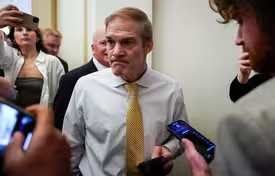
The leadership crisis in the House of Representatives today even became more chaotic.
Republicans, unable to agree on a speaker of the House, also rejected a plan for a temporary solution, to give the acting speaker more powers.
Our Lisa Desjardins was outside the heated meeting today and joins us now.
So, Lisa, Republicans can't agree on a speaker and they can't agree on what to do next.
Help us understand what's happening.
LISA DESJARDINS: Even by the tumultuous standards of the past couple of weeks, today was especially chaotic, Geoff.
It began with Jim Jordan, the speaker nominee for the Republicans, presenting a plan to try and buy himself time.
He proposed giving the pro tem speaker more power to conduct business on the floor.
But that met a brick wall inside the conference.
And sooner -- soon after that, Mr. Jordan came out to tell us what he thought would happen next.
REP. JIM JORDAN (R-OH): I'm still running for speaker and I plan to go to the floor and get the votes and win this race.
But I want to go talk with a few of my colleagues.
Particularly, I want to talk with the 20 individuals who voted against me, so that we can move forward and begin to work for the American people.
LISA DESJARDINS: And that's what's happening right now, Geoff.
Jordan has been speaking to those holdouts, so far, none of them changing their mind at all.
But let's briefly talk about that plan that he floated and which failed today, which could have gotten things operating again.
The idea is to give the speaker pro tem of the House, Patrick McHenry, more power to conduct business.
That would require a House vote, but it did meet with that very intense divide.
So, now with no real plan for who could be a permanent speaker and no plan for who could hold those powers temporarily, Geoff, to use a Star Wars reference, it feels like we're entering the outer rim here.
GEOFF BENNETT: Well, to your point, it's hard to believe we're entering a fourth week of this.
Help us understand why Republicans are unable to move forward, especially when they have a temporary solution available to them.
LISA DESJARDINS: I know this seems to defy a lot of logic and rationality for many of our viewers, so I spent a lot of time thinking about it.
You have a conference that really has been built upon questioning institutions.
Now it is questioning this institution itself.
Now, at the same time, you have a group of people who themselves are not unified, who have had deep divides within the party, which really they have been trying to hold to a minimum publicly, but which privately have only grown.
All of that added up today as members walked out of this meeting with signs of very clear and growing frustration.
REP. GREG MURPHY (R-NC): I think we need a speaker.
And I'm tired of putzing around with this.
REP. MARJORIE TAYLOR GREENE (R-GA): Our conference has a responsibility to the American people, to our districts to work together and unify, and this conference is absolutely broken.
REP. JIM BANKS (R-IN): There's nothing I have ever wanted more in this Congress than for Jim Jordan to be the speaker of the House.
He is the fighter that we need for our country.
And what they're doing right now is walking the Republicans off the plank.
We don't deserve the majority if we go along with a plan to give the Democrats control over the House of Representatives.
It's a giant betrayal to our Republican voters.
REP. MIKE GALLAGHER (R-WI): If we go to the floor for another vote, if Jim doesn't show progress or backslides, then it's time to go back to the drawing board.
There's any, I think, number of people who are interested who would be good, but we have to ultimately choose a speaker.
We're just -- we have got so many things we have got to do, and we just can't get down to business.
REP. PAT FALLON (R-TX): So, we're here.
We're in the middle of an ugly process.
It's not enjoyable, but we need to muddle through it.
We need to get through it as a team.
LISA DESJARDINS: For House Republicans, the problem, though, is, there is no leader for that team.
There is a leadership vacuum here.
And I don't know if you could pick up on that in the sound, but it was especially evident today that emotions are running high.
And there's a real emotional contagion here, resentment between Republicans that is adding fuel to this fire.
GEOFF BENNETT: Meantime, Lisa, you have got some Republicans who voted against Jim Jordan who say they have been receiving threatening phone calls, in some cases death threats.
How is that affecting the dynamic on the Hill?
LISA DESJARDINS: This is quite serious.
And it has, in fact, hurt Mr. Jordan, because there's a sense that his allies, whether they are here in Congress or there are viewers, voters who are putting threats in, apparently, that they're not playing fair and that they're playing dangerous games here.
I spoke to a couple of the members who have been receiving those threats.
REP. JEN KIGGANS (R-VA): Yes, that was a large part of what we did today, was to express our concern with the threats that so many of us have received from within our own party.
That's the part that's most disheartening.
We all have the same -- we share the same conservative values and principles.
So, to get those threats, to be intimidated by members of our own party are really frustrating, especially for people like me.
REP. NICHOLAS LALOTA (R-NY): It probably makes me more resolved, I think.
I think that folks who express themselves to have courage, to have guts, those sort of threats probably embolden us even more.
LISA DESJARDINS: So, you see, this is part of why the opposition is standing their ground.
They are telling me, if they give in to these threats right now, change their votes, support Mr. Jordan, that they feel their entire career, then they will be beholden to this kind of tactic.
One other note, one Republican member told the conference today that he had to see that a sheriff would be posted at his daughter's school, because these threats seem to be so serious.
So there are many dynamics here, some dangerous for the country, some dangerous for individuals.
Republicans want to way forward, but they clearly cannot find it.
GEOFF BENNETT: Lisa Desjardins, great reporting, as always.
Thanks so much.
LISA DESJARDINS: You're welcome.
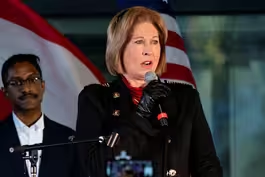
AMNA NAWAZ: The wide-ranging racketeering case against former President Donald Trump took a new turn in a Georgia courtroom today, as a second co-defendant pleaded guilty to charges in the alleged scheme to overturn the 2020 election.
This time, it was one of Trump's former attorneys, Sidney Powell.
WOMAN: How do you plead to the sixth council of conspiracy to commit intentional interference with the performance of election duties?
SIDNEY POWELL, Former Attorney For President Trump: Guilty.
AMNA NAWAZ: Following all of this closely for Georgia Public Broadcasting is Stephen Fowler, who joins me now.
Stephen, welcome back.
And let's start with Sidney Powell, a former member of Donald Trump's legal team.
But just remind us what role prosecutors say she played in this sprawling election interference case.
STEPHEN FOWLER, Georgia Public Broadcasting: Well, Amna, Powell is accused of orchestrating a plan that saw a forensic data firm travel down to a rural Georgia county, Coffee County, and copy sensitive election data, ballots, machines, everything like that, in efforts to find alleged fraud with the election.
Now, let's be clear.
There was no fraud in Georgia's election.
And Coffee County was an overwhelmingly Republican county.
But, still, prosecutors say that she helped orchestrate this plan to steal election data from Georgia.
AMNA NAWAZ: Tell us about the plea deal.
We know she's the second co-defendant, as we said, to plead guilty in this case.
But what does her plea deal entail?
STEPHEN FOWLER: Well, instead of starting a trial process tomorrow that has jury selection beginning, she pled guilty to six months -- or six years of probation -- excuse me -- $6,000 fine.
She has to pay additional restitution to the state to cover the cost of replacing election equipment, write a letter of apology, and agree to testify in future trials of other co-defendants, including former President Donald Trump.
Notably, Amna, she also has to turn over documents.
It doesn't specify what type of documents, but there are documents in her possession that prosecutors say that is important to them.
So that's the scope of what we're looking at.
AMNA NAWAZ: So, Sidney Powell, let me just underscore, was a key adviser to President Trump in those weeks in which he was working to overturn the 2020 election results.
What could her cooperation with prosecutors mean for the case against Mr. Trump and for others, like Rudy Giuliani?
STEPHEN FOWLER: Well, even though she's only accused of a small part of this massive racketeering conspiracy in Georgia, her tendrils leaked into several other co-defendants and other aspects of this.
Sidney Powell was there when Rudy Giuliani held a press conference talking about fraud in the election.
She had communications with Donald Trump that she could testify if she was called to the stand.
So the more defendants that testify in this case, the more locked down, prosecutors have potential avenues to show that former President Donald Trump committed a racketeering violation by trying and failing to overturn Georgia's presidential race.
AMNA NAWAZ: So this is related, of course, to this Georgia state case.
Mr. Trump also faces federal cases brought by the special counsel, Jack Smith.
Do we know if her cooperation or testimony here in any way impacts those cases?
STEPHEN FOWLER: Well, we don't exactly know what overlap there is, other than both of these cases are looking at election interference.
Georgia's state case is a different set of laws, a different prosecutor, a different scope and scale, even though there are several key players.
Now, former President Trump's attorney in Georgia said that he welcomes this, because he believes that Sidney Powell's testimony will exonerate Donald Trump.
That remains to be seen.
Also, Powell might not be the most reliable witness to be used in the federal case and the state case.
So it doesn't help Donald Trump, but it doesn't necessarily hurt him at this juncture.
AMNA NAWAZ: That is Stephen Fowler from Georgia Public Broadcasting joining us tonight.
Stephen, thank you.
Always good to see you.
STEPHEN FOWLER: Thank you.
GEOFF BENNETT: The war between Israel and Hamas has caused an eruption of anger and grief in many corners of the world.
It has also launched governments into action, and, first among them, the U.S. and the Biden White House.
But even inside government, there is some disagreement about the approach.
Here's Nick Schifrin.
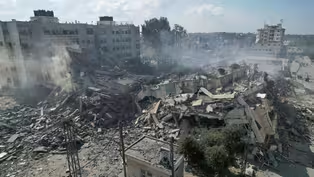
NICK SCHIFRIN: The State Department's Bureau of Political-Military Affairs is responsible for most arms transfers to American allies and partners.
And for more than 11 years, Josh Paul ran its congressional and public affairs office.
He wrote in his public resignation letter this week he knew his job was not -- quote - - "without moral compromise," but calls the transfer of weapons to Israel -- quote -- "shortsighted, destructive, and unjust."
And Josh Paul joins me now.
Thank you very much.
Welcome to the "NewsHour."
JOSH PAUL, Former State Department Official: Thank you.
Good to be here.
NICK SCHIFRIN: So, why are weapons transfers to Israel in this moment unjust?
JOSH PAUL: So, let's back up and recognize what we're talking about.
We're talking about the transfer of arms that can last for decades whose purpose is to kill.
That's an obvious point.
But it underlines the gravity of the decisions that we make every single day in the U.S. government and the State Department.
Recognizing that, the Biden administration earlier this year issued a conventional arms transfer policy which raised the standard for the transfer of weapons to what they call a more likely than not.
If it is more likely than not that weapons the U.S. provides to another country will be used for violations of human rights, they will not be transferred.
What we have seen with Israel repeatedly in operations in government is that the U.S. Gaza in 2009, in 2014, in 2021 is massive civilian casualties, thousands of Palestinians killed through a relatively indiscriminate use of bombs to destroy buildings.
And yet, in this context of this conflict today, where we have already seen, again, thousands of Palestinian casualties, there has been no policy debate.
Indeed, there's been a rush to provide arms, where, normally, there is discussion, consideration and thought.
NICK SCHIFRIN: So, the Israeli Defense Forces, I should say, say that they only target Hamas officials, Hamas weapons and rocket launch sites.
It sounds like what you said at the end there is one of your key criticisms.
Did you raise your concerns within State, and what was the response?
JOSH PAUL: I raised them, in fact, as soon as two days after the Hamas atrocity.
And let me just be clear, that was an atrocity and an outrage, full stop, period, no further caveats.
Shortly after that, I raised concerns that, look, we have seen that, for 20 years, the provision of security assistance to Israel, and for longer than that, has not led to peace.
And, instead, it has used -- the way it has employed that security has actually led us further from peace.
And so I wrote to a number of leaders within the department two days after Hamas' attack and said, I recognize that there's going to be a demand signal for arms to Israel.
Can't we for once stop and think about if this is actually getting us to where we need to be before we move forward?
NICK SCHIFRIN: And what was the response?
JOSH PAUL: No response.
NICK SCHIFRIN: And how unusual is that?
JOSH PAUL: It's extremely unusual.
If you think about other countries in the region, I won't name names, but there are obviously a number where there are troubling human rights records.
And the debate over arms sales requests that come from those countries can last within the administration itself for months, sometimes even years.
NICK SCHIFRIN: During your time, though, the United States, for example -- I will name names -- provided arms to Egypt, widely criticized for its human rights abuses... JOSH PAUL: Yes.
NICK SCHIFRIN: ... and to the Saudi coalition... JOSH PAUL: Yes.
NICK SCHIFRIN: ... that has killed many, many civilians in Yemen and accused of violating the laws of war by Human Rights Watch.
JOSH PAUL: Yes.
NICK SCHIFRIN: Why did you not resign after those arms transfers?
JOSH PAUL: Because those were cases where I could make a difference and manage through my work and the work of many others in the department to add some elements to it.
So, for example, there is a training program that has been going on now with Saudi pilots to improve their targeting.
And, in the case of Egypt, of course, we have Leahy vetting, where units that are identified to be involved in gross violation of human rights are not eligible to receive U.S. weapons.
There is a Leahy vetting process for Israel.
It has never found an Israeli unit to be guilty of a gross violation of human rights.
It's a broken system.
NICK SCHIFRIN: OK. Well, you could argue that isn't that proof that the vetting that State Department does do, you say, of the Israel's Defense Forces have not found a violation of Leahy?
Does that mean that they don't violate the Leahy?
JOSH PAUL: Well, they have identified many, but they have not been able to come to a conclusion, which requires senior level sign-off within the department.
NICK SCHIFRIN: Just to be clear, are you saying that there have been units inside Israel's Defense Force that the State Department has been concerned about... JOSH PAUL: Yes.
NICK SCHIFRIN: ... their violations or their actions, you have brought that to senior officials and over the years consistently they have not acted on them?
JOSH PAUL: That is correct.
NICK SCHIFRIN: These questions, of course, were put to Matt Miller, the State Department spokesman, earlier today.
Let's take a listen to what he said.
MATTHEW MILLER, State Department Spokesman: We comply with all applicable congressional statutory requirements and regulatory requirements in our provision of military assistance to Israel, as we do to every other country in the world.
NICK SCHIFRIN: Isn't that what the U.S. pushes, and isn't that the policy?
JOSH PAUL: I think Matt is right.
We have complied with the laws.
The problem is that the laws are intentionally vague in some cases.
So for example, they require a determination that something has happened in terms of gross violation of human rights before sanctions, as they were, could be applied.
So, yes, absolutely, we are acting within the law.
The question is, is that good enough?
And we are certainly not acting within the conventional arms transfer policy.
NICK SCHIFRIN: Finally, you have deep experience in the region.
You have connections throughout the region.
Do those connections drive your opinion this?
JOSH PAUL: They certainly drive a lot of my passion.
But I think, at the end of the day, what has driven me throughout my service in the Political-Military Affairs Bureau is a passion for human rights, something that has compelled me always to look at those issues and to carry them forward as something that we need to do better on and can do better on.
NICK SCHIFRIN: Josh Paul, thank you very much.
JOSH PAUL: Thank you.
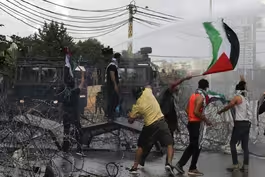
AMNA NAWAZ: Let's delve further into the Biden administration's response to the Israel-Hamas war and specifically how President Biden's trip to Israel yesterday is being seen in the region.
For that, we get two views.
Marwan Muasher was Jordan's deputy prime minister and foreign minister.
He's now vice president of the Carnegie Endowment for International Peace.
And David Makovsky is a distinguished fellow at the Washington Institute for Near East Policy.
He's a former journalist and was also a senior adviser for Israeli-Palestinian negotiations during the Obama administration.
And welcome to you both, gentlemen.
Thank you for joining us.
David, I want to begin with you.
The president has now made this trip to Israel to show solidarity on wavering U.S. support.
From what you know, what's the message he was delivering behind closed doors?
DAVID MAKOVSKY, Senior Fellow, Washington Institute for Near East Policy: I think behind closed doors was a couple of things.
He was -- because, having built the street cred of the empathy with a country at a time of severe trauma, sense of more clarity of saying, I have no illusions who Hamas is, the slaughter of 1,300 people and the like, and I have dispatched these aircraft carriers to deter Iran, so this war is not regionalized, which you don't want, the Arabs don't want.
So, having that street cred in a certain way with the Israeli public and that bond that I feel he's really deepened in these last 10 days, I think he also thought this is a chance for some friendly advice and to say, hey, I really want this humanitarian corridor, bringing trucks in from Egypt.
And Secretary of State Blinken paved the way also with his diplomacy over the last week.
And second is, I want to know the endgame.
I want to know how a military strategy is part of a political strategy after this is over.
What would a post-Hamas Gaza look like?
Have you given some thought to that?
AMNA NAWAZ: This is the message he's delivering, President Biden's delivering.
DAVID MAKOVSKY: Yes.
AMNA NAWAZ: Marwan, over to you now, because President Biden did announce that some of those aid lines into Gaza have been opened.
He pledged another $100 million in U.S. aid to Palestinians.
How is his trip resonating among Palestinians, among their neighbors there and in the broader region?
MARWAN MUASHER, Former Jordanian Foreign Minister: To be candid, it's being seen in extremely negative light, not because the president did not -- did show empathy for the Israeli civilians that have been killed -- I mean, nobody should condone targeting civilians, nobody -- but because he did not show the same empathy towards the Palestinians who are being harmed, towards the collective punishment of two million Palestinians in Gaza.
And the Arab world today is asking, what about the day after, not just who will rule Hamas and Gaza after that, but if we are to have a political process that deals with the root cause of the problem, which is the occupation, can the United States -- this is what the Arab world is asking -- can the United States be counted on as a broker?
Forget the word honest broker, but as a broker, period, between Palestinians and Israelis.
Today, the United States' image in the region as a leader in trying to effect a political solution has been severely damaged.
AMNA NAWAZ: David, let me take a piece of what Marwan said there, specifically on civilian casualties.
And there have been over 3,000 Palestinians killed in retaliatory Israeli strikes since that Hamas attack.
How hard did President Biden press on that?
Publicly, he said, we want them to minimize casualties.
Is that a priority for the U.S., and do they have sway?
DAVID MAKOVSKY: Yes, no doubt, No doubt.
I mean, I have no doubt.
He said -- by the way, he said he got very little pushback.
This is not about checking a box.
This is not about being pro forma.
It is ironic, though, that this -- according to American intelligence, our system, according to the president, who said, my data comes from the Pentagon, and then the I.C., the international -- the intel community, this bomb, it was a misfire.
AMNA NAWAZ: You're talking about the Baptist hospital explosion, right?
DAVID MAKOVSKY: Right, but that's what triggered these demonstrations in the Arab world is... AMNA NAWAZ: Yes.
DAVID MAKOVSKY: And I worry that the disinformation on social media is going to be a new factor here that can inflame attitudes throughout the region.
And go prove a negative to something you didn't do.
But -- because for the people who demonstrated, they heard one side.
AMNA NAWAZ: So, Marwan, let's talk about that reaction we have seen to the hospital blast, and also just to continued Israeli airstrikes, a potential ground invasion ahead.
What would be the impact on Jordan and in other countries that have a relationship with Israel in the area?
MARWAN MUASHER: Again, it would be a very strong impact.
We have witnessed protests in Jordan that are unprecedented.
Not since the Arab Spring, not even during the Arab Spring we witnessed such demonstrations.
Jordan and Egypt are extremely worried that this is going to result in a mass transfer of Palestinians from Gaza to Egypt, and, potentially, if the conflict escalates, from the West Bank to Jordan.
When we talk about human corridor, people ask, why should a human corridor be from Gaza to Egypt?
Why can't Palestinians go to the West Bank, for example, and be assured that they're not going to leave their homes again?
This conflict might be used by Israel to try to empty parts of the Palestinians into Egypt.
And so that is what is at stake here.
We are already seeing thousands of Palestinians - - as you said, Amna, thousands of Palestinians have been killed by Israeli raids, even without the hospital issue.
And I'm afraid this is going to be only a prelude to the carnage that will occur if Israel indeed goes into Gaza.
We are going to talk about tens of thousands of casualties.
And then where do we go from here?
How do we translate this crisis into a political process?
It's something that nobody knows.
AMNA NAWAZ: So, David, let me get your response to what you just heard there.
DAVID MAKOVSKY: No, look, I -- as someone who worked in the Obama administration on this issue, our effort for two states was stymied by the fact that the rejectionists were just too strong.
Three times, the United States tried to solve this conflict, which you don't hear about often, Clinton, Condoleezza Rice and John Kerry that I worked for in the Obama administration.
I think these were noble efforts to solve this once and for all.
But Hamas was strong enough to -- frankly, to torpedo.
And my hope is that there's more dignity for both sides here, that you don't have ISIS as a neighbor, that you're able to have a post-Hamas Gaza which is about, how do we reconstruct, how do we build, how do we work together, Israelis and Palestinians alike?
And I think the president's effort, by the way, with Saudi Arabia, when this is all over, to find some sort of broader normalization, I think that would be a real answer to this kind of rejectionism that we have seen.
AMNA NAWAZ: I take your point.
DAVID MAKOVSKY: Yes.
AMNA NAWAZ: But also, at this moment in time, when everything seems to be trending the opposite direction... DAVID MAKOVSKY: Right.
AMNA NAWAZ: ... is there any space to have that conversation right now?
DAVID MAKOVSKY: No, it's very hard.
It's very hard.
You have no space in Israel.
You have no space in the Arab world.
There has to be... AMNA NAWAZ: And could a ground invasion and the further displacement of two million Palestinians further complicate that conversation?
DAVID MAKOVSKY: Well, first of all, I don't - - I disagree.
Marwan and I have known each other for many years, and I have a lot of respect.
I don't see Israel moving Gazans into the Sinai.
I just don't see it.
And Israel has sharply denied all these kinds of reports.
So I think some of the reports are just -- are not based, in my view, on reality.
My view is that the status quo cannot continue this way.
We need some way that the rejectionists do not have a veto over most of the people on both sides who just want to live together.
And we keep saying, well, we kick the can, but no one can live with a genocidal group next door.
And there's no hope for two states if they're - - if they have that veto.
AMNA NAWAZ: Marwan, I will give you the last word here.
MARWAN MUASHER: I totally agree that the status quo cannot be maintained, Amna.
Otherwise, the cycle of virus will continue.
But if the status quo is not to remain, we have to deal with the root cause, which is the occupation.
Why is there an occupation in the first place, the longest occupation in modern history?
If there was no occupation, we would all live peacefully together.
But Israel insists on keeping the land.
It cannot have -- keep the cake and eat it.
We have to deal with the root cause.
And until we understand this reality, no normalization agreement with the region can come -- can bring peace to the Middle East and bring peace to that piece of land if the Israelis and the Palestinians are not able to come to terms with each other.
This does not require a normalization agreement with Saudi Arabia.
It requires a peace agreement with the Palestinians.
AMNA NAWAZ: Marwan Muasher and David Makovsky, thank you so much to both of you for joining us.
We appreciate your time.
DAVID MAKOVSKY: Thank you.
Thank you.
MARWAN MUASHER: Thank you.
GEOFF BENNETT: Amid ongoing police reform efforts in the U.S., Native American activists say they have often been left out of the conversation.
But more than three years after the police murder of George Floyd, there's a renewed push in places like Minneapolis for awareness and change around law enforcement interactions with Native communities.
Special correspondent Fred de Sam Lazaro has this report.
FRED DE SAM LAZARO: A recent rally in the heart of South Minneapolis' Native American community brought out high emotions and strong numbers.
They were protesting the imprisonment of Leonard Peltier, an American Indian activist serving life sentences for the 1975 killings of two FBI agents.
Peltier's supporters have long said he was wrongly convicted and they consider him a political prisoner.
WOMAN: As long as Leonard Peltier isn't free, there is a piece that this system holds of every single one of us as indigenous people.
FRED DE SAM LAZARO: Activists say the problems with that system are upheld by law enforcement authorities, who regularly mistreat Native people.
The vast majority of Native Americans live away from the reservation or tribal communities in which they're officially enrolled.
They live in cities like New York, Albuquerque, or Minneapolis, meaning that most of their law enforcement encounters happen with local police.
In Minneapolis, a city that became the center of a global racial reckoning after the murder of George Floyd, police interactions with communities of color remain under intense scrutiny.
In June, the Department of Justice released its investigation into the Minneapolis police, launched after Floyd's killing.
Among its findings, MPD unlawfully discriminates against Black and Native American people.
Officers stop Native residents at almost eight times the rate they stop white people.
During those stops, Native people are at least 20 percent more likely to face searches or use of force.
And the disparities were worse in Minneapolis' Third Precinct, where George Floyd was murdered by Derek Chauvin and where many Native Americans live.
That area, the DOJ said, is where officers referred to as cowboys wanted to work.
JOLENE JONES, Little Earth Protectors: It didn't tell us anything we didn't already know.
FRED DE SAM LAZARO: We spoke to Vinny Dionne, Rachel Dionne-Thunder and Jolene Jones, three Native community leaders with deep understanding of police interactions here.
VINNY DIONNE, Community Organizer, Indigenous Protector Movement: As a young man grown up in this neighborhood, I have always dealt with the police.
It was always us against them.
RACHEL DIONNE-THUNDER, Co-Founder, Indigenous Protector Movement: The DOJ report specifically said that Native people are the most adversely affected, discriminated against, and abused by the Minneapolis Police Department.
Yet there hasn't been one listening session here in this community.
JOLENE JONES: So, basically, it's just another report that says, hey, we're doing this to your people, but you're still invisible, because we're not going to work with you.
FRED DE SAM LAZARO: They said residents in this area, known as Little Earth, rarely call the police.
Wait times can be lengthy, and they want to avoid escalation with the department that, by their count, has only four Native American officers out of nearly 600.
JOLENE JONES: When the police are called here, they're called because they're desperately needed.
VINNY DIONNE: I have been beaten by the police twice.
I have never once reported it out of fear, out of fear of retaliation, because you are going to see these same officers again out here.
They work your beat.
You see them every day.
FRED DE SAM LAZARO: Minneapolis was the birthplace of the American Indian Movement founded in 1968 to improve conditions for Natives living in urban areas.
It grew into an international movement for treaty rights and the reclamation of tribal lands.
It created the AIM Patrol, a citizen watch group whose goal was to help victims of police brutality.
MIKE FORCIA, Chair, American Indian Movement of Twin Cities: And then here's where I got beat by the cops.
FRED DE SAM LAZARO: Mike Forcia chairs the American Indian Movement Twin Cities.
In 2002, he settled a police brutality case with the MPD for $125,000.
Today Forcia sees a community plagued by homelessness and substance abuse and a police department focusing on the wrong issues.
MIKE FORCIA: This is what neglect looks like, Native Americans homeless in their own land.
FRED DE SAM LAZARO: Last year, Forcia and other leaders toured Little Earth With Brian O'Hara, the new police chief in Minneapolis.
He also spoke at O'Hara's swearing-in ceremony.
MIKE FORCIA: We were planting seeds.
Seeds of trust, seeds of accountability, seeds of transparency, seeds of community.
But planting it is the easy part.
So much damage was done to our community, not just by the police, but by the city too.
And we have to make an accounting of what happened.
And we have to have some restitution.
FRED DE SAM LAZARO: These issues are hardly unique to Minneapolis.
Native American people make up less than 3 percent of the population in the U.S., but, between 2010 and 2020, they were killed in law enforcement encounters at a higher rate than any other racial group.
Thirty-five-year-old Johnny Crow grew up in Minneapolis.
He remembers bouncing between homeless shelters in a community grappling with cycles of poverty and violence.
He also recalls his father getting roughed up by the MPD.
JOHNNY CROW, Minneapolis Resident: It's just the way they treat us.
You got to be strong.
That's kind of mentality I was taught.
You got to be strong.
FRED DE SAM LAZARO: Last fall, Crow himself was detained at a Minneapolis gas station after police said his car was connected to a wanted person.
Crow was handcuffed and put in the back of a squad car before officers checked his I.D.
They accepted that the person of interest was actually Crow's cousin and let him go.
Crow is suing the city and the officers involved, saying he was injured and traumatized during the unlawful stop and unreasonable seizure.
JOHNNY CROW: I remember, as a kid, being here in South Minneapolis, the police would hand me stickers, and I used to think, like, oh, wow, they're so amazing.
They keep us safe.
Once I became a young man and I started to look like an adult, like a Native man, I was no longer welcomed.
I was more of a threat.
FRED DE SAM LAZARO: MPD said it cannot comment on pending litigation, but in a statement to the "NewsHour," it said the department is planning a listening session on police reform with the Native community.
And Chief O'Hara said -- quote -- "It is misguided to think that we will erase these disparities completely without correcting the underlying historic systemic injustices which have created the conditions that police are often called to deal with."
JOHNNY CROW: I'm hopeful that things will be different for my son, because, right now, I mean, my incident with the police wasn't as bad as my father's.
And if one day my son has a traffic stop or has an incident with the police, it won't be like mine.
FRED DE SAM LAZARO: What gives you that optimism?
JOHNNY CROW: It's -- sorry.
My belief -- being Lakota, we say (SPEAKING IN FOREIGN LANGUAGE) ultimate belief.
And I'm trying to instill that in my son.
FRED DE SAM LAZARO: Activists say the invisibility of Native Americans in the city is an enduring challenge.
But, as the future of public safety is charted here, they are demanding to be seen.
For the "PBS NewsHour," I'm Fred de Sam Lazaro in Minneapolis.
GEOFF BENNETT: Fred's reporting is a partnership with the Under-Told Stories Project at the University of St. Thomas in Minnesota.
AMNA NAWAZ: And please join us in just a little while for special coverage of President Biden's live address to the nation.
That begins at 8:00 p.m. Eastern right here on your PBS station and streaming online as well.
We hope you will join us then.
And that is the "NewsHour" for tonight.
I'm Amna Nawaz.
GEOFF BENNETT: And I'm Geoff Bennett.
Thanks for joining us, and have a good evening.
GOP rejects plan to empower interim House speaker
Video has Closed Captions
GOP rejects empowering interim House speaker as Jordan says he's still running for the job (5m 27s)
How U.S. response to Israel war is resonating in Middle East
Video has Closed Captions
How Biden's trip to Israel and U.S. response to war is resonating in Middle East (9m 35s)

Israel hammers Gaza as forces prepare for ground invasion
Video has Closed Captions
Israel hammers Gaza with more airstrikes as forces prepare for ground invasion (15m 4s)

Native people feel left out of police reform conversation
Video has Closed Captions
Amid national push for police reform, Native people feel left out of conversation (7m 58s)

News Wrap: Fed chair says inflation still too high
Video has Closed Captions
News Wrap: Fed chair says economy may need to cool to bring inflation down (3m 20s)
State Dept. official quits over response to Israel-Hamas war
Video has Closed Captions
Ex-State Department official explains resigning over U.S. response to Israel-Hamas war (5m 56s)
What Powell's guilty plea means for Trump in Georgia case
Video has Closed Captions
What Sidney Powell's guilty plea means for Trump in his Georgia election subversion case (3m 56s)
Providing Support for PBS.org
Learn Moreabout PBS online sponsorship
- News and Public Affairs

FRONTLINE is investigative journalism that questions, explains and changes our world.

- News and Public Affairs

Today's top journalists discuss Washington's current political events and public affairs.












Support for PBS provided by:
Major corporate funding for the PBS News Hour is provided by BDO, BNSF, Consumer Cellular, American Cruise Lines, and Raymond James. Funding for the PBS NewsHour Weekend is provided by...