
October 2, 2023
Season 2 Episode 88 | 27m 29sVideo has Closed Captions
Dozens of organizations receive money to help fight the opioid epidemic.
Dozens of organizations receive money to help fight the opioid epidemic, a program designed to help domestic abuse survivors has seen its enrollment double, why Lexington is expanding an expungement clinic, and how KY's federal delegation voted on the government shutdown bill.
Problems playing video? | Closed Captioning Feedback
Problems playing video? | Closed Captioning Feedback
Kentucky Edition is a local public television program presented by KET
October 2, 2023
Season 2 Episode 88 | 27m 29sVideo has Closed Captions
Dozens of organizations receive money to help fight the opioid epidemic, a program designed to help domestic abuse survivors has seen its enrollment double, why Lexington is expanding an expungement clinic, and how KY's federal delegation voted on the government shutdown bill.
Problems playing video? | Closed Captioning Feedback
How to Watch Kentucky Edition
Kentucky Edition is available to stream on pbs.org and the free PBS App, available on iPhone, Apple TV, Android TV, Android smartphones, Amazon Fire TV, Amazon Fire Tablet, Roku, Samsung Smart TV, and Vizio.
Providing Support for PBS.org
Learn Moreabout PBS online sponsorshipAttorney General Daniel Cameron announces nearly 14 million new funding to fight the opioid epidemic.
You know, one person at a time.
You know, we all can work, you know, come together and work together to make Eastern Kentucky and Appalachia, Kentucky a better version of itself.
A preview of what's planned for this year's saw summit.
I think ultimately people challenge books because they are different from what they hold to be true.
Hear why one Kentucky Library says they don't have many challenges to the books on their shelves.
We are super proud of the fact that we have the first barrel of bourbon produced in the county since before prohibition.
Plus, see how joining the Bourbon Trail has led this town to new heights.
Production of Kentucky Edition is made possible in part by the KET Endowment for Kentucky Productions, the Leonard Press Endowment for Public Affairs and the KET Millennium Fund.
Good evening and welcome to Kentucky Edition on this brand new week, Monday, October the second.
I'm Renee Shaw.
Thank you for starting off your weeknight with us.
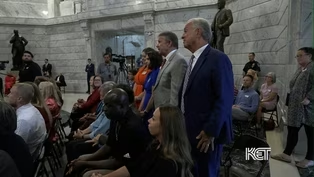
Dozens of organizations are receiving money to help fight Kentucky's opioid epidemic.
Kentucky Attorney General Daniel Cameron recently announced nearly $14 million in new funding.
He announced that today the money comes from settlements reached with companies who played a role in the opioid crisis and is allocated by the Kentucky Opioid Abatement Advisory Committee.
For the first time since 2018, Kentucky saw a decline in overdose deaths last year.
Still, more than 2100 Kentuckians died, and most of the deaths were from opioids.
General Cameron says it's important to get the money into the hands of these organizations.
Making sure that we get the money back to our communities because you all are best equipped to fight this epidemic and know what is needed in your particular regions or communities.
And so this is what it's about, making sure that we're in a position to allocate this money through the great work of our commissioners on $1 million.
Now, we'll have more on this story, including a breakdown of where the money is going.
That's tomorrow night right here on Kentucky Edition.
The state's drug woes have emerged as an issue in Kentucky's gubernatorial campaign, pitting General Cameron against incumbent Governor Andy Beshear.
Election Day is now just a little more than five weeks away.
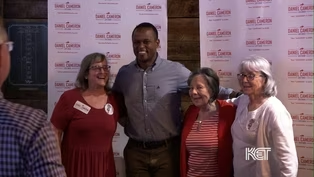
Attorney General Cameron was in Scott County campaigning on Friday where he talked about crime and education and again addressed his stance on abortion and whether he would sign off on a change to the state's abortion ban to allow exceptions for rape and incest.
If a criminal commits the ultimate act and murders one of our law enforcement officers.
I think it's the responsible thing to do, and we're going to offer legislation on this.
It's the responsible thing to do to make sure that we automatically seek the death penalty against that criminal.
And I say that knowing what happened right here in Scott County.
I know Sheriff Hampton just walked in the room.
Everyone's horror is broken.
In fact, I came to calmly lost his life.
And my office right now is seeking the death penalty against that murderer.
And we need a new governor who's going to address violent crime.
I've got a plan to do so with putting a Kentucky State Police post in Louisville to address violent crime.
There, making sure that we have a carjacking statute.
I on a few states in the nation that does not have a standalone carjacking statute.
And so, again, this is a strong plan that I put forward.
I'm 100% pro-life and I support the Human Life Protection Act.
And as I've said repeatedly, if the wall was to need to be changed, I would sign those exceptions.
I've made that abundantly clear.
We need to increase the starting point pay of our teachers, make sure that we restore discipline to the classroom, and make sure all of our teachers are empowered to remove any disruptions In my existing classroom.
Now, tomorrow, we'll hear from Governor Andy Beshear, who is scheduled to unveil his infrastructure plan called Better Kentucky.
Bashir's office says the plan will further support Kentucky families and boost economic development.
Now, we began our candidate conversations tonight on Kentucky.
Tonight, a programing note for you.
You'll hear from the candidates for state auditor Kimberly Reeder and Alison Ball and the candidates for state treasurer Michael Bowman and Mark Metcalf.
And we hope that you'll send us your questions and comments by phone, by email, and by using X formerly known as Twitter.
That's all happening tonight, starting at eight Eastern, seven Central right here on Kates, Kentucky, tonight.
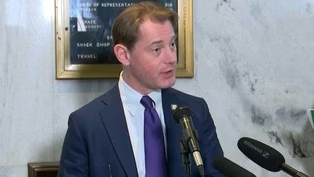
October is Domestic Violence Awareness Month and Kentucky, a program designed to help domestic abuse survivors has seen its enrollment double since a new law went into effect.
State Senator Julie Rocky Adams of Louisville sponsored Senate Bill 79, which became law in June.
It created the Safe at Home program, which allows victims to participate and the secretary of State's address confidentiality program without having a protective order.
Secretary of State Michael Adams put out a short video explaining the program.
This safe at Home program has three main functions.
First is address substitution.
Participants use the Secretary of State's designated address on all public records in lieu of their own.
This allows their real address to be masked on all local and state public records.
Second is mail forwarding to Secretary of State's office, who receives participant mail and then forwards it to the confidential address.
Third is voter registration.
Participants can safely exercise their right to vote by having their address hidden and publicly available voter records.
Secretary Adams office says there are now 50 participants in Kentucky's Safe at Home program, 54 counties one Plan for Prosperity in Eastern Kentucky.
That's the overarching goal of the PSAs initiative, which stands for Shaping our Appalachian Region.
Fifth District Congressman Hal Rogers and former Governor Steve Beshear founded PSAs in 2013 to revitalize southern and eastern Kentucky and the region's coal producing counties.
1200 folks have already registered for the two day conference that begins tomorrow in Corbin and Wednesday.
To learn more about how to improve broadband access, revitalize downtowns and improve workforce and economic development.
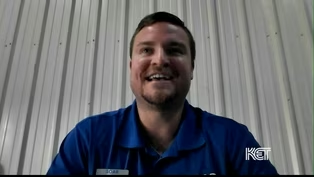
I spoke with SAWS executive Director Colby Hall earlier today.
One of our our sessions or multiple sessions are one of our programing aspects this year, something called Tin Talk.
And it's an opportunity.
We put an application out for community leaders to come and take the plenary stage, this big, beautiful stage that we have here in Corbin and 10 minutes and two slides.
And these these talks are going to be so interesting and range from broadband to to your point to workforce development to tourism to downtown revitalization to mental health.
And so even this year, more than in past years, Renee, between the ten talk sessions, between our panel discussions, we have a panel around e-sports and its potential economic impact and harnessing its economic engines for for the betterment of Eastern Kentucky.
And in specifically our downtowns.
I mean, there's just so many interesting topics that are going to be covered at the summit this year.
Like I said, more this year than even in past summits.
So how have you seen the impact in the region and not just where the conference is located, but there is I mean, it's a multi region perspective and impact.
You're trying to make.
What kind of growth has come from this collaborative effort beyond just a conference?
Well, you know, Renee, I think sometimes it's hard to measure, but I still do.
I don't think it takes away, you know, sort of a catalytic organization.
Right.
Not to use it.
You know, we exist to serve communities and lift other communities up and really be a reminder that we get more working together than trying to do everything by ourselves.
And in Kentucky, in eastern Kentucky especially, that's a really important lesson to remember, Renee, because we have a lot of counties, right?
We have a lot of cities, and it's really easy for us to operate naturally in our silos, not because we're trying to it's just everybody's kind of got their head down focused on improving their community.
And so I still think that source biggest asset or biggest advantage or biggest benefit to the region is going back to when Congressman Rogers and Governor Steve Beshear at the time put us together, which is to be this engine for collaboration, this engine for innovation.
And that comes just by getting everybody in the same room together and as excited and as proud as I am of the programing.
And some of the experts that we have assembled for this year, Summit surveys show year after year, Renee attendees favorite part is the exhibit hall and the exhibit hall.
That's for some of those organic conversations that happen when you get a bunch of excited, passionate people in the same room together.
And we don't plan any of that.
Renee That just comes naturally when people get in the same room together and start talking to one another and like that sauce superpower, it always has been, always will be for as long as we're around.
And we can't measure it, right, Because we don't know exactly what happens when everybody leaves our doors from the conference we have.
We continue those conversations throughout the year as a as a small, you know, nonprofit that punches above its weight class.
But we know that because of these initial conversations and because of this energy and this buzz that we keep in the spotlight that we keep on eastern Kentucky, we know that that that pushes people and compels people to get out in their communities and to do more and to reach across county lines.
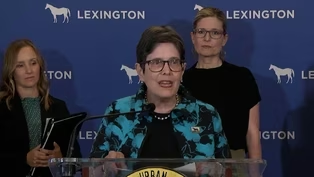
Lexington Mayor Linda Gordon says recent expungement clinics have been heavily attended.
So this year the city is expanding.
The clinic to include a conference as well.
Both events will take place on Tuesday, October 31st, which is Halloween from 8 a.m. to 3:30 p.m.. That's Eastern time.
Mayor Gordon says the event will teach people about fair hiring practices and how to begin the expungement process.
This event is focused directly on helping many residents of our community overcome barriers to employment, housing and education by providing information and support is also geared to help businesses with transformational workforce development and fair housing.
In 2016, the Kentucky State Legislature expanded expungement eligibility to include some Class D felonies.
In 2019, the law was expanded again to include hundreds of Class D felonies.
You can find more details and register for the clinic at Lexington, K-Y Dot gov slash Expungement.
The threat of a federal government shutdown is over for now.
Late Saturday night, just hours before the midnight deadline, Congress approved a temporary funding bill to keep federal agencies open until November 17th.
The bill drops aid for Ukraine but adds money for U.S. disaster assistance.
President Joe Biden said he expects House Speaker Kevin McCarthy to keep his commitment to the Ukrainian people and push for aid in the war with Russia.
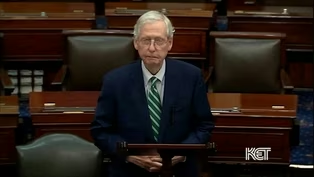
Senate Minority Leader Mitch McConnell of Kentucky is encouraging his colleagues to do the same.
As I've said for weeks, the clearest path forward has been to pass a straightforward short term funding extension that gives us time to continue a number of important discussions about outstanding priorities from securing supplemental relief for victims of natural disasters to restoring security and sanity at the southern border that the Biden administration has dragged into chaos to put stronger restraints on the president's reckless spending to supplying Ukraine with even more of the lethal assistance it need On that particular point, Madam President.
Most Senate Republicans remain committed to helping our friends on the front lines through investing more heavily in American strength that reinforces our allies and deterring our top strategic adversary, China.
I'm confident the Senate will pass further urgent assistance to Ukraine later this year.
The U.S. has approved four rounds of aid to Ukraine in response to Russia's invasion, totaling about $113 billion.
But Kentucky's other U.S. senator, Rand Paul, thanked members of Congress who voted to keep the government open without sending more money to Ukraine.
On social media, Senator Paul said, quote, We cannot continue to put the needs of other countries above our own.
The battle to fund our government isn't over yet.
The Forever War crowd will return, end quote.
Paul was one of nine Republican senators to vote against the spending bill.
Congressman Thomas Massie was the only member of Kentucky's congressional delegation to vote against the bill in the House.
This is Banned Books week and annual event that in part draws attention to book censorship in libraries and schools.
The Lexington Public Library is participating in Banned Books Week and says center censorship is not the way to handle material some may find objectionable.
Banned Books Week is a promotion that is put on every year by the American Library Association, and that really highlights different books that have been challenged and for intellectual freedom.
So typically that means that someone has questioned whether that book has merit or belongs in a library collection.
They are most often related to gender or race or sexuality, sometimes related to religion, and very definitely directed towards people in the minority.
I can tell you, out of the top 13 most challenged books tracked last year across the American Library Association system.
I think ten of 13 of them were related to sexuality.
I think ultimately people challenge books because they are different from what they hold to be true.
It doesn't necessarily mean that it isn't true, but it's not.
It's different from their truth.
That's scary for some people.
Every library has a different system for how how to challenge a book.
Ultimately, for a public library, it would be a boards decision and or executive management.
It is important to note here in Lexington that we do not ban any books.
For the most part, our community really loves to read, and it's just a question of finding the book that speaks to them.
But we have had some concerns.
There are always concerns.
Our whole philosophy is that parents absolutely have the choice of what they want their children to read, but just because they don't want their child to read that doesn't necessarily mean that somebody else doesn't want their child to read that.
So we encourage parents to come with their children to the library and select the books that align with your values.
Libraries typically have a very strong collection development policy, and what they've done with that is try to determine what interests the people in our community for a public library.
We look at our different demographics.
We look to see what are the bestsellers in different categories.
We really want to make sure that we have a popular collection that appeals to everybody in the community.
We really want to support intellectual freedom.
That's how we grow, build our creativity and think, think through things differently.
No.
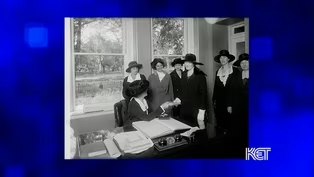
Last week we heard from Family and Children's Place CEO Pam Darnell about the organization that celebrates 140 years in the community.
Our Christy Dutton continues the interview today as the organization reflects on the difference they've made over the years.
So since 1883, Family and Children's Place, even through the various names, has had a 140 year presence in this community.
What difference has that made?
So we know that we we estimate based on our data that we have served over 275,000 children in their family members over our history.
And so we know, based on some of the information that we have, this organization over 30 years ago that adoptions and I actually was on a call with a woman.
I just called her to thank her for her support about a year ago.
And she was so thankful for my call.
And I would not have known this had I not called her.
Her daughter was adopted at this organization 40 years ago, and she also received services later.
She wanted some of our home visiting services.
So that's just one example of the impact that this organization has had for 140 years.
All of our services that we now operate five different services, we track data about how we help kids and families.
But an outcome to us is not how many families that you serve.
How many children did you see?
We count all that and it's important.
But the real outcome is what is the change that happened in the life of that child or family and family members because they got our services.
You've had your career here at this place for almost 30 years, and it's a place that you've poured your heart into, but a place that if you had your wish, you wouldn't need it.
What keeps you going?
You know?
You're exactly right.
And often people will say, How do you all do this?
It's so hard.
And it is hard.
But you know what?
I grew up in a home where my parents never finished high school, never graduated high school.
They got married when they were 16.
And they both came from families who really lacked significant resources.
So it's always been sort of in my DNA that kids and families need help.
It's always been a part of me that I really felt compelled.
Call it a calling or whatever, but I just felt compelled that children and families in crisis needed help and it didn't always mean they weren't doing what they should be doing.
Despite that, the hard work and the very best efforts of my mom and dad, there were times we didn't have everything we needed, but they worked hard.
And it wasn't because of a lack of that that we lacked the things that we needed.
So it's just always been a part of me.
How can I help kids and families who don't have the resources that some other kids and families do?
I believe that every child, no matter where they live, no matter the circumstances of their birth, no matter who they are, they deserve every opportunity for the very best education that they they can have.
Just like everyone else who has resources and really helping families to have what they need is how we will, number one, prevent child abuse.
And number two, help make sure that every single family and every child in our communities can really grow and thrive and be successful later in life.
It is really important to me, you know, that my career was dedicated to helping kids and families in crisis.
Pam Darnell was named one of business first most admired CEOs in 2021.
She announced that she will retire in November of 2024.
We head west on I-64 for today's Monday's on main series.
Shelbyville is the seat of Shelby County and is sometimes referred to as the saddle bread capital of the world.
But city leaders say they hope to capitalize on a different industry that's also well known in Kentucky.
I've lived in Shelbyville my entire life.
I've been born and raised here, obviously.
And we have such a great, fabulous community that I'm very proud of.
And we have spent a lot of time and efforts on revitalizing the downtown as well.
We currently have many grants, matching grants available to a lot of our buildings that are that have been vacant.
And we've been able to put those in place for our young entrepreneurs, people that have interest in building a business and coming downtown, like take the city of Shelbyville, as well as Shelby County, has kind of undergone kind of a big change because we were primarily a large agricultural county, tobacco and dairy in both of those was kind of going away, and in the same time they went away.
The distillery industry is really stepped in into Shelby County.
You've seen a couple of really nice distilleries move in.
There's more coming, great benefit to the county.
We're supporting local agriculture and we sure make a great product.
Well, the county and the city of both played a very important roles for us as we started this project.
Distilleries were not allowed in the county.
They weren't allowed to be built.
So we worked very closely with the county and the city both to get ordinances set up that allowed distilleries to even exist.
And when we were actually first starting this, the county was actually dry or moist, so we weren't going to be able to sell our products.
So the city worked very closely with us at that beginning time frame to allow us to get annexed into the city so that we could have our gift shop and sell our products and be part of the bourbon trail and be a tourism destination.
So the county and the city have both been very, very great to work with.
Being a stop on the bourbon trail is something that impacts our downtown.
People stay here in our Airbnbs, so we have at least seven of them right on our main street in our local right downtown.
So when people are coming, they're staying here and then they're venturing out.
So whether that's to jump the bullet or they're going outside of Shelby County, we become kind of that or that hub.
It also brings in a lot of money.
So when people are staying here, they're using the Airbnbs, but then they're eating or they might be going shopping, you know, So they're the impact on the economic side of things is really pretty huge and it's great.
So they get to come in and have a great time and enjoy what we have and go drink some bourbon and have a really good time there.
But then they're also benefiting our community and so much goes back into what we are doing to develop downtown and Shelby County.
I'm actually the local Farm Bureau insurance guy, and I can tell you we're insuring a lot of Airbnbs now.
And what's kind of neat about the Airbnbs in Shelby County and Shelbyville is they all are kind of different and they all have their own different flavor and their own different style.
So it's kind of cool.
You get a really nice selection of what what are you looking for in an Airbnb?
In regards to the economic development, it is a juggling act.
I'm a firm believer in having smart growth.
It is important that we keep that small town charm, if you will.
I think that's what makes us the most appetizing.
And with all the different things that we have in Shelby County and here in Shelbyville, we are a really good destination for people and we're very proud of that.
Finally tonight, Kentucky has played host to some iconic world figures.
Our Toby Gibbs explains.
And this look at this week in Kentucky history, Former Vice President John C Breckenridge fled Kentucky on October 2nd, 1861, when the civil War began.
Breckinridge sympathized with the South as Kentucky remained in the union, Breckinridge would eventually become a Confederate general and later Confederate Secretary of War.
Kentucky University moved from Harrodsburg to Lexington on October 2nd, 1865.
It absorbed Transylvania University, but kept the name Kentucky University until 1908, when it began using the name Transylvania.
Speaking of colleges, Morehead Normal School began classes in a rented home on October 3rd, 1887.
It became a public college in 1922.
Presidential candidate John F Kennedy campaigned in Lexington on October six, 1960.
His trip included a visit to the University of Kentucky Secretariat.
The 1973 Triple Crown winner was euthanized on October 9th, 1989, at Claiborne Farm in Paris while suffering from a disease affecting the homes and or tissues.
Queen Elizabeth, the second arrived at Bluegrass Airport in Lexington on October 7th, 1984.
Her first visit to Kentucky.
She stayed in central Kentucky six days.
And that's a look back at this week in Kentucky history.
I'm Toby Gibbs.
Thank you, Toby.
And before we leave you, we want to wish a very happy birthday to Mr. Oakley Hacker.
The World War two veteran turned 107 years young today.
Hacker is from Clay County, was a state worker and owned a used car lot.
State Senate President Robert Stivers, who was also from Clay County, delivered a special Senate resolution to Hacker commemorating the milestone.
Happy birthday to him.
And we hope you'll join us tomorrow, whether it's your birthday or not.
At 630 Eastern, 530 Central on Kentucky Edition, where we inform, Connect and Inspire Connect with us all the way as you see on your screen, whether that's through Facebook, Twitter, formerly known as X and Instagram to stay in the loop.
Thank you again for watching.
I'll see you right back here at 8:00 for Kentucky tonight.
Take care.

Banned Books Week At Lexington Library
Video has Closed Captions
Clip: S2 Ep88 | 2m 48s | The Lexington Public Library is participating in Banned Books Week. (2m 48s)
Enrollment Doubles For KY's Safe At Home Program
Video has Closed Captions
Clip: S2 Ep88 | 1m 18s | Enrollment doubles for Kentucky's Safe At Home Program. (1m 18s)
Expungement Clinic Announcement
Video has Closed Captions
Clip: S2 Ep88 | 1m 11s | Lexington Mayor Linda Gordon announces upcoming expungement clinics. (1m 11s)
Video has Closed Captions
Clip: S2 Ep88 | 3m 53s | Pam Darnell, CEO of Family and Children's Place, reflects on the past years. (3m 53s)
Video has Closed Captions
Clip: S2 Ep88 | 2m 31s | Kentucky Senators comment on the temporary funding bill to keep Federal agencies open. (2m 31s)
Fighting Opioid Epidemic In Kentucky
Video has Closed Captions
Clip: S2 Ep88 | 1m 10s | Dozens of organizations are receiving money to help fight Kentucky's opioid epidemic. (1m 10s)
KY Governor's Race Comes To Georgetown
Video has Closed Captions
Clip: S2 Ep88 | 2m 14s | Attorney General Daniel Cameron campaigned in Scott County on Friday. (2m 14s)

Mondays On Main: Shelbyville, KY
Video has Closed Captions
Clip: S2 Ep88 | 3m 55s | Shelbyville, KY is sometimes referred to as the American Saddlebred Capital of the World. (3m 55s)
Video has Closed Captions
Clip: S2 Ep88 | 3m 55s | The SOAR Summit conference is focused on Eastern KY progress. (3m 55s)
Providing Support for PBS.org
Learn Moreabout PBS online sponsorship
- News and Public Affairs

Top journalists deliver compelling original analysis of the hour's headlines.

- News and Public Affairs

FRONTLINE is investigative journalism that questions, explains and changes our world.












Support for PBS provided by:
Kentucky Edition is a local public television program presented by KET