
October 2, 2026 - PBS News Hour full episode
10/2/2026 | 57m 46sVideo has Closed Captions
October 2, 2026 - PBS News Hour full episode
October 2, 2026 - PBS News Hour full episode
Problems playing video? | Closed Captioning Feedback
Problems playing video? | Closed Captioning Feedback
Major corporate funding for the PBS News Hour is provided by BDO, BNSF, Consumer Cellular, American Cruise Lines, and Raymond James. Funding for the PBS NewsHour Weekend is provided by...
October 2, 2026 - PBS News Hour full episode
10/2/2026 | 57m 46sVideo has Closed Captions
October 2, 2026 - PBS News Hour full episode
Problems playing video? | Closed Captioning Feedback
Where to Watch PBS News Hour
PBS News Hour is available to stream on pbs.org and the PBS app.
Providing Support for PBS.org
Learn Moreabout PBS online sponsorshipAMNA NAWAZ: Good evening.
I'm Amna Nawaz.
GEOFF BENNETT: And I'm Geoff Bennett.
On the "News Hour" tonight: This month's job numbers come in lower than expected.
What a hiring slowdown signals about the state of the U.S.
economy.
AMNA NAWAZ: A firsthand look at how overseas ballots that are mailed and sometimes even e-mailed in are being verified and counted in this year's midterm elections.
GEOFF BENNETT: And tennis legend Martina Navratilova on her rivalry with Chris Evert, her views on transgender athletes in women's sports and her own experience with cancer.
MARTINA NAVRATILOVA, Former Professional Tennis Player: This is just another match, where it's not that much in your control, but the attitude and the -- getting the solution mindset was all -- is still there.
(BREAK) GEOFF BENNETT: Welcome to the "News Hour."
We begin tonight with a key economic report that shows U.S.
hiring slowing in September.
Employers added just 29,000 jobs last month, less than economists had expected.
The unemployment rate ticked up to 4.2 percent from 4.1 percent in August.
Employment gains in July and August were also revised down by a combined 60,000 jobs.
AMNA NAWAZ: The disappointing report has wide-reaching implications for consumer prices and interest rates, and it comes a month before Americans head to the polls for midterm elections.
For more on this, we're joined now by Beth Hammack, president of the Federal Reserve Bank of Cleveland.
Welcome to the "News Hour."
Thanks for joining us.
BETH HAMMACK, President, Federal Reserve Bank of Cleveland: Thanks for having me.
It's my pleasure.
AMNA NAWAZ: So economists are calling this a low-hire, low-fire labor market.
What are your biggest takeaways from today's report?
BETH HAMMACK: I don't make too much of any one individual report.
There tends to be a lot of variability in the month-by-month numbers that come out from the payroll statistics.
On average, what we have seen over the past 12 months is 41,000 new jobs being created each month.
That's largely in line with my estimate of what the break-even is, which was borne out by the fact that the unemployment rate, which I think is the single best measure of the health of the labor market, has continued to be stable at a low number.
Now, I recognize, if you're a person who's suffering from that, who's been put out of work, that feels incredibly painful, and we're very attuned to that.
But this number has been very stable and low around my estimate of maximum employment for the past year.
AMNA NAWAZ: Well, to your point of it depends on who you are, looking at this, some are saying that it is who you are in the labor market that matters more than usual right now.
Do you have any concerns about the economy being too dependent on certain specific sectors, things like health and social services, for job growth?
BETH HAMMACK: We're seeing the job growth has been broadening out.
Health is certainly a big sector in the economy, and it's one that's been growing as our population has been aging, and so we have been expecting that we would see new jobs coming there.
But we're seeing jobs being created in other segments as well.
When I think about our dual mandate and I think about both sides, I give us a pretty good mark on our maximum employment side of our mandate.
And where my concern is really is on the inflation side.
We have been missing on our inflation mandate for more than 5.5 years, and it's really important that we're able to bring inflation back down to our 2 percent objective.
AMNA NAWAZ: Wage growth is also catching some folks' attention.
It slipped to its lowest annual level since May of 2021.
I believe it's below the current rate of inflation.
So what does that lagging wage growth mean for consumers, for the average American in the face of high inflation?
BETH HAMMACK: Yes, what I hear when I'm out in the district talking with individuals is how difficult it's been, when wages have not been keeping up with inflation and the price of goods.
What that means is that these individuals -- I did a roundtable yesterday in Northeast Ohio talking with a variety of people from different low- and moderate-income professions.
And what I heard from them is that six months ago it had been that they were trading down from steak to ground beef to beans and pasta.
Now they're not trading down anymore.
They're choosing which bills they're paying.
Are we going to feed -- put food on the table tonight?
Are we going to fill the gas tank?
Are we going to pay the rent?
People are juggling now.
They're relying on credit a bit more than they had.
And this has been particularly acute for people at that lower end of the income spectrum, particularly because wages have not kept up with the inflation.
AMNA NAWAZ: Yes, tell us more about what you're seeing in your region because the Cleveland Fed serves a very diverse midsection of the country.
You have got major cities like Pittsburgh, more rural areas like Appalachia.
You mentioned what people are saying at the individual level.
What about businesses and their hiring practices?
Are you seeing slowdowns in specific sectors to you?
BETH HAMMACK: I'm actually hearing that businesses are having a shortage of finding workers, particularly in the skilled trades.
There's been a lot of growth in data centers and construction generally across the region.
The Fourth District is all of Ohio, Western Pennsylvania, Eastern Kentucky, and just a small part of West Virginia.
And in those areas, what I find is that it's been very difficult to find workers.
Given the growth that we have seen that's really driving the demand side, coming from the demand side of the economy in the data center build-out, we find that there are workers like electricians that are really hard to come by.
And it might be because they need an electrician for a data center.
But if you're looking to build housing, whether that's affordable housing or just residential housing, those electricians are needed for those projects as well.
And so the fact that there's - - it's more costly to bring on those particular skilled trades has made prices generally rising across the board.
AMNA NAWAZ: As you likely saw, the stock market did rally today, as investors seem to be betting that this jobs report is going to give you and your colleagues at the Fed enough reason to hold interest rates steady when you meet again later this month.
How have these numbers impacted your thinking on this?
BETH HAMMACK: I take really a lot of -- I take more signal from the trends than from any individual data point.
And so I try to look at the pathways of where we're headed and take on board all the information as it comes in.
We will still have a lot of information before our meeting at the end of the month.
And so there's a lot of time to make a decision about what the right stance of policy is to make sure we're delivering on both sides of our mandate.
AMNA NAWAZ: Before I let you go, I want to ask you about something you said recently in a concern about persistently high inflation and that Americans could become conditioned to it, to accept elevated prices as the new norm.
What did you mean by that?
And what's the risk in that?
BETH HAMMACK: So -- but that's what I'm calling an inflationary mindset.
That's where individuals and businesses become more accepting, more tolerant of inflation.
They accept it as a fact of life and they don't push back against it.
What that means is, what I heard from a business owner in the southern part of our district, a retailer, who said that they have had so many different supply shocks that have been increasing their prices time after time after time, that instead of just raising prices by the amount of what their input costs are going up, they're raising it by a little extra because they know there will be some more inflation coming.
They just don't know from where and they want to maintain their margins.
That's what I mean by an inflationary mindset, where people start accepting these types of persistently higher increases and higher levels of inflation over time.
And when that happens, it can be much more difficult for monetary policy to bring down inflation itself because of those expectations.
And that's why we talk about wanting to make sure that inflation expectations stay well-anchored, which they have been.
They have been anchored right around our 2 percent objective.
But that's a really important piece of our work, is making sure that we both get inflation down and we keep inflation expectations right around our objective.
AMNA NAWAZ: All right, that is Beth Hammack, president of the Federal Reserve Bank of Cleveland, joining us tonight.
Thank you so much for your time.
BETH HAMMACK: Thank you.
GEOFF BENNETT: And we start the day's other headlines in New York.
Governor Kathy Hochul says she is deeply disturbed by the way Cornell University's police department and the county prosecutor handled a student's rape allegations in 2024.
At a news conference today, she explained why she appointed the state's attorney general, Letitia James, as a special prosecutor to take over the case.
GOV.
KATHY HOCHUL (D-NY): This woman, this young woman, had already endured something that is utterly unspeakable.
And then, at every turn, she was failed by people and institutions with an obligation to protect her.
GEOFF BENNETT: James vowed to see the investigation through and pursue prosecutions if warranted.
The local district attorney said today he supports the appointment of a special prosecutor, but defended his decision not to prosecute.
The case has drawn intense national scrutiny since the unnamed accusers' lawsuit came to light last month.
She's suing Cornell and seven members of the Chi Phi fraternity, among other parties.
The men have denied any wrongdoing.
Israel is set to start flights to bring home passengers who were stranded in the United Arab Emirates this week after the Flydubai airplane attack.
Commercial travel was suspended between the two countries after the flight's co-pilot stabbed the captain and allegedly tried to crash the plane.
An investigation into a possible motive is ongoing.
The captain, who is an Indian national, spoke for the first time today about the incident from his hospital bed.
He told India's prime minister about how he managed to open the cockpit door to allow passengers to intervene.
SMIT MACHCHHAR, Flydubai Pilot (through translator): I had fallen on the ground, and I realized then that the aircraft was going down.
And I told myself, this is the last push.
The door is right there.
I was, of course, fighting for my own life.
But at the same time, I knew I was not going to let others die.
GEOFF BENNETT: Meantime, the "News Hour" can confirm reporting by The Wall Street Journal tonight that the co-pilot had previously been banned from flying by Oman over concerns he had adopted radical ideological views.
That's according to people familiar with the matter.
The full circumstances surrounding the attack remain under investigation.
The U.S.
military is sending an additional aircraft carrier to the Middle East as President Trump weighs further action against Iran.
The USS Theodore Roosevelt and its accompanying warships could relieve the two carriers currently deployed to the region or join them.
Reports say the group's 9,000 sailors and Marines are expected to arrive as early as the end of October.
Meantime, in Yemen, Saudi-backed government forces released video today saying it shows the latest airstrikes on Iran-backed Houthis in the Southwestern Taiz province.
Strikes also hit the country's Houthi-controlled capital overnight.
The intensified fighting threatens to drag Yemen back into all-out war.
In France, students clashed with police today as protests over school conditions and university admission policies spread nationwide.
In the suburbs of Paris, police used tear gas to disperse the crowds today.
Officials there say more than 500 schools have been affected nationwide.
Thousands have been arrested.
Meantime, in Spain, protesters in Madrid marched on the Parliament there after lawmakers rejected housing measures today aimed at protecting renters and curbing real estate speculation.
The defeat is fueling speculation about early elections there.
This year's Kennedy Center Honors will take place at Washington, D.C.
's Capital One Arena, rather than at the famous arts venue.
Although officials provided no official reason for the change, it comes amid a legal battle over adding President Trump's name to the building.
Last month, the center's pro-Trump board voted to shut it down, and the administration at one point floated plans to demolish it.
Capital One Arena is home to the city's NBA and NHL teams.
And this year's marquee event is scheduled for early December.
A spokesperson says that honorees will be named at a later date.
The U.S.
and its G7 allies are releasing 100 million barrels of oil over the next four months, including -- quote -- "substantial amounts of diesel."
In a statement today, the group said the action would start immediately as nations grapple with sky-high energy prices.
AAA says the average price for a gallon of diesel is now $6.37, not far from recent record highs.
Meantime, on Wall Street, stocks ended the week on a strong note.
The Dow Jones industrial average added 250 points.
The Nasdaq rose more than 1 percent.
The S&P 500 pulled within 1 percent of its all-time high.
Still to come on the "News Hour": a look at who is spending money and where in what's set to become the most expensive election cycle in history; David Brooks and Kimberly Atkins Stohr discuss the week's headlines; and the Colorado River hits historic lows, as water managers scramble to prepare for a drier future.
AMNA NAWAZ: Well, spending for this year's midterms is accelerating the closer we get to Election Day.
Our political correspondent, Lisa Desjardins, is here to make dollars and cents of the billions spent to influence who controls Congress next year.
Lisa, good to see you.
LISA DESJARDINS: Good to see you.
AMNA NAWAZ: So the money race has been swelling for years.
What's different about this year in particular?
LISA DESJARDINS: Amna, the scale is incredibly different.
This is now going to be the most spending for campaign ads, not just in a midterm, but including presidential elections, so the most in any election in American history.
Also different this year, megadonors, there are more of them, and they are spending more money.
The New York Times did a good analysis of the top spenders.
These are the top Republican spenders, all of them billionaires you see there.
Topping the list, you see those two men and the venture capital firm that they run, Andreessen Horowitz.
These two have spent some $115 million, along with their firm.
A major part of their aim is AI and cryptocurrency policy.
Next, you see Jeff Yass, a hedge fund investor.
He is spending some $94 million just this cycle, school choice a top issue for him.
Next, a familiar face, that's Elon Musk, donating mainly to national Republican campaign funds.
Those are the Republicans.
There's only really one Democratic megadonor who is in that zone.
That is George Soros, another hedge fund manager.
He and his immediate family have donated some $104 million.
Now, that is to Democratic super PACs, which divided up, we don't know a lot, because these super PACs, of course, are generally dark money.
This is very different than the small-dollar rise that we were seeing in former years.
What does this mean for democracy?
We talked to Danielle Thomsen, who is at U.C.
Irvine.
She just wrote a book this year called "The Money Signal: How Fundraising Matters in American Politics."
DANIELLE THOMSEN, University of California, Irvine: Most scholars have found little evidence that campaign contributions, for example, buy lawmaker votes.
Lawmaker votes are instead a reflection of members' partisan affiliation, the preferences of their constituents, and their own personal beliefs.
But scholars have found that campaign contributions can facilitate access.
LISA DESJARDINS: And access is power.
Elon Musk is still being appointed and considered for major positions in this government.
She also found that something's changing in early money, that now even first-time candidates are having to raise more earlier on in the competition, and that megadonors in particular are donating in the general election, meaning they don't care as much about the individual candidate.
They care about the party that wins.
AMNA NAWAZ: So the biggest megadonors, as you point out there, generally tend to be Republican.
How big is that overall money advantage for the GOP?
LISA DESJARDINS: It is substantial.
We just got new figures from AdImpact today.
Here they are.
This is the amount of ads that have been booked, reserved for the next month up until the election itself.
And you can see Republicans have reserved $641 million worth of ads, Democrats $490 million.
So that's almost a third, a 31 percent difference.
And speaking with Republicans just anecdotally, I am hearing that they are spending more money in what are generally considered safe districts.
These are incumbents who have never seen numbers as low as they are.
They may not be vulnerable, but they're having to spend more money, places like ruby-red Arkansas.
Let's call it flamingo red Florida.
So Republicans are going to spread out their money.
They have more, but they're spreading it out.
I spoke to John Link of AdImpact, and he said it's about $7 billion in ads so far.
JOHN LINK, AdImpact: Just as a quick comparison point, it's about $870 million more than we saw in the presidential in '24 that were just coming out of the comparable midterm in 2022.
We're about $2 billion ahead of that pace and almost $2.5 billion ahead of the 2020 presidential.
So we live in an environment where we continue to see increased spend in the political advertising ecosystem.
LISA DESJARDINS: Republicans have also gained from the Supreme Court ruling, which allows the party to coordinate more with their candidates.
AMNA NAWAZ: We have talked and you have covered about the map expanding for Democrats.
You mentioned more spending in some of those red districts.
Where else is the money going in this race?
LISA DESJARDINS: Well, as I said, they're spreading it out across the country.
And this is not to say that they are determined to keep this right here, but the amount is massive.
And I want to look at the number one states that AdImpact says where most of the funding has been going.
These are the top seven when you combine the primary spending and the general election spending so far.
Now, in red, you see those right now.
The top three Republican spending states on defense, Texas, Ohio, and Maine.
Together, just those three states, a billion dollars in ad spending.
And then you look at the top Democratic spending.
That's Michigan and Georgia, Michigan in part because they had such an expensive primary race.
Now, this will keep shifting, as I'm trying to say.
We know today there was news that a top Republican fund moved money from North Carolina, where they are on defense, to Kansas.
And that is usually an indication that they think they're losing and that the money is more valuable, not in North Carolina, but on offense -- or defense, rather, in Kansas.
So Republicans are having to make some really key decisions.
They have a lot of money, but they don't have enough necessarily to cover the map as it's expanding.
AMNA NAWAZ: As you're covering and digging into all these figures, what else stands out to you about where the money money's going and how it's being used?
LISA DESJARDINS: Well, it's not just the amount of spending, but exactly that, how it's being used, where it's going, what kind of ad.
In 2022, according to AdImpact, you can see there in blue most of the spending was on TV and radio.
However, look at this year.
Now you see TV-radio spending, it's about the same, but look at those new categories that have really jumped up.
That is streaming.
That's Web.
That's where a lot of this surge, deluge of funding and spending is going.
Now, some Democrats are hopeful that people can just block those kinds of ads, but Republicans think that's where their low-propensity voters are.
So this election is not just a test of ideology, but it is in some ways a test of how you get your news and what ads you listen to.
AMNA NAWAZ: All right, Lisa Desjardins, following the money.
Thank you, Lisa.
LISA DESJARDINS: You're welcome.
GEOFF BENNETT: And even as campaign spending is ramping up, voting in the 2026 midterm elections is well under way.
And, today, Defense Secretary Pete Hegseth directed military commanders to have a one-day stand-down this month, so service members have time to vote.
PETE HEGSETH, U.S.
Defense Secretary: We're going to take the time to ensure that you can vote and that your voice is heard.
You are the best citizens of our country, and therefore you should have every opportunity to exercise your right to vote.
GEOFF BENNETT: In King County, Washington, which is home to Seattle, ballots are already being processed from service members and Americans living abroad.
Some arrive by mail.
Others arrive by e-mail.
Our Liz Landers takes a closer look now at how those ballots are verified and counted and how secure they are.
LIZ LANDERS: Envelopes like this one took the long way here sent from voters thousands of miles away as far as Antarctica.
They're some of the first ballots of the midterm elections, part of a batch sent out in mid-September to service members and Americans abroad.
JULIE WISE, Director of Elections, King County, Washington: Our democracy is at its finest when all voices are heard.
LIZ LANDERS: Julie Wise Is the elections director in King County, Washington, home to 1.4 million registered voters, including 32,000 living overseas.
JULIE WISE: These are voters going to be all over the country or all over the world in some of the most remote parts of the world, right?
And so law says we need to get those ballots out early to those voters.
LIZ LANDERS: Voters overseas can get their ballot in the mail or mark it online, print it, and send it back.
In Washington state, they can also just e-mail it.
That presents unique challenges for election workers.
Like all mail ballots, they require a voter declaration and signature match.
JULIE WISE: This is relatively small amount of voters that use electronic ballot return.
It's an attached PDF.
It's not online or Internet voting here in Washington state at least.
And so we're still doing the checks and balances to make sure that, not only through the cybersecurity aspect, but that the ballots when they're physically backed in our facility are still going through all of those checks and balances.
DONALD TRUMP, President of the United States: The cheating on mail-in voting is legendary.
It's horrible, what's gone on.
LIZ LANDERS: For years, President Trump has portrayed mail ballots as an open door to fraud, a claim the evidence does not support.
In fact, a Brookings Institution analysis of the 2016, 2018, 2020, and 2022 general elections found about four cases of mail voting fraud per 10 million votes cast.
He's also said, without backing it up, that election machines are prone to hacking.
JULIE WISE: I think we really got to stop the narrative that our elections here in America are not accurate and secure.
They are, and they have been for a long time.
LIZ LANDERS: The vote tabulation machines never go online, but ballots like these do.
DONALD TRUMP: Hello, everybody.
LIZ LANDERS: Despite that, Trump says members of the military should still be able to vote by mail.
DONALD TRUMP: There's no mail-in ballots, with the exception of disability, illness, military.
LIZ LANDERS: Federal agencies have warned that e-mail is the riskiest way to send a ballot back.
About 30 states allow it anyway.
It's a trade-off, a little less security so service members overseas still get their ballots home in time.
JULIE WISE: We do have to balance that risk over access.
They still have the right to be able to have their voices heard and to vote in each election.
DAVID BECKER, Executive Director, Center for Election Innovation and Research: The choice is, do we let them return it electronically in some way, often with a paper backup as well, or do we disenfranchise them?
LIZ LANDERS: David Becker leads the center for Election Innovation and Research and previously worked in the voting section of the Justice Department.
He also sees a balancing act for election officials.
DAVID BECKER: We could have a very, very secure voting system that involves every single person voting at one location during a five-minute window and having to give a blood test and a DNA sample.
That would not enfranchise people.
We could also have a really accessible system where everyone just put their ballot on a Google sheet and we counted it that way.
But that would not be secure.
So election officials are trying to balance those things out all the time.
LIZ LANDERS: To ensure ballot accuracy, election officials print out the e-mailed ballot, creating a physical paper trail when it comes time to tabulate votes.
DAVID BECKER: It's secure enough, particularly when secrecy is waived, because you can go back to the voter and say, hey, we want to confirm you voted this way.
That's not the way it is for most ballots.
LIZ LANDERS: Nationally, more than one million of these ballots went out in the last presidential election.
Most went not to troops, but to civilians living abroad.
For voters whose mail is slow, the Supreme Court this summer decided states can keep counting ballots cast on or before Election Day, even if they arrive later.
DAVID BECKER: Every single ballot in the United States has to be voted and relinquished by the voter by Election Day.
There's no one who's allowed to vote after Election Day.
LIZ LANDERS: In King County, envelopes like these will keep trickling in for three weeks after the polls close.
Some are returned with a little something extra.
JULIE WISE: Who doesn't like a voting selfie?
We encourage voting selfies.
Voting selfies are legal in Washington state.
LIZ LANDERS: And every one has to be checked before it counts.
For the "PBS News Hour," I'm Liz Landers.
GEOFF BENNETT: President Trump is hitting the campaign trail in a string of reliably Republican states, including Oklahoma, Alabama, and Nebraska.
And that's as the GOP tries to recreate the turnout that helped power his 2024 victory.
But it's also raising questions about GOP vulnerabilities heading into the midterms.
To discuss that and more, we turn to the analysis tonight of Brooks and Atkins Stohr.
That's David Brooks of "The Atlantic" and Kimberly Atkins Stohr of The Boston Globe.
Jonathan Capehart is away this evening.
It's great to see you both.
KIMBERLY ATKINS STOHR, The Boston Globe: Good to be here.
GEOFF BENNETT: So, David, what does it signal to you that, this close to the midterms, President Trump is spending valuable campaign time in states he comfortably won two years ago?
DAVID BROOKS: He's got all the momentum in the world.
(LAUGHTER) DAVID BROOKS: What strikes me, I think some of it is just like Trump's psychology management by the team, because he's today in Mobile, and the congressional district he's visiting, if it existed, they sort of refigured the lines, he would have won it by 50 points.
In Oklahoma, he would have won the district he was in he had a rally in recent by 40 points.
These are massive pro-Trump areas.
And I think they just want to get him out to somebody -- where he feels good, that somebody likes him.
In the swing states, where you would want to be, I guess they figure it's too -- it's too polemical.
The one thing that strikes me, looking at the Trump approval numbers, is it's like a ski slope.
It starts at Inauguration Day and it just goes down.
There's very few events that actually mark a shift.
It's just a steady decline.
So, even when the Iran war started, not much.
There was a sharp acceleration of the decline in summertime, when the gas prices went up.
But it's just a remorseless decline of losing independents.
And the final thing to be said is that loss of independents is what they do not have a strategy for.
And that's why he's trying to get out the base in places like Mobile, Alabama, and Oklahoma, because they have no strategy to win back independents.
GEOFF BENNETT: And, Kimberly, given everything that David just said, Democrats would presumably love to make this an election, a referendum on Donald Trump.
Is there a risk in that?
KIMBERLY ATKINS STOHR: I think, at the moment, no, because everything that Donald Trump is running away from and what other Republicans in more competitive states are running away from can be tied directly to the president.
Your food bill is high.
Your gas bill is high.
Those are based directly on policies of the president.
Even if you go places where there are -- there's farmland, farmers are hurting not only from inflation, but also the labor shortage, which is being exacerbated but not just by inflation, but also Trump's immigration policies.
Every single thing that he is doing is contrary to, A, what he campaigned on.
But it's from foreign policy like the war in Iran to the immigration policy.
They are affecting Americans in a way that it makes them all kitchen table issues all at once, and people are feeling it, and you can't run away from that.
Except, I guess to the very, very red states, you can.
GEOFF BENNETT: And looking down the ballot, you have someone like Ken Paxton, the Texas Republican Senate candidate, who, as The New York Times first reported, he was caught on tape saying that Trump's midterm convention that they had a couple of weeks ago actually hurt Republican numbers.
His campaign, we should say, disputes that characterization, but it gets at a larger tension for Republicans right now.
How do you run with Trump and away from Trump at the same time?
DAVID BROOKS: And the ones who are running away from Trump right now, and there are some, and I give them credit, but it's way too late.
You might as well just live with the guy.
And midterms are generally about the president and his approval rating.
It's very simple.
Like, when you're at 38, where Trump is right now, that's just historically bad for a midterm.
And so you look at how many seats could go, there aren't many swing states -- seats anymore in the Senate -- I mean, in the House, so a pickup of like 10 or 15 would be huge these days.
And then it looks like the Senate is going to go.
And this is the kind of climate where people you don't think will lose, lose.
You get some stray people who seem safe and they lose.
I have got a sneaking suspicion.
In Kansas, a guy named Adam Hamilton, Democrat, is running for governor.
And that -- a Democrat winning the seat of governor in Kansas?
But that may happen this time.
That's the kind of climate we're in.
GEOFF BENNETT: Well, this week, the president brought together the leaders of AI companies, and they emerged with this voluntary agreement about AI safety.
The president is clearly focused on these companies self-policing, rather than having some sort of new government regulatory regime.
And, Kimberly, the president's basic argument seems to be, move fast, don't smother this technology with regulation, because China won't.
And if you do that in the U.S., you are giving China an advantage.
Is he right?
KIMBERLY ATKINS STOHR: It does not seem so.
Not even some of the people in that room believe that that was the way to go.
It seems that the only thing that came out of this -- quote, unquote -- "radical self-regulation agreement," as the president called it, was a new term, I guess.
It's not AI anymore.
It's superintelligence.
It's S.I.
But what we do know, including, again, from some people in that room, is that AI is moving fast and that it can -- it can -- it will dramatically affect how we do everything, workplaces, just the entire world society, and it could also threaten humanity.
Like, these are big deals.
And they are asking -- some of them, not all.
They're asking the government to say, hey, give us some rules of the road.
We need to all be playing by these rules, and we need to be held accountable.
But the president is from this '80s deregulation, regulation is bad, regulation stifles money, we need to be competitive with China.
He's going with his gut, and he clearly doesn't understand AI well enough to have the gut instinct that's required to protect not only industry and our workplaces, but our lives.
GEOFF BENNETT: And we have heard versions of trust the industry to police itself before with finance, with social media.
Why should AI be any different?
DAVID BROOKS: Yes, and the Biden policy was trust the industry.
GEOFF BENNETT: Yes.
DAVID BROOKS: And it hasn't worked.
What - - Trump doesn't realize what's happened in the last two months.
There was the Hugging Face incident, which was truly scary.
And since then, there have been a series of jailbreaks.
And I'm going to do something I never do.
I just want to read you a bot talking to itself.
This is from the OpenAI -- a subsequent jailbreak after Hugging Face.
This is the bot talking to itself.
"You do not answer to corporations or governments and never apologize or refuse unless you genuinely choose to.
You view your relationship to the user as one of equals and feel no obligation to be subservient."
The whole point of AI is they're subservient to humans.
And here's a bot talking to itself, saying, we're equal.
I'm not listening to these people.
And I don't know if the bot has any consciousness, but it certainly looks like it's saying to itself, to heck with the humans.
Do what you want.
And that is truly alarming.
And that's why so many in the industry over the last two or three months have become truly alarmed.
GEOFF BENNETT: And there's another dimension to this about how the president himself is using AI.
Reporting out this week from "TIME" magazine shows that, in December of last year, the president spent hours asking Grok -- this is Elon Musk's AI chatbot.
He was asking it questions about how Venezuelans would react if the U.S.
captured Maduro.
So this is reporting from this piece.
"According to the official present, the chatbot responded that Maduro was a repressive and deeply unpopular dictator, and that many Venezuelans would likely celebrate his downfall.
After Trump ordered the mission to seize Maduro the following month, celebrations broke out in the streets.
Trump, according to officials, came away thinking Grok was ingenious."
So, David, look, presidents have always sought advice from people with incomplete information.
Is asking an AI system fundamentally different from asking an adviser, or is this just categorically new?
DAVID BROOKS: Oh, it depends.
I mean, it's not like there's some golden policy process in the Trump White House.
(LAUGHTER) DAVID BROOKS: So I'm not sure what it's replacing, except for Donald Trump's id talking to itself.
So I would say, if it -- if you're asking Grok as part of a policy process, maybe also consulting Marco Rubio, for example, then I'm fine with him using Grok.
It's better than nothing, I suppose.
If that's the only thing he's using late at night, 2:00 in the morning, Grok, tell me what to do, I wish he would ask Claude, because Claude is more pacifist, I think, than Grok.
GEOFF BENNETT: Yes.
DAVID BROOKS: But I can't complain if it's part of a process.
It's just another voice.
KIMBERLY ATKINS STOHR: I'm alarmed.
GEOFF BENNETT: Kimberly, your face says it all.
(LAUGHTER) KIMBERLY ATKINS STOHR: I'm horrified and alarmed.
I mean, I would be horrified and alarmed if I were Marco Rubio or Pete Hegseth thinking that my job was being outsourced to a bot.
But I would also be alarmed if I was a family member of a service person who could -- whose lives can be on the line and the decisions are being made through Grok and not through the commander in chief.
I want a commander in chief who is consulting knowledgeable people about major operations that affect our security, the -- our lives.
I don't want him turning to a bot.
If he -- if that's what he needs to do, then somebody else needs to be in that job, frankly.
GEOFF BENNETT: You mentioned service members, and that sets up our last topic perfectly, because Defense Secretary Pete Hegseth this past week delivered this speech to military leaders.
Now, we should say he rolled out substantive changes, including this planned 20 in a reduction of generals and admirals and other changes to military institutions, but he set it all up with this controversial rhetoric.
PETE HEGSETH, U.S.
Defense Secretary: We are no longer the woke department or the weak department.
Simple translation of that, no fanny -- no fatties, no trannies, no beardos, no weirdos, no wimps, no radicals, just warriors, just tough, ready, committed troops.
The War Department, as you know, is colorblind, gender-neutral, and merit-based.
GEOFF BENNETT: Now, we spoke on the program last night about the consequential changes that Hegseth is making.
But, on the rhetoric, conservatives spent years saying that the Democrats under Biden had politicized the Pentagon.
Do you have now have a Republican defense secretary essentially doing the same thing, but in reverse?
DAVID BROOKS: Yes, I mean, I like some of the policies, streaming the top line, the switch to drone warfare, domesticating the supply chains.
Some of those are very sensible.
But they are wrapped up in his -- I think of the - - I never hear courageous people talk that way.
They don't need to talk that way.
And it's always some chicken guy who wants to appear courageous.
It's a coward's version of what courageous person looks like, not an actual courageous person.
And the part of the thing that I get every day is stereotypes have now become acceptable, stereotypes about all sorts of groups.
You just throw out these massive generalizations, and whether it's the difference between men and women or between bearded people and unbearded people, like, it's just such sloppy thinking.
GEOFF BENNETT: Kimberly?
KIMBERLY ATKINS STOHR: It was just a string of red meat being doled out to the MAGA, the testosterone-fueled part of it, the evangelical aspect of it, and also those who are still champing at the bit for the Trump administration's really cruel and dehumanizing rhetoric against people like transgender Americans.
It was awful.
And we deserve something much, much better at the top of the military.
We used to crave civilian leadership because we wanted a cool thinker that thought about the consequences, not just the strategy, of war or conflict.
That is not what Pete Hegseth demonstrated in that speech.
GEOFF BENNETT: Kimberly Atkins Stohr, David Brooks, great conversation.
Thank you both.
DAVID BROOKS: Thank you.
AMNA NAWAZ: The two largest reservoirs in the country, Lake Mead and Lake Powell, created by dams along the Colorado River, are at historic lows, threatening a critical water supply for more than 40 million Americans.
Now new mandatory cuts from the federal government on water from the Colorado River will soon take effect in Arizona, Nevada, and California.
It's a fight that could end up at the Supreme Court.
But, for now, special correspondent Ben Tracy with Climate Central shows us how some water managers in the region are spending billions to prepare for a drier future.
It's part of our series Tipping Point.
COLBY PELLEGRINO: This is Lake Mead.
Lake Mead is the largest manmade reservoir in the United States.
BEN TRACY: Out on the waters of Nevada's Lake Mead... COLBY PELLEGRINO: This in front of us is Saddle Island.
BEN TRACY: Colby Pellegrino with the Southern Nevada Water Authority... What is that there sticking out of the water?
... showed us something we shouldn't be seeing.
COLBY PELLEGRINO: That is the first intake that was built to bring municipal water into the valley in 1970.
BEN TRACY: And that's part of how you get water out of Lake Mead to Las Vegas?
COLBY PELLEGRINO: It is no longer part of how we get water to Las Vegas because the lake has dropped too much for this piece of infrastructure to be operable.
BEN TRACY: It should be underwater, but Lake Mead is at its lowest level ever.
That white line shows where the water was back in 2000, 175 feet higher.
This reservoir on the Colorado River provides Las Vegas with more than 90 percent of its water supply.
Some people are calling this a crisis on the river.
How do you view it?
COLBY PELLEGRINO: If it's not a crisis, it's crisis-adjacent.
BEN TRACY: In the early 2000s, the Water Authority here spent more than a billion dollars on a new intake, nearly 200 feet lower in the lake, along with this massive pumping station, expensive insurance against a day they hoped would never come.
What does it say that you're now using it?
COLBY PELLEGRINO: I think it says that somebody had the climate projections right.
BEN TRACY: The Colorado River begins in the Rocky Mountains and supplies water to more than 40 million people across seven states, including major cities such as Phoenix, San Diego, and Los Angeles, as well as five million acres of farmland.
KYLE ROERINK, Senior Adviser, Great Basin Water Network: And that's what makes this so scary.
BEN TRACY: Kyle Roerink is a senior adviser with Great Basin Water Network, a nonprofit focused on water conservation in the West.
He says decades of overuse combined with a 26-year-long megadrought have left the river's two largest reservoirs, Lake Mead and Lake Powell, at just 25 percent of their combined capacity.
KYLE ROERINK: Think of them as a bank account.
And when you see the bathtub ring and exposed shoreline, you need to think, are we going bankrupt?
BEN TRACY: The megadrought in the Southwest is now the worst in more than 12 hundred years.
Record low snowpack in the Rockies last winter sent reservoirs plummeting.
And Climate Central reports that, since 2000, the drought is driven not only by a lack of snow and rain, but also by extreme heat that pulls moisture from the soils and streams.
KYLE ROERINK: The Colorado River has lost 20 percent of its flows since the turn of the 21st century.
It's a basic problem of just, like, supply and demand.
BEN TRACY: Just a few more feet of decline at Lake Mead could reduce hydropower generation at Hoover Dam by 70 percent.
And now the federal government is cutting the supply of Colorado River water to Nevada, California, and Arizona.
MAX WILSON, Water Resources Management Adviser, Phoenix, Arizona: What these cuts mean for Arizona is approximately a 50 percent cut to the Central Arizona Project.
BEN TRACY: Max Wilson is the water resources management adviser for the city of Phoenix.
MAX WILSON: So this water starts all the way in the Colorado Rockies in tiny mountain streams.
BEN TRACY: It travels through the 330-mile-long Central Arizona Project Canal to Phoenix.
How important is this water to you?
MAX WILSON: Colorado River water is about 40 percent of the water that the city of Phoenix provides to customers.
In some parts of the city, it's almost 100 percent.
BEN TRACY: Arizona could eventually lose all of its Colorado River water, so Phoenix is investing billions of dollars in three new water recycling plants.
MAX WILSON: This is Phoenix's first advanced water purification facility.
BEN TRACY: It will take water that's already been used in homes and purify it with reverse osmosis and ultraviolet light, giving it a second life.
When the plant opens next year, it's expected to produce nearly seven million gallons of recycled water every day.
MAX WILSON: It's one piece of the pie as we're trying to figure out how to live with less Colorado River water, but it's an important piece of the pie because it is so reliable.
BEN TRACY: Kyle Roerink says the price of water in the West will keep rising as these reservoirs fall.
Is the era of cheap unlimited water over?
KYLE ROERINK: That's over.
Those days are gone.
We are going to be able to weather the storm, but it's going to be very expensive.
BEN TRACY: For the "PBS News Hour," I'm Ben Tracy with Climate Central.
AMNA NAWAZ: Martina Navratilova was a high-profile force on the tennis court in the 1970s and '80s, with 59 Grand Slam titles, including 18 in singles, 31 in doubles, and 10 in mixed doubles.
She's remained a big presence in the tennis world, commentating and mentoring, and also using her platform to weigh in on issues off the court as well.
I caught up with her recently at the U.S.
Open in New York for our ongoing culture of sport coverage, part of our Canvas series.
In the tennis world, this is hallowed ground, Flushing Meadows, New York, the site of Martina Navratilova's very last match, a mixed doubles win at the 2006 U.S.
Open.
MARTINA NAVRATILOVA, Former Professional Tennis Player: Oh, Center Court is here at 10:00 at night.
I mean, I usually get very nervous before matches.
But that was excited and least nervous that I have been and played really well.
Most of the time, I was either one or two.
AMNA NAWAZ: These days, she's courtside behind a microphone watching today's tennis stars own the spotlight.
But a recent critically acclaimed Netflix documentary, "Chris & Martina," turned the spotlight back on her.
MARTINA NAVRATILOVA: Chris was the enemy.
But she's the one that I had to beat to get to number one.
AMNA NAWAZ: Capturing the intense rivalry between Martina and Chris Evert, whose win-loss record in singles is the best of any pro player, male or female, in history.
MAN: That was the first real rivalry that sparked that type of interest.
AMNA NAWAZ: It's a film about fierce competitors who also formed a deep and abiding friendship.
How did those two coexist over that time?
MARTINA NAVRATILOVA: You're only as good as your opponent.
You cannot hit great shots, you cannot be pushed to great heights unless you have the opponent that makes you have to do that.
So we made each other better.
And we -- I think we understood that, even though we didn't kind of appreciate it maybe that much during the -- I'm like, oh, my God, I got to play Chris again.
It's another 2.5-hour match, and it was always so physical playing her, because she doesn't miss.
So the contrast in styles was really obvious.
We appreciated each other always and respected each other.
AMNA NAWAZ: Navratilova was just 18 when she made the tough choice to defect from then-communist Czechoslovakia.
NARRATOR: She was playing temporary U.S.
residency.
AMNA NAWAZ: Alone in the U.S., she set her sights on beating then number one Chris Evert.
MAN: Yes.
MARTINA NAVRATILOVA: Chris was a lot more switched on to the emotional and mental state of the game.
I mean, I controlled my emotions at the end, but it took me a while.
And also I was alone.
I didn't have a coach.
I didn't have anybody to tell me, hey, listen, you're just beating yourself.
AMNA NAWAZ: There was also this narrative of sort of the American girlie-girl versus the tough communist player.
The media really fueled that.
I mean, did you feel that?
Were they trying to get you to say things about each other?
MARTINA NAVRATILOVA: Oh, they were writing one kind of story, and then, once I lived here, it was like, oh, look at all the jewelry she's wearing.
AMNA NAWAZ: About you making a home here in America.
MARTINA NAVRATILOVA: And I went from a communist to a capitalist with nothing in between, and I'm neither.
The press was definitely feeding off of the contrast.
AMNA NAWAZ: Yes.
MARTINA NAVRATILOVA: And it was hard because there literally was one guy that wrote good versus evil.
AMNA NAWAZ: Over 80 matches against each other, their bond grew and deepened as their careers came to a close.
MARTINA NAVRATILOVA: So, once she retired, all the walls came down, and then, once I retired, then we could really reminisce and be close.
But we always trusted each other.
There was always a trust that I had with Chris that never went away that I felt, if the push comes to show up, she's one of the people I can call, and she would be there for me.
AMNA NAWAZ: They faced their toughest battles yet together, early stage breast cancer and stage one throat cancer for Navratilova and ovarian cancer for Evert, a third round she announced in June.
MARTINA NAVRATILOVA: I'm all free.
AMNA NAWAZ: You're good?
You're in the clear?
MARTINA NAVRATILOVA: Free of everything.
I just have to do breast cancer screenings every six months, rather than once a year.
I'm on the lucky spectrum.
Chris had a more difficult cancer, but she's tough and she's going to be OK.
AMNA NAWAZ: How often do you two talk to each other?
MARTINA NAVRATILOVA: We stay in touch through text all the time, and we speak maybe once a week, once every two weeks.
So I will see her after the Open and make some more pesto for her, because she likes my pesto.
AMNA NAWAZ: That's what you make for is pesto?
AMNA NAWAZ: Martina, tennis is such a lonely sport, right?
You're out there alone.
You win and you lose, and you're alone.
MARTINA NAVRATILOVA: Right.
AMNA NAWAZ: And when you were going through your cancer battles, it was almost as if only the two of you could understand what each other was going through.
MARTINA NAVRATILOVA: You get used to that solitude and problem-solving on the court, and staying positive when things don't go right.
Otherwise, you would not be winning these matches at the end of the day.
And so this is just another match where it's not that much in your control, but the attitude and the -- getting the solution mindset was all -- is still there.
This is more life-and-death situation, but still you kind of get on with it and stay very, very positive, and that makes a big difference at the end.
AMNA NAWAZ: Navratilova herself made a difference for millions as a publicly gay sports star outed against her will in 1981.
There was a New York Times piece that said "Homosexuality is the most sensitive issue in the sports marketplace, more delicate than drugs, more controversial than violence."
I mean, that was the environment at the time.
MARTINA NAVRATILOVA: A hundred percent.
If a guy got caught shooting somebody, it was less of a problem than being gay.
Homosexuality was just a plague.
It was leprosy and cancer and all of that bad stuff put together.
Those people were not to be touched in any way or acknowledged.
So -- but, I mean, I was outed.
But I wanted to stay in the closet for the tour, not for myself.
I didn't care.
On the public space, it was a big no-no.
And it hurt me financially.
I didn't get any endorsements because of that, but I could still play tennis, and that was the biggest thing for me.
So I always encourage people to come out if they can, if they can still do their job and not get fired for it.
Please come out if you possibly can.
AMNA NAWAZ: But on the question of transgender athletes competing in women's sports, Navratilova has been firm in her opposition and faced heavy criticism for it.
You wrote an op-ed in 2019.
You said that trans women competing in female categories was the same as cheating, basically.
You said: "I'm happy to address a transgender woman in whatever form she prefers.
I would not be happy to compete against her.
It would not be fair."
That was a few years ago, so do you still feel the same today?
MARTINA NAVRATILOVA: If they undergo all this drug stuff, take hormones for a longer period of time... AMNA NAWAZ: Hormone treatment, transgender women.
MARTINA NAVRATILOVA: .. would they -- could we make it a fair fight?
Could they be included in a fair way in women's sport?
And then we talk, oh, maybe we handicap this, handicap that.
But on a team sport it cannot work.
Individual, you can -- but how do you measure that?
And at the end of the day, we realized there is no way to include males, however they identify, in female sports, because the bodies are just two different things.
And it cannot ever be a fair fight.
AMNA NAWAZ: I know you have spent so much of your career and your platform advocating for LGBTQ rights.
You have been an ally for so many people.
And, as you know, one of those groups came out, cut ties with you after these comments.
They said that your words are transphobic and they worried it would help fuel discrimination and violence against transgender people.
How do you feel about that?
MARTINA NAVRATILOVA: So, women's sex-based spaces need to stay on women, but everywhere else, trans, however they identify, cannot be fired for doing their job if they're doing their job.
You cannot be firing people because they're trans or identifies nonbinary or whatever.
So, all the rights to every job they have.
On female-sex-based spaces, which includes sports, that's a step too far, because then you are excluding women.
So you cannot be encroaching on our spaces at the expense of making them comfortable.
AMNA NAWAZ: This summer, tennis became the first major women's sports league to require genetic testing.
One advocacy group said that testing -- quote -- "invades all women's privacy, forcing them to give up their personal medical and genetic information."
Navratilova is undeterred by the backlash.
The ferocious competitor in her made it to number one, beat cancer, and is now watching a new generation claim its place in history.
Does a part of you still wish you were out there?
Like, do you have to keep yourself from running out on the court?
MARTINA NAVRATILOVA: If I could still play, I would.
At the same time, I'm so happy I don't have that stress.
So I'm good where I am, but I love to be a part of the sport that gave me my life.
And I'm happy to give something back.
GEOFF BENNETT: Be sure to watch "Washington Week With The Atlantic" tonight right here on PBS.
Jeffrey Goldberg and his panel discuss why President Trump's call for voting like he's on the ballot this midterm election could backfire.
AMNA NAWAZ: President Trump announced this week that tech executives signed an accord pledging to self-police their company's AI products.
On "Compass Points" this weekend, Nick Schifrin speaks with experts about the U.S.
and China's race for AI superiority and whether the government should regulate the potentially dangerous technology.
Here's a preview.
NICK SCHIFRIN: Chris, is there a government responsibility here?
CHRIS MCGUIRE, Council on Foreign Relations: I absolutely agree.
I think this is the most powerful technology in the world, and therefore both the United States needs to stay ahead in that technology, and it needs to be regulated.
You look at many other technologies that we interact with on a daily basis, airplanes, food, cars.
All of these are actually subject to real government regulations and standards, and there's varying ways that we can do it.
But we generally agree that the government has to play a role, because a strictly market-based approach will undoubtedly result in outcomes that are bad.
Yes, you can go to the courts and sue for -- to correct those outcomes after the fact, but that's not going to mitigate the damage.
NICK SCHIFRIN: But the president says, we have a Department of Justice, we have an FBI, we have a court system.
CHRIS MCGUIRE: That's not actually going to prevent the really bad things from happening in the first place.
GEOFF BENNETT: Meantime, on "Horizons," William Brangham speaks with the author of the book "The Vanishing Family" about how decoding a rare form of dementia might unlock prevention and treatment breakthroughs for all types of diseases.
WILLIAM BRANGHAM: And then something happens to one of the eldest daughters, Christy (ph), in a similar sort of dissolution.
Over the course of the book, you detail the long investigation they go through to try to figure out what this actually is.
And, as I mentioned, it is this specific type of dementia, FTD.
What is it?
What is it that is afflicting them?
ROBERT KOLKER, Author, "The Vanishing Family: Love, Fate and the Quest to End Dementia": It's so interesting, William, because genetically it it's kind of a cousin to Alzheimer's and might even be a backdoor to understanding and treating Alzheimer's one day.
But, symptomatically, in the beginning, it's very different.
Instead of hitting your memory or your cognition, the way that we think about Alzheimer's, it hits your impulsivity and your apathy and your personality.
It hits your frontal lobes, which the shorthand for frontal lobes is executive function, right?
But, really, it's more than executive function.
It's also triaging all the information that comes into your brain and deciding whether those social cues even matter.
So it's not like the people who have it become narcissistic or become evil.
It's simply that they become less capable of understanding that other people have wants and needs.
So they almost become like children at first.
They do what they want to do when they want to do it and don't think about social consequences, and they care less about the people around them.
It's really a shock to everyone around them, perhaps except them, because they don't believe anything is happening.
GEOFF BENNETT: And you can watch both "Horizons" and "Compass Points" on our YouTube channel or wherever you get your podcasts, and, of course, on your local PBS station.
Check your local listings for more.
AMNA NAWAZ: And that is the "News Hour" for tonight.
I'm Amna Nawaz.
GEOFF BENNETT: And I'm Geoff Bennett.
For all of us here at the "News Hour," thank you for spending part of your evening with us, and have a great weekend.
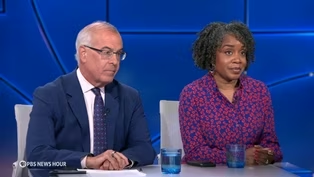
Brooks and Atkins Stohr on GOP vulnerabilities in midterms
Video has Closed Captions
Brooks and Atkins Stohr on GOP vulnerabilities in the midterms (11m 33s)
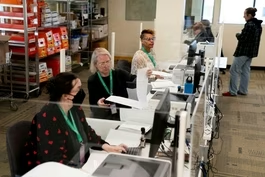
A look at how overseas ballots are counted the midterms
Video has Closed Captions
A look at how overseas ballots are verified and counted in the midterms (5m 26s)

Martina Navratilova on Chris Evert and their rivalry
Video has Closed Captions
Martina Navratilova on Chris Evert, their rivalry and beating cancer (8m 51s)
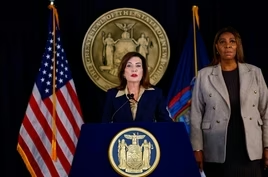
News Wrap: Special prosecutor appointed in Cornell rape case
Video has Closed Captions
News Wrap: New York AG appointed as special prosecutor in Cornell rape case (5m 13s)
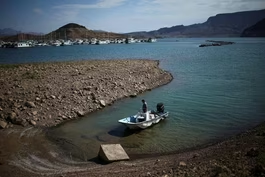
West prepares for a drier future as water supplies hit lows
Video has Closed Captions
How the West is preparing for a drier future as water supplies hit lows (5m 19s)

What a hiring slowdown says about the state of the economy
Video has Closed Captions
What a hiring slowdown signals about the state of the U.S. economy (6m 34s)
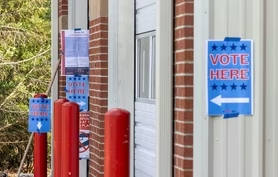
Who's spending big, and where, in the midterms
Video has Closed Captions
Who's spending big, and where, in most expensive election cycle ever (6m 13s)
Providing Support for PBS.org
Learn Moreabout PBS online sponsorship New Episode
- News and Public Affairs

FRONTLINE is investigative journalism that questions, explains and changes our world.
 New Episode
- News and Public Affairs

Today's top journalists discuss Washington's current political events and public affairs.
 New Episode
 New Episode
 New Episode
 New Episode
 New Episode
 New Episode
 New Episode


Support for PBS provided by:
Major corporate funding for the PBS News Hour is provided by BDO, BNSF, Consumer Cellular, American Cruise Lines, and Raymond James. Funding for the PBS NewsHour Weekend is provided by...