Compass
October 2021 Edition
Season 5 Episode 13 | 26m 46sVideo has Closed Captions
Veterans home, Just Eat, MN 4-H agronomy and the Broadmoor Valley lawsuit.
The groundbreaking of a Montevideo veterans home, the plant-based egg processing facility in Appleton, the Minnesota 4-H agronomy program and a lawsuit filed by Minnesota Attorney General Keith Ellison on behalf of residents of Broadmoor Valley in Marshall.
Problems playing video? | Closed Captioning Feedback
Problems playing video? | Closed Captioning Feedback
Compass is a local public television program presented by Pioneer PBS
Compass
October 2021 Edition
Season 5 Episode 13 | 26m 46sVideo has Closed Captions
The groundbreaking of a Montevideo veterans home, the plant-based egg processing facility in Appleton, the Minnesota 4-H agronomy program and a lawsuit filed by Minnesota Attorney General Keith Ellison on behalf of residents of Broadmoor Valley in Marshall.
Problems playing video? | Closed Captioning Feedback
How to Watch Compass
Compass is available to stream on pbs.org and the free PBS App, available on iPhone, Apple TV, Android TV, Android smartphones, Amazon Fire TV, Amazon Fire Tablet, Roku, Samsung Smart TV, and Vizio.
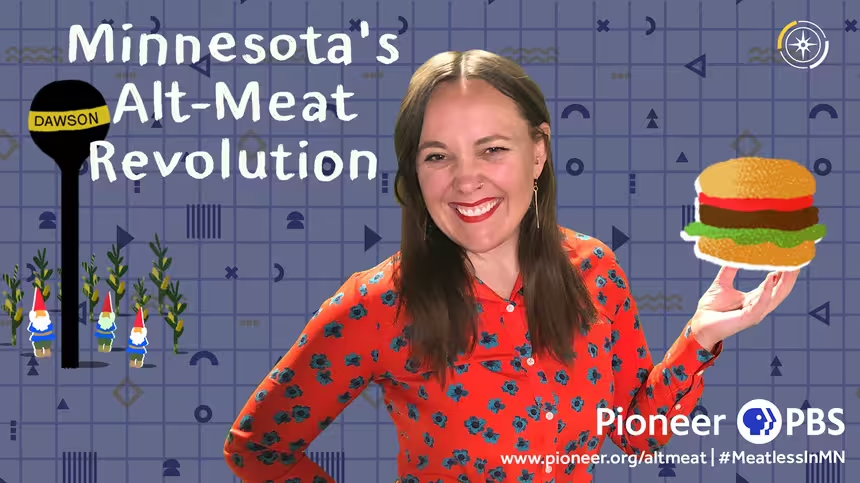
Minnesota’s Alt-Meat Revolution
“Minnesota’s Alt-Meat Revolution" is a year-long video and print journalism collaboration project, looking into the roots and impact of the plant-protein phenomenon that’s exploding across the globe.Providing Support for PBS.org
Learn Moreabout PBS online sponsorship(gentle music) - [Narrator] Funding for "Compass" is provide in part by, the Otto Bremer Trust, The McKnight Foundation and members of Pioneer PBS, thank you.
- Hi, I'm Amanda Anderson.
Welcome to the October edition of Compass, the regional public affairs show on Pioneer PBS.
A reminder to viewers that you can watch and engage with our stories online.
Head over to our website, Facebook and YouTube pages to watch and comment.
Tonight on Compass, we'll learn about the largest plant-based egg facility in the world, located in Appleton and hear from some Minnesota H students.
But first the Minnesota Department of Veterans Affairs is building three new veteran's care facilities to fill gaps in their service area throughout the state.
One in Montevideo carries the legacy of a local veteran, Steve Williams.
(gentle music) A groundbreaking event for a new veteran's home in Montevideo took place on August 23rd.
- [Marve] Good morning and welcome.
- This highly anticipated facility has been about 14 years in the making.
Marve Garbe is the chairman of the Montevideo Veterans Home Committee, a group that took regular bus trips to St. Paul, to push for the project, along with the Montevideo Veterans Coffee Group.
- Veterans Coffee Group, would you stand up please?
(crowd applauding) - The Coffee Group raised $19,000 for the project.
Garbe said that of the 17 original group members, seven have since died, but their mission lived on.
- Back in 2007, a small group of us started to talk about a veterans home and the need for it.
Our mission was to get a veterans home built in this area to serve the veterans here.
And the main reason is so their families don't have to travel long distances to visit them.
- [Amanda] Current Minnesota Department of Veterans Affairs, operated homes exist in Fergus falls, Hastings, Laverne, Minneapolis, and Silver Bay.
This Montevideo facility is one of three new veteran's homes being built by the MDVA.
The others are in Bemidji and Preston, and they will provide gap services for veterans living in greater Minnesota.
The regional hub for veteran care in Montevideo will sit on about 14 acres and will have 72 beds.
- When we started talking about veterans home, there was 1500 veterans in the state that weren't being served.
Yes, they went to nursing home to things, but it's nice when it could be have veterans together in their own home, there's some comradery there.
We raised $5 million, over $5 million in our area.
- [Amanda] The largest local fundraising Push came from the estate of Steve Williams from Clarkfield, who died in March of 2018.
- Steve was a Vietnam veteran and carry greatly prevented.
And he had said before he passed away, he wanted to contribute to the Montevideo Veterans Home and he left $3 million for the project.
So it was just a godsend.
And just what that additional money we're able to put a community room onto the facility.
I know other veterans on that.
- It gets a moment where you see the community standing up and hearing the story of Steve Williams, who, you know, basically, and in his state put the startup money for this is what I'd call it.
So it would get going and that he wanted his experience as a veteran to live on and help other veterans.
- [Amanda] And in 2018, the Minnesota state legislature approved $32 million for the three homes, the Montevideo project received $9.4 million.
Larry Herke is the commissioner of the Minnesota Department of Veterans Affairs.
- And that sort of starts the process for my department, the Minnesota department of veterans affairs, because at that point, we can go in and we can ask for federal funds.
- [Amanda] According to the MDVA website, the three new homes are slated to receive more than $80 million, in US Department of Veterans Affairs, state home construction grants.
- When we took the next step and went to the federal level and said, yeah, we're gonna do all three homes and you guys are gonna fund it, and they actually did, it was a good day, so we're here today, celebrate a little bit and get there, get our golden shovels in the ground.
- [Amanda] Senator Andrew Lang is the chair of the veterans committee in the Senate and his counterpart in the house, Rob Ecklund was also in attendance.
- And then there are good economic driver for all the communities that get a facility like this to so it's a, these things are usually bipartisan... - [Amanda] Herke expects this new facility to bring in 120 to 130 full and part-time jobs, which could be challenging to fill.
- My biggest challenge is employers to try to find those healthcare people.
So I'll be asking the community today to help and assist me to find those people.
And in some cases we'll help to, for the entry level positions will actually help train those individuals.
For other positions we'll need to draw people with experience from other places.
- All of this is it's really, really exciting.
And I just figure when our bet sign up to serve there wasn't a waiting line.
And when they need healthcare or a place to live, a bed to sleep in, there shouldn't be a waiting line in this area.
So we're really excited about this partnership.
- This facility represents two unique wins for Minnesota, a successful bipartisan effort.
What seems like a rarity in modern politics and a substantial investment in rural people and places.
The Montevideo veterans home project is expected to be completed in 2023.
Did you know that the largest plant-based egg production facility in the world is located in Appleton Minnesota.
Eat Just, the producer of JUST Egg makes about 420 plant-based eggs per minute out of their Appleton location.
- [Amanda] What if I told you that these images are of mung beans?
Well, it's mung bean protein isolate.
Eat Just was created about nine years ago with the mission to make food starting with eggs, healthier and more sustainable.
- Meaning better for the climate at less land, less water.
And ultimately even more cost-effective than everything else.
- [Amanda] Joshua Tetrick is the co-founder of Eat Just which has 186 employees based in San Francisco, California, and Appleton, Minnesota.
When the company started, first on their quest to find the perfect egg substitute was to find a plant that scrambles like an egg, enter the mung bean.
- It turns out that the mung bean naturally has a property called gelation, which is just a fancy word for scrambling.
And when you remove the protein, it gels, or it scrambles just like chicken, egg protein, it took us about four years to find it.
- [Amanda] Estimates are that the mung bean has been in our global food system for over 3,500 years.
Native to India, it's a small, round, green legume.
As you might imagine, Tetrick, didn't want to reveal too much of his proprietary information, but basically these legumes have a storage protein inside of them, and when the protein is removed, you get all that eggy-like goodness.
- In order to get the protein, now, there is a set of processes from milling to centrifugation, and all of that is designed to remove the protein from the fat and the fiber and the starch.
It's far and away the most important element of our manufacturing process and that protein separation is happening in Appleton, Minnesota.
- Eat Just was established in 2011 and in 2020, Eat Just purchased the facility here in Appleton, Minnesota, where we are producing a mung bean isolate.
Haha, the traffic.
- [Amanda] In Appleton, Eat Just is located on Munsterman Street, a popular route for semi trucks in town.
It's the biggest plant-based egg facility in the world.
Ron Athey the plant manager at the Appleton facility said they employ about 50 people, All of whom have equity in the company.
- We Produce about 30 metric ton of isolate per week.
Looking expand that process continually.
Right now we're at about 118 hundred metric tons per year.
And we're looking at an expansion that's gonna put us over 2000 metric ton per year.
- [Amanda] Athey said that since production started in Appleton, the facility has made the equivalent of 160 million eggs.
Now that might sound like a lot, and that is a lot.
But here this.
- The "why egg," were over 2 trillion eggs that were consumer in our world last year, 2 trillion and 2 trillion eggs requires a whole bunch of stuff.
So it requires tens of billions of animals.
And there's tens of billions of animals are eating and billions of pounds of soy and corn.
And the soy and corn is requiring hundreds of millions of acres of land and water, lots of energy goes into it.
- [Amanda] Tetrick said that a typical egg facility produces 1.6 million eggs per month at the rate of about 37 eggs per minute, Eat Just in Appleton makes 18 million of their plant-based eggs per month at 420 per minute.
There is some mung bean farming happening in Oklahoma, but Eat Just sources from places like India, east Africa, Thailand, and Australia.
- We have one other facility in Germany and we're building a facility in Singapore.
So the idea that Appleton would cover North America, our facility in Germany would cover Europe and the facility in Singapore would cover Asia.
The act of separating protein in a facility in Appleton in some ways can be so abstract, that if you're really double click into it, like what is happening is that the most important element of our manufacturing efforts in the company.
And it's something that we're pretty grateful for.
- Broadmoor Valley is a manufactured home park located off of Highway 23 and Saratoga street in Marshall.
Citing years of poor road conditions and unsafe housing, some residents of the park have worked with the Minnesota Attorney General's office to sue the owner.
- Manufactured housing home, our residents like all Minnesota, deserve to afford their lives and live with dignity, safety and respect.
- [Amanda] On August 27th, Minnesota State Attorney General, Keith Ellison visited Broadmoor Valley, a manufactured home park in Marshall, to announce a lawsuit against the Park's owner operator Schierholtz and associates.
Paul Schierholz is the president and CEO of Colorado-based Schierholz and Associates.
The lawsuit alleges that Schierholz failed to maintain clean, orderly and sanitary conditions, creating unsafe, unhealthy, and undignified living conditions.
The owner of the park was not in attendance at the meeting on the 27th.
Schierholz and Associates did file a response to the lawsuit on September 16th, 2021.
In a brief email to Compass, Paul Schierholz said that, "The answer speaks for itself, no facts presented.
We have been advised by counsel, 'no comment.'"
A number of Broadmoor Valley residents started organizing in 2018, unofficially calling themselves, the Broadmoor Valley Residents Association.
Jesus Hernandez, he goes by Chuy has lived in the park for 21 years with his family and is the president of the Broadmoor Valley Residents United.
The group had to change the name after Schierholz found out they were organizing, registered the name himself and threatened legal action if the group didn't stop using it according to the lawsuit.
- We met Pablo Tapia from the Asamblea de Derechos Civiles, translates to Assembly for Civil Rights.
We know that this is a unique situation here in Marshall.
We have this going on throughout the state, throughout the country.
There's a lot of issues with mobile home parks.
So he helped us organize and become an association.
- [Amanda] Hernandez said that he didn't realize they could go further than bringing their issues to the city of Marshall.
Tapia helped connect the residents with the Attorney General's office, where they alleged that over the course of many years, the owner has done separate unlawful acts.
- One is that the owner has a duty and obligation to maintain the roads and the infrastructure.
We argue they have not done that by just letting the roads deteriorate, potholes, things like that, making it so that the buses, school buses can't even come here.
- [Amanda] The day that Keith Ellison visited the park.
There were a number of maintenance people smoothing over some of the potholes with tractors and fence-like grates.
Hernandez said that for the past, maybe year and a half, they do that about once a month.
- It's not really fix, it's just a way to trying to get away from, to pass the inspections and stuff, you know?
So so that's why they do that.
They bring that gravel, they smooth the roads and make them look a little bit better.
We don't want fancy roads, you know, we just want them to keep them up to code.
- [Amanda] I met Hernandez and Dave Cornielson another resident of the park, for a tour.
The lawsuit said that years ago, the bus service serving Marshall Public Schools asked that the parks roads be maintained.
Instead of fixing the roads, Schierholz banned the buses from the park, an accusation Schierholz neither admitted nor denied in the response.
- Instead of working a deal with them or working something out to fix that situation.
He blamed the buses for the roads being in that condition.
So he kind of just turned it around and said, well, it's your fault that the roads are this way.
and truly, I've lived here for 21 years.
I've never seen them do any repavement or anything like that.
They've done patching, you can see there's patches of concrete and stuff.
- [Amanda] Hernandez and Cornielson showed one unoccupied house that had caught on fire.
- This is the one that caught on fire all by itself.
They think from a electric charge or something like that.
- Underneath the trailer.
- Underneath, right?
Yeah, no.
This has been empty for years too.
- [Amanda] The Attorney General's lawsuits said that it was investigated by the State Fire Marshal's Office and determined to be an electrical fire.
- And so that was a close call, you know, from all the things that are going on in here.
Why was that house with the electrics or like the power service on when no one lived there for years?
We don't know.
So it's just crazy how, you know, those things we're dealing with.
A lot of people don't know.
That's one of the reasons why we started our association.
We wanted to have a voice that was heard because a lot of us went individually to talk to the owner.
I never got a chance to it.
He closed his car door in my face once, but when people did actually talk to the management or the owner, they didn't get nothing in return.
Sometimes they got retaliation in return.
- [Amanda] Hernandez said that Schierholz has threatened to close the park and turn it into a truck stop, kicking out all of the people in the park's nearly 75 homes.
- The other part of the lawsuit is that the landlord has certain provisions in the documents, the leasing documents that are not lawful.
Having to do with late payments and things like that.
Certain numbers of fees are capped.
He's exceeded the caps on what you can charge people for late fees, things like that.
So these are the very guts of it were alleging consumer fraud and things like that.
But basically it boils down to poor maintenance of the property, improper provisions in the leasing documents.
- [Amanda] What started as a simple plea to maintain roads has evolved into a grassroots community effort, demanding dignity and living spaces.
Hernandez said that he doesn't think that Schierholz is willing to work with them.
And with aging infrastructure, he only sees one path forward.
- So ultimately, we want to become a co-op and own the park and fix everything that needs to be fixed.
And I think that's gonna be the answer to all these problems that we are dealing with right now.
- National 4 Week was October third through the ninth.
Over the summer, Compass chatted with some Minnesota, H agronomy students and their educator about the science of growing plants.
(upbeat music) For Minnesota H students, the Minnesota State Fair is a capstone experience where students exhibit projects, animals, plants, and knowledge learned throughout the previous year.
Five years ago, Minnesota H, with some very targeted money from the Minnesota Corn Growers Association, added agronomy to their H programming ecosystem.
- It's the science of plants.
It's the science of help plants grow.
- [Amanda] Brian McNeill is a regional H extension educator based in Morris.
because H students can span from ages five to 19, agronomy projects also vary.
Younger students can get project kits.
- Where they'd get a box or a bucket.
And they're actually able to grow corn in a bucket and learn about growing that.
- [Amanda] The older students can visit colleges that have agronomy programs or go on industry tours.
And as the agronomy program closed its fifth year, H cultivated new educational experiences.
- One is around ag technology, and we had a young person do some stuff around GMOs.
- That young person is Ellie.
Now a high school senior from Dodge county, the poster board that she showed at the Minnesota State Fair with info, mostly sourced from the USDA and FDA websites.
is all about GMOs, which stands for.
- For genetically modified organism.
- Her project Explored GMO-related topics, like the 10 types of GMO crops grown in the US and the difference between selective breeding and GMO's.
- Selective breeding is done differently.
It's more like breeding from different pollens and things like that, GMOs are like on the molecular level.
So it's like scientifically altering the genes to make it more disease resistant or produce better yields or different things Like that.
- [Amanda] Another new opportunity is studying specialty crops.
Kellie, who was in her first year of college when we spoke, is an Agronomy Ag Ambassador from Stevens County.
She brought her grand champion specialty sugar beets to the State Fair.
- They're specialty crop because they're not a row crop.
It's not like your corn or soybeans.
These get cut up and produced into the sugar that a lot of people put in their cereal or put in their cookies every day.
- As a college student, Kellie has been looking into agronomy and ag business at school.
As a 4-H Ag Ambassador, a leadership opportunity for older forage students, part of her role is to share her knowledge with younger students and maybe even bust some agriculture myths that new students and the general population might have about ag.
- So our Ag Ambassadors, one of the issues they wanted to work on was busting myths around ag.
They had many conversations that people just don't understand the world of agriculture, and they made have a certain lens, that don't understand the full aspect of agriculture.
And so they took time and learned from industry experts and created a virtual experience busting myths, did many presentations virtually to different youth groups, different staff groups about busting these ag myths.
And with that kind of momentum, we decided to do it at the state fair as well.
- [Amanda] So let's bust some myths, Courtney from a Anoka County and Keegan from Renville County learned that cow farts are really misunderstood.
- So I'm sure you've probably heard that a lot of people think that cows are the biggest producer of gas.
And that is actually not true.
In the US the biggest producer of gas is actually industry.
So that's, you know, factories and production and agriculture is only 10%.
And most of the gas that cows do produce it gets absorbed back into the soil and in the plants.
And because there's a protein in the plants that only cows can digest, they eat those plants.
And so it's just a big cycle for them.
- [Amanda] And next.
- So the myth we're busting here, is corn only has one use, that is not true.
- [Amanda] Courtney and Keegan explained that field corn also known as dent corn, is used for animal feed, food products and ethanol fuel.
And plenty of Minnesotans are familiar with the crunchy summertime backyard barbecue favorite sweet corn, but sweet corn is also used for corn starch.
There's corn oil, not super common said Keegan, and obviously popcorn.
- Popcorn.
That's used to make popcorn and all these are very different in size, the field corn, a lot bigger, a lot wider, sweet corn, kind of the same size, very soft kernels though.
so the kernels are these little yellow pieces, and that's what make up the corn, and our flour corn here that's to make your corn tortillas.
- [Amanda] As Minnesota H continues to fertilize their program, more opportunities for students interested in agronomy have taken root.
Brian McNeill says that any time a young person gets their hands dirty and learns about how dirt helps plants grow, - They can learn a lot from taking care of that plant and then watching it grow, but then learning about it as it's growing.
I think getting young people to see their global footprint and their footprint in agriculture and what that does in your specific community, or what that has that effect to someone else in Nepal or Japan or someplace else in the world.
And it does, we're all connected.
And so it's getting people to see the bigger picture of where they fit with agriculture, where they are, but how they affect others.
- For the past year I've been hosting Facebook Live conversations with area reporters about stories they're covering.
I recently spoke with MuMu Aye, a Myanmar refugee now based in southwest Minnesota.
She reports from her YouTube channel, updating people around the world about things happening in Myanmar.
(MuMu Aye speaking in Karen) - So can you, this was from the 25th of August.
Can you talk a little bit about what you were reporting on, all of your reports are in Karen?
- Yes.
So in this particular news, it was about the Burmese, the Myanmar military, jet, we're flying around and hovering around in Karen state big, sorry, brigade fire area, it's called the Kin Ma Village and those surrounding the area in this colony around, and this buying them using age, sorry, Russia made fighter jets kind of like that.
So it was a very worrying for local people there because back in May and April the military... - [Amanda] Watch our full conversation plus interviews with other area journalists at facebook.com/compassonpioneer.
Finally, over the weekend, Pioneer PBS received two Upper Midwest Regional Emmy Awards for work from our Postcards team.
Check out the winning stories, plus the other nominations from Pioneer PBS online at pioneer.org/emmys.
Thank you for watching the October edition of Compass.
The November edition of Compass will air on November 11th at 9:00 p.m on Pioneer PBS.
In the meantime, check out our social pages and website to see what we're working on throughout the month.
See you online.
- [Narrator] Funding for Compass is provided in part by, the Otto Bremer Trust, the McKnight Foundation, and members of Pioneer PBS.
Thank you.
(gentle music)
Video has Closed Captions
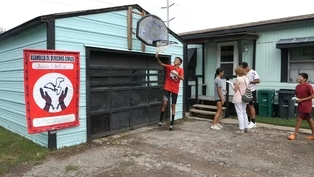
Clip: S5 Ep13 | 6m 37s | MN Attorney General Keith Ellison sued the owner of a mobile home park in Marshall. (6m 37s)

Video has Closed Captions
Clip: S5 Ep13 | 4m 33s | Eat Just's facility in Appleton is the largest plant-based egg facility in the world. (4m 33s)
Video has Closed Captions
Clip: S5 Ep13 | 6m 1s | Learn more about the science of growing plants from Minnesota 4-H students! (6m 1s)
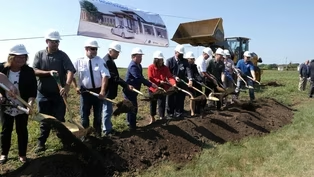
Montevideo Veterans Home groundbreaking
Video has Closed Captions
Clip: S5 Ep13 | 5m 7s | A groundbreaking event for the Montevideo Veterans Home took place on August 23, 2021. (5m 7s)

Preview: S5 Ep13 | 30s | Watch the October 2021 Edition on Oct. 14 at 9 p.m. on Pioneer PBS or the PBS Video App! (30s)
Providing Support for PBS.org
Learn Moreabout PBS online sponsorship
- News and Public Affairs

Top journalists deliver compelling original analysis of the hour's headlines.

- News and Public Affairs

FRONTLINE is investigative journalism that questions, explains and changes our world.












Support for PBS provided by:
Compass is a local public television program presented by Pioneer PBS