Northwest Profiles
October 2021
Season 35 Episode 3501 | 29m 2sVideo has Closed Captions
Spokane Para-athletes, Fossil hunting in Republic, Artist/bookbinder Timothy Ely, Wolfdogs
Train with Spokane para-athletes playing to win all the way to the Tokyo Paralympics. Digging for fossils in Republic, WA connects us with ancient mysteries just under our feet. See the amazing creations of a world renowned artist and bookbinder with his evocative and timeless masterpieces. And visit a Wolfdog refuge just outside Calgary, Alberta.
Problems playing video? | Closed Captioning Feedback
Problems playing video? | Closed Captioning Feedback
Northwest Profiles is a local public television program presented by KSPS PBS
Funding for Northwest Profiles is provided by Idaho Central Credit Union, with additional funding from the Friends of KSPS.
Support provided by:

Northwest Profiles
October 2021
Season 35 Episode 3501 | 29m 2sVideo has Closed Captions
Train with Spokane para-athletes playing to win all the way to the Tokyo Paralympics. Digging for fossils in Republic, WA connects us with ancient mysteries just under our feet. See the amazing creations of a world renowned artist and bookbinder with his evocative and timeless masterpieces. And visit a Wolfdog refuge just outside Calgary, Alberta.
Problems playing video? | Closed Captioning Feedback
How to Watch Northwest Profiles
Northwest Profiles is available to stream on pbs.org and the free PBS App, available on iPhone, Apple TV, Android TV, Android smartphones, Amazon Fire TV, Amazon Fire Tablet, Roku, Samsung Smart TV, and Vizio.
Providing Support for PBS.org
Learn Moreabout PBS online sponsorship♪ Hello and welcome to the season premiere of Northwest Profiles.
I'm your host Lynn Veltrie... and yes indeed, this is the opening act of a brand-new season, incredibly our 35th.
It's a remarkable achievement to be sure, but doesn't happen without first, a talented core of producers who take pride in producing stories that give center stage to some of the more fascinating people, places and events of interest in our region.
Secondly with the support of our viewers, who generously shared their story ideas with us.
as we see it, it's interactive television at its best and we thank you for that!
Season 35 is shaping up to be a good one, and will offer 6 episodes and up to 24 new illuminating profiles.
3 are just ahead in our season opener... so let's get underway shall we?
For our first story, we hit the gym to meet some amazing athletes who don't allow their disabilities stop them from enjoying competitive sports, some do it simply for recreation, while others train hard and play to win, taking it all the way to the Tokyo Paralympics.
Whoa!
The goal of this program has always been to provide sporting and recreational opport for youth and adults with physical disabilities free I basically run the overall orga and the entire program is volunt including myself.
I am an occupational therapist by background and kind of fell with the impact that sports had with disabilities.
So I approac St. Luke's and kind of got them in seeing, starting a program.
And we started with wheelchair r and then pulled in the wheelchai basketball guys that were kind doing it in the community and then started building it fr In nineteen ninety six, then I went to Atlanta and watched the Paralympic Games and it pretty much clinched it I like saw the impact that it re truly made on people with disab And I said, OK, we've got to kee this moving forward, keep building in Spokane and keep my addiction alive.
There's a saying that to get athletes to develop and to perform, you need the rig athletes in the right place with the right environment and the right coaching.
And I believe that we have a sit in Spokane that we can offer th We have wheelchair basketball, track and field, sw sled hockey, we're starting fencing and strength and condit I think that's all of them right Oh, you almost got that one.
Goo A lot of the coaches that we've over the last 10 to 15 years are somewhat experienced and maybe able-bodied sports.
And then we've brought them alon taught them kind of that the ad We have a five time Paralympian that's coaching our swimming pr and some up and coming swimmers that are coaching that.
So we have a we have a fantastic group of coaches for sure, for all of our differe The difference between coaching able-bodied and athletes with disabilities, for me, it's there's really not much of a di There's basically, I, I look at motivation, I look at biomechan I look at psychology, physiology all those elements.
And then it's just how how are you actualizing a t to meet the end goal?
My biggest thing for Tokyo is how grateful I am that they decided to actually d and to take it on and to recogni that they can keep people safe and they can make it happen and people could continue to tr and then compete and represent their country the We figured bronze was in her pot but for her to finish the race as quick and fast, as she did to set a personal record and ru her season's best time in the hu meters was absolutely amazing.
To be able to be a part of her whole story, to watch her grow and mature, and then to have her dream actua to actually get there to the ga and then actually make the final and then actually come in fourth and barely miss that bronze medal was pric I think it was the best experien I've ever experienced, having an opportunity to race against the best athletes in the who I always wanted to be that Looking back at my 12 year old s We are really supported by this community for sure.
We have a lot of donors and peop that participate in our auction that we do every February.
And that's been extremely helpfu over the last five years.
And then we have various organiz around the country that allow t athletes to apply for grants.
I'd like to say we blow people's minds or we open a lot of doors to pe who have disabilities or people exposed to people with disabili in that we're, we're not seeing as someone with limitations.
We're seeing them with someone with potential who we can enhance the potential within them to aim for goals an sometimes like competing in the Paralympic game.
We have about a hundred athletes in our program now and participating in all the various sports so, b it's only about one sixth, maybe one eighth of the actual of people within this community that could participate in sport And we really want to reach them It's been an amazing ride and an amazing opportunity.
And so, so much fun to see the i that sports has on people with disabilities from kids and adults who never t they would go to college, to fa that didn't think that their kid had opportunities like that.
It's just it's one person after that it dramatically impacts and changes the direction of th And that's kind of addicting.
One...two...three...ParaSport!
(CLAPPING) Para-sports Spokane is for para-athletes of all ages and abilities.
They offer each other support, inspiration and fun.
Up next, we transition from those who inspire to those on a mission of discovery, it's time now to get our hands dirty in the community of Republic Washington.
There we found a special place where one can discover items over 50 million years old.
Not only will you be the first human to see them, but, in many cases, you'll be able to take home the discoveries found just beneath your feet!
(Upbeat music) - People are really excited to come here and dig.
It's something very unique.
- Every find, no matter how big or small, is truly unique and just special.
- Get to dig in a rock and talk to kids and share in the happiness there, and enjoy.
- It is rare, that you can actually go to a fossil site and dig.
- I'm someone who loves to dig in the ground and find things.
- We are using our fossil resource to connect the public, the scientific community, our local community, and our students, to geology and expose them to paleontology and teach about the ancient lake that was here 50 million years ago.
We are in a building on the corner of Clark Avenue and Highway 20, which is the scenic route across our state.
It's right on the main street of Republic, which is really nice.
We get great exposure, and we're right here on the corner with the highway where the traffic comes through town.
(Upbeat music) - My name is Solea Kabakov.
I'm the Executive Director of The Stonerose Interpretive Center and Eocene Fossil Site in Republic, Washington.
Part of what's so special is we have a really large amount of a diversity of life that we find fossilized here.
Education is so huge because it's the core of our beginnings.
(Thoughtful music) - [Solea] The father of Stonerose, Wes Wehr, who's recently passed away, was really a citizen scientist, and he championed that for everyone.
He inspired so many people.
Even several that in their youth had worked with Wes here at the site, who've now gone on to become paleontologists.
So really the beginning of Stonerose started with this love of learning, this love of science, and a desire to share that with folks.
- And so as we split that apart, the joints will come apart looser.
I love being a part of doing this.
I get to work with people from all over the world and the different states, numerous amounts of children and I like to dig holes.
- We had the Tonasket Alternative School come out, and their students got to learn about how the lake looked and how the fossils were formed, and they all found something.
We have another really cool piece of wood on the back, and another section here.
- I didn't look on the other side.
- [Solea] Then they came back and we were able to provide them with some information so when they go home, they remember what they found, and they're able to learn more about it.
- You can tell a lot of how the world was and how the history of the world is, just by looking at the rocks in Stonerose.
A lot of these ones, we can tell numerous things from the climate, to how it used to be around here.
We have a very diverse species of trees, much more than we do now, and plants, and leaves.
Different insect varieties were here.
We actually can categorize how insects feed, because we can see that damage on the leaves themselves.
So we can see that we had a pretty thriving ecosystem here .
(Eerie music) - When you look back to the 50 million year old environment, being warmer and wetter, there were no polar ice caps, 50 million years ago, for example.
The average temperature was much higher than it is today, and now we consider we're moving in to climate change.
We're moving back towards hotter weather, in what could be called a climate crisis.
(Hopeful music) So, looking back at what kinds of relationships were there among plants, and animals, and insects in this warmer, wetter, environment?
"What was that like?"
may help us predict, the way plant life, and insect, and mammal life will change due to these increasing temperatures and changes in precipitation.
It's like counterintuitive that looking to the past would tell you about the future, but really it does, it's quite fascinating.
We also have graduate studies that happen here.
So we have professors who bring their graduate students out, who are studying paleontology and paleobotany specifically as well, which is the fossil plants.
And we have some new programs that we're working on.
So we're completing a virtual studio so that if your school is unable to host us as an outreach program, we can reach out to you virtually in real time.
That virtual program is going to be huge because it's a struggle to get students to come a great distance, and as you know, Ferry County is quite remote, even in the Northwest.
We're going to be able to reach into all these classrooms, so we're really excited to be able to provide that.
You see a child or maybe even a young adult, it just clicks for them.
They get into it.
They spend so much time up there and that kind of excitement is infectious.
It's really wonderful, when we see that.
- One of my favorite things to tell students is that when they split open a rock, they're the first person to ever see inside of that rock.
So whether they find something like a pine needle, or a leaf, or even a fish, doesn't really matter, their eyes are the first human eyes to ever see inside of that rock.
- [Solea] All of these years, it's been very well-respected in the scientific community and very well known actually as this prolific site.
And so now we have the opportunity with our new space to bring the center up to the level that our fossil resource has always had.
And that's so exciting to us that we can match that importance in the scientific community.
And then it'll be very clear as you come to visit, and you'll get this sense of importance and this better understanding of this environment and how we fit into the larger picture.
Makes us so pleased that we can share this fossil resource and have it affect people's lives in such a positive way.
The team and members of Stonerose are excited to offer their outreach programs not only to the schools around the northwest, but to the rest of the world.
It promises to draw attention to the beautiful little town of Republic.
Up next, we go from unearthing really ancient artifacts to experiencing an art form perfected by centuries of practice.
For 40 plus years world-renowned artist and book binder Timothy Ely has worked to master the materials he uses to encase his art.
The end result?
Wonderous manuscripts that are tactile, evocative and timeless.
My big idea, if I've had any big ideas at all, is to fuse speculative drawing structures with fairly fine book binding to build an object that has a lot of physical appeal and intellectual appeal and curiosity just kind of designed to drive people to hopefully ask questions.
My name is Timothy Ely and I make books.
I started making books a very long time ago.
I can probably push the story back to grade school, but more relevant was when I got into college, I discovered ideas about portfolios and presenting bodies of work.
And this clicked with awareness of libraries that I'd had for a very long time.
And that connection to libraries made me think about the library book as a functioning art object that could have the same kind of expressive potential as a large-scale painting.
I grew up in a hardware store.
My dad owned a hardware store.
I grew up around craftspeople.
I grew up around people that made a lot of things.
So, when I started making books, it seemed to me that it had a lot of qualities of that craft objects and household objects have they were built, they had function, they had beauty.
And I was not good at that when I started.
And so, I would dig through libraries, or I would visit special collections and I would look at books and just try to suss out how was this thing built?
Why are these corners beautiful and invisible?
And everything has been basically like rehearsing, like learning to play a very complex piece of music, to memorize it, to instill it with nuance.
So that's been the push.
And in the last 15 years, I have really started to see that I wasn't going deep enough.
I wasn't going complex enough.
And the idea of emergent complexity, like how much farther can you push a drawing?
Can you push a binding before it either begins to dysfunction or becomes unreadable?
The books have an architectural quality.
They have a plan, but they also need to protect the binding.
I love leather covered books, but to me, they seem vulnerable to scratching and handling.
So, I began to think about, well, I can cover books in leather, but I can also cover them in floor, finish as sand and aggregates and materials that will make these things far more bulletproof and durable over time.
I like these things to have that sort of medieval affectation where you open the book, and you take a breath, and you breathe out and you pray.
And there's something about this machine, if you will, that really compels me.
And then in this book, this is 40 folio.
So, there's a 168 drawings in this.
That would be a massive show.
If we pull these out of this book, framed everything and installed it somewhere, it would be.
Almost undoable.
But in this book, it's compressed.
It's available.
You can go sit in the red chair and turn on the light and have this very, very intimate looking.
there aren't a whole lot of people doing this the way I do it, I know a lot of book binders and from those guys and gals, I learn, you know, I learned so much from my peers, from conservators.
And my approach to this is unusual because I make a living doing this and I make these things to want to see them.
I make books people can't really read.
And that in itself is kind of weird.
And I don't write these books, but I devised a little drawing system that I call crib reform that looks like it could be readable, and it makes people quite crazy that they can't read it and I can't read it.
it looks like it should be legible.
But what I was after was I wanted the effect of captioning an image without actually writing a caption and making an explanation, because the further I can get away from cogency of being lucid and clear, the better I like it.
My wife, Ann, is my muse.
She is my color coordinator.
She's an award-winning designer in her own right.
And I've learned so much from her, including patience.
When I find myself up against it, like I don't know what the next step was on this thing.
She usually has some very brief words of wisdom that just basically get the wheels back on the track and.
I love her for what she shows me, for who she is.
Her integrity, her place in the world it's a big role and I'm barely scratching the surface.
The biggest thing, I think, is reading once in a while, there's a phrase that just shapes a feeling beautifully.
I'm starting a book On invisibility or it's about invisible things.
I was thinking this morning of how many qualities reading has that are invisible, that we may physically hold a book.
But this whole translation of what's happening in the book and in our imaginal spaces is really weird, but it's all imperceptible.
We don't see it.
And so it tends to get like lot of things that are invisible, that are dismissed.
Once these drawings are made, they will be assembled into a portfolio, into a finished structure.
these drawings are sequential.
They do have a read quality to that.
You go from the first one through the last one.
And there isn't a linear narrative, per se.
But it all hooks together.
Some parts are very gentle.
Some are very jarring.
They're very musical they can start somewhat quiet and then they can reach a crescendo somewhere about two thirds of the way through the book and get very noisy and then taper off close at the end papers.
And the book is closed.
It goes into its box and it's a contained experience.
Tim says that growing up he was enamored with Tom Swift books and what he called, Tom's squirrely inventions.
He's tried to hold onto that childhood imagination that helps him to innovate & grow in his craft.
Now for our final story, let's head west from Calgary to visit a sanctuary for a unique group of residents, wolfdogs.
They're often not able to live either in the wild or among humans, but they can live good lives as rescue animals.
And they can help educate and inspire their visitors.
♪ Alyx Harris: The wolfdogs are incredible animals.
♪ A wolfdog is exactly what it sounds like.
It is a canine with some amount of wolf and some amount of dog.
A big thing to keep in mind is that it can range from any amount a wolf to any amount of dog.
And humans intentionally breed wolfdogs.
It's not the result of your dog has wandered off into the wild and come home pregnant.
The big thing with wolfdogs is that they don't get the best of both sides of things.
You have a lot of instinctual behavior when it comes to wolves.
So, the more wolf content or the closer related they are to a pure wolf, the more you're going to see that very instinctual behavior.
(Wolves howling) >> Wolfdogs that are too wild to be someone's pet can find a home at the Yamnuska Wolfdog Sanctuary near Calgary, Alberta.
Alyx: We are the only wolfdog rescue in Canada.
So, to have the opportunity to have it be so close to home and to get the opportunity to actually be a part of it is just incredible to me.
>> Whenever possible, the sanctuary offers up the wolfdogs for adoption.
But, that's very rare.
So besides giving wolfdogs a home, Yamnuska educates the public about the dangers and the appeal of these animals.
Alyx: So, the reason why wolfdogs are still a thing is really, just exotic pet trade.
It is a matter of people want to have a cool pet that they can brag to their friends about.
And I mean, there are people out there that 100 percent provide fantastic homes for wolfdogs.
It's just that unfortunately, majority of people don't.
And, the majority of people don't understand what they're getting themselves into.
And most of the breeders are not reputable.
And they are backyard breeders that are really, just trying to make a profit, in all honesty.
♪ >> Georgina De Caigny established The Yamnuska Wolfdog Sanctuary after discovering firsthand the challenges of owning a wolfdog.
Alyx: So, she wanted to start educating the public about that.
But as well, realizing that there was nothing in Canada to really help with this.
She started the first rescue to be able to take in some of these animals that are at risk of being euthanized or don't have any other place to go.
♪ So, our wolfdogs come from a variety of places.
But for the most part they're all either owner surrenders or transfer or some other organizations.
>> Incoming wolfdogs are quarantined, vaccinated and evaluated to see if Yamnuska will be a good fit for them.
Alyx: So when a wolfdog first arrives it's usually fairly planned.
And even just for us to get a chance to know them a little bit to figure out what their personality is and if there is gonna be a specific place that they might be able to be paired into an enclosure.
From there if we have a spot that we can pair them in, it's a slow process.
Sometimes, it might be an interaction through a fence line to see how they feel about each other.
♪ (Chain link fence sounds) Alyx: But one really important thing about these captive animals with these instinctual behaviors is to give them some different types of forms of enrichment.
So, lots of different zoos will do these types of things, as well.
And it's something that we find very important for them, just to make sure they're not bored all the time, that they're you know looking forward to something in the day.
♪ We are mainly funded by our tours.
That is without a doubt the biggest way that we are able to keep doing what we're doing.
We have three different tours that we have; sanctuary walk which is just kind of general admission, letting people just come out and check things out explore at their own pace, and then two other guided tours that get a little bit more in-depth, give you the chance to speak with a guide, see the wolfdogs a bit closer.
Some of which even allow you to somewhat interact with the wolfdogs, all in the wolfdog's own terms, of course.
But some of them are definitely comfortable with that kind of thing.
And those are both very popular tours that have really exploded, in all honesty.
And we say really, really busy especially in the summertime and that really allows us to keep doing, like I said what we're doing.
♪ ♪ Our animals here at the sanctuary are permanent residents because they're not suitable to be re-homed.
They either have way too much wolf content, making them too instinctual to be pets or they just haven't been treated the best.
So, I know some people will have the impression that it's going to be kind of like a zoo which, I would say we're pretty far from being like a zoo because we're set up more for the animals rather than for just kind of showing them off.
But, it is definitely a matter of people will get a lot out of their experience, in my opinion.
Touch?
Touch?
Hop?
Thank you.
♪ The wolfdog sanctuary was closed to the public during the pandemic, but it is open again and has special activities planned like a howling Halloween weekend.
And on that note, I think you'll agree our new season, season 35 is off to a great start, and of course there's more ahead next time on Northwest Profiles...until then this is Lynn Veltrie saying so long and keep in mind, there is always much to see and do here in the Inland Northwest and western Canada... you just have to be looking for it, so get out there and when you do, do it safely and as always take time to enjoy the view.
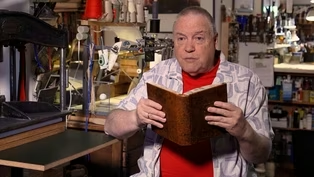
Video has Closed Captions
Clip: S35 Ep3501 | 6m 47s | Timothy Ely encases his artwork inside his finely crafted manuscript bindings. (6m 47s)
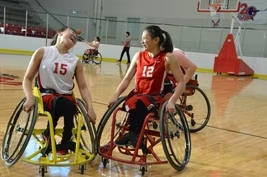
Video has Closed Captions
Clip: S35 Ep3501 | 6m 10s | Spokane para-athletes train hard and play to win. (6m 10s)
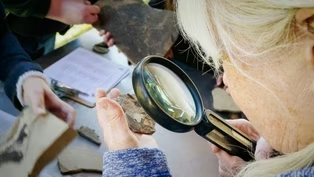
Video has Closed Captions
Clip: S35 Ep3501 | 6m 47s | Fossil digging at Stonerose Interpretive Center in Republic Washington. (6m 47s)
Preview: S35 Ep3501 | 1m 32s | Spokane para-athletes, artist/bookbinder Tim Ely, Fossils in Republic, WA, Wolfdog refuge (1m 32s)
Providing Support for PBS.org
Learn Moreabout PBS online sponsorship












Support for PBS provided by:
Northwest Profiles is a local public television program presented by KSPS PBS
Funding for Northwest Profiles is provided by Idaho Central Credit Union, with additional funding from the Friends of KSPS.